ORIGINAL
RES
EAR
CH
Correspondence to: Paulo Roberto Veiga Quemelo – Programa de Pós-Graduação em Promoção da Saúde da UNIFRAN – Avenida Doutor Armando Salles Oliveira, 201 – CEP: 14404-600 – Franca (SP), Brasil – E-mail: [email protected]
Presentation: Oct. 2013 – Accepted for publication: Oct. 2014 - Financing source: National Counsel of Technological and Scientific Development (CNPq), Bolsa PIBIC – Conflict of interests: nothing to declare – Presentation at a scientific event: 27º JOPEF BRASIL – XV Fórum Internacional de Qualidade de Vida e Saúde, Curitiba (PR), Brazil, 2013 – Approval at the Ethics Committee n. 105.950/12 (NCT01933737).
ABSTRACT | The aging process leads to balance disorders that can increase the number of falls. The Kinesio Taping is a method that aims at improving muscle performance, proprioception, coordination and balance. The aim of the study was to investigate the Kinesio Taping effects on pos-tural balance in the elderly population. We evaluated 62 female seniors, with an average age of 68±5 years, who were divided into two groups: the Kinesio Taping group, in which the elderly women (n=31) were submitted to the protocol of this tape application for gastrocnemius and median foot muscles (n=31), and Control, where the elderly women (n=31) received a placebo tape (3M Micropore). We used a force plate to record stabilometric signals for the postural balance analysis. Both groups were evaluated post-application and with an interval of 48 hours. The used variables were total displacement, anteroposterior and mediolateral amplitudes, area, and anteroposterior and mediolateral velocities. The results showed that Kinesio Taping did not cause significant changes in relation to the Control Group, post-application and 48 hours after application. The findings indicate that Kinesio Taping was not able to change postural balance in the elderly female population.
Keywords | Postural Balance; Aged; Proprioception; Physical Therapy Modalities.
RESUMO | O processo de envelhecimento provoca
alte-rações no equilíbrio, as quais podem aumentar o número de quedas. A Kinesio Taping é uma técnica com a pro-posta de melhorar a fisiologia muscular, a propriocepção, a coordenação e o equilíbrio. O objetivo do estudo foi veri-ficar o efeito da Kinesio Taping no equilíbrio postural de idosas. Foram avaliadas 62 idosas, do sexo feminino, com média de idade de 68±5 anos, divididas em dois grupos:
Kinesio Taping effect on postural balance in the elderly
Efeito da Kinesio Taping no equilíbrio postural de idosos
Efecto de la Kinesio Taping en el balance postural de ancianos
Tathiana Sartori Cabreira1, Karla Helena Vilaça Coelho2, Paulo Roberto Veiga Quemelo1
Study conducted at the Physical Therapy Clinic, Universidade de Franca (UNIFRAN) – Franca (SP), Brazil.
1Physical Therapy Course and Graduate Program in Health Promotion, UNIFRAN – Franca (SP), Brazil.
2Physical Therapy Course and Graduate Program in Gerontology, Universidade Católica de Brasília (UCB) – Brasília (DF), Brazil.
Kinesio Taping, com idosas (n=31) que foram submetidas ao protocolo de aplicação da Kinesio Taping para os múscu-los gastrocnêmio e do mediopé, e o Controle (n=31), com aquelas que receberam uma fita placebo (Micropore 3M). Para a análise do equilíbrio postural, utilizou-se uma plata-forma de força para o registro dos sinais estabilométricos. Ambos os grupos foram avaliados pós-aplicação e com intervalo de 48 horas. As variáveis utilizadas foram deslo-camento total, amplitudes anteroposterior e mediolateral, área e velocidades anteroposterior e mediolateral. Os resul-tados demonstraram que a Kinesio Taping não provocou modificações significativas em relação ao Grupo Controle, pós e 48 horas após a aplicação. Os achados apontam que a Kinesio Taping não foi capaz de alterar o equilíbrio postu-ral de idosos do sexo feminino.
Descritores | Equilíbrio Postural; Idoso; Propriocepção; Modalidades de Fisioterapia.
RESUMEN | El proceso de envejecimiento provoca
INTRODUCTION
According to the Brazilian Institute of Geography and Statistics (IBGE), the proportion of elderly people is growing rapidly. In 1991, this population accounted for about 4.8% of Brazilians. his ratio rose to 12.1% in 2011, and there are estimates that this proportion will double
in 20501,2. he aging process compromises the
compo-nents responsible for postural balance, such as the central nervous system (CNS), the vestibular, the sensory and the proprioceptive systems, which may result in
imbal-ance and falls3.
In this sense, the slowness in the response of the neu-romuscular system can generate a functional deicit and decrease the muscle power and the speed of that elderly people use to start, perform and inish their actions. hus, a careful evaluation is part of the approach of preventive programs and physical therapy rehabilitation, not only for the prevention of falls, as well as for the treatment of disorders related to chronic degenerative diseases,
com-mon in this age group4.
Based on this information, it is important to think about strategies that can improve postural balance of elderly people to try to prevent problems. he Kinesio Taping (KT) is an increasingly popular technique, which proposes to modify and activate the proprioceptive sys-tem. his method consists in the application of an elastic band without chemicals, with texture and elasticity that are very similar to human skin. It can be used in diferent ways and in diferent parts of the body, providing support to the muscles and joints, without interfering with the range of motion. It is believed that KT bandage sends sensory stimuli through mechanoreceptors found in the dermis and epidermis, providing a satisfactory response
to the desired location5,6.
Studies have shown that KT promotes pain reduc-tion, improved lexibility and alignment of postural balance, which may result in an improvement in the
functional performance of subjects7,8. he method can
also increase or decrease muscle tension and help in proprioception, coordination and balance disorders. The method can also increase or decrease muscle
tension and help in proprioception, coordination and
balance disorders9,10. However, studies using the KT
to evaluate the dynamic postural control in healthy
young people11 and in some clinical conditions, such
as multiple sclerosis12 and Parkinson’s disease13,
pre-sented diferent results between them.
Although the number of adherents to KT has grown in recent years, two literature reviews found a low qual-ity of studies with this bandage, concluding that data from studies provide insuicient evidence to prove its
beneits14. Based on these data, the purpose of this study
was to investigate the efect of KT on postural balance in elderly people.
METHODOLOGY
Ethical aspects and subjects
The project was approved by the Research Ethics Committee of Universidade de Franca (UNIFRAN) under public notice No. 105.950/12 and, once approved, the study participants signed a free and informed con-sent form.
he study included 62 elderly, healthy, female sub-jects, which are part of the Elderly Community Centre (CCI) of the city of Franca, in the state of São Paulo. CCI participants performed preventive and educa-tional physical activities daily. he subjects were invited to participate in the study, constituting a convenience sample. he study had the following exclusion crite-ria: bedridden elderly people, those who presented any acute illness or infection, who had cognitive impairment
detected by the Mini Mental State Examination15, with
diagnosed neurological diseases or recent fractures (last three months) in the lower limbs or that used some type of orthotics or prosthesis the lower limb. he elderly women who voluntarily agreed to participate in the study were randomly divided into two groups (Control and KT). During the study, there were no complica-tions or withdrawal of participants.
aplicación y con un intervalo de 48 horas. Las variables utilizadas fueron dislocación total, amplitudes antero-posterior y medio-lateral, área y velocidades antero-posterior y medio-laterales. Los resultados demuestran que la Kinesio Taping no causó modifi-caciones significativas con relación al Grupo Control, después y
48 horas después de la aplicación. Los hallazgos apuntan que la Kinesio Taping no fue capaz de cambiar el balance postural de ancianos del género femenino.
We collected demographic data of the elderly subjects, such as age, height, body weight and body mass index (BMI). To characterize the sample and study groups, was also applied a brief questionnaire, in which the par-ticipant pointed yes or no to alcohol, tobacco and drug consumption, as well as physical activity. he results of the socio-demographic data and characterization of the sample show a homogeneity of the participants between the control (CG) and KT groups (Table 1).
Application of bandages
he KT Group (GKT), composed of 31 participants,
received the application of KT (K-Tape®
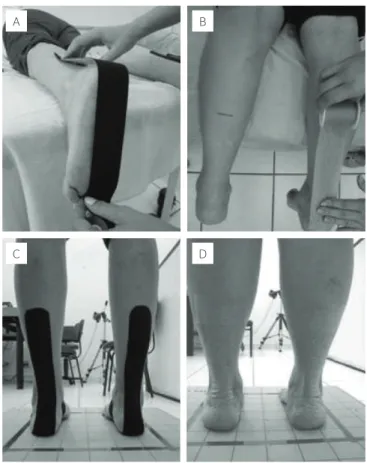
brand, Lumos, Inc.) for gastrocnemius and the midfoot muscles of both members. CH consisted of 31 subjects who received a placebo application of a tape (Micropore
3M®
brand) on the same muscles of both members, as shown in Figure 1. he order of application of the KT and placebo tapes was chosen randomly among the elderly women who agreed to participate volun-tarily in the study. he justiication for the choice of applying KT to that area of the body was due to the fact that the posterior muscles of the body play a role in postural balance, speciically the lower limbs, which provide support to the feet and for the standing posi-tion, assisting in the proprioception and balance of
the individual.16,17.
Before applying the tape, the area was cleaned with 70% rubbing alcohol for better ixation and, for both tapes, the application technique used was the “I” tech-nique, which consists in applying two strips in the for-mat of the letter “I”. he irst tape was placed along the length of the plantar aponeurosis with a ixed point in the middle third of the medial gastrocnemius muscle, up to the metatarsal phalangeal articulation; the sec-ond, which was also applied in the format of an “I” with no ixed point, was positioned along the midfoot
arch in the direction of tension lines, to assist with
sup-porting the metatarsal arch, as viewed in Figure 15,18.
Data collection and analysis
he experimental protocol was performed in the upright position, and the subjects were instructed to stand with their feet apart at a distance of 30 cm, with eyes open, directing their gaze to a ixed point, marked with colored tape on the wall at eye level (vertically) and at a distance of three meters from the force plate, horizontally. hey were asked to keep the position static for 40 seconds for the collection of stabilometric data, which was made after the application of the tapes and after 48 hours.
For the analysis of postural balance, we used a force
plate (EMG System do Brazil Ltda.®
) for recording stabi-lometric signals. he variables were calculated according to the speed of oscillation and displacement of the sub-ject’s center of pressure in the anteroposterior - AP (Fx), mediolateral - ML (Fy) and vertical (Fz) directions, on
the force platform19. he equipment was allocated in a
proper laboratory with all necessary care to avoid inter-ference in signal recording. he variables used were the AP (cm) and ML (cm) amplitudes; the total displacement
Figure 1. Kinesio Taping application and data collection. (A) application of Kinesio Taping; (B) Application placebo tape (3M Micropore); (C) data collection with Kinesio Taping on the force plate; (D) data collection with placebo tape (3M Micropore) on the force plate
A
C
B
D
Table 1. Distribution of participants, according to sociodemographic variables, and information on the sample
Variables CG (n=31) KTG (n=31) Total (n=62)
Age (years) 68±5 68±5 68±5 Height (cm) 1.56±0.06 1.56±0.07 1.56±0.06 Weight (kg) 65.3±12.4 64.5±11.3 64.8±11.8 BMI (cm/kg2) 26.6±4.3 26.1±4.3 26.4±4.3
Use of alcohol 16% (n=5) 3% (n=1) 9% (n=6) Use of medication 100% (n=31) 83% (n=26) 91% (n=57) Use of tobacco 3% (n=1) 0% (n=0) 1% (n=1) Physical activity 97% (n=30) 100% (n=31) 98% (n=61)
(variation in both directions, AP and ML); area (cm2),
which was calculated by adjusting the ellipse of the move-ment of the center of pressure (95% conidence interval of the ellipse of the center of pressure) and AP and ML
(cm/s) speeds19,20. To obtain the signals, an
analog-to-dig-ital converter (A/D) with 16-bit resolution and sampling
frequency of 100 Hz, were used19. Data were analyzed
later using WinDaq, version 3.36 (Dataq Instruments®
).
Statistical analysis
Stabilometry data were tabulated in Excel, in which the mean, standard deviation and frequency of results were calculated. For statistical analysis, we used the GraphPad Prism 5.0 software, with the Kolmogorov-Smirnov test for normal distribution among the domains. For the
comparison of the normal results, Student’s t test was
used. As for the data that did not show normal distri-bution, we used the Mann-Whitney test, with a signii-cance level of p<0.05.
RESULTS AND DISCUSSION
he results of the variables total displacement, AP and ML amplitude, AP and ML area and speed were not signiicantly diferent between the KTG and the CG, as shown in Table 2.
his study concludes that the application of KT was not efective for the improvement of postural balance in active elderly women for the variables total displace-ment, area, amplitude and AP and ML speed. he results of this study demonstrate that the KT did not induce neuromuscular activity and does not alter the balance of
elderly women. Similar to these indings, Lins et al.21
evaluated 60 healthy women after the application of KT in the lower limb and observed that it was not efective in improving balance and functional performance. Similarly, young patients with chronic ankle instability showed no
improvement in dynamic postural stability after application
of KT for the stabilization of the ibula22. On the other
hand, Karadag-Saygi et al.23 observed that the
applica-tion of KT associated with botulinum toxin resulted in enhancement of stride length, gait velocity and passive movement amplitude in elderly patients with spasticity. In a recent study, it was also shown that KT applied to the sural triceps muscle increases muscle performance
on vertical jump in sedentary young people24.
One must consider that the participants of this study did not have any balance disorder complaints and were physically active. Given this condition, it is possible to theorize that the application of KT may not show posi-tive results in healthy subjects who perform physical activity regularly. However, future studies are needed to conirm and clarify this hypothesis. Perhaps if the inves-tigation had been carried out with elderly women who presented any clinical conditions, such as osteoporosis or Parkinson’s disease, the results might have been
dif-ferent25,26. Most studies using KT found in the literature
involved inlammatory and algesic conditions in patients
or athletes27-30. According to the literature, the positive
results of applying KT in algesic conditions occur due to the shallowness of the cellular receptors of touch and pressure, which can be activated by the KT and cause the
efect of spinal cord lock6,31.
Taking into consideration the inference mentioned in the studies shown, one possible explanation for the indings of this study was probably due to the depth of proprioceptive receptors, such as muscle spindle and
Golgi tendon organ31. In addition, the intervention of this
study involved only part of the postural balance control system, which depends on integrated information from the vestibular, proprioceptive and visual systems, along with psycho-cognitive components, such as attention,
anxiety and fear of falling32. hus, such information and
the results presented corroborate the indings of Halseth
et al.33, which implemented KT in the anterior region of
the foot, the ankle and the leg, in order to improve pro-prioception of the ankle in healthy individuals. he authors
Table 2. Distribution of values in mean±standard deviation and p-value for the results of the variables for the force plate
Variables Post-application 48 hours after application
CG KTG p-value CG KTG p-value
TD (cm) 32±12 31±12 0.7074 34.7±14 32±13 0.4986 AP Amplitude (cm) 1.4±1.0 1.1±0.7 0.2065 1.5±1.0 1.3±0.8 0.2898 ML Amplitude (cm) 0.8±0.5 0.7±0.6 0.2751 0.9±0.9 0.8±0.5 0.6330 Area (cm²) 0.8±1.0 0.6±1.0 0.5129 1.2±1.8 0.8±1.4 0.5365 AP Speed (cm/s) 0.6±0.2 0.5±0.2 0.8003 0.6±0.2 0.6±0.3 0.4261 ML Speed (cm/s) 0.5±0.2 0.4±0.1 0.5133 0.5±0.2 0.5±0.2 0.8608
observed that the elastic band does not improve proprio-ception in healthy individuals, but report that their use can accelerate the return to activities in patients in acute and subacute phases of injury.
Other types of therapy may be adopted concurrently with the use of KT as a measure to improve postural bal-ance, as it is known that physical exercises and functional training programs have positive efects on the postural
balance of the elderly34,35. Buranello et al.35 demonstrated
that physically active elderly women performed better in the Berg Balance Scale and in the Timed Up and Go
test, with consequent reduction in the risk of falls35. In
this sense, the application of KT can be enhanced and present a better efect when combined with other types
of therapy, as observed by Şimşek et al.36, in which the
authors obtained better results in the rehabilitation of subacromial impingement syndrome when associated the use of KT to therapeutic exercise. In this context, future studies relating the use of KT to articulation lex-ibility programs, proprioceptive and balance training are needed to demonstrate possible efects on improvement of the functionality in the elderly.
In conclusion, the results suggest that the KT does not cause changes in postural balance of active elderly women, immediately after application or after 48 hours. his reinforces the fact that this technique should not be applied indiscriminately in clinical practice.
REFERENCES
1. INSTITUTO BRASILEIRO DE GEOGRAFIA E ESTATÍSTICA – IBGE. Censo Demográfico, 2010. IBGE: Rio de Janeiro; 2010.
2. INSTITUTO BRASILEIRO DE GEOGRAFIA E ESTATÍSTICA – IBGE. Pesquisa Nacional por Amostra de Domicílios 2009/2011. IBGE: Rio de Janeiro; 2011.
3. Teixeira IN, Guariento ME. Biologia do envelhecimento: teorias, mecanismos e perspectivas. Cienc Saúde Colet. 2010;15(6):2845-57. 4. Soto-Varela A, Faraldo-García A, Rossi-Izquierdo M, Lirola-Delgado
A, Vaamonde-Sánchez-Andrade I, Del-Río-Valeiras M, et al. Can we predict the risk of falls in elderly patients with instability? Auris Nasus Larynx. 2014 [Epub ahead of print].
5. Kase K, Tatsuyuki H, Tomoko O. Development of Kinesio tape. Kinesio Taping Perfect Manual. Kinesio Taping Association. 1996;6(10):117-8. 6. Kase K, Wallis J, Kase T. Clinical Therapeutic application of the Kinesio
Taping Method. Tokyo, Japan: Ken’i-kai Information; 2003.
7. Akbas E, Atay AO, Yuksel I. The efects of additional Kinesio taping over exercise in the treatment of patellofemoral pain syndrome. Acta Orthop Traumatol Turc. 2011;45(5):335-41.
8. Jaraczewska E, Long C. Kinesio Tape in stroke: improving functional use of the upper extremity in hemiplegia. Top Stroke Rehabil. 2006;13(3):31-42.
9. Jorge EM, Vieira JH, Sandoval RA. Kinesiology Taping nas lombalgias de trabalhadores que atuam na posição sentada. Trances. 2012;4(3):181-206.
10. Yasukawa A, Patel P, Sisung C. Pilot study: investigating the efects of Kinesio Taping in an acute pediatric rehabilitation setting. Am J Occup Ther. 2006;60(1):104-10.
11. Cortesi M, Cattaneo D, Jonsdottir J. Efect of Kinesio taping on standing balance in subjects with multiple sclerosis: a pilot study. NeuroRehab. 2011;28:365-72.
12. Capecci M, Serpicelli C, Fiorentini L, Censi G, Ferretti M, Orni C, et al. Postural rehabilitation and kinesio taping for axial postural disorders in Parkinson’s disease. Arch Phys Med Rehabil. 2014. [Epub ahead of print]. 13. Nakajima MA, Baldridge C. The efect of Kinesio® tape on vertical
jump and dynamic postural control. Int J Sports Phys Ther. 2013;8(4):393-406.
14. Morris D, Jones D, Ryan H, Ryan CG. The clinical efects of Kinesio® Tex taping: A systematic review. Physiother Theory Pract. 2013;29(4):259-70.
15. Lourenço RA, Veras RP. Mini-exame do estado mental: características psicométricas em idosos ambulatoriais. Rev Saúde Pública. 2006;40(4):712-9.
16. Abreu DC, Gomes MM, Santiago HA, Herrero CF, Porto MA, Defino HL. What is the influence of surgical treatment of adolescent idiopathic scoliosis on postural control? Gait Post. 2012;36:586-90.
17. Souchard P. RPG, reeducação postural global: o método. Rio de Janeiro: Elsevier; 2011.
18. Fu TC, Wong AM, Pei YC, Wu KP, Chou SW, Lin YC. Efect of Kinesio taping on muscle strength in athletes – a pilot study. J Sci Med Sport. 2008;11(2):198-201.
19. Duarte M, Freitas SM. Revisão sobre posturografia baseada em plataforma de força para avaliação do equilíbrio. Rev Bras Fisioter. 2010;14(3):183-92.
20. Oliveira LF, Simpson DM, Nadal J. Calculation of area of stabilometric signals using principal component analysis. Physiol Meas. 1996;17:305-12. 21. Lins CA, Neto FL, Amorim AB, Macedo LB, Brasileiro JS. KinesioTaping(®) does not alter neuromuscular performance of femoral quadriceps or lower limb function in healthy subjects: randomized, blind, controlled, clinical trial. Man Ther. 2013;18(1):41-5.
22. Delahunt E, McGrath A, Doran N, Coughlan GF. Efect of taping on actual and perceived dynamic postural stability in persons with chronic ankle instability. Arch Phys Med Rehabil. 2010;91(11):1383-9. 23. Karadag-Saygi E, Cubukcu-Aydoseli K, Kablan N, Ofluoglu D.The role
of Kinesio taping combined with botulinum toxin to reduce plantar flexors spastic spasticity stoke. Top Stroke Rehabil. 2010;17(4):318-22. 24. Huang CY, Hsieh TH, Lu SC, Su FC. Efect of the Kinesio tape to
muscle activity and vertical jump performance in healthy inactive people. Biomed Eng Online. 2011;10(70):1-11.
25. Meneses SR, Burke TN, Marques AP. Equilíbrio, controle postural e força muscular em idosas osteoporóticas com e sem quedas. Fisioter Pesq. 2012;19(1):26-31.
26. Bertoldi FC, Silva JA, Faganello-Navega FR. Influência do fortalecimento muscular no equilíbrio e qualidade de vida em indivíduos com doença de Parkinson. Fisioter Pesq. 2013;20(2):117-22. 27. Aguilar-Ferrándiz ME, Castro-Sánchez AM, Matarán-Peñarrocha GA,
28. Campolo M, Babu J, Dmochowska K, Scariah S, Varughese J. A comparison of two taping techniques (Kinesio and Mcconnell) and their efect on anterior knee pain during functional activities. Int J Sports Phys Ther. 2013;8(2):10.
29. Castro-Sánchez AM, Lara-Palomo IC, Matarán-Peñarrocha GA, Fernández-Sánchez M, Sánchez-Labraca N, Arroyo-Morales M. Kinesio Taping reduces disability and pain slightly in chronic non-specific low back pain: a randomised trial. J Physiother. 2012;58(2):89-95. 30. Chang HY, Chou KC, Lin JJ, Lin CF, Wang CH. Immediate efect of
forearm Kinesio taping on maximal grip strength and force sense in healthy collegiate athletes. Phys Ther Sport. 2010;11:122-7.
31. Guyton AC, Hall JE. Tratado de Fisiologia Médica. 11 Ed. Rio de Janeiro: Elsevier; 2006.
32. Harringe ML, Halvorsen K, Renström P, Werner S. Postural control measured as the center of pressure excursion in young female
gymnasts with low back pain or lower extremity injury. Gait Posture. 2008;28:38-45.
33. Halseth T, McChesney JW, DeBeliso M, Vaughn R, Lien J. The efects of Kinesio taping on proprioception at the ankle. J Sports Sci Med. 2004;3:1-7.
34. Lustosa LP, Oliveira LA, Santos LS, Guedes RC, Parentoni NA, Pereira LS. Efeito de um programa de treinamento funcional no equilíbrio postural de idosas da comunidade. Fisioter Pesq. 2010;17(2):153-6. 35. Buranello MC, Campos SA, Quemelo PR, Silva AV. Equilíbrio corporal
e risco de queda em idosas que praticam atividades físicas e sedentárias. Rev Bras Cienc Env Hum. 2011;8(3):313-23.