Key words:
Cavernous nerve; Erectile dysfunction; Matrixen; Mesenchymal stem cell
Int Braz J Urol. 2012; 38: 833-41
__________________ Submitted for publication: April 25, 2012
__________________ Accepted after revision: August 14, 2012 Objectives: To evaluate the effect of mesenchymal stem cells (MSCs) and MSCs mixed
with Matrixen as a cell carrier on the erectile dysfunction caused by bilateral cavernous nerve crushing injury.
Materials and Methods: White male Sprague-Dawley rats were divided into 4 groups: sham-operated control group (n = 5), bilateral cavernous nerve crushing group (BCNC group, n = 10), BCNC administered with MSCs group (n = 10,1x10⁶ in 20 µL), BCNC administered with Matrixen group (n = 10.1x10⁶ in 20 µL), BCNC administered with MSCs/Matrixen group (n = 10.1x10⁶ in 20 µL). After functional assessment at 4 weeks, major pelvic ganglion (MPG) and penile tissue were collected. Immunofl uorescent stai-ning of MPG was performed with PKH26 and Tuj1. Western blot analysis of endothelial nitric oxide synthase (eNOS) and neuronal nitric oxide synthase (nNOS) were done in corpus cavernosum.
Results: ICP/MAP ratios of BCNC with MSCs and MSCs/Matrixen groups were signifi -cantly increased compared with BCNC and BCNC with Matrixen group. Moreover, ICP/ MAP ratios of MSCs/Matrixen group were signifi cantly increased compared with BCNC with MSCs group. In MPG, the more implantation of MSCs and increased expression of nerve cells were observed in MSCs/Matrixen group compared with BCNC with MSCs group. Signifi cant increase expression of eNOS and nNOS was also noted in BCNC with MSCs/Matrixen group.
Conclusion: The erectile function was more preserved in MSCs/Matrixen group compared with the administration of MSCs alone in the rats with bilateral cavernous nerve crushing injury. Therefore, we consider that the use of transplant cell carrier such as Matrixen may help the implantation of MSCs and improve the therapeutic effect of MSCs.
INTRODUCTION
Diagnosis of prostate cancer has been ele-vating due to the increase in prostate-specifi c antigen (PSA) screening. In addition, this earlier diagnosis increases the number of patients
pre-senting with clinically organ-confi ned disea-se and therefore, it has led to an increadisea-se of the number of candidates for radical prostatectomy (1,2). Radical prostatectomy has been associated with complications such as postoperative urina-ry incontinence and erectile dysfunction. Erectile dysfunction is a bothersome complaint among
pa-Effect of Mesenchymal Stem Cells Associated to
Matrixen on the Erectile Function in the Rat Model
with Bilateral Cavernous Nerve Crushing Injury
___
_______________________________________________
____________________________________________
Su Jin Kim, Sang Hoon Park, Young Chul Sung, Sae Woong Kim
Department of Urology, Catholic University of Korea, College of Medicine (SJK, SWK) and Division of Molecular and Life Science, Integrative Bioscience and Biotechnology, WCU, Pohang University of Science and Technology (POSTECH) (SHP, YCS), Pohang, Republic of Korea
ABSTRACT
ARTICLE
INFO
tients submitted to radical prostatectomy and it is an important reason for the decrease of the quality of life in these patients. Therefore, nerve-sparing procedures have been proposed to reduce short--term and longshort--term functional complications such as erectile dysfunction (3-5). However, some patients submitted to radical prostatectomy with nerve-sparing technique have been experiencing erectile dysfunction and need other treatments to improve their symptoms (6).
Mesenchymal derived stem cells (MSCs) from bone marrow seems to be one of the attractive treatments for tissue regeneration and engineering due to their differentiation potentials into various adult tissues, including endothelial cell, smooth muscle and nerve (7). Therefore, there have been several studies using MSCs and the treatment effect of MSCs has been studied in the animal model of erectile dysfunction caused by cavernous nerve in-jury. As a result, stem cell therapy may be one of the treatment options for the patients that lost their potency after radical prostatectomy. However, some diffi culties appeared in stem cell therapy in spite of their therapeutic effect. For example, stem cells were easily spread-out to the adjacent tissue after stem cell injection into the target tissue according to the report by Lee et al. (8). This may cause unex-pected, unfavorable events and moreover, we are not able to get anticipating results from the stem cell therapy, neither. To overcome this weakness, some investigators used polymers to promote the retention of stem cells in the targeted tissue (9-11).
Among various biomaterials, Matrixen is a collagen based biocompatible polymer and it has been used widely as scaffolds in medical fi eld. In addition, Matrixen is easy to handle depending on the investigator’s purpose due to its characteristics of thermo-dependant sol-to-gel transition. There-fore, we used Matrixen to enhance the implantation ability of MSCs and compared the effect of MSCs and MSCs mixed with Matrixen in rats with caver-nous nerve crushing injury.
MATERIALS AND METHODS
Animals
White male Sprague-Dawley rats aged 8 weeks with weight distribution of 300-350 gm
were purchased from Saemataco Inc. (Osan, Ko-rea). Then, the rats were divided into 5 groups: the control group (n = 5), the bilateral cavernous nerve crushing group (BCNC group, n = 10), the administration of mesenchymal stem cells follo-wing the bilateral cavernous nerve crushing (BCNC with MSCs group, n = 10), the administra-tion of Matrixen following the bilateral cavernous nerve crushing (BCNC with Matrixen group, n = 10), and the administration with MSCs mixed with Matrixen following the bilateral cavernous nerve crushing (BCNC with MSCs/Matrixen group, n = 10). The experimental protocol was approved by the Catholic University Animal Ethics Committee (CUMC-2009-0045-01).
Preparation of MSCs
For preparation of rat bone marrow--derived MSCs (rBM-MSCs), bone marrow cells were collected from the femurs and tibias of 3-4 week-old Sprague-Dawley rats by fl ushing the respective tissues with Hank’s balanced salt so-lution (HBSS, WelGENE, Korea) containing 2% fetal bovine serum (FBS; Hyclone, USA). After red blood cells were removed, bone marrow cells were fi ltered through a 40 µm cell strainer (BD Bioscience, San Jose, CA) and separated using Fi-coll density gradient centrifugation. Isolated bone marrow cells were re-suspended and cultured in Dulbecco’s Modifi ed Eagle Medium (DMEM, 1000 mg/L glucose; WelGENE) with 20% FBS, 100 U/mL penicillin and 100 g/mL of streptomycin (Invitro-gen, Carlsbad, CA) for about 10 days until colonies formed. Colonies were harvested and used for sub-sequent experiments as MSCs. For animal experi-ments, ex-vivo expanded MSCs (less than passage 5) were seeded into a 70 mm fl ask at an initial density of 1.4x10⁶ cells and incubated overnight at 37 °C. Cells were then trypsinized, washed with PBS, and injected into the rats (1x10⁶ cells/rat).
Bilateral cavernous nerve crushing and adminis-tration of MSCs or MSCs mixed with Matrixen
bi-lateral prostates, the cavernous nerves, tracking posterolaterally, were identifi ed and isolated. In control group (sham surgery), there was no further surgical manipulation. In the remaining groups the cavernous nerves were isolated and a crush injury was induced using a hemostat clamp for 2 min. In the BCNC group, the abdomen was clo-sed after the bilateral cavernous nerve crushing. In the BCNC with MSCs group, MSCs (1x10⁶ in 20 µL) were administered to the MPG, Matrixen (20 µL) was administered to the MPG, and MSC (1x10⁶ in 20 µL) mixed with Matrixen (Bioland, Cheongwon, Chunbuk, KOREA) administered to the MPG in BCNC with MSCs/Matrixen group af-ter bilaaf-teral cavernous nerve crushing (Figure-1).
Then a bipolar electrical stimulator was placed on the ganglion to stimulate the cavernous nerve for 50 seconds at 1.5 mA, 20 Hz, pulse width 0.2 ms. The cavernous nerve stimulation was conducted at least 3 times and the interval between stimula-tions was maintained for over 10 minutes. At the completion of functional analysis, the MPG and penis were excised for histopathology.
Immunofl uoescent staining of MSCs in MPG
Immediately following ICP measurement, the ganglion was removed. The tissue was then snap frozen using 2-methylbutane pre-cooled in liquid nitrogen. Cryostat sections of the ganglion embedded in tissue-Tek OCT were obtained. From each ganglion, consecutive sections (5 µm) were collected on 4-5 slides, and thus each contained a similar collection of 10-15 serial sections from the same animal.
Ganglion sections were washed three ti-mes for 5 min with PBS and to avoid nonspecific antibody binding; they were then incubated for 60 min with 2% normal goat serum (Chemicon International, Temecula, CA) containing 0.1% Tri-ton X-100. To evaluate neuronal differentiation of MSCs, the samples were incubated with anti--beta-tublin III (Tuj1) (diluted to 1:200; Abcam, Cambridge, UK) overnight at 4 °C in a humidified chamber. Sections were incubated with the se-condary antibody (Alexa Fluor 488 goat anti-ra-bbit IgG; Invitrogen) for 2 hours in the dark in a humidified chamber at room temperature. After a washing (3 times, 10 min. each) with PBS, the nuclei were counterstained with 4,6-diamino-2--phenylindole dihydrochloride (DAPI;vector Labs, Burlingame, CA). Immunofl uorescence was visu-alized using an Olympus BX51 fl uorescence mi-croscope.
eNOS and nNOS protein expression tests: Wes-tern blot
The corpus cavernosum was obtained from all rats and homogenized individually in a buffer solution of 0.32M sucrose, 0.2M Hepes, (pH 7.4), 1mM ethylenediaminetetraacetic acid (EDTA), 1mM dithiothreitol (DTT), 10 µg/mL leupeptin, 2 µg/mL aprotinin, 1 µg/mL pepstatin, 10 µg/mL trypsin inhibitor and 1mM phenylmethylsulfonyl
Figure 1 - The gross fi nding of MSCs plus collagen based cell carrier after immediate administration into MPG. A: MPG of normal rats, B: Gel formation of collagen based cell carrier contacting of MSCs after implantation, MPG: major pelvic ganglion, MSCs: mesenchymal stem cells.
Erectile functional assessment
fl uoride (PMSF). The homogenized buffer solution was placed on ice for 15 min and centrifuged at 4 ºC for 13,000 rpm for 15 minutes. The supernatant solution was separated. The separated solution was utilized in the bovine serum albumin. 30 µg of the quantitative protein was denatured at 95 ºC for 5 min. and electrophoresis was performed on a 12% discontinuous sodium dodecylsulfate (SDSPAGE)--polyacrylamide gel. The proteins were then elec-troblotted onto a 0.2 µm polyvinylidenedifl uoride (PVDF, Amershambioscience, USA) membrane for 150 minutes at 25V. The membranes were reacted with blocking buffer (5% skim milk in TBS-T bu-ffer) for 30 minutes at the ambient temperature. The eNOS and nNOS (BD Biosciences, USA) anti-bodies were added for 2 hours, and the membra-ne was washed 3 times using TTBS at intervals of 10 min. The secondary antibodies, anti-mouse IgG-HRP and anti-goat IgG-HRP (1:2000 dilution) (Zymed Laboratories Laboratories, USA) were ad-ded at the ambient temperature for 1 hours and the membrane was washed again with TTBS for 6 times with an interval of 5 minutes between each washing. Chemiluminescence was detected using ECL Western blotting detection reagents. Densito-metric assessment of the bands on the autoradio-gram was performed using Bio1D software (ver-sion 97; Vilber Lourmat, France).
Statistical analysis
All measurements were expressed as mean ± standard deviation (SD). Statistical analysis was obtained via Sigma stat for Windows. An inter--group comparison was made with the use of Neu-man-Keuls multiple comparison test. The cut-off value of statistical signifi cance was P < 0.05.
RESULTS
Erectile functional assessment
The erectile function was assessed by tra-cing the ICP under cavernous nerve electrical sti-mulation at 4 weeks after operation. The analysis is presented in ICP/MAP ratios (Figure- 2). The ICP/MAP ratios in the control group were 0.83 ± 0.02, which was signifi cantly higher compared with all other groups (P < 0.05). BCNC group
sho-wed signifi cantly decreased ICP/MAP ratios 0.23 ± 0.04 (P < 0.05). The ICP/MAP ratios (0.21 ± 0.08) of BCNC with Matrixen group was signifi cantly decreased compared with control group (P < 0.05). The ICP/MAP ratios of BCNC with MSCs group (0.49 ± 0.1) and BCNC with MSCs/Matrixen group (0.65 ± 0.03) were signifi cantly higher compared with BCNC group (0.23 ± 0.04) (P < 0.05). Moreo-ver the the ICP/MAP ratios of BCNC with MSCs/ Matrixen group (0.67 ± 0.09) was signifi cantly hi-gher compared with BCNC with MSCs group (0.49 ± 0.1) (P < 0.05).
Expression of MSCs in MPG using immunofl uo-escent staining
MPG in BCNC group showed decreased expression of neuronal cells compared with that of control group. The expression of neuronal cells was increased in BCNC with MSCs and BCNC with MSC/Matrixen groups compared with BCNC group. In the MCSs/Matrixen group, increased im-plantation of MSCs was observed in MPGs compa-red with BCNC with MSCs group (Figure-3).
Quantifi cation of eNOS and nNOS proteins
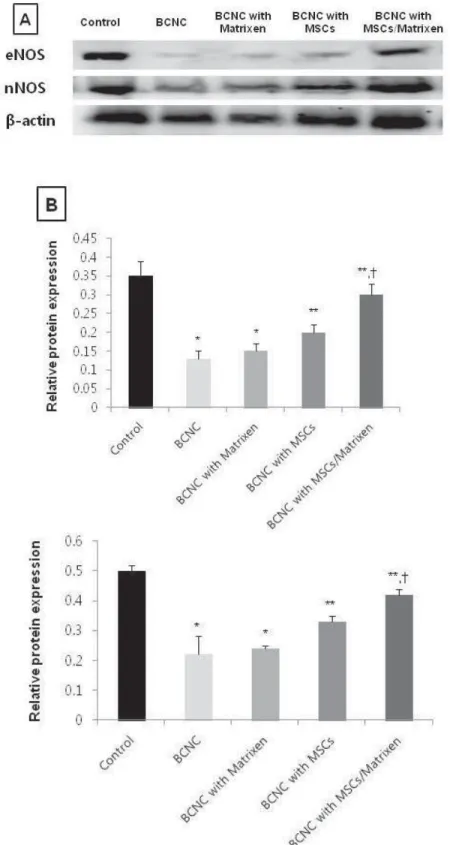
Decreased expressions of eNOS and nNOS were observed in the BCNC and BCNC with Ma-trixen groups than the control group (P < 0.05). The increase expressions of the eNOS and nNOS was observed in the BCNC with MSC and BCNC with MSCs/Matrixen groups compared with BCNC group (P < 0.05). The signifi cant increase expres-sion of the eNOS and nNOS was observed in BCNC with MSC/Matrixen group compared with BCNC with MSCs group (P < 0.05) (Figure-4).
DISCUSSION
We observed that the administration of MSCs into major pelvic ganglion (MPG) showed the preservation of erectile function after bilateral cavernous nerve crushing injury. Moreover, the implantation of MSCs was enhanced in the MPG with the help of collagen based cell carrier, Ma-trixen, and the improvements of functional and histological results were noted in this study.
because this type of injury was designed to mimic the partial nerve damage that occurs during ner-ve-sparing radical prostatectomy through mecha-nical nerve stretch (11). And several studies were performed about the periodic changes of MPG in response to the cavernous nerve injury in the ani-mals with erectile dysfunction induced by caver-nous nerve injury (12,13). For example, Palma et
al. (12) observed the sprouting of injured postgan-glionic axons in MPG of adult male rats at the fi rst week after unilateral cavernous nerve transaction or crushing. And the recovery of cavernous nerve probably partly depends on sprouting of the re-maining neural tissue after adverse manipulation. However, clinically, the recovery of erectile func-tion cannot be observed in all patients who are
supposed to experience the partial nerve damage that occurs during nerve-sparing radical prosta-tectomy (6). As a result, stem cell therapy has been introduced as one of therapeutic options to help the preservation and restoration of erectile func-tion in these patients (4). Therefore, we adminis-tered MSCs to MPG to evaluate the infl uence on the recovery of neurogenic erectile dysfunction by bilateral cavernous crushing injury. Moreover, we evaluated the role of Matrixen as a stem cell car-rier to promote the implantation ability of MSCs in MPG by administration of MSCs mixed with Matrixen.
At 4 weeks after injury, ICP/MAP ratios in BCNC with MSCs and BCNC with MSCs mixed with Matrixen were signifi cantly elevated compa-red with BCNC group. Even more elevated ICP/ MAP ratio was observed in the BCNC with MSCs/ Matrixen group than in the BCNC with MSCs group. This result supposed that more implanta-tion of MSCs was possible in MPG, since Matrixen prevented the spread-out of MSCs to the adjacent, unexpected area form the MPG. And this result was identifi ed with increased expression of stem
cell in MPG in the BCNC with MSCs/Matrixen group compared with the BCNC with MSCs group from the immunofl uorescent staining results.
Currently, MSCs suspended in cell culture medium are administered and therefore, there may be a limitation in the cell retention and transplant survival (15,16). There have been several studies to promote cell survival and retention, for example, the use of biomaterial scaffolds, which provide a microporous framework to improve cell survival (16,17). Xu et al. (9) reported treatment effect of the muscle derived stem cell (MDSC) mixed with fi brin glue on the restoration of urethral sphinc-ter function resulted from the pudendal nerve transaction rat model. They observed an obvious increase of the thickness of muscle mass and of the muscle/collagen ratio, as well as a higher neo-vasculature density after MDSC mixed with fi brin glue injection. There is another study about the effect of MDSC mixed with polymer such as algi-nate (Alg)/polycaprolactone (PCL) in the same ure-thral sphincter dysfunction animal model (10). It also observed signifi cant functional improvement compared with injection with MDSCs, alone and
Figure 4 - Westerm blot analysis of eNOS and nNOS in corpus cavernosum at 4 weeks control, bilateral cavernous nerve crushing (BCNC), BCNC with Matrixen, BCNC with mesenchymal stem cells (MSCs), BCNC with MSCs mixed with Matrixen group (A). Densimetric analysis to β-actin of eNOS and nNOS (B).
suggested that the polymer may promote the stem cell viability and bulking effect. To be clinically useful cell transplant carriers, there are several re-quired conditions. They need to be biocompatible without toxic side effects and biodegradable. And the ideal preparation must be liquid because liquid would be shaped and administered more easily.
We used Matrixen as stem cell carrier be-cause it is collagen based biocompatible polymer and also shows thermosensitive character. It has easily sol-to-gel transition character that depen-ds on the temperature. Matrixen remains as a sol state at the low temperature; therefore, it can be easily mixed with MSCs. After implantation into MPG with MSCs mixed with Matrixen, we could observe the immediate sol-to-gel transition and the gel formed three-dimensional shape at the body temperature. This means that the gel for-mation rate is fast. If the process of gel forma-tion is slow Matrixen spreads to form a sheet like structure (19,20) and it may disturb the retention and localization of MSCs in MPG. Therefore, the better preservation of eNOS and nNOS levels in BCNC with MSCs/Matrixen group may be due to the stable immobilization of MSCs by Matrixen in MPG compared with BCNC with MSCs group. In addition, there was a study that suggested the necessity of a cell transplant carrier in other as-pect. They observed that relatively large amount of MDSCs was needed for the functional improve-ment in the rats of intrinsic sphincter defi ciency due to the spread-out of MDSCs (21). Practically, it is impossible to use a large number of MSCs for the regeneration of damaged tissue because the acceptable capacity may be limited according to the size of damaged tissue. However, the admi-nistration with Matrixen after BCNC did not show functional and molecular improvement compared with BCNC with MSC/Matrixen group. From this fi nding, we consider that Matrixen does not have a role in the restoration of damaged nerve tissue and its ability seems to be a simple cell carrier to enhance cell implantation.
The safety of MSCs has been well demons-trated (22,23), however, there is a probable chance to occur unexpected adverse events after MSCs treatment. Thus it is important to make MSCs act on the targeted damage tissue as possible and we
expect the better treatment outcome of MSCs with the help of transplant cell carrier such as Matri-xen. As a result, Matrixen is supposed to enhan-ce the implantation of MSCs and differentiate to neural cells in MPG.
CONCLUSIONS
After administration with MSCs, alone, functional and histological restoration was ob-served in the rats with bilateral cavernous nerve crushing injury. In addition, the effect of MSCs on recovery of erectile function might be impro-ved by using the cell carrier such as Matrixen. The reason of this result seemed that Matrixen might prevent spread-out of MSCs after administration. Therefore, we considered that the use of transplant cell carrier such as Matrixen may help the implan-tation of MSCs and improve the therapeutic effect of MSCs.
ACKNOWLEDGMENT
This work was supported by the Catholic Institute of Cell Therapy in 2011.
CONFLICT OF INTEREST
None declared.
REFERENCES
1. Schröder FH, Carter HB, Wolters T, van den Bergh RC, Gos-selaar C, Bangma CH, et al.: Early detection of prostate can-cer in 2007. Part 1: PSA and PSA kinetics. Eur Urol. 2008; 53: 468-77.
2. Bove P, Asimakopoulos AD, Kim FJ, Vespasiani G: Lapa-roscopic radical prostatectomy: a review. Int Braz J Urol. 2009; 35: 125-37; discussion 137-9.
3. Walsh PC: Radical prostatectomy for localized prostate cancer provides durable cancer control with excellent qual-ity of life: a structured debate. J Urol. 2000; 163: 1802-7. 4. Montorsi F, Salonia A, Suardi N, Gallina A, Zanni G,
Brig-anti A, et al.: Improving the preservation of the urethral sphincter and neurovascular bundles during open radical retropubic prostatectomy. Eur Urol. 2005; 48: 938-45. 5. Graefen M, Walz J, Huland H: Open retropubic
6. Zippe CD, Pahlajani G: Penile rehabilitation following radi-cal prostatectomy: role of early intervention and chronic therapy. Urol Clin North Am. 2007; 34: 601-18.
7. Deans RJ, Moseley AB: Mesenchymal stem cells: biology and potential clinical uses. Exp Hematol. 2000; 28: 875-84. 8. Lee JY, Cannon TW, Pruchnic R, Fraser MO, Huard J, Chan-cellor MB: The effects of periurethral muscle-derived stem cell injection on leak point pressure in a rat model of stress urinary incontinence. Int Urogynecol J Pelvic Floor Dys-funct. 2003; 14: 31-7; discussion 37.
9. Xu Y, Song YF, Lin ZX: Transplantation of muscle-derived stem cells plus biodegradable fi brin glue restores the ure-thral sphincter in a pudendal nerve-transected rat model. Braz J Med Biol Res. 2010; 43: 1076-83.
10. Lee HN, Lee JY, Koh JS, Kim HW, Byun SS, Lee SS, et al.: Muscle Derived Stem Cell/Alginate/Polycaprolactone/Injec-tion Therapy in Rats with Denervated Urethral Sphincter. Korean J Urol. 2007; 48: 1296-1301.
11. Canguven O, Burnett A: Cavernous nerve injury using ro-dent animal models. J Sex Med. 2008; 5: 1776-85. 12. Palma CA, Keast JR: Structural effects and potential
chang-es in growth factor signalling in penis-projecting autonom-ic neurons after axotomy. BMC Neurosci. 2006; 7: 41. 13. Carrier S, Zvara P, Nunes L, Kour NW, Rehman J, Lue TF:
Regeneration of nitric oxide synthase-containing nerves after cavernous nerve neurotomy in the rat. J Urol. 1995; 153: 1722-7.
14. Harraz A, Shindel AW, Lue TF: Emerging gene and stem cell therapies for the treatment of erectile dysfunction. Nat Rev Urol. 2010; 7: 143-52.
15. Müller-Ehmsen J, Whittaker P, Kloner RA, Dow JS, Sakoda T, Long TI, et al.: Survival and development of neonatal rat cardiomyocytes transplanted into adult myocardium. J Mol Cell Cardiol. 2002; 34: 107-16.
16. Reinecke H, Murry CE: Taking the death toll after cardio-myocyte grafting: a reminder of the importance of quantita-tive biology. J Mol Cell Cardiol. 2002; 34: 251-3.
17. Gutowska A, Jeong B, Jasionowski M: Injectable gels for tissue engineering. Anat Rec. 2001; 263: 342-9.
18. Natesan S, Baer DG, Walters TJ, Babu M, Christy RJ: Ad-ipose-derived stem cell delivery into collagen gels using chitosan microspheres. Tissue Eng Part A. 2010; 16: 1369-84.
19. Jeong B, Bae YH, Kim SW: In situ gelation of PEG-PLGA-PEG triblock copolymer aqueous solutions and degradation thereof. J Biomed Mater Res. 2000; 50: 171-7.
20. Jeong B, Bae YH, Kim SW: Drug release from biodegrad-able injectbiodegrad-able thermosensitive hydrogel of PEG-PLGA-PEG triblock copolymers. J Control Release. 2000; 63: 155-63. 21. Lee JY, Paik SY, Yuk SH, Lee JH, Ghil SH, Lee SS: The
Iso-lation and Characterization of Muscle Derived Stem Cells from Gastrocnemius Muscle of Rats Using the Modifi ed Preplate Method. Korean J Urol. 2004; 45: 1279-84. 22. Deans RJ, Moseley AB: Mesenchymal stem cells: biology
and potential clinical uses. Exp Hematol. 2000; 28: 875-84. 23. Levy YS, Bahat-Stroomza M, Barzilay R, Burshtein A, Bulvik
S, Barhum Y, et al.: Regenerative effect of neural-induced human mesenchymal stromal cells in rat models of Parkin-son’s disease. Cytotherapy. 2008; 10: 340-52.