Licenciado sob uma Licença Creative Commons DO): http://dx.doi.org. . / - . . .AO
[T]
Anthropometric, cardiovascular and functional variables as
indicators of health related physical fitness in university professors
[)]
Variáveis antropométricas, cardiovasculares e funcionais
como indicadores de aptidão física relacionada
à saúde em professores universitários
[A]
Osvaldo Costa Moreira[a], Renata Aparecida Rodrigues de Oliveira[b],
Cláudia Eliza Patrocínio de Oliveira[b], Leonice Aparecida Doimo[b],
Paulo Roberto dos Santos Amorim[b], João Carlos Bouzas Marins[b]*
[a] Universidade Federal de Viçosa UFV , )nstituto de Ciências Biológicas e da Saúde, Florestal, MG, Brazil [b] Universidade Federal de Viçosa UFV , Departamento de Educação Física, Viçosa, MG, Brazil
[R] Abstract
Objective: To verify the behavior of anthropometric, cardiovascular and functional variables as indicators of
health-related physical fitness in university professors and perform a comparison of these variables between sexes. Materials and methods: We conducted an observational epidemiological cross-sectional study in
professors . ± . years , men . % , which were evaluated by measuring heart rate (R and systolic SBP and diastolic DBP pressure at rest, body weight, height, body mass index BM) , body fat per-centage BF% , handgrip strength (GS , flexibility and cardiorespiratory fitness CRF . We proceeded to the
descriptive analysis, Student t-test for comparison between sexes and multiple regression analysis to verify the association between the variables analyzed. )t was adopted a significance level of p < . . Results: The
sex affected all variables. Women had better levels of BM), flexibility, SBP and DBP. The BF% and CRF were associated with SBP and BM) in both sexes. Conclusion: The behavior of anthropometric, cardiovascular and
functional variables indicated unsatisfactory values for flexibility, (GS and BM), with the worst levels among men. Furthermore, the variables that showed better association with (RPF were BF% and CRF.
[P]
Keywords: (ealth. Lifestyle. Aptitude tests. Adiposity. Anthropometry.
]
[B]Resumo
Objetivo: Verificar o comportamento de variáveis antropométricas, cardiovasculares e funcionais como indi-cadores de aptidão física relacionada à saúde em professores universitários, bem como realizar a comparação dessas variáveis entre os sexos. Materiais e métodos: Realizou-se um estudo epidemiológico observacional de corte transversal em 145 professores (45,86 ± 9,7 anos), sendo 103 homens (71,03%), que foram avaliados, por meio de medidas de frequência cardíaca (FCR) e pressão arterial sistólica (PAS) e diastólica (PAD) de repouso, massa corporal, estatura, índice de massa corporal (IMC), percentual de gordura corporal (%GC), força de pre-ensão manual (FPM), flexibilidade e aptidão cardiorrespiratória (ACR). Procedeu-se à análise descritiva dos dados, teste t de Student para comparação entre sexos e análise de regressão múltipla para verificar a associa-ção entre as variáveis analisadas. Adotou-se nível de significância de p < 0,05. Resultados: O sexo influenciou todas as variáveis. As mulheres apresentaram níveis melhores de IMC, flexibilidade, PAS e PAD. O %GC e a ACR associaram-se à PAS e ao IMC em ambos os sexos. Conclusão: O comportamento de variáveis antropométricas, cardiovasculares e funcionais indicou valores insatisfatórios para flexibilidade, FPM e IMC, com níveis piores nos homens. Além disso, as variáveis que melhor se associaram à AFRS foram o %GC e a ACR. [K]
Palavras-chave: Saúde. Estilo de vida. Testes de aptidão. Adiposidade. Antropometria.
Introduction
The health-related physical fitness (RPF can be understood as the capacity of an individual carry out his daily life activities with ease and less effort . The components of physical fitness related to reduced risk of morbidity and mortality, and thus, with health are: cardiorespiratory fitness, muscular strength, flexibility and body composition , .
Adequate levels of (RPF may promote reduction of chronic degenerative disorders, in addition to pre-vention, maintenance and improvement of the func-tional capacity . Because of this fact, investigations of the components that constitute it have attracted the interest of some research groups in Brazil , , , . These studies state that the behavior of the indica-tor variables of (RPF present distinct values between males and females and tend to show worsened levels as individuals get old. (owever, publications about (RPF in adults, especially of specific populations,
such as university professors, are still little explored in the literature, since most publications only focus on isolated indicators, such as anthropometric variables or cardiovascular risk factors , , .
Therefore, the development of investigations aimed to characterize the (RPF components in other population groups, such as university professors, be-sides adding information to the scientific literature on this issue, can optimize the application of material, financial and human resources, in order to contribute to the development and implementation of actions to promote a physically active lifestyle and to help in the improvement of functional capacity and performance in everyday and work activities in these individuals.
547 Materials e methods
We conducted an epidemiological cross-sectional study, in a population of university professors of the Federal University of Viçosa UFV , regardless of gen-der, ethnicity and age.
The sample size was calculated according to the equation proposed by Lwanga and Lemeshow , so that, for probabilistic substantiation, a sample of professors was necessary, considering the total number of teachers of the institution profes-sors and a standard error of % with a % confi-dence interval.
After the approval by the Ethics Committee on hu-man research of UFV Of. Ref. No. / / Ethics Committee , all professors of the institution were informed, and after performing a simple random draw, the drawn ones were invited to participate in this study, employing strategies by invitation letter and personal e-mail. Upon confirmation of interest in participating and fulfilled the )nformed Consent, it was done a schedule for individualized assessment. Considering the possibility of losses and refusals, the sample size was increased in %, seeking to assure that the minimum subjects to be part of the study was reached.
All assessments happened at the (uman Performance Laboratory, at UFV Physical Education Department, in the morning, between h and h a.m., performed in a heated room around ºC and % relative humidity by an experienced assessor and prior trained for the routine of study, which followed standard procedure, consisting of: maintaining the evaluated at rest for measurement of resting param-eters, anthropometry and measurement of physical fitness parameters, followed by development of in-dividual reports for each evaluated. Before any mea-sure, a pre-participation triage was done through the application of questionnaires R)SKO and PAR-Q , in order to preserve the physical integrity of the volunteers.
Resting measures
Resting measurements were performed in the morning, with the individual lying at supine decubi-tus position, after prior rest of, at least, five minutes. The resting heart rate R(R was obtained through a heart monitor Polar, model F computing the
lower heart rate obtained in the five-minute interval. Systolic blood pressure SBP and diastolic DBP were measured with the evaluated in the supine de-cubitus position using a mercury sphygmomanom-eter with a cuff standard for adult Unilec™ , properly calibrated. The measures were carried out accord-ing to criteria proposed by the Brazilian Society of Cardiology .
Anthropometry
The body mass of the subjects was obtained in a digital scale Filizola with accuracy of . kg and height was determined using a wall stadiom-eter Sanny™ , with accuracy of . cm. From this information it was determined the body mass index BM) , classifying it according to the World (ealth Organization W(O .
As body adiposity indicator were measured the skinfolds triceps, suprailiac and thigh for women and pectoral, abdominal and thigh for men, taking as reference Jackson & Pollock technique . These measurements were performed with skinfold caliper Cescorf, model Top Tec, Brazil with accuracy of . mm and constant pressure of g/mm in its open-ing. All measurements were made in rotational form and replicated three times, considering the median value. The anthropometric procedures met the crite-ria of the American College of Sports Medicine .
Physical i tness tests
As strength indicator parameter, it was used the hand grip test, which was performed using a me-chanical dynamometer Sammons Preston™, model
JAMAR . Three trials alternately were performed, computing the highest values of both hands. The classification table adopted was proposed by the Canadian Society for Exercise Physiology .
)t was used the sit-and-reach test to assess the flexibility, which was conducted with a mat and Wells’ standard bank Sanny™ . The classification table of levels of flexibility adopted was proposed in the Canadian Standardized Test Fitness . Both the strength test and the flexibility met the rules of the American College of Sports Medicine .
comparison of the physical fitness and health com-ponents according to sex.
When the sample studied is stratified by age and compared according to their age group, it was pos-sible to notice an upward trend in BM) – years =
. ± . kg/m²; to years = . ± . kg/m²; over years = . ± . kg/m² and SBP – years = . ± . mm(g, to years = . ± . mm(g; over years = . ± . mm(g , especially after years. Furthermore, it is observed decreased flexibility levels – years = . ± . cm; to years = . ± . cm; over years = . ± . cm and CRF – years = . ± . ml/kg.min-; to years = . ±
. ml/kg.min-; over years = . ± . ml/
kg.min- , following the increase of age, especially
after years old.
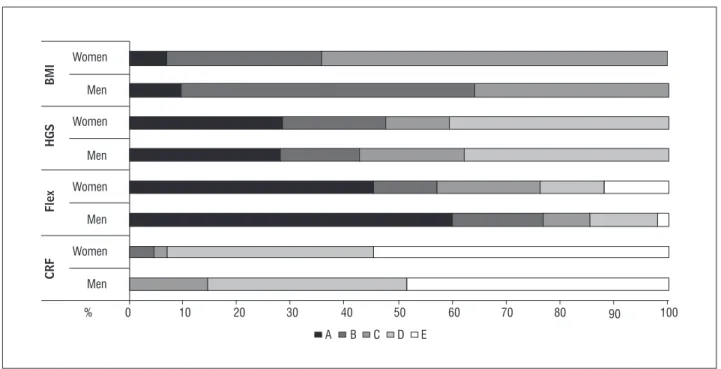
Figure shows the classification of the components of physical fitness, according to sex. Nevertheless, the Tables and show the relationship of physical fit-ness indicators CRF and %BF, with health indicators SBP and BM) both in women and men. )n men, flex-ibility also showed correlation with BM).
Discussion
This study seeked to verify the behavior of anthro-pometric, cardiovascular and functional variables as indicators of health-related physical fitness and in university professors, as well as perform the com-parison of these variables between the sexes. test of single-stage proposed by Ebbeling et al. ,
which was performed by adopting the following pro-cedure: three minutes of warm-up, which progres-sively increased in load and inclination; a single stage of four minutes with constant load and inclination; and three minutes of recovery with progressive de-crease of inclination and speed.
Statistical treatment
All data obtained were stored and analyzed using the statistical softwares Sigma Stat for Windows ver-sion . and SPSS . The data analysis consisted of descriptive exploration of the variables studied. )t was verified initially the normality of the variables us-ing the Kolmogorov-Smirnov test. The Student t-test was used to comparison between sexes. The multiple regression analysis was used in order to verify the association between the values of indicator variables of (RPF analyzed. For all treatments, it was adopted a significance level of p < . .
Results
This study assessed professors, with a mean age of . ± . years, with men . % and women . % , with . % n = of these individuals aged concentrated between and years. Table shows the anthropometric and func-tional characteristics of professors assessed and the
Table 1 - Characterization and comparison of the physical fitness and health components of professors at UFV, according to sex
Variable Male (n = 103)
Mean ± SD
Female (n = 42)
Mean ± SD p value
Age (years) 46.90 ± 9.82 43.27 ± 9.09 0.042
BM (kg) 77.56 ± 11.97 62.10 ± 9.89 < 0.001
Estatura (m) 1.74 ± 0.07 1.61 ± 0.06 < 0.001
BMI (kg/m²) 25.57 ± 3.54 24.11 ± 3.65 0.027
%BF 22.58 ± 6.05 31.37 ± 6.83 < 0.001
CRF (ml/Kg.min-1) 43.34 ± 6.12 35.85 ± 5.98 < 0.001
Flexibility (cm) 18.38 ± 10.12 27.40 ± 10.66 < 0.001
HGS (kgf) 100.68 ± 16.03 60.45 ± 11.71 < 0.001
549
Table 1 - Characterization and comparison of the physical fitness and health components of professors at UFV, according to sex
Variable Male (n = 103)
Mean ± SD
Female (n = 42)
Mean ± SD p value
RHR 67.62 ± 8.91 71.07 ± 7.12 0.027
SBP (mmHg) 118.79 ± 10.01 111.67 ± 12.28 < 0.001
DBP (mmHg) 78.64 ± 7.80 74.88 ± 8.94 0.013
Note: BM = body mass; BMI = body mass index; %BF = body fat percentage; HGS = hand grip strength; CRF = cardiorespiratory fi tness; RHR = resting heart rate; SBP = systolic blood pressure; DBP = diastolic blood pressure.
(Conclusion)
Figure 1 – Classification of physical fitness components according to sex
Note: BMI: A = obesity; B = overweight; C = eutrophic; D = low weight; HGS: A = well below the mean; B = below the mean; C = mean; D = above the mean; E = well above the mean; Flex: A = well below the mean; B = below the mean; C = mean; D = above the mean; E = well above the mean; CRF: A = very weak; B = weak; C = regular; D = good; E = excellent. CRF = cardiorespiratory fi tness; FLEX = fl exibility; HGS = hand grip strength; BMI = body mass index.
Table 2 – Relationship between indicator variables of physical fitness and health in the women assessed
CRF FLEX HGS %BF R2 Standardized
coefficient p-value RHR r = -0.12;
p = 0.47
r = -0.002; p = 0.49
r = 0.15; p = 0.18
r = 0.13; p = 0.18
0.05 - 0.746
SBP r = -0.31; p = 0.02a
r = 0.17; p = 0.14
r = 0.2; p= 0.1
r= 0.48; p = 0.001b
0.37 a 33% b 47.7%
0.001
DPB r = -0.13; p = 0.2
r= 0.08; p = 0.31
r = 0.2; p = 0.1
r = 0.32; p = 0.20
0.15 - 0.184
(To be continued)
Women
Men
Men Men Men
Women
Women
Women
%
CRF
Flex
HGS
B
MI
0
A B C D E
Table 2 – Relationship between indicator variables of physical fitness and health in the women assessed
CRF FLEX HGS %BF R2 Standardized
coefficient p-value BMI r = -0.05;
p = 0.39
r = -0.05; p = 0.37
r = 0.18; p = 0.13
r = 0.84; p < 0.001c
0.72 c 83% < 0.001
Note: a standardized coeffi cient of the relation between CRF and SBP; b standardized coeffi cient of the relation between %BF e SBP; c standard-ized coeffi cient of the relation between %BF and BMI. CRF = cardiorespiratory fi tness; FLEX = fl exibility; HGS = hand grip strength; BMI = body mass index; %BF = body fat percentage; RHR = resting heart rate; SBP = systolic blood pressure; DBP = diastolic blood pressure.
(Conclusion)
Table 3 - Relationship between indicator variables of physical fitness and health in the men assessed
CRF FLEX HGS %BF R2 Standardized
coefficient p-value RHR r = -0.23;
p = 0.01
r = -0.09; p = 0.19
r = -0.11; p = 0.13
r = 0.16; p = 0.05
0.06
-0.18
SBP r = -0.24; p = 0.007a
r = -0.03; p = 0.37
r = -0.13; p = 0.09
r = 0.42; p < 0.001 b
0.2 a 15%
b 42.5% < 0.001
DBP r = -0.01; p = 0.16
r = 0.08; p = 0.22
r = -0.03; p = 0.39
r = 0.12; p = 0.11
0.03
-0.5
BMI r = -0.19; p = 0.03 c
r = -0.006; p = 0.48
r = -0.22; p = 0.01d
r = 0.75; p < 0.001 e
0.585 c 1.5% d 14.5% e 83.1%
< 0.001
Note: a standardized coeffi cient of the relation between CRF and SBP; b standardized coeffi cient of the relation between %BF e SBP; c standard-ized coeffi cient of the relation between CRF and BMI; d standardized coeffi cient of the relation between HGS e BMI; e standardized coef-fi cient of the relation between %BF and BMI. CRF = cardiorespiratory fi tness; FLEX = fl exibility; HGS = hand grip strength; BMI = body mass index; %BF = body fat percentage; RHR = resting heart rate; SBP = systolic blood pressure; DBP = diastolic blood pressure.
Therefore, it was found that men presented a high-er absolute value of BM), when compared to women. Similar data were described by Oliveira et al. in university servants and by the Brazilian Society of Cardiology , in Brazilian adults. Besides, . % of men and . % of women presented classifica-tion values considered insufficient, i.e., BM) levels above . kg/m². Similar values were found in the study called (earts of Brazil , which found . % of men and % of women with BM) inappropriate. The data from this study indicate that, university professors assume a high prevalence of overweight and obesity, a factor that may act as a mechanism for triggering a series of physical and physiologi-cal impairments.
)t was observed an upward trend in BM), from the age of , similar to that described by Chumlea
et al. and Ortega-Alonso et al. . This is due to genetic changes that occur together with the aging process, responding for % of these changes in men and % in women . Furthermore, the decrease in physical activity levels and dietary changes , may also negatively impact the BM), promot-ing the increase of its values and, consequently, the cardiovascular risk.
551 Despite displaying higher values for BM), men had
a lower %BF compared to women. Similar behavior for body composition were reported by Moreira et al. in beginners in weight training gyms, where men had lower %BF and higher BM), when com-pared to women; and by Oliveira et al. , in univer-sity servants, in which women had lower BM) than men, however, higher concentrations of abdominal fat. A possible explanation for the higher BM) and lower BF% in men, may be in the fact that they have greater component of lean body mass, giving them these higher body mass and impacting on BM) .
)t is noticed that the variable BM) showed relation-ship with %BF, both in women Table , and in men
Table . The increase of %BF, seems to be the most important factor for the increase of BM), as it seems to explain . % of the increase in men and % in women. )n this sense, Kulkarni et al. reported that the increase in body fat is strongly related to the increased BM), concluding that body composition is closely associated with the work activity.
Additionally, the excess of body fat is a predispos-ing factor for hypertension, as observed in tables and , a possible explanation is the fact that there is a positive correlation between blood pressure and circulating angiotensinogen levels, and since the adi-pose tissue is an important source of extra-hepatic production of this substance, it is stated that subjects with high %BF are inclined to an increased produc-tion of angiotensinogen and, thereby, increase of pressure levels .
Thus, the adoption of measures that result in re-duction of %BF of professors, such as participation in a regular exercise program and/or a nutritional guidance program, may have beneficial effects both in reducing the prevalence of hypertension, and in reducing the incidence of overweight and obesity, allowing the reduction of comorbidities associated to these diseases.
As described in the results, SBP and DBP values showed higher values for men than women, although the mean values for both sexes fit in the normal clas-sification. Similar results were reported in studies of Oliveira et al. and Moreira et al. . Although, the SBP showed a trend to follow the age increasing , fact that may be due to the triggering of the physiological changes proper of the aging process, which make the subjects more likely to develop hy-pertension as they get old , .
This behavior in the studied group may indicate that hypertension, can become an institutional health problem within a few years. Thus, measures must be adopted to promote the maintenance and/or im-provement of (RPF and pressure levels, such as the insertion of physical exercises for professors commu-nity, since this practice is recommended to patients with hypertension as an option of treatment to reduce pressure levels in hypertensive and normotensive individuals , .
Another variable that showed downward trend with increasing age was the CRF, which may be ex-plained by reductions in the supply of muscle oxygen, mainly due to reduced cardiac output, which plays an important role in reducing the CRF until middle age . Moreover, there is a decline in the oxidative ca-pacity of skeletal muscle with aging, due to mitochon-drial dysfunction that seems to play a particularly important role in reducing the CRF in the third age . Thus, the decline in CRF with age can generate a facilitating condition for cardiovascular impair-ments and increased blood pressure. This suggests the need to implement aerobic training, in order to maintain and/or increase the CRF and, consequently, the reduction of risk of cardiovascular accidents in the individuals assessed.
Although it is considered the most important com-ponent of physical fitness because of its strong asso-ciation with the development of chronic-degenerative diseases , in this study, the CRF showed a discreet relationship with SBP, both in men and women, and with BM) in men. Similarly, Song et al. found relationship between increased CRF and reduction in pressure levels, and improvement of the body composition in Korean businessmen who have un-dergone to a general check-up health in . These data indicate that an exercise program that promotes increased aerobic capacity of the UFV professors, can beneficially impact the levels of blood pressure and body mass of these individuals, and thereby, minimize the risk of development of diseases, particularly car-diovascular diseases .
an institutional health policy, involving both specific actions such as the prevention of risk factors cam-paigns, and the implementation of a health promotion program, which should be guided in multidisciplinary work and has as scientific basis on the studies per-formed in this population amount.
Conclusion
The results of this study indicate that, the pro-fessors presented unsatisfactory values of (RPF, for the variables: flexibility, hand grip strength and BM), being found worse classification levels in males. Moreover, the indicator variables of physical fitness that showed better relationship with health indica-tors were the body fat percentage and cardiorespira-tory fitness.
The information obtained may provide a starting point for the development and insertion of health promotion policies, since they point the indicators of health-related physical fitness that deserve more at-tention, thus serving, to outline future investigations, or even intervention actions in order to promote the prevention, maintenance and/or improvement of health levels and quality of life of UFV professors.
Reference
. (askell WL, Lee )M, Pate RR, Powell KE, Blair SN, Franklin BA, et al. Physical activity and public health: updated recommendation for adults from the Amer-ican College of Sports Medicine and the AmerAmer-ican (eart Association. Circulation. ; : - . . Jorgensen T, Andersen LB, Froberg K, Maeder U, Smith
LV(, Aadahl M. Position statement: testing physical condition in a population – how good are the meth-ods? Eur J Sport Sci. ; : - .
. Dórea V, Ronque ERV, Cyrino ES, Serassuelo Junior (, Gobbo LA, et al. aptidão física relacionada à saúde em escolares de Jequié, BA, Brasil. Rev Bras Med Esporte.
; : - .
. Michelin E, Coelho CF, Burini RC. Efeito de um mês de destreinamento sobre a aptidão física relacionada à saúde em programa de mudança de estilo de vida. Rev Bras Med Esporte. ; : - .
analyzing the percentage of the population assessed, since . % of men and . % of women met the classification well below average .
Values close to those found in this study were re-ported by Silva and Juvêncio , who used the same procedures for collecting such data in civil servants at UFV, with . % in men and . % women, for frequency of low physical fitness in relation to levels of flexibility, thus indicating that there is a similarity of results and enhancing the handicap in the levels of flexibility in this population amount.
The trunk anterior flexibility is an important com-ponent of clinical exams and physical fitness used as indicative of vertebral function. )n this sense, lower levels of flexibility may be associated with a variety of musculoskeletal problems such as low back pain, which is one of the major causes of absence from work . Thus, the maintenance of adequate levels of flexibility can act as a protective factor against the appearance of the motor system diseases, being a strategy to be considered when developing actions of promotion of health and prevention of musculo-skeletal diseases.
The (GS values of the professors showed that . % of men and . % of women are classi-fied as below the mean or well below the mean
Figure . Similarly, Silva and Juvêncio found frequency of unsatisfactory levels for (GS of . % and . % respectively for men and women. The (GS serves as an indicator of upper limbs strength, which is related to a series of activities of daily life that require some level of force, for example, sustain, hold or pull a heavy object, so it is recommended its assessment.
553
. Chumlea WC, Choh A, Lee M, Towne B, Sherwood RJ, Duren D, et al. The first seriatim study into old age for weight, stature and BM): the Fels Longitudinal Study. J Nutr (ealth Aging. ; : - .
. Ortega-Alonso A, Sipilä S, Kujala UM, Kaprio J, Ran-tanen T. Genetic influences on change in BM) from middle to old age: a -year follow-up study of twin sisters. Behav Genet. ; : - .
. (jelmborg JV, Fagnani C, Silventoinen K, McGue M, Korkeila M, Christensen K, et al. Genetic influences on growth traits of BM): a longitudinal study of adult twins. Obesity Silver Spring . ; : - . . Savoca MR, Arcury TA, Leng X, Bell RA, Chen (,
Anderson A, et al. The diet quality of rural older adults in the South as measured by healthy eating index- varies by ethnicity. J Am Diet Assoc. ;
: - .
. Moreira OC, Oliveira RAR, Latkin CT, Oliveira CEP. Risco cardiovascular de ingressantes em aca-demia de musculação. Rev Bras Prescr Fisiol Exerc.
; : - .
. van Geel TA, Geusens PP, Winkens B, Sels JP, Dinant GJ. Measures of bioavailable serum testosterone and estradiol and their relationships with muscle mass, muscle strength and bone mineral density in post-menopausal women: a cross-sectional study. Eur J Endocrinol. ; : - .
. Kulkarni B, Shatrugna V, Nagalla B, Rani KU. Regional body composition of )ndian women from a low-in-come group and its association with anthropometric indices and reproductive events. Ann Nutr Metab.
; : - .
. Einstein F(, Atzmon G, Yang XM, Ma X(, Rincon M, Rudin E, et al. Differential responses of visceral and subcutaneous fat depots to nutrients. Diabetes. ;
: - .
. Souza ARA, Costa A, Nakamura D, Mocheti LN, Ste-vanato Filho PR, Ovando LA. Um estudo sobre hiper-tensão arterial sistêmica na cidade de Campo Grande, MS. Arq Bras Cardiol. ; : - .
. Amorim PRS, Moura BP, Moreira OC, Marins JCB. Efeito hipotensor de uma sessão de exercícios aquáticos: variabilidade e reprodutibilidade. R Bras Ci e Mov.
; : - . . Geraldes AAR, Oliveira ARM, Albuquerque RB,
Car-valho JM, Farinatti PTV. A força de preensão manual é boa preditora do desempenho funcional de idosos frágeis: um estudo correlacional múltiplo. Rev Bras Med Esporte. ; : - .
. Oliveira RAR, Moreira OC, Andrade Neto F, Amorim W, Costa EG, Marins JCB. Prevalência de sobrepeso e obesidade em professores da Universidade Federal de Viçosa. Fisioter Mov. ; : - .
. Oliveira RAR, Moreira OC, Lopes PRNR, Amorim W, Breguez MS, Marins JCB. Variáveis bioquímicas, antro-pométricas e pressóricas como indicadores de risco cardiovasculares em servidores públicos. Fisioter Mov. ; : - .
. Sociedade Brasileira de Cardiologia. Atlas Corações do Brasil. São Paulo: SBC; .
. Lwanga SK, Lemeshow S. Sample size determination in health studies: a practical manual. Geneva: World (ealth Organization; .
. Michigan (eart Association. Risko. Lancet. ; : - .
. Chisholm DM, Collis ML, Kulak LL, Davenport W, Gru-ber N. Physical activity readiness. Br Col Med J. ;
: - .
. Sociedade Brasileira de Cardiologia. V Diretrizes brasileiras de hipertensão arterial. Arq Bras Cardiol.
; :e -e .
. National )nstitutes of (ealth. Clinical Guidelines on the )dentification, Evaluation, and Treatment of Over-weight and Obesity in Adults — The Evidence Report. National )nstitutes of (ealth. Obes Res. ; Suppl :
S- S.
. Jackson AS, Pollock ML. Generalized equations for predicting body density of men. Br J Nutrition. ;
: - .
. American College of Sports Medicine. Manual do ACSM para avaliação da aptidão física relacionada à saúde. Rio de Janeiro: Guanabara Koogan; . . Ebbeling CB, Ward A, Puleo EM, Widrick J, Rippe JM.
. Coeuret-Pellicer M, Descatha A, Leclerc A, Zins M. Are tall people at higher risk of low back pain sur-gery? A discussion on the results of a multipur-pose cohort. Arthritis Care Res (oboken . ;
: - .
Received: / /
Recebido: / /
Approved: / /
Aprovado: / /
. Betik AC, (epple RT. Determinants of VO max decline with aging: an integrated perspective. Appl Physiol Nutr Metab. ; : - .
. Song YK, Lee KK, Kim (R, Koo JW. Job demand and cardiovascular disease risk factor in white-collar workers. )nd (ealth. ; : - .
. Araújo CGS. Avaliação da flexibilidade: valores nor-mativos do flexiteste dos aos anos de idade. Arq Bras Cardiol. ; : - .