ABSTRACT
Objective: To determine the cut-off points for FEV1, FEV0.75,FEV0.5, and FEF25-75% bronchodilator responses in healthy preschool children and to generate reference values for FEV0.75. Methods: This was a cross-sectional community-based study involving children 3-5 years of age. Healthy preschool children were selected by a standardized questionnaire. Spirometry was performed before and after bronchodilator use. The cut-off point of the response was deined as the 95th percentile of the change in each parameter. Results: We recruited 266 children, 160 (60%) of whom were able to perform acceptable, reproducible expiratory maneuvers before and after bronchodilator use. The mean age and height were 57.78 ± 7.86 months and 106.56 ± 6.43 cm, respectively. The success rate for FEV0.5 was 35%, 68%, and 70% in the 3-, 4-, and 5-year-olds, respectively. The 95th percentile of the change in the percentage of the predicted value in response to bronchodilator use was 11.6%, 16.0%, 8.5%, and 35.5% for FEV1, FEV0.75, FEV0.5, and FEF25-75%, respectively. Conclusions: Our results provide cut-off points for bronchodilator responsiveness for FEV1, FEV0.75, FEV0.5, and FEF25-75% in healthy preschool children. In addition, we proposed gender-speciic reference equations for FEV0.75. Our indings could improve the physiological assessment of respiratory function in preschool children.
Keywords: Spirometry; Bronchodilator agents; Reference values; Child, preschool.
Bronchodilator response cut-off points and
FEV
0.75
reference values for spirometry in
preschoolers
Edjane Figueiredo Burity1, Carlos Alberto de Castro Pereira2, Marcus Herbert Jones3, Larissa Bouwman Sayão4,
Armèle Dornelas de Andrade4, Murilo Carlos Amorim de Britto1
Correspondence to:
Edjane Figueiredo Burity. Rua Dr. Geraldo de Andrade, 75/501, Espinheiro, CEP 52021-220, Recife, PE, Brasil.
Tel.: 55 81 99961-7132. Fax: 55 81 3426-1947. E-mail: [email protected]
Financial support: None. INTRODUCTION
Although spirometry with bronchodilator testing is routinely used in order to investigate respiratory diseases in children and adults, it is rarely used in preschool children.
In children, only a few studies have deined bronchodilator
response cut-off points (for FEV1), the established change in baseline FEV1 and in percent predicted FEV1 in response to bronchodilator use having varied across studies, from 9% to 14% and from 9% to 10%, respectively.(1-4) The
American Thoracic Society (ATS) and the European Respiratory Society (ERS) have yet to determine the best cut-off points for children. In addition, given the lack of studies, the ATS and the ERS have not been able to determine cut-off points for preschool children.(5,6)
One obstacle is that only a low proportion (34-90%) of preschoolers are able to exhale for 1 s or more.(7-12) Therefore, measurements of FEV during the irst 0.5 s
of FVC (FEV0.5) or during the irst 0.75 s of FVC (FEV0.75) can be used as surrogates for FEV1. According to the ATS and the ERS, FEV0.5 and FEV0.75 should always be reported from spirometry maneuvers performed by preschool children.(6) Several studies have shown that FEV
0.5 and
FEV0.75 are reproducible.(7,8,10,12-14) Several reference
equations for FEV0.5 and FEV0.75 have been established in various populations.(13-17)
In a case-control study,(18) bronchodilator response
cut-off points of 14%, 14%, and 33% were found for baseline FEV1, FEV0.75, and FEF25-75%, respectively. In another study,(19) cut-off points of 10%, 11%, and 25%
were found for baseline FEV1, FEV0.5, and FEF25-75%, respectively; however, their sensitivity for the diagnosis of asthma was found to be low (12%, 30%, and 41%,
respectively), their speciicity being 84%, 90%, and
80%, respectively.(9)
Given that spirometry is a low-cost and noninvasive test, and given that several studies(7,8,10,12-14) have demonstrated
that preschool children can perform acceptable and reproducible FEV0.5 and FEV0.75 measurements, there is a need to determine bronchodilator response cut-off points for children in this age group so that spirometry can be used in daily clinical practice. Only two studies(18,19)
have assessed bronchodilator response using spirometry exclusively in preschool children.
In the present study we sought to determine broncho-dilator response cut-off points for FEV1, FEV0.75, FEV0.5, and FEF25-75% using the 95th percentile of the change in each parameter and establish reference values for FEV0.75 in healthy preschool children (i.e., preschoolers without respiratory symptoms).
1. Instituto de Medicina Integral Prof. Fernando Figueira – IMIP – Recife (PE) Brasil.
2. Escola Paulista de Medicina, Universidade Federal de São Paulo, São Paulo (SP) Brasil.
3. Escola de Medicina, Pontifícia Universidade Católica do Rio Grande do Sul, Porto Alegre (RS) Brasil. 4. Departamento de Fisioterapia,
Universidade Federal de Pernambuco, Recife (PE) Brasil.
Submitted: 1 September 2015. Accepted: 9 March 2016.
METHODS
This was a community-based study of preschool children 3-5 years of age selected from among those attending any one of 18 public day care centers and schools in the city of Recife, Brazil. Data were collected in the period between February and December of 2014. We selected a convenience sample, giving priority to the schools and day care centers attended by the highest number of children and located in central, northern, and western Recife. We calculated the sample size required to achieve a mean increase in FEV0.75, after bronchodilator use, of 4.5% and a standard deviation of 5.1%, a value found in a study by Borrego et al.,(18) with 95% conidence, assuming an estimation error
of 1%, in accordance with the sample size calculation of Pardos et al.(20) The minimum sample size was
calculated to be 100.
In order to characterize the study sample, we used the ATS and Division of Lung Diseases questionnaire for the diagnosis of asthma—designated ATS-DLD-78-C—previously adapted and validated for use in Brazil in children 4 months to 13 years of age.(21) The
questionnaire was administered by two of the authors of the present study.
The inclusion criteria were as follows: being 3-5 years of age; having been a full-term infant; having had a
birth weight ≥ 2,500 g; and having no respiratory
symptoms, i.e., having no symptoms of asthma (dyspnea, wheezing, recurrent cough, or exertional dyspnea) or other respiratory diseases. The exclusion criteria were as follows: respiratory disease at birth requiring the use of oxygen for more than 24 h; chronic respiratory disease (including bronchopulmonary
dysplasia, cystic ibrosis, and bronchiolitis obliterans);
thoracic and pulmonary malformations; acute viral bronchiolitis in the last 6 months; acute nasopharyngitis; heart disease; and other severe diseases (including
immunodeiciencies, neurological diseases, and genetic
syndromes). A questionnaire administered up to one week before testing was used in order to determine whether prospective participants met any of the aforementioned criteria. Testing was not performed if there were signs of acute nasopharyngitis at the time of testing.
All tests were performed by the principal investigator, having been performed in the morning in all participating schools and day care centers. A back-extrapolated volume of < 80 mL or 12.5% of FVC was accepted, as recommended for preschool children.(6) The objective
was to obtain two acceptable maximal expiratory curves, the variation between the two highest values of FVC, FEV1, and FEV0.75 being equal to or less than 10% and the variation between the two highest values of FEV0.5 being equal to or less than 5%. Curves with a forced expiratory time (FET) of at least 0.5 s were accepted regardless of whether or not they ended abruptly. Each session of testing lasted a maximum of 25 min. Encouragement screens were used, and each session of testing was preceded by a brief (5-min)
session of training. Spirometry was repeated 15 min after administration of 400 µg of albuterol delivered by a metered dose inhaler, as recommended by the ATS/ERS.(6) An aluminum spacer with a face mask was
used (inAl-air; RSMed, Belo Horizonte, Brazil). Testing was performed with the children in the sitting position. No nose clips were used in the present study, because the use of nose clips in children undergoing spirometry has been shown to have no clear advantage.(22) Testing
was performed with a portable spirometer validated by the ATS (Koko; Ferraris Respiratory, Louisville, CO, USA). Calibration was performed at the testing site, before each session of testing, with the use of a 3-L syringe, within the acceptable range of volume
and low.(23) Room temperature and humidity were
measured, and the data collected were entered into the software. In order to obtain acceptable maneuvers, testing sessions were suspended after an average of eight attempts or, before that, if the child showed fatigue or disinterest in continuing.
The following spirometric parameters were assessed: FVC; FEV1; FEV0.75; FEV0.5; and FEF25-75%. The values of the aforementioned parameters were obtained
from the two best low-volume curves, both of which
were acceptable and reproducible.(6) The criteria for
determining the values of FEF25-75% were as follows: for curves with a maximum FET of < 0.75 s, FEF25-75% was obtained from the curve with the highest FEV0.5 value and the highest FEV0.5 + FVC value; for curves with a maximum FET of < 1 s, FEF25-75% was obtained from the curve with the highest FEV0.75 value and the highest FEV0.75 + FVC value; for curves with a
maximum FET ≥ 1 s, FEF25-75% was obtained from the
curve with the highest FEV1 value and the highest FEV1 + FVC value. The variables used in order to determine bronchodilator response cut-off points for FEV1, FEV0.75, FEV0.5, and FEF25-75% were the percent change regarding the predicted values, the percent change regarding the baseline values, and the change in absolute values.
Statistical analysis was performed with the IBM SPSS Statistics software package, version 21 (IBM Corporation, Armonk, NY, USA). Numerical variables are expressed as means, medians, and percentiles. Categorical variables are expressed as proportions. The reproducibility of the spirometric measurements was
tested by the intraclass correlation coeficient (ICC).
Weight, height, and BMI are expressed as Z scores.(24)
The Shapiro-Wilk test was used for testing data normality. The Student’s t-test for paired samples was used in order to compare mean baseline and post-bronchodilator values of all spirometric parameters.
The changes in response to bronchodilator use were calculated by the following formulas:
(post-bronchodilator value − baseline value) ×
100/baseline value
(post-bronchodilator value − baseline value) ×
The predicted values were derived from a reference equation for preschool children developed by our research group in a previous study.(17) Because the
aforementioned equation(17) does not include reference
values for FEV0.75, they were calculated in the present study by linear regression.
In order to determine bronchodilator response cut-off points for FEV1, FEV0.75, FEV0.5, and FEF25-75%, the 95th percentile of the change in each parameter was calculated for baseline, predicted, and absolute values.
Spearman’s correlation coeficient was calculated in
order to evaluate the correlation of the bronchodilator response indices tested with age, height, and baseline FEVt (FEV1, FEV0.75, and FEV0.5).
The study project was approved by the Research Ethics Committee of the Professor Fernando Figueira Institute of Integrative Medicine (Protocol no. 2616-11). The parents or legal guardians of all participating preschoolers gave written informed consent, and the researchers signed a statement of responsibility.
RESULTS
Of the 462 eligible children, 447 completed the questionnaires. Of those 447 children, 41 (9%) met the exclusion criteria and 34 (8%) constituted losses: 26 for missing school on the day of testing and 8 for declining to undergo testing. Of the remaining 372
preschoolers, 266 (71%) were classiied as having
no respiratory symptoms. Of those 266 children, 56 (21.0%) failed to perform spirometry correctly and 50 (19.0%) failed to perform bronchodilator
testing correctly. The inal sample consisted of 160
asymptomatic preschool children (60% of the initial
sample of 266 asymptomatic children). A lowchart
of the sample selection process is shown in Figure 1. The demographic characteristics of the sample are presented in Table 1. Of the children who performed acceptable measurements, 19 (12%) were 3 years old, 74 (46%) were 4, and 67 (42%) were 5. Curves with
a back-extrapolated volume ≤ 5% were obtained in
99% of the tests, and, in 95% of those, the difference between the two highest FVC, FEV1, FEV0.75, and FEV0.5 values was < 5%, demonstrating a high reproducibility.
We calculated the ICCs for the two highest values of each of the spirometric variables tested. Mean ICCs (and their respective 95% CIs) for FVC and FEV1 were 0.994 (0.990-0.996) and 0.993 (0.989-0.996), respectively. Mean ICCs (and their respective 95% CIs) for FEV0.75, FEV0.5, and FEF25-75% were 0.993 (0.990-0.995), 0.992 (0.990-0.994), and 0.935 (0.913-0.951), respectively. Among the 3-year-olds in the initial sample of 266 children, FVC, FEV1, FEV0.75, and FEV0.5 measurements were considered acceptable and reproducible in 5%, 7%, 9%, and 37%, respectively; among the 4-year-olds, they were considered acceptable and reproducible in 23%, 29%, 39%, and 68%, respectively; and among the 5-year-olds, they were considered acceptable and reproducible in 23%, 26%, 44%, and 70%, respectively. Spirometry was considered unacceptable in 63% of the 3-year-olds, in 32% of the 4-year-olds, and in 30% of the 5-year-olds. Bronchodilator response testing was considered inadequate in 19% of the
462 eligible preschoolers
15 missed school on the day of testing and did not complete the questionnaires
447 completed the questionnaires
26 missed school on the day of testing
8 declined to undergo testing
41 met the exclusion criteria
372 completed the questionnaires
266 had no respiratory symptoms and underwent spirometry
106 presented with wheezing
50 tests considered unacceptable 56 performed post-BD measurements considered unacceptable
Final sample of asymptomatic preschoolers (n = 160)
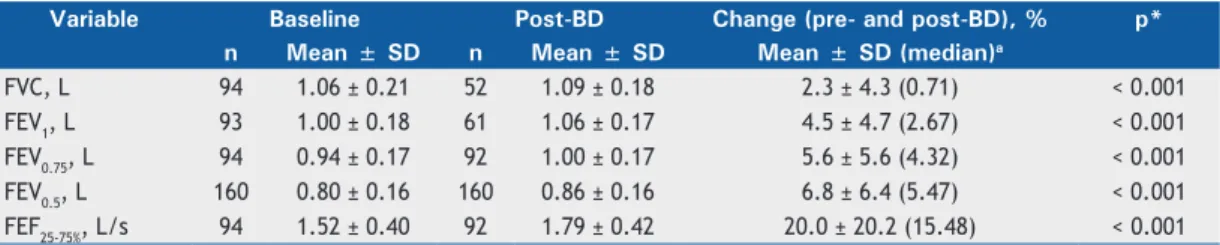
3-year-olds, in 20% of the 4-year-olds, and in 20% of the 5-year-olds, proportions that were very similar. Mean baseline and post-bronchodilator FVC, FEV1, FEV0.75, FEV0.5, and FEF25-75% values are shown in Table
2. There were signiicant differences between mean
pre- and post-bronchodilator values of the aforemen-tioned parameters (p < 0.005). Proportionally, mean and median pre- and post-bronchodilator changes in FVC, FEV1, FEV0.75, FEV0.5, and FEF25-75% with non-normal distribution can be seen in Table 2.
In order to calculate reference values for FEV0.75,
gender-speciic reference equations were derived by
linear regression. For males, the equation and the lower limit (LL) are as follows:
FEV0.75 = height × 0.013 + weight × 0.010
LL = predicted value − 0.21(5th percentile of the
residual)
For females, the equation and the LL are as follows:
FEV0.75 = height × 0.008 + age × 0.008 + weight
× 0.013
LL = predicted value − 0.19
The dispersion of FEV0.75 values is shown in Figure 2. Table 3 shows all cut-off points established by the 95th percentile of the change in FEV1, FEV0.75, FEV0.5, and FEF25-75% in response to bronchodilator use.
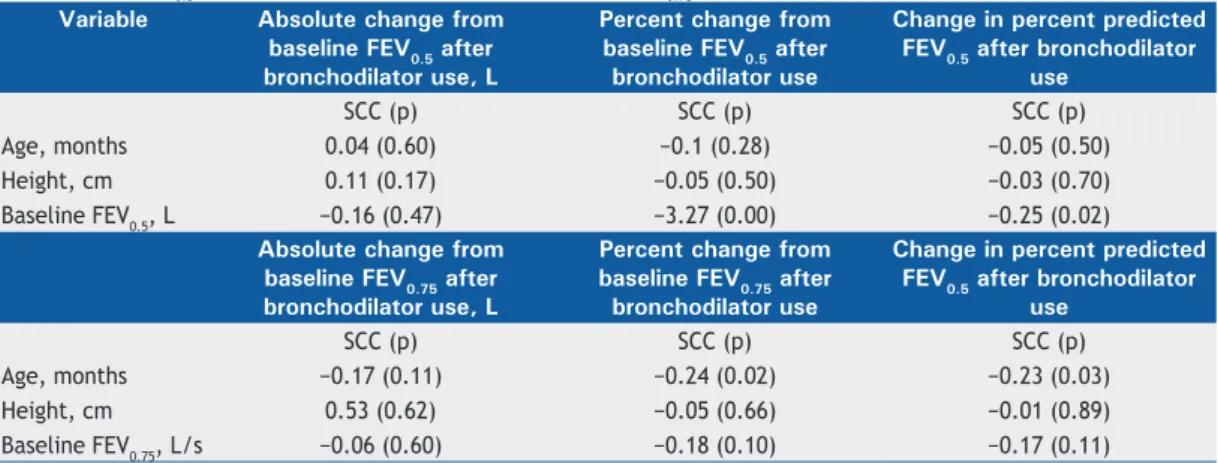
Table 4 shows the Spearman’s correlations of the bronchodilator response cut-off points for baseline, percent predicted, and absolute values of FEV0.5 and FEV0.75 with age, height, and baseline FEVt (FEV0.5 and FEV0.75).
DISCUSSION
This is the irst study to establish, by means of
spirometry, bronchodilator response cut-off points in preschoolers, the cut-off points being expressed as the change in percent predicted FEV1, FEV0.75, FEV0.5, and FEF25-75%. Of the 4-year-olds in the study sample, 67% were able to perform FEV0.5 measurements and 39% were able to perform FEV0.75 measurements. Of the 5-year-olds in the study sample, 70% were able to perform FEV0.5 measurements and 44% were able to perform FEV0.75 measurements. Therefore, in preschoolers, FEV0.5 measurements are more useful than FEV0.75 measurements because the proportion of children who can perform the former is higher. In community-based samples, spirometry is not useful in 3-year-olds due to the high rate of unacceptable tests. The low proportion of children who were able to perform acceptable and reproducible pre- and post-bronchodilator measurements of FVC, FEV1, FEV0.75, and FEF25-75% can be explained by the fact that ours was a community-based sample, the children therefore being more inexperienced in performing such measurements; in general, children selected from among those treated at respiratory outpatient clinics have previously been evaluated by their physicians regarding their motor coordination to perform such
tests. Given that it is dificult for children to perform
pre- and post-bronchodilator spirometry, the proportion of preschoolers who can perform it is lower. The high ICCs for the spirometric parameters tested in the present study constitute evidence of the low variability and high reproducibility of the measurements performed, as well as of the technical skills of the professional who performed the tests.
We found no studies evaluating bronchodilator response exclusively in healthy preschool children. The studies that we found involved children with asthma. The mean changes in the percentage of the predicted values of FVC, FEV1, and FEV0.75 in response to bronchodilator use in the present study were 2.3%, 4.5%, and 5.6%, respectively, being similar to those found in another study (2.5%, 4.7%, and 4.5%, respectively). (18) For FEF
25-75%, Borrego et al.
(18) found
a change of 11.7%, compared with 20.0% in the present study. This difference can be explained by the difference in study sample between the two studies: ours was a community-based sample, whereas that
Table 1. Sociodemographic characteristics of the study population, Recife, Brazil, February-December of 2014.a
Variable Result
Male gender 84 (52.5)
Age, months 57.8 ± 7.8
Race
White 33 (20.6)
Black 11 (6.9)
Mulatto 116 (72.5)
Weight-for-age (Z score)b 0.20 ± 1.18
Height-for-age (Z score)b −0.38 ± 1.03
BMI (Z score)b 0.65 ± 1.20
aValues expressed as n (%) or mean ± SD. bBased on data from the Brazilian National Ministry of Health.(24)
Table 2. Means and dispersion of baseline and post-bronchodilator spirometric parameters in the preschoolers studied.
Variable Baseline Post-BD Change (pre- and post-BD), % p*
n Mean ± SD n Mean ± SD Mean ± SD (median)a
FVC, L 94 1.06 ± 0.21 52 1.09 ± 0.18 2.3 ± 4.3 (0.71) < 0.001
FEV1, L 93 1.00 ± 0.18 61 1.06 ± 0.17 4.5 ± 4.7 (2.67) < 0.001
FEV0.75, L 94 0.94 ± 0.17 92 1.00 ± 0.17 5.6 ± 5.6 (4.32) < 0.001
FEV0.5, L 160 0.80 ± 0.16 160 0.86 ± 0.16 6.8 ± 6.4 (5.47) < 0.001
FEF25-75%, L/s 94 1.52 ± 0.40 92 1.79 ± 0.42 20.0 ± 20.2 (15.48) < 0.001
BD: bronchodilator; FEV0.5: FEV during the irst 0.5 s of FVC; and FEV0.75: FEV during the irst 0.75 s of FVC. aMean and median of the changes observed after bronchodilator use (variables with non-normal distribution). All parameters had a normal distribution. The greatest differences between mean and median values are due to a lower n of FVC and FEV1 measurements after bronchodilator use. *Student’s t-test for paired samples.
in the study by Borrego et al.(18) was a case-control
sample. In addition, the high reproducibility and, consequently, low variability of FEF25-75% measurements in the present study increase the power to detect differences between pre- and post-bronchodilator values. In the present study, the mean post-bronchodilator percentage changes of FEV1, FEV0.5, and FEF25-75% were
4.5%, 6.8%, and 20.0%, respectively, whereas, in another study,(19) they were 8.9%, 2.9%, and 8.1%,
respectively. The type of sample used in ours and in that study(19) (community-based and case-control
samples, respectively), as well as the fact that dose of albuterol was lower in that study (200 µg),(19) might
have contributed to those differences.
Table 3. Percentiles of the changes in FEV1, FEV0.5, FEV0.75, and FEF25-75% in response to bronchodilator use, the parameters being expressed as percentages of the predicted values, percent changes from baseline, and absolute changes in the preschoolers studied.
Variable Percentile
5th 25th 75th 95th
FEV1, L % of predicteda 0 0 7.91 11.6
% change from baseline 0 0 8.80 13.0
Absolute change, L 0 0 0.09 0.13
FEV0.5, L % of predicteda 0.51 1.18 9.66 16.0
% change from baseline 0 1.07 10.74 20.0
Absolute change, L 0 0.01 0.08 0.15
FEV0.75, L % of predictedb 0 0.57 5.35 8.50
% change from baseline 0 0.85 9.20 18.0
Absolute change, L 0 0.01 0.08 0.14
FEF25-75%, L/s % of predicteda −2.88 3.87 22.02 35.5
% change from baseline −4.74 6.33 33.17 61.0
Absolute change, L −0.06 0.09 0.44 0.74
FEV0.5: FEV during the irst 0.5 s of FVC; and FEV0.75: FEV during the irst 0.75 s of FVC. aValues according to Piccioni et
al.(13)bValues calculated on the basis of the data from the present study.
Figure 2. Scatter plots of FEV during the irst 0.75 s of FVC (FEV0.75) in relation to height and weight in male preschoolers (A and B) and in female preschoolers (C and D).
1.75
1.50
1.25
1.0
.75
.50
2.00
1.50
1.00
.50
.00
1.50
1.00
.50
.00 1.60
1.40
1.20
1.00
.80
.60
.40
90 100 110 120 130
90 95 100 105 110 115 120 12 13 14 15 16 17 18 19 20 21 22 23 24 25 26 27 12
131415161718192021222324252627
28 31
334051
Height (cm) Weight (Kg)
Height (cm) Weight (Kg)
C
A B
D
R = 0.70. p < 0.001
R = 0.71. p < 0.001 R = 0.63. p < 0.001
R = 0.58. p < 0.001
F
E
V0.7
5
(
L
)
F
E
V0.7
5
(
L
)
F
E
V0.7
5
(
L
)
F
E
V0.7
5
(
L
For FEV1, the cut-off point found in the present study (a change of 13% from baseline in response to bronchodilator use) was similar to that found in another study (14%)(18) but different from that found
by Linares et al. (10%, with a sensitivity of 12% and
a speciicity of 84%).(19) This low sensitivity suggests that there were no signiicant differences between the
groups regarding bronchodilator response or that the
administered dose of albuterol (200 µg) was insuficient
to produce a bronchodilator effect. Because the afore-mentioned study was a case-control study involving patients with moderate to severe persistent asthma, it is more likely that the administered dose of albuterol
was insuficient to provide effective bronchodilation.
With regard to the change in the percentage of the predicted FEV1 in response to bronchodilator use in the present study (i.e., 11.6%), we found no other studies evaluating this parameter in samples composed exclusively of preschool children.
For FEV0.5, the cut-off point found in the present study (a change of 20% from baseline in response to bronchodilator use) differs from that found by other authors (11%, with a sensitivity of 30% and a
speciicity of 90%).(19) This low sensitivity suggests
that is not the best cut-off point. The high ICCs for the measurements performed in the present study increase its power regarding the reliability of those measurements. It should also be taken into account that the cut-off points for a community-based study should be higher than those for studies comparing patients and healthy controls, as was the case of the two aforementioned studies.(18,19) With regard to the
change in the percentage of the predicted FEV0.5 in response to bronchodilator use in the present study (16%), the fact that there have been no studies evaluating this parameter makes it impossible to make comparisons.
For baseline FEV0.75, the bronchodilator response cut-off point found in the present study (18%) was higher than that found in another study (14%).(18)
This difference might be due to the type of study (a case-control study)(18) and how the cut-off point
was calculated (mean + 2 standard deviations after bronchodilator use in healthy participants).(18) With
regard to the change in the percentage of the predicted FEV0.75 in response to bronchodilator use in the present study (8.5%), the lack of evidence in the literature makes it impossible to make comparisons.
Although some studies have included FEF25-75% in the analysis of bronchodilator response,(1,19,20) FEF
25-75% is
not given weight in studies evaluating bronchodilator response, because it varies widely.(6,20) For FEF
25-75%, the
cut-off point found in the present study (a change of 61% from baseline in response to bronchodilator use) is different from those found by Borrego et al. (33%) (18)
and other authors (25%, with a sensitivity of 41%
and a speciicity of 80%).(1) Unlike the present study,
the aforementioned studies were both case-control studies, and this might explain these discrepancies. The high ICC for FEF25-75% in the present study indicates good reproducibility. With regard to the change in the percentage of the predicted FEF25-75% in response to bronchodilator use in the present study (35.5%), the lack of studies on this topic makes it impossible to make comparisons. The use of this parameter in the evaluation of bronchodilator response in preschool children will require further studies.
Some studies have shown that, in children, it is best to express bronchodilator response as a percentage of the predicted values, because percent predicted values do not depend on age, height, or baseline FEV1.(6,25) However, for preschool children, the present
study showed correlations of baseline FEV0.5 with the percent change from baseline after bronchodilator use and the percent change in the predicted value after bronchodilator use. With regard to FEV0.75, regarding this age group, age correlates with the percent change from baseline after bronchodilator use and the percent change in the predicted value after bronchodilator use. Therefore, in preschool children, there is no difference between the percent change from baseline after bronchodilator use and the percent change in the predicted value after bronchodilator use for the two parameters.
Table 4. Spearman’s coeficients correlating the bronchodilator response indices with age, height, FEV during the irst 0.5 s of FVC (FEV0.5), and FEV during the irst 0.75 s of FVC (FEV0.75) in the study sample.
Variable Absolute change from
baseline FEV0.5 after bronchodilator use, L
Percent change from baseline FEV0.5 after bronchodilator use
Change in percent predicted FEV0.5 after bronchodilator
use
SCC (p) SCC (p) SCC (p)
Age, months 0.04 (0.60) −0.1 (0.28) −0.05 (0.50)
Height, cm 0.11 (0.17) −0.05 (0.50) −0.03 (0.70)
Baseline FEV0.5, L −0.16 (0.47) −3.27 (0.00) −0.25 (0.02)
Absolute change from baseline FEV0.75 after bronchodilator use, L
Percent change from baseline FEV0.75 after bronchodilator use
Change in percent predicted FEV0.5 after bronchodilator
use
SCC (p) SCC (p) SCC (p)
Age, months −0.17 (0.11) −0.24 (0.02) −0.23 (0.03)
Height, cm 0.53 (0.62) −0.05 (0.66) −0.01 (0.89)
Baseline FEV0.75, L/s −0.06 (0.60) −0.18 (0.10) −0.17 (0.11)
One of the strengths of the present study is that it was a community-based study, the results of which are more generalizable than are those of studies conducted in secondary or tertiary care settings. Another strength of the present study is that we used predicted values that had been derived from preschoolers in the same region as those in the present study, thus increasing the reliability of the results obtained. The high reproducibility of the spirometric measurements in the present study shows that they are reliable.
To our knowledge, this is the irst study to deter -mine, in preschool children, bronchodilator response cut-off points for FEV1, FEV0.75, FEV0.5, and FEF25-75%, expressed as percentages of the predicted values. We derived reference values for FEV0.75. Given that FEV0.5 is reproducible and that FEV0.5 measurements can be performed by a higher proportion of preschoolers, it is the most useful of all of the parameters studied here. FEV0.75 is useful in children ≥ 4 years of age. . In community-based samples, spirometry is not useful in 3-year-olds due to the high rate of unacceptable tests.
For clinical practice, the recommended bronchodilator response cut-off points for percent predicted FEV1, FEV0.75, and FEV0.5 are ≥ 12%, ≥ 8%, and ≥ 16%,
respectively; for baseline FEV1, FEV0.75, and FEV0.5,
the recommended cut-off points are ≥ 13%, ≥ 18%, and ≥ 20%, respectively. For percent predicted and
baseline FEF25-75%, the recommended cut-off points are
≥ 35% and ≥ 61%, respectively. Given that FEF25-75%
showed good reproducibility, it might be useful in the evaluation of bronchodilator response. Further studies are needed in order to test the utility of these cut-off points in samples of patients with respiratory symptoms treated at respiratory outpatient clinics.
ACKNOWLEDGMENTS
We would like to thank Professor José Figueiroa Natal, a statistician at the Professor Fernando Figueira Institute of Integrative Medicine, for his invaluable assistance with the statistical analysis in the present study.
REFERENCES
1. Casan P, Roca J, Sanchis J. Spirometric response to a bronchodilator. Reference values for healthy children and adolescents. Bull Eur
Physiopathol Respir. 1983;19(6):567-9.
2. Bussamra MH, Cukier A, Stelmach R, Rodrigues JC. Evaluation of the magnitude of the bronchodilator response in children and adolescent with asthma. Chest. 2005;127(2):530-5. http://dx.doi. org/10.1378/chest.127.2.530
3. Galant SP, Morphew T, Amaro S, Liao O. Value of the bronchodilator response in assessing controller naïve asthmatic children. J Pediatr. 2007;151(5):457-62, 462.e1.
4. Dundas I, Chan EY, Bridge PD, McKenzie SA. Diagnostic accuracy of bronchodilator responsiveness in wheezy children. Thorax.
2005;60(1):13-6. http://dx.doi.org/10.1136/thx.2004.029934 5. Pellegrino R, Viegi G, Brusasco V, Crapo RO, Burgos F, Casaburi R,
et al. Interpretative strategies for lung function tests. Eur Respir J.
2005;26(5):948-68. http://dx.doi.org/10.1183/09031936.05.00035205 6. Beydon N, Davis SD, Lombardi E, Allen JL, Arets HG, Aurora P,
et al. An oficial American Thoracic Society/European Respiratory
Society statement: pulmonary function testing in preschool children. Am J Respir Crit Care Med. 2007;175(12):1304-45. http://dx.doi. org/10.1164/rccm.200605-642ST
7. Burity EF, Pereira CA, Rizzo JÂ, Sarinho ES, Jones MH. Early termination of exhalation: effect on spirometric parameters in healthy preschool children. J Bras Pneumol. 2011;37(4):464-70. http://dx.doi.
org/10.1590/S1806-37132011000400008
8. Nystad W, Samuelsen SO, Nafstad P, Edvardsen E, Stensrud T, Jaakkola JJ. Feasibility of measuring lung function in preschool children. Thorax. 2002;57(12):1021-7. http://dx.doi.org/10.1136/ thorax.57.12.1021
9. Zapletal A, Chalupová J. Forced expiratory parameters in healthy preschool children (3-6 years of age). Pediatr Pulmonol. 2003;35(3):200-7. http://dx.doi.org/10.1002/ppul.10265
10. Aurora P, Stocks J, Oliver C, Saunders C, Castle R, Chaziparasidis G, et al. Quality control for spirometry in preschool children with and
without lung disease. Am J Respir Crit Care Med. 2004;169(10):1152-9. http://dx.doi.org/10.1164/rccm.200310-1453OC
11. Eigen H, Bieler H, Grant D, Christoph K, Terril D, Heilman DK, et al. Spirometric pulmonary function in healthy preschool children.
Am J Respir Crit Care Med. 2001;163(3 Pt 1):619-23. http://dx.doi.
org/10.1164/ajrccm.163.3.2002054
12. Crenesse D, Berlioz M, Bourrier T, Albertini M. Spirometry in children aged 3 to 5 years: reliability of forced expiratory maneuver. Pediatr
Pulmonol. 2001;32(1):56-61. http://dx.doi.org/10.1002/ppul.1089 13. Piccioni P, Borraccino A, Forneris MP, Migliore E, Carena C,
Bignamini E, et al. Reference values of Forced Expiratory Volumes
and pulmonary lows in 3-6 year children: a cross-sectional study. Respir Res. 2007;8:14. http://dx.doi.org/10.1186/1465-9921-8-14
14. Pesant C, Santschi M, Praud JP, Geoffroy M, Niyonsenga T, Vlachos-Mayer H. Spirometry pulmonary function in 3-to 5-year-old children. Pediatr Pulmonol. 2007;42(3):263-71. http://dx.doi.org/10.1002/ ppul.20564
15. Jeng MJ, Chang HL, Tsai MC, Tsao PC, Yang CF, Lee YS, et al. Spirometric pulmonary function parameters of healthy Chinese
children aged 3-6 years in Taiwan. Pediatr Pulmonol.
2009;44(7):676-82. http://dx.doi.org/10.1002/ppul.21038
16. Pérez-Yarza EG, Villa JR, Cobos N, Navarro M, Salcedo A, Martín C, et al. Forced spirometry in healthy preschool children [Article
in Spanish]. An Pediatr (Barc). 2009;70(1):3-11. http://dx.doi.
org/10.1016/j.anpedi.2008.10.003
17. Burity EF, Pereira CA, Rizzo JA, Britto MC, Sarinho ES. Reference values for spirometry in preschool children. J Pediatr (Rio J).
2013;89(4):374-80. http://dx.doi.org/10.1016/j.jped.2013.01.002 18. Borrego LM, Stocks J, Almeida I, Stanojevic S, Antunes J, Leiria-Pinto
P, et al. Bronchodilator responsiveness using spirometry in healthy
and asthmatic preschool children. Arch Dis Child. 2013;98(2):112-7. http://dx.doi.org/10.1136/archdischild-2012-301819
19. Linares Passerini M, Meyer Peirano R, Contreras Estay I, Delgado Becerra I, Castro-Rodriguez JA. Utility of bronchodilator response for asthma diagnosis in Latino preschoolers. Allergol
Immunopathol (Madr). 2014;42(6):553-9. http://dx.doi.org/10.1016/j.
aller.2014.02.004
20. Pardos Martínez C, Fuertes Fernández-Espinar J, Nerín De La Puerta I, González Pérez-Yarza E. Cut-off point for a positive bronchodilation test [Article in Spanish]. An Esp Pediatr. 2002;57(1):5-11. http://
dx.doi.org/10.1016/S1695-4033(02)77885-5
21. Esteves AR. Adaptação e validação do questionário “ATS-DLD-78-C” para diagnóstico de asma em crianças com até 13 anos [dissertation].
São Paulo: Universidade Federal de São Paulo; 1995.
22. Chavasse R, Johnson P, Francis J, Balfour-Lynn I, Rosenthal M, Bush A. To clip or not to clip? Noseclips for spirometry. Eur Respir J.
2003;21(5):876-8. http://dx.doi.org/10.1183/09031936.03.00048303 23. Sociedade Brasileira de Pneumologia e Tisiologia. Diretrizes para
testes de função pulmonar. J Pneumol. 2002;28(Suppl 3):S59-S62. 24. Brasil. Ministério da Saúde. Secretaria de Atenção à Saúde.
Departamento de Atenção Básica. Coordenação-Geral da Política de Alimentação e Nutrição [homepage on the Internet]. Brasília: o Ministério; [cited 2015 Aug 1]. Incorporação das curvas de crescimento da Organização Mundial da Saúde de 2006 e 2007 no SISVAN. [Adobe Acrobat document, 38p.]. Available from: http/ www.nutrição.saúde.gov.br/docs/geral/curvas_oms_2006_2007.pdf
25. Waalkens HJ, Merkus PJ, van Essen-Zandvliet EE, Brand PL, Gerritsen J, Duiverman EJ, et al. Assessment of bronchodilator response in children with asthma. Dutch CNSLD Study Group. Eur