Leni de Lima Santana
I, Leila Maria Mansano Sarquis
I, Fernanda Moura D’Almeida Miranda
I,
Luciana Puchalski Kalinke
II, Vanda Elisa Andres Felli
III, Vivian Aline Mininel
IVI Universidade Federal do Paraná, Postgraduate Program in Nursing. Curitiba, Paraná, Brazil.
II Universidade Federal do Paraná, Nursing Department. Curitiba, Paraná, Brazil. III Universidade de São Paulo, Nursing School. São Paulo, Brazil.
IV Universidade Federal de São Carlos, Postgraduate Program in Nursing. São Carlos, São Paulo, Brazil.
How to cite this article:
Santana LL, Sarquis LMM, Miranda FMA, Kalinke LP, Felli VEA, Miniel VA. Health indicators of workers of the hospital area. Rev Bras Enferm [Internet]. 2016;69(1):23-32. DOI: http://dx.doi.org/10.1590/0034-7167.2016690104i
Submission: 04-02-2015 Approval: 08-31-2015
ABSTRACT
Objective: to analyze the health indicators of workers of hospital area for exposure to workloads, wear processes and its
consequences. Method: a retrospective, descriptive and exploratory study performed in a hospital in southern Brazil. The
population consisted of 1,050 workers notifi cations of registered in the Monitoring System of Nursing Workers Health, in
2011. Results: 80.8% of the records were female workers, with 34.2% aged between 31 to 40 years old, corresponding to
2478 working lost days. The results subsidized the implementation of nine indicators that showed the prevalence of respiratory
and osteoarticular problems. Conclusion: the results allow the refl ection and redirection of actions for workers’ health, as the
processes of becoming ill are compounded by exposure to psychic burdens. These indicators, when monitored, can contribute to the transformation of the profi le of morbidity of these workers.
Key words: Occupational Health; Epidemiological Surveillance; Hospital Human Resources; Health Basics Indicators; Nursing.
RESUMO
Objetivo: analisar os indicadores de saúde dos trabalhadores da área hospitalar quanto à exposição às cargas de trabalho,
processos de desgaste e suas consequências. Método: estudo retrospectivo, descritivo e exploratório realizado em um hospital
no Sul do Brasil. A população foi composta por 1.050 notifi cações de trabalhadores cadastrados no Sistema de Monitoramento
da Saúde dos Trabalhadores de Enfermagem, no ano de 2011. Resultados: dos registros, 80,8% correspondiam a trabalhadores
do sexo feminino, sendo 34,2% com idade entre 31 a 40 anos, que corresponderam a 2.478 dias perdidos de trabalho. Os resultados subsidiaram a implementação de nove indicadores que evidenciaram a prevalência de problemas respiratórios e
osteoarticulares. Conclusões: os resultados permitem a refl exão e redirecionamento das ações para a saúde dos trabalhadores,
uma vez que o processo de adoecer é potencializado pela exposição às cargas psíquicas. Estes indicadores, quando monitorados, podem contribuir para a transformação do perfi l de morbidade desses trabalhadores.
Descritores: Saúde do Trabalhador; Vigilância Epidemiológica; Recursos Humanos em Hospital; Indicadores Básicos de Saúde; Enfermagem.
RESUMEN
Objetivo: analizar los indicadores de salud de los trabajadores del área hospitalaria en relación a la exposición a las cargas de
trabajo, procesos de desgaste y sus consecuencias. Método: estudio retrospectivo, descriptivo y exploratorio realizado en un
hospital en el Sur de Brasil. La población fue compuesta por 1.050 notifi caciones de trabajadores registrados en el Sistema de
Monitoreo de la Salud de los Trabajadores de Enfermería, en el año de 2011. Resultados: de los registros, 80,8% correspondían
a trabajadores del sexo femenino, siendo 34,2% con edad entre 31 a 40 años, que correspondieron a 2.478 días perdidos de
Health indicators of workers of the hospital area
INTRODUCTION
Health workers and all professionals in the labor market, suffer the consequences of social and economic policies of the country. The influence of these factors on health, on workers’ quality of life and quality of provided services, is a
consensus among researchers(1-2), although its consequences
remain nearly invisible in national statistics(2).
Working conditions are closely related to the health worker
illness process(3), and absenteeism-disease is responsible for
most of the absences at work. Such absences resulting from occupational diseases and work accidents that involve health workers are associated with adverse factors in the work envi-ronment and characteristics of the activities.
Therefore, monitoring of workers’ health is an indispens-able tool to recognize and change this reality, as it enindispens-ables the construction of indicators that enable the identification of the workloads involved in the disease process and the character-ization of the worker’s morbidity profile.
The indicators provide relevant information about the char-acteristics, conditions and the performance of services. In health care area, they are an important tool for building param-eters that allow analysis and monitoring of the health conditions of a given population as a basis for surveillance activities. In the area of occupational health, they are used to measure exposure to risk factors inherent to the activity and its impacts on
institu-tions, in the family(4) and the Social Security system.
The Pan American Health Organization provides some
in-dicators in the area of occupational health(4). However, despite
allowing the identification of the worker’s illness conditions, do not allow the establishment of relation with the working environment, especially in the hospital environment, which is the purpose of this study.
Given this reality, the “Studies about Nursing Worker Health” group, of the University of São Paulo School of Nurs-ing (EEUSP), developed the software MonitorNurs-ing System of Nursing Workers Health (Simoste) to capture the health
prob-lems of workers inserted in the hospital through indicators(5).
The objective of the Simoste is to register and monitor work-ing conditions and health problems in the workplace through indicators that support the implementation of preventive mea-sures to thus, improve the quality of life and health of
work-ers(5). The use of this software should occur in association with
hospitals, available as it is trampled in the institutional interest to invest in workers’ health surveillance. The registration and forwarding of data for analysis are done by these employees.
Considering that, the understanding of disease processes is essential for the elaboration of action plans involving preven-tion, monitoring, promotion and restoration of workers’ health conditions, this study aims to analyze the health indicators of health workers in the hospital area for exposure to workloads, wear processes and its consequences.
METHOD
This study used information extracted from the Master’s thesis entitled “Proposals for action on workers’ health sup-ported by indicators”, presented at the Federal University of Parana – UFPR, Brazil. A cutout of existing data was done to cover the worker’s health indicators available through the
Simoste(5) and others built from the studied reality.
This is a retrospective, descriptive and exploratory study, performed at a teaching hospital in the city of Curitiba, South-ern Brazil. The population consisted of 1,050 notifications of hospital workers registered at the Simoste in the period from January to December 2011. The records corresponded to the located workers or service providers in that hospital, regard-less of the profession and employment, which have suffered labor accident or developed any health problems from expo-sure to workloads.
The collection of secondary data took place between March and June 2012, in its study setting, which is the Simo-ste Project partner. For implementation and construction of
indicators, it was used the information in the software(5),
re-lated to the institution, to workers, to workloads and suffered wear processes and the consequences, i.e., the absence from work activities.
Concerning the workers, data were considered about sex, age, and professional category. Concerning removal or absences from labor activities, the types of absences were analyzed (whether via Work Accident Report - CAT, medical certificate or faults); causes, according to the International
Classification of Diseases (ICD-10)(6) and the number of
work-ing lost days. Workloads and its wear, subdivided into the categories of biological, physiological, physical, mechanical, mental and chemistry cargo, were also analyzed.
The analysis of data occurred by Microsoft Excel® 2010 and
the results were expressed in absolute frequency (n) and rela-tive (%). The results of the first analysis were analyzed by nine
indicators, three supplied by the Simoste (I1, I2, and I7), one
adaptable (I5) and five constructed (I3, I4, I6, I8, and I9) sup-ported by a statistician, as shown below:
Leni de Lima Santana E-mail: [email protected]
CORRESPONDING AUTHOR
trabajo. Los resultados subsidiaron la implementación de nueve indicadores que evidenciaron la prevalencia de problemas
respiratorios y osteoarticulares. Conclusión: los resultados permiten la reflexión y re direccionamiento de las acciones para
la salud de los trabajadores, una vez que el proceso de enfermar es potenciado por la exposición a las cargas psíquicas. Estos indicadores, cuando son monitoreados, pueden contribuir para la transformación del perfil de morbosidad de esos trabajadores.
This research is a subproject of the study entitled “Implan-tation and Evaluation of the Monitoring System of Nursing Worker Health – Simoste” approved by the Research Ethics Committee of the University of São Paulo Nursing School.
RESULTS
Among the 1.050 registrations made in the Simoste in
2011, 80.8% referred to female workers, 34.2% were aged between 31 to 40 years old and the sum of the days of work absence corresponded to 2478 working lost days.
According to the records, 60.6% (n=636) were performed by nursing professionals, being 49.7% for nursing assistants, 36.5% for nursing technicians and 13.8% by nurses. The workers of the administrative sector accounted for 18.9% of the records (n=198), general services assistants by 6.5%
Box 1 - Worker’s health indicators of the hospital area, Curitiba, Paraná, Brazil, 2011
Indicator Formula
I1* = Number of notifications by burden type x total number of exposed workers
Number of notifications by burden type
(biological, physical, chemical, mechanical, physiological, mental)
___________________________________________________ Total number of exposed workers
x100
I2* = Number of wear by burden type x total number of notifications
Number of wear by burden type
(biological, physical, chemical, mechanical, physiological, mental)
___________________________________________________ Total number of notifications
x100
I3 = Number of working lost days x total number of notifications by professional category
Average of working lost days
_________________________________________________ Total number of notifications by professional category
x100
I4 = Number of notifications by ICD grouping x total number of notifications
Number of notifications by ICD grouping _________________________________________________
Total number of notifications
x100
I5 = Number of working lost days by ICD grouping x total number of notifications
Number of working lost days by ICD grouping ____________________________________________________
Total number of notifications
x100
I6 = Average of working lost days by ICD grouping x total number of notifications
Average of working lost days by ICD grouping ____________________________________________________
Total number of notifications
I7 = Number of notifications by ICD grouping x total number of notifications
by professional category
Number of notifications by ICD grouping __________________________________________________
Total number of notifications by professional category
I8 = Number of working lost days by ICD grouping x number of notifications by
professional category
Number of working lost days by ICD grouping ______________________________________________________
Number of notifications by professional category
I9 = Average of working lost days by ICD grouping x number of notifications by
professional category
Average of working lost days by ICD grouping ____________________________________________________
Number of notifications by professional category
Notes: The ICD term used in this box corresponds to the International Classification of Diseases(6).
(n=68), the auxiliary/lab technicians by 2.4% (n=25) and maintenance workers for 1.8% (n=19). The remaining re-cords (n=104) were performed by trainees (n=15), physi-cians (n=14), biochemical (n=10), physiotherapists (n=09), warehouse assistants (n=08), pharmacy auxiliaries (n=08), social worker (n=06), undertaker (n=06), nutritionist (n=06), driver (n=05), telephone operator (n=03), computer tech-nician (n=03), psychologist (n=02), electronics techtech-nician (n=02), manager (n=2), radiology technician (n=02) and advisor (n=01).
The Indicator number of notifications by burden type x the
total number of exposed workers(I1) evaluates the exposure risk coefficient of the health worker to different workloads, considering the biological, physiological, mental, mechanics, physics and chemistry burden, as shown in Table 1. Due to the representativeness of the nursing staff (60%) and techni-cal-administrative workers (18.86%) in the total registrations, these categories were evaluated individually. Other workers, which together amounted to 9.9% of total registrations, were grouped in the “Other” category. Due to technical problems, the institution has made available the total of workers by cat-egory only for nursing professionals.
The Indicator number of wear by burden type x the total
number of notifications (I2) evaluates the wear arising from worker exposure to workloads about the total number of com-pleted notifications. The results showed that the most preva-lent wear resulted from exposure to biological cargo, which accounted 43.3% of total registered wear. The physiological burden accounted for 22.4% and then, in descending order, the psychic wear, mechanical, physical and chemical.
The wear more presented by hospital workers were re-lated to the biological, physiological and psychological bur-den. Among the wear generated by the biological burden, the largest frequency of records occurred for diseases of the respiratory system (18.6%), gastrointestinal infections (9.7%) and conjunctivitis (6%). The wear resulting from exposure of physiological burden showed the highest number of records for a headache (4%) and varicose veins (1.5%). Among the wear generated by the mental burden, the largest frequency records were for depression (2.9%) and hypertension (2.8%).
The Indicator number of working lost days x the total
num-ber of notifications by professional category (I3) calculates the average number of working lost days according to profes-sional categories. This indicator showed an average of 2.63 working lost days for nursing technicians, followed by other health care workers, averaging 2.21 days and nursing auxilia-ries with an average of 2.19 days. The nurses had the lowest average number of lost days of the total number of notifica-tions, equivalent to 2.02 days about the nursing staff.
The diseases classified by ICD in the analyzed the records
were evaluated using the Indicator number of notifications by
ICD grouping x the total number of notifications (I
4). Diseases of the respiratory system (J00-J99) were the most prevalent, ac-counting for 19.62% of total records; symptoms, signs and ab-normal clinical and laboratory findings not classified (R00-R99) accounted for 15.71%; finally, diseases of the musculoskeletal system and connective tissue (M00-M99) accounted for 14.19%.
Interestingly, despite the respiratory diseases were the more generated notifications (i.e. records in Simoste) were the wear related to ICD O (pregnancy, childbirth and postpartum) and ICD F (mental and behavioral disorders) those who generated more absences from work, 7 and 5.76 working lost days by
notification, respectively, as calculated by the Indicator
num-ber of working lost days by ICD grouping x total numnum-ber of notifications (I5). Therefore, it is important to consider the working lost days that demonstrate the severity of events.
The Indicator 5 as the Indicator 6, which evaluates the aver-age of working days lost by the ICD group are shown in Table 2.
O Indicador número de notificações por agrupamento de
CID x número total de notificações por categoria profissional (I
7) calcula o número absoluto de registro de afastamento do
trabalho segundo o agrupamento de CID por categoria profis-sional. O maior número de registros entre os profissionais de enfermagem correspondeu às doenças do aparelho respira-tório (J00-J99), com 115 ocorrências, às doenças do sistema osteomuscular e do tecido conjuntivo (M00-M99), com 101 ocorrências, e aos sintomas, sinais e achados anormais de exames clínicos e de laboratório, não classificados em outra parte (R00-R99), com 98 ocorrências.
The Indicator number of notifications by ICD grouping x
the total number of notifications by professional category (I
7) calculates the absolute number of
absence from work registration according to the ICD grouping by professional category. The larg-est number of records among nurses correspond-ed to respiratory diseases (J00-J99), with 115 oc-currences, diseases of the musculoskeletal system and connective tissue (M00-M99) with 101 oc-currences, and the symptoms, signs and abnor-mal clinical and laboratory findings, not else-where classified (R00-R99), with 98 occurrences. By this indicator, it was observed that the re-spiratory diseases (J00-J99) had eighteen records of absenteeism among nurses. Genitourinary system diseases (N00-N99) and the musculoskel-etal system and connective tissue diseases (M00-M99) totaled eleven records, each.
Table 1 - Number of notifications* by burden type x total number of
exposed workers (I1), Curitiba, Paraná, Brazil, 2011
Burden Nurse Nursing
Technician
Nursing
Auxiliary Others**
Biological 0.63 1.21 0.51 0.17
Physiological 0.52 0.60 0.28 0.08
Psychic 0.37 0.61 0.20 0.06
Mechanics 0.35 0.32 0.21 0.05
Physical 0.26 0.24 0.10 0.04
Chemical 0.02 0.06 0.02 0.01
Source: Simoste (2011).
Among nursing technicians, diseases of the respiratory sys-tem (J00-J99) accounted for 42 records. Then, in descending order, diseases of the musculoskeletal system and connective tissue (M00-M99) and infectious and parasitic diseases (A00-B99) with 38 and 34 records, respectively. Among nursing auxiliaries, symptoms, signs and abnormal clinical and labo-ratory findings, not found elsewhere (R00-R99) accounted for 56 records. Diseases of the respiratory system (J00-J99) totaled 55 records and diseases of the musculoskeletal system, and connective tissue (M00-M99) totaled 52 occurrences.
Among other health workers, diseases that obtained the greatest number of records were the respiratory system dis-eases (J00-J99), with 91 records, followed by symptoms, signs and abnormal clinical and laboratory findings, not found elsewhere (R00-R99) with 67 records and diseases of the musculoskeletal system and connective tissue (M00-M99) with 48 records.
In this category, the main absence records by respiratory diseases (J00-J99) were performed by auxiliary/administra-tive technicians (n=48) and auxiliary/laboratory technicians (n=09). The absence due to symptoms, signs and abnormal
clinical and laboratory findings, not found elsewhere (R00-R99), totaled 40 records between the auxiliary/administrative technicians. The records corresponding to the diseases of the musculoskeletal system and connective tissue (M00-M99) were obtained by general services auxiliaries (n=18) and aux-iliary/administrative technician (n=14).
The Indicator number of working lost days by ICD
group-ing x number of notifications by professional category (I8)
calculates the absolute number of working lost days according to the ICD grouping by professional category. By this indica-tor, it was observed that the respiratory diseases (J00-J99) and injuries, poisoning and certain other consequences of exter-nal causes (S00-T98) deviate the nurses of their work activities for 33 days each. Diseases of the musculoskeletal system and connective tissue (M00-M99) remained missing for 24 days.
Among the nursing technicians, mental and behavioral dis-orders (F00-F99) accounted for 162 working lost days. Then, in descending order, appear injuries, poisoning and certain other consequences of external causes (S00-T98), with 78 days. Finally, diseases of the musculoskeletal system and con-nective tissue (M00-M99) with 72 days.
Table 2 - Worker Health indicators in the Labor Hospital, according Simoste data (I5, I6) - Curitiba, Paraná, Brazil, 2011
International Classification of Disease (ICD – 10) Number of
notifications
Percentage of notifications
Average of working lost days
Respiratory diseases 206 19.62 1.70
Symptoms, signs and abnormal clinical and laboratory findings,
not elsewhere classified 165 15.71 1.52
Diseases of the musculoskeletal system and connective tissue 149 14.19 2.42
Certain infectious and parasitic diseases 116 11.05 1.73
Injuries, poisoning and other certain consequences of external causes 78 7.43 3.59
Eye diseases and attachments 72 6.86 3.17
Mental and behavioral disorders 55 5.24 5.76
Genitourinary diseases 49 4.67 1.31
Circulatory diseases 48 4.57 2.63
Nervous system disorders 37 3.53 2.76
Digestive diseases 33 3.14 1.94
External causes of morbidity and mortality 12 1.14 2.17
Skin and subcutaneous tissue diseases 11 1.05 3.0
Diseases of ear and mastoid process 7 0.66 2.29
Neoplasms [tumors] 7 0.67 4.57
Factors that influence health status and contact with health services 4.0 0.38 5.0
Pregnancy, childbirth and postpartum* 1 0.09 7.0
Total 1050 100 1.73
Source: Simoste (2011).
Among nursing auxiliaries, diseases of the musculoskeletal system and connective tissue (M00-M99) accounted for 99 working lost days. Symptoms, signs and abnormal clinical and laboratory findings not elsewhere classified (R00-R99) add 91 days and diseases of the respiratory system (J00-J99) 87 days.
Among other health workers, the disease that most com-monly lead to absence were musculoskeletal system and con-nective tissue (M00-M99), with 164 days of which 75 days be-tween the auxiliary/administrative technicians. Diseases of the respiratory system (J00-J99), 162 days, being 88 for absence of auxiliary/administrative technicians, and the symptoms, signs and abnormal clinical and laboratory findings not elsewhere classified (R00-R99), with 85 days, of which 57 registered by auxiliary/administrative technicians.
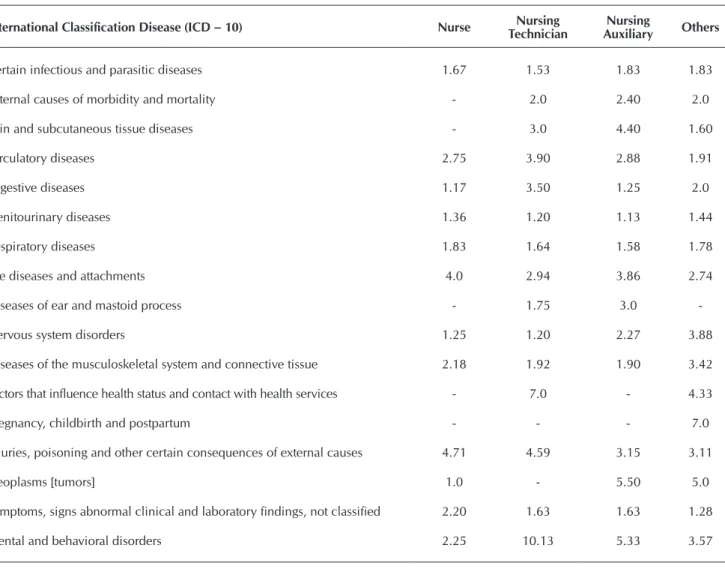
The diseases responsible for the absence of health workers
at work, according to ICD-10 were evaluated by the Average
indicator of working lost days by ICD grouping x number of notifications by professional category (I9), as described in Table 3.
DISCUSSION
The results showed that the medium and technical level of nursing workers obtained the highest number of working lost days attributed to burden and wear of work. These results are justified by the proportion of workers by the care of object and the activities inherent in this profession in the hospital, as well
as the closeness of professionals with workloads(3). The fact
that they remain great part of the time in care activities, per-forming invasive procedures or manipulating sharps, expose
them to the body fluids(3), main biological burden. Similarly
biomechanical factors such as repeatability, physical effort and psychosocial pressures, characteristic of the physiological and psychological burden are clear and constant in the daily lives of these workers.
It is considered that these results demonstrate the division of roles and different responsibilities of each category. As es-tablished by the Federal Nursing Council by the Professional Practice Law (Law 7. 498/86), it is up to the nurse to carry out
Table 3 - Average working lost days by grouping of the International Classification of Diseases x number of notifications by
professional category (I9), according to Simoste data, Curitiba, Paraná, Brazil, 2011
International Classification Disease (ICD – 10) Nurse Nursing
Technician
Nursing
Auxiliary Others
Certain infectious and parasitic diseases 1.67 1.53 1.83 1.83
External causes of morbidity and mortality - 2.0 2.40 2.0
Skin and subcutaneous tissue diseases - 3.0 4.40 1.60
Circulatory diseases 2.75 3.90 2.88 1.91
Digestive diseases 1.17 3.50 1.25 2.0
Genitourinary diseases 1.36 1.20 1.13 1.44
Respiratory diseases 1.83 1.64 1.58 1.78
Eye diseases and attachments 4.0 2.94 3.86 2.74
Diseases of ear and mastoid process - 1.75 3.0
-Nervous system disorders 1.25 1.20 2.27 3.88
Diseases of the musculoskeletal system and connective tissue 2.18 1.92 1.90 3.42
Factors that influence health status and contact with health services - 7.0 - 4.33
Pregnancy, childbirth and postpartum - - - 7.0
Injuries, poisoning and other certain consequences of external causes 4.71 4.59 3.15 3.11
Neoplasms [tumors] 1.0 - 5.50 5.0
Symptoms, signs abnormal clinical and laboratory findings, not classified 2.20 1.63 1.63 1.28
Mental and behavioral disorders 2.25 10.13 5.33 3.57
more complex procedures and activities related to the
man-agement and supervision of staff(7). Because they are
respon-sible for the continuity of care, it may be that, not to leave the team without a reference person, nurses choose to work sick
to move away for short periods(8).
Nursing technicians are responsible for performing medi-um level activities, to guide and monitor the work of nursing
auxiliaries and assist in the planning of care(7). In the Brazilian
public health institutions, a category that fits the setting of this study, these professionals are overloaded by the need to meet a high demand of users who seek or are referred for these ser-vices. This occurs mainly about nursing technicians who work in intensive care units in operating rooms and emergency care services. In these sectors, the assistance the user requires more concentration, technical skills, quick thinking and continuous attention due to the severity of the sick.
In addition to wearing arising from biological burden, there was a great exhibition of the health worker to the physiologi-cal and psychologiphysiologi-cal burden, results that corroborate those observed in a study developed in the Midwest region of
Bra-zil(9). Although, with minor differences, the results showed
that regardless of the professional category, there is a greater exposure to these charges. Factors related to work organiza-tion, models of management, the lack of collective defenses, lack of autonomy and power abuse, might be associated with
these results(9). Therefore, it evidences the need for
interven-tional measures to minimize this exposure(10).
Noteworthy is the high number of absences due to mental and behavioral disorders, and the high average of absence days from their work. These values are worrying because they dem-onstrate the mental illness of older workers, although the causal
link with working conditions is hardly established(11). Although
difficult association with work, these diseases are among the
most costly to health services(12) and the employing institutions.
The average absence time for mental disorders indicates that such conditions require more time to recover, resulting in higher expenses for the institution, to the pension system for workers.
Depression is a mental worker disorder and was also iden-tified in this study. It indicates stress in the work environment, influences in the physical and psychological health of profes-sionals and its occurrence results in dissatisfaction, absenteeism,
turnover in services, loss in quality of care(13) and reduction of
cognitive activities, as demonstrated in a study developed among
workers in Norway(14). Given that stress is harmful to health, this
symptom may affect the work process and trigger consequences
in health maintenance or restoration of capacity for work(13).
An important study conducted in southeastern Brazil among nursing workers found that when submitted to high demand in the workplace, they are more likely to have re-duced capacity for work, which can promote the development of stress. It is important to emphasize that age and sex of these
workers were associated with these findings(13).
Wear processes responsible for working lost days converge partially with those found in the literature, indicating that re-spiratory diseases and musculoskeletal are among the most frequent among health professionals when compared to the
general population(2,9-10,15). The general index of population
is 1.4% while the cleaning hospital workers are 3%, nurses
2.9% and nursing auxiliaries 1.6%(16).
The work-related musculoskeletal disorders (Dort), diseas-es also evidenced in this study, are associated with exposure to physiological burden, especially by adopting inadequate postures and excessive manipulation of weight that cause changes in physical, psychological and psychosocial order. The chronic disease causes signs and symptoms as stress, depression, anxiety, insecurity, fear, adopting introverted at-titudes and mood alterations, also committing to social and
family life(17). Physical symptoms lead to frequent worker
ab-sences. This can compromise the environment, leading to an atmosphere of distrust and tension between co-workers and interfering in team motivation and quality of care, factors ob-served in research conducted on the South American
conti-nent(18), North American(19) and European continent(20).
Some studies on different continents confirm the magnitude of the disease process among workers with Dort. Economic glo-balization articulated to restructure the production processes has contributed to the redefinition of the profile of morbidity and mortality of workers. Some studies have indicated a range
between 34.3% and 62.5% of osteoarticular disorder(18-19,21).
The pain expressed by physical wear can trigger stress in the workplace and influence the psychological domain of workers, in general, resulting in feelings of dissatisfaction at work,
anxi-ety and even diseases such as depression(14,22). A study carried
out in Oslo, Norway(14) analyzed the impact of psychosocial
and mechanical exposure related to work in the development of pain in shoulder and neck in the workplace. The associa-tion of pain presence in the face of psychosocial exposure was slightly influenced to physical risk factors. The indicators used in this study showed an association between the musculoskel-etal diseases and mental disorders, whose absences records to-taled 677 working lost days in the study setting.
The Simoste records amounted 2478 working lost days from workplace. Serious consequences are triggered by work-related diseases, especially in Dort. These can cause a substantial loss of working days, resulting in socio-economic losses, since the company needs to replace this worker when is absent from work
process(20). Epidemiological studies carried out in Brazil(23-24),
Denmark(25) and Italy(26) emphasize the high rates of
absentee-ism resulting from different disease processes among health workers. These results commit the production, influence the total of lost workdays and keep active the morbidity processes.
The number of absences records by symptoms, signs and ab-normal clinical and laboratory findings not elsewhere classified (ICD R00-R99) was also high, which reinforces the hypothesis that there may be links between the various burden and wear of work. Wear processes for these diseases are considered when signs and symptoms do not have a defined etiology when can lead to two or more diseases and in different body systems. They are classified in this way when it is not possible to set a diagno-sis, when the disease or symptoms present transitory or
symp-toms, regardless of etiology, are major health problems(6).
demand for health services. Among health workers, these
di-agnoses may be related to exposure to workloads(2). However,
it is unknown which health problems will be triggered, and this is the weathering process that had no detectable disease.
There is a need of clarification regarding the working lost days due to diseases related to pregnancy, childbirth and postpartum (O00-O99 ICD). A unique record, referring to an episode of hypertension complicating pregnancy deviate the worker of its activities for seven consecutive days. Hyperten-sion has physiological causes; however, hypertensive situa-tions can be exacerbated by unfavorable situasitua-tions like stress
pressures in the workplace(27)
.
Another important aspect refers to records of neoplasm ab-sence that correspond to the diagnosis of skin cancer among nursing staff working in the Intensive Care Unit and the Mate-rial and Sterilization Center. In those sectors where there is great exposure of workers to the chemical burden by handling of medicines and products used daily for disinfection and
pro-cessing of materials(28). However, the causal link between this
disease and the work was not performed in this study. The wear corresponding to injuries, poisoning and certain other consequences of external causes had a high average of working lost days in this study. They have been associated with the occurrence of trauma, poisoning or complications
and squeals arising from these diseases(6). A Brazilian study
carried out in northeastern Brazil showed that when related to work, they have a representation of 82.8% among typical
accidents and 75% of stretch accidents(29). These results may
not be confirmed in this study due to the lack of Occupational Accident Report in the period, which may indicate under-re-porting of accidents at work in the institution.
National and international findings allow reflecting about the
need for interventions(14) in the workplace. Articulation strategies
should be adopted to reduce this installed morbidity(19), mainly
to the physiological and psychological workloads, observed in this study by the magnitude of expressed and registered morbidi-ty process. Investments in better-working conditions for all
work-ers ‘life stages reduce temporary and permanent absences(13) and
contribute to the improvement of workers’ quality of life.
CONCLUSION
Worker health indicators used in this study indicated prob-lems arising from the characteristics and dynamics of the work of the hospital environment, in the sectors in which the rou-tines are more intense and wearing, like the Intensive Care Unit in the Surgical Center and Emergency Room.
The results point to worker exposure to various types, pre-dominantly biological, physiological and psychological bur-den. They reflect the health work processes, whose activities are characterized by close contact with the patient, exposure to bodily fluids, handling weights and intense and stressful work routines.
There is the loss of 2478 days of work among research par-ticipants, and the nursing team is responsible for 1526 days of this sum. The indicators showed that these workers fall ill by physical and psychological diseases. In the study setting, it should be considered the high number of respiratory diseases register, musculoskeletal and connective tissue diseases and mental and behavioral disorders. Thus highlights the need for intervention measures to reduce these numbers.
These results lead to reflection and a redirect to the health surveillance of workers since the process of becoming ill is compounded by the sum of psychosocial factors, physical symptoms such as pain, as well as the workplace. The health indicators used in this study may contribute to the design of the morbidity profile, helping to monitor over time. They can also support actions aimed at changing the illness profile. However, it is for managers and workers with an integrative vision for health promotion in the face of this existing epide-miological profile. The technological tool entitled Simoste can contribute to the construction of this process.
There are the limitations of this research, which was per-formed in specific scenario in southern Brazil and method-ological issue, not to allow the establishment of association and correlation between workload and disease. Despite the limitations, the results replied to the proposed goals and pro-vide support for interventions in reality, as well as for the de-velopment of other studies with the same perspective.
REFERENCES
1. Laurel AC, Noriega M. Processo de produção e saúde: trabalho e desgaste operário. São Paulo: Hucitec; 1989.
2. Felli VEA. [Nursing working condition and sickness: reasons why to reduce the work journey to 30 hours]. Enferm Foco [Internet]. 2012[cited 2015 Apr 02];3(4):178-81. Avail-able from: http://revista.portalcofen.gov.br/index.php/enfer-magem/article/view/379/170 Portuguese.
3. Trindade LL, Grisa CC, Ostrovski VP, Adamy EK, Fer-raz L, Amestoy SC, et al. Absentismo en el equipo de enfermería en el ambiente hospitalário. Enfermería Global [Internet]. 2014[cited 2015 Apr 02];13(36):138-46. Available from: http://scielo.isciii.es/pdf/eg/v13n36/ docencia3.pdf
4. Brasil. Organização Pan-Americana da Saúde – OPAS.
Indicadores básicos para a saúde no Brasil: conceitos e aplicações [Internet]. Brasília (DF): Rede Interagencial de Informação para a Saúde – Ripsa, 2008 [cited 2015 Apr 02]; Available from: http://tabnet.datasus.gov.br/tabdata/ livroidb/2ed/indicadores.pdf
5. Felli VEA, Mininel VA, Sarquis LMM, Karino ME, Silva FJ, Costa TF, Baptista PCP. Sistema de Monitoramento da Saúde do trabalhador de Enfermagem. In: Felli VEA, Bap-tista PCP (Org.). Saúde do trabalhador de enfermagem. Barueri, SP: Manole, 2015 p.204-54.
exercício da Enfermagem e dá outras providências [Internet]. Brasília, 25 de junho de 1986[cited 2015 Apr 02]; Available from: http://portalcofen.gov.br
7. Gehring Junior G, Corrêa Filho HR, Vieira Neto JD, Fer-reira NA, Vieira SVR. [Sick leaves among nursing pro-fessionals in basic healthcare centers of the Brazilian National Unified Healthcare System – SUS – in the city of Campinas]. Rev Bras Epidemiol [Internet]. 2007[cited 2015 Apr 02];10(3):401-9. Available from: http://www. scielo.br/pdf/rbepid/v10n3/10.pdf Portuguese.
8. Mininel VA, Felli VE, Silva EJ, Torri Z, Abreu AP, Branco MTA. Workloads, strain processes and sickness absenteeism in nursing. Rev. Latino-Am Enfermagem [Internet]. 2013[cit-ed 2015 Apr 02];21(6):1290-7. Available from: http://www. scielo.br/pdf/rlae/v21n6/0104-1169-rlae-21-06-01290.pdf
9. Santana LL, Miranda FMD, Karino ME, Baptista PCP, Felli, VEA, Sarquis, LMM. Description of workloads and fatigue experienced among health workers in a teaching hospi-tal. Rev Gaúcha Enferm [Internet]. 2013[cited 2015 Apr 02];34(1):64-70. Available from: http://www.scielo.br/ pdf/rgenf/v34n1/en_08.pdf
10. João Silvestre da Silva-Junior JS, Almeida FSS, Morrone LC. [Discussion about use of Brazilian social security tool to characterize work-related disability]. Rev Bras Med Trab [Internet]. 2012[cited 2015 Apr 02];10(2):72-9. Available from: http://www.anamt.org.br/site/upload_arquivos/re-vista_brasileira_de_medicina_do_trabalho_volume_10_n %C2%BA_2_12122013824207055475.pdf Portuguese.
11. Bloom DE, Cafiero ET, Jane-Llopis E, et al. The global eco-nomic burden of non-communicable diseases. Geneva: World Economic Forum [Internet]. [cited 2015 Apr 02]; Available from: http://www3.weforum.org/docs/WEF_Harv ard_HE_GlobalEconomicBurdenNonCommunicable Diseases_2011.pdf
12. Prochnow A, Magnano TSBS, Urbanetto JS, Beck CLC, Lima SBS, Greco PBT, et. al. Work ability in nursing: relationship with psychological demands and control over the work. Rev Latino-Am Enfermagem [Internet]. 2013[cited 2015 Apr 02];21(6):1298-305. Available from: http://www.scielo.br/ pdf/rlae/v21n6/0104-1169-rlae-21-06-01298.pdf
13. Sterud T, Hakon A, Tynes JT. Work-related psychosocial and mechanical risk factors for low back pain: a 3-year follow-up study of the general working population in Norway. Occup Environ Med [Internet]. 2013[cited 2015 Apr 02];70:296-302. Available from: http://oem.bmj.com/ content/70/5/296.full.pdf+html
14. Nordin NAM, Leonard JH, Thye NC. Work-related inju-ries among physiotherapists in public hospitals a South-east Asian picture. Clinics [Internet]. 2011[cited 2015 Apr 02];66(3):373-8. Available from: http://www.ncbi.nlm.nih. gov/pmc/articles/PMC3071994/pdf/cln-66-03-373.pdf
15. Kim JL, Torén K, Lohman S, et al. Respiratory symptoms and respiratory-related absence from work among health care workers in Sweden. J Asthma [Internet]. 2013[cited 2015 Apr 02];50(2):174-9. Available from: http://www. tandfonline.com/doi/full/10.3109/02770903.2012.7602 03#.VkLSR7-urfc
16. Pessoa JCS, Cardia MCG, Santos MLC. [Analysis of the limitations, strategies and perspectives of the workers
with RSI/WRMD, participants of the PROFIT-LER Group: a case study]. Ciênc Saúde Coletiva [Internet]. 2010[cited 2015 Apr 02];15(3):821-30. Available from: http://www. scielo.br/pdf/csc/v15n3/v15n3a25.pdf Portuguese.
17. Vidor CR, Mahmud MAI, Farias LF, Silva CA, Ferrari JN, Comel JC, et al. Prevalence of musculoskeletal pain among nursing surgery teams. Acta Fisiátrica [Internet]. 2014[cited 2015 Apr 02];21(1):6-10. Available from: http://www.actafisia trica.org.br/detalhe_artigo.asp?id=529
18. Beach J, Senthilselvan A, Cherry N. Factors affecting work-related shoulder pain. Occup Med (Lond) [Internet]. 2012[cited 2015 Apr 02];62(6):451-4. Available from: http://occmed.oxfordjournals.org/content/62/6/451.full. pdf+html
19. Alexopoulos EC, Merekoulias G, Tanagra D, Konnstanti-nou EC, Mikelatou E, Jelastopulu E. Sickness absence in the private sector of Greece: comparing shipyard industry and national insurance data. Int J Environ Res Public Health [Internet]. 2012[cited 2015 Apr 02];9(4):1171-81. Avail-able from: http://www.ncbi.nlm.nih.gov/pmc/articles/ PMC3366606/pdf/ijerph-09-01171.pdf
20. Sadeghian F, Raei M, Amiri M. Persistent of neck/shoul-der pain among computer office workers with specific at-tention to pain expectation, somatization tendency, and beliefs. Int J Prev Med [Internet]. 2014[cited 2015 Apr 02];5:1170-8. Available from: http://www.ncbi.nlm.nih. gov/pmc/articles/PMC4192780/.
21. Machado LSF, Rodrigues EP, Oliveira LMM, Laudano RCS, Sobrinho CLN. [Health problems reported by nursing work-ers in a public hospital of Bahia]. Rev Bras Enferm [Internet]. 2014[cited 2015 Apr 02];67(5):684-91. Available from: http://www.scielo.br/pdf/reben/v67n5/0034-7167-re ben-67-05-0684.pdf Portuguese.
22. Zechinatti AC, Belloti JC, Moraes VY, Albertoni WM. Occupational musculoskeletal and mental disorders as the most frequent associations to worker’s sickness ab-sence: A 10-year cohort study. BMC Res Notes [Inter-net]. 2012[cited 2015 Apr 02];11(5):229. Available from: http://www.biomedcentral.com/1756-0500/5/229
23. Marques CF, Vieira MA, Sena RR. [Disease-related ab-senteeism among nursing team members in a teaching hospital]. Rev Bras Enferm [Internet]. 2009[cited 2015 Apr 02];62(1):38-44. Available from: http://www.scielo.br/ pdf/reben/v62n1/06.pdf Portuguese.
24. Andersen LL, Clausen T, Burr H, Holtermann A. Thresh-old of musculoskeletal pain intensity for increased risk of long-term sickness absence among female healthcare work-ers in eldercare. Plos One[Internet]. 2012[cited 2015 Apr 02];7(7):e41287. Available from: http://journals.plos.org/ plosone/article?id=10.1371/journal.pone.0041287
25. Carugno M, Pesatori AC, Ferrario MM, Ferrari AL, Silva FJ, Martins AC, et al. Physical and psychosocial risk fac-tors for musculoskeletal disorders in Brazilian and Italian nurses. Cad Saúde Pública [Internet]. 2012[cited 2015 Apr 02];28(9):1632-42. Available from: http://www.sci-elosp.org/pdf/csp/v28n9/v28n9a03.pdf
à Saúde - CID-10 [Internet]. 2008 [cited 2015 Apr 02]. Available from: http://www.datasus.gov.br
27. Ribeiro RP, Marziale MHP, Martins JT, Ribeiro PHV, Ro-bazzi MLCC, Dalmas JC. Prevalence of Metabolic Syn-drome among nursing personnel and its association with occupational stress, anxiety and depression. Rev Latino-Am Enfermagem [Internet]. 2015[cited 2015 Apr 02];23(3):435-40. Available from: http://www.scielo.br/ pdf/rlae/v23n3/0104-1169-rlae-0383-2573.pdf
28. Muñoz PM. Oliva MP. Los estressores psicosociales se
asocian a síndrome hipertensivo del embarazo y/o sínto-mas de parto prematuro en el embarazo adolescente. Rev Chil Obstet Ginecol [Internet]. 2009[cited 2015 Apr 02];74(5):281-5. Available from: http://www.scielo.cl/pdf/ rchog/v74n5/art03.pdf