Rev Saúde Pública 2004;38(5) www.fsp.usp.br/rsp
O ccupation and mortality in the Brazilian
N avy
M arlene Silvaa and Vilma Sousa Santanab
aFundação para o Desenvolvimento das Ciências. Escola Bahiana de Medicina e Saúde Pública.
Bahia, BA, Brasil. bPrograma Integrado de Saúde Ambiental e do Trabalhador. Instituto de Saúde
Coletiva. Universidade Federal da Bahia. Bahia, BA, Brasil
Work funded by Conselho Nacional de Desenvolvimento Científico e Tecnológico (CNPq – Process n. 141732/01-6) and National Institutes of Health/Fogarty Foundation (Process n. 1043 TW00827-02).
Received on 8/7/2003. Reviewed on 4/12/2003. Approved on 5/2/2004.
Correspondence to: Marlene Silva
Instituto de Saúde Coletiva - PISAT Rua Padre Feijó, 29 4o andar Canela 40110-170 Salvador, BA, Brasil E-mail: [email protected]
Keywords
Proportionate Mortality Ratio. Navy. Occupational risk factors. Digestive tract diseases. Genitourinary tract diseases. Nervous system diseases.
Abstract
Objectives
To describe the distribution of mortality due to digestive tract, genitourinary and nervous system diseases according to occupation among Brazilian Navy servicemen.
Methods
This was an exploratory study of proportional mortality among male servicemen in the Brazilian Navy who died between 1991 and 1995. The study population comprises the entire contingent of servicemen during this same time period. Data were obtained from death certificates submitted in order to obtain dependents’ pensions, and from the corresponding occupational histories of these individuals. Basic causes of death were coded in accordance with the International Classification of Diseases (9th Revision).
Results
Servicemen presented increased proportional mortality for liver diseases related to alcohol consumption (age-adjusted proportional mortality ratio, PMRadj =2.03; 95% confidence interval, CI: 1.26-3.00), pancreatitis (PMRadj=2.03; 95% CI: 1.06-3.38), digestive hemorrhage (PMRadj=1.61; 95% CI: 1.10-2.23), chronic kidney diseases (PMRadj=2.82; 95% CI: 1.98-3.84), Parkinson’s disease (PMRadj=3.00; 95% CI: 1.27-5.72) and degenerative brain diseases (PMRadj=2.88; 95% CI: 1.14-5.70), in relation to the reference population. A statistically non-significant association was observed between radar operators (PMR=6.50; 95% CI: 1.43-29.56) and nervous system diseases was observed.
Conclusions
The results indicate the existence of possible occupational risk factors in the working environment of the Brazilian Navy, and the need for studies using quantitative measurement of such exposure.
INTRODUCTION
Within the working environment of the armed forces, extended working days, ergonomic problems and ex-posure to chemical, physical and biological agents are common. These are well-known occupational risk
fac-tors for health.18 In the Navy, in particular, long
peri-ods of exposure to heat or solar radiation during
train-ing or shipboard activities,7 exposure to dust and
smoke of chemical origin in confined environments,7,18
and to asbestos fiber5 have been described. Social
iso-lation is another occupational risk described among Navy servicemen, particularly on combat training
trips,8 which may lead to changes in lifestyle,6 for
ex-ample increased smoking and alcohol consumption.3,4
Consequently, high rates of hospitalization due to
al-cohol-related disturbances,8 increased numbers of
vio-Rev Saúde Pública 2004;38(5) www.fsp.usp.br/rsp Ocupação e mortalidade na Marinha
Silva M & Santana VS
between death certificates and declarations, the di-agnoses of 106 records selected randomly from among those that made up the study population were com-pared. Concordance of 89.62% was estimated for groups of causes of death that were defined in ac-cordance with the International Classification of
Dis-eases, 9th Revision (ICD-9), with a weighted Kappa
index of 0.61 and 95% confidence interval (CI) of 0.51-0.72, which was considered acceptable.
The causes of death that were of interest in the present study were digestive tract diseases (ICD-9: 520-579), genitourinary tract diseases (ICD-9: 580-629) and nervous system diseases (ICD-9: 320-389), which were found to be associated with working in
the navy (Silva et al,15 1998). The covariables
ana-lysed were: age in years, marital status (single, mar-ried, widowed or separated), place of residence (Rio
de Janeiro or elsewhere), rank (enlisted men – marine,
sailor, sergeant, non-commissioned officer; or
com-missioned officers – ensign, lieutenant,
lieutenant-captain, lieutenant-commander, commander, commo-dore and admiral) and occupation. The occupation was assessed by forming occupational groups that were defined according to the similarity of their
ac-tivities: combat and arms – handlers of submarine
weapons and artillery, gunners, torpedomen, minemen
and infantry; healthcare – doctors, dentists,
pharma-cists, nurses and x-ray technicians; mechanical and
metalworking – machine and motor operators,
air-craft mechanics, air-craftsmen, metalworkers, boiler
op-erators; communications and electro-electronics –
ship-to-shore and internal communications, ship signaling, sonar, radar and telegraphy operators, gen-eral electronic equipment and aviation electronics
operators, and electricians; naval sciences and
ad-ministration – navy staff officers, hydrographers,
divers, superintendents, administrators, accountants,
secretaries, chaplains, storemen and musicians;
main-tenance and repairs – building and fittings
crafts-men, carpenters, damage assessors, deck and
avia-tion equipment handlers and repairers; general
serv-ices – master chefs, occupations related to
orderli-ness and housekeeping, hairdressing and cleaning.
The proportional mortality was calculated in accord-ance with the covariables and each of the groups of causes of death that were selected: digestive tract, geni-tourinary tract and nervous system diseases. Within these groups, specific diseases were analyzed, and those that presented sufficient numbers of cases were selected for study in more detail. The proportional mortality was calculated by dividing the number of deaths due to the cause of interest by the total deaths for the same period. Associations were measured as raw proportional mortality ratios and adjusted for age by an indirect
lent deaths5 and, most frequently, high mortality due
to cirrhosis of the liver5,13 are seen.
Studies carried out in Europe and in the United States have found increased mortality among servicemen due to digestive tract diseases in particular, in comparison
with the general population.2-5 Preliminary findings
from the Brazilian Navy, using the same database as in the present study, revealed greater proportional mor-tality due to digestive tract, genitourinary tract and nervous system diseases than in the reference
popula-tion.15 These results motivated the continuation of the
analysis, to form the subject of the present study. In this study, the diagnostic subcategories are detailed and also the differences in mortality according to oc-cupations, specifically, for digestive tract, genitouri-nary tract and nervous system diseases.
M ETH O D S
This was a proportional mortality study of service-men in the Brazilian Navy who died between Janu-ary 1, 1991, and December 31, 1995. The deaths that form the study population occurred among active, reserve and retired servicemen who were resident in Brazil and abroad, of male gender and aged over 19 years. Women were excluded from the study because they had only recently been admitted into the navy and only represented 3% of the personnel during the study period. The reference population considered in the study was the total number of deaths among males in the State of Rio de Janeiro that occurred during the same period. This area was chosen because it is the location where the greatest proportion of Navy serv-icemen are based, and because it presents a similar proportion of deaths recorded as having poorly-de-fined causes. Further detailing of the procedures is
described in the previous publication.15
Death certificates for the study population were ob-tained from the Navy’s service for retired personnel and dependants’ pensions (Serviço de Inativos e Pensionistas da Marinha - SIPM), which is the body responsible for certifying pensions for the families of dead servicemen. Sociodemographic and occupational data on these in-dividuals was also collected from this entity, from the records of the length of service required for, and the calculation of, indemnifications and pensions for eligi-ble family members. Other information, relating to the reference population, was obtained from the mortality information system (Sistema de Informação de Mortalidade - SIM) of the Ministry of Health.
!
Rev Saúde Pública 2004;38(5) www.fsp.usp.br/rsp
Ocupação e mortalidade na Marinha Silva M & Santana VS
method using the corresponding proportional mortal-ity for the population of the State of Rio de Janeiro. The statistical significance of the proportional mor-tality ratios was evaluated using 95% confidence in-tervals that were calculated by means of significance factors for the observed values in relation to the ex-pected values, for variables with Poisson’s distribution. Since occupational data were limited to the Navy population, the proportional mortality ratio was uti-lized for estimating associations with occupation for each of occupational groups, taking all the other groups as the reference. For specific estimates of pro-portional mortality according to illness and occupa-tional group, the total deaths for each occupaoccupa-tional group were taken as the denominator. When applica-ble, adjustment for age was done via the direct Man-tel-Haenszel method, which considers the relative im-portance of different strata. For the statistical inferences, 95% confidence intervals estimated via the Mantel
Haenszel method were utilized.16
RESU LTS
During the study period, 3,882 deaths were recorded. It was not possible to locate 319 death certificates
(8.0%), and seven individuals aged between 17 and 19 years were excluded because of the lack of corre-sponding strata in the reference population. The study population thus consisted of 3,556 deaths. The ma-jority of these individuals (60%) had died aged more than 59 years, were married (77%), were resident in Rio de Janeiro (70%) and belonged to the ranks of enlisted men (79%).
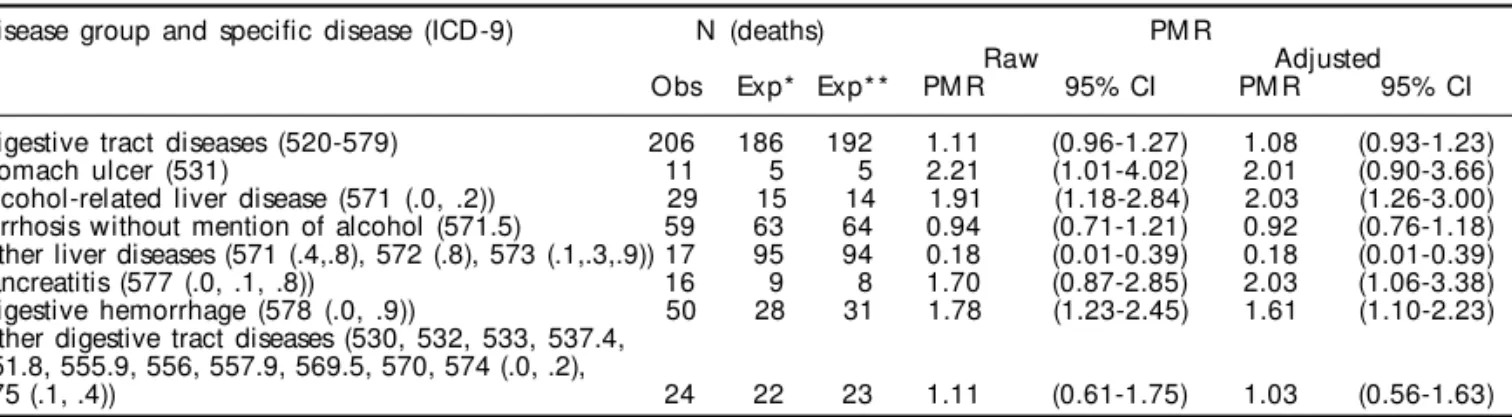
In Table 1, it can be seen that there was no statisti-cally significant difference between the observed and expected deaths for the group of digestive tract diseases (age-adjusted proportional mortality rate,
PMRadj =1.08; 95% CI: 0.93-1.23). Nonetheless, the
greatest proportional mortality ratios were found for
alcohol-related liver diseases (PMRadj =2.03; 95%
CI: 1.26-3.00), pancreatitis (PMRadj =2.03; 95% CI:
1.06-3.38) and digestive hemorrhage (PMRadj =1.61;
95% CI: 1.10-2.23), respectively. Among the
geni-tourinary tract diseases (PMRadj =1.45; 95% CI:
1.16-1.81), it was possible to identify an excess of deaths
due to chronic renal diseases (PMRadj =2.82; 95%
CI: 1.98-3.84) (Table 2). With regard to nervous
sys-tem diseases (PMRadj =1.36; 95% CI: 0.83-2.03),
larger proportions of deaths among servicemen than
Table 1 - Raw and age-adjusted proportional mortality ratios for digestive tract diseases and specific diseases.
Disease group and specific disease (ICD-9) N (deaths) PM R
Raw Adjusted
Obs Exp* Exp* * PM R 95% CI PM R 95% CI
Digestive tract diseases (520-579) 206 186 192 1.11 (0.96-1.27) 1.08 (0.93-1.23)
Stomach ulcer (531) 11 5 5 2.21 (1.01-4.02) 2.01 (0.90-3.66)
Alcohol-related liver disease (571 (.0, .2)) 29 15 14 1.91 (1.18-2.84) 2.03 (1.26-3.00) Cirrhosis without mention of alcohol (571.5) 59 63 64 0.94 (0.71-1.21) 0.92 (0.76-1.18) Other liver diseases (571 (.4,.8), 572 (.8), 573 (.1,.3,.9)) 17 95 94 0.18 (0.01-0.39) 0.18 (0.01-0.39)
Pancreatitis (577 (.0, .1, .8)) 16 9 8 1.70 (0.87-2.85) 2.03 (1.06-3.38)
Digestive hemorrhage (578 (.0, .9)) 50 28 31 1.78 (1.23-2.45) 1.61 (1.10-2.23)
Other digestive tract diseases (530, 532, 533, 537.4, 551.8, 555.9, 556, 557.9, 569.5, 570, 574 (.0, .2),
575 (.1, .4)) 24 22 23 1.11 (0.61-1.75) 1.03 (0.56-1.63)
Obs: Number of deaths observed among servicemen
*Number of deaths expected, on the basis of the total deaths that occurred between 1991 and 1995 for the male population of the State of Rio de Janeiro, which was utilized as the reference
**Number of deaths expected, on the basis of the age distribution of the deaths that occurred between 1991 and 1995 for the male population of the State of Rio de Janeiro, which was utilized as the reference
PMR: proportional mortality ratio
95% CI: 95% confidence interval calculated in the basis of Poisson’s distribution ICD-9: International Classification of Diseases, 9th Revision
Table 2 - Raw and age-adjusted proportional mortality ratios for genitourinary tract diseases and specific diseases.
Disease group and specific disease (ICD-9) N (deaths) PM R
Raw Adjusted
Obs Exp* Exp* * PM R 95% CI PM R 95% CI
Genitourinary tract diseases (580-629) 81 50 56 1.61 (1.28-2.00) 1.45 (1.16-1.81)
Acute renal disease (584.9) 15 9 9 1.76 (0.89-2.99) 1.59 (0.79-2.71)
Chronic renal disease (585) 48 16 17 3.07 (2.17-4.17) 2.82 (1.98-3.84)
All others (582.9, 588.1,590.0, 592.0, 595.0,
597.8, 586) 18 11 12 1.70 (0.91-2.78) 1.54 (0.82-2.53)
Obs: number of deaths observed among servicemen
*Number of deaths expected, on the basis of the total deaths that occurred between 1991 and 1995 for the male population of the State of Rio de Janeiro, which was utilized as the reference
**Number of deaths expected, on the basis of the age distribution of the deaths that occurred between 1991 and 1995 for the male population of the State of Rio de Janeiro, which was utilized as the reference
PMR: Proportional mortality ratio
" Rev Saúde Pública 2004;38(5) www.fsp.usp.br/rsp Ocupação e mortalidade na Marinha
Silva M & Santana VS
expected were observed, caused by Parkinson’s
dis-ease (PMRadj =3.00; 95% CI: 1.27-5.72) and
degen-erative brain diseases (PMRadj =2.88; 95% CI:
1.14-5.70) (Table 3). In general, it could be noted that the raw estimates did not differ significantly from the age-adjusted estimates.
The occupation-related results (Table 4) showed that there were positive associations between the occupa-tions in the communicaoccupa-tions and electro-electronics
group and nervous system diseases (PMRadj =2.28;
95% CI: 1.06-4.92), and between the general
serv-ices group and genitourinary diseases (PMRadj =1.82;
95% CI: 1.10-3.03). It should be noted that there was threshold statistical significance for the association between the occupations in the maintenance and
re-pairs group and digestive tract diseases (PMRadj =1.35;
95% CI: 0.95-1.91). Detailed analysis of these spe-cific occupational groups (Table 5) showed that the relative excess of deaths due to nervous system dis-eases was related to greater proportional mortality
among radar operators (PMRraw =6.50; 95% CI:
1.43-29.56) and telegraphers (PMRraw =2.94; 95% CI:
0.80-10.80), which were both in the communications and electro-electronics group. No other associations at a statistically significant level were found.
D ISCU SSIO N
The data from this study indicate that, among the digestive diseases, Brazilian Navy servicemen pre-sented increased proportional death due to alcohol-related liver diseases (ICD-9: 571 (.0, .2)), pancreati-tis (ICD-9: 577 (.0, .1, .8)) and digestive hemorrhage (ICD-9: 578 (.0, .9)), in relation to the reference popu-lation. For genitourinary tract diseases, they presented greater proportional death due to chronic renal dis-eases (ICD-9: 585), while among the nervous system diseases there were statistically significant associa-tions only with cerebral degeneration (ICD-9: 331 (.0, .7, .9)) and Parkinson’s disease (ICD-9: 332 (.0, .1)), in relation to the reference population.
Studies on servicemen from several armed services have made similar findings regarding mortality due to
digestive tract diseases.3,5 In particular, increased risk
of death due to cirrhosis of the liver has been found,4
which is related to abusive consumption of alcohol.3,5,13
However, the greater proportion of deaths due to genitourinary tract and nervous system diseases esti-mated for Brazilian servicemen differs from the
re-sults found by other authors.2,5 For example, a higher
Table 3 - Raw and age-adjusted proportional mortality ratios for nervous system diseases and specific diseases.
Disease group and specific disease (ICD-9) N (deaths) PM R
Raw Adjusted
Obs Exp* Exp* * PM R 95% CI PM R 95% CI
Nervous system diseases (320-389) 31 25 23 1.25 (0.75-1.87) 1.36 (0.83-2.03)
Meningitis (320.1(.9), 322.9)) 4 4 3 1.02 (0.17-2.62) 1.28 (0.25-3.29)
Cerebral degeneration (331.0 (.7, .9)) 8 2 3 3.47 (1.40-6.85) 2.88 (1.14-5.70)
Parkinson’s disease (332 (.0, .1)) 9 3 3 3.44 (1.47-6.55) 3.00 (1.27-5.72)
All others (323.4 (.9), 326, 335.2, 336.9, 340, 341,
348.5 (.9), 357)) 10 5 5 1.90 (0.81-3.57) 2.04 (0.88-3.81)
Obs: number of deaths observed among servicemen
*Number of deaths expected, on the basis of the total deaths that occurred between 1991 and 1995 for the male population of the State of Rio de Janeiro, which was utilized as the reference
**Number of deaths expected, on the basis of the age distribution of the deaths that occurred between 1991 and 1995 for the male population of the State of Rio de Janeiro, which was utilized as the reference
PMR: Proportional mortality ratio
95% CI: 95% confidence interval calculated in the basis of Poisson’s distribution ICD-9: International Classification of Diseases, 9th Revision
Table 4 - Proportional mortality ratios according to disease groups, adjusted for age according to occupational groups in the Brazi l i an N avy.
O ccupational group* Digestive tract diseases** Genitourinary tract diseases** Nervous system diseases**
(ICD-9: 520-579) (ICD-9: 580-629) (ICD-9: 320-389)
N PM R 95% CI N PM R 95% CI N PM R 95% CI
Combat and arms 52 1.27 (0.94-1.73) 16 1.04 (0.60-1.78) 5 0.80 (0.30-2.08)
M echanical and metalw orking 37 1.00 (0.71-1.42) 19 1.38 (0.83-2.28) 4 0.66 (0.23-1.89) Naval sciences and administration 28 0.76 (0.52-1.13) 10 0.67 (0.35-1.30) 6 1.12 (0.46-2.71) Communications and electro-electronics25 0.76 (0.50-1.14) 12 0.97 (0.53-1.78) 9 2.28 (1.06-4.92)
General services 20 0.86 (0.55-1.34) 16 1.83 (1.07-3.14) 3 0.82 (0.25-2.70)
M aintenance and repairs 36 1.35 (0.95-1.91) 7 0.57 (0.26-1.24) 1 0.21 (0.03-1.50)
H eal thcare 8 1.01 (0.51-2.01) 1 0.30 (0.04-2.13) 3 2.51 (0.77-8.18)
*Reference category is all the other occupational groups **Denominator is the total deaths due to all causes N: number of deaths
PMR: proportional mortality ratio
#
Rev Saúde Pública 2004;38(5) www.fsp.usp.br/rsp
Ocupação e mortalidade na Marinha Silva M & Santana VS
estimate for the incidence of genitourinary diseases among hospitalized servicemen has only been made in one study, which dealt with the period following
the Gulf War.9 Greater mortality due to nervous
sys-tem diseases was observed only in the British army for soldiers who served in desert areas, when
com-pared with the British navy and air force.5 Other
stud-ies have reported high incidence of sick leave due to nervous system diseases among boiler technicians in
the American navy9 and premature deaths due to
neu-romotor diseases among servicemen.14
It was observed that servicemen who were commu-nications technicians, electricians, technicians or operators of electronic equipment, carpenters, deck and aircraft equipment operators, maintenance per-sonnel in general, cooks, hairdressers, those respon-sible for cleaning, orderliness and housekeeping serv-ices or musicians presented greater proportional death due to nervous system, genitourinary tract and diges-tive tract diseases than did the respecdiges-tive reference populations. There are only a few studies on occupa-tional factors relating to servicemen’s health, but they show that workers in the occupations of healthcare, general operations, naval engineering, maintenance, repairs and services, including those that belong to the marines, are at a greater risk of accidents and vio-lent deaths, and infectious, respiratory and mental diseases, which are common among those working
on ships.6,7,9,10,17,18 Although some occupations are
indicated as presenting greater risk, the causes of death differ from those found for the Brazilian Navy.
In the present study, a strong association between the occupations of the communications and electro-electronics group and deaths due to nervous system diseases was noticeable, especially in relation to the
disease sub-categories of cerebral degeneration and Parkinson’s disease. It is plausible that some of these deaths in the navy may be associated with the elec-tromagnetic and microwave fields that are present in these occupations, especially among radar operators. For the latter, nervous system diseases were six times more frequent than in other occupations. Such expo-sure has, for example, been found to present an asso-ciation with Alzheimer’s disease and other neuromo-tor diseases among civilian workers who were operat-ing radio and television stations and electric energy plants, and repairing telephone and electrical
net-works.14 With regard to the effect of microwaves,
stud-ies on American servicemen who served during the period of the Korean War have presented data sug-gestive of a greater risk of nervous system diseases in the occupations of operating and repairing
electri-cal, electronic and communications equipment.12
Al-though there is no evidence regarding specific occu-pational risk factors among servicemen in relation to nervous system diseases, other types of exposure that are also common in the military working environ-ment are associated with neuropathies, such as expo-sure to various metallic compounds, organochlorates,
solvents and electromagnetic fields.1
The greater proportional mortality due to genitouri-nary tract diseases, in which specific analysis of occu-pations revealed greater risk for general services per-sonnel in the Brazilian Navy, differs from the majority of findings. Servicemen have generally presented low
estimates of mortality for this group of diseases.2,3,5
The exception to this is a study made among hospital-ized Gulf War veterans, which showed a slight increase
in the incidence of such diseases.8 A review of
occupa-tions in relation to genitourinary tract diseases has shown that chronic kidney diseases were the main
Table 5 - Proportional mortality and raw proportional mortality ratio according to disease group, for occupational specialties with in the Brazilian Navy.
Disease group and occupational specialty* N N * * * PM * * PM R 95% CI
Digestive tract diseases (N***=36) M aintenance and repairs (N=487)
M aneuvers and deck services 407 30 7.37 0.96 (0.41-2.22)
Carpentry and damage repair 52 5 9.62 1.34 (0.55-3.30)
Construction and installation 11 1 9.09 1.23 (0.18-8.20)
Genitourinary tract diseases (N***=16) General services (N =401)
O rderl y 231 11 4.76 1.62 (0.57-4.57)
H ai rdresser 45 2 4.44 1.16 (0.28-4.87)
Cook 100 2 2.00 0.43 (0.10-1.86)
Catering O rderlies 25 1 4.00 1.00 (0.14-7.29)
Nervous system diseases (N***=9)
Communications and electro-electronics (N=546)
Tel egrapher 163 5 3.07 2.94 (0.80-10.80)
Si gnal er 98 2 2.04 1.31 (0.28-6.19)
Radar operator 23 2 8.70 6.50 (1.43-29.56)
*Reference category is all the other occupations within the same occupational group **Denominator is the total deaths for the occupation
***Number of deaths per disease of interest (cases) N: Total number of deaths (all causes)
PM: Proportional mortality
$ Rev Saúde Pública 2004;38(5) www.fsp.usp.br/rsp Ocupação e mortalidade na Marinha
Silva M & Santana VS
causes of death for industrial workers.10 In addition to
these findings, there are records of the occurrence of subclinical nephropathy among workers exposed to nephrotoxic substances such as inorganic lead and mercury, cadmium and solvents, especially
halogen-ated aliphatic hydrocarbons.11 Such occurrences
sup-port the hypothesis of an association between the types of occupational exposure that are supposedly more common in the working environment of the navy and renal diseases. Although the estimate for the associa-tion between general services occupaassocia-tions and geni-tourinary diseases did not present great magnitude and statistical significance, possibly due to the instability of the small numbers, some of these deaths may have an occupational implication.
Some methodological limitations must be consid-ered in the present study. This was an exploratory study, and it was only possible to compare occupa-tional groups as approximations for supposedly ho-mogenous groups. Thus, specific exposure was not considered since, within a single occupational group, the individuals could present distinctly varying in-tensities and duration of exposure. Another limita-tion relates to the measurement of effect and associa-tion: when proportional mortality and proportional mortality ratios are utilized, the risk of death is not measured. The proportional mortality ratio is affected by the pattern of deaths among the population, which includes competing risks between the different causes of deaths and the age and gender composition. None-theless, the adjustment for age enabled better compa-rability with the reference population, especially be-cause the servicemen reached greater ages and pre-sented greater relative excess of deaths due to chronic diseases. It can furthermore be noted that the effect of
REFEREN CES
1. Axelson O. Neuroepidemiologia professional. In: Organización Internacional del Trabajo. Enciclopédia de Salud y Seguridad em el Trabajo. Madrid: Ministerio de Trabajo y Asuntos Sociales, 200l, vol. I, Parte I - El Cuerpo Humano, p. 7.26-8. Disponível em <http://segurancaetrabalhoonline> [2003 Junho 28].
2. Bullman TA, Kang HK, Watanabe KK. Proportionate mortality among Vietnam veterans who served in military region I. Am J Epidemiol 1990;132:670-4.
3. Coggon D, Wield G. Mortality of army cooks. Scand J Work Environ Health 1993;19:85-8.
4. Dalager NA, Kang HK. Mortality among Army Chemical Corps Vietnam veterans. Am J Ind Med 1997;31:719-26.
5. Darby SC, Muirhead CR, Doll R, Kendall GM, Thakrar B. Mortality among United Kingdom servicemen who served abroad in the 1950s and 1960s. Br J Ind Med 1990;47:793-804.
7. Garland FC, White MR, Garland CF, Shaw E, Gorham ED. Occupational sunlight exposure and melanoma in the US Navy. Arch Environ Health 1990;45:261-7.
8. Gray CG, Coate RB, Anderson MC, Kang KH, Berg, WS, Wignall FS et al. The postwar hospitalization experience of U.S. veterans of the Persian Gulf War. N Engl J Med 1996;335:1505-13.
9. Gunderson EKE, Colcord C. Health risks in naval occupations: an overview abstracted lifeline [abstract]. NHRC 1983 may/june; 22. Disponível em: http://mac088.nhrc.navy.mil/Pubs/Abstract/82/1.html [1998 May 10].
healthy workers was minimized in the present study, because all the deaths among servicemen on sick leave or who retired due to health problems or due to length of service were included. In other words, the complete population base and all of the deaths dur-ing the period of the study were observed.
Although occupational analysis was only done for occupations in the Navy, this procedure contributed towards minimizing the bias resulting from differences in the quality of diagnosis, measurement of exposure or healthy worker effect. The groups compared had the same origin and therefore were subjected to the same selection and classification criteria. In addition to this, it can be considered that the Navy population forms an excellent database for epidemiological studies. This database contains health and occupational informa-tion from the monitoring of servicemen’s health from when they join until they leave, as well as the continu-ation of attendance for retired servicemen within the Navy’s own healthcare services throughout Brazil. This allows complete cohorts to be followed, even though much of this information is not computerized.
This study has shown the need for further investi-gations, with measurement of occupational exposure that enables the identification of specific occupa-tional risk factors in order to prevent damage to health or early death.
ACKN O W LED GEM EN TS
To Serviço de Inativos e Pensionistas da Marinha
(SIPM), 1st Naval District, for making available the
%
Rev Saúde Pública 2004;38(5) www.fsp.usp.br/rsp
Ocupação e mortalidade na Marinha Silva M & Santana VS
10. Lilis R, Landrigan PJ. Renal and urinary track disorders. In: Levy BS, Wegman DH, orgs. Occupational health: recognizing and preventing work-related disease. 3rd ed. Boston: Little, Brown and Company; 1995. p. 599-616.
11. Mendes, R. Patologia do trabalho. Rio de Janeiro: Atheneu; 1995.
12. Robinette CD, Silverman C, Jablon S. Effects upon health of occupational exposure to microwave radiation (radar). Am J Epidemiol 1980;112:39-53.
13. Schuckit MA, Gunderson E. Deaths among young alcoholics in the U.S. Naval Service. Quart J Stud Alc 1974;35:856-62.
14. Schulte PA, Burnett CA, Boeniger MF, Johnson J. N eurodegenerative disease: ocuppational
occurrence and potential risk factors, 1982 through 1991. Am J Public Health 1996;86:1281-8.
15. Silva M, Santana VS, Loomis DP. Mortalidade proporcional entre militares da Marinha do Brasil. Arq Bras Med Naval 1998;59:7-16.
16. Stockes ME, Davis CS, Koch GG. Categorical data analysis using the SAS system. 2nd ed. Cary: SAS Institutes Inc.; 2000.
17. Thomas TL, Parker AL, Horn WG, Mole D, Spiro TR, Hooper TI et al. Accidents and injuries among U.S. N avy crew members during extended submarine patrols, 1997 to 1999. Mil Med 2001;166:534-40.