Rev Odontol UNESP. 2016 Mar-Apr; 45(2): 97-102 © 2016 - ISSN 1807-2577
ORIGINAL ARTICLE
Doi: http://dx.doi.org/10.1590/1807-2577.07315
Inluence of a heating device and adhesive temperature on bond
strength of a simpliied ethanol-based adhesive system
Inluência de um dispositivo de aquecimento e da temperatura do adesivo na
resistência de união de um sistema adesivo à base de etanol
Marcos Paulo Marchiori CARVALHO
a, Rachel de Oliveira ROCHA
a, Ivo KREJCI
b,
Tissiana BORTOLOTTO
b, Fábio Ecke BISOGNO
a, Alexandre Henrique SUSIN
a*
aUFSM – Universidade Federal de Santa Maria, Santa Maria, RS, Brazil
bDivision of Cariology and Endodontics, School of Dentistry, University of Geneva, Geneva, Switzerland
Resumo
Introdução: O aumento da temperatura do adesivo tem sido pesquisado como forma de melhorar a evaporação do solvente, reduzir a viscosidade e melhorar a permeação dos monômeros na dentina. Objetivo: Investigar a influência de diferentes métodos de aquecimento na resistência de união à dentina sob um ensaio de microtração de um adesivo de condicionamento ácido total. Material e método: Vinte e quatro terceiros molares hígidos foram seccionados transversalmente a fim de expor a superfície plana da dentina. As amostras foram condicionadas ácido fosfórico a 37% e dividido em três grupos (n=8). São eles: 1) Controle - onde o adesivo (Adper Single Bond 2, 3M ESPE) foi aplicado em temperatura normal (25°C); 2) Dispositivo de aquecimento – O adesivo foi aquecido em um dispositivo específico até alcançar a temperatura de 37°C e só então aplicado à dentina; 3) Ar quente – Usou-se jato de ar aquecido a 50°C por 10 segundos a uma distância de 10cm para facilitar a evaporação do solvente. Os espécimes foram restaurados com resina composta (Filtek Z250 A2, 3M ESPE) e preparados para o ensaio de microtração, após 24h de armazenamento em água destilada. Os dados obtidos foram submetidos para análise de variância (ANOVA) e teste de Tukey (p<0,05). Resultado: Não houve diferença significativa entre os grupos (p>0,05). As médias da resistência de união para o grupo controle, dispositivo de aquecimento e ar quente foram, respectivamente, 48,5 (± 5,2), 40,35 (± 4,9), e 47,2 (± 5,3). Conclusão: Os diferentes métodos de aquecimento não influenciaram significativamente na resistência de união imediata à dentina de um Sistema adesivo de condicionamento ácido total.
Descritores: Adesivos dentinários; dentina; temperarutra; adesão.
Abstract
Introduction: Increased adhesive temperature has been reported to promote solvent evaporation, reduce viscosity, and improve monomeric permeation into dentin. Objective: The aim of this study was to determine the influence of different heating methods on the microtensile bond strength of an etch-and-rinse adhesive to dentin. Material and method: Twenty-four caries-free extracted human third molars were transversally sectioned to expose a flat dentinal surface. The samples were etched with 37% phosphoric acid gel and divided into three groups (n = 8): 1) Control - the adhesive system (Adper Single Bond 2; 3M ESPE) was applied at room temperature; 2) Warming device - the adhesive was warmed to 37°C in a custom device before application; and 3) Warm air - the adhesive was warmed to 50°C with an air jet after application on dentin. The specimens were restored with a composite resin (Filtek Z250 A2, 3M ESPE) and prepared for microtensile bond strength testing, after 24 h in water storage. The data were subjected to one-way ANOVA and Tukey’s test (p < 0.05). Result: There was no significant difference among the groups (p > 0.05). The mean bond strength values in the control, the warming device, and the warm air groups were 48.5 (± 5.2), 40.35 (± 4.9), and 47.2 (± 5.3) MPa, respectively (p = 0.05). Conclusion: The different heating methods had no significant influence on the immediate microtensile bond strength of an etch-and-rinse ethanol-based adhesive to dentin.
INTRODUCTION
he adhesive-dentin interface is the weakest link in the tooth-restoration complex1. he interaction between dentin and resin
monomers depends on surface conditioning2, and optimal dentin
bonding occurs when adhesive monomers iniltrate completely into the mineralized dentin ibril network ater etching3. Procedure
changes have been suggested to improve bonding performance4,5.
Bonding efectiveness of adhesive systems may be associated with their temperature of application. Increased adhesive temperature promotes superior solvent evaporation and reduces the adhesive viscosity, hypothetically ensuring a stable and lasting bond6-12.
Enhanced solvent evaporation limits the residual solvent13, enhances
wettability11,14,15 — which inluence the hybrid layer formation
positively16 — and yields a highly reticulated polymer, with reduced
water sorption and lower hybrid layer solubility17.
It is widely accepted that the polymerization rate of adhesive systems is also improved by a temperature rise up to 60°C, which promotes a more stable and less degraded resin-dentin interface over time, whereas low temperatures have a negative impact on both aspects7-9,11.
Acetone, ethanol and water are commonly used as solvents to dissolve hydrophilic and hydrophobic monomers in the adhesive system. Use of warm air to raise adhesive temperature promotes solvent evaporation; consequently, the chemical content of the adhesive solution is altered9.
To preserve the integrity of the chemical composition of the adhesive system, a special device may be used to produce a controlled rise in adhesive temperature in a sealed chamber. hus, resin-dentin interfaces can be formed with an optimal chemical balance of the adhesive system.
Given the efects of temperature on adhesives, the impact of adhesive heating in a sealed chamber on the bond strength of adhesives should be evaluated.
herefore, the aim of this study was to evaluate the inluence of diferent heating methods on the microtensile bond strength of an etch-and-rinse dentin adhesive. he null hypothesis tested was that the heating methods would not improve the bond strength of the adhesive to dentin.
MATERIAL AND METHOD
he study was approved by the local ethics committee (protocol n. 553.956). Twenty-four caries-free human third molars, extracted from young patients, were selected and stored in a 0.5% thymol aqueous solution at 4°C, until use in the study.
Preparation and Grouping
he teeth were sectioned transversally with a precision sectioning saw (Isomet 1000; Buehler, Lake Bluf, IL, USA), at 250 rpm, to remove the occlusal third of the crown and expose a lat dentinal surface. he dentin surface was polished with #600-grit silicon carbide paper in a circular polishing machine (Arotec S/A, Cotia, SP, Brazil) for 40 s to standardize the smear layer.
Random Allocation Sotware 2.0 (freeware) was used to randomly allocate the specimens into three groups according to the heating method (n = 8), as follows: 1) Control group - the adhesive was applied on dentin at controlled room temperature (25°C) according to the manufacturer’s instructions; 2) Warming device group - the adhesive system was warmed to 37°C in a custom device before application to dentin; 3) Warm air group - the adhesive was warmed to 50°C with an air jet applied directly to the dentin, ater adhesive application and before light-curing (Table 1).
Restorative Procedures
All the specimens were etched with a 37% phosphoric acid gel (3M ESPE, St. Paul, MN, USA), for 15 s, rinsed and dried, according to the manufacturer’s instructions. Two layers of the etch-and-rinse adhesive system (Adper Single Bond 2; 3M ESPE) were applied according to the speciications of each group, dried with compressed air for 5 s, and light-cured with an LED unit (Emitter H; Schuster, Santa Maria, RS, Brazil) operating at 800 mW/cm2
for 10 s. Restorations made in 1.0-mm increments totaling 5 mm in height were then fabricated on the specimens with a composite resin (Filtek Z250 shade A2, 3M ESPE, St. Paul, MN, USA), each increment being light-cured for 20 s.
Figure 1 outlines the sequence of microtensile stick preparation. he groups are illustrated in the gray box.
Bond Strength Test
Ater 24 h in distilled water at room temperature, the specimens were sectioned into stick-shaped beams with an approximate cross-sectional area of 1 mm2, using a low speed diamond saw
under continuous water cooling. his resulted in 15-20 beams per tooth, depending on coronal size and pulp chamber volume. he cross-sectional dimensions of the beams were measured using a digital caliper (Mitutoyo America Corporation, Aurora, IL, USA) to calculate surface areas prior to microtensile bond strength (µTBS) testing. he specimens were attached to an apparatus using superglue gel (Cyanoacrylate Rite-Lok, 3M, Manchester, UK) and then subjected to tensile force at a crosshead speed of 0.5 mm/min until failure, using a universal testing machine (DL 1000; EMIC, São José dos Pinhais, PR, Brazil) equipped with a 50-kN load cell. Microtensile bond strengths (in MPa) were recorded, and the means and standard deviations of the groups were calculated. he bond strength (σ) was obtained using the formula σ = F/A, where F = load for specimen rupture (in N) and A = bonded area (in mm2).
he bonded interface of the fractured beams was observed under a stereomicroscope (Stereo Cl 1500 ECO; Carl Zeiss, Jena, Germany) at 35× magniication to select beams exclusively with adhesive failure. hose beams that presented cohesive or mixed failures were excluded from the analysis.
Statistical Analysis
RESULT
ANOVA did not reveal signiicant diferences among groups in regard to bond strength values (p > 0.05), indicating that the diferent heating methods were statistically similar. he mean bond strengths (and standard deviations) in the control, the warming device, and the warm air groups were 48.5 MPa (± 5.2), 40.35 MPa
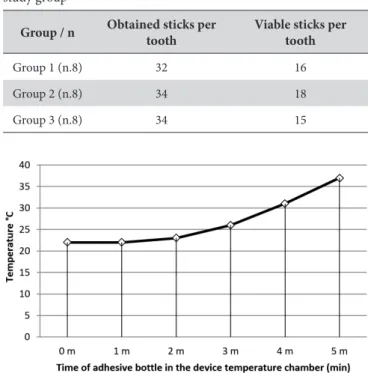
(± 4.9), and 47.2 MPa (± 5.3), respectively (Table 2). he average number of viable sticks per tooth in each group is shown in Table 3.
In the groups where the heating methods were applied (warming device and warm air), the temperature was raised up to the limits set for the study. he temperature was raised to 37°C in ive minutes in the specially designed warming device, and to 50°C in 15 s in the warm air group (Figures 2 and 3).
Table 1. Groups studied, materials and methodologic summary
Adhesive System /
Composite chemical composition
Methodology summary
G1 - Control group *G2 – Warming device group - 37°C
**G3 – Warming air group – 50°C
Adper Single Bond 2 37% Phosphoric acid Acid etching 15 s; Acid etching 15 s; Acid etching 15 s;
Batch number:
N345318BRI Rinse air-water spray 5s; Rinse air-water spray 5s; Rinse air-water spray 5s;
Exp Date: 2015/Jan Silica, Silane, BisGMA Water excess removal Water excess removal Water excess removal
HEMA, Dymethacrilates with absorbent paper; with absorbent paper; with absorbent paper;
ethanol, water, Adhesive applied (2 coats); adhesive heat inside the chamber; Adhesive applied (2 coats);
camphoroquinone, Photocure 10 s; Adhesive applied (2 coats); adhesive heat over dentin
copolymers of polyal Photocure 10 s; Photocure 10 s;
kenoic and polyacrilic
acids
Filtek Z250 (A2) BisGMA, BisEMA, UDMA Composite resin restorations resin restorationsComposite Composite resin restorations
Nt82566 TEGDMA, silica and in 5 increments of 1 mm in 5 increments of 1 mm in 5 increments of 1 mm
Exp Date: 2015/Jan Zirconia
*Need time to heat 37° C-5 min (controlled by electronic display). **Need time to heat 50°C-15 sec (controlled with digital thermometer).
DISCUSSION
An increase in the evaporation rate and a decrease in the viscosity of the solvent are consequences of temperature elevation. During the bonding procedure, these efects immediately promote less residual solvent and improve the wettability of the tooth surface11,14,15,
positively afecting the hybrid layer formation. herefore, at least theoretically, the enhanced bonding efectiveness of an adhesive system could be the result of a temperature increase altering the
physicochemical properties of the solutions involved16. Nonetheless,
under the conditions of the present study, an increased temperature did not inluence the bond strength values of the adhesive system tested. hus, the null hypothesis was accepted, since none of the heating methods improved the microtensile bond strength of the dentin adhesive.
Changes in the temperature of solutions are usually achieved by applying warm air directly either on top of the adhesive or in a drying oven. Unlike other methods described in the literature, a specially designed device was used in this study to warm up the adhesive solution. An electronic display was used to maintain a controlled temperature, and a heating chamber housing the adhesive bottle allowed the temperature to rise to a controlled 37°C. Adhesives can be heated to appropriate levels by directing warm air from a special three-way syringe or hair dryer ater application7,15,16. Simple drying cabinets with temperature control
displays can also be used. To our knowledge, this is the irst study to test a custom-designed device with a sealed chamber to ensure a controlled increase of temperature, thus heating the adhesive solution precisely, up to the required temperature.
Microtensile bond strength testing is widely accepted as a method for assessing resin-dentin adhesion, since it allows the evaluation of small surface areas (~1.0 mm2) and multiple samples
from a specimen17. No signiicant diferences in microtensile bond
strength were found among the groups tested in the present study. his inding contradicts some reports indicating that increased adhesive temperature immediately improves bond strength, regardless of the heating device or protocol used18,19. his discrepancy may be
explained by the possibility that the temperature increase promoted by the light-curing unit itself could have been enough to improve the physicochemical reactions and enhance monomeric permeation into the etched dentin16,20-22. In addition, the solvent in Adper Single
Bond 2 is based on ethanol, which reduces viscosity23. Studies of
acetone-based adhesives may present diferent results since the higher vapor pressure of acetone increases solvent evaporation22,24.
Furthermore, 37% phosphoric acid etching completely removes the smear layer and changes the energy surface of dentin2. All of
these factors could explain the lack of diference among the groups observed in the present study.
Both warming protocols could be relevant, considering that warmed air application to the adhesive could, in principle, be done clinically. A warming protocol presented in the literature as an option for in vitro tests has been found to increase bond strength values24.
Since heating promotes a forced evaporation of the solvent, it can alter the stoichiometric balance of the adhesive, thus afecting its permeation capability into the etched dentin10,19. However, despite
these advantages, warm air applied to heat up adhesives up to 20°, Table 2. Microtensile Bond Strength in Mpa, standard deviation (SD) - tested groups
Control group (25°C) Warming device group (37°C) Warming air group (50°C)
Adper Single Bond 2
MPa SD MPa SD MPa SD
48.52 a 5.2 40.35 a 4.9 47.21 a 5.3
Analisys of variance – Tukey´s test was applied at a level of 5% probability. Same letter indicate no statistically signiicant diference.
Table 3. Mean number of sticks obtained versus viable sticks per study group
Group / n Obtained sticks per tooth
Viable sticks per tooth
Group 1 (n.8) 32 16
Group 2 (n.8) 34 18
Group 3 (n.8) 34 15
Figure 2. Warming device group. Temperature of the adhesive bottle in the device chamber according to time.
30°, and 50°C has failed to increase bond strength values in a previous study19. his latter inding corroborates that of the present study,
mainly when considering some of the intrinsic characteristics of Adper Single Bond 2: (a) it is a one-bottle etch-and-rinse adhesive system wherein the solvent contains water and ethanol, rendering the adhesive less viscous, already favoring monomeric permeation, and (b) the 37% phosphoric acid etching prior to adhesive application completely removes the smear layer and promotes changes in the surface energy of the dentinal substrate. hese factors could also explain the indings of the present study.
It is expected that studies assessing heated acetone-based adhesives could present diferent results from those found for ethanol-based ones. he explanation for this distinct behavior is probably linked to the vapor pressure of acetone, which is higher than that of ethanol, positively afecting solvent evaporation22,24.
he monomeric structure is not altered following a controlled temperature rise, and some interfacial degradation is expected to occur regardless of adhesive heating20,21,25. Nevertheless, the
long-term efects of heating on bond strength cannot be predicted based on the results of this study. To clarify the long-term inluence of temperature on bonding, factors such as adhesive composition, solvent evaporation rates of acetone- and ethanol-based adhesives, and the clinical applicability of the proposed heating methods should also be considered.
CONCLUSION
In conclusion, the diferent heating methods used in this study had no inluence on the microtensile bond strength of the etch-and-rinse ethanol-based adhesive system evaluated in this study. herefore, adhesive heating seems pointless in the case of this adhesive system. herefore, application of this adhesive according to its standard protocol and at room temperature would seem suicient to achieve a satisfactory bond.
REFERENCES
1. Han GJ, Kim JH, Chung SN, Chun BH, Kim CK, Seo DG, et al. Effects of non-thermal atmospheric pressure pulsed plasma on the adhesion and durability of resin composite to dentin. Eur J Oral Sci. 2014 Dec;122(6):417-23. http://dx.doi.org/10.1111/ eos.12153. PMid:25311730.
2. Peumans M, Kanumilli P, De Munck J, Van Landuyt K, Lambrechts P, Van Meerbeek B. Clinical effectiveness of contemporary adhesives: a systematic review of current clinical trials. Dent Mater. 2005 Sep;21(9):864-81. http://dx.doi.org/10.1016/j.dental.2005.02.003. PMid:16009415.
3. Chen H, Fu D, Yang H, Liu Y, Huang Y, Huang C. Optimization of direct currents to enhance dentine bonding of simplified one-step adhesive. Eur J Oral Sci. 2014 Aug;122(4):286-92. http://dx.doi. org/10.1111/eos.12140. PMid:24965668.
4. Bortolotto T, Ferrari M, Susin AH, Krejci I. Morphology of the smear layer after the application of simplified self-etch adhesives on enamel and dentin surfaces created with different preparation methods. Clin Oral Investig. 2009 Dec;13(4):409-17. http://dx.doi. org/10.1007/s00784-008-0242-4. PMid:19132414.
5. Can Say E, Nakajima M, Senawongse P, Soyman M, Özer F, Ogata M, et al. Microtensile bond strength of a filled vs unfilled adhesive
to dentin using self-etch and total-etch technique. J Dent. 2006 Apr;34(4):283-91. http://dx.doi.org/10.1016/j.jdent.2005.07.003. PMid:16214284.
6. Abate PF, Rodriguez VI, Macchi RL. Evaporation of solvent in one-bottle adhesives. J Dent. 2000 Aug;28(6):437-40. http://dx.doi. org/10.1016/S0300-5712(00)00018-X. PMid:10856809. 7. de Alexandre RS, Sundfeld RH, Giannini M, Lovadino JR. The
influence of temperature of three adhesive systems on bonding to ground enamel. Oper Dent. 2008 May-Jun;33(3):272-81. http:// dx.doi.org/10.2341/07-79. PMid:18505217.
8. Andrzejewska E. Photopolymerization kinetics of multifunctional monomers. Prog Polym Sci. 2001 May;26(4):605-65. http://dx.doi. org/10.1016/S0079-6700(01)00004-1.
9. Lovell LG, Newman SM, Bowman CN. The effects of light intensity, temperature, and comonomer composition on the polymerization behavior of dimethacrylate dental resins. J Dent Res. 1999 Aug;78(8):1469-76. http://dx.doi.org/10.1177/002203 45990780081301. PMid:10439035.
10. Pazinatto FB, Marquezini L Jr, Atta MT. Influence of temperature on the spreading velocity of simplified-step adhesive systems. J Esthet Restor Dent. 2006;18(1):38-45, discussion 46. http://dx.doi. org/10.2310/6130.2006.00009. PMid:16426509.
11. Plasmans PJ, Creugers NH, Hermsen RJ, Vrijhoef MM. Intraoral humidity during operative procedures. J Dent. 1994 Apr;22(2):89-91. http://dx.doi.org/10.1016/0300-5712(94)90007-8. PMid:8195481. 12. Silikas N, Watts DC. Rheology of urethane dimethacrylate and
diluent formulations. Dent Mater. 1999 Jul;15(4):257-61. http:// dx.doi.org/10.1016/S0109-5641(99)00043-3. PMid:10551093. 13. Moura SK, Murad CG, Reis A, Klein-Júnior CA, Grande RHM,
Loguercio AD. The influence of air temperature for solvent evaporation on bonding of self-etch adhesives to dentin. Eur J Dent. 2014 Apr-Jun;8(2):205-10. http://dx.doi.org/10.4103/1305-7456.130602. PMid:24966771.
14. Garcia FC, Almeida JC, Osorio R, Carvalho RM, Toledano M. Influence of drying time and temperature on bond strength of contemporary adhesives to dentine. J Dent. 2009 Apr;37(4):315-20.; published online Feb 8, 2009. http://dx.doi.org/10.1016/j. jdent.2008.12.007. PMid:19203818.
15. Loguercio AD, Salvalaggio D, Piva AE, Klein-Júnior CA, Accorinte ML, Meier MM, et al. Adhesive temperature: effects on adhesive properties and resin-dentin bond strength. Oper Dent. 2011 May-Jun;36(3):293-303. http://dx.doi.org/10.2341/10-218L. PMid:21851256.
16. Bagis YH, Rueggeberg FA. Effect of post-cure temperature and heat duration on monomer conversion in a photo-activated dental resin composite. Dent Mater. 1997 Jul;13(4):228-32. http://dx.doi. org/10.1016/S0109-5641(97)80033-4. PMid:11696901.
17. Sano H, Shono T, Sonoda H, Takatsu T, Ciucchi B, Carvalho RM, et al. Relationship between surface area for adhesion and tensile bond strength--evaluation of a micro-tensile bond test. Dent Mater. 1994 Jul;10(4):236-40. http://dx.doi.org/10.1016/0109-5641(94)90067-1. PMid:7664990.
18. Reis A, Klein-Júnior CA, Accorinte ML, Grande RH, dos Santos CB, Loguercio AD. Effects of adhesive temperature on the early and 6-month dentin bonding. J Dent. 2009 Oct;37(10):791-8. http://dx.doi.org/10.1016/j.jdent.2009.06.007. PMid:19608324. 19. Reis A, Klein-Júnior CA, de Souza FH, Stanislawczuk R, Loguercio
AD. The use of warm air stream for solvent evaporation: effects on the durability of resin-dentin bonds. Oper Dent. 2010 Jan-Feb;35(1):29-36. http://dx.doi.org/10.2341/08-065-L. PMid:20166408. 20. Ding PG, Wolff D, Pioch T, Staehle HJ, Dannewitz B. Relationship
21. Bouillaguet S, Caillot G, Forchelet J, Cattani-Lorente M, Wataha JC, Krejci I. Thermal risks from LED- and high-intensity QTH-curing units during polymerization of dental resins. J Biomed Mater Res B Appl Biomater. 2005 Feb;72(2):260-7. http://dx.doi. org/10.1002/jbm.b.30143. PMid:15455367.
22. Hashimoto M, Nagano F, Endo K, Ohno H. Measurements of volatile compound contents in resins using a moisture analyzer. Eur J Oral Sci. 2010 Feb;118(1):94-9. http://dx.doi.org/10.1111/j.1600-0722.2009.00699.x. PMid:20156271.
23. Malacarne-Zanon J, Pashley DH, Agee KA, Foulger S, Alves MC, Breschi L, et al. Effects of ethanol addition on the water sorption/
solubility and percent conversion of comonomers in model dental adhesives. Dent Mater. 2009 Oct;25(10):1275-84. http://dx.doi. org/10.1016/j.dental.2009.03.015. PMid:19592083.
24. Ogura Y, Shimizu Y, Shiratsuchi K, Tsujimoto A, Takamizawa T, Ando S, et al. Effect of warm air-drying on dentin bond strength of single-step self-etch adhesives. Dent Mater J. 2012;31(4):507-13. http://dx.doi.org/10.4012/dmj.2011-258. PMid:22864201. 25. Sharafeddin F, Nouri H, Koohpeima F. The effect of temperature
on shear bond strength of Clearfil SE Bond and Adper Single Bond adhesive systems to dentin. J Dent (Shiraz). 2015 Mar;16(1):10-6. PMid:25759852.
CONFLICTS OF INTERESTS
he authors declare no conlicts of interest.
*CORRESPONDING AUTHOR
Alexandre Henrique Susin, Departmento de Odontologia Restauradora, UFSM – Universidade Federal de Santa Maria, Rua Mal. Floriano, 1184, Centro, 97015-372 Santa Maria - RS, Brazil, e-mail: [email protected]