Association between social
capital and self-perception of
health in Brazilian adults
I Departamento de Educação Física. Centro de Educação Física e Esporte. Universidade Estadual de Londrina. Londrina, PR, Brasil II Programa de Pós-Graduação em Saúde
Coletiva. Centro de Ciências da Saúde. Universidade Estadual de Londrina. Londrina, PR, Brasil
III Departamento de Medicina Preventiva y Salud Pública. Universidad Autónoma de Madrid. Madrid, España
Correspondence: Mathias Roberto Loch
Departamento de Educação Física Universidade Estadual de Londrina Rod. Celso Garcia Cid, PR 445 Km 380 86057-970 Londrina, PR, Brasil E-mail: [email protected] Received: 9/2/2013
Approved: 12/9/2014
ABSTRACT
OBJECTIVE: To investigate the association between social capital and social capital and self-perception of health based on examining the inluence of health-related behaviors as possible mediators of this relationship.
METHODS: A cross-sectional study was used with 1,081 subjects, which
is representative of the population of individuals aged 40 years or more in a medium-sized city in Southern Brazil. The subjects who perceived their health as ine, bad or very bad were considered to have a negative self-perception of their health. The social capital indicators were: number of friends, people from whom they could borrow money from when needed; the extent of trust in community members; whether or not members of the community helped each other; community safety; and extent of participation in community activities. The behaviors were: physical activity during leisure time, fruits and vegetable consumption, tobacco use and alcohol abuse. The odds ratios (OR) and conidence intervals (CI) 95% were calculated by binary logistic regression. The signiicance of mediation was veriied using the Sobel test.
RESULTS: Following adjustment for demographic and clinical variables,
subjects with fewer friends (OR = 1.39, 95%CI 1.08;1.80), those who perceived less frequently help from people in the neighborhood (OR = 1.30, 95%CI 1.01;1.68), who saw the violent neighborhood (OR = 1.33, 95%CI 1.01;1.74) and who had not participated in any community activity (OR = 1.39, 95%CI 1.07;1.80) had more negative self-perception of their health. Physical activity during leisure time was a signiicant mediator in the relationship between all social capital indicators (except for the borrowed money variable) and self-perceived health. Fruit and vegetable consumption was a significant mediator of the relationship between the extent of participation in community activities and self-perceived health. Tobacco use and alcohol abuse did not seem to have a mediating role in any relationship.
CONCLUSIONS: Lifestyle seems to only partially explain the relationship between social capital and self-perceived health. Among the investigated behaviors, physical activity during leisure time is what seems to have the most important role as a mediator of this relationship.
DESCRIPTORS: Adult Health. Self-Assessment. Social Support. Interpersonal Relations. Social Participation. Life Style. Health Behavior. Cross-Sectional Studies.
Mathias Roberto LochI
Regina Kazue Tanno de SouzaII
Arthur Eumann MesasII
Alberto Durán GonzálezII
Self-perception of health has been used in epidemio -logical studies as an indicator of health, which is useful due to the simplicity of obtaining and validating such information,13,17,24 as well as the idea that individuals
who have a negative perception of their health tend to present worse mortality and morbidity indicators.4,9
Social capital (SC) is linked to social organizational characteristics, including the trust between people, the norms of reciprocity and solidarity networks. These features can empower people to act collectively, thereby increasing eficiency for achieving common goals.10,18,20
Evidence highlights that people with higher SC levels tend to be more likely to present a positive self-perception of their health11,16,26 and that SC is asso -ciated with the lowest prevalence of certain behaviors that represent a risk to health.1,14,18,22,25
However, there is still little information regarding the associative mechanisms between SC and a better self-perception of health. Despite the mechanisms by which SC positively inluences the self-perception of health not being fully understood, it is assumed that among these are improved emotional state or, more comprehensively, by SC contribution, to better organize the health system itself.10 Moreover, SC can increase
the speed that knowledge is disseminated regarding the importance of behaviors that are considered positive and the harmful health effects from other behaviors, as well as increase the chance of healthy behaviors being adopted as standard by the community.10,14
Thus, part of the positive relationship that exists between SC and health is probably as a result of behavioral factors. However, only a small number of studies have investigated this relationship. Only two speciic studies on this topic were found, both of them cross-sectional in nature. One study preformed in England19 found that including behavioral variables did little to change the extent of the association between SC and self-perception; however, this particular study did not include physical activity. A Dutch study,15
which combined primary and secondary data, noted that physical activity was the behavior that had the greatest mediating effect on the relationship between SC and self-perception of health. The available studies were performed in European countries and had varying results. Therefore, the association between SC and self-perception of health needs to be investigated in speciic contexts and at different locations, since such a rela -tionship can present particularities.
INTRODUCTION
Thus, the aim of this study was to verify the association between SC indicators and self-perception of health, based on health-related behaviors being possible media-tors of this relationship.
METHODS
2011 was the year in which data for this cross-sectional study were collected, which evaluated residents from Cambé city, PR, aged 40 years or more. Cambé is a medium-sized city (96,735 inhabitants in 2010) located in Southern Brazil with a medium human develop -ment index (HDI = 0.793) and Gini index of 0.40.a
The sample was selected to be stratiied by gender and age based on the distribution of the census sectors in the urban area. The households were systematically and randomly selected from this area. All 86 census sectors in the city’s urban area were included. The sample size was calculated using Epi Info 3.5.1 soft -ware, considering a 50.0% expected frequency, an error margin of three percentage points and a 95% conidence interval, which resulted in a sample made up of 1,066 subjects. Based on the expectation of 25.0% drop-outs and refusals, the calculation resulted in 1,339 subjects. More information regarding the sample selection and composition is available in Souza et al.23
The dependent variable was self-perception of health, which was evaluated based on the following question: “How would you describe your state of health?”7,21
(categories: very good; good; ine; bad; very bad). For data analysis, the categories “very good” and “good” were considered to represent a positive perception of health and the others as a negative perception. Dichotomizing this variable is common in studies that investigate the relationship between SC and self-perception of health.11
SC indicators, which are this study’s independent vari -ables, were removed from the Brazilian version of the Integrated Questionnaire for the Measurement of Social Capital (IQMSC). This questionnaire is an instrument created by the World Bank’s Social Capital Thematic Group that is based on studies regarding the subject in different countries, as well as from contributions by specialists. The goal of this questionnaire is to provide a set of questions that enable quantitative information on various SC dimensions to be obtained for subsequent application in survey studies. The questions included
in the IQMSC were taken from previous studies that had demonstrated their reliability and validity.b Because
the psychometric properties of the instrument in the
a Instituto Brasileiro de Geografia e Estatística. Censo Demográfico 2010. Brasília (DF); 2010.
Brazilian version had not been tested, and due to the great length of the questionnaire (102 questions), the choice was made to use some SC indicators that contemplated indicators that had already been used in previous studies8,12,15,22,25 and some that encompassed
distinct SC areas: structural (related to civic and polit -ical participation), cognitive (perceptions and expecta -tions about social behavior and sense of community), formal (structured or oficial organizations or proce -dures) and informal (spontaneous interaction with neighbors, relatives, co-workers and/or friends). Six SC indicators were analyzed: 1) number of close friends, considered as people with whom the respon -dent felt comfortable asking for help or to talk about private matters (categories: four or more; less than four); 2) number of people who would be willing to lend the respondent money, if necessary (equivalent to one week’s income of the respondent) (categories: at least one person; no person); 3) trustworthiness of the neigh -borhood’s inhabitants, according to the opinion given about the following statement “most of the people who live in the neighborhood/location can be trusted” (cate -gories: positive = completely agree; partly agree; and negative = do not agree nor disagree; disagree in part or totally disagree with the statement); 4) perception of the frequency with which people help each other in the neighborhood (positive = always or almost always; and negative = sometimes, hardly ever or never); 5) percep -tion of security in the neighborhood (positive = consider the neighborhood to be very or moderately safe; nega -tive = consider the neighborhood to be neither peaceful nor violent; moderately violent; or very violent); 6) participation in community or civic activities (having participated in or performed at least one kind of the following activities in the previous 12 months: council meeting, open meeting or group discussion; intentional contact with some politician; protest or demonstration, electoral or informational campaign, reported some local issue to the newspaper, radio or television, notiied the police about some local problem; not having participated in any of the aforementioned activities).
The categorization criteria were deined after prelimi -nary analysis of the data, since there were no publica -tions found with criteria deining the cut-off points for each indicator.
The considered possible behavioral mediators of the relationship between SC and self-perception of health were: physical inactivity during leisure time (subjects who reported not performing any type of physical activity during their leisure time), moderate or low fruit and vegetable consumption (consuming fruits or vegetables less than ive days a week), tobacco use (a
currently active smoker, regardless of the quantity) and alcohol abuse (for women meaning the consumption of more than four measures of any alcoholic beverage at any one time over the previous 30 days; for men, more than ive doses). The stages of behavioral change model was used to evaluate physical activity. Those who reported not currently doing any kind of physical activity during their leisure time, (regardless of desire or not having started a planned activity) were consid -ered inactive, while those who reported to be currently performing any type of physical activity, regardless of duration of such, were considered active during leisure time.5 Questions referring to fruit and vege
-table consumption, tobacco use and alcohol consump -tion, were recorded using the VIGITEL questionnaire,c
which was applied by the Brazilian Ministry of Health, by telephone survey, in the Federal District and in the capitals of the 26 Brazilian States.
Information regarding some possible confounding vari -ables were also collected: sex; age group (40 to 49; 50 to 59; and 60 years or more); economic status (previously categorized as A and B – higher, C, D and E – lower, in accordance with the criteria provided by the Brazilian Association of Research Companies [ABEP]);d body
mass index (BMI), classified into three categories: normal weight (< 25 kg/m2), overweight (25-29.9 kg/m2)
and obese (≥ 30 kg/m2); dificulty making journeys on foot outside the house; the presence of chronic diseases diagnosed by a health professional (hypertension, diabetes, high cholesterol, angina, congestive heart failure, acute myocardial infarction, cerebrovascular disease, chronic renal failure or chronic lung disease); and health service utilization (medical consultation) in the previous 12 months. All the aforementioned variables were obtained in a previously tested questionnaire, with the exception of the BMI, which was calculated based on objective measurements collected in a standardized way.
Associations between self-perception of health and demographic, behavioral and clinical indicators were analyzed by calculating the odds ratios (OR) and their 95% conidence intervals (CI), which were obtained by binary logistic regression, with adjusted and crude analysis being performed for all variables.
OR was also calculated to estimate the association between SC indicators and self-perception of health. Six models were built in addition to the crude analysis. In model 1, only the block of demographic and clinical variables was included. In models 2, 3, 4 and 5, phys -ical inactivity during leisure time, fruit and vegetable consumption, tobacco use and the alcohol abuse were included, respectively. Finally, model 6, included all the behavioral variables in conjunction with the demographic
and clinical variable blocks. The results were compared, with and without interaction terms, in order to analyze whether the associations varied according to the demo-graphic variables (sex, age and economic status) in all models. The mediation effect was veriied by calculating the regression coeficient (beta), which was generated from the relationship between the social capital indicator (beta a) and the relationship between the mediator and the perception of health (beta b). The mediation signii -cance was veriied using the Sobel test.
Statistical tests were used and associations were considered statistically signiicant when p < 0.05. For variables with more than two categories (age group, economic status and BMI), in addition to the calcu -lated OR for each category of analysis (versus the
reference category), the p-value of the linear trend of the association between self-perception of health and such features, in the form of discrete quantita -tive variables, was also calculated. Consequently, the aim was to examine whether there was a tendency to increase or decrease the chance of presenting a negative self-perception among the irst and the last category. This study was approved by the Brazilian Health Secretariat in the Brazilian city of Cambé and by the Committee for Ethics in Research Involving Humans at the Universidade Estadual de Londrina (CEP-UEL, Protocol 236/10).
RESULTS
From the total 1,339 eligible subjects, 1,180 (88.1%) participated in this study. Among the non-participants (n = 159) were 93 individuals who refused to be included, and 66 who could not be found after three or more attempts to make contact were made at different times and on different days. For this study’s analysis, subjects who did not answer one or more questions, related to SC indicators (n = 77), behavioral variables, referring to the self-perception of health or confounding variables (n = 22), were excluded. As a result, the inal sample was made up of 1,081 subjects.
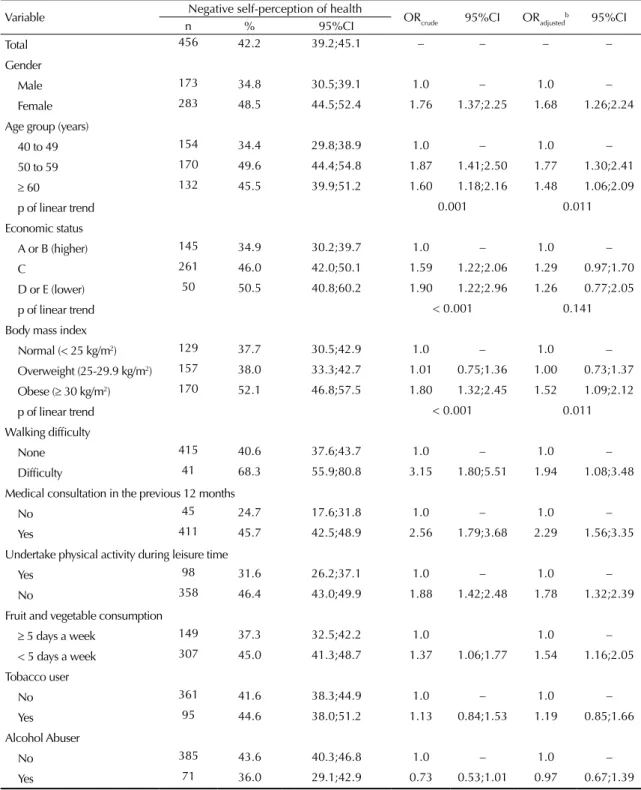
The prevalence of negative self-perception of health was 42.2%. Participants who had a higher chance of negative self-perception (both in the crude and adjusted analysis) were obese women, those over 49 years of age, those who had some kind of dificulty walking, those who had been given a medical consultation in the previous 12 months, those who did not do any physical activity during their leisure time and those whose consumption of fruits and vegetables was low or moderate. The economic status, which did present an association during crude analysis, lost such signif -icance following the adjustment. Tobacco use and alcohol abuse showed no association to self-perception of health (Table 1).
Physical inactivity during leisure time was the most common behavior (71.3%), followed by low or moderate fruit and vegetable consumption (63.1%), tobacco use (19.7%) and alcohol abuse (18.2%). Physical inactivity during leisure time was associated with all SC indicators, the exception being the borrowed money variable. Low or moderate fruit and vegetable consumption was associated with community partici -pation. Tobacco use was associated to the number of friends and the frequency with which people in the neighborhood helped each other. Alcohol abuse was associated with the frequency with which people in the neighborhood helped each other (data not presented). In all the aforementioned associations, the chance of any behavior considered being negative was higher among participants with a lower SC indicator.
During the crude analysis, all the SC indicators were asso -ciated with self-perception of health, except for the trust in the people from the neighborhood variable. Groups with the worst indicators had a higher chance of nega-tively perceiving their health (Table 2, crude analysis). When the demographic and clinical variables were included in the model (model 1), the extent of the asso -ciation between SC and self-perception of health was reduced, however, it was still statistically signiicant, with the exception of the borrowed money variable. The number of friends and community participa -tion variables were signiicantly associated with the self-perception of health across all models. In the model that included alcohol abuse (model 5), the frequency of help given and neighborhood safety remained asso -ciated with self-perception of health.
When the adjustment was simultaneously performed to all behavioral variables (model 6), the strength of the association declined, losing its statistical signiicance in all cases except in the number of friends variable. However, in all variables, except for trust in people of the neighborhood, the observed OR values were greater than 1.0, and in some cases, with a limit lower than the conidence interval, very close to 1.0.
During the mediation analysis, doing physical activity during leisure time was observed to be a signiicant mediator in the relationship between SC indicators (except borrowed money) and self-perception of health. Fruit and vegetable consumption was a signiicant mediator in the relationship between community partic -ipation and self-perception of health. Tobacco use and alcohol abuse did not mediate the relationship between any SC indicator or self-perception of health (Table 3).
DISCUSSION
behaviors, doing physical activity during leisure time was an important factor in mediating the relationship between SC and self-perception of health. Fruit and vegetable consumption was a signiicant mediator in only one of the investigated SC indicators (community participation), while tobacco use and alcohol abuse did not seem to exert
any mediating effect on the relationship between SC and self-perception of health. The results from the study gener -ally showed that only part of the relationship between SC and self-perception of health was due to lifestyle, and yet, not all the behaviors investigated, or physical activity, appear to have the clearest role in this mediation. Table 1. Relationship between negative self-perception of healtha and demographic, clinical and behavioral indicators. Cambé, PR, Southern Brazil, 2011. (N = 1,081)
Variable nNegative self-perception of health% 95%CI ORcrude 95%CI ORadjustedb 95%CI
Total 456 42.2 39.2;45.1 – – – –
Gender
Male 173 34.8 30.5;39.1 1.0 – 1.0 –
Female 283 48.5 44.5;52.4 1.76 1.37;2.25 1.68 1.26;2.24 Age group (years)
40 to 49 154 34.4 29.8;38.9 1.0 – 1.0 – 50 to 59 170 49.6 44.4;54.8 1.87 1.41;2.50 1.77 1.30;2.41
≥ 60 132 45.5 39.9;51.2 1.60 1.18;2.16 1.48 1.06;2.09
p of linear trend 0.001 0.011
Economic status
A or B (higher) 145 34.9 30.2;39.7 1.0 – 1.0 – C 261 46.0 42.0;50.1 1.59 1.22;2.06 1.29 0.97;1.70 D or E (lower) 50 50.5 40.8;60.2 1.90 1.22;2.96 1.26 0.77;2.05
p of linear trend < 0.001 0.141
Body mass index
Normal (< 25 kg/m2) 129 37.7 30.5;42.9 1.0 – 1.0 – Overweight (25-29.9 kg/m2) 157 38.0 33.3;42.7 1.01 0.75;1.36 1.00 0.73;1.37 Obese (≥ 30 kg/m2) 170 52.1 46.8;57.5 1.80 1.32;2.45 1.52 1.09;2.12
p of linear trend < 0.001 0.011
Walking difficulty
None 415 40.6 37.6;43.7 1.0 – 1.0 –
Difficulty 41 68.3 55.9;80.8 3.15 1.80;5.51 1.94 1.08;3.48 Medical consultation in the previous 12 months
No 45 24.7 17.6;31.8 1.0 – 1.0 –
Yes 411 45.7 42.5;48.9 2.56 1.79;3.68 2.29 1.56;3.35 Undertake physical activity during leisure time
Yes 98 31.6 26.2;37.1 1.0 – 1.0 –
No 358 46.4 43.0;49.9 1.88 1.42;2.48 1.78 1.32;2.39 Fruit and vegetable consumption
≥ 5 days a week 149 37.3 32.5;42.2 1.0 1.0 – < 5 days a week 307 45.0 41.3;48.7 1.37 1.06;1.77 1.54 1.16;2.05 Tobacco user
No 361 41.6 38.3;44.9 1.0 – 1.0 –
Yes 95 44.6 38.0;51.2 1.13 0.84;1.53 1.19 0.85;1.66 Alcohol Abuser
No 385 43.6 40.3;46.8 1.0 – 1.0 –
Yes 71 36.0 29.1;42.9 0.73 0.53;1.01 0.97 0.67;1.39 a Negative self-perception of health grouped into categories: fine, bad and very bad.
Social capital and self-per
ception of health
Loc
h MR et al
Variable n Crude Model 1 Model 2 Model 3 Model 4 Model 5 Model 6
OR (95%CI) OR (95%CI) OR (95%CI) OR (95%CI) OR (95%CI) OR (95%CI) OR (95%CI) Number of friends
≥ 4 534 1.0 1.0 1.00 1.0 1.0 1.0 1.0
0 to 3 574 1.54 (1.21;1.96) 1.39 (1.08;1.80) 1.34 (1.03;1.74) 1.35 (1.05;1.75) 1.38 (1.06;1.78) 1.39 (1.07;1.80) 1.31 (1.01;1.70)
Borrowed moneya
≥ 1 784 1.0 1.0 1.0 1.0 1.0 1.0 1.0
None 297 1.32 (1.01;1.73) 1.17 (0.88;1.56) 1.13 (0.85;1.51) 1.14 (0.86;1.52) 1.16 (0.87;1.54) 1.17 (0.88;1.56) 1.10 (0.83;1.47)
Trust in people
Positive 455 1.0 1.0 1.0 1.0 1.0 1.0 1.0
Negative 626 1.11 (0.87;1.42) 1.04 (0.81;1.35) 1.00 (0.77;1.29) 1.01 (0.78;1.32) 1.04 (0.80;1.34) 1.04 (0.81;1.35) 0.97 (0.75;1.26)
Frequency of help given
Always/Almost
always 492 1.0 1.0 1.0 1.0 1.0 1.0 1.0
Sometimes/Rarely/ Never
589 1.29 (1.01;1.64) 1.30 (1.01;1.68) 1.24 (0.96;1.60) 1.28 (0.99;1.65) 1.28 (0.99;1.65) 1.30 (1.01;1.68) 1.21 (0.94;1.57)
Security in the neighborhood
Safe 740 1.0 1.0 1.0 1.0 1.0 1.0 1.0
Violent/Medium 341 1.53 (1.18;1.97) 1.33 (1.01;1.74) 1.27 (0.97;1.68) 1.30 (0.99;1.71) 1.32 (1.00;1.73) 1.33 (1.01;1.74) 1.25 (0.94;1.65)
Community participation
Participated 521 1.0 1.0 1.0 1.0 1.0 1.0 1.0
Did not participate 560 1.42 (1.11;1.80) 1.39 (1.07;1.80) 1.31 (1.01;1.70) 1.34 (1.03;1.74) 1.38 (1.06;1.79) 1.39 (1.07;1.80) 1.26 (0.97;1.65)
a Variable expressed in number of people who would lend money, if needed.
b Adjusted for demographic and clinical variables (sex, age group, economic status, body mass index, walking difficulty and medical consultation in the previous 12 months). c Adjusted for demographic and clinical variables + physical inactivity during leisure time.
d Adjusted for demographic and clinical variables + low/moderate fruits and vegetable consumption. e Adjusted for demographic and clinical variables + tobacco use.
f Adjusted for demographic and clinical variables + alcohol abuse.
The prevalence of negative self-perception of health was relatively high when compared to other studies.2,7,21
However, part of this difference can be explained by the fact that all the individuals included in this study were subjects aged 40 years or more. The other studies also included younger subjects.
As regards the association between worse self-perception of health and demographic, clinical and behavioral vari -ables, part of the results is consistent with other inves -tigations. This is the case of the greater prevalence of negative self-perception of health among women, less-educated individuals or those with some kind of chronic disease.2,7,21 However, during the previous investigations, it was observed that the higher the age, the greater the prevalence of negative self-perception of health. In this study, subjects aged 60 years or over
perceived their health more positively when compared to middle aged individuals (50 to 59 years).
With respect to economic status, a result distinct to those found by Reichert et al21 and Fonseca et al7
was observed, because the participants with higher economic status had a more positive self-perception of health in these investigations. The behavioral vari-ables results in this study are similar to those found by Fonseca et al7 (relationship with physical activity
during leisure time, but not with tobacco use or alcohol abuse). The aforementioned studies do not include any information regarding eating behavior.
When the mediator effect was tested for each behavior in the relationship between SC indicators and self-perception of health, smoking and alcohol abuse Table 3. Analysis of the mediating role of health-related behaviors in the relationship between the social capital indicators and self-perception of health.*
Mediator effect Beta a × Beta b Sobel Test (Z) p Physical activity during leisure time
Number of friends 0.212 2.07 0.04
Financial help 0.192 1.71 0.085
Trust in people 0.223 2.16 0.030
Frequency of help given 0.298 2.65 0.008 Security in the neighborhood 0.242 2.11 0.034 Community participation 0.352 2.86 0.004 Fruit and vegetable consumption
Number of friends 0.143 1.80 0.072
Financial help 0.148 1.69 0.089
Trust in people 0.121 1.58 0.113
Frequency of help given 0.089 1.24 0.214 Security in the neighborhood 0.125 1.52 0.127 Community participation 0.214 2.33 0.019 Tobacco user
Number of friends 0.090 1.29 0.197
Financial help 0.061 1.02 0.306
Trust in people 0.038 0.79 0.431
Frequency of help given 0.138 1.37 0.169 Security in the neighborhood 0.058 1.01 0.310 Community participation 0.065 0.09 0.877 Alcohol Abuser
Number of friends 0.008 0.28 0.781
Financial help 0.001 0.13 0.890
Trust in people 0.003 0.21 0.832
Frequency of help given 0.022 0.25 0.800 Security in the neighborhood 0.006 0.24 0.810 Community participation 0.001 0.15 0.877 * All the analyses were adjusted for the sociodemographic variables.
changed almost nothing regarding the extent of this association. These results concur with those found during research conducted in England19 and the
Netherlands.15 However, fruit and vegetable consump -tion was the only mediator that had a signiicant effect on one of the investigated SC indicators (community participation). During one study conducted in England,19 fruit and vegetable consumption had practi
-cally no effect on the extent of the association between SC and self-perception of health. One investigation performed in the Netherlands found no evidence that the eating indicator used (consuming one hot meal per day and having breakfast at least ive days per week) was a possible mediator for the relationship between SC and self-perception of health.15 As regards physical
activity, a result similar to the Dutch study was found, since it was this behavior that had the greatest effect.
Few studies have focused on the mediation of health-related behaviors in the relationship between SC and self-perception of health, with this study having possibly been the irst study performed in Latin America to focus on this aspect. In addition, using primary data with a representative sample of a population from a medium-sized city was an important aspect of this study, as were the low percentage of drop-outs and the inclusion of all census sectors from the urban area of the investigated city.
However, this cross-section did not make it possible to establish causal relationships between SC and self-perception of health. No validated instruments were found for measuring SC in epidemiological studies. Given that SC involves many aspects and indica -tors, this fact is partially justiied by the choice in this study to use indicators whose data are easier to obtain and that are commonly used during research on this subject. Similarly, direct measurements were not used to assess behavior in this study. In addition, no single way or criteria exists to evaluate each of these behav -iors, as is the case, e.g., with physical activity. Some authors choose to evaluate physical activity in different domains and contexts. However, doing exercise during
leisure time (an indicator used in this study) seems to explain the major variations in the population’s levels of physical activity, which can be more easily modiied by intervention programs, while activities performed in other contexts, such as work and domestic activities, are more dificult to be modiied and rely less on the subjects’ choices and preferences.6
The aim of future studies should be to conirm or disprove the hypothesis that physical activity is an important mediator of the relationship between SC and self-perception of health. It is also important to explore other behavioral indicators, such as sleep. In addition, longitudinal observations, community inter -vention studies and work with qualitative methodolo -gies or with objective behavioral measurements can improve understanding of the relationship between SC and self-perception of health, as well as the under -standing of how social and health policies inluence and are inluenced by SC.
In Brazil, SC can be an important aspect to be consid -ered regarding public health policies, namely because it is in line with the principles of the Brazilian Uniied Health System (SUS), speciically referring to social control.3 Therefore, the SUS can exercise a developing role regarding structural and cognitive SC and, at the same time that it is helping build a sense of community and political participation, it can also improve the system’s eficiency. The conclusion of this study is that lifestyle seems to partially explain the relationship between SC and self-perception of health in the investigated population, and that part of this association may be a result of a direct effect from SC or even of factors that were not investigated. Nevertheless, more studies are required if this informa -tion is to be conirmed. However, the available evidence reinforces the hypothesis that lower levels of SC are nega -tively and independently associated with self-perception of health. This aspect reinforces the idea that the SC should also be considered when deining and implementing health promotion policies, which aim to encourage community participation and conidence in people and institutions.
1. Ball K, Jeffery RW, Abbott G, McNaughton SA, Crawford D. Is healthy behavior contagious:
associations of social norms with physical activity and healthy eating. Int J Behav Nutr Phys Act. 2010;7:86. DOI:10.1186/1479-5868-7-86
2. Barros MB, Zanchetta LM, Moura EC, Malta DC. Auto-avaliação da saúde e fatores associados, Brasil, 2006. Rev Saude Publica. 2009;43 Suppl 2:27-37. DOI:S0034-89102009000900005
3. Bastos FA, Santos E, Ferreira M. Capital Social e Sistema Único de Saúde (SUS)
no Brasil. Saude Soc. 2009;18(2):177-88. DOI:10.1590/S0104-12902009000200002 4. DeSalvo KB, Fisher WP, Tran K, Bloser N,
Merrill W, Peabody J. Assessing measurement properties of two single-item general health measures. Qual Life Res. 2006;15(2):191-201. DOI:10.1007/s11136-005-0887-2
5. Dumith SC, Gigante DP, Domingues MR. Stages of change for physical activity in adults from Southern Brazil: a population-based survey. Int J Behav Nutr Phys Act. 2007;4:25. DOI:1479-5868-4-25
6. Dumith SC. Physical activity in Brazil: a systematic review. Cad Saude Publica. 2009;25 Suppl 3:415-26. DOI:S0102-311X2009001500007
7. Fonseca SA, Blank VL, Barros MV, Nahas MV. Percepção de saúde e fatores associados em industriários de Santa Catarina, Brasil. Cad Saude Publica. 2008;24(3):567-76. DOI:S0102-311X2008000300010
8. Hurtado D, Kawachi I, Sudarsky J. Social capital and self-rated health in Colombia: the good, the bad and the ugly. Soc Sci Med. 2011;72(4):584-90. DOI:S0277-9536(10)00817-8
9. Idler EL, Benyamini Y. Self-rated health and mortality: a review of twenty-seven community studies. J Health Soc Behav. 1997;38(1):21-37. DOI:10.2307/2955359
10. Kawachi I, Berkman L. Social Cohesion, Social capital and health. In: Berkman L, Kawachi I, editors. Social Epidemiology. Oxford: Oxford University Press; 2000. 11. Kim D, Subramanian SV, Kawachi I. Social capital and
physical health: a systematic review of literature. In: Kawachi I, Subramania SV, Kim D, editors. Social capital and health. New York: Springer; 2008. p. 139-90. 12. Legh-Jones H, Moore S. Network social capital, social
participation, and physical inactivity in an urban adult population. Soc Sci Med. 2012;74(9):1362-7. DOI:10.1016/j.socscimed.2012.01.005
13. Lima-Costa MF, Firmo JO, Uchoa E. A estrutura da auto-avaliação da saúde entre idosos: projeto Bambuí. Rev Saude Publica. 2004;38(6):827-34. DOI:S0034-89102004000600011
14. Lindstrom M. Social capital and health related behaviors. In: Kawachi I, Subramania SV, Kim D, editors. Social capital and health. New York: Springer; 2008. p. 215-38. 15. Mohnen SM, Volker B, Flap H, Groenewegen PP.
Health-related behavior as a mechanism behind the relationship between neighborhood social capital and individual health – a multilevel analysis. BMC Public Health. 2012;12:116. DOI:10.1186/1471-2458-12-116
16. Murayama H, Fujiwara Y, Kawachi I. Social capital and health: a review of prospective multilevel studies. J Epidemiol. 2012;22(3):179-87. DOI:JST.JSTAGE/jea/JE20110128
17. Pagotto V, Bachion MM, Silveira EA. Autoavaliação da saúde por idosos brasileiros: revisão
sistemática da literatura. Rev Panam Salud Publica. 2013;33(4):302-10. DOI:S1020-49892013000400010 18. Pattussi MP, Moyses SJ, Junges JR, Sheiham A. Capital
social e a agenda da epidemiologia. Cad Saude Publica. 2006;22(8):1525-46. DOI:S0102-311X2006000800002 19. Poortinga W. Do health behaviors mediate the
association between social capital and health? Prev Med. 2006;43(6):488-93.DOI:S0091-7435(06)00262-3
20. Putnam R. Comunidade e democracia: a experiência da Itália moderna. Rio de Janeiro: Editora FGV; 1998.
21. Reichert FF, Loch MR, Capilheira MF. Autopercepção de saúde em adolescentes, adultos e idosos. Cienc Saude Coletiva. 2012;17(12):3353-62. DOI:S1413-81232012001200020
22. Sapag JC, Poblete FC, Eicher C, Aracena M, Caneo C, Vera G, et al. Tobacco smoking in urban neighborhoods: exploring social capital as a protective factor in Santiago, Chile. Nicotine Tob Res. 2010;12(9):927-36. DOI:10.1093/ntr/ntq117 23. Souza RKT, Bortoletto MSS, Loch MR, González
AD, Matsuo T, Cabrera MAS, et al. Prevalência de fatores de risco cardiovascular em pessoas com 40 anos ou mais de idade, em Cambé, Paraná (2011): estudo de base populacional. Epidemiol Serv Saude. 2013;22(3):435-44. DOI:10.5123/S1679-49742013000300008 24. Szwarcwald CL, Souza Jr PR, Esteves MA, Damacena
GN, Viacava F. Socio-demographic determinants of self-rated health in Brazil. Cad Saude Publica. 2005;21 Suppl:54-64. DOI:S0102-311X2005000700007 25. Ueshima K, Fujiwara T, Takao S, Suzuki E, Iwase T,
Doi H, et al. Does social capital promote physical activity? A population-based study in Japan. PLoS One. 2010;5(8):e12135.DOI:10.1371/journal.pone.0012135
26. Uphoff EP, Pickett KE, Cabieses B, Small N, Wright J. A systematic review of the relationships between social capital and socioeconomic inequalities in health: a contribution to understanding the psychosocial pathway of health inequalities. Int J Equity Health. 2013;12:54. DOI:10.1186/1475-9276-12-54
This research was supported by the Brazilian Coordenação de Aperfeiçoamento de Pessoal de Nível Superior (CAPES – Process 7242-12-3 – Scholarship from the Institutional Program of Overseas Sandwich Doctorate).
Based on the doctoral thesis by Mathias Roberto Loch, titled: “Associação entre capital social e comportamentos relacionados à saúde: estudo de base populacional”, presented at the Postgraduate Program in Collective Health at the Universidade Estadual de Londrina, Brazil, in 2013.