Analysis of prevention and treatment of
the pressure ulcers proposed by nurses
1 Nurse at the Pediatric Clinic at Waldemar de Alcântara General Hospital. Master in Clinical Health Care and Nursing. Fortaleza, CE, Brazil. [email protected] 2 Nurse. PhD in Nursing. Professor of the Nursing Undergraduate course. Professor of the Academic Masters course in Clinical Health Care and Nursing at State University of Ceará. Fortaleza, CE, Brazil. [email protected] 3 Nurse. PhD in Nursing. Professor of the Nursing Undergraduate course. Professor of
C
RITICAL
R
EVIEW
ANÁLISE DA PREVENÇÃO E TRATAMENTO DAS ÚLCERAS POR PRESSÃO PRO-POSTOS POR ENFERMEIROS
ANÁLISIS DE LA PREVENCIÓN Y DEL TRATAMIENTO DE LAS ÚLCERAS POR PRESIÓN PROPUESTO POR ENFERMEROS
RESUMO
A úlcera por pressão ainda é considerada um problema grave, especialmente em pes-soas idosas e nas situações de adoecimen-to crônico-degenerativo. O objetivo do es-tudo consistiu em identificar as produções bibliográficas sobre ações de prevenção e tratamento realizadas por enfermeiros publicadas no período de 1999 a 2004, des-crevendo o conhecimento produzido na temática. Trata-se de levantamento biblio-gráfico descritivo de periódicos de enferma-gem indexados na LILACS e MEDLINE, acer-ca da temátiacer-ca no período de 1999 a 2004. A coleta de dados ocorreu entre os meses de maio a junho de 2005. Procedeu-se o exa-me do material que compreendeu leitura exaustiva, o que proporcionou a identifica-ção de três aspectos estudados: prevenidentifica-ção das úlceras por pressão, tratamento das úl-ceras por pressão e cuidados de enferma-gem às úlceras por pressão. Concluiu-se ain-da a necessiain-dade de pesquisas envolvendo a atuação do enfermeiro na avaliação clíni-ca do cliente e no desenvolvimento de pro-gramas de prevenção sistematizados.
DESCRITORES
Úlcera de pressão/prevenção & controle. Ùlcera de pressão/terapia.
Cuidados de enfermagem.
Adriana Bessa Fernandes Medeiros1, Consuelo Helena Aires de Freitas Lopes2,
Maria Salete Bessa Jorge3
ABSTRACT
Pressure ulcers are still considered a seri-ous problem, especially in elderly people and in situations of chronic-degenerative diseases. The purpose of this study was to identify the literature production about actions of prevention and treatment per-formed by nurses published from 1999 to 2004, describing the knowledge produced about the theme. This is a descriptive lit-erature review of nursing journals indexed in LILACS and MEDLINE about the theme from 1999 to 2004. Data collection occurred from May to June, 2005. Afterwards, the material was read exhaustively, which yield-ed three aspects to be studiyield-ed: prevention of pressure ulcers, treatment of pressure ulcers and nursing care of pressure ulcers. It was also concluded that there is need for research involving the work of the nurses in the clinical evaluation of the client and the development of systematized preven-tion programs.
KEY WORDS
Pressure ulcer/prevention & control. Pressure ulcer/therapy.
Nursing care.
RESUMEN
La úlcera por presión, es todavía conside-rado un problema grave, especialmente en personas ancianas y en las situaciones de enfermedades crónicas degenerativas. El objetivo del estudio consistió en identifi-car las producciones bibliográficas sobre las acciones de prevención y tratamiento rea-lizadas por enfermeros y publicadas en el período de 1999 a 2004, describiendo el co-nocimiento producido sobre el tema. Se trata de levantamiento bibliográfico des-criptivo de periódicos de enfermería indexados en el LILACS y MEDLINE, acerca de la temática, en el período de 1999 a 2004. La recolección de datos se realizó entre los meses de mayo a junio de 2005. Se procedió a examinar el material con una lectura exhaustiva, lo que proporcionó la identificación de tres aspectos estudiados: prevención de las úlceras por presión, tra-tamiento de las úlceras por presión y cui-dados de enfermería de las úlceras por pre-sión. Se concluyó que todavía existe la ne-cesidad de realizar investigaciones sobre la actuación del enfermero en la evaluación clínica del cliente y en el desarrollo de pro-gramas de prevención sistematizados.
DESCRIPTORES
Úlcera por presión/prevención & control. Úlcera por presión/terapia.
INTRODUCTION
Pressure ulcer is still considered a severe problem, es-pecially for the elderly and clients with chronic-degenera-tive illnesses, making it imperachronic-degenera-tive to investigate how nurses deliver care to that kind of lesion through an analysis of scientific articles published on this subject.
It is defined as any lesion caused by unrelieved pres-sure, shearing or friction that may result in tissue death, being frequently found on bone prominence sites(1), which
in addition to causing tissular damage, may cause a num-ber of complications and worsen the clinical status of per-sons with restricted body movements. Although it is a sub-ject that receives a lot of attention in the scope of nursing care, studies show that global incidence and prevalence remain high, a fact that proves the need for new research, looking to improve prevention and therapeutical measures. This study’s relevance is in searching literature for knowl-edge, new technologies and experience with the subject, enabling updated and substantiated information regard-ing the prevention and treatment of pressure ulcers.
Of notice is the need to verify if the avail-able scientific knowledge about pressure ul-cers is being correctly applied during the nurse’s daily practice and, consequently, as-sociating the research result during the care given to the client with risk or presence of lesion. The importance of conducting new studies about prevalence, incidence, preven-tion and treatment of pressure ulcers is ob-served, aiming to guide nurses’ actions and practices.
OBJECTIVE
The study’s objective is to identify bibliographical pro-ductions about prevention and treatment actions taken by nurses, published in the period from 1999 until 2004, de-scribing the knowledge generated on this subject.
METHOD
Descriptive bibliographical research of nursing publica-tions indexed in LILACS (Latin-American and Caribbean health literature) and MEDLINE (Health Sciences interna-tional literature), on the subject during the period from 1999 until 2004. The descriptive study gathered informa-tion that permitted an investigainforma-tion of condiinforma-tions and ac-tions of the study’s subject in order to better plan and con-duct health practices(2).
The search for material happened in Escola de Saúde Pública’s and Associação Brasileira de Enfermagem’s librar-ies, in the city of Fortaleza, Ceará, as well as through BIREME (specialized center of Pan-American Health Organization),
and the internet. The considered publications addressed the pressure ulcer theme using descriptors (uniterms) such as pressure ulcer, decubitus ulcer and nursing care. The data collection was carried out between May and June, 2005.
Initially, the descriptors were studied individually, re-sulting in 3658 works, of which 166 in LILACS and 1471 in BIREME, with a total of 1637 articles. A large quantity of articles was noted. The decision was made to search the texts by combining the descriptors, which produced 111 articles. Concerning this delimitation, the inclusion criteria consisted in choosing studies focusing on aspects related to prevention, prevalence and treatment of pressure ulcers or decubitus ulcer, in the period from 1999 until 2004. Thus, the final sample included 30 articles.
Data analysis was based on literature about prevention, prevalence and treatment of pressure ulcers carried out by nurses, themes addressed in the analyzed articles.
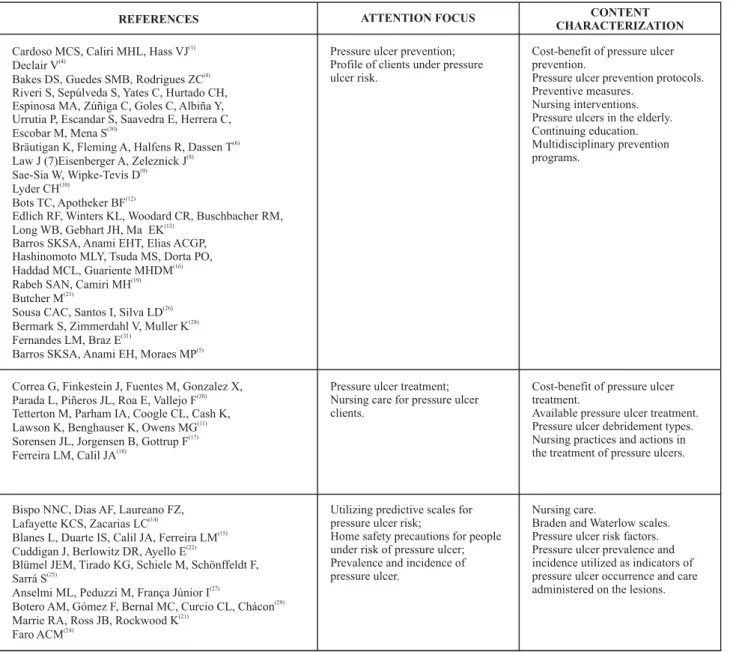
For a better understanding, Table 1 presents the ad-dressed articles according to study reference, attention fo-cus and content characterization.
The material was examined through exhaustive read-ing, which revealed the identification of three studied aspects: prevention of pressure ulcers, treatment of pressure ulcers and nursing care for pressure ulcers.
RESULTS AND DISCUSSION
The content pertaining to the prevention of pressure ulcers were focused on the more popular preventive measures among nurses and knowledge related to the use of prevention programs, especially nursing interventions. Also, the cost-benefit cor-relation and how the professionals dealt with their clients.
As for the subjects related to pressure ulcer treatment,
contents were found dealing with the various kinds of exist-ing pressure ulcer treatments, financial costs accordexist-ing to treatments by kinds of lesion, products and bandages used. Relating to nursing care for pressure ulcers, there was a discussion about the importance of predictive scales for pressure ulcer prevention, the risk factors directly influenc-ing their occurrence, as well as how nurses have been act-ing in relation to the causal factors. Also, the use of preva-lence and incidence rates to improve care according to the reality of each health unit and clients receiving home care.
PRESSURE ULCER PREVENTION
The nurse plays a determinant role in the prevention and treatment of pressure ulcers. The prevention routines include, according to some of the authors(3-5):
•
Evaluation of the risk degree with individualization of care and production of a pressure ulcer prevention protocol;The global incidence and prevalence of the
pressure ulcers remain high, a fact that proves the need
•
Use of risk degree evaluation scales, such as the Braden scale adapted to the Portuguese language and others, such as the Norton and Waterlow scales;•
Demonstrative chart emphasizing the areas suscep-tible to pressure ulcers;•
Providing a polyurethane mattress (e.g. box mattress) for the patient, especially patients in wheelchairs or bed-ridden;•
Identifying the risk factors and directing the preven-tive treatment, modifying the care according to individual factors;•
Mobilizing or position change every two hours, as well as administering a comfort massage with emulsions;•
Protection of bony projections, especially the heels, with rolls and pillows;Table 1- Chart of contents found in the nursing articles – Fortaleza – 1999 to 2004
REFERENCES ATTENTION FOCUS CONTENT
CHARACTERIZATION
Cardoso MCS, Caliri MHL, Hass VJ(1)
Declair V
Bakes DS, Guedes SMB, Rodrigues ZC Riveri S, Sepúlveda S, Yates C, Hurtado CH, Espinosa MA, Zúñiga C, Goles C, Albiña Y, Urrutia P, Escandar S, Saavedra E, Herrera C, Escobar M, Mena S
Bräutigan K, Fleming A, Halfens R, Dassen T Law J (7)Eisenberger A, Zeleznick J Sae-Sia W, Wipke-Tevis D Lyder CH
Bots TC, Apotheker BF
Edlich RF, Winters KL, Woodard CR, Buschbacher RM, Long WB, Gebhart JH, Ma EK
Barros SKSA, Anami EHT, Elias ACGP, Hashinomoto MLY, Tsuda MS, Dorta PO, Haddad MCL, Guariente MHDM Rabeh SAN, Camiri MH Butcher M
Sousa CAC, Santos I, Silva LD Bermark S, Zimmerdahl V, Muller K Fernandes LM, Braz E
Barros SKSA, Anami EH, Moraes MP
(4)
(4)
(30)
(6)
(8)
(9)
(10)
(12)
(13)
(16)
(19)
(23)
(26)
(28)
(31)
(5)
Pressure ulcer prevention; Profile of clients under pressure ulcer risk.
Cost-benefit of pressure ulcer prevention.
Pressure ulcer prevention protocols. Preventive measures.
Nursing interventions. Pressure ulcers in the elderly. Continuing education. Multidisciplinary prevention programs.
Correa G, Finkestein J, Fuentes M, Gonzalez X, Parada L, Piñeros JL, Roa E, Vallejo F Tetterton M, Parham IA, Coogle CL, Cash K, Lawson K, Benghauser K, Owens MG Sorensen JL, Jorgensen B, Gottrup F Ferreira LM, Calil JA
(20)
(11)
(17)
(18)
Pressure ulcer treatment; Nursing care for pressure ulcer clients.
Cost-benefit of pressure ulcer treatment.
Available pressure ulcer treatment. Pressure ulcer debridement types. Nursing practices and actions in the treatment of pressure ulcers.
Bispo NNC, Dias AF, Laureano FZ, Lafayette KCS, Zacarias LC
Blanes L, Duarte IS, Calil JA, Ferreira LM Cuddigan J, Berlowitz DR, Ayello E
Blümel JEM, Tirado KG, Schiele M, Schönffeldt F, Sarrá S
Anselmi ML, Peduzzi M, França Júnior I
Botero AM, Gómez F, Bernal MC, Curcio CL, Chácon Marrie RA, Ross JB, Rockwood K
Faro ACM
(14)
(15)
(22)
(25)
(27)
(29)
(21)
(24)
Utilizing predictive scales for pressure ulcer risk;
Home safety precautions for people under risk of pressure ulcer; Prevalence and incidence of pressure ulcer.
Nursing care.
Braden and Waterlow scales. Pressure ulcer risk factors. Pressure ulcer prevalence and incidence utilized as indicators of pressure ulcer occurrence and care administered on the lesions.
•
Registering patient’s skin changes, following the pres-sure ulcer classification stages proposed by the NPUAP (Na-tional Pressure Ulcer Advisory Panel) in 1989;•
Early skin treatment: to preserve and improve tissue pressure tolerance, aiming to prevent lesion;•
Checking vulnerable skin areas of all risk patients and optimizing that skin’s state through moisturizing with essen-tial fatty acid-based creams, treating incontinence, avoiding the use of excessively hot water, providing nutritional support;•
Monitoring and documenting interventions and achieved results;Preventive recommendations adopted by some nurses in their daily practice to detect pressure ulcers early and avoid their manifestation were observed. Prevention-related nurs-ing interventions should address aspects like: skin integrity care, use of moisturizing emollient, use of equipment for urinary incontinence and vesical reeducation, bed placement, daily observation of the penis’s skin when using urinary in-continence equipment, hygienic care, vitamin and protein rich nutrition at the first signs of pressure ulcer, according to the age and clinical condition of each client.
Nursing interventions should be enforced, such as bed immobilization, multiprofessional team interacting for edu-cational activity planning, pain management, raising the bed’s upper part to 30°, creation of rehabilitation programs for clients with medullar lesion, conduction of nursing re-search on risk factors, prevention and new therapies for pressure ulcers, knowledge of the prevalence of pressure ulcers in general hospitals and use of new technologies for prevention and treatment(6-13).
Advanced age causes intense changes in the human organism, making it more prone to illnesses and lesions that can become infected and produce sequels and long hospi-tal stays. The analyzed authors highlighted the importance of treating pressure ulcers as a serious hospital complica-tion. For that reason, the multiprofessional team should be engaged in the arrangement and implementation of pressure ulcer prevention programs and protocols, espe-cially in clients more exposed to risk(14) .
The epidemiological profile consisted of individual and demographical characteristics that will lead that person to develop the lesion. Most people affected by pressure ul-cers are elderly, with chronic-degenerative diseases, such as arterial hypertension and diabetes mellitus, presence of urinary incontinence and the use of antibiotics(15).
Other studies emphasize the application of a pressure ulcer prevention protocol as another alternative to fight the appearance of lesions in patients, especially under in-tensive care. The protocol should have information relat-ing to the client’s identification, the Braden scale, demon-strative chart of the areas in danger of ulcers, record of skin change, following the stages of pressure ulcers and a prevention guide(16).
PRESSURE ULCER TREATMENT
Pressure ulcer treatment should be deployed when the preventive measures are insufficient. The articles presented the treatment types: The systemic level, aiming to improve nutritional state and reduction of infection; the conserva-tive, carried out in the beginning of the lesions’ emergence; and the local treatment, which included surgical cleaning, bandages and coverings.
Surgical treatment is considered when the lesions are in an advanced state, with serious complication risks for
the client. According to a study carried out in the United States in 2004, only a small part of the patients are candi-dates for surgery. The most common types are skin graft-ing, debridement and plastic reconstruction, procedures that need post-surgery support and infection control(17).
Other works advocate treatment through debridement, cleaning of the lesion, use of solutions, ointments, indus-trialized bandages and assisting therapies. What we should keep in mind is that the prevention and treatment of pres-sure ulcers deserve individual care, based on scientific knowledge, evidences, studies and new approaches based on teamwork and intensive monitoring(18-19).
The cost-benefit relation of pressure ulcer treatment is also addressed and is a very important theme for the nurse, who develops therapeutical actions with the pressure ul-cer client and should have thorough knowledge of treat-ment costs.
A prevention program conducted in a hospital in Chile showed that adopting prevention has a lower cost than treating the already present disease. In 1995, according to the study, the costs added up to US$240.000. After the start of the program, in 1997-1998, there was a reduction in costs to US$11.000, with a cost-benefit relation of 1/21(20).
With the setting up of a prevention program (based on home visits and periodic exams) in a hospital in Chile in 1997-1998, it was possible to intensely reduce hospitaliza-tion time and surgery numbers for that cause, contributing to a reversal of pressure ulcer frequency. Due to the fact that the preventive measures comprised simple actions, which demanded low costs, such as prediction scales, the preventive program’s success is effective and helps to con-trol the lesions(20).
Nursing care for pressure ulcers
Studies related to prevalence and incidence made it possible to describe the epidemiological, demographical and functional characteristics of the client groups partici-pating in the studies, and also demonstrated the real di-mension of the problem when thinking about developing therapeutical strategies aiming to identify the presence of pressure ulcers and providing tools to prevent them(1,21-22).
Of the highlighted risk factors, the ones considered of risk were the clients with neurological disease, bone frac-tures, cardiac disease, anemia and vascular disease. Trig-gering factors were urinary incontinence, previous pressure ulcer, advanced age, motor problems, nutritional problems, changes in skin turgor and elasticity and others, such as medication and hygiene(21,23-24).
Studies show that it’s possible and mandatory to use the predictive risk scales as a way to evaluate the client’s risk of developing pressure ulcers. The Braden scale, for example, is a predictive risk assessment scale, using param-eters like humidity, sensory perception, physical activity, mobility, nutrition, friction and shearing in bedridden cli-ents, making it possible to improve the problem-solving ability of prevention actions(25-26).
Apart from using scales to predict pressure ulcer occur-rence, as a way to evaluate patients and to know their needs, research is needed to investigate the incidence and preva-lence of pressure ulcers, aiming to focus the actions by dem-onstrating how the lesion afflicted the patient’s reality.
Incidence and prevalence studies with analysis of the clinical competence of the nurses in charge of care for the wounds, individual patient observation, identifying the risk patients based on predictive scales, make it possible to de-termine the extent of the problem in health units, so as to support the development of prevention strategies(27-29).
It has been more than proved that the nursing care pro-vided to pressure ulcer patients should take into account the political aspects and financial costs of the treatment applied to the lesions, besides the psychological and emo-tional changes, complications caused by the infection and prolonged hospitalization.
Pressure ulcers cause pain and emotional imbalance, in-fection risk, loss of functionality or withdrawal from work. The last item causes financial harm and treatment costs for the patient and the government, respectively. For those rea-sons, it is mandatory to create prevention programs and com-mittees, aiming to lessen the institutional incidence of pres-sure ulcers, as well as prevention and treatmentcosts(30-31).
CONCLUSIONS
When evaluating nursing’s scientific production related to the prevention and treatment of pressure ulcers in the referred period, it was noted that the works revealed the importance of the nurse conducting the prevention measures for pressure ulcers. The articles addressed themes like the treatment’s cost-benefit, types of treatment, preventive mea-sures, nursing interventions, risk predictive scales such as Braden, development of protocols for accompaniment of pa-tients during prevention and treatment. These themes show the nurse’s concern with knowledge acquisition and adher-ence to new technology, improving decision making and the accompaniment of clients under risk of pressure ulcers.
Notable was the need to expand research relating to the prevalence and incidence of pressure ulcers, aiming to map the situations related to the development of ulcers in Brazil, thus making it possible to formalize an alert to the service managers, health authorities and professionals, bringing them together to create a lesion prevention and treatment network.
It was concluded that, in care practice, preventive and therapeutical interventions for pressure ulcers with new technology are still in the acknowledgement phase for nurses, making them non-institutionalized practices, with difficult access to the technologies in health services. This causes low usage by the nurses and risks when using the covers. Wound treatment needs to be socialized through evidence and scientific research, aiming to facilitate effec-tive interventions directed to the patient’s skin care, so that it can be acknowledged as knowledge and health care in the development of policies, aiming for the institutional-ization of wound treatment in health services.
REFERENCES
1. Cardoso MCS, Caliri MHL, Hass VJ. Prevalência de úlceras de pressão em pacientes críticos internados em um hospital uni-versitário. REME Rev Min Enferm. 2004;8(2):316-20.
2. LoBiondo-Wood G, Haber J. Pesquisa em enfermagem: méto-dos, avaliação crítica e utilização. 4ª ed. Rio de Janeiro: Guanabara Koogan; 2001. Desenhos não-experimentais; p. 110-121.
3. Declair V. Escaras de decúbito: prevenção e tratamento. Nursing
(São Paulo).2002;5(53):5-6.
4. Bakes DS, Guedes SMB, Rodrigues ZC. Prevenção de úlceras de pressão: uma maneira barata e eficiente de cuidar. Nursing (São Paulo). 1999;2(9):22-7.
5. Barros SKSA, Anami EH, Moraes MP. A elaboração de um proto-colo para prevenção de úlcera de pressão por enfermeiros em um hospital de ensino. Nursing (São Paulo). 2003;6(63):29-32.
6. Bräutigan K, Fleming A, Halfens R, Dassen T. Prevention of
decubitus ulcer: theory and pratice.Pflege. 2003;16(2):75-82.
7. Law J. Pressure ulcer prevention: education for nursing home staff. Br J Nurs. 2003;12(9):566-9.
8. Eisenberger A, Zeleznick J. Pressure ulcer prevention and treat-ment in hospices: a qualitative analysis. J Palliat Care. 2003;19 (1):9-14.
9. Sae-Sia W, Wipke-Tevis D. Pressure ulcer prevention and treat-ment practices in inpatient rehabilitation facilities. Rehabil Nurs. 2002;27(5):192-8.
10. Lyder CH. Pressure ulcer prevention and management. Annu Rev Nurs Res. 2002;20:35-6.
12. Bots TC, Apotheker BF. The prevention of heel pressure ulcers using a hydropolymer dressing in surgical patients. J Wound Care. 2004;13(9):375-8.
13. Edlich RF, Winters KL, Woodard CR, Buschbacher RM, Long WB, Gebhart JH, et al. Pressure ulcer prevention. J Long Term Eff Med Implants. 2004;14(4):285-304.
14. Bispo NNC, Dias AF, Laureano FZ, Lafayette KCS, Zacarias LC. Incidência de úlceras de pressão em residentes de uma insti-tuição de longa permanência. UNOPAR Cient Ciênc Biol Saú-de. 2002;4(1):45-8.
15. Blanes L, Duarte IS, Calil JA, Ferreira LM. Avaliação clínica e epi-demiológica das úlceras por pressão em pacientes internados no Hospital São Paulo. Rev Assoc Med Bras. 2004;50 (2):133-9.
16. Barros SKSA, Anami EHT, Elias ACGP, Hashimoto MLY, Tsuda MS, Dorta PO, et al. Aplicação de protocolo para prevenção de úlcera de pressão em Unidade de Terapia Intensiva. Semina Ciênc Biol Saúde. 2002;23(1):25-32.
17. Sorensen JL, Jorgensen B, Gottrup F. Surgical treatment of pressure ulcers. Am J Surg. 2004;188(1A Suppl):42-51.
18. Ferreira LM, Calil JA. Etiopatogenia e tratamento das úlceras por pressão. Diagn Tratamento. 2001;6(3):36-40.
19. Rabeh SAN, Camiri MH. Prevenção e tratamento de úlceras de pressão: práticas de graduandos de enfermagem. Rev Paul Enferm. 2002;21(2):133-9.
20. Correa G, Finkestein J, Fuentes M, Gonzalez X, Parada L, Piñeros JL, et al. Manejo de úlceras por presión: mejora calidad de vida de lesionados medulares. Bol Cient Asoc Chil Segur. 1999;1(2):36-9.
21. Marrie RA, Ross JB, Rockwood K. Pressure ulcers: prevalence, staging, and assessment of risk. Geriatr Today J Can Geriatr Soc. 2003;6(3):134-40.
22. Cuddigan J, Berlowitz DR, Ayello E. Pressure ulcers in America: prevalence, incidence and implications for the future. An Executive Summary of the National Pressure Ulcer Advsory Panel Monograph. Adv Skin Wound Care. 2001;4(4):208-15.
23. Butcher M. NICE Clinical Guidelines: pressure ulcer risk assessment and prevention - a review [text on the Internet]. Local: World Wide Wounds; 2001 [citado 2006 mar. 20]. Available from: http://www.worldwidewounds.com/2001/ july/Butcher/NICE-pressure-ulcer-review.html
24. Faro ACM. Fatores de risco para úlcera de pressão: subsídios para a prevenção. Rev Esc Enferm USP. 1999;33(3):279-83.
25. Blümel JEM, Tirado KG, Schiele M, Schönffeldt F, Sarrá S. Validez de la escala de Braden para predecir úlceras por presión em población femenina. Rev Méd Chile. 2004;132(5):595-600.
26. Sousa CAC, Santos I, Silva LD. Apropriação de concepções de Neuman e Braden na prevenção de úlceras de pressão. Rev Enferm UERJ. 2004;12(3):280-5.
27. Anselmi ML, Peduzzi M, França Júnior I. Estudo da incidência da úlcera de pressão, segundo cuidado de enfermagem. Rev Formação. 2003;3(7):59-72.
28. Bermark S, Zimmerdahl V, Muller K. Prevalence investigation of pressure ulcers. EWMA J. 2004;4(1):7-11.
29. Botero AM, Gómez F, Bernal MC, Curcio CL, Chácon A. Preva-lência y características de las úlceras por presión em ancianos al ingreso a uma unidad de cuidado agudo. Acta Med Colomb. 2000;25(6):329-32.
30. Riveri PL, Sepúlveda S, Yates C, Hurtado CH, Espinosa MA, Zúñiga C, et al. Creación de um comitê de prevención y control de úlce-ras por presión. Rev Hosp Clin Univ Chile. 2001;12(3): 168-71.