ACentro Universitário São Camilo - São Paulo/SP, Brazil.
BUniversidade do Vale do Paraíba - São José dos Campos/SP, Brazil. CUniversidade Paulista - São Paulo/SP, Brazil.
Email: [email protected]
Received for publication on September 07, 2006. Accepted for publication on September 25, 2006.
CLINICAL SCIENCES
CHANGES IN JOINT KINEMATICS IN CHILDREN WITH
CEREBRAL PALSY WHILE WALKING WITH AND
WITHOUT A FLOOR REACTION ANKLE–FOOT
ORTHOSIS
Paulo Roberto Garcia LucareliA,C, Mário de Oliveira LimaB, Juliane Gomes de
Almeida LucarelliC, Fernanda Púpio Silva LimaB
Lucareli PRG, Lima M de O, Lucarelli JG de A, Lima FPS. Changes in joint kinematics in children with cerebral palsy while walking with and without a floor reaction ankle–foot orthosis. Clinics. 2007;62(1):63-8.
INTRODUCTION: The floor reaction ankle-foot orthosis is commonly prescribed in the attempt to decrease knee flexion during the stance phase in the cerebral palsy (CP) gait. Reported information about this type of orthosis is insufficient.
PURPOSE: The purpose of this study was to determine the effect of clinically prescribed floor reaction ankle-foot orthosis on kinematic parameters of the hip, knee and ankle in the stance phase of the gait cycle, compared to barefoot walking on children with cerebral palsy.
METHODS: A retrospective chart review of 2200 patients revealed that 71 patients (142 limbs) had a diagnosis of diplegia, with no contractures in hip, knee or ankle flexion. Their average age was 12.2 ± 3.9. All of them were wearing clinically prescribed hinged floor reaction ankle-foot orthosis undergoing a three dimensional gait analysis. We divided the patients in three groups: Group I, with limited extension (maximum knee extension less than 15°); Group II, with moderate limited extension (maximum knee extension between 15° and 30°) and Group III Crouch (maximum knee extension in stance more than 30°).
RESULTS: Results indicate the parameters maximum knee extension and ankle dorsiflexion were significant in Group II e III; no change was observed in Group I. The maximum hip extension was not significant in all three groups. Conclusion: when indicated to improve the extension of the knees and ankle in the stance of the CP patients floor reaction ankle-foot orthosis was effective.
KEYWORDS: Ankle-foot orthosis. Cerebral palsy. Gait. Kinematic.
INTRODUCTION
Spastic cerebral palsy is a common affliction encoun-tered in all societies. Approximately 12,000 will suffer from this disability each year. The majority of children with cer-ebral palsy have the spastic physiologic variety. Approxi-mately 85% of these children will use an orthosis. The most common orthosis used in spastic cerebral palsy is the an-kle foot orthosis (AFO), which is available in many
differ-ent designs. It is important that all professionals involved in the treatment of individuals with cerebral palsy have an understanding of this orthosis. Often in medical practice, theoretically sound treatments are employed, and then at a later date, a more critical scientific evaluation is carried out. This is especially true with the use of AFOs in the treat-ment of the spastic cerebral palsy.
The thermoplastic molded ankle-foot orthosis was first described in 1958 by Yates who used it in the treatment of a flaccid foot drop.1 Subsequently, it was used in children
with cerebral palsy.
California Biomechanics Laboratory)—an in-shoe plastic slipper that controls functional varus and valgus deformities and, to some degree, supple malalignment of the hindfoot and midfoot; 2) a leaf-spring AFO—a 1-piece, short leg brace that is usually made with the ankle in 5º to 10o of
dorsiflex-ion and then ground back at the ankle to allow some flexdorsiflex-ion- flexion-extension mobility; 3) a rigid AFO—basically very similar to the leaf spring orthosis except that the ankle section is modeled in a neutral position and is left rigid. This orthosis is used to manage stance-phase deformities that are too strong to be controlled by a leaf-spring AFO; and 4) a floor-reaction AFO—it is used to control second rocker.2
The first floor reaction AFO, designed by Al Masunis, was made at Newington Children’s Hospital in 1983 as a modification of the Saltiel brace.3 There are currently 3
dif-ferent designs of this orthosis. The first is the 1-piece, rigid ankle design;4 the second is a rigid ankle design with a
re-movable anterior shell; and the third is a rear-entry, hinged design. Its major advantage is that it controls second rocker but does not interfere with first or third rocker, whereas the two earlier designs essentially eliminate ankle motion in stance. The major disadvantage of this brace is that it does not prevent equines in swing.2One of the most common gait
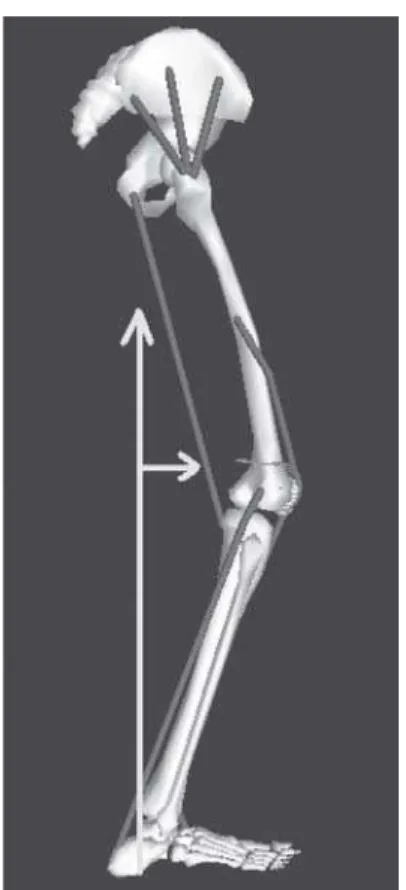
patterns in children with cerebral palsy is the crouch gait. There is increased knee flexion throughout the stance phase, with variable alignment in the swing phase (Figure 1).
This condition is seldom found in children younger than 7 years of age. Primary contractures of the hamstrings, with or without contracture of the hip flexors, are the most com-mon causes of crouch knee gait. This pattern may also be ia-trogenic, such as primary hamstrings contractures seen after injudicious or isolated lengthening of contracted triceps surae. The floor reaction ankle-foot orthosis (FRAFO) is com-monly prescribed in an attempt to decrease knee flexion dur-ing the stance phase in the cerebral palsy gait, but prescrip-tion is often made clinically, not based on gait analysis.
Modern clinical gait analysis traces its origins back to the early 1980s with the opening of the laboratory devel-oped by the United Technologies Corporation at Newington, Connecticut and those provided with equipment by Oxford Dynamics (later to become Oxford Metrics) in Boston, Glasgow, and Dundee. Retro-reflective mark-ers were placed on the skin in relation to bony landmarks. These were illuminated stroboscopically and detected by modified video cameras. If 2 or more cameras detect a marker and the position and orientation of these cameras are known, then it is possible to detect the 3-dimensional position of that marker.
The purpose of this study was to determine the effect that a clinically prescribed floor reaction ankle-foot orthosis has on kinematic parameters of the hip, knee, and ankle in the stance phase of the gait cycle, compared to barefoot walking by children with cerebral palsy.
METHODS
A retrospective chart review of data collected between 1996 and 2004 in our motion analysis laboratory (Six In-fra Red Cameras Vicon 370®, Three AMTI Force Plates and
10 channels Motion Lab System EMG) was performed. A retrospective chart review of 2200 patients revealed 71 pa-tients (142 limbs) with an average age of 12.2 ± 3.9 years. The inclusion criteria were cerebral palsy diagnosis type, spastic diplegia; walking with and without orthosis; hav-ing a clinically prescribed hhav-inged FRAFO; and undergo-ing 3-dimensional gait analysis. The exclusion criteria were contractures of more than 10° in hip and knee flexion and plantar-grade foot and malrotations of the foot or tibia. In accordance with our standard clinical practice, data for both conditions (brace and barefoot walking) were collected on the same day by the same examiner.
We divided the patients into 3 groups as follows: Group I—Limited extension (maximum knee extension less than
15o); Group II—Moderate limited extension (maximum
knee extension between 15o and 30o), and Group III—
Crouch (maximum knee extension stance more than 30o)
(Table 1). Figure 1 - Crouch Gait: increase knee flexion during stance phase and the
The maximum values of hip and knee extension and ankle dorsiflexion were extracted during the stance phase with and without FRAFO for each group.
RESULTS
Statistical analyses (t test) indicated the parameters maximum knee extension and ankle dorsiflexion were sig-nificant in Group II and III, and there was no change in Group I. The maximum hip extension was not significant in all 3 groups (Table 2).
DISCUSSION
This study supports the benefits of using hinged FRAFOs in children with spastic diplegic CP who exhibit a moderate or severe knee flexion (crouch gait) with excessive ankle dor-siflexion motion during the stance phase. Children wearing the FRAFO showed significant kinematic gait improvements including a reduction of abnormal ankle dorsiflexion and knee flexion motion. The hinged AFO produced significantly more normal ankle dorsiflexion motion and knee flexion, which has been one of the important benefits claimed by cli-nicians who recommend this orthosis.
Various ankle-foot orthoses (AFOs) have been used to correct the equinus gait pattern in children with spastic CP.8
The solid or fixed polypropylene AFO has been tradition-ally used to decrease equinus positioning and prevent
an-kle plantar flexor contractures.5 A disadvantage of the solid
AFO is its limitation of normal movement of the tibia for-ward over the weightbearing foot resulting in decreased ankle dorsiflexion and early heel rise in stance.6,7 The
hinged or articulated polypropylene AFO with a plantar flexion stop has been increasingly recommended by clini-cians to decrease equinus positioning.8 Unlike the solid
AFO, the hinged AFO allows the tibia to move forward over the weightbearing foot during stance resulting in a more normal ankle dorsiflexion.6,8
Few published studies have examined the differences between these two types of orthoses during ambulation. Middleton et al9 compared the solid and hinged orthoses
in a case study of one child with spastic diplegia and found reduced knee extensor moments during early stance and more normal ankle dorsiflexion motion after midstance with hinged AFOs. Rethlefsen et al10 compared gait with
shoes and solid and hinged AFOs in children with spastic diplegic CP, showing that dorsiflexion was greatest at ter-minal stance with the hinged AFO, but no differences in stride length or walking velocity were found.
This current study does not support previous findings9,10
that the abnormal ankle plantar flexion motion during gait without orthosis was reduced with both solid and hinged AFOs. However, the excessive ankle dorsiflexion motion while barefoot11 was remedied by the FRAFO.
More ankle dorsiflexion than expected also occurred with the solid AFO due to the deformation of the
Table 2 - Mean value of the kinematic variables of hip, knee and ankle joints of patients with cerebral palsy with and without a floor reaction ankle–foot orthosis
Nn HIP KINEMATICS KNEE KINEMATICS ANKLE KINEMATICS
GROUP I 14 17.7 ± 14.8 (P> 0.05) 6.1 ± 9.4 (P> 0.05) 9.5 ± 6.5 (P> 0.05)
GROUP II 57 19 ± 20.7 (P> 0.05) 15.7 ± 10.2 (P= 0.0001)+ 11.5 ± 9.0 (P< 0.05)* GROUP III 71 41.2 ± 19.9 (P > 0.05) 37.6 ± 11.4 (P= 0.0002)+ 4.2 ± 7.6 (P < 0.01)*
+P d•0.0001; *P < 0.05
polypropylene material during weightbearing.12 Other
stud-ies of solid AFOs have also shown ankle dorsiflexion of 8 to 11.9 degrees during stance10,13,14due to polypropylene
deformation that occurs even with these rigid AFOs. More normal dorsiflexion during TST was produced by the hinged AFO when compared to the solid AFO. These results confirmed previous research findings9,10 and clinicians’
observations6,8 that the solid AFO limits the normal forward
progression of the tibia over the weightbearing foot, result-ing in decreased ankle dorsiflexion and early heel rise. The hinged AFO has the advantage of allowing more normal dor-siflexion as the tibia transitions over the foot.11
Excessive knee flexion during stance was evident in sub-jects during barefoot gait.11 These abnormal knee motions
were not changed with either hinged or solid AFOs as re-ported by Rethlefsen et al10 and Radtka et al.13 Clinicians’
concerns regarding the possibility of more knee flexion for a crouched gait pattern as a result of hinged or solid AFOs were not substantiated.10 The increased knee extensor
mo-ments often seen in children with spastic CP15,16 were present
in this study’s subjects, which is possibly due to the FRAFO
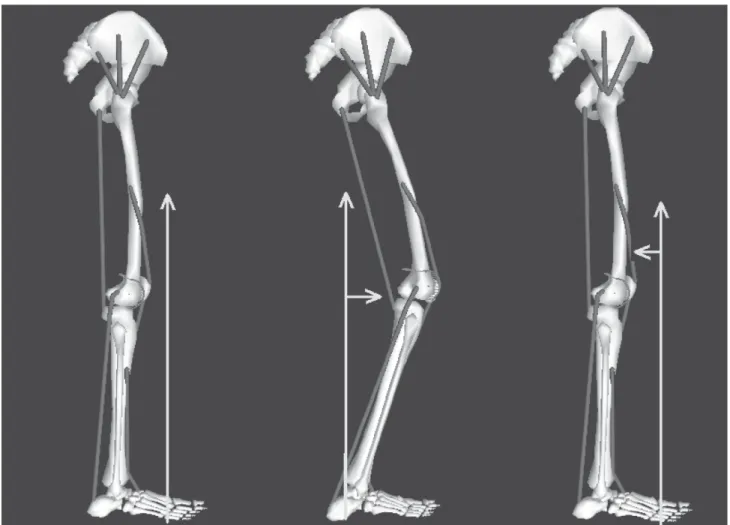
limiting the ankle dorsiflexion in the single support and con-sequently improving knee extension. The FRAFO provides a means of controlling or eliminating ankle and subtalar motion. By controlling the more distal joint, one can theo-retically alter the ground reaction force and effect more proximal joints by the principal of the coupling.
Harrington et al17 and Gage18report that the FRAFO
lim-its the second rocker, improves knee extension, and con-sequently increases knee external extension moment (Figure 2).
Knee moments during stance were not changed in sub-jects wearing hinged or solid orthosis. The findings of
Middleton et al9 of decreased excessive knee extension
moments occurring during loading response with hinged AFOs as compared to solid AFOs in 1 child with spastic diplegic CP were not fully substantiated by this study.
It is important to know that the FRAFO probably will not improve kinematics if knee or hip flexion is a fixed deformity; whenever possible fixed deformities should be corrected prior to bracing for the principle of coupling to be effective.
RESUMO
Lucareli PRG, Lima M de O, Lucarelli JG de A, Lima FPS. Mudanças na cinemática articular em crianças com paralisia cerebral durante o andar com e sem órteses de reação ao solo. Clinics. 2007;62(1):63-8.
INTRODUÇÃO: A órtese de reação ao solo é freqüen-temente prescrita com o objetivo de reduzir a flexão do joelho durante a fase de apoio na marcha de pacientes com paralisia cerebral. Não há informações suficientes relatadas na literature sobre este tipo de órteses.
OBJETIVOS: O objetivo deste estudo foi determinar o efeito que a órtese de reação ao solo tem na cinamática an-gular das articulações do quadril, joelho e tornozelo durante a fase de apoio da marcha de crianças com paralisia cerebral, comparando a marcha descalça e com o uso das órteses
MÉTODOS: Após um estudo retrospectivo de 2200 pacientes avaliados no laboratório de marcha, 71 pacientes com diagnóstico de paralisia cerebral do tipo diparesia espástica e idade média de 12.2 ± 3.9 foram selecionados (142 membros). Nenhum deles apresentou contratura em
flexão dos quadris, joelhos e tornozelos. Todos usavam órteses do tipo reação ao solo articulada durante a avaliação da marcha. Os pacientes foram divididos em três grupos: Grupo I Extensão Limitada (pico de extensão do joelho menor que 15º); Grupo II Extenão Moderadamente Limitada (pico de extensão do joelho entre 15o e 30o) e
Grupo III Agachamento (pico de extensão do joelho no apoio maior que 30o).
RESULTADOS: Os resultados demostraram que o pico de extensão do joelho e o pico de dorsiflexão tiveram alterações significantes nos grupos II e III enquanto que o grupo I não apresentou alteração. O pico de extensão do quadril não mostrou alteração nos três grupos
CONCLUSÃO: A órtese de reação ao solo é eficaz quando indicada para aumentar a extensão do joelho e tornozelo durante a fase de apoio da marcha de crianças com paralisia cerebral
UNITERMOS: Órteses. Paralisia Cerebral. Marcha. Cinemática.
REFERENCES
1. Knutson LM, Clark DE. Orthotic devices for ambulation in children with cerebral palsy and myelomeningocele. Phys Ther. 1991;12:947-52.
2. Yates GA. Method for the provision of lightweight orthotic orthopedic appliance. Orthopedic Journal. 1958;1:53-57.
3. Gage JR. Gait analysis in cerebral palsy. Mac Keith Press: London; 1991.
4. Saltiel J. A one-piece, laminated, knee locking, short leg brace. Orthotics and Prosthetics. 1969;10:68-75.
Group I did not present kinematic alterations, probably because the hip and knee flexion and ankle dorsiflexion were close to a normal gait.
No clinical studies have checked the effectiveness of FRAFO in patients with CP. Most studies discussed in this paper are based on solid or hinged ankle-foot orthoses (AFO) but not FRAFOs.
For future studies, it would be mandatory to correlate these results with physical exam, kinetics, and with electromyographs.
CONCLUSION
Floor reaction ankle-foot orthoses (FRAFO) were effec-tive to improve the extension of the knees and ankle in the stance of children with spastic cerebral palsy.
ACKNOWLEDGMENTS
5. Meadows B. The influence of polypropylene ankle-foot orthoses on the gait of cerebral palsied children. University of Strathclyde, PhD dissertation in Gage JR. Gait analysis in cerebral palsy. Mac Keith Press: London; 1991.
6. Carmick J. Managing equinus in a child with cerebral palsy: merits of hinged ankle-foot orthoses. Dev Med Child Neurol 1995;37:1006-19. 7. Abel MF, Juhl CL, Damiano DL. Gait assesment of fixed ankle-foot orthoses in children with spastic diplegia. Arch Phys Med Rehabil 1998;79:126-33.
8. Knutosn L, Clark D. Orthotic devices for ambulation in children with cerebral palsy and myelomeningocele. Phys Ter 1991;71:947-60. 9. Middleton EA, Hurley GRB, Mcllwain JS. The role of rigid and hinged
polypropylene ankle-foot-orthoses in the management of cerebral palsy: a case study. Prosthetics Orthotics Int 1988;12:129-35.
10. Rethelfsen S, Kay R, Dennis S, forstein M. Tolo V. The effects of fixed and articulated ankle-foot orthoses on gait patterns in subjects with cerebral palsy. J Pediatric Orthop 1999;19:470-4.
11. Freeman D, Orendurff M, Moor M. Case Study: Improving Knee Extension with Floor-Reaction Ankle-Foot orthoses in a Patient with Myelomeningocele and 20 Knee flexion Contractures. Journal of Prosthetics and Orthotics 1999;11:63-73.
12. Radtka SA, Skinner SR, Johanson ME. A comparison of gait with solid and hinged ankle-foot orthoses in children with spastic diplegic cerebral palsy. Gait Posture 2005;21:303-10.
13. Radtka SA, Skinner SR, Dixon DM, Johanson ME. A comparison of gait with solid, dynamic and no ankle-foot orthoses in children with spastic cerebral palsy. Phys Ther 1997;77:395-409.
14. Carlson WE, Vaughan CL, Damiano DL, Abel MF. Orthotic management of gait in spastic diplegia. Am J Phys Med Pehabil 1997;76:219-25. 15. Lai KA, Kuo KN, Andriacchi TP. Relationship between dynamic
deformities and joint moments in children with cerebral palsy. J Pediatr Orthop 1988;8:690-5.
16. Radtka SA, Oliveira GB, Lindstrom Ke, Borders MD. The kinematic and kinetic effects of solid, hinged and no ankle-foot orthoses on stair locomotion in healthy adults. Gait Posture. 2006;24:211-8.
17. Harrington ED, Lin RS, Gage JR. Use of anterior floor reaction orthosis in patients with cerebral palsy. Orthotics and Prosthetics, 1984;4:34-42.