O
riginal
a
r
ticle
RESUmo
Estudo avaliaivo de abordagem quanita
-iva, com amostra de 104 gestantes, com o objetivo de comparar os achados de infecções vaginais em gestantes obidos por meio do luxograma de corrimento vaginal com exames presentes na práica clínica da Enfermagem. Os dados foram coletados por meio de entrevista e exame ginecológico realizados de janeiro a julho de 2011. O luxograma não se mostrou eicaz na ideni
-icação de candidíase e tricomoníase, apre
-sentou baixa sensibilidade (0,0%; 50%) e valor prediivo posiivo (0,0%; 3,6%) para as duas infecções e baixa especiicidade para tricomoníase (46%). Mostrou-se saisfatório para vaginose bacteriana, com alta sensi
-bilidade (100%), valor prediivo negaivo (100%) e acurácia (74%). Conclui-se que o emprego do luxograma precisa ser reava
-liado, visto que não foi eicaz em ideniicar infecções importantes em gestantes. Os esforços para o desenvolvimento de testes eicazes devem ser conínuos, com intuito de prevenir a disseminação de infecções e reduzir tratamentos desnecessários.
DESCRIToRES
Doenças sexualmente transmissíveis Vulvovaginite
Gestantes
Enfermagem obstétrica AbSTRACT
This is a study for assessment of a quanita
-ive approach in pregnant women (N=104), in which indings of vaginal infecion were compared. The indings were obtained by two means, lowchart of vaginal discharge, and typical examinations in the clinical nursing pracice. Data were collected from January to July 2011 through interviews and gynecological examinaions. The lowchart showed no eicacy to idenify candidiasis and trichomoniasis. Furthermore, it showed low sensiivity (0.0%; 50%) and posiive predictive value (0.0%; 3.6%) for both infecions, and low speciicity for trichomo
-niasis (46%). The lowchart was shown to be saisfactory for bacterial vaginosis, with high sensiivity (100%), negaive predici
-ve value (100%), and accuracy (74%). We conclude that use of the lowchart should be reassessed, as it was not able to idenify important infecions in pregnant women. A coninuous efort must be directed for development of efecive tests in order to prevent the spread of infecion and reduce the number of unnecessary treatments.
DESCRIPToRS
Sexually transmited diseases Vulvovaginiis
Pregnant women Obstetrical nursing
RESUmEn
Estudio evaluaivo con enfoque cuanitai
-vo, con una muestra de 104 gestantes, cuyo objeivo fue comparar los resultados de infecciones vaginales en las gestantes, obte
-nidos a parir del diagrama de lujo vaginal y las pruebas presentes en la prácica clínica de enfermería. Los datos fueron recolecta
-dos por entrevista y examen ginecológico, realizados de enero a julio del 2011. El diagrama de lujo no fue eicaz en la iden
-iicación de candidiasis y tricomoniasis, presentando baja sensibilidad (0,0%; 50%) y valor predicivo posiivo (0,0%; 3,6%), para las dos infecciones y baja especiicidad para tricomoniasis (46%). Para vaginosis bacte
-riana, se mostró saisfactoria, con alta sen
-sibilidad (100%), valor predicivo negaivo (100%) y precisión (74%). Se concluye que el uso del diagrama necesita ser revisado, ya que no fue eicaz en la ideniicación de infecciones importantes en las gestantes. Los esfuerzos para desarrollar pruebas efec
-ivas deben ser coninuos, con el objeivo de prevenir la propagación de infecciones y reducir tratamientos innecesarios.
DESCRIPToRES
Enfermedades de transmisión sexual Vulvovaginiis
Mujeres embarazadas Enfermería obstétrica.
Vaginal discharge in pregnant women:
comparison between syndromic approach
and examination of clinical nursing practice
CORRIMENTO VAGINAL EM GESTANTES: COMPARAÇÃO ENTRE ABORDAGEM SINDRÔMICA E EXAMES DA PRÁTICA CLÍNICA EM ENFERMAGEM
FLUJO VAGINAL EN GESTANTES: COMPARACIÓN ENTRE EL ABORDAJE SINDRÓMICO Y LAS PRUEBAS EN LA PRÁCTICA CLÍNICA DE ENFERMERÍA
Thais marques Lima1, Liana mara Rocha Teles2, Amanda Souza de oliveira3, Fernanda Câmara Campos4, Rita de Cássia Carvalho barbosa5,
Ana Karina bezerra Pinheiro6, Ana Kelve de Castro Damasceno6
1 PhD Student in Nursing, Federal University of Ceará, Fortaleza, CE, Brazil. [email protected] 2 MSc student in Nursing, Federal University of
Ceará, Fortaleza, CE, Brazil. [email protected] 3 Undergraduate Student in Nursing, Federal University of Ceará, Fortaleza, CE, Brazil. 4 Professor, PhD,
Department of Pharmacy, Federal University of Ceará, Fortaleza, CE, Brazil. [email protected] 5 Adjunct Professor, Department of Nursing,
InTRoDUCTIon
Reproducive tract infecions, including sexually trans
-mited infecions (STI), are a problem for global public health, especially in developing countries, due to poor health services for prevenion, diagnosis, and treatment of these diseases. Despite the magnitude and transcendence of these infecions, the informaion available is sill scarce in most countries, creating difficulty for implementing efecive programs(1).
STI are the second leading cause for seeking care in health services in the world (trauma is the irst cause). In each country, prevalence of STI varies according to the characterisics of the populaion(2). In Brazil, determining the
incidence of STI is hampered by scarcity of epidemiological data and underreporing, which prevent a more accurate epidemiological assessment(3).
Besides STI, other condiions that cause imbalance in the normal vaginal lora are emphasized due to their high incidence and symptomatology. Bacterial
vaginosis (Gardnerella vaginalis, its principal eiologic agent, causes symptoms such as vaginal discharge; typically milky, bullous, and with ishy smelling) and Candida albi-cans (responsible for infecions in the vulva and vagina, causing intense itching and a white, lumpy, and odorless discharge) are among them(4).
Pregnant women are much afected by adverse efects of these infecions, which can have complicaions (including prematu
-re birth, p-rematu-re ruptu-re of membranes, low birth weight, aborion and neonatal
death) when not diagnosed early and treated properly(5).
During pregnancy, some changes in the lower genital tract, such as hypertrophy of the vaginal walls, increase in both blood low and temperature, increase in non-speciic immunity, and vaginal acidity are typical of this period. Although these changes have a protecive funcion on the uterus, pregnancy and fetus, they may predispose to vaginal infecion, requiring special atenion in the low-risk prenatal period in order to clarify changes in the vaginal lora and prevent verical transmission(6-7).
Some important tests can be performed to idenify these infecions. We can menion the Papanicolaou test, which is the most widespread test in gynecological pracice. It is used as a screening method because it is a rapid test and its cost is relaively low(8). It must be done imely, including
in the gynecological visits, those for family planning, and prenatal care(9).
The Papanicolaou test was introduced to idenify in
-lammatory changes and neoplasic lesions in the cervix. However, it has served as an important tool for idenifying
changes in the vaginal lora, although this is not its main purpose(3). Running this test is part of the work of nurses.
The amine test, fresh examinaions, Gram stain, and me
-asurement of vaginal pH are among the most indicated tests for ideniicaion of vaginal infecion. They are efecive in the diagnosis of infecions such as Chlamydia trachomais, Neisseria gonorrhoeae, Trichomonas vaginalis, Gardnerella vaginalis, Candida albicans, among others(10).
Unavailability of some of these tests in rouine clinical pracice, especially in developing countries, has led to Syndromic Approach (SAp), another way to idenify vaginal changes. This approach is based on the ideniicaion of signs and symptoms, as observed in the clinical evaluaion, and comprises lowcharts with basic informaion for the management of paients(11).
Use of the SAp is paricularly important in countries where health services have inadequate faciliies, lack of la
-boratories and equipment for examinaion, and transporta
-ion diiculies(12). Syndromic approach has
posiive and negaive points, which should be assessed for saisfactory use in speciic populaions such as pregnant women(11,13).
Given this scenario and the severity of vaginal infecion during pregnancy, asses
-sing the use of lowchart of vaginal discharge in a speciic populaion is relevant for both scieniic evidence on which its use in the prenatal period in clinical nursing pracice can be based and informaion for future studies with the aim of developing more accurate techniques to idenify STI. The aim of this study was to compare the indings of vaginal infecion in pregnant women obtained by using the lowchart of vaginal discharge with the result of tests used in clinical nursing pracice.
mETHoD
This assessment study had a cross-secional quanitaive approach and was developed in the period January-July 2011 at the Ligia Costa Barros Center for Natural Childbirth (CNC), a unit for primary health care in Fortaleza, Ceará (CE), Brazil.
The study populaion comprised women who had pre
-natal visit at the CNC. Selecion of the pregnant women had to meet the following inclusion criteria: the subjects should be in prenatal visit or referred from other health services for gynecological examinaion at the CNC; they should have no intercourse up to 24 h before the test, and should not be in use of vaginal cream. Having been atended in other STI clinics, and undergone treatment for STI in the current pregnancy were the exclusion criteria.
The aim of this study was to compare the
indings of vaginal
infection in pregnant women obtained by
using the lowchart
of vaginal discharge with the result of tests used in clinical nursing
Due to scarcity of data on the number of pregnant wo
-men atended in gynecological consultaions at the CNC, sample calculaion was not possible. Thus, census-type sampling was used for all women who had prenatal con
-sultaion at the CNC during the period of data collecion. A total of 140 pregnant women met the criteria for inclusion. However, 36 of them decided not to paricipate in the study when they were informed they would have to undergo speculum examinaion, showing concern in per
-forming this test during pregnancy. Therefore, the sample included 104 pregnant women.
These pregnant women underwent the following exa
-minaions: measurement of vaginal pH and collecion of three samples of vaginal content. The irst was stored in a vial with 95% alcohol for cytological examinaion; the second was uilized in the amine test; and the third was taken with a coton swab, which was immersed in saline (1 ml, in sterile glass) for direct examinaion.
The data thus obtained were inserted into the low chart of vaginal discharge to idenify the syndrome presented by the pregnant woman. All data were registered in the medi
-cal record of the insituion, compiled, and analyzed using the Staisical Package for Social Sciences (SPSS, version 18.0), presented in tables, and discussed according to the relevant literature.
Each pathology was analyzed separately. For candidiasis and trichomoniasis, direct examinaion was taken as the gold standard. For diagnosis of bacterial vaginosis, the Am
-sel criteria (indicated by the Ministry of Health) was taken as the gold standard. It allows diagnosis of bacterial vaginosis in presence of three of the following four condiions: vaginal discharge, vaginal pH>4.5, posiive result in the amine test, and presence of clue cells on microscopy(4).
For data analysis, the chi-square test (10% signiicance level) was used. The following parameters, sensiivity (S), speciicity (Sp), posiive predicive value (PPV), negaive pre
-dicive value (NPV), posiive likelihood raio (PLR), negaive likelihood raio (NLR), and accuracy (Ac), were calculated using known equaions(14).
The project was submited to the Commitee for Ethics in Research, Federal University of Ceará (UFCE), and was approved (protocol 298/10). The ethical aspects of the study involving humans (Resoluion 466/12 of the Brazilian Health Council) were observed(15).
RESULTS
The pregnant women studied herein were mostly young adults with ages in the age range 20-29 years (48.0; 46.2%, mean±SD: 23.7±6.6) years. A substanial number (33; 31.7%) of pregnant adolescents (age ≤ 19 years) was also observed. Menarche occurred when they were aged 12.8±1.4 years, and most of them occurred in the age range 9-14 years (92; 88.4%). The beginning of their sexual life
occurred at 16.0±2.9 years, in the age range of 12-15 years (56; 53.8%).
Although most of the pregnant women reported not having a previous history of STI (90; 86.5%), less than half of them had regular gynecological consultaions (46; 44.2%). Therefore, the informaion on inexistence of a previous history of STI is doubtful. Among those with previous treatment for STI, most could not tell the type of infecion (5; 35.7%), among those who had such informaion, most reported treatment for HPV (4; 28.5%).
Regarding obstetric data, muliparous were predomi
-nant (58; 55.8%), with reports of up to 13 pregnancies. Most of them reported never having aborted (81; 77.9%) and not becoming pregnant ater sexual contact with their irst partner (57; 54.8%). Slightly more than half of them were in the 2nd trimester of pregnancy (58; 55.8%), with 20.2±7.4
weeks of gestaion. On speculum examinaion, vaginal dis
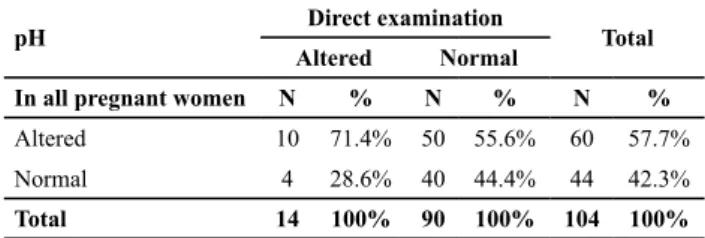
-charge was ideniied in all pregnant women (104; 100%). Regarding vaginal pH, the values varied in the range 3-7; pH 5 was predominant (50; 48.1%), followed by 4 (44; 42.3%). The pH values were compared with the informaion from the direct examinaion for evaluaion of pH as a me
-thod for idenifying changes in the vaginal lora of pregnant women (Table 1).
Table 1 – Distribution of results obtained in determinations of vaginal pH and direct examination – Fortaleza, CE, Brazil, 2011.
pH Direct examination Total
Altered Normal
In all pregnant women N % N % N %
Altered 10 71.4% 50 55.6% 60 57.7%
Normal 4 28.6% 40 44.4% 44 42.3%
Total 14 100% 90 100% 104 100%
S=71.42%; Sp=44.4%; PPV=16.7%; NPV=90.9%; PLR=1.2; NLR=0.65; Ac=48.7%.
Examinaion of vaginal pH saisfactorily ideniied preg
-nant women with altered vaginal lora (10; 71.4%). However, we obtained a high number of false posiive results, in com
-parison with the direct examinaion (50; 55.6%), revealing that determinaions of vaginal pH showed high values for sensiivity (71.42%) and NPV (90.9%) and low values for speciicity (44.4%), PPV (16.7%), and accuracy (48.7%).
The value for RVP (1.2) resuling from the test indicates that the probability of a posiive diagnosis in a healthy po
-pulaion being true is 1.2 imes higher than the probability of the result being a false posiive. On the other hand, the value for NLR (0.65) means a probability of 65 results being false negaives in every 100 negaive diagnoses. Thus, we infer that the value for vaginal pH is not an efecive pre
Then, we evaluated the diagnosic ability of the amine test in detecing changes in the vaginal lora (as an indicaion of bacterial vaginosis) and compared it with the posiive results of the test according to the Amsel criteria (Table 2).
result. A unit value for NLR allows us to infer that there is a 100% probability that the lowchart display a false negaive result for candidiasis.
Regarding trichomoniasis, agreement between the re
-sults obtained with the lowchart and direct examinaion is shown in Table 4.
Table 2 – Distribution of results obtained in the amine test and detection of bacterial vaginosis – Fortaleza, CE, Brazil, 2011.
Amine test Bacterial vaginosis Total Present Absent
In all pregnant women N % N % N %
Present 29 100% 9 12.0% 38 36.5%
Absent 0 0.0% 66 88.0% 66 63.5%
Total 29 100% 75 100% 104 100%
S=100%; Sp=88.0%; PPV=71.3%; NPV=100%; PLR=8.3; NLR=0; Ac=91.3%.
Table 3 – Distribution of results for detection of candidiasis using
the lowchart and direct examination – Fortaleza, CE, Brazil,
2011.
Flowchart Direct examination Total Present Absent
In all pregnant women N % N % N %
Present 0 0.0% 2 2.1% 2 1.9%
Absent 10 100% 92 97.9% 102 98.1%
Total 10 100% 94 100% 104 100%
S=0.0%; Sp=97.9%; PPV=0.0%; NPV=90.2%; PLR=0; NLR=1.0; Ac=88.5%.
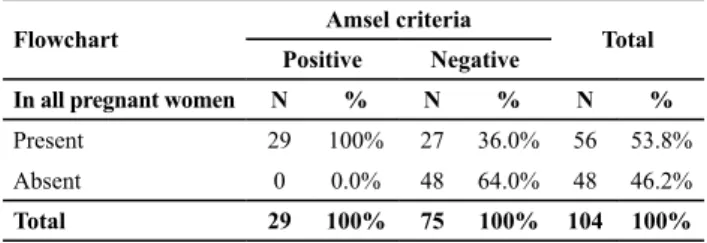
Table 5 – Distribution of results obtained for detection of
bacte-rial vaginosis using the lowchart and Amsel criteria – Fortaleza,
CE, Brazil, 2011.
Flowchart Amsel criteria Total Positive Negative
In all pregnant women N % N % N %
Present 29 100% 27 36.0% 56 53.8%
Absent 0 0.0% 48 64.0% 48 46.2%
Total 29 100% 75 100% 104 100%
S=100%; Sp=64.0%; PPV=51.8%; NPV=100%; PLR=2.7; NLR=0; Ac=74.0%.
The amine test showed to be highly eicient in detecing the presence of bacteria causaive of bacterial vaginosis in pregnant women, as it has ideniied all posiive cases for the pathology (29; 100%) and most cases of absence of the disease (66; 88.0%). Thus, it showed high sensiivity (100%), speciicity (88.0%), PPV (71.3%), NPV (100%), and accuracy (91.3%). In addiion, the values for PLR (8.3) and NLR (0) indicate a probability 8.3 imes higher of obtaining an actually posiive result and a null probability of obtaining a false negaive diagnosis. This makes the amine test a sui
-table examinaion for ideniicaion of bacterial vaginosis. Regarding ideniicaion of the syndrome, agreement between the lowchart of vaginal discharge and direct examinaion can be observed in the following tables. The data in Table 3 evidence ideniicaion of candidiasis by both lowchart of vaginal discharge and direct examinaion.
The lowchart of vaginal discharge correctly ideniied no case of candidiasis (10; 100%), but in most cases sais
-factorily ideniied that the disease was absent (92; 97.9%). Thus it showed null values (0.0%) for sensiivity and PPV, and high values for speciicity (97.9%), NPV (90.2%), and accuracy (88.5%). The lowchart also presented a null value for PLR, indicaing that the probability that it ideniies a true result is equal to that of presening a false posiive
Table 4 – Distribution of results for detection of trichomoniasis
using lowchart and direct examination – Fortaleza, CE, Brazil,
2011.
Flowchart Direct examination Total Present Absent
In all pregnant women N % N % N %
Present 2 50.0% 54 54.0% 56 53.8%
Absent 2 50.0% 46 46.0% 48 46.2%
Total 4 100% 100 100% 104 100%
S=50%; Sp=46%; PPV=3.6%; NPV=95.8%; PLR=0.9; NLR=1.08; Ac=46.2%.
The lowchart correctly ideniied half the cases of tri
-chomoniasis (2; 50.0%), but erroneously ideniied most cases of absence of the disease (54; 54.0%). Thus it showed low values for sensiivity (50.0%), speciicity (46.0%), PPV (3.6%), and accuracy (46.2%), and high values for NPV (95.8%). In addiion, he showed a value of 0.9 for PLR and a value equal to 1.08 for NLR. These values allow us to in
-fer that the probability of obtaining a true result with the lowchart is only 0.9 imes greater than the probability of obtaining a false result, and there is a 1.08 probability of obtaining a false negaive result for this disease.
Agreement between the results obtained with the lo
-wchart and Amsel criteria for diagnosis of bacterial vaginosis can be observed in Table 5.
Regarding the indings of bacterial vaginosis, the lo
low. The lowchart presented a value of 2.7 for PLR and a null value for NRL. Therefore, we infer that the probability of the lowchart to indicate a true posiive result is 2.7 imes greater than that of presening a negaive result when the disease exist. Furthermore, the probability of the lowchart to indicate a false negaive diagnosis is zero.
DISCUSSIon
Demographic data are included in scieniic studies due to the inluence of populaion characterisics on living condiions, access to informaion, habits, and beliefs. Inves
-igaion on the characterisics of the study populaion helps build knowledge about their possible impacts on health.
In this study, the pregnant women were in the age group of young adults, which corresponds to the period recommended for gestaion. However, the high number of pregnant adolescents is of concern due to the risks as
-sociated with pregnancy in this age group.
Regarding data on gynecological history, we observed precocity in both occurrence of menarche and the irst sexu
-al intercourse. This observaion conirms a study conducted in Rio de Janeiro (RJ, Brazil) to know the age of pregnant adolescents when they had their irst sexual intercourse and its relaionship with the pracice of safe sex. Its results revealed that the beginning has occurred in the range of 12-16 years, showing that the ages of both menarche and the irst sexual intercourse are becoming closer(16).
Reducion in the age when menarche occurs could lead to an early onset of sexual acivity, exposing adolescents to the possibility of an unwanted pregnancy and consequent vulnerability to STI in a criical period of their sexual deve
-lopment(17). Therefore, strategies to promote knowledge
of adolescents are needed in order to help them take conscious and informed decisions.
Most pregnant women reported never having had treat
-ment for STI. In addiion, they also reported not undergoing any periodic gynecologic exam. The Papanicolaou test must be performed every year or every three years (ater two consecuive annual examinaions with negaive results)(18).
Not undergoing these tests leads to underreporing of STI prevalence in this populaion, complicaing diagnosis and treatment of STI. Especially during pregnancy, management of STI must be fast and efecive, as these infecions involve complicaions not only during pregnancy, delivery, and puerperium, but also for the newborn(7).
Not undergoing periodic gynecological examinaion may be related to the factors described in a study (conducted in Rio Grande do Norte, RN, Brazil), in which the authors sought to idenify knowledge, aitude, and pracice on the exam among women. Negligence, failure to request examinaion by the physician, shame, work outside home, frequency to gynecological visits, parity, and acive sexual
life were menioned as obstacles for them to undergo the Papanicolaou test(19).
In the populaion of the present study, several obstacles to undergoing gynecological examinaion were ideniied, including insuicient knowledge on the importance for them to undergo this examinaion during pregnancy, and fear that it could afect the course of pregnancy (because they considered gynecological examinaion as invasive.)
During gynecological consultaion, an efecive commu
-nicaion (including on invesigaion of risk situaions, fear, and expectaions of pregnant women) must be associated with the appropriate physical examinaion and the use of speciic diagnosic technologies. Measurement of vaginal pH is among these technologies, and is part of the standard assessment of women complaining of vaginal symptoms. However, this study showed a high number of false posiive and false negaive results with relaively high sensiivity (71.4%) but low speciicity (44.4%). Thus, measurement of vaginal pH did not show a strong predicive power of vaginal infecion.
This inding conirms those of a study (conducted with 100 Chilean women) that showed high sensiivity (72.4%) and low speciicity (65.0%) for measurement of vaginal pH(20).
A study involving 311 pregnant women in the state of Alagoas (AL, Brazil) showed high values for sensiivity (89.5%) and speciicity (84.8%) of vaginal pH test, asso
-ciated with another test, such as the amine test (89.5%)
(21). Thus, this test is not indicated as a single method to
idenify changes in the vaginal lora. It must be associated with other tests for a correct assessment of changes in pregnant women.
In the present study, the amine test revealed a high ac
-curacy for bacterial vaginosis, with high values for sensiivity (100%) and speciicity (88.0%). A similar inding was found in a study to assess the clinical and epidemiological proile of 277 women with bacterial vaginosis, which pointed out the amine test as being one of the most frequently obser
-ved clinical criteria in the diagnosis of this infecion. This test showed a high posiivity rate (96.0%) in women with bacterial vaginosis(22).
This inding is conirmed by a study conducted in India (564 women), which showed high values for sensiivity (94.0%) and speciicity (87.5%) of the amine test for detec
-ion of of bacterial vaginosis. We emphasize that this test may improve the diagnosic value of the speculum examina
-ion in health services where no microscope is available(23).
Given the simplicity of its execuion and low cost of materials, the joint measurement of vaginal pH and amine test should be disseminated in clinical nursing pracice. They can be performed even without speculum examina
We observed that the lowchart of vaginal discharge showed no efeciveness in idenifying candidiasis and trichomoniasis. However, it revealed efeciveness in iden
-ifying changes caused by bacterial vaginosis.
Another study conducted in India (4,090 women) sho
-wed that the SAp was not efecive. High sensiivity (93.8%) and low speciicity (37.5%) were observed in this study, i.e., a higher proporion of women were diagnosed but determinaion of the agent was not efecive. Furthermore, associaion between the symptoms reported by women and ideniicaion of the syndrome and its eiology was not obtained. The SAp was not shown to be efecive in the management of STI and, thus, use of other diagnosic forms was necessary(2).
A study to assess the eicacy of the SAp in idenifying other STI also showed low values for sensiivity, specii
-city, and PPV in the diagnosis of cerviciis by gonococcus and chlamydia, and resulted in inappropriate treatment for more than 50.0% of women with cervical discharge. This study also suggests that this rate is higher regarding vaginal discharge(24).
The low efeciveness of the SAp in idenifying changes in pregnant women together with the high rate of women who do not have the habit of undergoing periodic preven
-ive examinaion lead the diagnosis to be performed when the disease is already in an advanced stage, making the treatment diicult(25).
ConCLUSIon
The high prevalence observed in this study of infecions such as candidiasis, trichomoniasis, and bacterial vaginosis
in pregnant women emphasizes the need to adopt efecive strategies for their early detecion associated with a rein
-forcement in the measures for prevenion and treatment of both women and their partners.
Use of the SAp of vaginal infecion in pregnant women requires reassessment because the rate of vaginal discharge in this populaion may be high although this does not repre
-sent a pathology. The lowchart was inefecive in idenifying infecions such as candidiasis and trichomoniasis, but was efecive in idenifying bacterial vaginosis.
The small sample of pregnant women was a limitaion in the present study. Its replicaion with a larger sample is indicated to give it a greater power of generalizaion regar
-ding suitability of the syndromic approach and a possible use of pracical alternaives to this method.
As the management and treatment of vaginal infecions during pregnancy is sill a challenge for clinical nursing pracice, the use of simple tests, such as the amine test, which showed a high accuracy, should be disseminated in health services due to its low cost.
Furthermore, it would be ideal that more advanced techniques, although simple as the direct examinaion, exceeded the limits of laboratories and could be available in health services for efecive use by nurses. These tests can bring a valuable contribuion to elucidate vaginal infec
-ions during pregnancy, contribuing to the improvement of nursing pracices in the sexual and reproducive health. Its use by nurses will contribute to both prevent the spread of infecion and reduce the number of unnecessary treat
-ments, in addiion to diagnose asymptomaic women and ofer a beter quality of life for pregnant women.
1. Pedrosa VL, Galban E, Benzaken AS, Vasquez FG, Izan Junior JL. DST e suas determinantes: quatro anos de vigilância em um Centro Seninela no Estado do Amazonas – Brasil. J Bras Doenças Sex Transm. 2011;23(2):57-65.
2. Hay P, Ugwumadu A. Detecing and treaing common sexually transmited diseases. Best Pract Res Clin Obstetr Gynaecol. 2009;23(5):647-60.
3. Rocha LVS, Diniz VC, Araújo JT, Rolim CK, Dantas AFR, Miranda HF, et al. A vulnerabilidade às DST em região com intensa prosituição e turismo sexual de Natal/RN. Rev Bras Anal Clin. 2008;40(1):3-6.
4. Brasil. Ministério da Saúde; Secretaria de Vigilância em Saúde. Programa Nacional de DST e Aids.Manual de controle das doenças sexualmente transmissíveis – DST [Internet]. Brasília; 2006 [citado 2011 jun. 15]. Disponível em: htp://bvsms. saude.gov.br/bvs/publicacoes/manual_controle_das_dst.pdf
5. Meyers DS, Halvorson H, Luckhaupt S. Screening for chlamydial infecion: an evidence update for the U.S. Prevenive Services Task Force. Ann Intern Med. 2007;147(2):135-42.
6. Alessi AMB, Okasaki ELJ. Diagnósico, tratamento e prevenção das vaginoses e vulvovaginites durante a gestação. Rev Enferm UNISA [Internet]. 2007 [citado 2011 jun. 15]; 8:5-8. Disponível em: htp://www.unisa.br/graduacao/biologicas/ enfer/revista/arquivos/2007-01.pdf
7. Gondo DCAF, Duarte MTC, Silva MG, Parada CMGL. Abnormal vaginal lora in low-risk pregnant womencared for by a public health service: prevalence and associaion withsymptoms and indings from gynecological exams. Rev Laino Am Enferm. 2010;18(5):919-27.
8. Pias AA, Vargas VRA. Avaliação dos exames citológicos de papanicolaou com células epiteliais atípicas e respectivos exames colposcópicos com relação aos exames histopatológicos. Rev Bras Anal Clin. 2009;41(2):155-60.
9. Jorge RBJ, Diógenes MAR, Mendonça FAC, Sampaio LRL, Jorge Júnior R. Exame papanicolaou: senimentos relatados por proissionais de enfermagem ao se submeterem a esse exame. Ciênc Saúde Coleiva. 2011;16(5):2443-51.
10. Giraldo PC, Passos MRL, Bravo R, Varella RQ, Campos WNA, Amaral RL, et al. O frequente desaio do entendimento e do manuseio da vaginose bacteriana. J Bras Doenças Sex Transm. 2007;19(2):84-91.
11. Rodrigues LMC, Mariniano CS, Chaves AEP, Azevedo EB, Uchoa SAC. Abordagem às doenças sexualmente transmissíveis em unidades básicas de saúde da família. Cogitare Enferm.
2011;16(1):63-9.
12. Rao VG, Anvikar A, Savargaonkar D, Bhat J. Sexually transmited infecions in tribal populaions of central India. Eur J Clin Microbiol Infect Dis. 2009;28(11):1391-3.
13. Tilli M, Orsini A, Alvarez MM, Almuzara M, Gallardo E, Mormandi JO. Validación clinica de un guante con indicador de pH (Vagitest) para la aproximación diagnósica de las infecciones vaginales. DST J Bras Doenças Sex Transm. 2007;19(2):70-4. 14. Hulley BH, Cummings SR, Browner WS, Grady DG, Newman
TB. Delineando a pesquisa clínica: uma abordagem epidemiológica. Porto Alegre: Artmed; 2008.
15. Brasil. Ministério da Saúde; Conselho Nacional de Saúde. Resolução 466, de 12 de dezembro de 2012. Dispõe sobre as diretrizes e normas regulamentadoras de pesquisas envolvendo seres humanos [Internet]. Brasília; 2012 [citado 2013 fev. 17]. Disponível em: htp://conselho.saude.gov.br/ resolucoes/2012/Reso466.pdf
16. Assis MR, Silva LR, Pinho AM, Moraes LE. Práica sexual na adolescência. Rev Pesq Cuid Fundam Online [Internet]. 2010 [citado 2011 Jun. 15];2Supl.:458-62. Disponível em: htp:// www.seer.unirio.br/index.php/cuidadofundamental/aricle/ view/1010/pdf_172
17. Simões A. Gravidez na adolescência: peril das gestantes e puérperas e fatores associados. Rev Saúde Pública Santa Cat [Internet]. 2010 [citado 2011 jul. 15];3(1):57-68. Disponível em: htp://esp.saude.sc.gov.br/sistemas/revista/index.php/ inicio/aricle/viewFile/70/112
18. Brasil. Ministério da Saúde. Controle dos cânceres do colo do útero e da mama. 2ª ed. Brasília; 2012. (Cadernos de Atenção Básica, 13).
19. Fernandes JV, Rodrigues SHL, Costa YGAS, Silva LCM, Brito AML, Azevedo JWB, et al. Conhecimentos, aitudes e práica do exame de papanicolaou por mulheres, Nordeste do Brasil. Rev Saúde Pública. 2009;43(5):851-8.
20. Lillo GE, Lizama IS, Medel CJ, Martínez TMA. Diagnóstico de vaginosis bacteriana en un consultorio de planificación familiar de la Región Metropolitana, Chile. Rev Chil Infectol [Internet]. 2010 [citado 2013 ene. 16];27(3):199-203. Disponible en: http://www.scielo.cl/pdf/rci/v27n3/ art02.pdf
21. Campos AAS, Leite APL, Lisboa CVF, Andrade CC, Bezerra AF, Matar R, et al. Estudo comparaivo entre o teste do pH e do KOH versus escore de Nugent para diagnósico da vaginose bacteriana em gestantes.Rev Bras Ginecol Obstet. 2012;34(5):209-14.
22. Leite SRRF, Amorim MMR, Calábria WB, Leite TNF, Oliveira VS, Ferreira Junior JAA, et al. Peril clínico e microbiológico de mulheres com vaginose bacteriana. Rev Bras Ginecol Obstet. 2010;32(2):82-7.
23. Thulkar J, Kriplani A, Agarwal N. Uility of pH test & whif test in syndromic approach of abnormal vaginal discharge. Indian J Med Res. 2010;131:445-8.
24. Benzaken AS, Sales DN, Palheta Junior JIL, Pedrosa VL, Garcia EG. Prevalência da infecção por Clamídia e Gonococo em mulheres atendidas na clínica de DST da Fundação Alfredo da Mata, Manaus, Amazonas. J Bras Doenças Sex Transm. 2010;22(3):129-34.