The development of an instrument
to assess nursing care responsiveness
at a university hospital
O
r
i
g
i
n
a
l
a
r
ti
c
le
1 RN. Resident in Nursing Service Management, University Hospital of the State University of Londrina. Londrina, PR, Brazil. [email protected] 2 RN. MS. Advisor in Nursing Service Quality, University Hospital of Londrina. Londrina, PR, Brazil. [email protected] 3 RN. PhD. Professor, State University
of Londrina, Nursing Department. Londrina, PR, Brazil. [email protected] 4 RN. PhD. Professor, State University of Londrina, Nursing Department.
Londrina, PR, Brazil. [email protected] 5 RN. Resident in Nursing Service Management, University Hospital of the State University of Londrina. RESUmo
Um indicador de qualidade introduzido pela Organização Mundial da Saúde no campo da avaliação em saúde é a
respon-sividade. Assim, o objeivo do trabalho foi
elaborar um instrumento para avaliar a opinião do cliente sobre a responsividade
do serviço de enfermagem de um hospital
universitário público. A pesquisa desenvol-veu-se nas seguintes etapas: construção do instrumento com base em levantamento
bibliográico, validação aparente, teste de
aplicabilidade e teste piloto. O
instrumen-to permite ideniicar as Expectaivas e as
Percepções do cliente, subdivididas em
as-pectos relacionados à Estrutura, Processo
e Resultados, mensurados por meio da es-cala Likert com valores de 0 a 7. Com base
nos resultados do teste piloto foi possível
estabelecer uma indicação numérica da
Taxa de Saisfação Relaiva e do seu inter
-valo. O trabalho proporcionou a constru -ção de uma escala de percentual de aceita-bilidade para o intervalo, que pode indicar
quanto o serviço de enfermagem responde às expectaivas dos clientes.
dEScRiToRES
Serviços de enfermagem
Qualidade da assistência à saúde Indicadores de qualidade Avaliação
Estudos de validação
AbSTRAcT
Responsiveness is a quality indicator
pre-sented by the World Health Organizaion in the ield of health evaluaion. Therefore, the objecive of this study was to develop an instrument to evaluate the clients’ opinions regarding the responsiveness of the nursing service of a public university hospital. The research was developed in the following stages: developing the instrument based on a literature review, apparent validaion, ap
-plicability test and pilot test. The instrument allows the ideniicaion of the clients’ ex
-pectaions and percepions, subdivided into aspects related to the Structure Process and
Outcomes, measured using a 7-point Likert
scale. Based on the results of the pilot test it was possible to establish a numerical indica
-ion of the Relaive Saisfac-ion Rate and its interval. The study promoted the develop
-ment of an acceptability percentage scale for the interval, which indicates the extent to which the nursing service meets the cli
-ents’ expectaions.
dEScRiPToRS
Nursing services
Quality of health care
Quality indicators
Evaluaion Validaion studies
RESUmEn
Responsividad es un indicador de calidad presentado por la Organización Mundial de la Salud en el campo de evaluación en
sa-lud. El objeivo del trabajo fue elaborar un
instrumento de evaluación de opinión del paciente respecto a la responsividad del
servicio de enfermería de hospital universi
-tario público. Invesigación desarrollada en
las etapas: construcción del instrumento
basado en reseña bibliográica, validación
aparente, prueba de aplicabilidad y prueba
piloto. El instrumento permite ideniicar las Expectaivas y Percepciones del pacien
-te, subdivididas en aspectos relaivos a Estructura, Proceso y Resultados, medido
mediante escala Likert en valores de 0 a
7. En base a los resultados de prueba pi
-loto, fue posible establecer una indicación numérica de Tasa de Saisfacción Relaiva y de su intervalo. El trabajo proporcionó la
construcción de una escala de porcentual de aceptabilidad para el intervalo, que puede indicar en cuanto responde el
ser-vicio de enfermería a las expectaivas del
paciente.
dEScRiPToRES
Servicios de enfermería
Calidad de la atención de salud Indicadores de calidad
Evaluación
Estudios de validación
Ana Vanessa deffaccio Rodrigues1, dagmar Willamowius Vituri2, maria do carmo Lourenço
Haddad3, marli Terezinha oliveira Vannuchi4, William Tiago de oliveira5
ELABoRAção DE UM INStRUMENto PARA AvALIAR A RESPoNSIvIDADE Do SERvIço DE ENfERMAgEM DE UM HoSPItAL UNIvERSItáRIo
inTRodUcTion
Quality of a service is a result of the commitment and responsibility of those involved, who are willing to provide good service while not huring the social, ethical and re
-ligious beliefs of clients and successfully fulill their tasks. Based on this assumpion, the evaluaion of the quality of health services becomes essenial to saisfying service users, permiing the detecion of problems and failures in the process of delivering care to paients.
All those involved in the care process should parici
-pate in the development and implementaion of evalua
-ive processes to legiimate and ensure greater involve
-ment in the search for quality. Quality indicators are another tool available to evaluate quality of care(1).
Evaluaion of the quality of nursing care through in
-dicators can be used to reinforce the natural desire of health workers to improve care at the same
ime as it helps to understand the quality of care. Evaluaing health services is not a simple procedure and it is essenial that this
process be based on criteria predetermined
by the service to achieve pre-established
quality standards developed according to
the local context(1).
A quality indicator introduced in the ield of evaluaion in healthcare is respon
-siveness. It emerged as an alternaive to the concept ‘saisfacion’ given the subjec
-ive nature of the later(2). Responsiveness is related to the way health system design recognizes and responds to expectaions of individuals universally recognized in relaion to non-medical aspects of care(3).
Responsiveness is translated into two di -mensions: respect for people and
client-ori-entaion. Respect for people is related to the
ethics involved in the interacion of paients with health services and is composed of the following: dignity, con
-ideniality, autonomy and communicaion. The second
dimension, client-orientaion, includes categories that in
-luence the saisfacion of paients and are directly related to care: fast service, social support, faciliies and choice(4).
Research addressing responsiveness(3) considers two
elements of operaion: measuring what happens when a client interacts with the system and measuring how the
client perceives and evaluates what happened.
This study was conducted considering the relevance of the concept of ‘responsiveness’ and the importance of measuring how a public university hospital nursing service responds to the percepions and expectaions of clients. We believe that, based on the development and validaion of an instrument to evaluate the respon
-siveness of a nursing service according to the opinion of
clients, we can collect data and transform the data into informaion that is essenial for implemening efecive and eicacious management as well as sensiizing the nursing staf to consider care needs beyond the technical dimension of care.
mETHod
This quanitaive study was conducted in a public uni
-versity hospital located in the North of the state of Paraná, Brazil. The hospital is linked to the Brazilian Uniied Health System (SUS) and has 317 beds distributed among female and male medical-surgical units, infecious and contagious
diseases, tuberculosis treatment, burn treatment center, maternity, nursery, pediatrics, emergency department, neonatal, pediatric and adult intensive and semi-intensive
care units. Addiionally, it maintains difereniated sectors such as an eye bank, a bone marrow transplant and blood
center, and also provides outpaient care. The process of the instrument’s devel
-opment took place in 2009 ater it was ap
-proved by the Nursing Board of the insitu
-ion where the study was conducted and by the Research Ethics Commitee at the State University of Londrina and registered in the Research Ethics Naional Informaion Sys
-tem (CAAE nº 0124.0.268.000-9). All those involved in the study, experts and paients, signed free and informed consent forms(5).
The methodological procedures were adapted from an exising study(1), which al -lowed the implementaion of the following stages: development of the instrument of evaluaion of responsiveness of nursing ser
-vices, face validity, applicability test, pilot test and computaion of relaive saisfac
-ion.
The development of the instrument to evaluate responsiveness in nursing services was based on an extensive bibliographic search concerning quality of care(1,3,6-9). Prioriies were established in the irst stage
to measure the responsiveness of the nursing service at the hospital where the study was conducted. These priori
-ies were based on three criteria: the importance of the care acivity to be measured; the potenial to improve its quality; and degree of control professionals performing care hold over the mechanisms that allow the desired im -provement(10).
The instrument was developed so that its measures can be applied in various sectors and faciliies with the most varied context for adult paients with safety and pre
-cision of results. Considering the level of informaion and culture of the interviewees, the instrument can be con
-sidered a quesionnaire when self-applied or a form if a researcher ills out the instrument(11).
We believe that, based on the development and validation of an instrument to evaluate
the responsiveness of a nursing service
according to the opinion of clients, we can collect data
and transform the data into information
that is essential for implementing effective
Paients can evaluate the quality of service of a hospi
-tal in diferent ways by comparing how hospi-tals should provide services and their percepions concerning how aciviies are performed in these faciliies. The percepion of the quality of a service is therefore the direcion and extent to which the percepions and expectaions of con -sumers diverge(12).
The term expectaions is used in the literature and re
-fers to the quality of services as opposed to the way the
term consumer’s saisfacion is used. ‘Paient saisfacion’ can be deined as posiive individual evaluaion of disinct
dimensions of health care(13). Expectaion is considered a preview the consumer makes about something according to his/her desires or needs(12), which is inluenced by the individual’s set of negaive and posiive experiences that inluence one’s behavior(14).
Hence, based on these concepts, an instrument was developed to evaluate the responsiveness of a nursing service with two disinct purposes: one focused on the ex
-pectaions of paients and another focused on their per
-cepions, which was subdivided into the categories Struc -ture, Process and Results(7).
Structure corresponds to the resources necessary to provide care, including physical area, human, material and inancial resources, in addiion to informaion systems. Pro
-cess involves a great part of the complexity of the treatment and directly depends on user access to the service, ethical/
interpersonal aspects, user autonomy, social support and
communicaion/informaion the individual received and the work process of the nursing team. Results refer to the user’s analysis of inal products in terms of health.
A Likert scale, ranging from 1 to 7(12), was used for pa -ients to choose according to how strongly they agree or disagree with whether the service provides a given re
-source or condiion: (1) strongly disagree and (7) strongly agree. The numbers between the two poles should be assigned according to how strong a feeling/impression is concerning the availability of a resource or condiion. Zero is assigned when the paient has no opinion concerning the statement or never experienced the situaion.
Face validity was tested. It is a subjecive evaluaion aimed to verify the supericial evidence of the integrity of what the instrument is supposed to measure. Thus, it is a supericial evaluaion performed by those who will use it(15).
The instrument was validated through a writen and objecive evaluaion with all ten nurses from the Burn Treatment Center at the insituion where the study was
conducted.
At this point, the experts evaluated each statement concerning Expectaions and Percepions according to the requirements Atributable, Accessible, Communicable, Contextual, Efecive/Precise, Feasible, Objecive and as
-signed a score from 1 to 4 to each(1,16). They also let writ
-ten comments and suggesions in relaion to each set of these components of indicators.
Each expert received an invitaion leter to paricipate in the study, a free and informed consent form to sign, the instrument to evaluate, and instrucions on how to ill it out. The results of the experts’ evaluaion were plot
-ted and analyzed according to agreement among them. Changes in the instrument were implemented according to the relevance of the expert opinions.
Ater the instrument was reformulated, it was submit
-ted to an applicability test in a randomized sample of ive paients hospitalized in the female medical-surgical unit at the studied hospital. These paients had to have been hospitalized for more than four hours and be able to pro
-vide answers so the level of understanding in relaion to the evaluaion items could be veriied. Data were ploted again and analyzed considering the diiculies the pa
-ients faced and suggesions were presented. The instru
-ment was then reformulated.
A pilot test was applied ater the applicability test and second reformulaion. The pilot test was applied to an in
-tenional sample of 20% of inpaients of the female med
-ical-surgical unit of the studied hospital who were admit
-ted at least two days before in the unit. The purpose was to verify the responsiveness of the service of the unit’s nursing team in the four work shits. Ater data were plot
-ted and analyzed, the authors considered the construc
-ion of the instrument to evaluate the responsiveness of nursing services was concluded.
To validate the methodology and present a score for responsiveness in the nursing services, a formula used in another study was employed(17). It computes the Relaive Saisfacion (RS) rate where:
RS = Percepion/Expectaion X 100
The GAP between the distance of users’ RS and full sat
-isfacion was also computed(17): GAP = 100% - RS
Data were ploted in the Microsot Oice Excel pro
-gram, 2003.
RESULTS
Of the ten nurses invited to paricipate in the study, only two did not evaluate the instrument: one was on ma
-ternity leave and another on vacaion during the data col
-lecion period. The age of professionals ranged from 26 to 49 years old. In relaion to ime working in the studied insituion: 37.5% of the individuals worked from 1 to 5 years, 25% from 6 to 15 years, 37.5% from 16 to 25 years, and only two (25%) individuals had another job.
-strument handed to experts, according to the required evaluaive elements of Atribuion, Accessibility, Commu
-nicaion, Context, Efecive/Precise, Feasible and Objec
-ive. The comments and suggesions presented by the ex
-perts were analyzed and contributed to the instrument’s reformulaions.
Only one statement was removed from the instrument and another was changed based on the suggesions; four comments were disregarded in the reformulaion. The other statements remained the same since, according to the paricipaing nurses, they were clear and objecive.
diScUSSion
The only statement removed from the instrument, which concerned Expectaion, was As a paient with no possibility of therapy, my family and I received support (emoional, social, psychological) from the insituion.
The reason is that it only received 77% of agreement and received comments and suggesions such as Item not
ap-plicable to paients since when paients are at a terminal phase they are not able to score this objecive; I suggest
changing paient with no possibility of therapy; and it does
not measure the quality of nursing care. It measures the insituion’s quality of service because it involves teams in psychology and social work (mulidisciplinary teams), not only nursing.
The statement The unit’s employees should have Knowledge, Competence, Technique, Technical Ability and Organizaion to provide safe care and not expose paients
to evitable risks received the comment The atribute may
be confused with trust and empathy, which was disregard
-ed since the authors believ-ed that relat-ed aspects were
clear.
The statement The ime passed since admission and
accommodaion in the unit should be brief to avoid caus
-ing paients discomfort received the comment It did not
take long is diicult to measure. How long is too long (two,
three or seven days)? was also disregarded because the
objecive is to evaluate how convenient or inconvenient the ime spent between admission and accommodaion in the unit was; opinions may vary depend on what one
considers too long or not too long.
The statement The unit’s nursing staf always wears a
visible and legible ideniicaion badge with name, profes
-sion and a picture received the following comment The
use of name tags in closed areas may not be possible; thus
this issue should be veriied. Hence, the authors decided
to consider this item only in units where the use of nam -etags is not restricted.
The statement The paient should have the opportuni
-ty to talk with nurses about his/her treatment and diagno
-sis received the following comment It is applicable but the
paient does not seek out nurses to clarify doubts. They
seek the physician. It’s a cultural mater. Nurses only rein
-force it. I suggest The nurses reinforced the importance of
medical instrucions in my treatment and diagnosis. We
opted for disregarding the comment because it shows the extent to which nurses occupy their space as profession
-als within the insituion and sector they work and is an important requirement to evaluate the quality of nursing. The statement The paient should have permission to bring in food/aricles not provided by the hospital and
which do not interfere in the treatment was not changed according to the suggesion Redact permission because
it is granted by the nutriionist. The reason it was disre
-garded is that nurses should also have control over the paient’s food.
The comment Atribute not directly linked to nursing
concerning the statement My family and I had the right to
access informaion contained in the medical ile guaran
-teed whenever asked was disregarded because nurses are
the ones technically responsible for the paient’s medical ile and the mediary in the release of the medical ile in case the paient or family ask for it.
The test of applicability of the instrument performed with paients revealed they had diiculies understanding and in
-terpreing some statements. Thus, some sentences had to be changed to make them clearer. The pilot test enabled a irst visualizaion of the applicaion of the instrument.
Ater all the methodological stages were complied with, the Instrument of Evaluaion of Responsiveness of Nursing Services – Expectaions and Percepions was con
-sidered concluded (Appendix A).
Data presented in the pilot test permited the compu
-taion of RS and GAP(17). We opted for using the medians so that the central measure would not be much inlu
-enced by extreme values and also because the percepion of some users exceeded expectaions, which could alter the average concerning percepion(18).
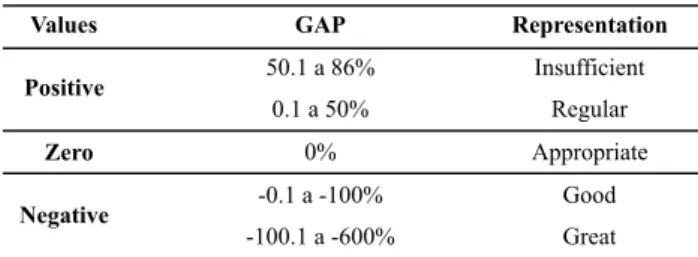
Given the results, a scale of percentage of acceptability for the GAP was developed, which allowed speciic analy
-sis of the results. According to data presented in Table 1, a posiive value means the service falls short of users’ ex
-pectaions, zero means the service is adequate and sais
-ies the user’s expectaions, while a negaive value means the services exceeded the expectaions of users.
Table 1 – Scale of the percentage of GAP acceptability and its
representation – Londrina, PR, Brazil – 2010
Values GAP Representation
50.1 a 86% Insufficient
Positive
0.1 a 50% Regular
Zero 0% Appropriate
-0.1 a -100% Good
Negative
Scores of zero concerning Expectaions and Percep
-ions were removed from data analysis because zero indi
-cates the user did not experience the situaion and there
-fore does not have an opinion concerning the statement. From the 1990s on, both public and private Brazilian organizaions in diferent sectors in the ields of manage
-ment and administraion began to contribute with instru
-ments and research methodologies to qualify managerial processes and the monitoring of the quality of services provided to ciizens/users/clients(19).
However, many criicized research addressing ‘saisfac
-ion’ due to the construct’s subjecive aspect with many determinants, such as degree of individual expectaions and requirements in relaion to services and the paient’s individual characterisics such as gender, age, social status and psychological status(20).
One of the challenges faced is the construcion of instruments to evaluate the saisfacion of service users that takes into consideraion educaional and cultural dif
-ferences and diferent ways of using the services, espe
-cially in relaion to the process’s cogniive aspects(19). A search for greater objecivity was one of the reasons for developing an instrument to measure how clients per
-ceive the responsiveness of nursing services, considering the diferent approaches, types of quesions, and how they were formulated to difer from research addressing the saisfacion of paients.
The need to develop an instrument emerged from the lack of standardizaion of instruments found in the litera
-ture that measure saisfacion and especially the lack of a speciic instrument evaluaing the responsiveness of nurs
-ing services from the perspecive of users. The purpose was to provide a reference for comparaive studies ad
-dressing responsiveness and, consequently, improve the rouines of nursing services, enabling signiicant advance
-ments in the area of health services management.
concLUSion
The evaluaion of nursing care quality can encourage health workers to improve the quality of care provided to clients and also help understanding and the measuring of the dynamics of such care. Saisfacion is a broad and subjecive construct, thus it cannot clearly evaluate care, while responsiveness indicates how the client perceives the services based on previous expectaions.
This study was conducted taking these issues into ac
-count since the objecive was to develop an instrument to evaluate the opinion of clients concerning the responsive
-ness of the nursing service of a university public hospital and idenify their expectaions and percepions.
Ater the Evaluaion of Responsiveness of Nursing Ser
-vices instrument was developed, there were the following stages: Face validaion; Applicability test; Pilot test; and Computaion of Relaive Saisfacion.
Average agreement reached among experts during the validaion phase ranged from 85% to 100% per statement, some of which required changes for the study to proceed. The applicability test conirmed the target populaion would understand the instrument, that the changes were coherent and demonstrated it can be applied either as a quesionnaire or a form. The pilot test provided data that enabled the computaion of Relaive Saisfacion Rate (RS) and interval (GAP).
This computaion in turn enabled the develop
-ment of a percentage scale concerning GAP acceptability, which may indicate the extent to which the nursing ser
-vice meets the expectaions of clients.
The objecive of this study was achieved but further studies are required to determine the instrument’s reli
-ability and the standardizaion of evaluaion of respon
-siveness so that comparaive studies can lead to the im
-provement of nursing services.
REFEREncES
1. Vituri DW, Matsuda LM. Content validaion of quality indica
-tors for nursing care evaluaion. Rev Esc Enferm USP [Inter
-net]. 2009 [cited 2010 Aug 12];43(2):429-37. Available from: htp://www.scielo.br/pdf/reeusp/v43n2/en_a24v43n2.pdf
2. World Health Organizaion (WHO). The world health report
2000: Health Systems: improving performance [Internet]. Ge
-neva; 2000 [cited 2010 Ago 15]. Available from: htp://www. who.int/whr/2000/en/
3. Vaitsman J, Andrade GRB. Saisfação e responsividade: formas de medir a qualidade e a humanização da assistência à saúde. Ciênc Saúde Coleiva. 2005;10(3):599-613.
4. Silva A. A framework for measuring responsiveness [Internet].
Geneva: World Health Organizaion; 2000. (GPE Discussion Paper Series, 32). [cited 2010 Aug 15]. Available from: htp:// www.who.int/healthinfo/paper32.pdf
5. Conselho Nacional de Saúde. Resolução n. 196, de 10 de outubro
de 1996. Dispõe sobre diretrizes e normas regulamentares de pes
-quisas envolvendo seres humanos. Bioéica. 1996;4(2 Supl):15-25.
7. Donabedian A. The deiniion of quality and approaches to its assessment: exploraions in quality: exploraions in quality assessment and monitoring. Chicago: Health Administraion Press; 1980.
8. Yuri NE, Tronchin DMR. Quality of maternal-child health care
at a university hospital, according to the nurses’ perspec
-ive. Rev Esc Enferm USP [Internet]. 2010 [cited 2010 Aug 12];44(2):331-8. Available from: htp://www.scielo.br/pdf/ reeusp/v44n2/en_13.pdf
9. Afanador NP. Indicadores de cuidado. Actual Enferm (Bogotá).
2001;4(1):13-8.
10. Mcglynn EA, Asch SM. Developing a clinical performance
measure. Am J Prev Med. 1998;14(3):14-21.
11. Cervo AL, Bervian PA, Silva R. Metodologia cieníica. 6ª ed.
São Paulo: Pearson Prenice Hall; 2007.
12. Parasuraman A, Zeithaml VA. Servqual: a muliple-item scale
for measuring consumer percepions of service quality. J Re
-tailing. 1988;64(1):12-40.
13. Linder-Pelz S. Toward a theory of paient saisfacion. Soc Sci Med. 1982;16(5):577-82.
14. Oliver R. Measurement and evaluaion of saisfacion pro
-cess in retail seings. J Retailing. 1981;57(1):25-48.
15. Queijo AF, Padilha KG. Nursing Aciviies Score (NAS):
cross-cultural adaptaion and validaion to portuguese lan
-guage. Rev Esc Enferm USP [Internet]. 2009 [cited 2010 Aug 12];43(n.esp):1018-25. Available from: htp://www.scielo. br/pdf/reeusp/v43nspe/en_a04v43ns.pdf
16. Fernandes MVL, Hallage NM. Construção e validação de in
-dicadores de avaliação de práicas de controle e prevenção de infecção do trato urinário associada a cateter. Acta Paul Enferm. 2006;19(2):174-89.
17. Berry LL, Parasuraman A. Serviços de markeing: compein
-do através da qualidade. São Paulo: Maltese-Norma; 1992.
18. Cozin SK, Turrini RNT. Avaliação dos produtos e serviços de uma biblioteca de enfermagem: saisfação do usuário. Rev Laino Am Enferm. 2008;16(4):758-64.
19. Andrade GRB, Vaitsman J, Farias LOT. Metodologia de elabo
-ração do Índice da Responsividade do Serviço (IRS). Cad
Saúde Pública. 2010;26(3):523-534
20. Sitzia J, Wood N. Paient saisfacion: a review of issues and
concepts. Soc Sci Med. 1997;45(12):1829-43.
Appendix
Instrument of Evaluation of Responsiveness of Nursing Service – Expectations and Perceptions
ASPECTS OF HEALTH CARE DELIVERY
A A)ASPECTS RELATED TO THE STRUCTURE 0 1 2 3 4 5 6 7
1E The nursing staff should be concerned to ensure appropriate air circulation in the room/nursing ward (natural or artificial ventilation) so the environment remains ventilated
1P The nursing staff was concerned about ensuring appropriate air circulation in the room/nursing ward (natural or artificial ventilation) so the environment remained ventilated.
2E The room/nursing ward should be structured with appropriate conditions of conservation and functionality, with painting in order, no rust, having working drawers and doors, and satisfactory hygienic and cleaning conditions.
2P The room/nursing ward's furniture is in appropriate condition in terms of conservation and functionality, with painting in order, no rust, working drawers and doors, and in satisfactory hygienic and cleaning conditions.
3E The hospitalization unit should offer clothing for personal use, bedding and bathing in sufficient quantity and in appropriate conditions of hygiene.
3P Clothing for personal use, bedding and bath was provided by the service in sufficient quantity and in appropriate hygienic and conditions.
4E The room/nursing ward should be kept clean and organized; it should be cleaned at every shift and whenever necessary. 4P The room/nursing ward was kept clean and organized and was cleaned at each shift and when necessary.
5E The nursing staff should offer food to patients at the time they need or ask, encouraging them to eat and provide a table or other means to meet the patients' needs.
5P The nursing staff offered food when I needed or asked, encouraging me to eat and provided a table or other means to facilitate or meet my needs.
6E The hospital's signalization (signs on walls and guide strips on the ground) should be clear and understandable so to facilitate the movement of patients and their families in a smooth manner.
6P I am able to move around the hospital following the signalization system (signs on the walls and strips on the ground) smoothly and safely.
7E The number of nursing workers should be sufficient to meet the needs of inpatients. 7P I think that the number of nursing workers is sufficient to meet all my needs.
8E The nursing staff should not be continuously overloaded. 8P I do not think that nursing staff is continuously overloaded.
9E The unit's employees should have Knowledge, Technical Competence, Technical Ability, and Organization to offer safe care and do not expose patients to evitable risks.
9P The unit's employees have Knowledge, Technical Competence, Technical Ability, and Organization so that I feel safe during care delivery.
10E The patient should be ensured the right to contact his/her physician(s) whenever s/he feels necessary.
6P The unit's nursing staff always uses a visible and legible badge with their names, professions and pictures on it.
B.2.2. AUTONOMY
1E The patient should have the right to access information concerning alternative nursing treatment.
1P I was informed about alternative nursing treatment and could decide based on my right to either consent or not to the provided treatment.
2E The patient should have the opportunity to talk with the nurses concerning treatment and diagnosis
2P I had the opportunity to talk with the nurse about my treatment
B.2.3. SOCIAL SUPPORT
1E The patient should have permission to receive visits by family and friends
1P I received or had permission to receive visits by family and friends
2E Patients should be allowed to practice their religions as long as these do not interfere in the work/treatment process.
2P I was allowed to practice my religion as long as it did not interfere in the work/treatment process.
3E The patient should be allowed to bring in food/articles not provided by the hospital that do not harm their treatment.
3P I was allowed to bring in food/articles that I needed/preferred as long as they were not provided by the hospital and did not harm my treatment
4E The patient should have access to radio, TV, newspaper or other type of reading material as long as it does not interfere in their treatment or disturb the other patients in the room.
4P I had access to radio, TV, newspaper or other type of reading as long as it did not interfere in my treatment or that of my roommates.
5E The legal right to have a companion (elderly, child, adolescent, pregnant women/just gave birth) should be ensured for patients, as long as the unit's structure permits.
5P I had my right to remain with a companion (elderly, child, adolescent, pregnant women/just gave birth) honored because the unit's structure allowed it.
B.2.4. COMUNICAÇÃO/INFORMAÇÃO
1E The patient should have the opportunity to be listened to by the nursing staff
1P The nursing staff listened me to when I needed to talk and I observed that the other patients also had the opportunity to be listened to.
2E The patient has the right to be informed concerning the sector's standards and routines, and their treatment and diagnosis in a clear, objective and understandable manner.
2P Information concerning the unit's standards and routine, my treatment and diagnosis were clearly provided in an objective and understandable manner.
3E The patient and family have the right to access the patient's medical file.
3P My family and I were able to exercise our right to access information contained in the medical file when we asked.
B.3. WORK PROCESS
1E The nursing staff should identify themselves (name and profession) to patient during the first contact.
1P The nursing staff always identified themselves by name and profession at the first time we met, as well as to the other patients.
2E The unit nurse's role/function (educational, care, managerial, supervision) should be clear and apparent to patients.
2P It is clear and apparent to me that the nurse manages the unit, supervises the technicians and auxiliaries, provides care to more severe patients and instructs employees concerning care they have, doubts or on new procedures.
B A)ASPECTS RELATED TO THE PROCESS 0 1 2 3 4 5 6 7
B.1. ACESS
1E Time spent from the beginning of my hospitalization and accommodation in the unit should be brief so as not to cause any discomfort to the patient
1P Time spent from the beginning of my hospitalization and my accommodation in the unit was not long so that I did not feel uncomfortable or upset.
B.2. CARE
B.2.1. INTERPERSONAL ASPECTS
1E The nursing staff should care for patients in a Friendly manner with Affection, Warmth, Dedication, Attention, Dignity and Respect.
1P The nursing staff cares for patients in a Friendly manner with Affection, Warmth, Dedication, Attention, Dignity and Respect.
2E The nursing staff should assist patients in order to ensure their individuality and respect their ethical and moral values.
2P The nursing staff provided assistance in such a way that they ensured my individuality and respected my ethical and moral values, as well as those of the other patients.
3E The nursing staff should respect and ensure the privacy of patients
3P The nursing staff always respected my privacy while performing procedures/providing treatment as well as for the other patients.
4E The nursing staff should keep confidentiality in regard to issues involving patient/family and diagnosis/treatment, caring for patients with no prejudice or privilege
4P The nursing team does not comment on issues involving my diagnosis/treatment nor on issues concerning my family and me and they treat patients with no prejudice or privilege. This is also the case for the other patients.
5E The patient should be identified by name while hospitalized in the unit.
5P The other patients and myself are identified by name when being cared for or called by the nursing team in the unit.
3E The role/function (care) of the unit's medium level nursing workers (auxiliaries and technicians) should be clear and apparent to patients.
3P It is clear and apparent to me that the role/function of nursing technicians and auxiliaries is to provide care, administer medication, transport patients and meet their needs.
4E The unit's routines should be flexible to permit patients to adapt so that humanized care is ensured (bath time, visits, companions, etc.).
4P The unit's routine is flexible in a way that allows for exceptions when I have some special need.
5E Care actions should be continuous, that is, health promotion/recovery actions should not be interrupted between shifts or weekends.
5P All nursing care actions were continuous between shifts and during weekends and constant care was ensured.
C ASPECTS RELATED TO OUTCOMES 0 1 2 3 4 5 6 7
1E Improvement/maintenance of the patient's health condition is expected with the implementation of treatment as long as the patient does not present any complication accruing from adverse events and/or has no further possibility of therapeutic action.
1P I perceive my health has improved with the beginning of treatment or at least my condition has been maintained as I experienced no complications during my hospitalization
2E All the exams and treatment should be accelerated to ensure continuity of care and prevent complications