RESUmo
Este estudo objeivou apresentar uma visão panorâmica da produção cieníica sobre os Centros de Atenção Psicossocial (CAPS). Trata-se de revisão bibliográica a parir das bases de dados LILACS, MEDLI-NE e SciELO. Foram selecionadas 68 refe-rências. Dessas, a maioria era de arigos de periódicos (88,24%) e de trabalhos relacio-nados à conclusão de cursos de pós-gradu-ação (10,29%); 75% das referências foram incluídas a parir do ano de 2003. Dentre os objeivos mais frequentes, destacam-se: a análise e avaliação da nova proposta as-sistencial em saúde mental, representada pela Reforma Psiquiátrica e pelo CAPS, e a análise dos proissionais de saúde mental e suas expectaivas quanto aos serviços. Espera-se que a presente revisão contribua para releir caminhos e implicações que (re)conigurem novos trabalhos cieníicos e práicas no coidiano dos serviços.
desCriTores Saúde mental
Serviços de Saúde Mental Assistência em Saúde Mental
The scientific production of
Psychosocial Care Centers
O
r
i
g
i
n
a
l
a
r
ti
c
le
AbsTrACT
The objecive of this study was to present a panoramic view of the scieniic produc-ion regarding Psychosocial Care Centers (CAPS). This literature review was per-formed using the LILACS, MEDLINE, and SciELO databases. Sixty-eight references were selected, most of which were journal aricles (88.24%) and studies related to i-nal graduate study essays (10.29%); 75% of the references found daing from 2003 were included. The following are highlight-ed among the most frequent objecives: the analysis and evaluaion of the new pro-posal for mental health care, represented by Psychiatric Reform and by CAPS, and the analysis of mental health professionals and their expectaions towards the services. The authors hope the present review will help ind pathways and implicaions that lead to new studies and pracices in the ev-eryday work of health care services.
desCriPTors Mental health Mental Health Services Mental Health Assistance
RESUmEn
Este estudio objeivó presentar una vista panorámica de la producción cieníica sobre los Centros de Atención Psicosocial (CAPs). Se trata de una revisión bibliográ-ica a parir de las bases de datos LILACS, MEDLINE y SciELO. Fueron seleccionadas 68 referencias. De ellas, la mayoría corres-pondía a arículos de periódicos (88,24%) y de trabajos relacionados a inalizaciones de cursos de posgrado (10,29%); 75% de las referencias fueron incluidas a parir del año 2003. Entre los objeivos más fre-cuentes, se destacan: análisis y evaluación de la nueva propuesta de atención en sa-lud mental, representada por la Reforma Psiquiátrica y por el CAPs, y análisis de los profesionales de salud mental y sus expec-taivas en cuanto a los servicios. Se espera que la presente revisión contribuya a re-lexionar sobre caminos e implicancias que (re)coniguren nuevos trabajos cieníicos y prácicas en el coidiano de los servicios.
desCriPTores Salud Mental
Servicios de Salud Mental Atención en Salud Mental
Laura regia oliveira Cordeiro1, Murilo santos oliveira2, rozemere Cardoso de souza3
Produção científica sobre os centros de atenção Psicossocial
título do artigo em esPanhol, título do artigo em esPanhol, título do artigo em esPanhol, título do artigo em esPanhol
1 Medicine undergraduate student, Universidade Estadual de Santa Cruz. Fellow of the Scientiic Initiation Program, Fundação de Amparo à Pesquisa do
Estado da Bahia. Ilhéus, BA, Brazil. [email protected] 2 nursing undergraduate student, universidade estadual de santa cruz. ilhéus, ba,
116
Rev Esc Enferm USP 2012; 46(1):115-9 www.ee.usp.br/reeusp/The scientiic production of Psychosocial Care Centers
Cordeiro LRO, Oliveira MS, Souza RC
iNTrodUCTioN
The model of mental health care, based on the ex-clusion of the subject from the social life, with his/her hospitalizaion in psychiatric hospitals, has showed signs of breakdown since the 1970’s. Ater the movements of criicism towards this model, oicial documents ap-peared concerning the Contemporaneous Psychiatric Re-form(1). Among them, the Declaraion of Caracas stands out, which is related to the protecion of the human and ciizenship rights of people with mental disorders and the need to develop networks of subsitute services from psy-chiatric hospitals and, in Brazil, the law 10216, also known as Brazilian Psychiatric Reform Law, which gives coninuity to the achievements of the Declaraion of Caracas(2-4).
This law has entered the senate in 1989 and was of-icially approved in the country only 12 years later, in April 2001. It defends the beneit to life, aimed at achieving re-covery through the inserion of the family into the work and into the community and emphasizing the use of com-munity services in mental health and treatment that aims at the social reinserion of people with
men-tal disorders(4).
In agreement with the Psychiatric Re-form, the Psychosocial Care Centers (CAPS), regulated through the regulaion of Min-isterial Decrees no. 336 from February 19 of 2002, are strategies of community ser-vices that work as organizaional deser-vices in mental health care with emphasis on psy-chosocial rehabilitaion(5-6). In this context, the CAPS were also recognized at the IV Naional Conference of Intersectorial Men-tal Health as subsituive care device, high-lighing its strategic funcion as ariculator of the network of services and the need to
strengthen intersectorial partnerships(7). The CAPS have showed efeciveness in the treatment allying clinical monitoring and the care for social inserion of the users through accessibility to work and leisure, as well as the exercise of civil rights and the (re)construcion of family and community bonds(1,8-9).
One of the inaugural milestones of the new paradigms in mental health is the CAPS Prof. Luiz Rocha Cerqueira, established in 1987, in the city of São Paulo(6,10). It be-came a type of insigator of a care model for the Brazilian psychiatry(10), a precursor of a technical proposal that is, pracically, recent, innovaive and ambiious.The numer-ous services implemented in the country is a result of the oicial-poliical reform of the government, the theorei-cal foundaions that led to the creaion of the CAPS and the success that their acions seem to have reached. Data from 2006 showed that the number of CAPS has increased from approximately 200 in 2002 to over 860 in 2006. This growth, according to the Ministry of Health, in December 2008, has reached a total of 1326(11).
In face of these consideraions and, also, the experi-ence at the Psychosocial Care Center of the city of Ilhéus, Bahia, the authors were interested to idenify the scien-iic producion related to this device, based on the fol-lowing guiding quesions: when and how does the scien-iic producion approach the themes related to the CAPS? Which of the gaps exising in this producion implicate in challenges for new studies regarding this service?
Therefore, this study presents a panoramic view of the scieniic producion regarding the Psychosocial Care Cen-ters (CAPS), published in health databases in the period from 1989 to 2008, and may contribute to relect path-ways and implicaions that conigure new pracices in the rouine of the services.
mETHoD
This study consists of a literature review regarding the scieniic producion proile of the CAPS. The literature review was performed using the LILACS - Lain American and Caribbean Literature in Health Sciences, MEDLINE - Medical Literature Analysis and Retrieval System Online and SciELO - Scien-iic Electronic Library Online databases, us-ing the descriptor Psychosocial Care Center, and including publicaions in Portuguese and in English.
LILACS provided 98 references. Among these, 39 were excluded, as they did not refer to Brazilian CAPS, resuling in 59 na-ional references. In MEDLINE there were 300 references, however, only 10 addressed Brazilian CAPS. Four of these 10 references were excluded because they had already been catalogued in the LILACS database. Fi-nally, SciELO presented 19 references, from which 16 were excluded because they had already been included in the list from the irst surveyed databases. The 68 references collected for the sample consisted of aricles, theses and book chapters. This material was organized according to the following items: references; addressed theme; types of study; objecives; context (study locaion); authors and main results. The informaion was obtained by analyzing the abstracts. Data were subjected to staisical analysis of numerical and percentage frequency.
resULTs ANd disCUssioN
All 68 references were analyzed. Regarding the type of producion, the most frequent were journal aricles (88.24%) and master’s theses (4.41%). It is observed that only seven (10.29%) references found are associated to studies of post graduaion courses (specializaion, mas-ter’s and doctor’s degree) and only one (1.47%) consisted of a book or book chapter.
When and how
does the scientiic production approach
the themes related
to the caPs? Which
of the gaps existing in this production implicate in challenges
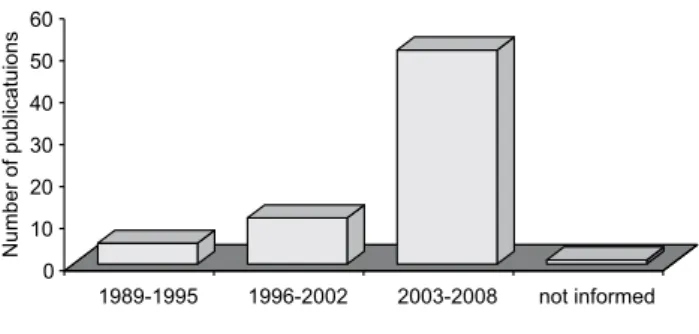
In the analysis of the years of publicaion, ive (7.35%) references were found in the period from 1989 to 1995, with the irst publicaion in 1989 resuling in the mean of approximately 0.71 publicaions a year. In the seven fol-lowing years, from 1996 to 2002, there was a producion 220% higher than that from the previous period (1989 to 1995), in other words, a total of 11 (16.18%) of the ana-lyzed references. From 2003 to 2008, the authors found 51 (75%) of the analyzed references, observing an increase of 463.64% in the producion in relaion to the previous pe-riod (1996 to 2002), resuling in a mean of approximately 8.5 producions a year (Figure 1).
This coninuous increase in the producion of studies regarding the CAPS may be associated with the changes in the model of treatment in mental health from the tra-diional model, based on the exclusion of the subject from his/her social life – almost exclusive unil 1970 –, to the healthcare model, which aims at the inclusion of the sub-ject into society(1). Based on this process, an increase is observed in the interest of researchers to assess and un-derstand all aspects of the CAPS, namely, in the latest pe-riod from 2003 to 2008, which precedes the approval of law no. 10216(4) in Brazil, with a more opened discussion about mental health.
Regarding the context of the studies analyzed, there is a concentraion of 73.91% of the references in the south and southeast regions, with 29 (42.02%) references in the state of São Paulo and 10 (14.49%) in Rio Grande do Sul. Only 2.90% were found in the northeast region and 23.19% of the references did not present informaion re-garding the study locaion, despite it being a ield study (Table 1). This disparity and the highlight of the context in the south and southeast regions demonstrate the need for studies in order to understand the reason of this low producion, the way the associaion of the implementa-ion of mental health services at CAPS is made and the development of studies regarding this service in other re-gions of Brazil.
The number of contexts presented is higher than the number of references analyzed, because a study com-pared a CAPS from Rio de Janeiro to one from São Paulo. In general, the studies were developed in the CAPS facil-ity (53) and some compared these areas to other environ-ments such as: Psychiatric Hospitals, Family Health Units, Psychosocial Care Nucleus (NAPS), Day Hospitals, Thera-peuic Residences and Damage Reducion Service.
Figure 1 – Numerical distribution of the national references
re-garding CAPS in the period from 1989 to 2008.
0 10 20 30 40 50 60
1989-1995 1996-2002 2003-2008 not informed
Number
of
publicatuions
Table 1 – Numerical and percentage distribution of references
regarding CAPS, according to the study context, in the period from 1989 to 2008
Context-State N %
Bahia 1 1.45
Ceará 1 1.45
Minas Gerais 3 4.35
Paraná 2 2.90
Rio de Janeiro 5 7.25
Rio Grande do Norte 1 1.45
Rio Grande do Sul 10 14.49
Santa Catarina 1 1.45
São Paulo 29 42.02
Not available 16 23.19
Total 69 100
Table 2 – Numerical and percentage distribution of articles
pu-blished regarding CAPS, according to the journal indexed, in the period from 1989 to 2008
Journal
Revista Texto & Contexto Enfermagem 9 15.00
Jornal Brasileiro de Psiquiatria 6 10.00
Revista da Escola de Enfermagem da USP 5 8.33
Revista Enfermagem UERJ 4 6.67
Revista Ciência & Saúde Coletiva 4 6.67
Revista Latino-Americana de Enfermagem 3 5.00
Revista de Terapia Ocupacional da USP 3 5.00
Cadernos de Saúde Pública 3 5.00
Outros periódicos 19 33.33
Not available 4 5.00
Total 60 100
N %
Considering only the aricles, according to the journal in which they were published, it was found that the 60 ar-icles ideniied in the survey were published on 27 difer-ent journals. The category other journals included 18 jour-nals that presented only one publicaion regarding the central theme of this study, CAPS, and one journal that presented two publicaions. Regarding the other jour-nals, listed in Table 2, those with the most publicaions were: Revista Texto e Contexto (15%), Jornal Brasileiro de Psiquiatria (10%) and Revista da Escola de Enfermagem da USP (8.33%).
so-118
Rev Esc Enferm USP 2012; 46(1):115-9 www.ee.usp.br/reeusp/The scientiic production of Psychosocial Care Centers
Cordeiro LRO, Oliveira MS, Souza RC
cial communicaion; physical educaion and physics, and there were no references ideniied regarding the areas of 20.28% of the authors. Among the authors ideniied, all of them presented at least an undergraduate degree in their area, observing, in this context, a gap regarding the paricipaion of undergraduate students in the producion of studies about CAPS.
According to the methodological approach used in the references, it was observed that 65 (95.59%) of the stud-ies had qualitaive character and only two (2.94%) were quanitaive, but one of these studies presented both quanitaive and qualitaive aspects. Only in one refer-ence (1.47%) the abstract was not available, therefore it was not possible to classify the type of study.
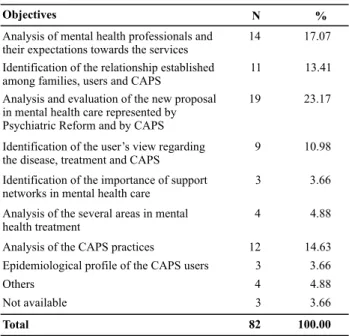
Table 3 presents the main objecives of the analyzed references, which were grouped according to the general theme they aimed to address in order to facilitate con-tent invesigaion. Therefore, the most frequent objec-ives were: analysis and evaluaion of the new proposal in mental health care represented by Psychiatric Reform and by CAPS (23.17%); analysis of mental health profession-als and their expectaions towards the services (17.07%); analysis of the CAPS pracices (14.63%); ideniicaion of the relaionships established among families, users and CAPS (13.41%) and ideniicaion of the user’s view regarding the disease, treatment and CAPS (10.98%). The next table highlights publicaions with objecives that aimed at social networks in mental health, new pers-pecives of treatment in mental health and, also, the pro-ile of the CAPS users, totalizing 20.74% of the explicit objecives.
The studies about the analysis and evaluaion of the new proposal in mental health care, represented by Psy-chiatric Reform and CAPS, represented the objecive that was most oten addressed in the surveyed abstracts (23.17%). Eight of these abstracts (42.11%) pointed to a historical retrospecive in the change of the paradigm for mental health care. Five (26.32%) referred both to the need for evaluaive methodologies regarding the new CAPS service and the efecive methodology type for a coherent evaluaion of the work developed. Others ad-dressed the theme through the analysis of the service transfer from a Hospital to a Psychosocial Care Center (21.05%). In the results of the studies, presented in the abstracts, it is observed that there is a need to work, regarding the Psychiatric Reform, both with the profes-sionals involved in the process of change and with the society in general. Furthermore, two percepions are ob-served regarding the inluence of CAPS: one that evalu-ates the service as a facilitator of change in the users’ life and as care device indicated for the new paradigms of mental health (99.95%), and another that evaluates it as efecive only to assist paients stabilized at a poor clini-cal degree from the afecive and ideaional point of view (0.05%). It is worth highlighing that, in the evaluaion developed, the conclusions of the abstracts did not point out only the quality of the services but also the failures; always searching for an alternaive for improving, aimed at applying a process of acion-relecion-acion.
In the analysis of the abstracts of studies that ad-dressed health professionals and their expectaions towards the services (17.07%), it was observed that 12 (85.71%) studies were centered on understanding the professionals’ view of the interdisciplinary work at CAPS and their preparaion to assume their roles in the care strategy. One of the studies evaluated this theme not only with a health team but also with a focal group in-volving users, families and professionals. In 100% of the results of these studies it was possible to observe the need for investment in the qualiicaion of professionals to work in the mental health care model and the view of the professionals regarding the services as an efecive strategy, despite the fact that their knowledge is sill as-sociated with the tradiional psychiatric care model. The other two studies (14.29%) evaluated the efeciveness of Brazilian scales elaborated by the WHO to measure saisfacion and the burden of mental health profession-als; and found that these scales were efecive.
The studies regarding the pracices of CAPS, which represented 14.63% of the studied abstracts, always ad-dressed the evaluaion of new technologies and their perspecives for changing the mental health paradigm. Among these studies, it is important to highlight that two (16.66%) analyzed the efeciveness of the thera-peuic group pracice and two (16.66%) evaluated in-cluding pracices involving families, aimed at beter ef-feciveness. One of the studies (8.33%) analyzed mental
Table 3 – Numerical and percentage distribution of national
refe-rences regarding the CAPS, according to the objectives approa-ched, in the period from 1989 to 2008.
Objectives
Analysis of mental health professionals and their expectations towards the services
14 17.07
Identification of the relationship established among families, users and CAPS
11 13.41
Analysis and evaluation of the new proposal in mental health care represented by Psychiatric Reform and by CAPS
19 23.17
Identification of the user’s view regarding the disease, treatment and CAPS
9 10.98
Identification of the importance of support networks in mental health care
3 3.66
Analysis of the several areas in mental health treatment
4 4.88
Analysis of the CAPS practices 12 14.63
Epidemiological profile of the CAPS users 3 3.66
Others 4 4.88
Not available 3 3.66
Total 82 100.00
health care regarding the pracices, poining out the need to know the service pracices and aimed problema-izing them so that they may actually support overcom-ing asylum pracices.
Regarding the studies that addressed the theme of idenifying the relaionships established among families, users and CAPS (13.41%), four main lines of study were observed: work overload in the rouine of caregivers and the psychological distress resuling from it — four stud-ies (36.36%) —; the importance of the partnership be-tween families and CAPS for the treatment — three stud-ies (27.27%) — and family’s knowledge regarding the treatment and the Psychiatric Reform — three studies (27.27%). One study (9.1%) addressed the family regarding the associaion of primary healthcare (Family Health Pro-gram) and mental health care. Among the results found, it is worth highlighing the conirmaion of the great im-portance found in establishing bonds between families and CAPS for the improvement of both the treatment in users and the quality of life of caregivers. Two gaps are observed in the analysis of these abstracts: the analysis of the relaionships between families and paients with men-tal disorders and the study of the socioeconomic condi-ion of the families.
CoNCLUsioN
This study permited to verify an increase in the num-ber of publicaions regarding CAPS in the last years, main-ly since 2001, ater the approval of the Psychiatric Reform Law and the incenives of the government for the imple-mentaion of replacement services in mental health care.
It also allowed to characterize the development pro-cess of the current knowledge and to guide new study projects. It was observed that the studies evaluate the new model of mental health treatment and its pracices.
It ideniied the need for studies regarding the social and socioeconomic characterizaion of the subjects in-volved in the mental health context; the relaionship of bonding and familiarity exising between families and mental health paients, and the therapeuic iinerary of the service users, analyzing the community care pracices in which they are inserted aside from CAPS.
It is also necessary to think about the orientaion of studies in order to understand the centralizaion of the scieniic producion in the south and southeast regions of the country, analyzing the relaionship between the imple-mentaion of the service and the development of studies.
Finally, the authors hope this review may act as an en-couragement for new studies regarding Psychosocial Care Centers (CAPS), and contribute with relecions to estab-lish the course and efects of the daily pracices of health care services.
reFereNCes
1. Schrank G, Olschowsky A. O Centro de Atenção Psicossocial e as estratégias para a inserção da família. Rev Esc Enferm USP. 2008;42(1):127-34.
2. Organização Mundial de Saúde (OMS); Organização Pan-Americana de Saúde (OPAS). Declaração de Caracas. Reestru-turação da Atenção Psiquiátrica na América Laina no Contex-to dos Sistemas Locais de Saúde (SILOS) [Internet]. Caracas; 1990 [citado 2009 set. 12]. Disponível em: htp://bvsms. saude.gov.br/bvs/publicacoes/declaracao_caracas.pdf
3. Hirdes A. A reforma psiquiátrica no Brasil: uma (re)visão. Ciênc Saúde Coleiva. 2009; 14(1):297-305.
4. Brasil. Lei n. 10.216, de 6 de abril de 2001. Dispõe sobre a pro-teção e os direitos das pessoas portadoras de transtornos men-tais e redireciona o modelo assistencial em saúde mental [Inter-net]. Brasília; 2001 [citado 2009 ago. 15]. Disponível em: htp:// www.planalto.gov.br/ccivil_03/Leis/LEIS_2001/L10216.htm
5. Leão A, Barros S. As representações sociais dos proissionais de saúde mental acerca do modelo de atenção e as possibili-dades de inclusão social. Saúde Soc. 2008;17(1):95-106.
6. Brasil. Ministério da Saúde; Secretaria de Atenção à Saúde; Departamento de Ações Programáicas Estratégicas. Saúde Mental no SUS: os Centros de Atenção Psicossocial. Brasília; 2004.
7. Brasil. Ministério da Saúde; Conselho Nacional de Saúde. Relatório inal da 4ª Conferência Nacional de Saúde Mental. Brasília; 2010.
8. Saraceno B. Libertando idenidades: da reabilitação psicosso-cial à cidadania possível. Rio de Janeiro: Te Cora; 1999.
9. Aranha e Silva AL, Fonseca RGS. Projeto Copiadora do CAPS Luis Cerqueira: do trabalho de reproduzir coisas à produção de vida. Rev Esc Enferm USP. 2002;36(4):358-66.
10. Tenório F. A reforma psiquiátrica brasileira: da década de 1980 aos dias atuais: história e conceitos. Hist Ciênc Saúde Manguinhos. 2002;9(1):25-59.