RESUmo
Este estudo clínico randomizado objeivou avaliar os níveis de estresse na equipe de Enfermagem de um hospital e analisar a efeividade da auriculoterapia com agulhas e sementes. 75 pessoas com escores médio
(44/58,7%) e alto (31/41,3%) de acordo com a Lista de Sintomas de Estresse foram
divididas em grupos (controle, agulhas e sementes), que receberam oito sessões nos pontos Shenmen, Rim e Tronco Cerebral e foram avaliados no início, com quatro, oito sessões e follow-up (15 dias). Na análise de variância (ANOVA), constataram-se di-ferenças entre os grupos, na 3ª avaliação (F=3,963/P=0,023) e follow-up (F=6,136/ P=0,003). Tais diferenças foram entre o grupo controle e agulha. Os grupos de in-tervenção mostraram diferenças (P<0,05) a parir da segunda avaliação, quando com-parados dentro do mesmo grupo. Concluiu--se que a auriculoterapia reduziu o estres-se em proissionais de enfermagem, com melhores resultados para agulhas do que
sementes, em escores altos, com manuten
-ção de efeitos por 15 dias.
dEScRiToRES
Estresse
Equipe de enfermagem Auriculoterapia
Terapias complementares Acupuntura
The applicability of auriculotherapy
with needles or seeds to reduce stress
in nursing professionals
O
r
i
g
i
n
a
l
a
r
ti
c
le
AbSTRAcT
This clinical randomized trial was performed with the objecive to evaluate the stress lev-els of the nursing staf of a hospital and ana-lyze the efeciveness of auriculotherapy with needles and seeds. The 75 paricipants with
mean (44/58.7%) and high (31/41.3%) scores
according to the Stress Symptoms List were divided into groups (control, needles, and seeds), who received eight sessions on the Shenmen, Kidney and Brainstem points and were evaluated at the baseline, fourth and eighth sessions and on the 15-day follow-up session. The analysis of variance (ANOVA) showed signiicant diferences among the groups at the third assessment (F=3.963/ P=0.023) and follow-up (F=6.136/P=0.003). These diferences occurred between the control and needle groups. The ‘seeds’ and
needles groups both showed diferences
(p<0.05) at the second assessment when compared within the same group. In conclu-sion, auriculotherapy reduced the stress in the nursing staf, with needles showing
bet-ter results than seeds for high scores, main
-taining the efects for 15 days.
dEScRiPToRS
Stress
Nursing, team Auriculotherapy
Complementary therapies Acupuncture
RESUmEn
Estudio clínico randomizado que objeivó evaluar niveles de estrés en equipo de En-fermería de un hospital y analizar la efec-ividad de la auriculoterapia con agujas y semillas. 75 personas con puntajes medio
(44/58,7%) y alto (31/41,3%) según Lista
de Síntomas de Estrés fueron divididas en grupos (control, agujas y semillas), reci-bieron ocho sesiones en puntos Shenmen, Rim y Tronco Cerebral, y fueron evaluadas al inicio, con cuatro, ocho sesiones y follow up (15 días). En análisis de varianza (ANO-VA) se constataron diferencias entre los grupos, en la tercera evaluación (F=3,963/ p=0,023) y follow up (F=6,136/P=0,003). Las diferencias corresponden a grupos con-trol y agujas. Los grupos de intervención mostraron diferencias (P<0,05) a parir de segunda evaluación, comparados dentro del mismo grupo. Se concluyó en que la au-riculoterapia redujo el estrés en
profesio-nales de Enfermería, con mejores resulta
-dos con agujas sobre semillas, en puntajes altos, con mantenimiento de efectos por quince días.
dEScRiPToRES
Estrés
Grupo de enfermería Auriculoterapia
Terapias complementarias Acupuntura
Leonice Fumiko Sato Kurebayashi1, Juliana Rizzo Gnatta2, Talita Pavarini borges3, Geysa belisse4,
Suzana coca5, Akemi minami6, Telma moreira Souza7, maria Júlia Paes da Silva8 AplicAbilidAde dA AuriculoterApiA com AgulhAs ou sementes pArA diminuição de estresse em profissionAis de enfermAgem
AplicAbilidAd de AuriculoterApiA con AgujAs o semillAs pArA disminución de estrés en profesionAles de enfermeríA
1 nurse Acupuncturist. master in nursing, university of são paulo. nurse coordinator of the Acupuncture course, instituto de terapia integrada e oriental. são paulo,
sp, brazil. [email protected] 2 master student of the graduate program in Adult health nursing, university of são paulo school of nursing. são paulo, sp, brazil.
[email protected] 3 nurse, graduated by university of são paulo school of nursing. são paulo, sp, brazil. [email protected] 4 nurse, graduated
by university of são paulo school of nursing. são paulo, sp, brazil. [email protected] 5 nurse, graduated by university of são paulo school of
nursing. são paulo, sp, brazil. [email protected] 6 nurse, university hospital, university of são paulo. são paulo, sp, brazil. [email protected] 7 nurse,
university hospital, university of são paulo. são paulo, sp, [email protected] 8 full professor, department of medical-surgical nursing, university of
inTRodUcTion
Stress is a state of tension that causes an unbalance in
the organism, being present in new or risk situaions that exceed the person’s adapive capability. It is a
physiologi-cal state of tension and is directly related to the demands
from the environment. When stress happens, there is a rupture in the body homeostasis(1), caused by a biological
reacion of confrontaion or escape, generaing responses in the organism that afect the bio-psycho-physiology of the subject. Persistent criical situaions without resolu-ion afect the subject emoresolu-ionally and physically, causing consequences such higher blood pressure, pepic ulcers, cancer, stroke, psoriasis, viiligo, increase of the adrenal gland, decrease of the thymus and lymph nodes, leading to the depression of the immune system(2).
Stress is present in the daily lives of at least 90% of the world populaion. In face of this fact, specialists and insituions combine eforts to propose means that aim at controlling the negaive aspects of stress. The World Health Organizaion(3) considers that high levels of stress
at work harm the physical and psychological health of workers, besides having a nega-ive efect on the results of the organizaions where they work. In fact, a stressed worker is more subject to diseases, less moivated, less producive and insecure regarding his/ her acions.
The hospital environment is recognized
as insalubrious, burdensome and also dan
-gerous for those working there. It is a fa-vorable place to cause sickness due to oc-cupaional, biological, chemical, physical and psychosocial risks. These condiions determine an environment favorable to
de-veloping mental disorders such as anxiety, depression and
stress(4). Besides the working environment of nursing, the
profession, itself, is considered stressful due to the direct and coninuous contact with the process of pain, death, sufering and due to the unpredictable, and, at imes, re-pulsive and distressing situaions he/she experiences.
The theory of Martha Elizabeth Rogers (1970), whose conceptual model focuses on human being as a whole, presents interfaces with the principles that rule the Chi-nese tradiional medicine, mainly in terms of energeic interacions(5). According to Rogers, in Science of Unitary
Human Beings, the person is seen as a uniied,
indivis-ible being, integrated to the environment, characterized as an energeic ield in interacion to a pandimensional universe. This theory allows to restructure nursing care, educaion and research beyond the analyical and reduc-ionist approach of the western medical model(5). In this
perspecive, it is understood that the care task implicates in the exchange and interacion between the energeic ields of those who assist and are assisted, and suggests that caregivers must be atenive to their own energeic
and health condiion. Being in balance before providing or promoing care is a responsibility that must be assumed by the professionals that take care of an unbalanced sub-ject, producing more posiive outcomes(6).
In this context, the authors aimed at allying a
concep-tual nursing model based on the energy and the eastern
therapies, which are based on the QI paradigm — an en-ergy manifested in the physical and spiritual ields that lows in variable states of aggregaion. Due to this reason, a complementary health pracice (CHP) was chosen, in this case the Chinese auriculotherapy or auricular acu-puncture. In this study, this therapy aims at helping to reduce the stress levels in nursing professionals, since it may afect negaively the care ofered to the paient, fam-ily, team, as well as the workers’ well-being and quality of life, also interfering in the quality of care(7).
Auriculotherapy is one of the techniques used in Chi-nese tradiional medicine, associated to acupuncture, phy-totherapy, massage, moxibusion, cupping, diet therapy and physical exercises(8-9). Its bases are deined in diferent
principles of convenional western medicine, staring at a concepion of the human being as an integral being, with no barriers between the mind, body and spirit. The human organism is un-derstood as a ield of energy and this integra-ive and systemic view agrees with the bioen-ergeical paradigm extended to all the other ields of health and human knowledge(10).
Both in the East and in the West, there are studies that conirm the efeciveness of the auriculotherapy in the improvement of several psychoemoional cases. Some of the beneits include: reduced stress and
anxi-ety in undergraduate students(11), improved
generalized anxiety disorders(12), reduced
anxiety and stress in paients during pre-hospital trans-portaion(13), among many other studies. In face of the
later, it is understood that auriculotherapy may be very useful in the hospital environment as it is fast, relaively simple to apply, safe and minimally invasive.
As for the ethical-legal aspects of acupuncture and auriculotherapy pracice in Brazil, the Federal Nursing Council established, through resoluion 197/97, that sev-eral complementary health pracices (CHP), including acu-puncture and auriculotherapy, are nursing specialies. As of 2006, law no. 971, from May 3, 2006, approved the Na-ional Policy of Integraive and Complementary Pracices (NPICP), which deined acupuncture as a muliprofession-al pracice, in other words, a specimuliprofession-alty of muliprofession-all categories of health professionals with higher educaion, guaranteeing the acion of the acupuncturist nurse(14).
Based on these data, this study aimed at evaluaing the applicability of Chinese auriculotherapy to reduce stress in the nursing staf of a public teaching hospital and at analyzing the efeciveness of this technique as a
both in the east and in the West, there are studies that conirm the effectiveness of the
auriculotherapy in the improvement
of several psychoemotional
therapeuic strategy. Auriculotherapy has been broadly accepted, it is safe and efecive for diferent condiions of energeic unbalance, being recognized for its posiive efects in physical, psychic and mental disorders. It has a high prevenive and therapeuic value, may be performed in 10 to 20 minutes with diferent invasive and non-inva-sive simulaion materials(15). This study quesions
wheth-er auriculothwheth-erapy with needles or seeds would produce similar outcomes regarding the reducion of stress in the nursing staf. There are few studies regarding auriculo-therapy in the Brazilian nursing area. Therefore, this study was developed considering the need for methods that help maintain the well-being of the nursing staf, reducing their stress levels.
The main objecives were to analyze the stress level of professionals from the nursing team of the Teaching Hospital and to compare the results obtained by auricu-lotherapy performed with semi-permanent needles and mustard seeds to reduce stress levels.
mETHod
Study Type and Locaion:
This randomized controlled clinical experiment was per-formed with three groups: control group (without any inter-venion), group of auriculotherapy with needles and group of auriculotherapy with seeds. The study was developed at the Teaching Hospital of the University of São Paulo.
Ethical and Legal Aspects:
The study complied with the resoluion 196/1996 of the Naional Health Council. A Free and Informed Consent Form was given to the study subjects and the paricipants who were in the Control Group were guaranteed that, ater the study, they would have the opportunity to be treated for the same period and for free. The study proj-ect was accepted by the Research Ethics Commitee of the Teaching Hospital of the University of São Paulo (Resolu-ion CEP-HU/USP 941/09).
Sample:
In order to deine the sample of paricipants, the au-thors used the Stress Inventory or Stress Symptoms List
– SSL(16). This instrument was applied to all subjects who
agreed to paricipate in the study (109); however, only subjects who achieved mean (29 to 60 points), high (61 to 120 points) or very high (>120 points) scores were in-cluded in the sample; 75 of them completed the study. As for the distribuion of the paricipants, 22 subjects were placed in the Control Group, 27 in the Needles Group and 26 in the Seeds Group.
Inclusion and Exclusion Criteria:
The inclusion criteria were: belonging to the nurs-ing team; voluntary paricipaion in the study with
avail-ability to atend the sessions; obtaining a minimum SSL score at mean, high and very high stress level; not being pregnant. The authors excluded from the sample all the subjects who went on vacaion or medical leave ater the beginning of the study; did not show up to the session or gave up due to adverse efects, and those who had low
SSL score.
Data Collecion Instruments:
The instruments used for data collecion were: the Stress Symptoms List (SSL) and a quesionnaire with so-ciodemographic data. Data were collected in the period from January to February 2010 and the sessions were per-formed in private rooms at the coninuing educaion, out-paient clinic and nursery units of the hospital.
Procedures for Data Collecion:
Data were collected in the period from January to Feb-ruary 2010 and the sessions were performed in private rooms at the coninuing educaion, outpaient clinic and nursery units of the hospital. The SSL instrument was applied before the treatment, after four sessions,
af-ter eight sessions and 15 days afaf-ter the end of the
treatment (follow-up). The intervention groups re-ceived eight sessions (one session a week), with duraion
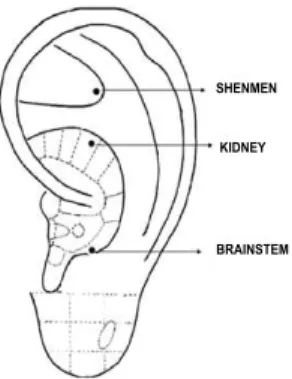
of 5 to 10 minutes each session, on the Shenmen, Kidney
and Brainstem points (Figure 1). The irst two points have calmaive properies and the kidney point has energeic funcion(9). Ater the locaion of the reacive points with
a point locator, the ear auricle was hygienized with cot-ton and ethyl alcohol 70% and, then, semi-permanent needles were applied or seeds were ixed with adhesive plaster, according to the intervenion group. In the group of auriculotherapy with seeds, mustard seeds were used and the paricipants were instructed to simulate them three imes a day, for 15 imes, with moderate pressure. The volunteers were instructed to remove the needles or seeds 24 hours before the session and, in case there was
any discomfort, itching or signs of allergy, they should re
-move them before that.
Figure 1 – Identiication of the points used in the intervention groups
KIDNEY
Data Treatment:
The mean and standard deviaion were calculated for the analysis and descripion of all the data. The normal-ity of data distribuion was veriied through Shapiro-Wilk’s test and, since distribuion was normal, parametric tests were used in the staisical analysis. The analysis of vari-ance (ANOVA) was used to evaluate the homogeneity between the intervenion groups. As for the comparison among the SSL scores in the diferent moments of the evaluaion, ANOVA was used for repeated measures. These tests were applied with the programs Microsot Of-ice Excel 2007® and Staisica 7®. The test of Bonferroni’s muliple comparisons was also performed to observe sta-isical diferences of the results among the groups.
RESULTS
The total number of paricipants was 75 nursing
pro-fessionals, being 12 nursing assistants, 49 nursing tech
-nicians and 14 nurses. They were iniially distributed ac-cording to the stress scores as mean or high level, gender and age. Besides the already menioned professionals who met the protocol, there was a loss of 34 subjects dur-ing the study. Seven professionals went on vacaion ater the beginning of the study and two on medical leave; 12 missed the session because they had forgoten it, due to
traic problems or the diiculty to reschedule it and sev-en did not show up for the irst session. One paricipant gave up due to adverse efects, in this case, nightmares, and ive exclusions were due to low score (1), not belong-ing to the nursbelong-ing team (3), and not illbelong-ing out properly the quesionnaires (1).
Out of the 75 professionals, 44 (58.7%) presented mean SSL level and 31 (41.3%) presented high stress score. There were no paricipants with very high stress level. In the fol-lowing stage, they were randomly distributed into three groups: Group 1 (Control); Group 2 (Needles) and Group 3 (Seeds). The average age of the subjects varied between 39 and 45 years. 71 were female and four male. There were professionals from the three diferent shits (morning, af-ternoon and night), who were treated ater their shit. The sectors where the paricipants worked were: Adult Emer-gency, Emergency Childcare, Medical Clinic, Surgical Clinic, Surgical Center, Hemodialysis, Nursery, Pediatrics, Room-ing-in, Outpaient Clinic, Adult ICU, Pediatric ICU, Material and Sterilizaion Center, Obstetric Center, Service of Hospi-tal Infecion Control and Health Basic Unit.
According to the results described in Table 1, there was homogeneity among the groups regarding age, period of work and iniial SSL. As for gender, there was prevalence of the female gender (71), with homogenous distribuion of the few men who took part in the study (4).
Table 1 – Mean and standard deviation of age, period of work, initial SSL score and proportion of gender in the sample - São Paulo, 2010
Control Needles Seeds p
Age (years) 39.25 (13.17) 41.37 (8.23) 45.57 (6.40) 0.51
Period of work (years) 13.91 (10.70) 14.03 (9.34) 15.37 (4.07) 0.29
Initial SSL (points) 54.36 (15.90) 66.82 (18.56) 63.27 (26.06) 0.34
Gender (%F) 91.66 96.29 96.15 0.65
Both the Needles Group and the Seeds Group pre-sented a staisically signiicant diference (p<0.05) as indi-cated by the graph represented in Figure 2, with the com-parison in ime between the sessions in the same group. This diference was found right ater the fourth session (SSL2) in the Needles Group and in the follow-up (SSL4). There was also a diference in the Seeds Group between
the SSL1 and the other scores.
The outcomes of subjects who presented mean stress level were not staisically signiicant, both in the seeds and in the needles group. However, in the high stress level, results showed a signiicant change in the needles group following the irst evaluaion (SSL2), increasing at each new evaluaion (SSL3 and SSL4). In the Seeds Group, there was a signiicant change ater the second evalua-ion (SSL3), coninuing ater the third evaluaevalua-ion (SSL4). This indicates that the Seeds Group started presening a signiicant diference between the 4th and the 8th session,
whereas the Needles Group obtained responses between
the 1st and the 4th session. Figure 2 – Meanand standard deviatio of the SSL score
80 70 60 50 40 30 20 10
0 LSS 1 LSS 2 LSS 3 LSS 4
Evolution of SSL
Control Needle Seed
p<0.05 when compared to other SSL scores in the needle group. p<0.05 in the comparison between SSL 2 and SSL 4. p<0.05 when compared with other SSL scores in the seed group.
SSL
As for the results of the ANOVA test for repeated mea-sures, there was a diference in the means among the groups when compared between SSL3/SSL1 (F=3.963/ P=0.023) and between SSL4 and SSL1 (F=6.136/P=0.003). Ater that, in the Post hoc test of Bonferroni’s muliple
comparisons, there was a staisically signiicant diference between the Control and the Needles Group (P=0.020), between SSL3/SSL1 and between SSL4/SSL1 in follow-up (P=0.003), as shown in Table 3. The Seeds Group did not present signiicant diferences.
Table 2 – Mean and standard deviation of the SSL score in the subjects with high stress level - São Paulo, 2010
LSS 1 LSS 2 LSS 3 LSS 4
Control 72.75 (12.01) 60.50 (17.48) 67.87 (25.73) 72.62 (31.51)
Needles 82.46 (18.36)* 62.69 (25.58) 59.84 (23.04) 55.54 (25.26)
Seeds 84.70 (23.97)** 74.20 (23.81) 67.10 (23.77)** 69.20 (30.03)**
Table 3 – Bonferroni’s multiple comparisons among the groups — São Paulo, 2010 * p<0.05 when compared to the other ssl scores in the needles group.
** p<0.05 when compared the ssl 1 to the ssl 3 and ssl 4.
Dependent Variable (I) Treatments (J) Treatments Mean Difference (I-J) Std. Error P
Needles 7.02189 4.95874 0.483
Control
Seeds 2.47203 5.00137 1
Control -7.02189 4.95874 0.483
Needles
Seeds -4.54986 4.74391 1
Control -2.47203 5.00137 1
DIF_2_1
Seeds
Needles 4.54986 4.74391 1
Needles 14.87542* 5.31053 0.02
Control
Seeds 9.45804 5.35618 0.245
Control -14.87542* 5.31053 0.02
Needles
Seeds -5.41738 5.08045 0.87
Control -9.45804 5.35618 0.245
DIF_3_1
Seeds
Needles 5.41738 5.08045 0.87
Needles 20.44613* 5.8792 0.003
Control
Seeds 9.17832 5.92975 0.378
Control -20.44613* 5.8792 0.003
Needles
Seeds -11.2678 5.62449 0.147
Control -9.17832 5.92975 0.378
DIF_4_1
Seeds
Needles 11.26781 5.62449 0.147
diScUSSion
In this study, it was observed that among the 75 par-icipants, only four were male. These data agree with other studies in nursing, showing that the great majority of these professionals are female. In a study at a Public Hospital of São José do Rio Preto, among the 333 stud-ied nursing professionals, 271 (81.4%) were female(17). It
is possible to state that since the beginning, women were the ones who mostly took care of sick people, because they were considered more appropriate, both culturally and socially, for this acivity.
In the staisical analysis of variance, it is observed that the results presented signiicant diferences among the groups in SSL3 and SSL4. By performing Bonferroni’s
test of muliple comparisons, it was observed that the signiicant diference occurred between the Needles and the Seeds Group, showing posiive results for the auricu-lotherapy with needles. Nevertheless, in the comparaive analysis of SSL scores within each group in ime, the Seeds Group presented a signiicant diference between SSL1 and the other evaluaions.
mag-nets, since they are not invasive and paients present
more tolerance(18). Tradiionally, auricular acupuncture
us-es both systemic and semi-permanent needlus-es as a means of simulaion.
A study developed with undergraduate students, aimed at verifying the efeciveness of auriculotherapy in the re-ducion of stress and anxiety levels with seeds, achieved signiicant improvement in stress levels with the use of seeds comparaively to the control group, using the Shen-men and Brainstem points(9). These same points were used
in other study developed at a private hospital in São Paulo to reduce stress levels in the nursing staf of the intensive
care unit(19). In this case, the same points were used, but
semi-permanent needles were inserted. The same data collecion instrument was used, the Stress Symptoms List
(SSL)(16), to evaluate the stress levels. The sample had the
paricipaion of 41 professionals and the results showed that 85.4% of the populaion presented improvement in the symptoms of stress, with a decrease of symptoms like faigue, backache, excessive eaing and iredness.
The acion mechanism of auriculotherapy has been discussed and this technique is considered to work be-cause groups of pluripotent cells contain informaion from the enire organism, creaing regional centers of organiza-ion that represent diferent parts of the body. The simu-laion of the relex point in the ear provides an acion of relief in symptoms in distant parts of the body(20).
Simu-laing points may also acivate small myelinated nervous ibers that send impulses to the spine, brain, pituitary and hypothalamus, causing the release of endorphins in the blood in the treatment of pain(21).
Another study regarding auricular acupressure as a treatment for anxiety in paients transported in an am-bulance, prior to hospitalizaion, concluded that the tech-nique was beneicial for several reasons(13). Firstly, its ex
-ecuion requires minimum equipment, so that doctors, nurses, paramedics or emergency technicians may per-form the treatment; secondly, due to the fast training to learn how to locate points and its applicaion, even with-out previous knowledge on Chinese tradiional medicine. And, inally, due to the intervenion cost, as it is nearly a cost-free treatment. In this study, which used only one point, it was concluded that the auricular acupressure may be efecive not only to reduce anxiety levels but also to prevent complicaions associated to traumaic stress(13).
The present study allowed observing that the improve-ment in the Acupuncture Group lasted for 15 days ater
the end of the treatment. In fact, it is possible to state that there was a cumulaive efect of the auriculotherapy with needles, because the posiive efects remained ater the applicaion for approximately two weeks. The same result was not observed in the Seeds Group, which presented a less emphasized response.
Adverse efects
During the auriculotherapy sessions, despite of the fact that the studied paricipants did not report major problems, some negaive responses deserve comments. Auriculotherapy was not posiive for a paient who had undergone bariatric surgery and referred efects such as increase in anxiety for food and inquietude. She had lost 40kg, almost a third of her total weight, and although she had not complained, she quit the treatment. There were indicaions in literature that acupuncture and moxibusion should not be performed in people who have not slept or eaten suiciently(22). In other words, the efect of these
therapeuic methods is to try to restore the balance, to recover the body homeostasis. It is understood, thus, that the paient may have had a contrary reacion, exactly be-cause her body needed more nutrients, increasing appe-ite. Another paient gave up ater the third session, stat-ing she had been havstat-ing nightmares as of the applicaion of the needles. It is important to highlight that this paient worked the night shit and slept during the day. Some pa-ients also reported discomfort with the applicaion and permanence of the needles, which shows a disadvantage of this material compared to the seeds. A paient referred itching in the applicaion of seeds and another adhesive material was used, which solved the problem.
concLUSion
The authors conclude that the stress levels among the nursing professions in the studied sample reached mean
(58.7%) and high (41.3%) scores, and that the auriculo
REFEREncES
1. Camelo SHH, Angerami ELS. Riscos psicossociais no trabalho
que podem levar ao estresse: uma análise da literatura. Cienc Cuid Saúde. 2008;7(2):232-40.
2. Lipp M. Pesquisas sobre o stress no Brasil. Campinas: Papirus; 1996.
3. Organización Mundial de la Salud (OMS). La organización del
trabajo y el estrés: estrategias sistemáicas de solución de problemas para empleadores, personal direcivo y represent-antes sindicales. Ginebra; 2004. (Serie Protección de la Salud de los Trabajadores, 3).
4. World Health Organizaion (WHO). Tradiional medicine
strat-egy: 2002-2005. Geneva; 2002.
5. Blumenschein L. Analysis and applicaion of Roger’s Science
of Unitary Human Beings. Visions. 2009;16(1):55-61.
6. Cox T. Unitary Health Care explained by Thomas Cox
[Inter-net]. 1998 [cited 2010 Dec 20]. Available from: htp://www.
societyofrogerianscholars.org/unitary.html
7. Harbs TC, Rodrigues ST, Quadros VAS. Estresse da equipe de
enfermagem em um Centro de Urgência e Emergência. Bol Enferm. 2008;1(2):41-56.
8. Kurebayashi LFS, Freitas GF, Oguisso T. Nurses’ percepion about
diseases that are treated by acupuncture Rev Esc Enfem USP [In-ternet]. 2009 [cited 2010 Dec 15];43(4):930-6. Available from: htp://www.scielo.br/pdf/reeusp/v43n4/en_a27v43n4.pdf
9. Landgren K. Ear acupuncture: a pracical guide. Philadelphia:
Churchill Livinsgtone; 2008.
10. Andrade JT, Costa LFA. Medicina complementar no SUS:
práicas integraivas sob a luz da antropologia médica. Saúde Soc. 2010;19(3):497-508.
11. Nakai LS. Eicácia de auriculoterapia no tratamento de
es-tresse e ansiedade de estudantes universitários [Internet]. São Paulo; 2008 [citado 2010 jul.2]. Disponível em: htp:// www.usp.br/siicusp/Resumos/16Siicusp/1763.pdf
12. Zaragoza Peña H, Faure Vidal A. Auriculoterapia y itoterapia
en los trastornos generalizados de ansiedad. Rev Hosp Psiq Habana [Internet]. 2008 [citado 2010 maio 6]; 5(1). Disponível em: htp://www.revistahph.sld.cu/hph0108/hph01208.html
13. Kober A, Scheck T, Shubert B, Strasser H, Gustorf B,
Berta-lanfy P, et al. Auricular acupressure as a treatment for anxi-ety in prehospital transport seings. Am Soc Anesthesiol. 2003;98(6):1328-32.
14. Brasil. Ministério da Saúde. Portaria n. 971, de 3 de maio
de 2006. Aprova a Políica Nacional de Práicas Integraivas e Complementares (PNPIC) no Sistema Único de Saúde [In-ternet]. Brasília; 2006 [citado 2010 maio 20]. Disponível em: htp://portal.saude.gov.br/portal/arquivos/pdf/PNPIC.pdf
15. Diaz Onivero CM. Papel de la auriculoterapia en el manejo
de las enfermidades crónicas no transmisibles en la comuni-dad [Internet]. Cuba; 2006 [citado 2010 maio 5]. Disponível em: htp://www.monograias.com/trabajos41/auriculotera-pia/auriculoterapia.shtml
16. Covolan AM. Stress ocupacional do psicólogo clínico: seus
sintomas, suas fontes e as estratégias uilizadas para con-trolá-lo. In: Lipp MEN, editor. Pesquisas sobre stress no Bra-sil: saúde, ocupações e grupos de risco. Campinas: Papirus; 1996. p. 225-40
17. Barboza DB, Soler ZASG. Afastamentos do trabalho na
enfer-magem: ocorrências com trabalhadores de um hospital de ensino. Rev Laino Am Enferm. 2003;11(2):177-83.
18. Suen LKP, Thomas KSW, Leung AWN. Auricular therapy using
magneic pearls on sleep: a standardized protocol for the el-derly with insomnia. Clin Acup Orient Med. 2002;3(1):39-50.
19. Giaponesi ANL, Leão ER. A auriculoterapia como
interven-ção para reduinterven-ção do estresse da equipe de enfermagem em terapia intensiva. Nursing (São Paulo). 2009;12(139):575-9.
20. Gori L, Firenzuoli F. Ear acupuncture in European tradiional
medicine. Evid Based Complement Altaernat Med. 2007;4 Suppl 1:13-6.
21. Hui KK, Liu J, Makris N, Gollub RL, Chen AJ, Moore CI, et al.
Acupuncture modulates the limbic system and subcorical gray structures of the human brain: evidence from fMRI studies in normal subjects. Hum Brain Mapp.
2000;9(1):13-25.
22. Scilipoi D. Moxabustão: aplicações da moxabustão em