ABSTRACT: The present paper aimed at evaluating the validity of the Portuguese version of the Research Diagnos-tic Criteria for Temporomandibular Disorders (RDC/TMD) Axis II Questionnaire. The sample was comprised of 155 patients with signs and symptoms of Temporomandibular Disorders (TMD), evaluated at the Orofacial Pain Control Center, School of Dentistry, University of Pernambuco, Brazil, between July 2003 and February 2004. Data collec-tion was performed with the following tools: the RDC/TMD Axis I (clinical evaluacollec-tion and TMD classiicacollec-tion), and Axis II (psychosocial evaluation), as well as speciic questionnaires for evaluation of Oral Health Related Quality of Life, namely, Oral Impacts on Daily Performances and the Oral Health Impact Proile-14, considered to be gold standard criteria. Validity evaluation consisted of internal consistency evaluation by the Cronbach alfa reliability test, reliability and reproducibility estimated by the Kappa test and the Spearman’s correlation, and concurring validation through Spearman’s correlation. The Portuguese version of the RDC/TMD Axis II questionnaire was considered consistent (Cronbach alfa = 0.72), reproducible (Kappa values from 0.73 to 0.91, p < 0.01), and valid (p < 0.01). It was concluded that this version showed valid and reproducible results for the Brazilian population, thus paving the way for including Brazil in transcultural epidemiological studies on TMD.
DESCRIPTORS: Temporomandibular joint disorders; Validation studies; Sickness impact proile.
RESUMO: O presente trabalho objetivou avaliar a validade da versão em português do questionário Eixo II dos Cri-térios Diagnósticos de Pesquisa em Disfunção Temporomandibular (RDC/TMD). A amostra foi composta por 155 pacientes com sinais e sintomas de disfunção temporomandibular (DTM) atendidos no Centro de Controle da Dor Orofacial da Faculdade de Odontologia da Universidade de Pernambuco, Brasil, no período de julho de 2003 a feve-reiro de 2004. Para a coleta de dados foram utilizados os seguintes instrumentos: RDC/TMD Eixo I, para avaliação clínica e classiicação da DTM, Eixo II, para avaliação psicossocial, e os questionários especíicos para avaliação da qualidade de vida relacionada à saúde bucal: Impacto da Saúde Bucal nas Atividades Diárias e Peril do Impacto na Saúde Bucal-14, considerados padrões-ouro. A validação consistiu na avaliação da consistência interna pelo teste de coniabilidade alfa Cronbach, coniabilidade e reprodutibilidade estimadas pela estatística Kappa e correlação de Spearman e validação concorrente, mediante correlação de Spearman. A versão em português do questionário Eixo II do RDC/TMD foi considerada consistente (α Cronbach = 0,72), reprodutível (valores de Kappa entre 0,73 e 0,91; p < 0,01) e válida (p < 0,01). Conclui-se que o instrumento em estudo mostrou-se reprodutível e válido para a população brasileira, possibilitando, assim, a inclusão do Brasil em estudos epidemiológicos transculturais em disfunção temporomandibular.
DESCRITORES: Transtornos da articulação temporomandibular; Estudos de validação; Peril de impacto da doença.
INTRODUCTION
Currently, several protocols are available in the literature for diagnosis and classification as well as clinical treatment and research strategies. However, most methods only emphasize findings obtained dur-ing clinical examination, requirdur-ing the inclusion of other instruments for evaluating psychosocial fac-tors. In addition, the majority of instruments and questionnaires were created originally for English
language speakers and their use for populations of non-English speakers could bias the results. This is because the translation process itself, without a cul-tural context, does not guarantee its success due to peculiarities in language and cultural behaviors.9
Therefore, we cannot expect to have equiva-lent results from the use of an instrument without submitting it to predefined rules established in the
* PhD, Professor, Discipline of Topographic Anatomy; ***PhD, Professor, Discipline of Stomatology – Federal University of Paraíba. ** PhD, Professor, Discipline of Orofacial Pain and Temporomandibular Disorders; ****PhD, Professor, Discipline of Public Health –
School of Dentistry, University of Pernambuco.
Validation of the Portuguese version of the RDC/TMD Axis II
questionnaire
Validação do questionário RDC/TMD Eixo II em português
Luciana Barbosa Sousa de Lucena* Maurício Kosminsky**
Lino João da Costa***
literature for translation, back-translation, face validation, cultural adaptation and psychometric properties equivalence measurement. In addition, reproducibility and validity must be tested.2,8,9,11
For this purpose, Dworkin, LeResche4 (1992)
developed a set of diagnostic tools for TMD, namely the Research Diagnostic Criteria for Temporoman-dibular Disorders (RDC/TMD). These represent a multiaxial approach, evaluating clinical aspects of TMD (Axis I), as well as psychological and psy-chosocial factors (Axis II). The RDC/TMD are an accepted and validated diagnostic tool for epide-miological and clinical research on TMD.11,14,17
The term temporomandibular disorder (TMD) covers a group of clinical disturbances affecting the masticatory muscles, the temporomandibu-lar joint (TMJ) or both.12 Its clinical course varies,
comprising concurrent or isolated muscular and articular pain, limited or asymmetric mandibular movements, as well as joint sounds.4 TMDs have
multifactorial etiology, including trauma, bruxism, joint hypermobility, and appear to be strongly in-fluenced by psychosocial factors.4
Epidemiological studies on TMDs have shown controversial results regarding prevalence and in-cidence. These findings could be attributed to dif-ferent diagnostic criteria. Thus, a standardized methodology is necessary when comparing studies related to this disease.
Initially, the RDC/TMD were developed for the English language. Their translation and validation have been made for various non-English speaking populations, allowing the application of transcul-tural clinical studies.5
The translation of the RDC/TMD into Portuguese was conducted by Pereira et al.15 (2002), by means
of the International RDC/TMD English-Portuguese Project. Furthermore, Kosminsky et al.11 (2004)
per-formed the face validation and cultural adaptation, resulting in the Portuguese version of the RDC/TMD Axis II. However, this version has not yet been sub-mitted to a validation process, which prevents its use. The aim of this study was to evaluate the validity of the Portuguese version of the RDC/TMD Axis II.
MATERIAL AND METHODS
The study population consisted of male and female patients with orofacial pain from different so-cial backgrounds seeking treatment at the Orofaso-cial
Pain Control Center, School of Dentistry, University of Pernambuco, Brazil, from July 2003 to Febru-ary 2004. The sample comprised 155 individuals with ages ranging from 18 to 65 years (mean = 37.3 years), 89% of whom were females and 11% males. All patients had TMD. The study inclusion criteria were the following: no previous history of TMD treat-ment, positive diagnosis of TMD, using the Fonseca et al.6 (1994) Simplified Anamnestic Index (SAI), and
inclusion in one of the three TMD groups according to the RDC/TMD Axis I questionnaire established by Dworkin, LeResche4 (1992).
Patient history/data collection
The following questionnaires were used: a) Simplified Anamnestic Index:6 the SAI verified
the presence of signs and symptoms of TMD providing a prompt diagnosis. All patients were classified as having TMD.
b) RDC/TMD Axis II Questionnaire (Portuguese version)*:11 this consisted of 31 items, divided
into socio-demographic, socio-economic, psy-chological (depression subscales and nonspe-cific physical symptoms – pain items included and pain items excluded), psychosocial (graded chronic pain severity – pain intensity and dis-ability); patient-related signs and symptoms and the limitation scale on mandibular function (lim-itations related to mandibular functioning). c) Oral Impacts on Daily Performances (OIDP)
and the Oral Health Impact Profile (OHIP-14): to evaluate oral health-related quality of life, both questionnaires were used. The OIDP con-sisted of nine questions related to how the mouth and teeth disrupt daily activities. The OHIP-14 comprised 14 questions for measur-ing the perception of the impact of orofacial pain on well-being related to TMD.
Clinical data collection
Items regarding clinical variables (Axis I) were filled out according to their order on the RDC/TMD Axis I Examination Form, whose findings corre-spond to the 10 items of the evaluation protocol for orofacial anatomic elements.
Validation process
The validation process consisted of:
a) Internal consistency (validity): this was
mated from the limitation scale on mandibular function, part of the RDC/TMD Axis II Question-naire, evaluating whether the 12 items had the same conceptual domain and correlated with one another. The degree of correlation was tested between the several domains of the RDC/TMD Axis II, considering the three subscales for psy-chological factors, graded chronic pain severity and limitation scale on mandibular function. b) Reliability and reproducibility: this consisted
of a test-retest study of the RDC/TMD Axis I and II Questionnaires, applied to 45 partici-pants randomly selected two weeks after the first test by the same clinician, none of whom had received any previous treatment for any associated co-morbidity or pharmacological or physical therapy for TMD.
c) Concurrent validity: the Portuguese version of the RDC/TMD Axis II, as well as the gold standard Oral Impacts on Daily Performances and the Oral Health Impact Profile-14 forms were tested in 155 sample individuals. The concurrent validity (convergent type) was de-termined by correlating results obtained from domains of the limitation scale on mandibular function (RDC/TMD Axis II) and Oral Impacts on Daily Performances and the Oral Health Impact Profile-14 scores. The assigned TMD scores from the Simplified Anamnestic Index6
were compared with scores from the graded chronic pain severity (RDC/TMD Axis II).
Divergent validity was demonstrated by corre-lating results obtained from the psychological sub-scale domains (RDC/TMD Axis II), the Oral Impacts on Daily Performances and the Oral Health Impact Profile-14 scores, testing their psychometric prop-erties.1,10,16
Statistical analysis
The data obtained were organized and proc-essed with the aid of a statistical software program (Statistical Package for the Social Sciences - SPSS for Windows, version 10) for descriptive and infer-ential analysis. The level of statistical significance used was 5%. Internal consistency was estimated by the Cronbach alfa Test and considered satisfac-tory with values above 0.5.7 The test-retest
reli-ability was estimated by the Cohen Kappa scale3
and Spearman’s rank correlation test (µ > .05).3,16
Concurrent, convergent and divergent validity were evaluated by Spearman’s rank correlation test.3,16
RESULTS
Internal consistency
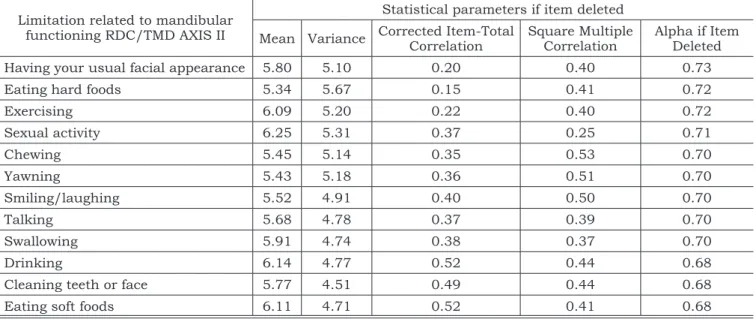
The evaluation of the internal consistency on limitation related to mandibular functioning as a RDC/TMD Axis II criterion identified 12 items that correlated with one another and represented the whole scale (alpha= 0.72) and standardized item alpha 0.73, as shown in Table 1. Alpha values did not increase by removal of any tested item.
TABLE 1 - Internal consistency of limitations related to mandibular functioning values of the RDC/TMD Axis II, evaluated by test-retest in 45 individuals.
Limitation related to mandibular functioning RDC/TMD AXIS II
Statistical parameters if item deleted
Mean Variance Corrected Item-Total Correlation Square Multiple Correlation Alpha if Item Deleted
Having your usual facial appearance 5.80 5.10 0.20 0.40 0.73
Eating hard foods 5.34 5.67 0.15 0.41 0.72
Exercising 6.09 5.20 0.22 0.40 0.72
Sexual activity 6.25 5.31 0.37 0.25 0.71
Chewing 5.45 5.14 0.35 0.53 0.70
Yawning 5.43 5.18 0.36 0.51 0.70
Smiling/laughing 5.52 4.91 0.40 0.50 0.70
Talking 5.68 4.78 0.37 0.39 0.70
Swallowing 5.91 4.74 0.38 0.37 0.70
Drinking 6.14 4.77 0.52 0.44 0.68
Cleaning teeth or face 5.77 4.51 0.49 0.44 0.68
Eating soft foods 6.11 4.71 0.52 0.41 0.68
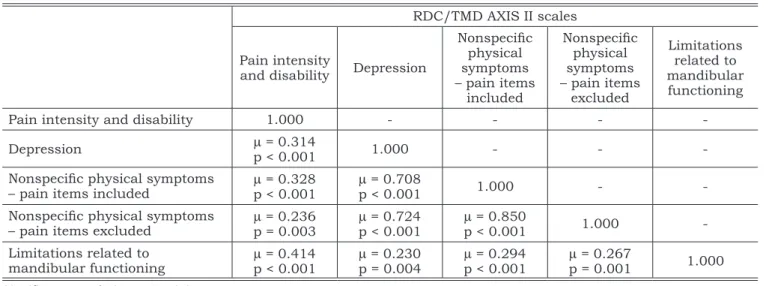
The degree of correlation between the different domains of the RDC/TMD Axis II was obtained by considering the three subscales for psychological factors, the graded chronic pain severity and the limitation scale on mandibular functioning (Ta-ble 2). The Spearman scores were higher (µ≥ 0.7) for the three subscales regarding psychological domain, with a statistically significant correlation (P < 0.001). Lower scores (µ≤ 0.2) were obtained for scales with a poor correlation with one another; this result could be interpreted as applying also to other domains, such as the limitation scale on mandibular functioning (physical) and the psycho-logical factor scales. Correlation values between the psychosocial and psychological domains were µ≤ 0.3. Correlation values between the physical and psychosocial domains were µ = 0.4; however, this correlation is weak to moderate, indicating
that, although these domains are part of the pro-posed domains measured by the scale, they add little to this study.1,10,16
Evaluation of reliability and reproducibility
Comparing information obtained from 45 pa-tients (test-retest study), a diagnostic agreement was statistically significant in Axis I and II, as shown in Table 3.
Concurrent validity
According to Table 4, scores from the Oral Im-pacts on Daily Performances and the Oral Health Impact Profile-14 produced a greater degree of cor-relation with the limitation scale on mandibular functioning (µ≥ 0.5), signifying convergent validity, i.e., a positive correlation between limitation scale
TABLE 2 - Correlation between scales of the RDC/TMD Axis II.
RDC/TMD AXIS II scales
Pain intensity
and disability Depression
Nonspeciic physical symptoms – pain items
included
Nonspeciic physical symptoms – pain items
excluded
Limitations related to mandibular functioning
Pain intensity and disability 1.000 - - -
-Depression µ = 0.314
p < 0.001 1.000 - -
-Nonspeciic physical symptoms – pain items included
µ = 0.328
p < 0.001
µ = 0.708
p < 0.001 1.000 -
-Nonspeciic physical symptoms
– pain items excluded µ
= 0.236
p = 0.003 µ
= 0.724
p < 0.001 µ
= 0.850
p < 0.001 1.000
-Limitations related to
mandibular functioning µ
= 0.414 p < 0.001
µ = 0.230
p = 0.004
µ = 0.294
p < 0.001
µ = 0.267
p = 0.001 1.000
Significant correlation at P = 0.01.
TABLE 3 - Reliability and reproducibility of established diagnostic procedures in the RDC/TMD Axis I and II, evalu-ated by test-retest of 45 patients.
Diagnosis from the RDC/TMD Statistical tests Interpretation
Kappa Value Kappa
A
x
is
I Group I (muscle disorders) 0.73 good agreement
Group II (disk displacements) 0.91 very good agreement
Group III (other joint conditions) 0.78 good agreement
Spearman’s Correlation (µ) P Value
A
x
is
II
Pain intensity and disability 0.764 < 0.01
Depression 0.821 < 0.01
on mandibular functioning and the Oral Impacts on Daily Performances and the Oral Health Impact Profile-14, measuring the same dimension.1,10,16
Low correlation values were obtained for the Oral Impacts on Daily Performances and the Oral Health Impact Profile-14 with the other items, such as psychological factor subscales (µ≤ 0.3), signify-ing a divergent validity and presentsignify-ing a different psychometric capacity.1,10,16 Convergent validity
was demonstrated by comparing the Simplified Anamnestic Index6 with the graded chronic pain
scale, this comparison being statistically signifi-cant (µ = 0.5, P < 0.01).
DISCUSSION
The present study makes an important con-tribution to further research in the TMD area by validating the Portuguese version of the RDC/TMD Axis II Questionnaire. This instrument will allow the standardization of TMD diagnosis and the col-lection of psychosocial data on the Brazilian pop-ulation, with a view to conducting transcultural epidemiologic studies on TMD.
The methodology used in this study judicious-ly follows the methodology already described in the literature, in accordance with similar criteria established by Ciconelli et al.2 (1999), Dworkin et
al.5 (2002), Góes8 (2001), Guillemin et al.9 (1993)
and Mota Falcão et al.13 (2003). The methodological
norms found in the literature related to transcul-tural adaptation of research questionnaires should not be restricted only to translation, but should also include the back-translation, face validation, cultural adaptation and validity.9 The failure to
perform any of these stages may lead to errors in the idiomatic, semantic, cultural and conceptual equivalences of the instrument.9
Each society has its own characteristics that reflect the culture of a country, as well as what differentiates it from others. Likewise, health
prob-lems are expressed in different ways from one cul-ture to another. Thus, when it is intended to apply an instrument of health-related data collection it should follow the methodology proposed in the literature and result in an instrument with clear, simple language and with equivalence with regard to cultural concepts.2 In epidemiology, the
valid-ity of data collection is one of the most important aspects in the consistency of the study.
The instrument used in this study was com-posed of several scales with different psychometric capacities. However, for the limitation scale on mandibular functioning, based on a list of com-monly used items in TMD clinical research, reli-ability and validity have not been evaluated yet.4
The internal consistency of a group of items can be evaluated by the Cronbach alpha test, where it is necessary to know whether these items could result in a measurement scale with the same do-main.1,10,16 This test indicates the degree of
correla-tion of an item with a scale and an item with itself. To be considered relevant, the degree of correlation should be no less than 0.5.7The lowest value used
as reference in clinical studies is 0.7.3,16 Thus, the
internal consistency was valid, with a global alpha index of 0.72 which is in excess of recommended values in clinical studies.3,16 In this paper, the
12-item integrating limitation scale on mandibular functioning presents the same conceptual domain and its items correlate with one another, resulting in a true scale.
With respect to the correlation scores regard-ing different domains of the RDC/TMD Axis II, the Spearman ranks revealed different psychometric properties for each scale studied, demonstrating that the proposed version of the instrument gener-ally had a positive correlation, indicating that the validated version is really measuring what it was intended to measure.1,16
Any evaluation instrument must be reproduc-ible over time, that is, it must reproduce the same
TABLE 4 - Spearman’s rank correlation coeficients among items evaluated by the RDC/TMD Axis II, OIDP and OHIP scores.
Items evaluated by the RDC/TMD AXIS II
Correlation between scales
OIDP OHIP
Spearman P Value Spearman P Value
Limitations related to mandibular functioning 0.602 < 0.01 0.598 < 0.01
Depression 0.306 < 0.01 0.349 < 0.01
or similar results between two or more applications for the same patient, provided that his/her clinical status has not changed.2 The intraexaminer
reli-ability and reproducibility for the tested-retested instrument, in approximately 30% of the sample studied, was considered valid.
CONCLUSION
The process for validating the Portuguese ver-sion of the RDC/TMD Axis II Questionnaire
fol-lowed the methodology proposed in the literature and resulted in a reproducible and applicable in-strument, valid for the Brazilian population, mak-ing possible the inclusion of Brazil in transcultural epidemiological studies on temporomandibular disorders. However, the responsiveness over time of the present version validated for the Portuguese language needs to be evaluated in further clinical and epidemiological studies.
REFERENCES
1. Bowling A. What things are important in people’s lives? A survey of the public’s judgements to inform scales of health related quality of life. Soc Sci Med. 1995;41:1447-62. 2. Ciconelli RM, Ferraz MB, Santos W, Meinão I, Quaresma
MR. Tradução para a língua portuguesa e validação do questionário genérico de avaliação de qualidade de vida SF-36 (Brasil SF-36). Rev Bras Reumatol. 1999;39(3):143-50.
3. Cohen J. A coefficient of agreement for nominal scales. Educ Psychol Measurement. 1960;20:37-46.
4. Dworkin SF, LeResche L. Research diagnostic criteria for temporomandibular disorders: review, criteria, examina-tions and specificaexamina-tions, critique. J Craniomandib Disord. 1992;6:301-55.
5. Dworkin SF, Sherman J, Mancl L, Ohrbach R, LeResche L, Truelove E. Reliability, validity and clinical utility of the re-search diagnostic criteria for temporomandibular disorders axis II scales: depression, non-specific physical symptoms, and graded chronic pain. J Orofac Pain. 2002;16(3):207-20.
6. Fonseca DM, Bonfante G, Valle Al, Freitas SFT. Diagnós-tico pela anamnese da disfunção craniomandibular. RGO. 1994;42(1):23-8.
7. Frankfort-Nachmias C, Nachmias D. Research methods in the social sciences. 4th ed. London: Edward Arnald; 1992. 8. Góes PSA. The prevalence and impact of dental pain in Brazilian schoolchildren and their families [Dissertation]. London: Department of Epidemiology and Public Health, Royal Free and University College Medical School, Univer-sity College London; 2001.
9. Guillemin F, Bombardier C, Beaton D. Cross-cultural adaptation of health-related quality of life measures:
lit-erature review and proposed guidelines. J Clin Epidemiol. 1993;46(12):1417-32.
10. Guyatt GH, Feeny DH, Patrick DL. Measuring health-related quality of life. Ann Intern Med. 1993;118:622-9. 11. Kosminsky M, Lucena LBS, Siqueira JTT, Pereira
FJ, Góes PSA. Adaptação cultural do questionário “Re-search diagnostic criteria for temporomandibular disor-ders: axis II” para o português. J Bras Clin Odontol Integr. 2004;8(43):51-61.
12. McNeill C. Temporomandibular disorders: guidelines for classification, assessment and management. The Ameri-can Academy of Orofacial Pain. 2nd ed. Chicago: Quintes-sence; 1993.
13. Mota Falcão D, Ciconelli RM, Ferraz MB. Translation and cultural adaptation of quality of life questionnaires: an evaluation of methodology. J Rheumatol. 2003;30(2):379-85.
14. Pehling J, Schiffman E, Look J, Shaefer J, Lenton P, Fricton J. Interexaminer reliability and clinical validity of the temporomandibular index: a new outcome meas-ure for temporomandibular disorders. J Orofac Pain. 2002;16(4):296-304.
15. Pereira FJ, Favilla EE, Dworkin SF, Huggins KH. Cri-térios de diagnóstico para pesquisa das desordens tempo-romandibulares RDC/TMD. On line 2002 [citado 15 jul 2002]. Disponível em: http://www.rdc-tmdinternational. org/translations/frmtranslations.htm.
16. Streiner DL, Norman GR. Health measurement scales. 2nd ed. New York: Oxford Press; 1995.
17. Svensson P. Orofacial musculoskeletal pain. In: Giambe-rardino MA, editor. Pain 2002 – An updated review: refresher course syllabus. Seattle: IASP Press; 2002. p. 447-58.