Deltamethrin-impregnated Dog Collars Have a Potent
Anti-feeding and Insecticidal Effect on
Lutzomyia longipalpis
and
Lutzomyia migonei
John R David/
+, Luisa M Stamm, Haroldo Sergio Bezerra*,
Raimundo Nonato Souza*, Robert Killick-Kendrick**,
José Wellington Oliveira Lima*
Department of Immunology and Infectious Diseases, Harvard School of Public Health, 665 Huntington Avenue, Boston, MA 02115, USA *Fundacão Nacional de Saúde, Fortaleza, CE, Brasil **Department of Biology,
Imperial College at Silwood Park, Ascot, UK
Deltamethrin-impregnated PVC dog collars were tested to assess if they were effective in protecting dogs from sand fly bites of Lutzomyia longipalpis and Lu. migonei. A protective effect against Old World species Phlebotomus perniciosus was demonstrated before. Four dogs wearing deltamethrin col-lars and three dogs wearing untreated colcol-lars (not impregnated with deltamethrin) were kept in sepa-rate kennels for over eight months in a village on the outskirts of Fortaleza in Ceará, Brazil. Periodi-cally, a dog from each group was sedated, placed in a net cage for 2 h in which 150 female sand flies had been released 10-15 min before. Lu. longipalpis were used 4, 8, 12, 16, 22, 27, and 35 weeks after the attachment of the collars. Lu. migonei were used 3, 7, 11, 15, 22, 26, and 36 weeks after attachment. During 35 weeks, only 4.1% (81 of 2,022) Lu. longipalpis recovered from the nets with the deltamethrin collared dogs were engorged, an anti-feeding effect of 96%. Mortality initially was over 90% and at 35 weeks was 35% with half of the sand flies dying in the first 2 h. In contrast, 83% of the 2,094 Lu.
longipalpis recovered from the nets containing the untreated collared dogs were engorged and the
mortality ranged from zero to 18.8% on one occasion with 1.1% dying in the first 2 h. Similar findings were found with Lu. migonei: of 2,034 sand flies recovered over this period, only 70 were engorged, an anti-feeding effect of 96.5%, and mortality ranged from 91% initially to 46% at 36 weeks. In contrast, engorgement of controls ranged from 91 to71% and a mortality ranged from 3.5 to 29.8%.
These studies show that deltamethrin impregnated collars can protect dogs against Brazilian sand flies for up to eight months. Thus, they should be useful in a program to control human and canine visceral leishmaniasis.
Key words: sand flies - deltamethrin - anti-feeding effect - Leishmania control visceral leishmaniasis -dog collars
Visceral leishmaniasis (VL) is one of the most important vector-borne diseases in the world with 400,000 new cases and 50,000 deaths occurring each year worldwide (Murray & Lopez 1996). In 1990, more than 2 million Disability Adjusted Life Years (DALYs) were estimated for VL in the world, second only to malaria for parasitic infec-tions (Murray & Lopez 1996).
This work was supported in part by USPHS NIH grant and from the Fundação Nacional de Saúde, Fortaleza, Ceará, Brazil. LM Stamm was supported by a Fulbright US student program grant.
+Corresponding author. Fax: +508-748.0672. E-mail:
[email protected] Received 15 August 2000 Accepted 6 April 2001
VL is a serious health problem in the north-eastern states of Brazil and in the State of Minas Gerais (Grimaldi et al. 1989, Marzochi & Marzochi 1994). There is considerable evidence that the domestic dog is an important reservoir host (Nicolle & Comte 1908, Adler & Theodore1932, Bettini et al. 1986, Bettini & Gradoni 1986, Shaw & Lainson
1987, Ashford et al. 1998). The sand fly Lutzomyia
longipalpis is the vector of the parasite, Leishma-nia chagasi, which is essentially indistinguishable
from Le. infantum in the Old World (Mauricio et
al. 2000a,b). Control of VL has been attempted by the destruction of serologically positive dogs and by spraying insecticides in peridomestic ar-eas.
nearly 1 million houses were sprayed and blood samples were taken from 6.5 million dogs for se-rology; 153,819 seropositive dogs were destroyed (Akhavan 1996). Despite this effort, morbidity and mortality in the human population remains unac-ceptably high, and the possibility of reducing the risk of infection to a negligible level is remote by the methods currently in use.
In 1997, Killick-Kendrick et al. reported that
plastic dog collars impregnated with the insecti-cide deltamethrin protected dogs from 96% of
Phlebotomus pernicious bites for up to eight
months. This sand fly transmits Le. infantum, the
parasite causing canine leishmaniasis (CanL) and VL in France and some other countries of the Medi-terranean Basin. If the deltamethrin-impregnated collars can be shown to be effective in preventing sand flies from biting dogs in Brazil, we would have a simple procedure to control this animal res-ervoir host. In contrast to killing seropositive dogs, collaring dogs would be simpler and more accept-able to owners of the dogs at risk.
In this paper, we show that deltamethrin im-pregnated dog collars (referred to as deltamethrin collars) are effective in preventing the neotropical
sand flies Lu. longipalpis and Lu. migonei from
biting dogs for at least six to eight months and, furthermore, the majority of the sand flies are killed.
MATERIALS AND METHODS
Dog collars - The collars were a gift from Hoechst Roussel Vet, Paris. They consist of a 48 cm strip of white polyvinylchloride (PVC) weigh-ing 20 g impregnated with deltamethrin 40 mg/g and are called Scalibor™ ProtectorBands™. They caused no visible reactions on the skin of the dogs during the period of the experiments. PVC collars without deltamethrin were used as untreated con-trols. If the collars were large on the dogs, the loose ends were cut off.
Sand flies - Lu. longipalpis and Lu. migonei
sand flies were reared in laboratory colonies at the Laboratory of Entomology at the Fundação Nacional de Saúde, Fortaleza, Ceará (CE), follow-ing a technique already described
(Killick-Kendrick et al.1977). The Lu. longipalpis colony
originated from captures in the municipalities of Baturité and Sobral, CE, in July 1996, whereas the
Lu. migonei colony originated from captures in the municipality of Maranguape, CE, in September, 1997. Briefly, larvae of both species were reared in plaster-lined pots of volume 200 ml and were fed on rabbit feces. Three days post-emergence,
females of Lutzomyia of both species were fed on
anaesthetised hamsters (Tiopental, 0.025
g/ham-ster), and were maintained in mesh cages (40 cm3)
in a B.O.D. incubator (Fanem®). Temperature
in-side the incubator was 25oC and humidity was
80-90%. The sand flies were stored for a period of four days for complete digestion of blood, then were placed in rearing pots, consisting of bottom-less plastic pots with the wall and bottom covered by a layer of plaster of Paris. After oviposition, the females died and were removed. The pots contain-ing the hatched larvae were placed in plastic boxes and maintained in the B.O.D incubator at the same
humidity (80-90%) and temperature (25oC) as the
adults. Adults were maintained in the Barraud cages
(40 cm3) with saturated sucrose solution until the
experiments. Sand flies 3-4 days old were used in all experiments, since in preliminary observations, we found that females fed well at that age. On the day of the experiment, female sand flies were counted and transferred using a Castro aspirator (Sherlock & Pessoa 1964, Alexander 2000) into two separate larger plaster-lined pots measuring
approximately 1500 cm3 and kept in styrofoam
containers with moist cotton wool to keep the hu-midity high for transport. The females were trans-ferred into large cubic net cages 10-15 min before the anesthetised dogs were placed inside the nets. The females found dead inside the transport pots were counted and subtracted from the total num-ber of sand flies released into the net cages.
Cubic nets - The net cages used in the experi-ment to expose the dogs to the sand flies were as described (Killick-Kendrick et al. 1997) with
mi-nor modifications. They measured 1.2 m2, and were
1.8 m in height. The bottom and the lower 55 cm of the walls were made of cotton to prevent drafts while the rest of the net was made of fine netting. On one side, the net had a vertical double-headed zipper to adjust the size of the opening when re-leasing flies, adding the dogs or entering to cap-ture the flies. The nets were suspended on PVC piping tied by cord to beams in the ceiling. A 6.5 cm thick sponge overlaid with plastic was laid un-der the net. The nets were placed in two indoor locations and separated by a canvas curtain. In preliminary tests these two locations were shown to give similar sand fly biting rates on dogs prior to the experiments with the collars. The tempera-ture during the experiments varied between
24-28oC, and humidity was 89-98%. In a series of 17
preliminary experiments using 10 dogs, we found no significant difference in the biting of sand flies in this temperature and humidity range. Atmo-spheric pressure was also measured and was ap-proximately 1009 mb.
Dogs - The dogs were 7-9 month-old mongrels
ra-bies (Tec-Par), canine viruses (Duramune, Fort Dodge, Campinas, São Paulo), and de-wormed at least four times with ivermectin and mebendazole before the start of the experiment. The kennels were located in Gereraru, approximately 25 km from Fortaleza. All dogs were fed the same mixture of dog food and given continuous clean water. Ten
dogs were initially tested with Lu.longipalpis and
Lu. migonei to assess their variability in attractive-ness to sand flies. Three dogs were eliminated before experiments with the collar started because of illness. The four deltamethrin-collared dogs and three untreated-collared dogs were housed in sepa-rate kennels made of chicken wire and a roof, and were approximately 37.5 m apart. To avoid con-tamination, the kennels were cleaned with a neu-tral soap twice a day by different people, and han-dlers of the deltamethrin-collared dogs always wore disposable gloves. Dogs were walked to the ex-perimental site, approximately 600 m from the kennels, by separate handlers and entered the in-door test site by different in-doors.
On the days of the experiments dogs were not fed before sedation. To anesthetise the dogs, atro-pine (0.044 mg/kg dog’s body weight, Aritson) was given intramuscularly 10 min before a mixture of
RompunR (0.2 mg/kg dog’s body weight, Bayer)
and KetalarR (10mg/kg dog’s body weight,
Parke-Davis). A second dose, 70-80% of the first dose of Rompun and Ketalar, was administered after the dogs spent 1 h in the net to keep them sedated for a total of 2 h. Dogs wore disposable diapers to absorb urine during the 2-h exposure period in the net. Upon awaking, the dogs were carried back to the kennel in wheelbarrows, were allowed to re-cover, and were fed. The dogs in each group in the experiments were picked using a rotating sched-ule.
Exposure of dogs to sand flies - Pots
contain-ing 150 females of Lu. longipalpis or Lu. migonei,
were used in the experiments. Male Lu. longipalpis
exhibit a lek-like behavior and arrive at the source of the blood meal before the females (Jarvis & Rutledge 1992). In some preliminary observations, we therefore added 50 males to the females in the net cages assuming this might improve female en-gorgement. We found, however, that the females showed an average engorgement of 64% when males were present (n = 20) and 81% without males (n = 5), p < 0.025. Therefore all experiments with collared dogs were carried out only with female flies, which were released into the cubic nets at 6 p.m. (In preliminary studies we found there was no significant difference whether the experiments started at 5:30 p.m. or 7 p.m, sunset being at 5:30 p.m, data not shown). The dogs were placed in the cages 10-15 min after the sand flies and kept there
for 2 h in total darkness and then removed. De-tails of the procedures are given below. The pro-tocol for these studies was approved by the Stand-ing Committee on Animals of the Harvard Medi-cal Area.
Experimental procedure with the collars - At 3, 7, 11, 15, 22, 26 and 36 weeks post-attachment of the collars, dogs were sedated and put into nets
with about 150 female Lu. migonei. On weeks 4,
8, 12, 16, 22, 27 and 35 weeks post-attachment of
the collars, tests were performed with Lu.
longipalpis using the same protocol. Each week, two sets of experiments were done; each night one deltamethrin-collared dog and one untreated-col-lared dog were tested, each group always using the same net. The pots were opened to release the flies into the net 10-15 min before the sedated dog was introduced. All experiments began at approxi-mately 6 p.m. While the dog was added or removed, or while recapturing the flies, a fluorescent light was turned on to attract the flies to the top of the net. The dogs were exposed for a 2 h period and examined for sand flies on their fur before being removed. Dead flies knocked down in the net were collected and saved until the next day to see if they recovered, after which they were scored as en-gorged or non-enen-gorged. Living flies were counted by inspection in the aspirator as they were replaced in the large pot. Accuracy of such inspection com-pared to inspection under the dissecting microscope was 99.5%. Essentially, throughout the study no sand flies had taken a small blood meal that was detectable only by microscopy. Live flies were scored as engorged and not-engorged. These flies were held in the stock cage for 18 h after which dead flies were counted and scored as engorged and not-engorged and subtracted from the previ-ous night’s live totals. We recovered almost every fly from the nets. Percent engorgement was calcu-lated as the ratio of the sum of all dead engorged flies after 2 and 20 h plus live engorged flies over the total of recovered sand flies. Percent mortality was calculated as the ratio of the sum of all dead sand flies after 2 and 20 h over the total of recov-ered sand flies.
Statistical analysis - Data used to produce Figs 1 and 2 were fitted on a repeated measure model, Stata (StataCorp 1999). In other statistical analy-sis Student’s t test for unpaired samples was used.
RESULTS
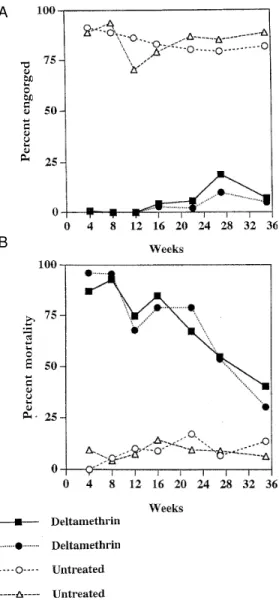
The deltamethrin collars had a dramatic anti-feeding effect on both species of sand flies. For
went below 90% in one of two dogs tested at 27 weeks, but was still 94% at 35 weeks. Fitting the data on a repeated measure model (StataCorp 1999), the difference between the anti-feeding on deltamethrin collars and the untreated collars was highly significant (p < 0.0005). The anti-feeding effect of the deltamethrin collars was still present after more than eight months (Table I).
The deltamethrin collars also caused mortality of Lu. longipalpis (Fig. 1B). This ranged from 96% at 4 weeks to 35% at 35 weeks, gradually falling after 22 weeks. When the data were fitted in the model as above, the difference in the mortality of
Lu. longipalpis with dogs with the deltamethrin collars compared to dogs with the untreated col-lars was highly significant (p < 0.0005). The
mor-tality of Lu. longipalpis was recorded at 2 h and
after 20 h. In early experiments almost 100% of the sand flies with the dogs wearing deltamethrin collars were killed in the first 2 h (Table II). Throughout the study an average of 50% of the sand flies died within 2 h. In contrast, over the whole study, only 1.1% of the sand flies with the untreated-collared dogs died at 2 h. With time, the sand fly killing effect diminished considerably faster than the anti-feeding effect (Fig. 1). The majority of the sand flies that engorged on the deltamethrin collared dogs also died. This was 100% during the first 16 weeks, falling to 35% at 35 weeks. In contrast, the mortality of sand flies engorged on dogs with untreated collars ranged from 3.8% to 0.7% with an average of only 1.6%. This difference was significant (p < 0.01).
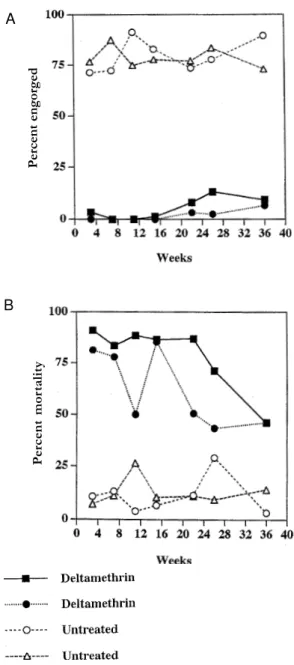
The deltamethrin collars also had a dramatic
anti-feeding effect on Lu. migonei (Fig. 2A).
Inhi-bition of feeding was 98.3% when tested 3 weeks after the application of the collars, 100% after 7 and 11 weeks, 99.3% at 15 weeks, 94.3% at 26 weeks and 91.8% at 36 weeks. Except for one test on dog # 1 at 26 weeks which showed 86.7% inhi-bition of feeding, the deltamethrin collars inhib-ited feeding by more than 90% throughout the 36 weeks of the study. We have no explanation for this single lower value except for biological varia-tion. Fitting the data on a repeated measure model (StataCorp 1999) the difference between the deltamethrin collars and the untreated collars was highly significant (p < 0.0005).
The deltamethrin collars also caused mortality of Lu. migonei (Fig. 2B). This ranged from 91% at 3 weeks to 46% at 36 weeks. Except for one test at 11 weeks, mortality gradually fell after 22 to 26 weeks. When the data were fitted in the model as
above, the mortality of Lu. migonei with dogs with
the deltamethrin collars compared to the untreated collars was highly significant (p < 0.0005). As with
Lu. longipalpis, the sand fly killing effect dimin-A
B
P
e
rc
e
n
t
e
n
g
o
rg
e
d
P
e
rc
e
n
t
m
o
rt
a
li
ty
Fig. 1: deltamethrin collars prevent biting by Lutzomyia longipalpis and cause mortality. A: the anti-feeding effect is seen by the diminished engorgement in the dogs with the deltamethrin collars. Two of the four deltamethrin-collared dogs and two of the three untreated-collared dogs were tested each week thus the two lines. The identification of the dogs for any given week can be found on Table I; B: the mortality as assessed at 20 h includes sand flies that died after 2 h.
ished considerably faster than the anti-feeding ef-fect. The mortality ranged from 100% to 50% and was still 86% at 22 weeks. In contrast, the mortal-ity of sand flies engorged on dogs with untreated collars ranged from 0 to 17%. This difference was
significant (p < 0.025). As with Lu. longipalpis,
the majority (55%) of Lu. migonei placed with the
deltamethrin collared dogs over the 36 weeks were dead when recovered at 2 h. In contrast, over this
period only 0.8% of Lu. migonei with untreated
TABLE I
Results of experiments with Lutzomyia longipalpis exposed to dogs wearing a deltamethrin-impregnated collar Dead flies after 2 h Dead flies after 20 h Live flies after 20 h
Engorged Not Engorged Not Engorged Not Totala Percent Percent
Week Dog engorged engorged engorged engorged mortality
4 9 1 124 0 1 0 19 145 0.6 86.9
4 10 1 142 0 2 0 6 151 0.6 96
8 9 0 124 0 13 0 11 148 0 92.6
8 10 0 141 0 6 0 7 154 0 95.5
12 9 0 72 0 26 0 33 131 0 74.8
12 10 0 78 0 13 0 43 134 0 67.9
16 9 4 62 2 53 0 22 143 4.2 84.6
16 10 3 103 1 8 0 31 146 2.7 78.8
22 9 4 49 3 41 1 46 144 5.6 67.4
22 10 1 78 0 36 2 29 146 2.1 78.8
27 9 3 18 7 51 17 48 144 18.8 54.9
27 10 1 34 4 39 9 58 145 9.6 53.8
35 9 0 22 2 35 8 79 146 6.9 40.4
35 10 3 28 1 12 3 98 145 4.8 30.3
Total - 21 1,075 20 336 40 530 2,022
a: total = 2 h + 20 h
TABLE II
Results of experiments with Lutzomyia longipalpis exposed to dogs wearing a control collar Dead flies after 2 h Dead flies after 20 h Live flies after 20 h
Engorged Not Engorged Not Engorged Not Totala Percent Percent
Week Dog engorged engorged engorged engorged mortality
4 7 0 0 0 0 135 13 148 91.2 0
4 5 0 1 2 11 131 5 150 88.7 9.3
8 5 0 0 2 6 129 11 148 88.5 5.4
8 6 0 0 1 6 156 5 168 93.5 4.2
12 6 0 2 1 12 127 7 149 85.9 10.1
12 6 0 0 3 9 110 39 161 70.2 7.5
16 7 0 2 4 7 116 16 145 82.8 9
16 5 0 3 5 13 111 15 147 78.9 14.3
22 5 1 0 2 22 114 7 146 80.1 17.1
22 6 0 2 0 12 128 6 148 86.5 9.5
27 7 1 0 2 7 115 24 149 79.2 6.7
27 5 0 2 2 9 121 11 145 84.8 9
35 5 0 3 0 17 119 7 146 81.5 13.7
35 6 0 2 2 5 125 10 144 88.2 6.3
Total - 2 17 26 136 1,737 176 2,094
a: total = 2 h + 20 h
Examining all the data to 35 weeks, of the total
of 2,022 Lu. longipalpis recovered from the nets
with the deltamethrin collared dogs, 81 or 4% were
engorged (Table I). Further, only 2% of the Lu.
longipalpis that became engorged in the nets with the deltamethrin-collared dogs during the 35 weeks
remained alive. In contrast, of the 2,094 Lu.
longipalpis recovered from the nets with the un-treated collared dogs, 1,737 or 83% were engorged and 98.4% of these engorged flies remained alive.
During this period of study, 54% of the sand flies with the deltamethrin-collared dogs died during the first 2 h and only 2% of these dead flies were en-gorged. In contrast, only 10% of the sand flies in the nets with the untreated- collared dogs died at 2h. Of the 2,094 sand flies in these nets, only 19 sand flies (1.1%) died after 2 h and only 2 of the these flies were engorged.
Similarly, all the data to 36 weeks showed that
DISCUSSION
Killick-Kendrick et al. (1997) showed that deltamethrin-impregnated collars prevented the
feeding of laboratory reared P. perniciosus on
beagles by an average of 94% over 34 weeks. Only 0-12% of the recaptured sand flies had fed on deltamethrin collared dogs compared to 55-95% that had fed on the collarless dogs. Furthermore, immediately after the dogs were removed from the nets, 21-60% of the flies from the collared dogs were dead compared to 0-12% from the controls. Lucientes (1999) has confirmed these findings also
using laboratory-reared P. perniciosus and beagles.
He found that 85-98% of the deltamethrin-col-lared dogs were protected from bites of sand flies compared to dogs with untreated collars lacking deltamethrin. The lethal effect of the deltamethrin collars was about 50%. His study was carried out over 26 weeks. Recently, Halbig et al. (2000) re-ported on a study in Iran using the same
deltamethrin collars and wild-caught P. papatasi
confined with large guard dogs. They tested the anti-feeding and killing effect before attachment and after the collars had been on the dogs for eight days. It rose from 11 to 51%. Sand fly mortality, however, did not differ, being 17% before and 18% eight days after attaching the collars.
During the development of the impregnated PVC collars, it was found that the deltamethrin was released slowly over several months from the collars (Killick-Kendrick et al. 1997). As deltamethrin is lipophilic like all synthetic pyre-throids (Miller & Salago 1985), it spreads in the dermal secretions over most of the body of the dog. This explains the delay in reaching its maximum efficacy demonstrated by the tests in Killick-Kendrick’s study at one week, and probably ex-plains the lower efficacy and lack of lethal effect
of the deltamethrin collars in the study on P.
papatasi done on day 8. Studies by the producers of the collars have also shown that their activity resists both rain and sun. Indeed, they were effec-tive on dogs that were exposed to rain (Killick-Kendrick et al. 1997).
As different species of sand flies, as well as mosquitoes, show different behavior and insecti-cide susceptibility (Killick-Kendrick 1999), it was important to determine whether if neotropical
Lutzomyia spp. were as susceptible as
Phleboto-mus spp. to the deltamethrin from the collars.
In-deed, whereas pyrethroid impregnated clothing was
found to protect against Phlebotomus spp. in the
Sinai desert (Dees et al. 1985), it protected poorly
against Lutzomyia spp. in Panama (Schreck et al.
1982). Our studies show that Lu. longipalpis and
Lu. migonei are at least as susceptible as the two previously tested phlebotomines to the anti-feed-A
B
P
e
rc
e
n
t
e
n
g
o
rg
e
d
P
e
rc
e
n
t
m
o
rt
a
li
ty
ing effects of the deltamethrin collars and much more susceptible to the lethal effect. Furthermore, as we used mongrel dogs, our studies show that the anti-feeding and killing effect of the deltamethrin collars are not limited to beagles.
The anti-feeding effect appears to need less pyrethroid than the killing effect as is seen by the more rapid decrease in the lethal effect compared to anti-feeding effect with time in our study, and to the absence of a lethal effect despite an
anti-feeding effect in the study after only eight days
with P. papatasi. This is consistent with the
find-ings of Wu et al. (1991) who showed strong anti-feeding effects of deltamethrin on impregnated
gauze on Culex quinquefasciatus well below doses
recommended to kill the mosquito.
The anti-feeding effects we observed (deter-mined by the lack of engorgement), is probably due to the neurotoxic effects of pyrethroids (Soderlund & Bloomquist 1989). Alterations of the
TABLE III
Results of experiments with Lutzomyia migonei exposed to dogs wearing a deltamethrin-impregnated collar Dead flies after 2 h Dead flies after 20 h Live flies after 20 h
Engorged Not Engorged Not Engorged Not Totala Percent Percent
Week Dog engorged engorged engorged engorged mortality
3 1 0 50 3 79 2 11 145 3.5 91
3 8 0 114 0 4 0 27 145 0 81.4
7 1 0 106 0 6 0 22 134 0 83.6
7 8 0 96 0 17 0 32 145 0 77.9
11 1 0 102 0 22 0 16 140 0 88.6
11 8 0 49 0 23 0 72 144 0 50
15 1 2 118 0 9 0 20 149 1.3 86.6
15 8 0 96 0 33 0 22 151 0 85.4
22 1 8 86 2 31 2 17 146 8.2 87
22 8 2 50 1 23 2 72 150 3.3 50.7
26 1 11 79 6 0 1 38 135 13.3 71.1
26 8 2 44 0 22 2 86 156 2.6 43.6
36 1 2 43 3 20 9 70 147 9.5 46.3
36 8 7 54 0 7 3 76 147 6.8 46.3
Total - 34 1,087 15 296 21 581 2,034
a: total = 2 h + 20 h
TABLE IV
Results of experiments with Lutzomyia migonei exposed to dogs wearing a control collar
Dead flies after 2 h Dead flies after 20 h Live flies after 20 h
Engorged Not Engorged Not Engorged Not Totala Percent Percent
Week Dog engorged engorged engorged engorged mortality
3 5 0 1 3 11 96 28 139 71.2 10.8
3 6 0 1 0 9 105 22 137 76.6 7.3
7 6 0 0 2 17 102 23 144 72.2 13.2
7 7 0 2 2 12 123 4 143 87.4 11.2
11 7 0 1 0 5 136 7 149 91.3 4
11 5 0 2 8 32 111 6 159 74.8 26.4
15 5 0 0 2 8 120 17 147 83 6.8
15 6 0 0 6 9 106 23 144 77.8 10.4
22 6 1 5 3 8 104 26 147 73.5 11.6
22 7 0 0 0 16 111 17 144 77.1 11.1
26 5 0 0 26 16 86 16 144 77.8 29.8
26 6 0 1 2 11 120 12 146 83.6 9.6
36 7 0 0 1 4 128 11 144 89.6 3.5
36 5 0 2 1 18 107 20 148 73 14.2
Total 1 15 56 176 1,555 232 2,035
voltage-sensitive sodium channel is the principle molecular target site for all pyrethroids in insects and mammals, although it is probably not the only site involved in intoxication. Insect neurosecretory neurons are sensitive to low concentrations of pyre-throids and disruption of the neuroendocrine sys-tems has also been implicated as contributing to pyrethroid intoxication.
The finding in our study that only 1% of the few sand flies that have fed live after the first bite should significantly reduce the circulation of the
Leishmania parasite when the dog is the major res-ervoir host. This is especially true since flies have
to bite twice to transmit the Leishmania parasite to
the reservoir host and the collars should greatly reduce the passage of the parasite from dog to dog as well as from dog to man. Indeed, it is probable the risk of infection to man where the dog is the predominant reservoir host would be reduced sig-nificantly or fall to zero (Killick-Kendrick 1999). These deltamethrin collars should not have the untoward effect of causing sand flies to bite hu-mans instead of dogs. Once having gone to the dogs, the majority of flies would die before get-ting a blood meal and thus very few of the re-maining living sand flies would be infected.
A field trial is about to start to find out whether the collars are effective on dogs in their natural habitat. If they are, the deltamethrin collars would appear to be an excellent and cost effective strat-egy for the control of leishmaniasis where the dog is the main animal reservoir. Use of collars should be much more acceptable to the population than the current strategy of killing seropositive dogs. The deltamethrin collars, however, must first be shown to be effective in the field, i.e. they should dramatically decrease the seroconversion of serone-gative dogs in the endemic areas. The effect of collaring dogs on the incidence of human cases of VL must be also assessed. The collars could also be used to determine how important the dog is in the transmission of the parasites in various other clinical forms of leishmaniasis where dogs have been postulated to be the natural reservoir host.
ACKNOWLEDGEMENTS
To Prof. Marcelo Pagano from the Department of Biostatistics, Harvard School of Public Health for car-rying out the statistical analysis using a repeated mea-sure model, to Gina Monteforte for making the figures, to Jose Valderi Souza, Afonso Celso Gadelha, Ana Claudia Regazzi for their help with the sand fly colo-nies, and to Maria Nogueira Evangelista for watching over the kennels by her house.
REFERENCES
Adler S, Theodor O 1932. Investigations on Mediterra-nean kala-azar. VI - Canine visceral leishmaniasis.
Proc R Soc Lond110: 402-412.
Akhavan D 1996. Análise de custo-efetividade do componente de leishmaniose no projeto de controle de doenças endêmicas no nordeste do Brasil. Rev Patol Trop25: 203-252.
Alexander B 2000. Sampling methods for phlebotomine sand flies. Med Vet Entomol14: 109-122
Ashford DA, David JR, Freire M, David R, Sherlock I, Eulalio MC, Sampaio DP, Badaro R 1998. Studies on control of visceral leishmaniasis: impact of dog control on canine and human visceral leishmaniasis in Jacobina, Bahia, Brazil. Am J Trop Med Hyg59: 53-57.
Bettini S, Gradoni L 1986. Canine leishmaniasis in the Mediterranian area and its implications for human leishmaniasis. Insect Sci Appli7: 241-245. Bettini S, Contini C, Atzeni MC, Tocco G 1986.
Leish-maniasis in Sardinia. I. Observations on a larval breeding site of Phlebotomusperniciosus, Phleboto-mus perfiliewi perfiliewi and Sergentomyiaminuta
(Diptera: Psychodidae) in the canine leishmaniasis focus of Soleminis (Cagliari). Ann Trop Med Parasitol 80: 307-315.
Dees WH, Overington KR, Karuru ER, Helmy L, Schreck CE 1985. Preliminary investigations of pro-tective clothing and repellents used against medi-cally important arthropods in the Sinai Desert. Meet-ing ProceedMeet-ings, New Jersey Mosquito Control As-sociation, Atlantic City, p. 239-241.
Grimaldi G, Tesh RB, McMahon-Pratt D 1989. A re-view of the geographic distribution and epidemiol-ogy of leishmaniasis in the New World. Am J Trop Med Hyg41: 687-725.
Halbig P, Hodjati MH, Mazloumi-Gavagni AS, Mohite H, Davies CR 2000. Further evidence that delta-methrin-impregnated collars protect domestic dogs from sandfly bites. Med Vet Entomol 14: 223-226. Jarvis EK, Rutledge LC 1992. Laboratory observations
on mating and lek-like aggregations in Lutzomyia longipalpis (Diptera: Psychodidae). J Med Entomol 29: 171-177.
Killick-Kendrick R 1999. Anti-feeding effects of synthetic pyrethroids against phlebotomine sand flies and mos-quitoes, and the prospects of controlling canine leish-maniasis with deltamethrin-impregnated Pro-tectorBands (Scalibor®). In R Killick-Kendrick, Ca-nine Leishmaniasis: an Update, Proceedings of a Canine Leishmaniasis Forum, Barcelona (Sitges), 28-31 January, 1999, Wiesbaden: Hoechst Roussel Vet, p. 82-88 (available gratis from jac. [email protected]).
Killick-Kendrick R, Killick-Kendrick M, Focheux MC, Dereure J, Puech MP, Cadiergues MC 1997. Pro-tection of dogs from bites of phlebotomine sandflies by deltamethrin collars for control of canine leish-maniasis. Med Vet Entomol11: 105-111.
Killick-Kendrick R, Leaney AJ, Ready PD 1977. The establishment, maintenance and productivity of a laboratory colony of Lutzomyia longipalpis (Diptera: Psychodidae). J. Med Entomol13: 429-440. Lucientes J 1999. Laboratory observations on the
Leishmaniasis: an Update, Proceedings of a Canine Leishmaniasis Forum, Barcelona (Sitges), 28-31 January, 1999, Wiesbaden: Hoechst Roussel Vet, p. 92-94 (available gratis from jac. [email protected]).
Marzochi MCA, Marzochi KBF 1994. Tegumentary and visceral leishmaniasis in Brazil - Emerging anthropozoonosis and possibilities of their control.
Cad Saúde Pública10 (Suppl. 2):359-375. Mauricio IL, Howard MK, Stothard JR, Miles MA
2000a. Genomic diversity in the Leishmania donovani complex. Parasitology119: 237-246. Mauricio IL, Stothard R, Miles MA 2000b, The strange
case of Leishmania chagasi. Parasitol Today16: 188-189.
Miller TA, Salago VL 1985. The mode of action of pyre-throids on insects. In JP Leahey, The Pyrethroid Insecticides, Taylor and Francis, London, p. 43-97. Murray CJL, Lopez AD 1996. The Global Burden of Disease, HSPH/WHO/Harvard University Press, Boston, p. 264, 348.
Nicolle G, Comte M 1908. Recherches sur la kala-azar enterprises a l’Institut Pasteur de Tunis. IV. Origine
canine du kala-azar. Arch Inst Pasteur Tunis3: 59-62.
Schreck CE, Kline DL, Chaniotis BN, Wilkinson N, McGovern TP, Weidhaas DE 1982. Evaluation of personal protection methods against phlebotomine sand flies including vectors of leishmaniasis in Panama. Am J Trop Med Hyg31: 1046-1053. Shaw JJ, Lainson R 1987. Ecology and epidemiology:
New World. In R Killick-Kendrick, W Peters (eds),
The Leishmaniases in Biology and Medicine, Aca-demic Press, London, p. 365.
Sherlock IA, Pessoa SB 1964. Métodos practicos para a captura de flebótomos. Rev Bras Biol 24: 331-340. Soderlund DM, Bloomquist JR 1989. Neurotoxic ac-tions of pyrethroid insecticides. Annu Rev Entomol 34: 77-96.
StataCorp 1999. Stata Statistical Software: Release 6.0, College Station, TX: Stata Corporation. The program used within this package was glm.