Chromosomal localization and molecular marker development of the
lipopolysaccharide and beta-1,3-glucan binding protein gene in the Zhikong
scallop
Chlamys farreri
(Jones et Preston) (Pectinoida, Pectinidae)
Pin Huan
1,2, Xiaojun Zhang
1, Fuhua Li
1, Yang Zhang
1,2,3, Cui Zhao
1,2and Jianhai Xiang
11
Key Laboratory of Experimental Marine Biology, Institute of Oceanology,
Chinese Academy of Sciences,Qingdao, P.R. China.
2
Graduate University of Chinese Academy of Sciences, Beijing, P.R. China.
3
Department of Soil & Crop Sciences, Texas A&M University, College Station, TX, USA.
Abstract
Zhikong scallopChlamys farreri (Jones et Preston) is an economically important species in China. Understanding its immune system would be of great help in controlling diseases. In the present study, an important immunity-related gene, the Lipopolysaccharide and Beta-1,3-glucan Binding Protein (LGBP) gene, was located onC. farreri chromo-somes by mapping severallgbp-containing BAC clones through fluorescence in situ hybridization (FISH). Through the localization of various BAC clones, it was shown that only one locus of this gene existed in the genome ofC. farreri, and that this was located on the long arm of a pair of homologous chromosomes. Molecular markers, consist-ing of eight sconsist-ingle nucleotide polymorphism (SNPs) markers and one insertion-deletion (indel), were developed from the LGBP gene. Indel marker testing in an F1 family revealed slightly distorted segregation (p = 0.0472). These mark-ers can be used to map the LGBP gene to the linkage map and assign the linkage group to the corresponding chro-mosome. Segregation distortion of the indel marker indicated genes with deleterious alleles might exist in the surrounding region of the LGBP gene.
Key words: Chlamys farreri, LGBP, fluorescencein situhybridization (FISH), indel, SNP. Received: March 3, 2009; Accepted: August 17, 2009.
Introduction
The first step in the immune response for organisms is to recognize invading molecules. This is generally the func-tion of pathogen recognifunc-tion proteins (PRPs), capable of recognizing the specific molecules existing in the invading organism through pathogen-associated molecular patterns (PAMPs) (Janeway Jr, 1989). After recognizing specific PAMPs, including lipopolysaccharide (LPS), peptidoglycan (PG) and beta-1,3-glucans (BG), PRPs initi-ate downstream immune responses. These proteins are es-sential for the invertebrates, as they lack adaptive immune system. The lipopolysaccharide and beta-1,3-glucan bind-ing protein (LGBP), as a form of PRP, can recognize both LPS existing on the surface of Gram-negative bacteria, as well as BG on the surface of fungi. Furthermore, it can trig-ger off activation of the prophenoloxidase (proPO) system, thereby leading to the synthesis of antimicrobial proteins and peptides, after binding with LPS or BG (Lee, 2000; Sritunyalucksana and Söderhäll, 2000). The full length
cDNA of LGBP gene has been identified in many inverte-brates, includingBombyx mori(Lepidoptera, Bombycidae) (Lee et al., 1996), Drosophila melanogaster (Diptera, Drosophilidae) (Kimet al., 2000),Pacifastacus leniusculus
(Decapoda, Astacidae) (Leeet al., 2000),Fenneropenaeus chinensis (Decapoda, Penaeidae) (Liu et al., 2007) and
Litopenaeus vannamei(Decapoda, Penaeidae) (Cheng et al., 2005), Research has revealed pronounced LGBP affin-ity to LPS and BG.
The Zhikong scallopChlamys farreri(Jones et Pres-ton) (Pectinoida, Pectinidae) is an economically important species in China. Much research has been dedicated to this species and appreciable progress made (Li et al., 2005; Wanget al., 2005a; Zhanet al., 2007, 2008; Zhanget al., 2007a, 2008). Nevertheless, over the last decade, problems with disease have assumed increasing severity, attaining high mortality. An understanding of the immune system would be extremely beneficial in dealing with this problem. To date, many immune-related genes have been cloned and their expressions analyzed (Su et al., 2004; Gao et al., 2007; Qiuet al., 2007a, b; Wanget al., 2007; Yuet al., 2007; Zhanget al., 2007a, 2008). LGBP gene expression in
C. farreriwas significantly up-regulated followingVibrio Send correspondence to Jianhai Xiang. Institute of Oceanology,
Chinese Academy of Sciences, 7 Nanhai Road, Qingdao 266071, P.R. China. E-mail: [email protected].
anguillarumchallenge (Vibrionales, Vibrionaceae), this in-dicating a possibly important role during infection with gram-negative bacteria (Suet al., 2004).
Nevertheless, the above-mentioned studies on im-mune related genes inC. farrerihave mainly focused on gene expression at transcription or translation levels. Re-sults at the genomic DNA level have seldom been reported, although they could provide information on gene regula-tion and localizaregula-tion, which is especially important for ge-netic breeding. The lack of several important resources, such as cell lines and large-insert genomic DNA libraries, limits research thereof. Recently, the situation improved with the construction of a species specific fosmid library (Zhanget al., 2007b) and two BAC libraries (Zhanget al., 2008) onC. farreri.
Gene localization on genetic, physical and cyto-genetic maps could provide basement support for funda-mental and applied research. In our previous work,lgbp -containing BAC clones were screened out from the BAC li-brary ofC. farrerithrough over-go screening (Zhanget al., 2008). In the present work, BAC clones containing LGBP genes were successfully mapped toC. farrerichromosome by both single-color and double-color fluorescencein situ
hybridization (FISH), whereby various molecular markers in LGBP gene were developed for genetic mapping. This could be an aid in expanding knowledge on the innate im-mune system and in promoting the integration of physical, genetic and cytogenetic maps ofC. farreriin the near fu-ture.
Material and Methods
Chromosome preparation
Chromosomes were prepared from larvae of C. farreri. Larvae were treated with 0.01% colchicine for 2 h, and then transferred into 0.075 mol/L of KCl for a further 15 min. After hypotonicity, the larvae were fixed twice in Carnoy solution (methanol: acetic acid, 3: 1), for 15 min each time, and then stored in storage solution (methanol: acetic acid, 1: 1) at -20 °C. Just before use, the fixed larvae were dissolved in freshly prepared 50% acetic acid, dropped onto clean slides, and then air dried.
Validation of the BAC clones
Six BAC clones, viz., CFB094J04, CFB066B03, CFB040L24, CFB183I08, CFM008L23 and CFM005H15, were identified aslgbp-containing clones in our previous study, by using over-go screening (Zhang et al., 2008). Identity was further confirmed through PCR reactions. A couple of primers were designed based on the LGBP gene cDNA sequence ofC. farreri(GenBank No. AY259542).
The forward primer (CFLGBPF1) was
5’-GGGAACGCATACATCAT-3’, and the reverse
(CFLGBPR2) was 5’- CGATCCGTGGTAAGTGT-3’. PCR reactions were carried out using both BAC plasmids
and genomic DNA as templates. The PCR products were cloned into host bacteria (E. coli., Top10) and sequenced by means of an ABI 3730 sequencer. The obtained sequences were analyzed by BLASTN search against the NCBI non-redundant (nr) database.
Plasmid extraction and probe synthesis
For plasmid extraction, the lgbp-containing BAC clones were cultured overnight at 250 rpm and 37 °C. The bacteria were then collected by centrifugation at 3000 g for 15 min. BAC plasmids were purified with a NUCLEOBOND AX 100 kit (Machery-Nagel), examined by agarose gel electrophoreses, and after quantified with a spectrophotometer.
One microgram of BAC plasmid was used for probe synthesis. Digoxigenin or biotin-labeled probes were gen-erated using the corresponding nick translation labeling kit from the Roche Company.Cot-1DNA, which was used as competitive DNA in FISH, was prepared according to the method described by Zwicket al.(1997).
Fluorescence in situ hybridization
For hybridization, 1mg of probe was co-precipitated with 10mg ofCot-1DNA and 50mg of salmon sperm DNA, and then dissolved in 60mL of blank hybridization buffer (50% formamide, 2x SSC, 10% dextran sulfate, 50 mmol/L phosphate buffer, pH 7.0), this yielding a hybridization buffer with a probe concentration of 16.67 ng/mL. For dou-ble-color FISH, digoxigenin and biotin-labeled probes were mixed equally and then co-precipitated. These were dissolved as described above.
Chromosome slides were pre-treated using 1.6% pep-sin at 37 °C for 30 min and washed in 2x SSC for at least 2 min. They were then denatured in 70% formamide at 68 °C for 2 min. To suppress the repetitive sequences that might exist in the probes, the hybridization buffer was pre-annealed at 37 °C for 1 h after denaturation at 78 °C for 3 min. Ten microliters of pre-annealed hybridization buffer was added to each slide, whereupon a coverslip was ap-plied. The slide was sealed and incubated at 37 °C for 14 to 22 h in a humid box. Immunodetection was carried out us-ing mouse-anti-digoxigenin and FITC-rabbit-anti-mouse and FITC-goat-anti-rabbit (for digoxigenin-labeled probes), or rhodamine-avidin and biotin-anti-avidin (for bi-otin-labeled probes), respectively. For double-color FISH, the antibodies of each layer were mixed and then incubated together. DAPI (4’,6-diamidino-2-phenylindole) was used to counter-stain the chromosomes. Slides were observed under a Nikon 80i microscope equipped with a cool CCD. Pictures were merged and edited using NIS-element (Ni-kon) and Photoshop (Adobe) software.
Molecular marker development
fromC. farrerigenomic DNA. PCR products were directly sequenced using an ABI 3730 sequencer. SNPs were iden-tified through the presence of two sequence peaks at each locus in the sequencing trace files. To eliminate potentially false positives, the DNA from two individuals which had been proved to be highly heterozygous in a previous study, and a DNA sample prepared by mixing the DNA of 30 ran-domly selected individuals, were used as PCR templates. Each SNP marker was nominated as the base of one allele followed by its locus and the base of the other allele. For ex-ample, G169A refers to a G/A SNP marker on locus 169 of the reference sequence.
In this study, comparative analysis revealed many in-sertion-deletion variations of sequences amplified by CFLGBPF1 and CFLGBPR2 primers. Based on these vari-ations, another reverse primer, CFLGBPR4 (5’-TCCAGGTCCAGCGTGTCG-3’), was used to generate an indel marker combining with CFLGBPF1. The location of CFLGBPR4 was carefully designed to ensure that, in the expected PCR products amplified from different alleles, variations in length could be about 50 bp. DNA samples of 13 randomly selected individuals ofC. farreriwere used as templates to guarantee that different alleles of the indel marker were distinguishable, one from the other, on 1.5% agarose gel electrophoresis.
The indel marker segregation pattern was explored through genotyping one F1 family with 105 progenies. PCR products of homogenous individuals with only one amplified fragment were marked ‘AA’ (only the shorter fragment), or ‘aa’ (only the longer fragment), and those of heterogeneous individuals, with both fragments amplified, were marked “Aa”. The number of individuals with each genotype was calculated, and the chi-square test was ap-plied to detect whether the heredity of the indel marker co-incided with the Mendel heredity principle.
Results
Validation of BAC clones by PCR
All the sixlgbp-containing BAC clones screened by over-go hybridization, viz., CFB094J04, CFB066B03, CFB040L24, CFB183I08, CFM008L23 and CFM005H15, were confirmed by PCR reactions using the primers CFLGBPF1 and CFLGBPR2. A BLASTN search of ob-tained sequences confronted with the NCBI non-redundant (nr) database showed that all the six clones bore the LGBP gene. The obtained sequences were submitted to NCBI, with accession numbers FJ434687- FJ434690.
Fluorescencein situhybridization
Onelgbp-containing BAC clone (CFB094J04) was first used for FISH. This clone, successfully mapped on the interphase nucleus and chromosome of C. farreri (Figu-re 1), was localized at the distal ends of the long arms of a pair of homologous chromosomes, of a total of 38. Based
on measurements, the lgbp-bearing chromosomes were characterized with an arm-length ratio of 2.8.
In order to confirm whether all the screened BAC clones were located on the same pair of chromosomes, CFB094J04 was co-hybridized with each of the other five
lgbp-containing clones, CFB066B03, CFB040L24, CFB183I08, CFM008L23 and CFM005H15, through dou-ble-color FISH. Co-localization of CFB094J04 with each of the five was confirmed by the probes being capable of generating merged signals in each case (Figure 2). Thus, it was concluded that all the sixlgbp-containing clones were located at the same site in the genome.
Sequence analysis and marker development
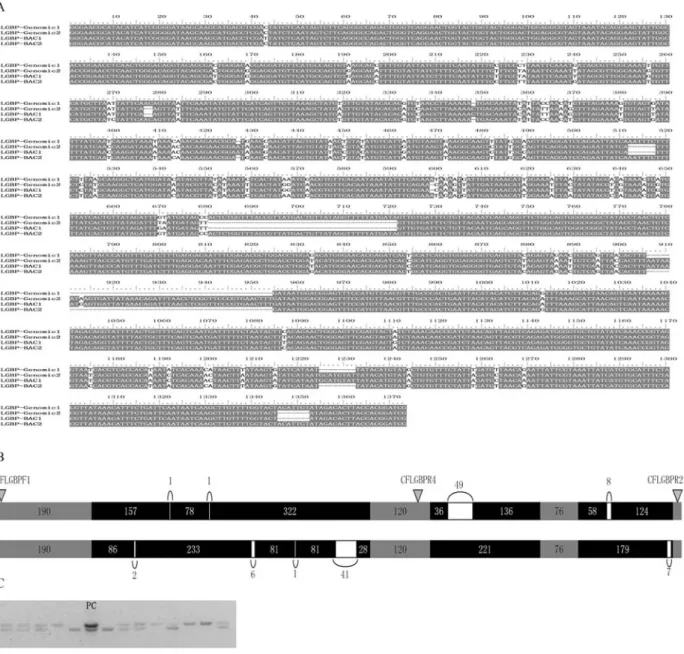
Four sequences amplified from the CFLGBPF1 and CFLGBPR2 primers were obtained from both BAC clones and genomic DNA (FJ434687-FJ434690). Through ana-lyzing these sequences, as well as the corresponding cDNA sequence of LGBP genes, it was concluded that the four consisted of four exons and three introns. Through further multi-alignment analysis, they were classified into two types: type 1 with a length of 1314 bp and type 2 with 1316 bp (Figures 3a and 3b). The varition in length between type 1 and type 2 were caused by nine insertion/deletions in the introns, with lengths ranging from 1 bp to 49 bp (Figu-re 3b). The(Figu-re we(Figu-re four deletions in type 1 and five in type 2.
Up to 77 nucleotide mutations were revealed through multi-alignment analysis (Figure 3a). To develop SNP
markers, PCR products amplified fromC. farrerigenomic DNA were directly sequenced. Results are shown in Figure 4. Apart from the continuous signal confusions caused by the insertion-deletion variations, 224-bp sequences were readable in the sequencing-trace files. Eight SNPs were re-vealed in this region through the detection of two peaks at one and the same location, whereas there was only a single sequence peak at other locations (Figure 4a). Taking the se-quence with the GenBank accession number FJ434689 as reference, they were denominated G169A, G191A, C194G, A197C, T223C, A229T, T240G and G256T. Among these, one (G169A) was located in the exons (total 138 bp) and seven in the introns (total 86 bp). Sequence translation
re-vealed that the mutation at locus 169 in the coding region did not generate a mutation in amino acids (AGG®AGA, Arg).
Through comparative analysis, it was evident that seven of the SNPS detected in PCR product sequencing were coincident with the nucleotide mutations revealed by multi-alignment (Figure 3a). One,viz., C194G, was only detected in PCR product sequencing, whereas four nucleo-tide mutations were only revealed through multi-alignment and not by sequencing (Figure 4b).
One indel marker was obtained through amplification by CFLGBPF1 and CFLGBPR4 primers. The reverse primer CFLGBPR4 was located in exon 2, thus PCR
ucts of the two types would be 782 bp and 830 bp, respec-tively. Indel marker testing, using 13 randomly selected individuals, showed that the PCR products of the two geno-types could be separated one from the other in 1.5% agarose gel electrophoresis (Figure 3c).
A family ofC. farreri, consisting of both parents and 105 progenies, was employed to provide evidence of the indel marker segregation pattern during heredity. The data showed that the number of progeny with genotype AA, aa and Aa was 26, 16 and 63 respectively, while both parents were heterozygous (Aa). Chi-square testing revealed the occurrence of slight segregation distortion (p = 0.0472, p < 0.05). Homozygous deficiency was detected, since the
number of individuals with genotype aa (16) was signifi-cantly less than the expected (26.25).
Discussion
In the present work, we localized lgbp-containing BAC clones on C. farreri chromosomes through FISH. When localizing specifically CFB094J04 in either the chro-mosome metaphase or the nucleus interphase, the result was the same. Co-localization of the sixlgbp-containing BAC clones showed that LGBP genes are located on one chromosome inC. farreri. To our knowledge, this is the
first report on mapping immune related genes on these chromosomes in particular.
Functionally related genes might be physically linked, and could thus form gene clusters. For instance, in human beings three transglutaminases form a gene cluster on chromosome 15q15 (Grenardet al., 2001), whereas in
Drosophila, six homeobox genes, involved in mesodermal patterning and differentiation programs, form a gene clus-ter at 93DE on the third chromosome (Jaglaet al., 2001). The immune system ofC. farreriinvolves a vast number of functionally related genes (Su et al., 2004; Gao et al., 2007.; Qiuet al., 2007a, b; Wanget al., 2007; Yuet al., 2007; Zhanget al., 2007a, 2008). As things stand, it is quite reasonable to assume the existence of a certain number of gene clusters. So far, no physical linkage of these genes has been reported. FISH mapping of gene-containing BAC clones provides an important approach in exploring whether there are gene clusters among immune related genes. Based on large-insert libraries and double-color FISH, as presented in this study, many other immune re-lated genes could be screened and mapped in the near fu-ture. The discovery of physical linkages among these genes would enlighten further research.
The localization of BACs facilitates chromosome identification inC. farreri, especially through FISH, which itself is both efficient and transferable by being sequence-specific. The construction of BAC libraries inC. farreri
opens up vast possibilities for this identification process, by the abundance of resultant probes. Previous reports have al-ready shown that FISH techniques together with large-insert libraries could be efficiently used, hereto. In
Crassostrea virginica(Ostreoida, Ostreidae), ten
chromo-somes were identified through the localization of nine bacteriophage P1 clones together with the configuration characters of the chromosomes (Wanget al., 2005b), and in
C. farreri, eight of 19 chromosomeswere identified through the localization of eight fosmid clones (Zhang et al., 2007c). Furthermore, the lgbp-bearing chromosome was successfully identified through locating lgbp-containing BACs with FISH. In the latter case, a larger number would have been if more BACs had been localized. Furthermore, FISH techniques are extremely helpful in the construction of integration maps through using molecular markers as bridges. In potatoes, all the linkage groups were assigned to the corresponding chromosomes by mapping 12 BAC clones which contained RFLP markers genetically mapped to the chromosomes (Donget al., 2000). Thus, it is possible to develop molecular markers in BAC clones ofC. farreri
for further application in constructing integration maps.
Molecular markers, including AFLP and SSR mark-ers, have been developed in C. farreri, in the course of many studies (Liet al., 2005; Wanget al., 2005a; Zhanet al., 2007; Zhanet al., 2008).Herein, we developed several markers applicable to linkage mapping inC. farreriLGBP gene. On combining this with information from FISH map-ping, LGBP gene mapping would assign the linkage group to the corresponding chromosome.
SNPs frequency and their distribution pattern in LGBP genes ofC. farreriare both impressive. Altogether, we obtained eight SNP markers in a 224 bp-long region, an average length of 28 bp each. Although only a short frag-ment was analyzed in this study, it still reflected the high abundance of SNPs in theC. farrerigenome, thus possibly implying the likelihood of developing these markers in any
given region therein. Moreover, it was also observed that more markers are located in introns than in exons. Among the nine markers in this study, only one was located in a coding region (totally 138 bp), whereas the other seven, as well as the indel marker itself, were located in the non-coding region (a total of 86 bp), thereby reflecting the selec-tive pressures which might be playing an important part in the evolution of the organism. The distribution model of molecular markers in coding and non-coding regions is im-portant for marker development in the construction of ge-netic maps and their integration. The putative roles of molecular markers are important in selective breeding. Among the nine SNP markers identified in the present study, only one (G169A) was detected in the coding region, and proved to be a silent mutation. The role of G169A may be illustrated in future research.
Indel marker segregation was revealed to be slightly distorted through genotyping an F1 family ofC. farreri. Segregation distortion in this scallop had already been re-vealed in previous studies (Liet al., 2005; Wang et al., 2005a). Artificial errors could account for this. In the pres-ent study, the possibility of false positives could not be ex-cluded, since only a relatively small population (105 progeny) was used and the p value was close to 0.05 (p = 0.0472). On the other hand, and pending future confir-mation, homozygote deficiency in indel marker heredity could be instructive in further research. In oysters, homozygote deficiency was explained by the high genetic load and selection against deleterious recessive mutations (Launey and Hedgecock, 2001). Accordingly, various al-leles were hypothesized to be deleterious when they were homogenous (Hubert and Hedgecock, 2004). It is reason-able to assume the same might occur inC. farreri, due to the relatively close evolutional relationship. Therefore, it is in-structive to observe a significant reduction in the F1 family “aa” genotype, since this may indicate genes with deleteri-ous recessive alleles linked with the indel marker. In a pre-vious study, LGBP has been shown to play crucial roles in infections through up-regulated expression immediately af-terVibrio anguillarumchallenge (Suet al., 2004). There-fore, segregation distortion of the indel marker in LGBP genes provides functional illustration, although proof re-mains concealed.
Acknowledgments
Our sincere thanks are due to Dr. Fengtang Yang from Wellcome Trust Sanger Institute, Wellcome Trust Genome Campus, for his creative suggestions on BAC-FISH techniques. We also thank Dr Yutao Li from the Aus-tralian Commonwealth Scientific and Research Organiza-tion (CSIRO) and Dr. Jiquan Zhang for technical support. This work was financially supported by grants from the Key Program of the National Natural Science Foundation of China (30730071), the Major State Basic Research De-velopment Program of China (2006CB101804) and
Na-tional High-Tech Research and Development Program of China (863 program) 2007AA09Z430.
References
Cheng W, Liu CH, Tsai CH and Chen JC (2005) Molecular clon-ing and characterisation of a pattern recognition molecule, lipopolysaccharide- and beta-1,3-glucan binding protein (LGBP) from the white shrimpLitopenaeus vannamei. Fish Shellfish Immunol 18:297-310.
Dong F, Song J, Naess SK, Helgeson JP, Gebhardt C and Jiang J (2000) Development and applications of a set of chromo-some-specific cytogenetic DNA markers in potato. Theor Appl Genet 101:1001-1007.
Gao Q, Song L, Ni D, Wu L, Zhang H and Chang Y (2007) cDNA cloning and mRNA expression of heat shock protein 90 gene in the haemocytes of Zhikong scallop Chlamys farreri. Comp Biochem Physiol B Biochem Mol Biol 147:704-15. Grenard P, Bates MK and Aeschlimann D (2001) Evolution of
transglutaminase genes: Identification of a transglutaminase ene cluster on human chromosome 15q15. J Biol Chem 276:33066-33078.
Hubert S and Hedgecock D (2004) Linkage maps of microsatellite DNA markers for the Pacific oysterCrassostrea gigas. Ge-netics 168:351-362.
Jagla K, Bellard M and Frasch M (2001) A cluster ofDrosophila
homeobox genes involved in mesoderm differentiation pro-grams. BioEssays 23:125-133.
Janeway Jr CA (1989) Approaching the asymptote? Evolution and revolution in immunology. Cold Spring Harb Symp Quant Biol 54:1-13.
Kim YS, Ryu JH, Han SJ, Choi KH, Nam KB, Jang IH, Lemaitre B, Brey PT and Lee WJ (2000) Gram-negative bacteria-binding protein, a pattern recognition receptor for lipo-polysaccharide and beta-1,3-glucan that mediates the signal-ing for the induction of innate immune genes inDrosophila melanogastercells. J Biol Chem 275:32721-7.
Launey S and Hedgecock D (2001) High genetic load in the Pa-cific oysterCrassostrea gigas. Genetics 159:155-165. Lee SY, Wang R and Söderhäll K (2000) A
lipopolysaccharide-and b-1,3-glucan-binding protein from hemocytes of the freshwater crayfishPacifastacus leniusculus. J Biol Chem 275:1337-1343.
Lee WJ, Lee JD, Kravchenko VV, Ulevitch RJ and Brey PT (1996) Purification and molecular cloning of an inducible gram-negative bacteria-binding protein from the silkworm,
Bombyx mori. Proc Natl Acad Sci USA 93:7888-93. Li L, Xiang J, Liu X, Zhang Y, Dong B and Zhang X (2005)
Con-struction of AFLP-based genetic linkage map for Zhikong scallop,Chlamys farreriJones et Preston and mapping of sex-linked markers. Aquaculture 245:63-73.
Liu F, Li F, Dong B, Wang X and Xiang J (2007) Molecular clon-ing and characterisation of a pattern recognition protein, lipopolysaccharide and b-1,3-glucan binding protein (LGBP) from Chinese shrimpFenneropenaeus chinensis. Mol Biol Rep Online, DOI: 10.1007/s11033-007-9203-2. Qiu L, Song L, Xu W, Ni D and Yu Y (2007a) Molecular cloning
Qiu L, Song L, Yu Y, Xu W, Ni D and Zhang Q (2007b) Identifi-cation and characterization of a myeloid differentiation fac-tor 88 (MyD88) cDNA from Zhikong scallop Chlamys farreri. Fish Shellfish Immunol 23:614-23.
Sritunyalucksana K and Söderhäll K (2000) The proPO and clot-ting system in crustaceans. Aquaculture 191:53-69. Su JG, Song LS, Xu W, Wu LT, Li HL and Xiang JH (2004)
cDNA cloning and mRNA expression of the lipopoly-saccharide- and beta-1,3-glucan-binding protein gene from scallopChlamys farreri. Aquaculture 239:69-80.
Wang H, Song L, Li C, Zhao J, Zhang H, Ni D and Xu W (2007) Cloning and characterization of a novel C-type lectin from Zhikong scallopChlamys farreri. Mol Immunol 44:722-31. Wang L, Song L, Chang Y, Xu W, Ni D and Guo X (2005a) A
pre-liminary genetic map of Zhikong scallop (Chlamys farreri
Jones et Preston 1904). Aquac Res 36:643-653.
Wang Y, Xu Z, Pierce JC and Guo X (2005b) Characterization of Eastern oyster (Crassostrea virginica Gmelin) chromo-somes by fluorescencein situhybridization with bacterio-phage P1 clones. Mar Biotechnol 7:207-14.
Yu Y, Qiu L, Song L, Zhao J, Ni D, Zhang Y and Xu W (2007) Molecular cloning and characterization of a putative lipo-polysaccharide-induced TNF-afactor (LITAF) gene homo-logue from Zhikong scallopChlamys farreri. Fish Shellfish Immunol 23:419-29.
Zhan A, Bao Z, Hu X, Hui M, Wang M, Peng W, Zhao H and Hu J (2007) Isolation and characterization of 150 novel micro-satellite markers for Zhikong scallop (Chlamys farreri). Mol Ecol Notes 7:1015-1022.
Zhan A, Bao Z, Wang S, Peng W, Wang M, Hu J, Liang C and Yue Z (2008) Characterization of 95 novel microsatellite markers for Zhikong scallop Chlamys farreri using FI-ASCO-colony hybridization and EST database mining. Fish Sci 74:516-526.
Zhang H, Song L, Li C, Zhao J, Wang H, Gao Q and Xu W. (2007a) Molecular cloning and characterization of a
thioester-containing protein from Zhikong scallopChlamys farreri. Mol Immunol 44:3492-500.
Zhang H, Song L, Li C, Zhao J, Wang H, Qiu L, Ni D and Zhang Y (2008) A novel C1q-domain-containing protein from Zhikong scallop Chlamys farreriwith lipopolysaccharide binding activity. Fish Shellfish Immunol 25:281-9. Zhang L, Bao Z, Cheng J, Li H, Huang X, Wang S, Zhang C and
Hu J (2007b) Fosmid library construction and initial analy-sis of end sequences in Zhikong scallop (Chlamys farreri). Mar Biotechnol 9:606-12.
Zhang L, Bao Z, Wang S, Hu X and Hu J (2007c) FISH mapping and identification of Zhikong scallop (Chlamys farreri) chromosomes. Mar Biotechnol10:151-157.
Zhang Y, Zhang X, Scheuring CF, Zhang HB, Huan P, Li F and Xiang J (2008) Construction and characterization of two bacterial artificial chromosome libraries of Zhikong scallop,
Chlamys farreriJones et Preston, and identification of BAC clones containing the genes involved in its innate immune system. Mar Biotechnol 2008 10:358-65.
Zwick MS, Hanson RE, Islam-Faridi MN, Stelly DM, Wing RA, Price HJ and McKnight TD (1997) A rapid procedure for the isolation ofC0t-1DNA from plants. Genome 40:138-42.
Internet Resources
BLASTn, http://blast.ncbi.nlm.nih.gov/Blast.cgi?PAGE = Nu-cleotides&PROGRAM = blastn&MEGABLAST = on&BLAST_PROGRAMS = megaBlast&PAGE_TYPE = BlastSearch&SHOW_DEFAULTS = on.
NIS-element software, http://www.nis-elements.com/index.html. Photoshop software,
http://www.adobe.com/prod-ucts/photoshop/family/.
Associate Editor: Fausto Foresti