Analysis of moisture content, acidity and contamination by yeast and molds
in
Apis mellifera
L. honey from central Brazil
Karla Rubia Ananias, Adriane Alexandre Machado de Melo, Celso José de Moura
Escola de Agronomia e Engenharia de Alimentos, Universidade Federal de Goiás, Goiânia, GO, Brazil.
Submitted: April 14, 2011; Approved: November 13, 2012.
Abstract
The development of mold of environmental origin in honey affects its quality and leads to its deterio-ration, so yeasts and molds counts have been used as an important indicator of hygiene levels during its processing, transportation and storage. The aim of this study was to evaluate the levels of yeasts and molds contamination and their correlation with moisture and acidity levels inApis melliferaL.
honey from central Brazil. In 20% of the samples, the yeasts and molds counts exceeded the limit es-tablished by legislation for the marketing of honey in the MERCOSUR, while 42.8% and 5.7% pre-sented above-standard acidity and moisture levels, respectively. Although samples showed yeasts and molds counts over 1.0 x 10²UFC.g-1, there was no correlation between moisture content and the number of microorganisms, since, in part of the samples with above-standard counts, the moisture level was below 20%. In some samples the acidity level was higher than that established by legisla-tion, but only one sample presented a yeasts and molds count above the limit established by MERCOSUR, which would suggest the influence of the floral source on this parameter. In general, of the 35 samples analyzed, the quality was considered inadequate in 45.7% of cases.
Key words:honey,Apis melliferaL., quality.
Introduction
People are more and more convinced that the quality of their health is directly related to the food they consume. According to the principles of healthy eating, a diet should provide water, carbohydrates, proteins, lipids, fiber, vita-mins and minerals, irreplaceable and indispensable compo-nents for the proper functioning of the body (Brasil, 2005). In this context, honey is of excellent nutritional value and the move towards contamination-free natural foods, which retain their original nutritional characteristics, and are pro-duced by a system with little impact on the environment has led to an increase in its consumption (Araújoet al., 2006;
Arvanitoyannis and Krystalli, 2006).
Another constant concern on the part of consumers and producers is the sanitary quality of food, as it has been estimated that annually there are 1.2 billion cases of diar-rhea and some 2.2 million deaths attributed to contaminated food consumption (Organizacão, 2009). Honey is usually consumedin natura, so during harvesting and extraction,
hygienic norms must be rigorously applied, because there is no way of reducing or eliminating the pathogenic microor-ganisms which cause the product to deteriorate. Thus, a lack of proper procedures when handling honey can irre-versibly compromise its quality, and make it unfit for sale (Brasil, 1985; European, 2002).
The physical and chemical features of honey mean that it has low susceptibility to the proliferation of microorgan-isms (low pH, low moisture content, oxidation reduction po-tential, antimicrobial constituents, etc.). Nevertheless, exter-nal factors, such as environmental conditions and handling and storage, can have a negative effect on the final quality (Pereiraet al., 2003; Silva, 2007). In general, one can expect
to find a reduced number of microorganisms in this sub-strate, which under normal moisture conditions, would not seem to interfere with the quality of honey. They are not pathogenic and are considered to be just indicator microor-ganisms (Pereiraet al., 2003, Snowdon and Cliver, 1996).
Contamination of honey can occur through primary sources (pollen, floral nectar, dust, soil and the bodies and
Send correspondence to C.J. Moura. Universidade Federal de Goiás, Escola de Agronomia e Engenharia de Alimentos, Campus Samambaia, Goiânia, GO, Brazil. E-mail: [email protected].
digestive tracts of bees) or through secondary sources, dur-ing extraction or processdur-ing (Almeida-Anacleto, 2007; Al-ves, 2008; Mendeset al., 2009; Pereira, 2008; Silva, 2007).
Certain microorganisms cause honey to ferment, thereby acidifying it and modifying the taste (Pereiraet al., 2003;
Silva, 2007). Contamination can be avoided by implement-ing quality control programs, one of which could be the set-ting up of “Good Manufacturing Practices” by beekeepers, “distribution centers” and warehouses (European, 2002).
Consequently, the aims of this study were to do a yeasts and molds count, to analyze the moisture content and acidity level inApis melliferaL. honey, produced in a
cer-tain region in Goias State, in order to compare it with the parameters established for products marketed in the MERCOSUR, and then correlate the values found.
Material and Methods
Collection and sample preparation
A total of 35 samples ofApis melliferaL. honey was collected between May and August 2009. They were cho-sen at random from 29 beekeepers, participating in the “Beekeeping in the Railroad Territory Project”, carried out by theServico de Apoio às Micro e Pequenas Empresas
(SEBRAE) in 10 municipalities in the Pires do Rio, Goiás. The samples were collected from individual jars of honey of different sizes (from 0.3 to 1 Litre), ready for sale, or from bulk storage, in which case the honey was trans-ferred to sterilized jars. Each sample was assigned a se-quence number according to the order of collection. The samples were stored at room temperature and kept in dry, airy conditions to await analysis.
Analyses were performed in the Physics & Chemistry Laboratories at the School of Agronomy and Food Science at the Federal University of Goiás (UFG); at the Centre for Food Research at the Veterinary Medical School/UFG and at the Food Quality Control Laboratory at the Faculty of Pharmacy/UFG from September 2009 to May 2010.
Yeasts and molds count
Yeasts and molds count was undertaken according to the methodology proposed for animal origin products (Brasil, 2003). A sample of 25 ± 0.2 g of honey was weighed, and 225 mL of 0.1% peptone solution (Apijã, Goiânia, Brazil) was added and serial dilutions were made and inoculated (0.1 mL) on a dry 2% potato glucose agar surface (Merck, São Paulo, SP), acidified to pH 3.5. The Petri dishes were incubated without inverting at 25±1 °C, for 5 days, in a BOD incubator. The results were expressed as colony forming units (cfu) of yeasts and molds per gram of honey.
Moisture content
Moisture content in the samples was determined us-ing a refractometer (WYA 2S, Polax) at 20 °C, and the
re-fractive index was then converted for moisture content us-ing the standard table, as recommended by the AOAC (2003). The values were calculated on a wet basis.
Total acidity
Following AOAC (2003), total acidity results were obtained by adding free and lactone acidities. Free acidity was found using the titimetric method, with sodium hy-droxide up to the equivalence point. Then, the lactonic acidity was also found using the titimetric method with hy-drochloric acid.
Statistical analysis
Analyses were performed in quintuplicate and from the data, the Spearman correlation coefficient between the variables was calculated. For this end, Statistica 7 program was used (StatSoft, 2004).
Results and Discussion
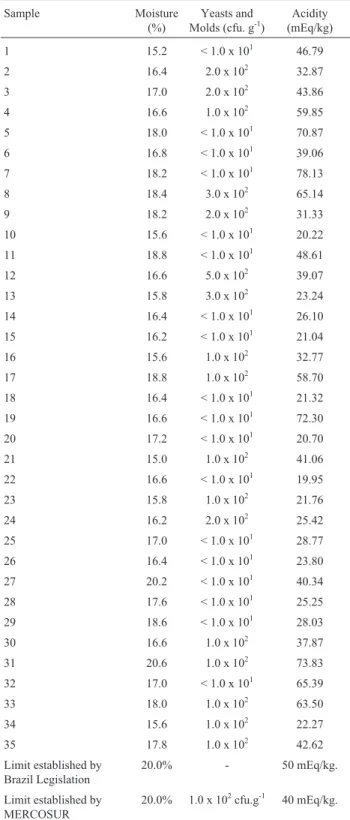
Yeasts and molds counts in the samples ranged from < 1.0 x 101to 5.0 x 10²cfu.g-1(Table 1). As the maximum level allowed for trading in the MERCOSUR is 102cfu.g-1, it was considered that 20% of samples showed cell count above this stipulated value. Similar counts of 1.0 x 101to 3.0 x 10²cfu.g-1were reported by Sodré
et al.(2007) inApis melliferahoneys produced in the State of Piauí, and of < 1.0
x 101to 6.1 x 10²cfu.g-1, reported by Schlabitz
et al.(2010)
in honeys from the Vale do Taquari region of Rio Grande do Sul State.
The molds which are commonly found in honey may survive, but do not reproduce, so high scores are often re-lated to a recent contamination by the environment or by equipment used during processing (Finola et al., 2007;
Pereira, 2008; Snowdon and Cliver, 1996). So, the presence of these microorganisms could indicate the hygiene levels in which the product was processed and are indicators of the practices adopted by the processor (Garcia, 2003; SEBRAE, 2008; SEBRAE, 2009). When evaluating hon-eys from Western Cameroon, Tchoumboue et al.(2007)
found that 73.4% of samples had been contaminated by mi-croorganisms, occurring during the post-harvest process-ing, as there was an absence of microorganisms in honeys collected under ideal hygienic conditions. This hypothesis confirms the need to implement quality control manage-ment programs for beekeepers, “honey distribution cen-ters” and warehouses.
Finolaet al.(2007) explain that the high
microorgan-ism count can increase the acidity in honeys. Osmophilic yeasts ferment honey by acting on the glucose and fructose, forming alcohol and carbon dioxide. Alcohol, in the pres-ence of oxygen, can be broken down into acetic acid and water, which makes the fermented honey more acidic (Pe-reiraet al., 2003; Silva, 2007). Yeasts can grow in low pH
higher activity of water in the liquid phase (Osachlo, 2004). But some studies have shown that a high level of acidity is not always an indicator of fermentation by microorganisms (Balanzaet al., 2004; Evangelista-Rodrigueset al., 2005;
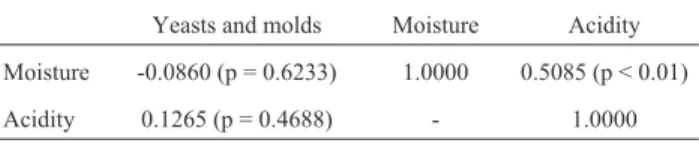
Welkeet al., 2008). This study found no correlation
be-tween the yeasts and molds counts and the acidity of the honeys (Table 2). From an analysis of the data it can be seen that in part of the samples with high acidity values, the yeasts and molds count was below the standard established by MERCOSUR (MERCOSUL, 1999). So these results corroborated what has been said earlier, that an increase in acidity in honey is not related to one single parameter, which in this case, was the yeasts and molds count.
Total acidity ranged from 19.9 to 78.1 mEq/kg, so 25.7% of the samples exceeded the limit permitted for mar-keting in the Brazil (Brasil, 2000) and MERCOSUR (MERCOSUL, 1999) (Table 1). These values are higher than those observed by Terrabet al.(2004) in thyme hon-eys, whose maximum value was 48.6 mEq/kg. Acidity in honey is associated with same factors, such as floral sources, amount of minerals, time of harvesting, and also the amount of gluconic acid resulting from enzymatic ac-tion on glucose (De-Rodriguezet al., 2004; Finolaet al., 2007; Kücüket al., 2007; Mendeset al., 1998, Mendeset al., 2009; Olaitanet al., 2007; White Jr., 1989).
A maximum limit for acidity in honey is also set out in legislation adopted by the European Union, where the limit is even lower, 40 mEq/g (União, 2001), but this pa-rameter alone should not disqualify the product (Balanzaet al., 2004; Evangelista-Rodrigueset al., 2005; Welkeet al.,
2008). These regulations may be reviewed so that honeys with acidity levels above presently accepted standards, but which show no signs of fermentation, may be accepted and this level may be considered as a feature not related to the loss of quality, but to the origin of the product (bee species, flowering, climate or region).
Moisture content levels ranged from 15% to 20.6% and only two samples exceeded the 20% moisture limit es-tablished by Brazil (Brasil, 2000) and MERCOSUR (MERCOSUL, 1999) (Table 1). This result may be related to the relatively low moisture levels of the air in this region and to the beekeeper’s concern in collecting only combs with at least 90% operculation. According to Evangelista-Rodrigueset al. (2005),Apisbees have a habit of
oper-culating the combs only when the honey is already at the point of collection, that is, with moisture content levels be-tween 17% and 18%.
The moisture content influences the flavor, preserva-tion, viscosity, specific weight, crystallization and palat-ability, and it also contributes to the development of fer-menting microorganisms (Abramovic et al., 2008;
Almeida, 2002; Araújoet al., 2006; Silva, 2007). The
val-ues found were close to those of 16.6 to 20.8%, reported by Almeida (2002), and to those of 18.6 to 21%, found by Salgadoet al.(2008), both in honeys produced in upstate
São Paulo. The moisture content influences important char-acteristics of honey, such as viscosity and ºBrix (Anupama
et al., 2003), and as well as that, according to some studies,
the higher the moisture level the greater the development of
Table 1- Moisture content, yeasts and molds and acidity values in 35 sam-ples of Apis mellifera L. honey from central Brazil, and the limit estab-lished by Brazilian Legislation and MERCOSUR.
Sample Moisture
(%)
Yeasts and
Molds (cfu. g-1) (mEq/kg)Acidity
1 15.2 < 1.0 x 101 46.79
2 16.4 2.0 x 10² 32.87
3 17.0 2.0 x 10² 43.86
4 16.6 1.0 x 10² 59.85
5 18.0 < 1.0 x 101 70.87
6 16.8 < 1.0 x 101 39.06
7 18.2 < 1.0 x 101 78.13
8 18.4 3.0 x 10² 65.14
9 18.2 2.0 x 10² 31.33
10 15.6 < 1.0 x 101 20.22
11 18.8 < 1.0 x 101 48.61
12 16.6 5.0 x 10² 39.07
13 15.8 3.0 x 10² 23.24
14 16.4 < 1.0 x 101 26.10
15 16.2 < 1.0 x 101 21.04
16 15.6 1.0 x 10² 32.77
17 18.8 1.0 x 10² 58.70
18 16.4 < 1.0 x 101 21.32
19 16.6 < 1.0 x 101 72.30
20 17.2 < 1.0 x 101 20.70
21 15.0 1.0 x 10² 41.06
22 16.6 < 1.0 x 101 19.95
23 15.8 1.0 x 10² 21.76
24 16.2 2.0 x 10² 25.42
25 17.0 < 1.0 x 101 28.77
26 16.4 < 1.0 x 101 23.80
27 20.2 < 1.0 x 101 40.34
28 17.6 < 1.0 x 101 25.25
29 18.6 < 1.0 x 101 28.03
30 16.6 1.0 x 10² 37.87
31 20.6 1.0 x 10² 73.83
32 17.0 < 1.0 x 101 65.39
33 18.0 1.0 x 10² 63.50
34 15.6 1.0 x 10² 22.27
35 17.8 1.0 x 10² 42.62
Limit established by Brazil Legislation
20.0% - 50 mEq/kg.
Limit established by MERCOSUR
microorganisms, which culminates in increased total acid-ity due to fermentation (Özcanet al., 2006).
This study found no correlation between moisture content and the yeasts and molds counts of the honeys (Ta-ble 2), possibly because in the majority of samples (94.3%), moisture levels were below 20%, and according to Snowdon and Cliverb (1996) a minimum of 20% moisture is needed for the development of yeasts and molds. More-over, according to Souzaet al.(2009), in order to get
pre-cise information on the relationship between moisture and the growth of microorganisms, determinations over a cer-tain time interval would be necessary to find the mean growth of microorganisms.
A positive correlation was found between the mois-ture and acidity levels of the samples to the extent that 50% of the variations in acidity were shown to be related to vari-ations in moisture. These results may be related to the glu-cose oxidase enzyme activity, which is promoted by higher levels of moisture in honey. The activity of this enzyme gives rise to gluconic acid, which increases honey acidity (Mendeset al., 2009).
Conclusion
The results of the analyses carried out on honeys from a region within Goiás State indicated that 20% of the sam-ples had yeasts and molds counts above 1.0 x 10²cfu.g-1. However, there was no direct relationship between mois-ture content levels and the presence of these microorgan-isms. The acidity index was above the permitted standard, but contamination by microorganisms was identified in only one of these samples, which would suggest the influ-ence of other factors in the increase of total acidity in honey of this region.
Acknowledgments
The authors wish to thank the Federal University of Goiás for the use of their premises and concession of a scholarship and SEBRAE, Goiás, for its financial support.
References
Abramovic H, Jamnik M, Burkan L, Kac M (2008) Water activity and water content in Slovenian honeys. Food Control 19:1086-1090.
Almeida D (2002) Espécies de abelhas (Hymenoptera, Apoidae) e tipificacão dos méis por elas produzidos em área de cerrado, do município de Pirassununga, Estado de São Paulo.
Pira-cicaba, Brasil, 116p. (M.Sc. Dissertation. Escola Superior de Agricultura “Luiz de Queiroz”, USP).
Almeida-Anacleto D (2007) Recursos alimentares, desenvolvi-mento das colônias e características físico químicas, micro-biológicas e polínicas de mel e cargas de pólen de melipo-níneos, do município de Piracicaba, Estado de São Paulo. Piracicaba, Brasil, 134p. (Tese de Doutorado, Escola Supe-rior de Agricultura “Luiz de Queiroz”).
Alves EM (2008) Identificacão da flora e caracterizacão do mel orgânico de abelhas africanizadas das ilhas floresta e laran-jeira, do alto do Rio Paraná. Maringá, Brasil, 77 pp. (Tese de Doutorado, Centro de Ciências Agrárias, UEM).
Anupama D, Bhat KK, Sapna VK (2003) Sensory and physico-chemical properties of commercial samples of honey. Food Res Int 36:183-191.
AOAC - Association of Official Analytical Chemists. (2003). Of-ficial methods of analysis. 17. ed. 2nd revision. AOAC. Gaithersburg.
Araújo DR, Silva RHD, Sousa JS (2006) Avaliacão da qualidade físico-química do mel comercializado na cidade de Crato, CE. Rev Biol Cienc Terra 6:51-55.
Arvanitoyannis I, Krystalli A (2006) An empirical examination of the determinants of honey consumption in Romania. Int J Food Sci Technol 41:1164-1176.
Balanza ME, Ordóñez A, Barrera M (2004) Acidez total y lactó-nica de la miel de abejas: correlación com otros parâmetros. Seminário Internacional de calidad de miel de Rafaela, Rafaela, SF. http://www.alimentosargentinos.gov.ar/foros/ apicola/biblio/11-diciembre/Acidez%20total%20y%20lact %F3nica%20de%20la%20miel_%20Balanza-2.pdf. Brasil (1985) Portaria nº 06, de 25 de julho de 1985.Aprova as
normas higiênico-sanitárias e tecnológicas para mel, cera de abelhas e derivados. Brasília, DF, 1985.
Brazil (2000) Instrucão Normativa nº 11, de 20 de outubro de 2000. Aprova o Regulamento Técnico de Identidade e Qua-lidade do Mel. Brasília, DF, 2000.
Brazil (2003) Instrucão Normativa nº 62, de 26 de agosto de 2003. Oficializa os Métodos Analíticos Oficiais para Análises Microbiológicas para Controle de Produtos de Origem Ani-mal e Água.Ministério da Agricultura, Pecuária e Abas-tecimento, Brasília, DF, 2003.
Brazil, Ministério da Saúde (2005) Guia alimentar para a popu-lacão brasileira: Promovendo a alimentacão saudável. Edi-tora MS, Brasília, DF.
De Rodríguez GO, Ferrer BS, Ferrer A, Rodríguez B (2004) Char-acterization of honey produced in Venezuela. Food Chem 84:499-502.
European Commission (2002) Opinion of the scientific commit-tee on veterinary measures relating to public health on honey and microbiological hazards. http://ec.europa.eu/food/ fs/sc/scv/out53_en.pdf.
Evangelista-Rodrigues A, Silva SEM, Beserra EMF, Rodrigues ML (2005) Análise físico-química dos méis das abelhas Apis mellifera eMelipona scutellarisproduzidos em duas regiões no Estado da Paraíba. Cienc Rural 35:1166-1171. Finola MS, Lasagno MC, Marioli JM (2007) Microbiological and
chemical characterization of honeys from central Argentina. Food Chem 100:1649-1653.
Garcia W (2003) Guia de Buenas Prácticas de Apícolas y de Manufactura.Secretaría de Agricultura, Ganadería, Pesca y Alimentos, Buenos Aires.
Table 2- Spearman correlation coefficient between the yeasts and molds counts, moisture content and acidity inApis melliferaL. honey, produced
in central Brazil.
Yeasts and molds Moisture Acidity
Moisture -0.0860 (p = 0.6233) 1.0000 0.5085 (p < 0.01)
Kücük M, Kolail S, Karaoglu S, Ulusoy E, Baltac C, Candan F (2007) Biological activities and chemical composition of three honeys of different types from Anatolia. Food Chem 100:526-534.
Mendes CG, Silva JBA, Mesquita LX, Maracajá PB (2009) As análises de mel: Revisão. Rev Caatinga 22:7-14.
Mendes E, Brojo Proenca E, Ferreira IMPLVO, Ferreira MA (1998) Quality evaluation of Portuguese honey. Carbohydr Polym 37:219-223.
MERCOSUL - Mercado Comum do Sul. - Resolucão nº 56, de 29 de setembro de 1999. Aprova o Regulamento técnico “Identidade e Qualidade do Mel. Montevidéu, 1999. http://www.mercosur.int/msweb/portal%20intermediario/ Norma/Normas_web/Resoluciones/PT/Res_056_099_RT M%20Identidade%20Qualidade%20_Ata%203_99.PDF. Olaitan PB, Adeleke OE, Ola IO (2007) Honey: a reservoir for
mi-croorganisms and an inhibitory agent for microbes. Afr Health Sci 7:159-165.
Organizacão Pan-Americana da Saúde (2009) Guias para o geren-ciamento de riscos sanitários em alimentos. OPAS/OMS, Rio de Janeiro.
Osachlo L (2004) Aplicacão do sistema de análise de perigos e pontos críticos de controle no processamento industrial de mel de abelhas (Apis mellifera). Brasília, Brasil, 67 pp (Esp. Monografia. Centro de Excelência do Turismo, UNB). Özcan M, Arslan D, Ceylan DA (2006) Effect of inverted
saccha-rose on some properties of honey. Food Chem 99:24-29. Pereira APR (2008) Caracterizacão de mel com vista a producão
de hidromel. Braganca, Brasil, 85 pp (M.Sc. Dissertation, Escola Superior Agrária de Braganca, Instituto Politécnico de Braganca.
Pereira FM, Lopes MTR, Camargo RCR, Vilela SLO (2003) Producão de Mel. EMBRAPA, Teresina.
Salgado TB, Orsi RO, Funari SRC, Martins AO (2008) Análise físico-química de méis de abelhasApis melliferaL. comer-cializados na região de Botucatu. PUBVET 2:art. 175. Schlabi0tz C, Silva SAF, Souza CFV (2010) Avaliacão de
parâ-metros físico-químicos e microbiológicos em mel. Rev Bras Tecnol Agroind 4:80-90.
SEBRAE – Servico Brasileiro de Apoio às Micro e Pequenas Empresas (2009) PAS Mel: Manual de Boas Práticas Apí-colas.SEBRAE/NA. Brasília, DF.
SEBRAE – Servico Brasileiro de Apoio às Micro e Pequenas Empresas (2008) PAS Indústria: Manual de Seguranca e Qualidade para Apicultura.SEBRAE/NA Brasília, DF. Silva MBL (2007) Diagnóstico do sistema de producão e
quali-dade do mel deApis Mellifera. Vicosa, Brasil, 97 pp (M.Sc. Dissertation, Departamento de Tecnologia de Alimentos. Universidade Federal de Vicosa).
Snowdon JA, Cliver DO (1996) Microorganisms in honey. Int J Food Microbiol 31:1-26.
Sodré GS, Marchini LC, Moreti ACCC, Otsuk IP, Carvalho CAL (2007) Caracterizacão físico-química de amostras de méis deApis melliferaL. (Hymenoptera: Apidae) do Estado do Ceará. Cienc Rural 37:1139-1144.
Souza BA, Marchini LC, Dias CTS, Oda-Souza M, Carvalho CAL, Alves RMO (2009) Avaliacão microbiológica de amostras de mel de trigoníneos (Apidae: Trigonini) do Esta-do da Bahia. Cienc Tecnol Aliment 29:798-802.
StatSoft Inc (2004) Statistica: Data Analysis Software System (version 7).(1 CD-ROM).
Tchoumboue J, Awah-Ndukum J, Fonteh FA, Dongock ND, Pinta J, Mvondo ZA (2007) Physico-chemical and microbiologi-cal characteristics of honey from the sudano-guinean zone of West Cameroon. Afr J Biotechnol 6:908-913.
Terrab A, Recamales AF, Hernanz D, Heredia FJ (2004) Charac-terisation of Spanish thyme honeys by their physicoche-mical characteristics and mineral contents. Food Chem 88:537-542.
União Européia. Comissão do Conselho Europeu - Diretiva CE nº 110, de 20 de dezembro de 2001. Define as normas comuns para o mel adaptando-as a legislacão geral aplicada a pro-dutos alimentícios. Bruxelas, EU, 2001.
Welke JE, Reginatto S, Ferreira D, Vicenzi R, Soares JM (2008) Caracterizacão físico-química de méis deApis melliferaL. da região noroeste do Estado do Rio Grande do Sul. Cienc Rural 38:1737-1741.