%'
From the Department of Pediatrics, Hospitaldas Clínicas, Faculty of Medicine, University of São Paulo.
REVIEW
PREVENTION OF RESPIRATORY SYNCYTIAL VIRUS
INFECTIONS
Lucia Ferro Bricks
RHCFAP/3041
BRICKS LF - Prevention of respiratory syncytial virus infections. Rev. Hosp. Clín. Fac. Med. S. Paulo 56(3):79-90, 2001.
Respiratory syncytial virus is the most important cause of viral lower respiratory illness in infants and children worldwide. By the age of 2 years, nearly every child has become infected with respiratory syncytial virus and re-infections are common throughout life. Most infections are mild and can be managed at home, but this virus causes serious diseases in preterm children, especially those with bronchopulmonary dysplasia. Respiratory syncytial virus has also been recognized as an important pathogen in people with immunossupressive and other underlying medical problems and institutionalizated elderly, causing thousands of hospitalizations and deaths every year. The burden of these infections makes the development of vaccines for respiratory syncytial virus highly desirable, but the insuccess of a respiratory syncytial virus formalin-inactivated vaccine hampered the progress in this field. To date, there is no vaccine available for preventing respiratory syncytial virus infections, however, in the last years, there has been much progress in the understanding of immunology and immunopathologic mechanisms of respiratory syncytial virus diseases, which has allowed the development of new strategies for passive and active prophylaxis. In this article, the author presents a review about novel approaches to the prevention of respiratory syncytial virus infections, such as: passive immunization with human polyclonal intravenous immune globulin and humanized monoclonal antibodies (both already licensed for use in premature infants and children with bronchopulmonary dysplasia), and many different vaccines that are potential candidates for active immunization against respiratory syncytial virus.
DESCRIPTORS: Respiratory syncytial virus. Monoclonal antibodies. Vaccines. Imunoglobulins. Immunization.
The Respiratory Syncytial Virus (RSV) is considered the primary etio-logic agent in acute respiratory infec-tions in infants. Since its identification, in the mid 50’s, several studies have been conducted to develop effective and safe vaccines against RSV. How-ever, despite more than four decades of intensive research, no effective vaccine for the prevention of infections caused by this agent has been developed up to now. In the last few years, it was dem-onstrated that passive immunization with polyclonal and/or monoclonal specific antibodies against RSV can ei-ther prevent or attenuate the clinical manifestations of RSV infections in high-risk groups3,13,15,19,20,22,26,34,43,44. In
this paper, a short review on the pre-vention of RSV infections through the use of these pharmaceutical products is presented, as well as a review on the development of new vaccines against RSV.
The agent – The RSV was first
iso-lated from chimpanzee’s coryza in
1955 and called the chimpanzee coryza
agent22,44. Soon after, the virus was
iso-lated from children with bronchiolitis and recognized as the most common cause of lower respiratory tract
dis-eases in children all over the world. In 1957, due to its ability to infect the res-piratory tract cells and induce the for-mation of syncytial giant cells in tissue cultures, the virus was called respira-tory syncytial virus44,51.
The RSV is a member of the
Paramyxoviridae family of the Pneumovirus genus.34 There are two
primary antigenic groups (A and B) and both present several strains.
The viral genoma, formed by a single strand of RNA, codes for at least 10 distinct proteins, most of them struc-tural proteins. There are at least two non-structural proteins, the functions of
which are still unkonwn22,44,51. The
&
proteins forms the virus core or nucleo-capsid, which is enclosed by an enve-lope formed by different glycoproteins. The glycoproteins F and G cross the membrane and are the primary surface antigens that are the target of the host immune response. Protein F accounts for the virus penetration into cells, and for the cell membrane fusion which re-sults in the formation of multinucleated syncytial giant cells; the protein G ac-counts for the virus binding to the cells22,23,51. Whereas protein F undergoes
few changes, protein G presents greater antigenic and genetic diversity in groups A and B11,32,50 The subtype A seems to
be the most frequent, accounting for the most severe cases12,30,56.
The aminoacid sequence of protein G, of a virus of the same group which circulates during an epidemic, can reach 20%. Like the influenza virus, the antigenic variations play a role in RSV reinfections that occur over a life-time; however, since RSV has a non-segmented genoma, it presents less an-tigenic variations than the influenza vi-rus44.
RSV transmission occurs through direct contact with secretions from in-fected people or with contaminated objects1,22. When infected, infants and
immunosuppressed individuals excrete for a long time large quantities of RSV in respiratory secretions. RSV infects the respiratory tract mucosa and the conjunctiva, and the symptoms appear following a 2 to 8 day-incubation pe-riod (most commonly 4 to 6 days)1,44.
Clinical Manifestations –RSV
replicates in the upper respiratory tract cells, causing an inflammatory process, which includes epithelium destruction, edema and increased mucus produc-tion. When the lower respiratory tract is involved, bronchiolar hyperreactiv-ity, frequently occurs, as well as the changes already described 6,12,21-23,33.
Whereas most adolescents and adults present mild disease with upper respiratory tract symptoms (rhinorrhea and cough) and low-grade fever, RSV
is considered the major etiologic agent for lower respiratory tract infections, such as bronchiolitis and pneumonia in children under two years old; however, mild and asymptomatic infections are uncommon in infants. RSV is detected in 40 to 90% of the bronchiolitis epi-sodes and, during epidemic outbreaks, accounts for more than 80% of the cases. Half of the cases of pneumonia occurring in children under two years old are believed to be caused by RSV; this agent is identified in 10 to 30% of the cases of tracheobronchitis and, at a lower rate (3%-10%) of the cases of croup12,23,25,30,48.
Children under two months of age, mainly preterm ones, can develop ap-nea and atelectasis. In their first year of life, preterm infants can present a high risk of hospital readmission, par-ticularly those with low weight at birth and shorter gestational period1,51,61.
Be-sides preterm infants, children with chronic pulmonary disturbances and congenital heart disease present a greater risk of lower respiratory tract complications. The risk of hospital ad-mission due to chronic respiratory dis-ease was estimated in 12%, 17% and 28%, respectively, for preterm infants without bronchopulmonary disease, with mild bronchopulmonary disease and moderate to severe bronchopulmo-nary disease39.
RSV has been recognized as a ma-jor cause of morbidity and mortality in people presenting immune deficiency associated with malignancies, chemo-therapy or organ transplantation and has accounted for up to 10% of hospi-talizations for lower respiratory tract infections in the elderly in the winter season12,30,34,51.
RSV epidemics frequently occur in a hospital environment, where the virus is introduced by adults who generally present either asymptomatic or mild in-fection.1 When preterm infants as well
as other risk groups are infected, the consequences can be devastating55. In a
study carried out by Langley et al.
(1997)29 in nine Canadian hospitals, 6%
of 1,516 hospitalized children presented hospital-acquired RSV infections, fea-tured by the agent identification and the beginning of lower respiratory tract symptoms 72 hours after hospitaliza-tion. When compared with children with community-acquired RSV infection, those infected in the hospital environ-ment had longer hospital stays (10 ver-sus 5 days) and a higher rate of
mortal-ity (4.4% versus 0.42%).
RSV frequently causes bronchiolar hyperreactivity both in children and in adults11,21,22,33. Gross et al. (2000)21 have
recently demonstrated that the rate of RSV infection in children under one year of age admitted to hospital for chronic obstructive respiratory disease was 34.3% (74/216), whereas in the control group, which involved 133 children hospitalized for other reasons, RSV was detected in only 15% (20/ 133). In this study, the children admit-ted to hospital for CRD (chronic res-piratory disease) or for other reasons presented no differences regarding risk factors for RSV infections, showing that RSV plays a major role in obstruc-tive respiratory disease in infants21.
&
Therapy for RSV Infections
The management of RSV infections is basically supportive, including diet care, oral hydration and ventilation sup-port51. The antiviral therapy is restricted
to the use of aerosol ribavirine1,44.
Ribavirine is a virustatic drug that should be used early, since the greatest activity of RSV occurs up to three days after the beginning of the lower respi-ratory tract symptoms. Although it is a low toxicity drug that has been shown in several studies to be much more ef-fective than placebo regarding the need of oxygen supplementation, mechanical ventilation and number of days of hos-pitalization, controversies still remain regarding its use, since this drug has not shown to be effective in some studies. There are doubts concerning the cost/ benefit ratio of its use and the effective-ness of ribavirine in the prevention of late pulmonary sequellae following RSV infections30,32,47.
Epidemiology of RSV Infections
Humans are the unique sources of infection. RSV is highly contagious and its transmission occurs through di-rect, or close, contact with contami-nated secretions, droplets or fomites. It is important to stress that the virus can survive in contaminated hands for more than a half hour, being common the self-inoculation infections. The vi-rus can survive for several hours in the surface of contaminated objects1.
RSV presents a highly predictable infection pattern, since the beginning of outbreaks is anticipated by the in-creased number of hospitalized infants for bronchiolitis and/or pneumonia23.
In temperate climate countries, the outbreaks occur in the winter season, from the end of October up to the be-ginning of the spring52 and, in tropical
climate countries, they occur during the rainy season51.
It is estimated that more than 95% of children are infected with RSV up
to the age of two, and more than half are reinfected every year34. RSV
infec-tions and reinfecinfec-tions are common at all ages, and a previous infection does not protect against further infection, even in the following years51,57.
About 15% to 22% of RSV in-fected children under one year old present lower respiratory tract involve-ment and 0.5% to 2% require hospital-ization34,57. The rate of mortality among
hospitalized children range from 0% to 5.2%44.
It is estimated that RSV causes ap-proximately 84,000 to 144,000 hospi-tal admissions of children under five years old49, and 4,500 deaths each year
only in the United States26,31,43. In late
80’s, the annual cost of hospitalization for RSV in the U.S. was estimated to surpass 300 million dollars, without considering the social burden caused by work and school absenteeism.44,51
The outbreaks duration varies from one year to another, but on average, the outbreaks have a 22-week duration. Both RSV groups (A and B) circulate during the same epidemic period, but the rate of episodes attributed to group A and B virus varies from one year to another, and from one site to another; in addition, since there are different strains of virus A and B, outbreaks caused by genetically distinct strains can follow an outbreak caused by a single strain12,23,25,56.
Approximately, 50% of the chil-dren are infected during RSV seasonal outbreaks43. In Houston (USA), the rate
of infection was 68.8 per 100 children under one year old and 82,6 per 100 children under two years old; in Swe-den, seroepidemiological surveys re-vealed that 87% of 18-month old chil-dren, and almost all children over three years old, have already been infected with RSV20. Most infections occur
be-tween six weeks and six months of age1,48. The mean age of the
hospital-ized children is 3 months, but among the children seen at outpatient clinics and private offices the mean age is
higher. From 100 children under one year of age, 22 present lower respira-tory tract disturbances, whereas from 100 children between one and two years of age, 13 present lower respira-tory tract impairment23. Although the
infections are much more common and severe in young infants, many school children present symptomatic infec-tions caused by RSV51.
In Brazil, as in other countries, RSV frequently circulates in the same season as the influenza virus22,27,35,36.
Several studies have demonstrated that RSV is the primary virus isolated from children with severe respiratory dis-ease, particularly in fall and winter sea-sons 7,10,12,36. The infections are very
common in infants and the prevalence in serum increases as they grow up.
Cox et al. (1998)7 observed in a
seroepidemiological survey that the maternal antibodies against RSV per-sist on average for 3.3 months. At 3 years old, 90% of children present an-tibodies against RSV, whereas at 5 years old, such percentages reach 100% 7.
In São Paulo, it was observed that RSV was the most frequently isolated virus from children hospitalized for acute respiratory disturbances, from
April to July 1996, in the Hospital
Universitário of São Paulo University.
&
episodes (79% versus 33%). In the same
period, RSV was isolated from only two of the 75 children hospitalized for non-respiratory tract-related disturbances (control group), suggesting that when infected by RSV, the young children normally present symptoms35.
Groups of Risk For Severe RSV In-fections
RSV is responsible for the annual outbreaks of bronchiolitis and pneumo-nia which affect typically the children under six months of age. In a study conducted in the 70’s in Houston (USA), Glezen et al. (1981)16 observed
that, among children from low-income families, the risk of hospitalization for infections caused by RSV was 5 out of 1,000 live born babies. More than 80% of the hospitalized children were under six months of age and the risk of hos-pitalization was higher among those who were born six months before RSV seasonal outbreaks. The antibody titer in the serum of 65 children with con-firmed RSV infection was significantly lower than that observed in 575 chil-dren randomly selected, born in the same period16.
In two large studies carried out in Canada, it was observed that the groups at higher risk of severe RSV in-fections were the preterm infants, chil-dren with bronchopulmonary dysplasia (BPD) and those with congenital heart
disease (CHD)37.55. In both studies,
more than 25% of preterm infants hos-pitalized for RSV infection required ICU care and 15% to 18% required ventilation support. The mortality rates were also much higher in preterm in-fants (0-3.3%), children with BPD (3.5-5%) and CHD (3.4-5.2%), com-pared to those observed in normal chil-dren (<0.3%)44.
The major risk factors for severe RSV infections are listed in table 19,13,16,29,43,55.
Studies involving children under five years old from several developing
countries revealed that RSV was the primary causative agent of lower res-piratory tract infections, and that fac-tors such as low social status, malnu-trition, living in crowded environments (two or more individuals sharing the same bedroom, nursery attendance), birth within the previous six months from the beginning of RSV seasonal outbreaks, the mothers’ low educa-tional level and the domestic exposure to cigarette smoke predispose to more severe disease16,34,50,51.
In the developed countries the mor-tality rates from RSV infections range from 0.5% to 2%, but in the develop-ing countries, these rates reach 7%. In winter, up to 10% of the hospital ad-missions of elderly people are due to RSV infections and the rate of mortal-ity achieves 10%, similar to the values observed in the infections caused by the influenza virus51.
Immune Response to RSV Infections
The humoral response is known to play a significant role in the prevention of RSV infections. Secretory IgA pro-tects against infections of the mucosa and the serum IgG partially protects against the infections. However, the antibodies do not provide full protec-tion, and RSV reinfections continue to occur over a lifetime 12,57.
The cell response seems to play an essential role in the recovery from in-fections, considering that individuals with congenital or acquired impairment of cell-mediated immunity present more severe diseases and excrete the
virus for longer periods51. After
natu-ral infection, normal children respond with the proliferation of cytotoxic lym-phocytes specific against RSV; how-ever, the cytotoxic lymphocytes can both help the recovery and be respon-sible for a more severe disease. In rats, the cytotoxic lymphocytes CD8+ are responsible for the elimination of the virus from the lungs, but paradoxically, seem to increase the severity of symp-toms. The same can be observed in helper T-lymphocytes CD4+, which play a protective role and, at the same time, can increase the disease severity. There are two types of helper T-lym-phocytes (Th1 and Th2), that are re-sponsible for the production of differ-ent cytokines: the lymphocytes Th1 produce interleukin 2 (IL-2), gamma interferon and the tumor necrosis fac-tor, whereas lymphocytes Th 2 produce the interleukins IL-4, IL-5, IL-6 and IL-318. The predominant stimulation of
lymphocytes Th2 are believed to be as-sociated with more severe disease23.
Prevention of RSV Infections
The first vaccine against RSV was developed in the 60’s. It was a forma-lin-inactivated virus vaccine. Some children immunized with this vaccine developed a severe disease, followed by sequelae after the natural infection with RSV. Recent studies demonstrated that the inactivated vaccine produced a greater response of Th 2 lymphocytes, whereas the live virus vaccines induced a greater response of Th 123. The
pre-dominant stimulation of Th 2 response
Table 1 - Major risk factors for RSV infections.
- Under one year of age, especially under six months of age - Prematurity
- Presence of chronic pulmonary disease, particularly bronchopulmonary dysplasia and cystic fibrosis
- Presence of congenital heart disease, especially children with left-to-right shunt and pulmonary hypertension
&!
and/or of cytotoxic lymphocytes is be-lieved to have been responsible for the occurrence of more severe disease in infants vaccinated with this vaccine 28,40-42,45,50.
Several problems should be taken into account when considering the vac-cination of children against RSV. The major ones are listed in table 2.
Although the immunologic charac-teristics of RSV are being gradually re-vealed, the first vaccine failure and the difficulties in obtaining immunogenic vaccines with low adverse reaction po-tential in young infants led to studies designed to evaluate the ways of pro-tecting children against RSV through passive immunization 2,23,34,44,51.
Passive immunization with policlonal antibodies against RSV
Experimental studies conducted in animals, and epidemiologic findings obtained from full-term children re-vealed that high antibody titers against RSV’s protein F (1:200 to 1:400) pro-vide protection against pulmonary in-fection caused by this agent. Children with high titers of transplacental-ac-quired antibodies remain free from in-fection for longer periods of time than those presenting low antibody titers; therefore, serum antibodies can
pro-vide partial protection against RSV in-fection12,57.
Antibody titers against RSV above 100 reduce both the frequency and the severity of respiratory tract infections in children; the protection seems to be cor-related with antibody titers against RSV. In rats, neutralizing antibody titers above 1:390 reduce by 99% the chance of pulmonary infections, but higher ti-ters (1:3.500) are needed for a similar reduction in nasal symptoms to occur; therefore, the neutralizing antibodies protect better against lower than upper respiratory tract infections44.
Based on these results, the role played by human immunoglobulin in the protection against RSV has been investigated since the beginning of the 90’s. Although safe, the monthly infu-sion of high doses (750 mg/kg) of nor-mal human immunoglobulin in preterm neonates contains low antibody titers against RSV (only 1:87) and provides no protection against RSV infections19.
Therefore, a specific immunoglobulin containing high antibody titers against RSV (RSV-IGIV) has been developed. The specific immunoglobulin (res-piratory syncytial virus immunoglobu-lin – RSV-IGIV, Respigam) contains approximately six times the antibody titers of the normal human immunoglo-bulin and is 10 times more potent in the
reduction of RSV titers after experi-mental infections in rats. In vitro
stud-ies demonstrated that RSV-IGIV can neutralize a number of groups A and B RSV strains3,34,43.
The first multicenter study to dem-onstrate the effective use of the policlonal immunoglobulin specific against RSV was sponsored by the Na-tional Institute of Allergy and Infec-tious Diseases (NIAID) and published by Groothuis et al. (1993).19 In this
study, 249 children under 48 months of age (mean age = 8 months) presenting bronchopulmonary dysplasia due to prematurity (n= 102), congenital heart disease (n= 87) or preterm infants un-der 35 week-gestational age and below six-month chronological age (n= 60) were evaluated. The children were di-vided into three groups: A) a group of 81 children received five monthly 750 mg/kg injections of RSV-IGIV immu-noglobulin (high dose group = 15 ml/ kg); B) a group of 79 children received 150 mg/kg of RSV-IGIV (low dose group = 3 ml/kg) and group C, com-posed of 89 children who received pla-cebo in five monthly injections. Dur-ing the follow-up period, 64 episodes of RSV infections were confirmed: 19 in group A (high dose of RSV-IGIV), 16 in group B (low dose of RSV-IGIV) and 29 in group C (control). In group A (high doses of RSV-IGIV) a lower rate of lower respiratory tract infections (7 versus 20, compared to the control
group, p=0.01), a lower rate of hospi-tal admissions (6 versus 18 in the
con-trol group), shorter hospital stays (43
versus 128 days, p=0.02), shorter stays
in intensive care units and lower use of ribavirine (p= 0.05) were observed. In group B (low dose of RSV-IGIV), only a reduction in the number of days of hospitalization in intensive care units was observed, no significant effect on the reduction of lower respiratory tract infections rate being detected.
The adverse effects associated with the use of RSV-IGIV were rare (3%) and mild in most cases. Five children
Table 2 - Major problems associated with the active immunization against RSV.
Problem Comments
1. Most infections occur in infants - There are technical and ethical obstacles involved in the vaccination of young infants or pregnant women
2. RSV has a short period of incubation - The vaccines should stimulate both the serum and the mucosa immunity 3. Glycoproteins F and G are the primary - Glycoproteins are poor immunogenic
antigens responsible for the immunity antigens, particularly in infants 4. There are several strains of RSV - The vaccines should provide protection
against several strains of Types A and B 5. Natural infection does not provide - Effective vaccines that can provide greater
full protection protection than that obtained after the natural infection will hardly be developed. 6. Children who have received the inactivated - All the pathophysiologic mechanisms and
vaccine presented more severe disease the immune response to RSV are still
&"
presented fluid overload associated to RSV-IGIV infusion, but all of them showed a good response to the use of diuretics. Eight children presented a slight reduction in oxygen saturation and six presented fever. Only a more severe reaction was observed – a 17-month old infant developed high-grade fever (T= 40.6oC) after the second dose
of RSV-IGIV, followed by increased respiratory distress. This child pre-sented severe BPD and evoluted to pro-gressive fall in ventilation function, dying three months later. In total, six children died during the follow-up pe-riod, five of them presenting congeni-tal heart disease and, in three cases, death was directly associated to the surgical intervention. In none of the cases the death was directly associated to the use of RSV-IGIV.
This study showed that, although the total number of RSV infections has not been significantly reduced in groups 1 and 2, the use of high doses of RSV-IGIV reduced the disease severity, de-creasing in up to 63% the rate and du-ration of hospital stays for RSV, and, in up to 97%, the number of days in ICU19.
Despite the good results observed in this study, the Food and Drug Administra-tion (FDA) did not approve of the li-cense for RSV-IGIV, due to potential immunoglobulin adverse events and the need for a better study design to evalu-ate its effectiveness in different groups57.
In order to better evaluate the safety and effectiveness of high-doses of RSV-IGIV among children with bron-chopulmonary dysplasia and/or prema-turity status, a new study was con-ducted (Prevent Study Group) in 54 centers in the United States, in which 510 children with bronchopulmonary dysplasia and/or prematurity status were included and randomly assigned to treatment with high-dose RSV-IGIV (750 mg/kg) or placebo (1% albumin) in five monthly intravenous infusions, during the 1994-1995 RSV season. The children were followed over 30 days after the last infusion. In the
group receiving RSV-IGIV, 20 RSV infections (8%) were observed, whereas in the placebo group, 35 (13.5%) were confirmed, with a 41% reduction in the incidence of hospital-izations for RSV in the treated group. For each 100 children treated with RSV-IGIV, a 53% reduction in the number of days of hospitalization was observed in the presence of moderate to severe lower respiratory tract infec-tions and, in the presence of lower res-piratory tract infections of any sever-ity, this reduction achieved 38%43.
The children presented good toler-ability to high doses of RSV-IGIV (15 ml/kg). However, in 1.8% of the cases, the infusion had to be discontinued due to volume overload. In total, 8.4% of the children (1% preterm and 13% with BPD) received diuretics in, at least, one infusion, but, in most cases, it was im-possible to specify if its use was preven-tive or therapeutic. Three children in-cluded in the RSV-IGIV-treated group presented an increase in the number of CSF cells (20 cells or below); one of them was presumptively diagnosed with enteroviral meningitis (nasopharinx-isolated enterovirus), the other was treated for herpes simplex and presented an improvement and the third one was diagnosed during an investigation for sepsis. Fever was observed in 6% of the treated group and in 2% of the placebo group. One of the most interesting as-pects of this study was the finding that the children receiving RSV-IGIV pre-sented a lower incidence of skin rash (38% versus 48%) and acute otitis
me-dia (27% versus 43%), when compared
to the placebo group43.
The role of RSV-IGIV prophylaxis in children with congenital heart disease is controversial. One study conducted by Simões et al. (1998)50 evaluated the
effectiveness and safety of this policlonal immunoglobulin in 416 chil-dren with congenital heart disease; 202 received monthly injections of RSV-IGIV and 214 served as a control group. A tendency towards a reduction in the
rates and duration of hospital stays was observed among the treated children. However, the children presenting con-genital cyanotic heart disease and treated with the specific immunoglobu-lin presented a greater number of cyano-sis episodes and higher rates of compli-cations following cardiac surgery when compared with the control group.
In none of the studies in which the use of the specific immunoglobulin against RSV has been evaluated, it was possible to demonstrate a significant reduction in the mortality rates in the treated groups, when compared to non-treated groups44, but since the safety
and effectiveness of RSV-IGIV in re-ducing RSV infection complications has been demonstrated, this product was licensed by the USA FDA in Janu-ary 18, 19961,2,34,57.
The use of RSV-IGIV: cost/benefit ratio
The use of RSV-IGIV is approved for children under two years of age who were born with less than 36 weeks of gestation, or who present bronchop-ulmonary dysplasia. However, for each hospitalization for RSV prevented, it is estimated that 16 preterm infants (12 preterm with BPD or 63 preterm with-out BPD) should receive prophy-laxis44,46,50.
In the U.S., the cost of five doses of RSV-IGIV ranges from US$3,200 to US$13.988 for infants weighting 1,2 to 10 kg at the beginning of treatment39,52.
It is estimated that US$ 1,4 billion is necessary to administer RSV-IGIV to all preterm infants. Due to its high cost, it is believed that the use of RSV-IGIV should be reserved only to high-risk groups, such as those with BPD requir-ing oxygen supplementation or neo-nates under 32 weeks of gestation, spe-cially those born close to RSV sea-son44. A recent study demonstrated that
ges-&#
tation, a significant reduction in the disease-related costs (>60%) has been observed, when compared to the two years that preceded the licensing of this immune biologic product3.
Besides the high cost, the use of RSV-IGIV carries the following pro-blems: it requires the use of a venous access route, hospitalization for several hours for drug infusion, difficulties re-garding product availability (blood de-rivative), potential for severe adverse events (volume overload, aseptic men-ingitis, anaphylactic reactions in people with IgA deficiency and cyanosis epi-sodes) and possible interference with the immunogenicity of measles, mumps, rubella and varicella live vac-cines, which should be postponed for 9 to 10 months1,13,34,52. For these
rea-sons, other forms of infection preven-tion have been investigated, such as the use of monoclonal antibodies11,13,20,28-30
or new vaccines4,5,8,13-15,20,23,28,40-42,44,59.
Passive immunization against RSV with monoclonal antibodies
Since the nasal mucosa is the ma-jor route for the RSV, the topical use of IgA-type antibodies was thought to protect against the infection. In mon-keys, the topical use of murine IgA monoclonal antibodies targeting RSV protein F reduced the RSV replication, but in children, a placebo-controlled study did not demonstrate a good ef-fectiveness of these antibodies, despite the small size of the study34.
In experimental animals, the parenteral use of monoclonal antibod-ies can lower in up to 99% the rate of RSV infections. Two large studies have been carried out with monoclonal an-tibodies, targeting RSV glycoprotein F, given to children through the parenteral route. In a first study, a monoclonal antibody, produced by Smith Kline Beecham (SB 209763) was used in 791 children from 93 centers. The children were randomly assigned to receive monthly injections of 10 mg/kg of the
drug or placebo. The results of this study were disappointing, probably due to the low dose or low antiviral activity of the antibodies34.
In a second study, the parenteral use of humanized monoclonal anti-bodies produced by MedImmune (MEDI-493, palivizumab, Synagis) showed good results in the prevention of RSV severe infections26.
Palivizumab contains monoclonal antibodies that bind to RSV surface pro-tein F and exert high activity against group A and B virus; it is produced by genetic engineering techniques (fusion of murine myeloma cell with T lympho-cytes in BALB/c rats immunized with the RSV human A2 strain). In order to reduce the potential sensibilization that murine antibodies could cause in hu-mans, the nucleotide sequence that codes for the antibody binding site con-tains 95% of the aminoacid sequence found in human antibodies and only 5% of that found in murines. This is ob-tained through the insertion of the gene that codes for a human IgG1 subclass molecule in the genoma of the cell line, which produces the monoclonal anti-bodies. The murine aminoacid sequence is restricted almost exclusively to the combination sites of the antibody with the virus, which decreases the chances for an individual to present hypersensi-tivity reactions to the product, due to the production of idiotypical anti-bodies13,26.
The Impact-RSV Study Group was the first large study conducted to deter-mine the safety and effectiveness of palivizumab7. This study was carried out
in 1996-1997 in 139 centers from the U.S. (n=119), Canada (n=9) and the United Kingdom (n=11) and included 1,502 preterm infants (<35 weeks and <6 months of age) or children under two years of age with bronchopulmonary dysplasia requiring continuous medical treatment (i.e., oxygen supplementation, steroids, bronchodilators or diuretics within the last six months). The children were randomly assigned to receive
monoclonal antibody (15 mg/kg) or matched placebo intramuscularly in the form of five monthly injections and were followed for 150 days (up to 30 days af-ter the last injection), being evaluated the hospitalization rate, the number of days of hospitalization, the need for oxygen supplementation, the disease severity, the number of days of hospitalization in in-tensive care unit and the need of me-chanical ventilation. More than 93% of the children completed the protocol. The use of palivizumab reduced by 55% the hospitalizations for RSV (10.6% in the placebo group versus 4.8% in the
mono-clonal antibody-treated group; p=0.00004); preterm infants without BPD presented a 78% reduction in the
rate of hospitalizations (8.1% versus
1.8%; p=0,001) and children with BPD
presented a 39% reduction (12.8%
ver-sus 7.9%; p=0.038). For each group of
100 children followed, it was observed that the treatment with palivizumab re-duced significantly the number of days of hospitalization (62,6 days in the
pla-cebo group versus 36,4 in the
palivizumab group), the number of days with increased need of oxygen supple-mentation (50,6 days in the placebo
group versus 30,3 days in the
palivizumab group) and the number of days with more severe pictures (severity score 3: 47,7 days in the placebo group
versus 29,6 days in the palivizumab
group). The drug was well tolerated with few adverse events occurring at a fre-quency not significantly superior to that observed in the placebo group. Local re-actions occurred, such as mild erythema (1.8% in the placebo group versus 2.7%
in the treated group), being observed a slight increase in hepatic enzymes in both groups (AST: 1.6% in the placebo group versus 3.6% for palivizumab; ALT:
2.0% in the placebo group versus 2.3%
for palivizumab). Only 0.3% of the chil-dren treated discontinued therapy26.
&$
monoclonal antibodies is safer and
more convenient for the child13.
Whereas the use of high doses of RSV-IGIV requires venous access and sev-eral hours of infusion (15 ml/kg dose), the use of monoclonal antibodies is easier through the intramuscular route. In addition, monoclonal antibodies seem to be more effective in the reduc-tion of hospitalizareduc-tion rates in children infected with RSV. The reduction of hospitalization rates obtained with palivizumab and RSV-IGIV were, re-spectively, 55% (95% CI: 38%-72%)
and 41% (95% CI: 10%-72%)26.
The size of the Impact trial allowed for the evaluation of the efficacy of monoclonal antibodies in different groups, stratified according to the birth weight, gestational age and the presence of BPD. Significant reductions in hos-pitalizations were observed in the fol-lowing groups: children over 5 kg (51%, p=0.014) and children < 5 kg (57%, p=0.001); children under 32-weeks (47%; p=0.03) and 32-to-35 week ges-tational age (80%, p=0.002). The results were similar in all study centers (USA,
Canada and United Kingdom)26.
Palivizumab (Synagis) was licensed in the United States in June 1998 and has been available in several countries since 199951. In Brazil, it is
commer-cialized by Abbott and distributed in packages containing one 100 mg vial of lyophilized powder, which should be stored at 2oC to 8oC (do not freeze).
According to the manufacturer, palivzumab should be gently reconsti-tuted before use with sterile water and homogenized with slow movements
(do not shake the vial). After reconsti-tution, it should be allowed to rest at room temperature for at least 20 min-utes, until the solution becomes clear. It should be used within six hours.
Despite the proven efficacy of palivizumab in 32 to 35 week-gestation children without bronchopulmonary disease (82% reduction in hospitaliza-tion rates among 335 children born be-tween the 32nd and the 35th gestational
weeks without chronic pulmonary dis-ease)26, it should be considered that
RSV infections rarely are fatal, even in high-risk groups, if the children receive proper medical care, and that the cost of the drug is still too high to be rec-ommended for all preterm infants un-der 35-week gestation.
It is estimated that 288,000 babies under 36-week gestation and approxi-mately 80,000 under 32-week gestation are born each year in the United States alone34,44. Since there are no studies on
the cost/benefit ratio of palivizumab, the cost of the drug is high and few ex-periments exist on this drug, the AAP does not recommend it for all children under 35-week gestation. In the United States, the cost of a 100 mg vial of palivizumab is US$ 900; the cost of the therapy involving five doses of the product for a child under 3 kg weight ranges from US$ 2,250 to US$4,500, depending on whether the product can be or not shared with other
cli-ents13,34,44,51,57. It is estimated that 17,2
patients need to be treated with the product to prevent hospitalization and that the cost of each hospitalization prevented would achieve
approxi-mately US$77,000. This cost is 10 times greater than the cost of hospital-ization for non-treated individuals44.
Therefore, it is suggested that the prophylactic use of monoclonal anti-bodies, as well as RSV-IGIV, be re-served for higher risk groups and that, for 32 to 35-week gestation children, these drugs are indicated only if the child presents concomitant problems that also predispose for respiratory complications such as, neurologic dis-turbance, promiscuity (a large number of people sharing the same bedroom, many siblings, nursery or day-care cen-ter attendance), domestic exposure to cigarette smoke or a scheduled cardiac surgery. In addition, the availability and access to hospital centers for the treatment of severe respiratory diseases should be taken into consideration. Despite these recommendations, it is essential to remember that most chil-dren presenting such prerequisites will not have severe RSV disease and that the costs and logistic difficulties to treat these children can neutralize the pos-sible benefits1,3,13,44,51,57.
Since 1997, the American Academy of Pediatrics has recommended the use of RSV-IGIV for children under two years of age with previous history of chronic bronchopulmonary disease, who required oxygen supplementation within the previous six months from RSV season1. After palivizumab
regis-tration, the use of monoclonal antibod-ies (palivizumab) has been preferred.
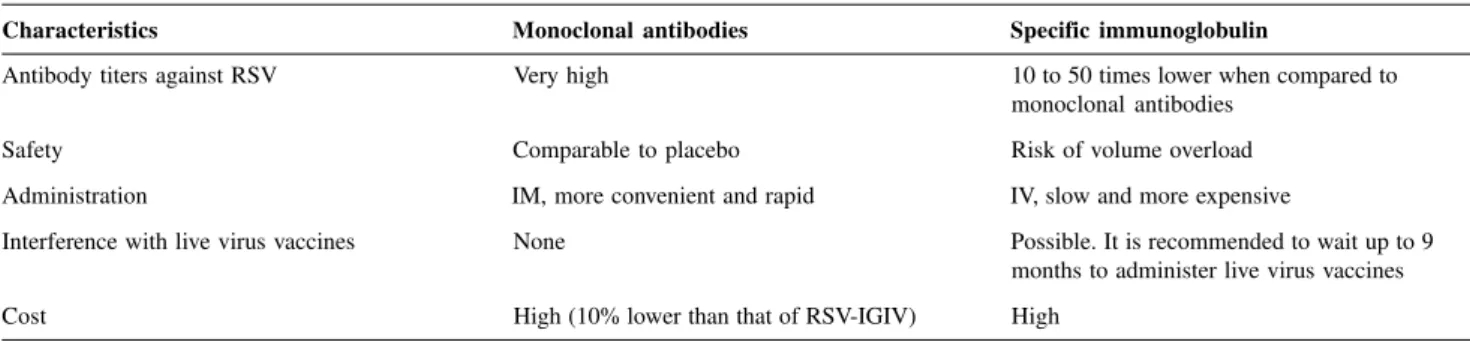
The advantages of the use of mono-clonal antibodies are summarized in table 3.
Table 3 - Advantages and disadvantages of the use of monoclonal antibodies when compared to the specific immunoglobulin.
Characteristics Monoclonal antibodies Specific immunoglobulin
Antibody titers against RSV Very high 10 to 50 times lower when compared to
monoclonal antibodies
Safety Comparable to placebo Risk of volume overload
Administration IM, more convenient and rapid IV, slow and more expensive
Interference with live virus vaccines None Possible. It is recommended to wait up to 9
months to administer live virus vaccines
&%
Considering that the use of mono-clonal antibodies is safer and more convenient for the child than the RSV-IGIV, its use should be considered in the following cases34:
1. Children under 24 months of age with chronic pulmonary disease, who required treatment in the last six months;
2. Infants born between the 28th and
the 32nd week of gestation, without
chronic pulmonary disease, and un-der six months of age at the begin-ning of winter;
3. Infants born with less than 28 weeks of gestation, without chronic pulmo-nary disease and under one year of age at the beginning of RSV season; 4. Infants born with 32 to 35 weeks of gestation without chronic pulmo-nary disease, who are under six months of age at the beginning of RSV season presenting concomi-tant risk factors (crowded environ-ments, siblings at school age, do-mestic exposure to cigarette smoke, multiple parities).
5. Prophylaxis with palivizumab is not recommended for children with congenital heart disease, unless the child is included in the groups men-tioned above, and if it presents he-modynamically compensated le-sions, such as patent ductus arterio-sus or small septal defects. 6. Neither the specific
immunoglobu-lin (RSV-IGIV) nor the monoclonal antibodies (palivizumab) are indi-cated for the treatment of RSV in-fections.
Despite the advantages of palivizumab, there is, up to now, no study comparing directly the risks, benefits and costs derived from the use of monoclonal antibodies with specific immunoglobulin. In addition, since RSV-IGIV provides protection against other viral respiratory diseases, in some situations its use can be preferred in certain groups of risk, such as children who have already been re-ceiving replacement therapy with
intra-venous immunoglobulin for the treat-ment of immune deficiency, including HIV infection1,13,34,51.
Passive immunoprophylaxis in im-mune deficient individuals
The safety and effectiveness of pas-sive immune prophylaxis against RSV is being clinically evaluated in indi-viduals with cellular immune defi-ciency, particularly those undergoing organ transplants or presenting more severe illnesses. HIV-infected children, although excreting RSV for prolonged periods, do not seem to present more severe illnesses and the routine use of passive prophylaxis with specific im-munoglobulin, or with palivizumab, is not recommended. The indication for prophylaxis against RSV has been evaluated in children with cystic fibro-sis and asthma, but, up to now, the risks and benefits derived from the use of passive immune prophylaxis are not clear in such situations34.
New perspectives for the active im-munization against RSV
Besides specific immunoglobulin and monoclonal antibodies for nasal and intramuscular use, several new vaccines containing RSV-attenuated strains (cold adapted, temperature sen-sitive, developed through recombinant technology), vaccines containing puri-fied proteins (developed through re-combinant genetic engineering or live-vector produced), synthetic peptide vaccines and DNA vaccines are
cur-rently under investigation
4,5,8,13-15,17,18,20,23,28,32,40-42,54,59,60.
Attenuated live virus vaccines – In
the 70’s, Wright et al. (1976)59 tested a
temperature-sensitive (ts) intranasal vac-cine containing attenuated RSV in twenty-five children aged 11 to 19 months, in a randomized and controlled trial (controlled, double-blind protocol). From the 25 children receiving this vac-cine (100 TCID50), eight were infected
with the vaccinal strain, as confirmed by viral shedding or higher serum antibod-ies; however, the rate of infection with the wild virus was comparable to the groups of children receiving the nasal vaccine or placebo. Despite having failed to provide protection to vacci-nated children, unlike the inactivated vaccine, this nasal, live, attenuated vi-rus vaccine showed to be safe, causing no increase in the disease severity in the vaccinated children exposed to and in-fected with the wild virus in the follow-ing year. Therefore, the attenuated virus vaccine becomes the standard for the development of new experimental vac-cines59. One of the greatest difficulties
in the development of vaccines against RSV is to obtain strains properly bal-anced in terms of immunogenicity, sta-bility and safety. Some attenuated vac-cines have shown a low level of immu-nogenicity while others have shown to be very unstable 8,31.
Since the temperature-sensitive at-tenuated virus vaccines are not ad-equately immunogenic, new vaccines have been recently tested in which the virus attenuation is obtained through other techniques, such as expression of interleukins and are presently undergo-ing clinical trials in animals5.
Vaccines containing protein F puri-fied
Protein F is the major antigen re-sponsible for the production of antibod-ies against RSV subtypes A and B; therefore, vaccines containing the puri-fied protein F, obtained through genetic engineering techniques, seem to be highly promising in the prevention of diseases caused by this agent. Groothuis et al. (1998)20 administered one dose of
&&
in those receiving the influenza vaccine. After one year, it was observed that both groups presented similar antibody titers against protein F and neutralizing anti-bodies against RSV. However, whereas in the control group half of the children (6/11) were hospitalized for RSV respi-ratory disease, in the vaccinated group, the hospitalization rate for the same rea-son was only 10% (1/10; p=0.06). The PFP-2 vaccine showed to be safe and immunogenic in children with BPD20.
Piedra et al. (1996)41 administered
the PFP-2 vaccine against RSV to 17 children with cystic fibrosis (median age=4,5 years) and other 17 children (median age= 5,8 years) received pla-cebo. While the vaccine has failed to fully protect against RSV, a significant reduction (P=0.01) in the number of lower respiratory tract infection epi-sodes was observed in the vaccinated group (0,8) when compared to the con-trol group (2,1), as well as a significant
reduction in the days of disease dura-tion (30,5 versus 67) in the group
re-ceiving the PFP-2 vaccine. The local and systemic reactions to this vaccine were mild in nature, being observed no increase in the disease severity in the reinfected children.
In the following year, the same group of investigators revaccinated the children with the PFP-2 vaccine and demonstrated that the revaccination was quite safe, causing no increase in the adverse events42.
CONCLUSIONS
Preliminary studies using several vaccines against RSV, both in experi-mental animals and humans, seem to provide promising results9,11,19,17.
How-ever, it should be stressed that natural infection does not fully protect against infection and reinfection and, since the
immunological factors related to RSV protection have not been fully clarified, it is unlike that an effective vaccine that can provide a high level of protection against this agent can be developed on a short-term basis. Theoretically, the vaccination of pregnant women could benefit neonates. However, the vaccine safety issues in this group make it dif-ficult to conduct studies on this new perspective for the prevention of severe RSV diseases18,34.
Concluding, it is worth remember-ing that the most effective way to con-trol nosocomial RSV infections is through careful hand washing, in order to prevent adults (health professionals and relatives) from transmitting the RSV to high-risk children. Thorough hand washing, combined with the use of disposable aprons, gloves, goggles that protect both eyes and nose, can re-duce by up to eight times the chances of nosocomial infection44,47.
RESUMO RHCFAP/3041
BRICKS LF – Prevenção das infecções pelo vírus sincicial respiratório.
Rev. Hosp. Clín. Fac. Med. S. Paulo 56(3):79-90, 2001.
Em todo o mundo, o vírus sincicial respiratório é o principal agente de in-fecções agudas das vias aéreas baixas em lactentes jovens e crianças. Aos dois anos de idade, praticamente todas as crianças já foram infectadas, e as reinfeções são comuns, durante toda a vida. Embora a maioria das infecções seja leve, o vírus sincicial respiratório pode causar doenças graves, especial-mente em prematuros com displasia broncopulmonar e, nos últimos anos, tem sido identificado como causa im-portante de infeções respiratórias em
pessoas que apresentam comprometi-mento da imunidade ou outros proble-mas médicos e em idosos hospitaliza-dos. O impacto econômico dessas in-fecções faz com que o desenvolvimen-to de vacinas contra o vírus sincicial respiratório seja altamente desejável, entretanto, o insucesso da primeira va-cina inativada contra esse agente difi-cultou os progressos nesse campo e, até o presente, não há nenhuma vaci-na licenciada contra o vírus sincicial respiratório. Nos últimos anos, entre-tanto, o melhor entendimento sobre imunologia e os mecanismos imuno-patológicos envolvidos na resposta ao vírus sincicial respiratório propiciaram o desenvolvimento de novas estratégi-as para a profilaxia ativa e pestratégi-assiva
con-tra essas infecções. Neste artigo, a au-tora apresenta uma revisão sobre os mais recentes avanços na prevenção das infecções pelo vírus sincicial res-piratório, tais como: uso de imunoglo-bulina humana policlonal, anticorpos monoclonais humanizados (ambos já licenciados para uso em prematuros e crianças com displasia bronco-pulmonar) e o desenvolvimento de di-ferentes vacinas que são potenciais candidatas para imunização ativa con-tra o vírus sincicial respiratório.
DESCRITORES: Vírus sincicial
&'
REFERENCES
1. AMERICAN Academy of Pediatrics - Respiratory syncytial virus. In: PETER G ed. Report of the Committee on Infectious Disease, 24th ed, Chicago, Elk Grove Village, 1997. p. 443-448.
2. AMERICAN Academy of Pediatrics Committee on Infectious Disease, Committee on Fetus and Newborn - Respiratory syncytial virus immune globulin intravenously: Indications for use. Pediatrics 1997;99:645-650.
3. ATKINS JT, KARIMI P, MORRIS BH et al. - Prophylaxis for respiratory syncytial virus with respiratory syncytial virus-immunoglobulin intravenous among preterm infants of thirty-two weeks gestation and less: reduction in incidence, severity of illness and cost. Pediatr Infect Dis J 2000, 19:138-43.
4. BELSHE RB, ANDERSON EL & WALSH EE - Immunogenicity of purified F glicoprotein of respiratory syncytial virus: clinical and immune responses to subsequent natural infection in children. J Infect Dis 1993;168:1024-1029.
5. BUKREYEV A, WHITEHEAD SS, PRUSSIN C et al. - Effect of coexpression of interleukin-2 by recombinant respiratory syncytial virus on virus replication, immunogenicity, and production of other cytokines. J Virol 2000;74, 7151-7157.
6. CHANOCK RM, PARROT RH, CONNORS et al. - Serious respiratory tract disease caused by respiratory syncytial virus. Prospects for improved therapy and effective immunization. Pediatrics 1992;90:137-143.
7. COX MJ, AZEVEDO RS, CANE PA et al. Seroepidemiological study of respiratory syncytial virus in São Paulo State, Brazil. J Med Virol 1998;55:234-239.
8. CROWE JE Jr - Immune responses of infants to infection with respiratory viruses and live attenuated respiratory virus candidate vaccines. Vaccine 1998;12:783-790.
9. CUNNINGHAM CK, MCMILLAN JA & GROSS SJ - Rehospitaliza-tion for respiratory illness in infants of less than 32 weeks gestaRehospitaliza-tion. Pediatrics 1991;88:527-32.
10. DINIZ EMA, VIEIRA RA, ISHIDA MA et al. - Clinical and laboratorial evaluation of neonates with respiratory syncytial virus interstitial pneumonia. In: COSMI EV - INTERNATIONAL CONGRESS ON NEW TECHNOLOGIES IN REPRODUCTIVE MEDICINE, NEONATOLOGY AND GYNECOLOGY. 2nd. Porto
Conte, Itália. Monduzzi Ed., 1999. (18-23 de Setembro). p.531-535. 11. DUDAS RA & KARRON RA - Respiratory syncytial virus vaccines.
Clin Microbiol Rev 1998;11:430-439.
12. DURIGON EL, TAKAHASHI VNVO, SOARES et al. - Vírus respiratório sincicial humano. Revisão e levantamento dos dados brasileiros. Universidade de São Paulo. Departamento de Microbiologia – Instituto de Ciências Biomédicas, 2000. p. 1-16. (Monografia distribuída pela Abbot – Divisão Hospitalar). 13. ENGLUND JA - Prevention strategies for respiratory syncytial virus:
passive and active immunization. J Pediatr 1999;135:S38-S44. 14. FALSEY AR & WALSH EE - Safety and immunogenicity of a
respiratory syncytial virus subunit vaccine (PFP-2) in ambulatory adults over age 60. Vaccine 1996;14:1214-1218.
15. FALSEY AR & WALSH EE - Safety and immunogenicity of a respiratory syncytial virus subunit vaccine (PFP-2) in the institutionalized elderly. Vaccine 1997;15:1130-1132.
16. GLEZEN WP, PAREDES A, ALLISON JE et al. - Risk of respiratory syncytial virus infection for infants from low-income families in relationship to age, sex, ethic group, and maternal antibody level. J Pediatr 1981;98;708-715.
17. GONZALEZ IM, KARRON RA, EICHELBERGER M et al. Evaluation of the live attenuated cpts 248/404 RSV vaccine in combination with a subunit RSV vaccine (PFP-2) in healthy young and older adults. Vaccine 2000;18:1763-72.
18. GRAHAM BS - Pathogenesis of respiratory syncytial virus vaccine-augmented pathology. Am J Respir Crit Care Med 1995;152 :S63-66.
19. GROOTHUIS JR, SIMOES EAF, LEVIN MJ et al. Prophylatic administration of respiratory syncytial virus immunoglobulin to high-risk infants and young children. N Engl J Med 1993;329:1524-1530.
20. GROOTHUIS JR, KING SJ, HOGERMAN DA et al. Safety and immunogenicity of a purified F protein respiratory syncytial virus (PFP-2) vaccine in seropositive children with bronchopulmonary dysplasia. J Infect Dis 1998;177;467-469.
21. GROSS M, BRUNE T, JORCH G et al. Significance of respiratory syncytial virus (RSV) infection in the 1st year of life. Infection
2000;28:34-37.
22. HALL C & MCCARTHY CA - Respiratory syncytial virus. In: MANDELL GL, DOUGLAS RG Jr & BENNETT JE eds. -Principles and Practice of Infectious Diseases. 4th ed, New York, NY. Churchill Livingston, 1995:1501-1519.
23. HALL CB - Respiratory syncytial virus: a continuing culprit and conudrum. J Pediatr 1999;135:S2-S7.
24. HAY JW, ERNST RL & MEISSNER HC - Respiratory syncytial virus immune globulin: a cost-effectiveness analysis. Am J Managed Care 1996;2:841-56.
25. IMAZ MS, SEQUEIRA MD, VIDELA C et al. - Clinical and epidemiologic characteristics of respiratory syncytial virus subgroups A and B infections in Santa Fe, Argentina. J Med Virol 2000; 61:76-80.
26. IMPACT-RSV study group - Palivizumab, a humanized respiratory syncytial virus monoclonal antibody, reduces hospitalization from respiratory syncytial virus infection in high-risk infants. Pediatrics 1998;102:531-537.
27. IZURIETA HS, THOMPSON, WW, KRAMARZ et al. - Influenza and the rates of hospitalization for respiratory disease among infants and young Children. N Engl J Med 2000;342:232-239. 28. KARRON RA & AMBROSINO DM - Respiratory syncytial virus
vaccines. Pediatr Infect Dis J 1998,17:919-20.
29. LANGLEY JM, LEBLANC JC, WANG EEL et al. – Nosocomial respiratory syncytial virus infection in Canadian pediatric hospital: a pediatric investigators collaborative network in Canada. Pediatrics 1997;100:943-946.
'
31. LOVEYS DA, KULKARNI S & ATREYA PL - Role of type I IFNs in the vitro attenuation of live, temperature-sensitive vaccine strains of human respiratory syncytial virus. Virology 2000; 271:390-400. 32. MALHOTRA A, KRILOV LR - Influenza and respiratory syncytial
virus. Pediatr Clin North Am 2000;47:353-72.
33. MCBRIDE JT - Pulmonary function changes in children after respiratory syncytial virus infection in infancy. J Pediatr 1999;135:S28-S32.
34. MEISSNER HC, WELLIVER RC, CHARTRAND AS et al. -Immunoprophylaxis with palivizumab, a humanized respiratory syncytial virus monoclonal antibody, for prevention of respiratory syncytial virus infection in high risk infants: a consensus opinion. Pediatr Infect Dis J 1999;18:223-31.
35. MIYAO CR, GILIO AE, VIEIRA S et al. - Infecções virais em crianças internadas por doença aguda do trato respiratório inferior. J Pediatr (Rio J.) 1999;75:334-344.
36. NASCIMENTO JP, SIQUEIRA MM, SUTMOLLER F et al. – Longitudinal study of acute respiratory diseases in Rio de Janeiro. Occurence of respiratory viruses during four consecutive years. Rev Inst Med TropSão Paulo 1991;33:287-296.
37. NAVAS L, WANG E, DE CARVALHO V et al. - Improved outcome or respiratory syncytial virus infection in high-risk hospitalized population of Canadian children. J Pediatr 1992;121:348-354.
38. NOWAK-WEGRZYN A & LEDERMAN HM - Supply, use, and abuse of intravenous immunoglobulin. Curr Opin Pediatr 1999;11:533-539.
39. O’SHEA TM, SEVICK MA & GIVNER LB - Costs and benefits of respiratory syncytial virus immunoglobulin to prevent hospitalization for lower respiratory tract illness in very low birth weight infants. Pediatr Infect Dis J 1998;17:587-93.
40. PARADISO PR, HILDRETH SW, HOGERMAN DA et al. - Safety and immunogenicity of a subunit respiratory syncytial virus vaccine in children 24 to 48 months old. Pediatr Infect Dis J 1994;13 :792-798.
41. PIEDRA PA, GRACE S, JEWELL A et al. - Purified fusion protein vaccine protects against lower respiratory tract illness during respiratory syncytial virus season in children with cystic fibrosis. Pediatr Infect Dis J 1996;15:23-31.
42. PIEDRA PA, GRACE S, JEWELL A et al. - Sequential annual administration of purified fusion protein vaccine against respiratory syncytial virus in children with cystic fibrosis. Pediatr Infect Dis J 1998;17:217-224.
43. PREVENT Study Group. - Reduction of respiratory syncytial virus hospitalization among premature infants and infants with bronchopulmonay displasia using respiratory syncytial virus immunoglobulin prophylaxis. Pediatrics 1997;99:93-99. 44. PROBER CG & SULLENDER WM - Advances in prevention of
respiratory syncytial virus infections. J Pediatr 1999; 135 :546-58.
45. RAZA MW, BLACKWELL CC, ELTON RA et al. - Bactericidal activity of a monocytic cell line (THP-1) against common respiratory tract bacterial pathogens is depressed after infection with respiratory syncytial virus. J Med Microbiol 2000,49 :227-233.
46. ROBBINS JM, TILFORD JM, JACOBS RF et al. - A number-needed-to-treat analysis of the use of respiratory syncytial virus immune globulin to prevent hospitalization. Arch Pediatr Adolesc Med 1998;152:358-366.
47. RODRIGUEZ WJ - Management strategies for respiratory syncytial virus infections in infants. J Pediatr 1999; 135:S45-S50. 48. SELWYN BJ - On behalf of the coordinated data group of bostid
researchers. The epidemiology of acute respiratory tract infection in young children: comparison of findings from several developing countries. Rev Infect Dis 1990; 12 (suppl 8):S870-88.
49. SHAY DK, HOLMAN, RC, NEWMAN RD et al. - Bronchiolitis-associated hospitalizations among US children, 1980-1996. JAMA 1999;282:1440-1446.
50. SIMOES EAF, SONDHEIMER HM, TOP H et al. - Respiratory syncytial virus immune globulin for prophylaxis against respiratory syncytial virus disease in infants and children with congenital heart disease. J Pediatr 1998;133:492-9.
51. SIMOES EA. Respiratory syncytial virus infection. Lancet 1999;354:847-52.
52. TAKUR BK, WU LR & SCHAEUFELE JF - RSV-IGIV Therapy: a cost/benefit analysis. Pediatrics 1997;100;3:417.
53. TREANOR JJ, MATTISON HR, DUMYATI G et al. - Protective efficacy of combined live intranasal and inactivated influenza A virus vaccines in the elderly. Ann Intern Med 1992;117:625-633. 54. TRISTAM DA, WELLIVER RC, MOHAR CK et al. - Immunogenicity and safety of respiratory syncytial virus subunit vaccine in seropositive children 18-36 months old. J Infect Dis 1994;167:191-5.
55. WANG EEL, LAW BJ, STEPHENS D et al. - Pediatric Investigator Collaborative Network on Infections in Canada prospective study of risk factors and outcomes in patients hospitalized with respiratory syncytial viral lower respiratory infection. J Pediatr 1995;126:212-219. 56. WALSH EE, MCCONNOCHIE KM, LONG CE et al. - Severity of respiratory syncytial virus is related to virus strain. J Infect Dis 1997;175:814-820.
57. WELLIVER RC - Respiratory syncytial virus immunoglobulin and monoclonal antibodies in the prevention and treatment of respiratory syncytial virus infection. Semin Perinatol 1998;22:87-95. 58. WILSON SD, ROBERTS K, HAMMOND K et al. - Estimation of
incidence of respiratory syncytial virus infections in schoolchildren using salivary antibodies. J Med Virol 2000;61:81-84.
59. WRIGHT PF, SHINOZAKI T, FLEET W, et al. - Evaluation of a live, attenuated respiratory syncytial virus vaccine in infants. J Pediatr 1976;88:931-936.
60. WRIGHT PF, KARRON RA, CROWE JE Jr et al. - Evaluation of a live, attenuated respiratory syncytial virus (RSV) vaccine candidate, cpts 248/1404, in infancy [abstract] Pediatr Res 1998;43:161 A. 61. YÜKSEL B & GRENOUGH A - Birth weight and hospital readmission
of infants born prematurely. Arch Pediatr Adolesc Med 1994;148: 384-388.
62. ZERR DM & FRENKEL LM - Advances in antiviral therapy. Curr Opin Pediatr 1999;11:21-27.