$!
From the Division of Respiratory Diseases ofthe Heart Institute (InCor), Hospital das Clínicas, Faculty of Medicine, University of Sao Paulo.
ORIGINAL ARTICLE
PERSISTENT ASTHMA IN ADULTS: COMPARISON OF
HIGH RESOLUTION COMPUTED TOMOGRAPHY OF
THE LUNGS AFTER ONE YEAR OF FOLLOW-UP
Alberto Cukier, Rafael Stelmach, Jorge Issamu Kavakama, MárioTerra Filho and Francisco Vargas
RHCFAP/3038
CUKIER A et al. - Persistent asthma in adults: comparison of high resolution computed tomography of the lungs after one year of follow-up. Rev. Hosp. Clín. Fac. Med. S. Paulo 56(3):63-68, 2001.
Objective: The aims of this study were to evaluate the role of high resolution computed tomography of the torax in detecting abnormalities in chronic asthmatic patients and to determine the behavior of these lesions after at least one year.
Method: Fourteen persistent asthmatic patients with a mean forced expiratory volume in 1-second that was 63% of predicted
and a mean forced expiratory volume in 1-second /forced vital capacity of 60% had two high resolution computed tomographys separated by an interval of at least one year.
Results: All 14 patients had abnormalities on both scans. The most common abnormality was bronchial wall thickening,
which was present in all patients on both computed tomographys. Bronchiectasis was suggested on the first computed tomography in 5 of the 14 (36%) patients, but on follow-up, the bronchial dilatation had disappeared in 2 and diminished in a third. Only one patient had any emphysematous changes; a minimal persistent area of paraseptal emphysema was present on both scans. In 3 patients, a “mosaic” appearance was observed on the first scan, and this persisted on the follow-up computed tomography. Two patients had persistent areas of mucoid impaction. In a third patient, mucus plugging was detected only on the second computed tomography.
Conclusions: We conclude that there are many abnormalities on the high resolution computed tomography of patients with
persistent asthma. Changes suggestive of bronchiectasis, namely bronchial dilatation, frequently resolve spontaneously. Therefore, the diagnosis of bronchiectasis by high resolution computed tomography in asthmatic patients must be made with caution, since bronchial dilatation can be reversible or can represent false dilatation. Nonsmoking chronic asthmatic subjects in this study had no evidence of centrilobular or panacinar emphysema.
DESCRIPTORS: X-ray tomography, computed. Asthma. Function test, lung. Lung diseases. Obstructive. Bronchial diseases.
High resolution computed tomo-graphy (HRCT) has become an invalu-able tool in the detailed evaluation of the lung structure in vivo.
Recently, several authors have re-ported the appearances of the lungs on CT in asthmatic patients 1–6. In addition to the expected abnormalities, such as hyperinflation, mucoid impaction, aci-nar pattern, lobar collapse and bron-chial wall thickening, some unexpected
results emerged from these studies. Particularly surprising were the inci-dence of bronchiectasis (37 to 65%)2, 3, 5 and emphysema (18%)3 described in
the chronic asthmatic patients in these series.
$"
pattern, and lobar collapse are revers-ible lesions, and bronchiectasis, bron-chial wall thickening, and emphysema are irreversible abnormalities3.
More recently, the criteria for diag-nosing HRCT disturbances in asth-matic patients, particularly bronchial wall thickening and bronchial dilata-tion, have been criticized2, 7, since ima-ges sugima-gestive of these abnormalities have been detected in healthy subjects. The aims of this study were to fur-ther evaluate the role of HRCT in de-tecting abnormalities in chronic asth-matic patients and to determine the be-havior of these lesions after at least one year.
SUBJECTS AND METHODS
Subjects
Fourteen patients with persistent asthma were studied. Three patients had moderate and 11 had severe asthma8. Patients were chosen for the study if they had undergone a high-resolution CT scan of the thorax and lung function tests at least 12 months before the reevaluation (mean 512.2 + 141.3 days), and kept attending the outpatient clinic of our institution regu-larly. All patients had either reversible airway obstruction, i.e., 15% improve-ment in forced expiratory volume in 1-second (FEV1) after bronchodilation or a positive histamine challenge test. None of the subjects had a history of bronchiectasis or allergic bronchopul-monary aspergillosis (as defined by means of positive Aspergillus preci-pitins). The study population had a mean age of 36.5 + 11.8 years. The mean duration of the asthma was 23.6 + 14.4 years. None of the patients tested were current or previous smok-ers. All the subjects were studied dur-ing remission on adequate therapy.
All patients underwent physiologic evaluation that included measurement
of the forced expiratory volume in 1-second (FEV1), forced vital capacity (FVC), single-breath diffusing capacity of the lung for carbon monoxide cor-rected for lung volumes (DLCO/VA), residual volume (RV), and total lung capacity (TLC). The pulmonary func-tion testing was done on the same day as the CT scanning.
The study was carried out after in-formed consent of the patients, and ap-proval by the Ethics Committee of our Institution was obtained.
Computed tomography
The CT scans were performed on a Philips - LX (Netherlands) scanner using high resolution technique. All scans were obtained at full inspiration. Thin CT sections of 1.5 mm were ob-tained through the lungs at 10 mm in-tervals using a scan time of 1.2 se-conds. The high-resolution CT scans were reconstructed by using a high-resolution algorithm and a matrix size of 512x512. The images were obtained and viewed at window levels of 800 HU and window width of 1200 HU.
The 2 scans of each patient were evaluated independently by 3 obser-vers, and final interpretation was ob-tained by consensus. The scans were evaluated for evidence of emphysema9, 10, bronchial wall thickening11,
bron-chiectasis2, 11, mucoid impaction11, and “mosaic” appearance12.
Three high-resolution CT sections were chosen for detailed analysis. The initial section evaluated was at the level of the hila, at or close to the upper lobe bronchi. Subsequent sections evaluated were 6 cm above and 6 cm below the initial section.
Statistical analysis
The difference in the level of pul-monary function tests between the two moments of the study was assessed us-ing a two-sample t test.
RESULTS
The pulmonary function data in the two moments of the study are summa-rized in table 1. There was no statisti-cally significant difference in the level of pulmonary function between the two moments.
The HRCT findings in the first and second evaluations are shown in table 2. We observed bronchial wall thicken-ing in all patients in both CT. In the first CT, 65 (57.5%) of the 113 bron-chi evaluated fulfilled the criteria for bronchial wall thickening, compared with 57 (72.1%) of 79 bronchi in the second CT.
On the first CT, 5 (36%) of the 14 asthmatic subjects had at least one di-lated bronchus consistent with chiectasis. One patient had cystic bron-chiectasis that was not seen on the sec-ond CT. A secsec-ond patient had cylindri-cal bronchiectasis that persisted. A third patient had on the first CT a di-lated bronchus in the middle lobe that failed to taper normally, which was consistent with cylindrical bronchiecta-sis. In the follow-up CT, this dilated bronchus became normal. In the other 2 patients, the diameters of dilated bronchi were slightly greater than that of the accompanying artery in the first CT. In one of these patients, the bron-chial diameter was considered normal in the second CT, and in the other, the dilated bronchi were less prevalent than in the previous CT.
Emphysema was not observed in any of the patients, with the exception of one patient where a minimal persis-tent area of paraseptal emphysema was detected in the right apex.
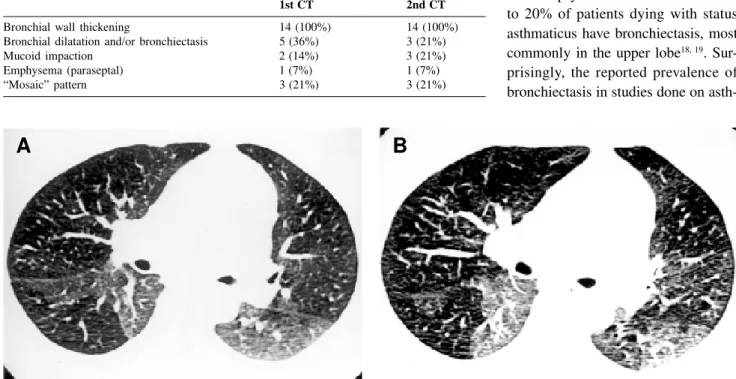
In 3 patients, a “mosaic” appear-ance was observed on the first scan and this persisted on the follow-up CT (Fig. 1). Two patients had persistent areas of mucoid impaction. In a third patient, mucus plugging was detected only on the second CT.
$#
sections of the HRCT from eachpa-tient revealed that bronchial wall thick-ening was present in 65/113 bronchi (57.5%) on the first CT and in 57/79 (72.1%) on the second CT.
DISCUSSION
In this study, we found that mod-erate to severe persistent asthmatic pa-tients have abnormalities in HRCT, such as bronchial wall thickening, bronchial dilatation, mucoid impaction, and a “mosaic” appearance. However,
the bronchial lesions must be cau-tiously interpreted, since bronchial di-latation frequently was not persistent on the second scan obtained after at least a one-year interval.
Bronchial wall thickening is com-monly seen on chest radiographs and CT scans in subjects with airway dis-ease, presumably because of a combi-nation of bronchial and peribronchial inflammation, muscular wall thicken-ing, and peribronchial fibrosis13. How-ever, the finding of mild bronchial thickening is subjective, and it may also be found in healthy subjects2,14.
The prevalence of bronchial wall thick-ening in the asthmatic subjects studied by Paganin et al.3 was 16% at HRCT. In contrast, the prevalence was 92% in the study reported by Lynch et al.2. In our study, bronchial wall thickening was detected in all patients on both evaluations. When individual bronchi were examined, there was bronchial thickening in 65/113 bronchi (57.5%) at the first CT and in 57/79 (72.1%) bronchi in the second evaluation. These discrepancies confirm the subjectivity of the finding of bronchial wall thick-ening and indicate that this finding can-not be considered diagnostic of airway disease or asthma.
The use of CT to diagnose bron-chiectasis has been validated by several studies of subjects with suspected bronchiectasis who underwent both CT and bronchography15–17. The accuracy of these different studies varied de-pending on the technique and the type of bronchiectasis. The most commonly missed dilatations were those due to mild to moderate cylindrical bron-chiectasis. Asthmatic subjects were ex-cluded from most of the studies.
Autopsy studies have shown that 15 to 20% of patients dying with status asthmaticus have bronchiectasis, most commonly in the upper lobe18, 19. Sur-prisingly, the reported prevalence of bronchiectasis in studies done on
asth-Table 1 - Pulmonary function tests of the asthmatic patients.
1th CT 2nd CT
FEV1 (% of predicted) 63.2 + 18.5 55.0 + 15.3
FEV1/FVC (%) 59.7 + 14.7 51.0 + 10.3
RV (% of predicted) 143.9 + 34.5 124.5 + 50.3
TLC (%of predicted) 93.6 + 16.3 91.6 + 14.1
DLCO/VA (% of predicted) 132.2 + 28.4 113.8 + 31.5
Data are reported as means + SD
FEV1 - forced expiratory volume in the first second; FVC – forced vital capacity; RV-residual volume; TLC - total lung capacity; DLCO/VA - single breath diffusing capacity.
Figure 1 - A - High-resolution CT scan shows “mosaic” appearance with patchy decrease in lung density. B - High-resolution CT scan of the same patient after 443 days, showing persistence of areas with decrease in lung density.
A
B
Table 2 - HRCT findings in the 14 asthmatic patients at the first and second
evaluation.
1st CT 2nd CT
Bronchial wall thickening 14 (100%) 14 (100%)
Bronchial dilatation and/or bronchiectasis 5 (36%) 3 (21%)
Mucoid impaction 2 (14%) 3 (21%)
Emphysema (paraseptal) 1 (7%) 1 (7%)
$$
matics using CT is higher than that in the autopsy studies. Neeld et al.5 found cylindrical bronchiectasis in 3 of 8 pa-tients (37%) in their series without proven evidence of allergic bronchop-ulmonary aspergillosis (ABPA). Paganin et al.3 observed bronchiectasis, mostly cylindrical, in 65% of 57 asth-matic patients. Lynch et al.2 found that 36% of bronchi in asthmatic subjects without ABPA were larger than the ac-companying pulmonary artery, and 77% of asthmatic subjects had one or more such bronchi. However, 19% of bronchi in control subjects also met the criteria for bronchial dilatation, and 59% of control subjects had one or more such bronchi. It is suggested that this prevalence of bronchial dilatation in subjects with asthma is due to bron-chial destruction3, 18, 19. Also, it is pos-sible that some asthmatic subjects with-out serologic evidence of ABPA might have subclinical ABPA, perhaps par-tially suppressed by steroids5.
In the present study, 5 (36%) of our 14 asthmatic subjects had at least one dilated bronchus on the first HRCT. In only 2 of these patients did the abnor-mal bronchi remain unchanged on the follow-up CT. In the other patients, the images consistent with the diagnosis of bronchial dilatation disappeared or be-came less prevalent on the second CT. In general, a bronchus appears di-lated if its diameter is greater than that of the associated artery. The explana-tions proposed to explain why a bron-chus may be larger than its adjacent pulmonary artery, without indicating true bronchiectasis include the follow-ing: different branch points for the ar-tery and bronchus, and local hypoxia
leading to a decrease in the size of the artery20, 21. These considerations may explain the differences observed be-tween the first and second CT in 2 of our patients. In the remaining patient, the disappearance of the localized di-lation of the middle lobe bronchus might be related to the normalization of a reversible bronchial dilatation in a patient who had a documented pneu-monia 8 months before the first CT.
Mucous-filled airways result from inflammation and decreased clearance of secretions. This is an expected ab-normality in asthmatic patients, who have thick and tenacious mucus, and it represents a reversible abnormality3, 6. This abnormality was found on both scans in 2 of our patients and only on the second scan in a third patient.
Although one pathologic study sug-gested that the occurrence of emphy-sema in asthma was common22, the majority of the authors believe it to be rare18,19,23. Several reports have corre-lated the CT findings with pathologic assessment of emphysema and have concluded that the CT scan is useful in both the quantitative and qualitative assessment of emphysema10,24–26.
Studies using CT in the evaluation of emphysema in nonsmoking asth-matic subjects have demonstrated em-physema in 0 – 20% of patients1,2,4, 27. A higher prevalence of emphysema has been reported in asthmatic patients who smoke 1,2. It has been suggested that emphysema in the nonsmoking asthmatic may not be due to a paren-chymal destructive disease per se, but rather to an extensive peribronchial fi-brosis that might relate to cicatricial
emphysema3. The results of the present study are in accordance with the results reported by others.
Areas of decreased lung attenuation can sometimes be recognized on HRCT in patients who have diseases that produce air trapping, poor venti-lation, or poor perfusion of the lung parenchyma 28. This is particularly common in subjects with bronchiolitis obliterans 29, leading to marked hetero-geneity of lung density, with lobules of increased and decreased lung density that create a striking “mosaic” appear-ance 12. The areas of decreased lung density are presumed to be due to air trapping, with associated reflex pulmo-nary oligemia. The areas of increased lung density are more difficult to ex-plain. They may be due to redistribu-tion of blood flow to more normal lung, with relative over-perfusion of the more normal areas 11, 30. We ob-served a “mosaic” appearance in 3 of our patients. In all of them, this find-ing was unchanged in the follow-up CT, suggesting it to be an irreversible abnormality.
$%
RESUMO RHCFAP/3038
CUKIER A e col. – Asma persistente em adultos: comparação da tomo-grafia computadorizada de tórax de alta resolução após um ano de seguimento. Rev. Hosp. Clín. Fac. Med. S. Paulo 56(3):63-68, 2001.
Objetivo: Avaliar o papel da
tomo-grafia computadorizada de tórax de alta resolução em detectar alterações estruturais pulmonares em pacientes asmáticos persistentes e determinar o comportamento destas lesões após pelo menos um ano de seguimento.
Método: Foram avaliados 14
paci-entes asmáticos persistpaci-entes em que eram disponíveis duas tomografias computadorizadas de tórax de alta re-solução realizadas com um intervalo de pelo menos um ano. O valor médio do volume expiratório forçado no primei-ro segundo foi de 63% do predito e o
da relação volume expiratório forçado no primeiro segundo/capacidade vital forçada foi de 60%.
Resultados: Alterações estruturais
foram detectadas em todos os pacien-tes em ambas tomografias. A anorma-lidade mais comumente observada foi espessamento brônquico, presente em todos os pacientes nos dois exames. Bronquectasias foram sugeridas na pri-meira tomografia em cinco dos 14 (36%) pacientes, mas no segundo exa-me a dilatação brônquica tinha desapa-recido em dois e reduzido em um. Enfisema paraseptal foi detectado em um paciente. Em três, havia padrão “em mosaico “ no primeiro exame, que persistiu no segundo exame. Em dois pacientes foram detectadas áreas per-sistentes de impactação mucóide. Em um terceiro, a impactação foi observa-da somente na segunobserva-da tomografia.
Conclusões: Pacientes com asma
persistente apresentam múltiplas anor-malidades na tomografia computado-rizada de tórax de alta resolução. Ima-gens sugestivas de bronquectasias freqüentemente têm resolução espontâ-nea. Desta forma, é necessária precau-ção ao fazer o diagnóstico de bron-quectasias através de tomografia com-putadorizada de tórax de alta resolução em pacientes asmáticos, uma vez que a dilatação brônquica pode ser rever-sível ou representar uma falsa dilata-ção. Enfisema centrilobular ou panacinar não foi detectado em ne-nhum paciente deste estudo.
DESCRITORES: Raio-X, tomo-grafia computadorizada. Asma. Tes-tes funcionais, pulmão. Doenças pul-monares, obstrutivas. Bronquectasias.
REFERENCES
1. KONDOH Y, HIROYUKI T, YOKOYAMA S et al. - Emphysematous change in chronic asthma in relation to cigarette smoking. Assessment by computed tomography. Chest1990;97: 845-49. 2. LYNCH DA, NEWELL JD, TSCHOMPER BA et al. - Uncomplicated
asthma in adults: comparison of CT appearance of the lungs in asthmatic and healthy subjects. Radiology 1993;188: 829-833. 3. PAGANIN F, TRUSSARD V, SENETERRE E et al. - Chest radiography
and high resolution computed tomography of the lungs in asthma. Am Rev Resp Dis 1992; 146:1084-1087.
4. KINSELLA M, MÜLLER NL, STAPLES C et al. - Hyperinflation in asthma and emphysema. Assessment by pulmonary function testing and computed tomography. Chest 1998; 94: 286-289.
5. NEELD DA, GOODMAN LR, GURNEY JW et al. - (1990). Computerized tomography in the evaluation of allergic bronchopulmonary aspergillosis. Am Rev Resp Dis 1990; 142: 1200-1205.
6. GRENIER P, MOUREY-GEROSA I, BENALI K et al. - Abnormalities of the airways and lung parenchyma in asthmatics: CT observations in 50 patients and inter- and intraobserver variability. Eur Radiol 1996; 6: 199-206.
7. KING GG, MÜLLER NL & PARÉ PD - Evaluation of airways in obstructive pulmonary disease using high-resolution computed tomography. Am J Resp Crit Care Med 1999; 159: 992-1004. 8. GLOBAL Strategy for Asthma Management and Prevention - (1995).
NHLBI/WHO Workshop. National Institutes of Health, National Heart, Lung, and Blood Institute, Publication Number 95-3659. 9. MILLER RR, MÜLLER NL, VEDAL S et al. - Limitations of computed
tomography in the assessment of emphysema. Am Rev Resp Dis 1989;139: 980-983.
10. STERN EJ & FRANK MS - CT of the lung in patients with pulmonary emphysema: diagnosis, quantification, and correlation with pathologic and physiologic findings. Am J Roentgenol 1994;162: 791-798.
11. WEBB RW, MÜLLER NL & NAIDICH DP - High-resolution CT of the lung. New York, Raven Press, 1992.
$&
13. CARROLL, ELLIOT J, MORTON A et al. - The structure of large and small airways in nonfatal and fatal asthma. Am Rev Resp Dis 1992;147: 405-410.
14. REMY-JARDIN M, REMY J, BOULENGUEZ C et al. - Morphologic effects of cigarette smoking on airways and pulmonary parenchyma in healthy adult volunteers: CT evaluation and correlation with pulmonary function tests. Radiology 1993;186: 107-115. 15. JOHARJY IA, BASHI AS & ADBULLAH AK - Value of
medium-thickness CT in the diagnosis of bronchiectasis. Am J Roentgenol 1987;149: 1133-1137.
16. GRENIER P, MAURICE F, MUSSET D et al. - Bronchiectasis: assessment by thin-section CT. Radiology 1986;161: 95-99. 17. SILVERMAN PM & GODWIN JD et al. - CT/bronchographic
correlations in bronchiectasis. J Computer Assist Tomogr 1987;11:52-56.
18. THURLBECK WM - Chronic airflow obstruction in lung disease. Philadelfia, Saunders, 1976.
19. DUNNILL MS - The pathology of asthma, with special reference to changes in the bronchial mucosa. J Clin Pathology 1960;13 :27-33.
20. HEROLD CJ, WETZEL RC, ROBOTHAM JL et al. - Acute effects of increased intravascular volume and hypoxia on the pulmonary circulation: assessment with high-resolution CT. Radiology 1992;183:655-662.
21. WETZEL R, HEROLD C, ZERHOUNI E et al. - Hypoxic bronchodilation. J Appl Physiol 1992;73:1202-1206.
22. MESSER JW, PETERS GA & BENNETT WA - Causes of death and pathological findings in 304 cases of bronchial asthma. Diseases of the Chest 1960;38:616-624.
23. WILLIAMS MH JR & LEVIN M - Sudden death from bronchial asthma. Am Rev Resp Dis 1966;94: 608-611.
24. BERGIN CJ, MÜLLER NL & MILLER RR - CT in the qualitative assessment of emphysema. J Thorac Imaging 1986;1:94-103. 25. FOSTER WL JR, PRATT PC, ROGGLI VL et al. - Centrilobular
emphysema: CT-pathologic correlation. Radiology 1986;156 :27-32.
26. WEBB WR, STEIN MG, FINKBEINER WE et al. - Normal and diseased isolated lungs: high-resolution CT. Radiology 1988;166:81-87.
27. AUERBACH O, HAMMOND EC, GARFINKEL L et al. - Relationship of smoking and age to emphysema: whole-lung section study. N Engl J Med 1972;286:853-857.
28. LYNCH DA, BRASCH RC, HARDY KA et al. - Pediatric pulmonary disease: assessment with high-resolution ultrafast CT. Radiology 1990;176:243-248.
29. SWEATMAN MC, MILLAR AB, STRICKLAND B et al. - Computed tomography in adult obliterative bronchiolitis. Clin Radiol 1990;41:116-119.
30. LYNCH DA - Imaging of small airways diseases. In: KING TE Jr. Bronchiolitis. Philadelphia,Saunders. 1993.