Article
Production and Characterization of Ti/PbO
2Electrodes by a Thermal-Electrochemical Method
Edison A. Laurindo, Nerilso Bocchi and Romeu C. Rocha-Filho*
Departamento de Química, Universidade Federal de São Carlos, CP 676, 13560-970, São Carlos - SP, Brazil
Visando obter eletrodos com alto sobrepotencial para a reação de desprendimento de oxigênio (RDO), úteis para a oxidação de poluentes orgânicos, prepararam-se eletrodos de Ti/PbO2 por um
método térmico-eletroquímico e compararam-se seus desempenhos com o de eletrodepositados. O potencial de circuito aberto em solução de H2SO4 0,5 mol L-1 para esses eletrodos apresentou
valores bastante estáveis, próximos entre si, na faixa de potenciais para a região de estabilidade de PbO2 em diagramas de Pourbaix. Análises por difração de raios X mostraram que o óxido
térmico-eletroquímico é uma mistura de ort-PbO, tetr-PbO e ort-PbO2. Já os eletrodos produzidos por
eletrodeposição se apresentaram mais provavelmente na forma tetr-PbO2. Micrografias obtidas por
microscopia eletrônica de varredura mostraram que a morfologia básica do PbO2
térmico-eletroquímico é determinada na etapa térmica, sendo bem distinta da dos eletrodos eletrodepositados. Curvas de polarização, em H2SO4 0,5 mol L-1, mostraram que no caso dos eletrodos de Ti/PbO2
térmico-eletroquímicos a RDO foi deslocada para potenciais mais positivos. Entretanto, os valores dos coeficientes de Tafel, bastante altos, indicam que possivelmente houve formação de filmes passivantes sobre os substratos de Ti, o que pode eventualmente explicar os valores de corrente algo baixos para a RDO.
Looking for electrodes with a high overpotential for the oxygen evolution reaction (OER), useful for the oxidation of organic pollutants, Ti/PbO2 electrodes were prepared by a
thermal-electrochemical method and their performance was compared with that of electrodeposited elec-trodes. The open-circuit potential for these electrodes in 0.5 mol L-1 H
2SO4 presented quite stable
similar values. X-ray diffraction analyses showed the thermal-electrochemical oxide to be a mixture of ort-PbO, tetr-PbO and ort-PbO2. On the other hand, the electrodes obtained by electrodeposition
were in the tetr-PbO2 form. Analyses by scanning electron microscopy showed that the basic
morphology of the thermal-electrochemical PbO2 is determined in the thermal step, being quite
distinct from that of the electrodeposited electrodes. Polarization curves in 0.5 mol L-1 H 2SO4
showed that in the case of the thermal-electrochemical PbO2 electrodes the OER was shifted to more
positive potentials. However, the values of the Tafel slopes, quite high, indicate that passivating films were possibly formed on the Ti substrates, which could eventually explain the somewhat low current values for OER.
Keywords: Ti/PbO2 anode, thermal-electrochemical method, oxygen evolution reaction,
modi-fied electrode
Printed in Brazil 0103 - 5053 $6.00+0.00
Introduction
Research on new anode materials to be used for the oxy-gen evolution reaction (OER) has increased in the last few years, due to conventional metallic electrodes not being stable under the operational conditions used in industrial
electrolysers1. Furthermore, there are electrochemical
pro-cesses (e.g., ozone generation and oxidation of organic
molecules) that require a high OER overpotential, since the
occurrence of this reaction decreases the global efficiency of
the reaction of interest2. Many electrode materials have been
investigated, for example: Ti/SnO22-6, Ti/IrO
27,8, Ti/RuO27
and Ti/PbO22,6,9-12. When compared with Ti/SnO
22-6,
Ti/PbO2 electrodes present a low OER overpotential and,
thus, a low current efficiency for the oxidation of organic
molecules. Kötz et al.2, based on anodic Tafel lines, showed
that the OER on electrodeposited PbO2 in 0.5 mol L-1 H
2SO4
occurs at overpotentials higher than those on Pt but lower
than on Sb-doped SnO2. At 0.1 mA cm-2, the OER potentials
(vs. SCE) were 1.5 V (on Pt), 1.65 V (on PbO2) and 1.95 V (on
SnO2). Additionaly, they reported that the SnO2 electrode
presented a higher efficiency for the oxidation of phenol.
Considering that up to now the Ti/PbO2 electrodes
investigated were produced by either anodization13 or
electrodeposition6,7,11-17, the present work concerns the
preparation of Ti/PbO2 electrodes through an alternative
method (thermal-electrochemical) aiming to obtain trodes with higher OER overpotentials. The obtained elec-trodes were characterized by X-ray diffraction and scan-ning electron microscopy, as well as by open-circuit po-tential measurements and polarization curves for the OER
in 0.5 mol L-1 H
2SO4.
Experimental
Production of the Ti/PbO electrodes through the thermal decom-position of Pb(NO3)2
First of all, the substrate Ti sheet (99.7%, Müller Metais - Brazil) was sandblasted with glass microspheres. Then, after being cut into smaller pieces (useful electrode area of
~3 cm2), each piece was cleaned in an isopropanol
ultra-sound bath for 20 min and etched in boiling concentrated HCl for 60 s, washed with deionized water and dried in air.
Immediately after, a Pb(NO3)2 coating was deposited on the
substrate by repeating the following steps 25 times in order to obtain the required final PbO coating thickness (~2 µm):
first, a 1.5 mol L-1 Pb(NO3)2 aqueous solution was applied
on the substrate with a soft brush; then, after the water was evaporated at 60 °C for 20 min, the substrate was cooled
down at room temperature for 5 min. Finally, the Pb(NO3)2
was decomposed18 to PbO by leaving the substrate in an
oven at 550 °C for 1 h, either in an air, O2 or N2 atmosphere.
Electrochemical oxidation of the Ti/PbO electrodes to Ti/PbO2
This oxidation was carried out in a borate buffer (pH 9.4) in a three-electrode electrochemical cell, using an Eco Chemie Autolab/GPES potentiostat/galvanostat system.
The working electrode was the ~3 cm2 Ti/PbO electrode
thermally prepared; the counter electrode was a cylindri-cal platinum grid placed around the working electrode,
and a saturated calomel electrode (sce) was used as
refer-ence. Different electrolysis conditions were investigated:
potentiostatic (2.0 V vs.sce for 7 h), galvanostatic (0.5 mA
cm-2 for 5 h) and galvanostatic in three steps (50 µA cm-2
for 1 h; scanning from 50 µA cm-2 to 400 µA cm-2 at
v = 0.28 µA s-1; then, 400 µA cm-2 for 5 h).
Characterizations
The Ti/PbO electrodes were qualitatively character-ized by X-ray diffractometry (XRD) in a diffractometer
model D5000 Siemens (CuKα radiation and Ni filter).
Their morphology was characterized by scanning elec-tron microscopy (SEM) using a microscope model DSM 960 Zeiss.
The Ti/PbO2 electrodes were also characterized
through XRD and SEM, as well as through measurements of their open-circuit potential and steady-state
polariza-tion curves (from 1.6 V to 4.5 V vs. sce, at 0.2 mV s-1) in
aqueous 0.5 mol L-1 H
2SO4 so as to investigate the
oxy-gen evolution reaction (OER) on these electrodes. These curves were obtained using a potentiostat/galvanostat model 273A EG&G interfaced to a microcomputer. The characteristics and electrochemical behavior of the Ti/
PbO2 electrodes obtained by the
thermal-electrochemi-cal method were compared with those of Ti/PbO2
elec-trodes galvanostatically electrodeposited (50 mA cm-2
for 3 h) from a 275 g L-1 Pb(NO
3)2 + 25 g L-1 Cu(NO3)2
+ 0.5 g L-1 sodium lauryl sulfate solution, as described
by Bemelmans et al.19.
Results and Discussion
Characterization of the Ti/PbO2 electrodes through their
open-circuit potentials
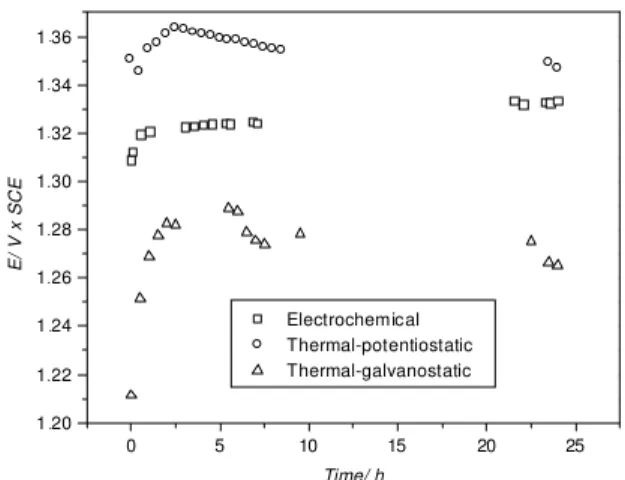
The open-circuit potential vs. time behavior of the
differ-ent Ti/PbO2 electrodes in a 0.5 mol L-1 H2SO4 solution is shown in Figure 1. After 24 h in solution, the electrodes pre-pared by the thermelectrochemical method presented al-most the same open-circuit potential as the one prepared by electrodeposition; furthermore, the values were quite stable. These open-circuit potentials are in the range of the poten-tials for the stability region for PbO2 in Pourbaix diagrams20, indicating that the surface of the oxide film obtained by the
thermal-electrochemical method is predominantly PbO2.
Figure 1. Open-circuit potential (vs. sce) as a function of time for Ti/PbO2 electrodes produced by the thermal-electrochemical
method and by electrodeposition, in a 0.5 mol L-1 H
2SO4 solution
at room temperature.
0 5 10 15 20 25
1,20 1,22 1,24 1,26 1,28 1,30 1,32 1,34 1,36
Electrochemical Thermal-potentiostatic Thermal-galvanostatic
E/
V x SC
E
Time/ h .
Qualitative characterization of the Ti/PbO and Ti/PbO2
electrodes through X-ray diffractometry
Comparison of the diffraction angles for the different peaks in the X-ray diffractogram obtained for the Ti/PbO electrode with JCPDS (Joint Committee of Powder Diffraction Stan-dards) standard data did not allow to conclude whether the PbO was in the orthorhombic or the tetragonal form. On the
other hand, the diffractograms for the Ti/PbO2 electrodes
obtained by the thermal-electrochemical method did not dif-fer very much from the one for the Ti/PbO electrode. Figure 2
shows the diffractogram for the Ti/PbO2 electrode obtained
by the thermal-galvanostatic method. The peaks at the dif-fraction angles 2θ = 18.6o, 28.7o, 31.8o, 35.8o, 40.2o and
48.7o,also present in the diffractogram for the Ti/PbO2 elec-trode obtained by the thermal-potentiostatic method, are quite
similar to the ones typical of PbO. The peak at 2θ = 40.2o is
clearly due to the Ti substrate. On the other hand, only the
peaks at 2θ = 28.7o and 35.8o coincide with those of the
JCPDS standard data for orthorhombic PbO2. Thus, the X-ray
diffractograms indicate that the electrode coating is a
mix-ture of ort-PbO, tetr-PbO and ort-PbO2. Although only two of
the peaks are attributable to PbO2, the values of the
open-circuit potential in 0.5 mol L-1 H
2SO4 and the color of the
electrode surface (dark gray) are typical of PbO2;
further-more, the fact that the electrode is stable in 0.5 mol L-1 H 2SO4
also indicates that its surface is made of PbO2 (PbO is soluble in acid media).
phase in favor of the tetragonal phase. Furthermore, PbO traces seem to be present, since peaks also attributable to this oxide were observed.
Surface morphology characterization of the Ti/PbO and Ti/PbO2 through scanning electron microscopy
No significant influence of the atmosphere used
dur-ing the decomposition of PbO to PbO2 on the final surface
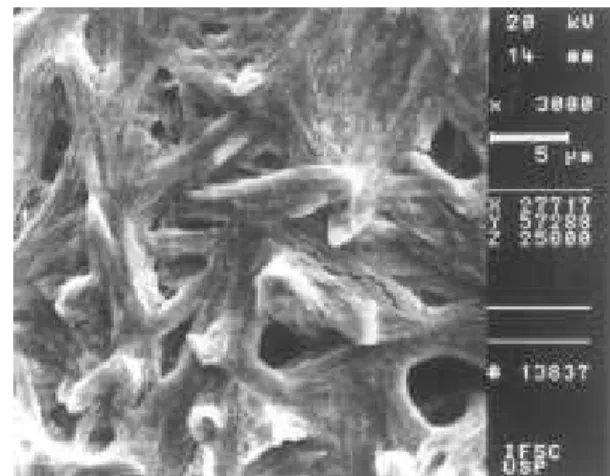
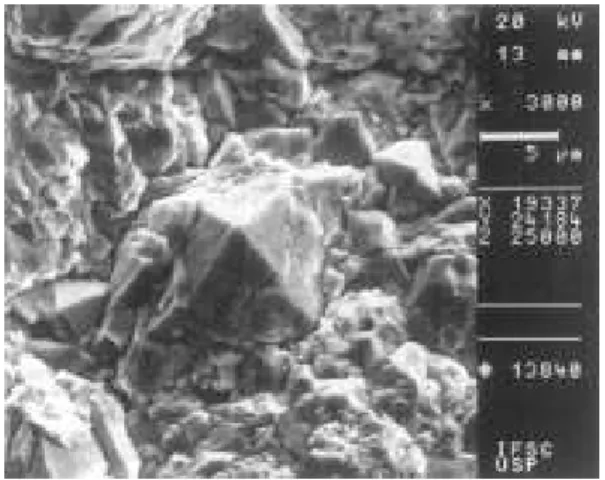
morphology of the electrodes was noticed. Figures 3 to 6 show SEM images of the surface of the Ti/PbO electrode,
Ti/PbO2 electrode obtained by the thermal-potentiostatic
method, Ti/PbO2 electrode obtained by the
thermal-galvanostatic method and Ti/PbO2 electrode obtained by
electrodeposition, respectively; in all cases the
decompo-sition of PbO to PbO2 was carried out in a O2 atmosphere.
The comparison of Figures 3 to 5 allows one to conclude
that the basic morphology of the PbO2 surface (entangled
and porous) is determined in the thermal step, i.e., during
the PbO formation (Figure3). Clearly the electrochemical
oxidation of PbO to PbO2 (Figures 4 and 5) does not
change the basic features of the initial morphology. On the other hand, there is a subtle difference between the Ti/
PbO2 electrodes (Figures 4 and 5), that is the presence of
fibrils on top of the thermal-potentiostaic electrode (Fig-ure 4), increasing its surface area and rugosity.
Figure 2. X-ray diffractogram of the Ti/PbO2 electrode produced by the thermal-galvanostatic method.
On the other hand, it should be noted that, according to the obtained diffractograms, the coating in the
electrode-posited Ti/PbO2 electrodes is made most probably of
tet-ragonal PbO2 (actually some peaks are common to
orthor-hombic PbO2). This result agrees well with those of
Bemelmans et al.19, who reported that the addition of
so-dium lauryl sulfate to the electrolyte used for the
electrode-positon of PbO2 supressed the growth of the orthorhombic
Figure 3. SEM image of the surface of the Ti/PbO electrode ob-tained by the thermal decomposition of Pb(NO3)2 to PbO.
Magni-fication: 3,000.
On the other hand, the comparison of Figures 4 and 5
with Figure 6 clearly shows that the Ti/PbO2 electrode
obtained by electrodeposition (Figure 6) has a distinctly different, polyhedral surface morphology, which is similar
to the one reported by Bemelmans et al.19. Its formation is
Electrochemical characterization of the oxygen evolution reaction on the Ti/PbO2 electrodes
This characterization was carried out in a 0.5 mol L-1
H2SO4 solution, at room temperature. No significant
difference was noticed between the behavior of Ti/PbO2
elec-trodes produced by the thermal-electrochemical methods. Thus, considering that the galvanostatic oxidations of PbO
to PbO2 could be carried out in less time, hereinafter only
electrodes thus obtained were characterized.
Figure 7 shows that the atmosphere in which PbO was
decomposed to PbO2 influences the efficiency of the OER
on Ti/PbO2 electrodes obtained by the
thermal-galvanostatic (three steps) method. Clearly the reaction
occurs more readily on the electrodes produced in a N2
atmosphere. This may be due to the absence of O2 in the
oven during the decomposition of PbO to PbO2 at 550 °C. It
is known that when titanium is heated in air, even at tem-peratures smaller than 550 °C, an oxide film is formed on its
surface21. This insulating/passivating film makes the
trode less conductive, thus leading to a decrease of the elec-trode efficiency for the OER. A comparison of these results with those reported by Kötz et al.2 clearly indicates that the
Ti/PbO2 electrodes produced by the alternative method
described in this paper have a much higher overpotential for the OER, which may be of interest when using the elec-trodes for the oxidation of organic molecules. However, it
should be noticed that the Ti substrate in the Ti/PbO2
elec-trodes studied by Kötz et al.2 was platinized, which may
hinder any oxidation of the titanium substrate.
Figure 4. SEM image of the surface of the Ti/PbO2 electrode ob-tained by the thermal-potentiostatic method. Magnification: 3,000.
Figure 5. SEM image of the surface of the Ti/PbO2 electrode ob-tained by the thermal-galvanostatic method. Magnification: 3,000.
Figure 6. SEM image of the surface of the Ti/PbO2 electrode ob-tained by electrodeposition. Magnification: 3,000.
Figure 7. Steady-state polarization curves (v = 0.2 mV s-1) in a 0.5 mol L-1 H
2SO4 solution at room temperature for Ti/PbO2
elec-trodes produced by the thermal-galvanostatic method (three steps); comparison of the performance of electrodes produced in different atmospheres during the thermal step: either air, O2 or N2.
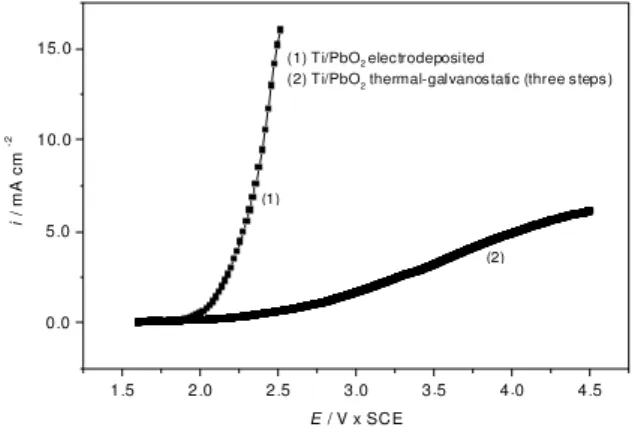
Figure 8 shows that the OER on the
thermal-galvano-static Ti/PbO2 electrode has a much higher overpotential
than on the electrodeposited Ti/PbO2 electrode. The
corresponding Tafel slopes are about 240 mV/decade and
500 mV/decade, respectively. Kötz et al.2 reported a slope
of 120 mV/decade for Ti/PbO2 and 240 mV/decade for Ti/
SnO2. The difference between the Tafel slopes of the
elec-trodeposited Ti/PbO2 electrodes studied by Kötz et al.2
1,5 2,0 2,5 3,0 3,5 4,0 4,5
0,0 1,0 2,0 3,0 4,0 5,0 6,0 7,0
(3)
(2) (1) (1) Thermal-galvanostatic (PbO in air)
(2) Thermal-galvanostatic (PbO in O2)
(3) Thermal-galvanostatic (PbO in N2)
i
/
m
A
c
m
-2
E / V x SCE
. . . . . . . .
and by us indicates that the Ti substrate may have been
passivated under the polarization conditions used for PbO2
electrodeposition22. Furthermore, the larger Tafel slope for
the thermal-galvanostatic Ti/PbO2 electrode indicates that
the passivation of the Ti substrate may have occurred to a greater extent under the heating conditions used in the
ther-mal-galvanostatic method (550 °C in a N2 atmosphere).
Al-though, as pointed out by Bemelmans et al.19, the PbO
2
phase influences the polarization behavior of the electrode
(PbO2 exists as a different phase in each case: ort-PbO2 in
the thermal-galvanostatic electrode, and tetr-PbO2 in the
electrodeposited electrode), such a large difference in the Tafel slopes cannot be accounted for solely by this. Further studies are presently being carried out in order to confirm or not the passivation of the Ti substrate in these electrodes.
J. Electrochem. Soc.1998, 145, 555.
2. Kötz, R.; Stucki, S.; Carcer, B. J. Appl. Electrochem.
1991, 21, 14.
3. Comninellis, C. Electrochim. Acta 1994, 39, 1857.
4. Fugivara C. S.; Sumodjo, P. T. A.; Cardoso, A. A.;
Benedetti, A. V. Analyst 1996, 121, 541.
5. Lipp, L.; Pletcher, D. Electrochim. Acta 1997, 42, 1091. 6. Polcaro, A. M.; Palmas, S.; Renoldi, F.; Mascia, M.
J. Appl. Electrochem. 1999, 29,147.
7. Comninellis, C. I. Chem. E. Symp. Ser. 1992,
127,189.
8. Comninellis, C.; Nerini A. J. Appl. Electrochem.
1995, 25,23.
9. Stucki, S.; Kötz, R.; Carcer, B.; Suter, W. J. Appl.
Electrochem. 1991, 21,99.
10. Chiang, L. C; Chang, J. E.; Wen, T. C. J. Environ. Sci.
Health, Part A: Toxic/Hazard. Subst. Environ. Eng.
1995, 30, 753.
11. Schümann, U.; Gründler, P. Water Res. 1998,
32, 2835.
12. Tahar, N.B.; Savall, A. J. Appl. Electrochem. 1999,
29,277.
13. Sucre, V. S. de; Watkinson, A. P. Can. J. Chem. Eng.
1981, 59, 52.
14. Comninellis, C.; Plattner, E. J.Appl. Electrochem.
1982, 12, 399.
15. Kawagoe, K. T.; Johnson, D. C. J. Electrochem. Soc.
1994, 141,3404.
16. Tahar, N. B.; Savall, A. J. Electrochem. Soc. 1998,
145,3427.
17. Brooman, E. W.; Fenton, J. M.; Hamel, C. (Eds.)
Electrochemical Technology Applied to Environ-mental Problems. Pennington, Electrochemical
Society, 1995.
18. Greenwood, N. N.; Earnshaw, A. Chemistry of the
Elements. Pergamon Press; Oxford, 1984, p. 448, 450, 524, 541.
19. Bemelmans, C.; O’Keefe , T.; Colie, E. Bull.
Electrochem. 1996, 12, 591.
20. Pourbaix, M.; Zoubov, N.; Vanleugenhaghe, C.;
Rysselberghe, P. V.; “Lead”. In: Atlas of
Electrochemi-cal Equilibria in Aqueous Solutions, Pourbaix, M. (Ed.), National Association of Corrosion Engineers; Texas, 1974, p. 486.
21. Camara, O. R.; De Pauli, C. P.; Vaschetto, M. E.; Retamal,
B.; Aguirre, M.J.; Zagal, J.H.; Biaggio, S. R. J. Appl.
Electrochem.1995, 25, 247.
22. Musiani, M.; Furlanetto, F.; Bertoncello, R.
J. Electroanal. Chem. 1999, 465,160.
Received: June 16, 1999.
FAPESP helped in meeting the publication costs of this article. Figure 8. Steady-state polarization curves (v = 0.2 mV s-1) in a 0.5 mol
L-1 H
2SO4 solution at room temperature for Ti/PbO2 electrodes
pro-duced by the thermal-galvanostatic method (three steps) or by elec-trodeposition; the thermal step was carried out under a N2 atmosphere.
Finally, it should be noted that although from the point
of view of the OER overpotential the Ti/PbO2 electrodes
produced by the alternative method described in this paper are very good, the fact that the OER currents obtained are quite low is worrisome, since the electrodes may turn out not to be practical; this will be determined by the outcome of the tests of these electrodes for the oxidation of organic compounds, which will be carried out in the near future.
Acknowledgments
Financial support and scholarships from CNPq are gratefully acknowledged.
References
1. Musiani, M. M.; Furlanetto, F.; Guerriero, P.
1,5 2,0 2,5 3,0 3,5 4,0 4,5 0,0
5,0 10,0 15,0
(2) (1)
(1) Ti/PbO2 elec trodeposited
(2) Ti/PbO2 thermal-galvanos tatic (three s teps )
i
/ m
A
c
m
-2
E / V x SCE
. .
. .