
Models of the Electroreduction of Passive Layers on Cobalt
C.A. Gervasi*
Instituto de Investigaciones Fisicoquímicas Teóricas y Aplicadas (INIFTA), Facultad de Ciencias Exactas, Universidad Nacional de La Plata, Sucursal 4, C.C. 16,
1900 La Plata, Ar gen tina
Re ceived: June 30, 1996; No vem ber 18, 1996
Técnicas de transientes de corrente potenciostáticos foram empregadas no estudo de processos de eletroredução de camadas superficiais formadas no cobalto policristalino em soluções contendo íons carbonato-bicarbonato. As análises dinâmicas do sistema, realizadas através de procedimentos de investigação paramétrica e de rotinas de ajuste não-lineares, demonstraram que os da dos obtidos sob numa grande variedade de condições experimentais podem ser interpretados considerando a participação de várias espécies superficiais contendo Co(II)/Co(III). A influência do tempo de anodização no potencial de formação do óxido pode ser discutida na base dos modelos de eletroredução aqui propostos.
Potentiostatic cur rent tran sient tech niques were em ployed to study the electroreduction pro cess of sur face lay ers formed on polycrystalline co balt in car bon ate-bicarbonate ioncontaining so lu tions. The dy namic sys tem anal y sis per formed us ing para met ric iden ti fi ca tion pro ce dures and nonlinear fit rou tines dem on strated that data ob tained un der a wide va ri -ety of ex per i men tal con di tions may be in ter preted by tak ing into ac count the par tic i pa tion of var i ous Co(II)/Co(III)-con tain ing sur face spe cies. The in flu ence of the an od iz ing time at the po ten tial of ox ide film for ma tion may be dis cussed on the ba sis of the pro posed electroreduction mod els.
Key words: Co balt ox ides, electroreduction, po ten tial steps, ki netic mod els
In tro duc tion
An odic ox ide films formed on co balt in al ka line so lu -tions have been in ves ti gated in the past in or der to de rive the most likely struc ture of the ox i da tion prod ucts, as well as their prop er ties. Elec tro chem i cal and ellipsometric stud -ies were used to pro pose the over all mech a nisms for the elec tro-oxidation re ac tions1-2. The pas sive films that are formed in the po ten tial range of the sec ond ary pas siv ity pres ent a bilayer struc ture and ag ing pro cesses may be pro -duced by proper po lar iza tion pro grams3. By con trast, the
electroreduction of these sur face lay ers has re ceived com -par a tively less at ten tion. More over, it should be ex pected that the cor re spond ing re ac tion mech a nisms are con sis tent with the pre vi ously ad vanced elec tro-oxidation path ways. The anal y sis of electroreduction us ing po ten tialstep tech -niques may yield sig nif i cant in for ma tion con cern ing not only the ki net ics of the re ac tion of this pro cess, but also the
na ture of the pas sive film and the ki net ics of its growth and dis so lu tion4,5.
In this ar ti cle, a study of the electroreduction of co balt pas sive films formed through po ten tial con trolled an od iza tion in car bon atebicarbonate buff ers is pre sented. Fur ther -more, the po ten ti al i ties of the electroreduction po ten tialsteps tech nique in the study of pas sive state prop -er ties will be dis closed.
Ex per i men tal
The ex per i men tal setup has been de scribed in pre vi ous pub li ca tions4,6. “Specpure” co balt in the form of both static
and ro tat ing disks (John son Matthey Chem i cal, 0.30 cm2
ap par ent area), em bed ded in PTFE hold ers was used for the work ing elec trodes. Po ten tials were mea sured against a sat u rated cal o mel elec trode (SCE) (0.242 V in the NHE scale), but in the text they are re ferred to the NHE. The elec tro lyte so lu tion con sisted of x M KHCO3 + y M K2CO3 Ar ti cle
(0.0075 ≤ x ≤ 0.75 ; 0.0005 ≤ y ≤ 1.5) cov er ing the 8.4-11.6 pH range. The so lu tions were pre pared from an a lyt i cal grade (p.a. Merck) re agents and tri plydistilled wa ter, pre -vi ously boiled un der in ert at mo sphere to re move CO2. The
work ing elec trode sur face was finely pol ished with γalu -mina (1.0 and 0.3 µm), rinsed in tri ply-distilled wa ter, and fi nally cath od i cally po lar ized for τ0 = 3 min at po ten tials
suf fi ciently neg a tive to pro duce a net hy dro gen evo lu tion. Ex per i ments were made un der pu ri fied N2 gas sat u ra
tion at 25 °C by em ploy ing the fol low ing per turb ing po ten -tial pro grams: i) sin gle (STPS) tri an gu lar po ten tial scans be tween pre set cath odic (Es,c) and an odic (Es,a) switch ing
po ten tials at a scan rate of v = 0.025 V s-1; ii) com bined po
-ten tial scans and po-tentiostatic steps, usu ally two po -ten tial steps, cov er ing dif fer ent po ten tial re gions. The first po ten -tial step (Ei) was ap plied for a cer tain time τ to mod ify the
an od i cally formed layer in or der to change the to tal amount of an odic sur face prod ucts and to pro duce ag ing ef fects which may vary the com po si tion of the an odic layer con -stit u ents. Most of these cur rent tran sient ex per i ments were per formed by set ting Ei = Es,a. The sec ond po ten tial step
(Ef) was fixed suf fi ciently neg a tive to electroreduce the an
odic layer ei ther par tially or com pletely, and the cor re -spond ing cur rent tran sients were sys tem at i cally re corded.
Re sults and Dis cus sion
It has al ready been es tab lished that the re gion of pri mary pas siv ity of co balt elec trodes in al ka line me dia cov -ers the 0.4-0.6 V range for po ten tials re ferred to the hy dro gen elec trode in the same elec tro lyte (UHss)7. Co(II)
ox ide or the re spec tive hy drox ide is the sta ble phase in this po ten tial range. Be yond that, i.e. in the re gion of sec ond ary pas siv ity, a spinel phase be comes sta ble and the film con -sists of an in ner layer of CoO and an outer layer of Co3O4 8.
As such, set ting Es,a = 0.14 V (vs. NHE) ren ders a film cor
-re spond ing to the sec ond ary pas siv ity, i.e.Es,a≥ 0.6 V (vs.
UHss), in the pH range stud ied in this work.
The voltammogram of co balt in 0.75 M KHCO3 + 0.05
M K2CO3 so lu tion, at pH 8.9, and run at v = 0.025 V s-1
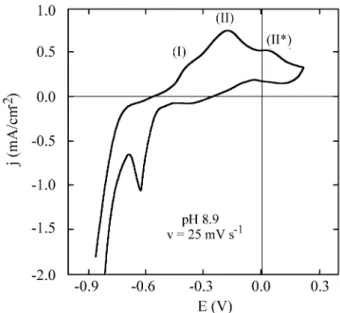
shows (Fig. 1) one main an odic peak at c.a. -0.17 V (peak II) and two sat el lite humps, one at c.a. -0.33 V (peak I) and the other at 0.07 V (peak II*), which pre cedes the on set of the sec ond ary pas sive cur rent re gion. The re verse scan pres ents a re ac ti va tion of the elec trooxidation pro cess fol -lowed by a lim it ing cur rent re gion prior to a cath odic peak at -0.63 V and a cath odic cur rent at po ten tials lower than -0.75 V, largely due to the hy dro gen evo lu tion re ac tion. The pre sen ta tion of Fig. 1 is sim ply in tended to show the po ten tial re gions where the main elec tro chem i cal re ac tions take place. A de tailed de scrip tion may be found in Ref. 2. The electroreduction of co balt ox ide lay ers was in ves ti -gated through the potentiostatic cur rent tran sient method. In the case of nu cle ation and egrowth-controlled pro cesses,
experimental stud ies us ing this method are usu ally pre -ferred, be cause then the elec tro chem i cal rate pa ram e ters are con stant for t > 0. In a pre vi ous pa per6, the sys tem atic anal y sis of po ten tial steps for the electroreduction re ac tion were de scribed for the same sys tems con sid ered in this work. It was con cluded that for a fixed value of τ = 30 s, the cur rent tran sients can be well de scribed ac cord ing to the fol low ing the o ret i cal model:
j(t) P
t P [1 exp( P t
3
1 2 1
3
1 2
= + − − ) (1)
where
t t ti = − lag t P= − 4 (2)
P z F k1 = 1 (3)
P M k A
3
2 2
2 2
2 =π
ρ (4)
and
P3 =z F D c
1 2
1 2
∆
π (5)
k1 (mol cm-2 s-1) and k2 (mol cm-2 s-1) stand for the new
gres sive nu cle ation and three-dimensional (3D) growth of nu clei un der charge trans fer con trol9. The model also in
-cludes the ap pear ance of an in duc tion time (P4) for the for
-ma tion of 3D nu clei. Fig ure 2 shows ex per i men tal cur rent
tran sients ob tained in 0.075 M KHCO3 + 0.005 M K2CO3
so lu tion, at pH 8.9, with a po ten tial step be tween Ei = 0.14
V and Ef = -0.74 V, and at times τ = 8 s and 30 s. A good
agree ment can be ob served be tween the ex per i men tal val ues and the the o ret i cal curves cal cu lated with Eq. 1. How -ever, when Ef is set ≥ -0.57 V, the ex per i men tal cur rent
tran sients lack the max i mum typ i cal for a nu cle ation and growth con trolled pro cess. Fig ure 3 de picts an ex per i men -tal cur rent tran sient re corded at Ef = -0.57 V in 0.75 M
KHCO3 + 0.05 M K2CO3 so lu tion, at pH 8.9, with τ = 3 s,
to gether with the cor re spond ing the o ret i cal curve de rived
through fit ting to the ini tial dif fu sion term in Eq. 1. This type of ki netic law at first sight sug gests that un der these work ing con di tions, the electroreduction re ac tion, cor re -sponds to a pro cess con trolled solely by dif fu sion.
The pro posed the o ret i cal model in Eq. 1 also fails to prop erly de scribe the ex per i men tal tran sients ob tained at lon ger timesτ. Thus, Fig. 4 shows two cur rent tran sients re corded un der the ex per i men tal con di tions de scribed in Fig. 2, but with τ = 90 s (Fig. 4 a) and τ = 180 s (Fig. 4 b). The ex per i men tal re sults at a lon ger τ can be sat is fac to rily de scribed ac cord ing to the fol low ing re la tion ship:
Fig ure 2. Ex per i men tal cur rent tran sients [•] re corded at Ef = -0.74 V in 0.075 M KHCO3 + 0.005 M K2CO3 so lu tion, at pH 8.9, at dif fer ent τs. The the o ret i cal curves were de rived from the fit ting of these data ac cord ing to Eq. 1 [—].
Fig ure 3. Ex per i men tal cur rent tran sient [•] re corded at Ef = -0.57 V in 0.75 M KHCO3 + 0.05 M K2CO3 so lu tion, at pH 8.9, with τ = 3 s. The the o ret i cal curve de rived from the fit ting of these data ac cord ing to the dif fu sion term of Eq. 1 [—].
j P
t P t P t
3
i i
2
( )t = 1 + exp(− )
2 5 6
(6)
where
P5 z F h Mk N2
2 0
2
= π
ρ (7)
P6 M k N
2 2 2
0 =π
ρ (8)
h is the height of the growth layer when N0 nu clei are in
stan ta neously formed, and the rest of the sym bols have al -ready been de fined. In this case, the ini tial dif fu sion term re mains un changed, while the sec ond term cor re sponds to an in stan ta neous nu cle ation and 2D growth pro cess un der charge trans fer con trol10. Fig ure 4 con tains best-fit curves ac cord ing to Eqs. 1 and 6. A com par i son of these re sults makes it clear that a tran si tion from a 3D to a 2D growth model can be mainly as so ci ated with lon ger ag ing times τ.
Ex per i men tal cur rent tran sients re corded at dif fer entτs in a 0.75 M KHCO3 + 1.5 M K2CO3 so lu tion, at pH 10.5,
are de picted in Fig. 5, to gether with the cor re spond ing the -o ret i cal curves de rived thr-ough fit ting t-o Eq. 6. Even f-or very short times τ the nu cle ation and growth model cor re sponds to a 2D pro cess. The val ues of the pa ram e ters, as de -rived from the fit ting pro ce dure, are as sem bled in Ta ble 1, which also in cludes the height of the growth phase h and the electroreduction charge den sity q com prised in the nu cle ation and 2D growth pro cesses. These val ues were cal cu -lated as fol lows:
h P
P M
zF
= 5
6
2 ρ (9)
q P t P t dt P
P
=∞
∫
− =0
5 6
2 5
6
2
exp( ) (10)
The val ues of h cal cu lated with Eq. 9 de crease with in -creas ing timesτ, and are in good agree ment with the thick -ness of the pri mary pas sive layer of CoO elec tro formed in other elec tro lytes at com pa ra ble pH val ues8.
An en hanced chem i cal dis so lu tion of the in ner CoO layer is to be ex pected in so lu tions with in creased con cen -tra tions of car bon ate and bi car bon ate ions, like the
electrolyte used in the ex per i ments in Fig. 52. The ear lier ex haus tion of electroactive spe cies in the ox ide film in the per pen dic u lar di rec tion im poses a phys i cal limit for fur ther ver ti cal 3D growth and de ter mines the ob served 2D be hav ior. This is a con se quence of a thin ning of the film by its en -hanced dis so lu tion af ter lon ger times in con tact with the elec tro lyte.
The re ac tions tak ing place dur ing the electroreduction of pas sive co balt elec trodes formed in the sec ond ary pas -siv ity re gion in car bon ate-bicarbonate so lu tions can be put as fol lows:
Co3O4 + 4H2O + 2e- 3Co2+ + 8OH- (11)
Co2+ + 2HCO3- Co(CO3)22- + 2H+ (12)
CoO + 2H+ + 2e- Co + H2O (13)
Re ac tion 11 cor re sponds to an electroreductive dis so lu -tion of the outerCo3O4 layer with the for ma tion of sol u ble
Co(II) spe cies, rather than an ox ide layer with lower va -lency. This re ac tion may ex plain the electroreduction charge in the tran sients as so ci ated with a dif fu sion con -trolled pro cess and the lim it ing cur rent de tected in the voltammogram of Fig.1. More over, Re ac tion 11 has pre vi ously been pro posed to ex plain the electroreduction of co -balt ox ide lay ers formed in elec tro lytes con tain ing bo rate ions by means of mea sur ing tech niques dif fer ent from those de scribed here1.
Re ac tion 12 takes into ac count the for ma tion of a com -plex ion of Co(II) which has been shown to be the sta ble form in car bon ate-bicarbonate con tain ing so lu tions12. Al -though the dif fu sion cur rent in the tran sients was re lated, in a dif fer ent fash ion, to a re ac tion in volv ing the com plex ion
Ta ble 1. Pa ram e ters used for fit ting the electroreduction cur rent de cay data in 0.75 M KHCO3 + 1.5 M K2CO3, at pH 10.5, ac cord ing to Eq. 6 for P4 ′ 0; the height of the growth phase h cal cu lated with Eq. 9 and the electroreduction charge den sity q, cal cu lated with Eq. 10.
τ/s P3/mAcm-2s1/2 P5/mAcm-2s-1 P6/s-2 q/mCcm-2 h/nm
3 0.925 0.350 0.0126 13.9 4.77
30 0.921 0.382 0.0289 6.61 2.27
300 0.943 0.412 0.0370 5.57 1.91
-Co(CO3)22- 6, no clear ex pla na tion was given for the
Co(III) → Co(II) trans for ma tion, which should be de tected in the tran sients dur ing the electroreduction of Co3O4 films.
As the po ten tial ap plied to the elec trode en ters the po ten tial win dow of the voltammetric cath odic peak, the re -duc tion of the in ner CoO to yield an electrore-duced co balt layer also takes place (Re ac tion 13). Re ac tions 11 and 13 prob a bly in volve mul ti ple steps.
Con clu sions
The pro posed electroreduction path way of co balt ox ides formed in the po ten tial range of the sec ond ary pas siv -ity in car bon ate-bicarbonate buff ers is con sis tent with the pre vi ously pro posed struc ture of the pas sive films. As such, the mech a nisms pre sented de scribe the electroreduction ki
-net ics of both the outer Co3O4 layer and the in ner CoO
layer. The tran si tion of the growth mech a nism for the new phase from a 3D to a 2D pro cess may be re lated to the time of potentiostatic ag ing τ. The height of the growth phase h can be cor re lated to the thick ness of the an odic film, as pre -vi ously mea sured us ing other tech niques. The electroreduction po ten tial step tech nique ap plied to an odic films has the abil ity not only to al low dis crim i na tion among dif fer ent ki netic mech a nisms, but also to pro vide in for ma -tion about the na ture of these films.
Ac knowl edg ments
This re search was fi nan cially sup ported by the Consejo Nacional de Investigaciones Científicas y Técnicas (CONICET) and the Comisión de Investigaciones Científicas de la Provincia de Bue nos Ai res (CIC).
Ref er ences
1. Kudo, K.; Sato, N.; Ohtsuka, T. In Pas siv ity of
Metals; Frankenthal, R.P.; Krugger, J. Eds.; The Elec -tro chem i cal So ci ety, Prince ton, NJ, 1978, pp. 918-934, .
2. Gervasi, C.A.; Biaggio, S.R.; Vilche, J.R.; Arvia, A.J.
Corros. Sci. 1989, 29, 427.
3. Gervasi, C.A.; Vilche, J.R.; Alvarez, P.E.
Electrochim. Acta 1996, 41, 445.
4. Urraza, J.I. de, Gervasi, C.A.; Saidman, S.B.; Vilche, J.R. J.App. Electrochem. 1993, 23, 1207.
5. Al len, P.D.; Bignold, G.J.; Hampson, N.A. J.
Electroanal. Chem. 1980, 112, 239.
6. Gervasi, C.A.; Biaggio, S.R.; Vilche, J.R. Arvia, A.J.
Electrochim. Acta 1991, 36, 2147.
7. Heusler, K.E. In Pas siv ity of Metals; Frankenthal,
R.P.; Krugger, J. Eds.; The Elec tro chem i cal So ci ety, Prince ton, NJ, 1978 pp. 771-801.
8. Ohtsuka, T.; Sato, N. J. Ja pan Inst. Met. 1975, 39, 60.
9. Armstrong, R.D.; Fleischmann, M.; Thirsk, H.R. J.
Electroanal. Chem. 1966, 11, 208.
10. Fleischmann, M.; Thirsk, H.R. J. Electrochem. Soc.
1963, 11, 688.
11. Davies, D.H.; Burstein, G.T. Cor ro sion 1980, 36,
![Fig ure 4. Ex per i men tal cur rent tran sients [•] re corded at E f = -0.74 V in 0.075 M KHCO 3 + 0.005 M K 2 CO 3 so lu tion, at pH 8.9, for (a) τ = 90 s and (b) τ = 180 s](https://thumb-eu.123doks.com/thumbv2/123dok_br/18988026.459588/3.892.91.431.693.1016/fig-ure-rent-tran-sients-corded-khco-tion.webp)
![Fig ure 5. Ex per i men tal cur rent tran sients [•] re corded at E f = -0.79 V in 0.75 M KHCO 3 + 1.5 M K 2 CO 3 so lu tion,at pH 8.9, at dif fer ent τs.](https://thumb-eu.123doks.com/thumbv2/123dok_br/18988026.459588/4.892.468.796.708.858/fig-ure-rent-tran-sients-corded-khco-tion.webp)
