Hadron Spectra from a Non-Relativistic Model
with Confining Harmonic Potential
(Espectros de Hadrons a partir de um modelo n˜ao relativ´ıstico com potencial harmˆonico confinante
Eduardo Cuervo-Reyes
Instituto Superior de Ciencias y Tecnolog´ıa Nucleares-ISCTN, Ave. Salvador Allende y Luaces, Quinta de los Molinos, La Habana, Cuba
Marcos Rigol
Institut f¨ur Theoretische Physic III, Universit¨at Stuttgart, Pfaffenwaldring 57, D-70550 Stuttgart, Germany
Centro Brasileiro de Pesquisas F´ısicas-CBPF, Rua Dr. Xavier Sigaud 150, 22229-180, Rio de Janeiro, Brazil
Jesus Rubayo-Soneira
Instituto Superior de Ciencias y Tecnolog´ıa Nucleares-ISCTN, Ave. Salvador Allende y Luaces, Quinta de los Molinos, La Habana, Cuba
Recebido em 25 de julho, 2002. Aceito em 28 de outubro, 2002.
Hadron spectra and other properties of quark systems are studied in the framework of a non-relativistic spin-independent phenomenological model. The chosen confining potential is harmonic, which allowed us to obtain analytical solutions for both meson and baryon (of equal constituent quarks) spectra. The introduced parameters are fixed from the low-lying levels of heavy quark mesons. The requirement of flavor independence is imposed, and it restricts the possible choices of inter-quark potentials. The hyper-spherical coordinates are considered for the solution of the three-body problem.
Espectros de Hadrons e outras propriedades de sistemas de quarks s˜ao estudados do ponto de vista de um modelo fenomenol´ogico n˜ao-relativ´ıstico independente de spin. O potencial confinante escolhido ´e harmˆonico, o qual nos permite obter soluc¸˜oes anal´ıticas tanto para os espectros dos m´esons quanto para os dos b´arions (de iguais quarks constituintes). Os parˆametros introduzidos s˜ao fixos a partir dos primeiros estados excitados dos m´esons pesados. A condic¸˜ao de independˆencia de sabor ´e imposta, o que restringe as poss´ıveis escolhas de potenciais inter-quarks. As coordenadas hiper-esf´ericas s˜ao consideradas para a soluc¸˜ao do problema de trˆes corpos.
I
Introduction
The study of the fundamental or constituent blocks of matter has been for long time a fascinating field in physics. With the pass of the years new fundamental blocks or particles have appeared, modifying old concepts. For example the atom, that was initially supposed to be fundamental, was found to be formed by the nucleus and electrons, the nucleus was found to be formed by neutrons and protons (nucleons) and finally the nucleons to be formed by quarks.
Nowadays it is believed that the theory describing the interactions between fundamental particles is the Standard Model. This model has aSU(3)×SU(2)×U(1)
energy region of the QCD theory, in which quarks inter-act strongly to form bound states known as hadrons. When these bound states are formed by a quark and an antiquark (qq) they are called mesons; and when they are formed by 3-quark states (qqq) they are called baryons. The study of the hadron spectra is a fundamental and open field in theo-retical physics. Up to the moment the more important ap-proaches to this subject have been: Lattice QCD, QCD sum rules and potential models. Lattice QCD is the most funda-mental approach and together with QCD sum rules have had good success. Potential models, although less fundamen-tals, have proved to be very useful even in non-relativistic approximations. Since the latest seventies a lot of attempts have been made in this field with very good results [1].
An important question for the use of potential models is whether it is possible to consider hadrons as non-relativistic bound states of quarks. This question could be answered solving the Schrodinger equation assuming a qq potential and then checking if the obtained quark velocities are non-relativistic. For the charmonium system this was done in Ref.[2] and it was obtained a result of v2/c2® = 0.2 in the ground state. For lighter hadrons the results are no so good and the validity of the non-relativistic approxima-tion depends strongly from the interacapproxima-tion potential cho-sen. For example, the interaction potential proposed by De Rujula, Georgi and Glashow [3] was shown [4] to be un-suitable for dynamical non-relativistic calculations of light hadrons. However, Martin showed latter [5, 6, 7] that a non-relativistic model with a power law potential is able to describe heavy quark mesons and the clearly relativisticss states. The potential proposed by Martin had the form
V(r) =A+Brα, (1)
whereA=−8.093GeV,B = 6.898GeV andα= 0.1. The study of baryon systems with this power law poten-tial was done by Richard [8] obtaining good results. At that time the baryon spectra in potential models, although rather elaborated [9], was completely disconnected from the me-son sector. Exceptions were some attempts to derive meme-son and baryon potential energies from a common framework as the instanton, string or bag model. The rule adopted by Richard for theqqpotential was
Vqq =
1
2Vqq. (2)
Other very well known phenomenological non-relativistic potential models have been based in the Cornel potential [10, 2]
V(r) =ACr− BC
r +CC, (3)
where AC = 0.1756 GeV2, BC = 0.52 and CC = −0.8578GeV; and the logarithmic potential [11]
V(r) =AL+BLln (r), (4) whereAL=−0.6631GeV andBL= 0.733GeV.
Finally, other two propositions of inter-quark potentials are due to Song and Ling [12]
V (r) =ASr 1 2 +B
Sr− 1
2, (5)
whereAS = 0.511 GeV 3 2 andB
S = 0.923 GeV 1 2; and Turin [13]
V (r) =−ATr− 3 4 +B
Tr 3 4 +C
T. (6) where AT = 0.620 GeV
1 4, B
T = 0.304 GeV 7 4 and CT =−0.823GeV.
Studies with phenomenological potentials, like the Cor-nell one, but considering a relativistic kinetic energy term, are able to describe the observed spectra of heavy and light hadron systems [14, 15]. Non-trivial connections be-tween these relativistic potential models and rigorous nu-merical results from lattice QCD have been demonstrated [16]. Some recent works have tried to understand why the non-relativistic treatment works and allows useful predic-tions even for relativistic systems [17, 18].
In the previously mentioned potential models, central conditions have been the flavor independence of the poten-tial chosen and the existence of a confining term. Quark masses appearing in these phenomenological models are the so called constituent quark masses that should not be con-fused with the current quark masses, that are the mass pa-rameters appearing in the QCD Lagrangian. Constituent quark masses are bigger than current quark masses and it is suppose that this is due to gluonic condensate effects. In general constituent quark masses are considered as free pa-rameters to fit in potential models, that is why different val-ues are found all over the literature. Up to our knowledge there are two works in which constituent quark masses are calculated from QCD: one is due to Elias et al. [19, 20] that used an operator-product expansion (OPE) of approximate non-perturbative vacuum expectation values in the fixed-point gauge; the other work is due to Cabo and Rigol [21] in which a Modified Perturbative QCD expansion incorporat-ing gluon condensation was employed [22]. Because there are no free quarks, a lot of care should be taken with the meaning of these quark masses.
will be spin averaged. For fitting our parameters spin aver-ages of experimental values were calculated, but for certain resonances the experimental values were not at hand [23] and theoretical results obtained by Fulcher [24] were used. It should be mentioned that in a work by Hirata et al. [25] the harmonic oscillator was employed as an unperturbed confinement potential, in the asymptotically free colored-quark-gluon model in which the one-gluon-exchange force was treated perturbatively. Later Ram and Hasala [26] used the pure harmonic oscillator potential in the Klein-Gordon equation to determine the meson masses.
The exposition will be organized as follows. In Section II meson spectra is calculated for two different potentials with harmonic confining terms, that allowed to obtain ana-lytical solutions. The first potential is the harmonic oscil-lator and the second one is the harmonic osciloscil-lator plus a term proportional to r12. The results are analyzed for the flavor dependent and independent cases. In Section III we study the properties of the radial wave function, and some related physical quantities, at the origin. Section IV is de-voted to the study of the baryon spectra and the summary can be found in Section 5. Finally, an Appendix was
intro-duced for mathematical details of the three-body problem solution.
II
Meson Spectra
In the present section, the non-relativistic meson spectra are calculated for two different potentials. The first one is the pure harmonic potential and in the second one a term pro-portional to r12 is added to the harmonic oscillator, allowing to improve the short-range interaction. That is the potentials considered are:
V1(r) =k1r 2
2 +W1, (7)
and
V2(r) =k2r 2
2 −
α
r2 +W2. (8)
The Schrodinger equation, in the Center-of-Mass (CM) system and in spherical coordinates, has the form (notation
~=c= 1is considered)
⌋
½
− 1 2µ
½
1
r2 ∂ ∂r
³
r2 ∂ ∂r
´
+ 1
r2
·
1 sinθ
∂ ∂θ
³
sinθ ∂ ∂θ
´
+ 1
sin2θ ∂2 ∂φ2
¸¾
−(Ei−Vi)
¾
Ψi(r, θ, φ) = 0, (9)
wherei= 1,2andµ= m1m2
m1+m2 is the reduced mass. Introducing the spherical harmonics
Ψi,nlimi(r, θ, φ) =
1
rRi,nli(r)Yi,limi(θ, φ), (10) the radial Schrodinger equation can be written as
½
−21µ d 2 dr2 +
kir2
2 +
li(li+ 1)
2µr2 −(Ei,nli−Wi)
¾
Ri,nli(r) = 0, (11) where
li(li+ 1) =
½
l(l+ 1) for i= 1, l(l+ 1)−2µα for i= 2.
⌈
The solution of Eq. (11) can be found in any classical textbook of Quantum Mechanics [27, 28] and has the form
Ri,nli(ξ) =Ni,nlie
−ξ
2 2 ξli+1F
µ
−n, li+
3 2, ξ
2

, (12)
where
ξ= qr1
√ µk
,
Ni,nliis a normalization factor andF
¡
−n, li+32, ξ2
¢
is the confluent hyper-geometric function. The eigenvalues of the energy are
Ei=
s
k µ
µ
2n+li+
3 2

+Wi. (13)
First, in order to compare with experimental values we fitted the parameters without imposing the flavor indepen-dence condition on the potentials. For that case [5] it is only possible to determine from the experimental spectra the val-ues ofε = qk
µ,2µαandV0 = W0+m1+m2 that are shown in Table 1 for charmonium (cc) and upsilon (bb) sys-tems. As it can be seen, the parameter2µαhas the limiting value for the existence of the solution for the flavor depen-dent (FD) potentialV2for both quark systems, because
l2=−1
2 + sµ
l+1 2
¶2 −2µα,
Table 1: Parameters obtained for theccandbbsystems with the flavor dependent potential. System ε(M eV) 2µα V0=W0+m1+m2(M eV)
VF D
1 1(cc) 296 2679
VF D
2 2(cc) 302 0.25 2773 VF D
1 (bb) 217 9235
VF D
2 (bb) 219 0.25 9301
3000 3200 3400 3600 3800 4000 4200 4400
1S 1P 2S 1D 2P 3S
3123 3419 3715 4011 4307
3075 3502 3679 3814 4106 4283
3112 3397 3681 3966 4252
3102 3467 3661 3763 3915 4081
3068 3525 3663 3770 4040
✂✁☎✄
✆
✂✁☎✄
✝
✂✁☎✞
✆ ✟✡✠☞☛✌✎✍✑✏✓✒✕✔✗✖✙✘✑☛✌✎✚✛✏ 9300 9500 9700 9900 10100 10300 10500
1S 1P 2S 1D 2P 3S
9561 9778 9995 10212 10429
9520 9830 9958 10056 10268 10396
9560 9769 9978 10186 10396
9509 9880 10000 10121 10239 10345
9447 9900 10018 10260 10351
✂✁☎✄
✆
✂✁☎✄
✝
✂✁✟✞
✆ ✠☛✡✌☞✍✏✎✒✑✔✓✖✕✘✗✘✙✒☞✍✛✚✒✑
Figure 1: Charmonium (left) and Upsilom (right) energies (M eV) (V1F Iis the flavor independent potentialV1(r)).
The mass values obtained forcc andbbsystems, with the parameters in Table 1, are presented in Figure 1 to-gether with the theoretical values obtained by Fulcher [29] and compared with the experimental values [23] (the results for each potential are presented in the figure as columns). The experimental masses of the states 1S, 1P,2S for the charmonium systems and all the ones presented for the Up-silom systems are spin averaged and were used in our fit of the parameters. The experimental masses reported for the
1Dand3Scharmonium resonances belong to the13D 1and
33S
1 states. The results obtained for the potentialV2 are in better agreement with the experimental results because the non-harmonic term (∼ 1
r2) improves the behavior of the potential in the region r → 0, and breaks some degener-acy present in the solution of the pure harmonic oscillator. Unfortunately the potentialV2was found incompatible with the flavor independence condition, been impossible to ob-tain a unique potential like this for charmonium and upsilon systems. Then, after requiring the flavor independence con-dition only the pure harmonic oscillator parameters can be
fitted, and the following values were obtained k= 0.155GeV3, m
s= 2.725GeV, W0=−4.94GeV, mc= 3.812GeV, mb= 7.093GeV,
where thesquark was included as in Martin’s works. The spectra calculated with these parameters, for cc and bb mesons are presented in Figure 1 (VF I
1 ). Other meson reso-nances likess,cs−sc,bsandbcare shown in Table 2. The mass of the1Sresonance for thessmeson was employed to fit thesquark mass.
Table 2: Other meson resonances (M eV). State VF I
1 (ss) Expt1(ss) V1F I(cs) Expt1(cs) V1F I(sb) Expt1(sb) V1F I(bc) Expt1(bc) FU2(bc)
1S 1016 1019 2065 2076 5299 5370 6340 6400 6361
1P 1353 2377 5580 6590 6703
2S 1690 2689 5861 6840 6876
the degeneracy present. The differences between the pro-posed potential and the former ones also cause the so called constituent quarks masses to be here like twice of the usual values for the heavy quarks c, b and fifth times for thes quarks. The addition of the non harmonic term improved the
results for the lower levels and broke the degeneracy present, but for the higher excited states the deficiencies remain; and this potential was also unable to fit with the flavor indepen-dence condition.
III
Properties of the radial
wave-function at the origin and related
magnitudes
As it was mentioned in the previous section, the major rea-son for differences between our calculation for the pure har-monic oscillator and previous ones are the non-singularity of the potential at the origin, and its concavity. The value of the radial wave function or its first non-vanishing derivative at the origin
R(l)nl(0)≡ d lR
nl(r) drl
¯ ¯ ¯ ¯
r=0
, (14)
is needed for the evaluation of pseudo-scalar decay con-stants and production rates through heavy-quark fragmen-tation [31, 32]. In Figure 2 we compare our results for
¯ ¯
¯R(l)nl(0)¯¯¯2 with the ones presented for other potentials in Ref. [33] forcbmesons.
0.1 1 1S
1P 2S
1D 2P 3S
1S
1P 2S
1D 2P 3S
1.006
0.455 1.652
0.452 1.138 2.065
1.642
0.201 0.983
0.055 0.264 0.817
1.710
0.327 0.950
0.101 0.352 0.680
1.508
0.239 0.770
0.055 0.239 0.563
3.102
0.392 1.737
0.080 0.531 1.427
✂✁☎✄
✆ ✝✟✞✡✠☞☛✌✎✍✑✏✓✒✕✔✗✖✡✘✚✙✡✛✢✜ ✛✣✔✑✤✥✜
✞
✔✑✙✧✦✥✘✩★
Figure 2: Radial wave functions at the origin and related quantities (
¯ ¯ ¯R(nll)(0)
¯ ¯ ¯
2
(GeV)2l+3) forcbmesons.
Two interesting magnitudes to evaluate, related with the wave functions at the origin, are the leptonic widths and the hyperfine splitting.
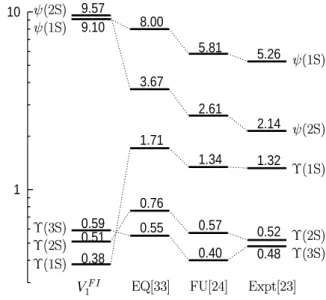
Leptonic widths for charmonium and upsilon systems are presented in Figure 3 and compared with results in Ref. [33, 24]. They were obtained by the formula [35]
Γ¡V0→e+e−¢=16πNcα 2e2
q
3
|Ψ (0)|2 M2
V
, (15)
whereNc= 3(number of colors),αdenotes the fine struc-ture constant, eq denotes the quark charge andMV is the mass of the vector meson.
1 10
0.38 0.51 0.59 9.10 9.57
1.71
0.76
0.55 8.00
3.67
1.34
0.57
0.40 5.81
2.61
1.32
0.52
0.48 5.26
2.14
✂✁☎✄
✆ ✝✟✞✡✠☛☞☛✍✌✏✎✒✑✓✠✔✖✕✖✌✗✝✙✘✛✚✢✜✣✠✔✣☛✍✌ ✤✡✥✧✦✍★✛✩
✤✡✥✪✦✫★✛✩
✤✡✥
✔
★✛✩ ✤✡✥
✔
★✛✩
✤✡✥
☛
★✛✩ ✤✡✥
☛
★✛✩
✬✭✥✪✦✫★✮✩ ✬✓✥✧✦✍★✛✩
✬✭✥
✔
★✮✩ ✬✓✥
✔
★✛✩
Figure 3: Leptonic widths (KeV).
Finally, the hyperfine splitting can be obtained through the expression [5]
M¡3S1
¢
−M¡1S0
¢
=Cte|Ψ (0)| 2 mamb
in which the constant is fixed through the hyperfine splitting observed in the charmonium family
M(J/ψ)−M(ηc) = 117M eV.
Results for thecc¡J/ψ=3S1ηc=1S0
¢
, bc¡B∗ c = 3S1 Bc = 1S0¢ andbb ¡Υ =3S1η=1S0¢ resonances are shown in Figure 4.
40 60 80 100 120 140 160
117
77
54
117
73 87
117
71 64
117
68
65
117
89 141
✂✁☎✄
✆ ✝✟✞✡✠☞☛✌✎✍✑✏✓✒✕✔✗✖✙✘✗✚✡✛✢✜ ✛✣✔✑✤✥✜
✞
✔✎✚✧✦☎✘✩★ ✪✬✫✮✭✰✯✰✱✳✲
✴✶✵✲ ✯✓✴✷✲
✸ ✯✹✱
Figure 4: Hyperfine splitting for quarkonium ground states (M eV).
IV
Baryon Spectra
In the present section we study the baryon spectra using the harmonic potential obtained in Section II. For the three-body system the Hamiltonian has the form
H =− 1
2m1∇ 2 r1−
1 2m2∇
2 r2−
1 2m3∇
2 r3
+V12(r12) +V23(r23) +V31(r31). (17) In order to separate the C-M motion, we define the Ja-cobi (−→r,−→R) and C-M (−→RCM) coordinates through
−
→r = · µbc µa,bc
¸1 4
(−→rb− −→rc),
−
→R = ·µa,bc µbc
¸1 4µ
−
→ra−mb−→rb +mc−→rc mb+mc

,
− →R
CM =
ma−→ra+mb→−rb+mc−→rc
M , (18)
where
µbc =
mbmc mb+mc
,
µa,bc =
ma(mb+mc)
M ,
M = ma+mb+mc. (19)
Considering equal massesma =mb =mc ≡m, and Eqs. (18), (19) the C-M motion is separated and the Hamiltonian for the relative motion takes the form
H =−21µ¡∇2r+∇2R
¢ +
√
3 4 k
³
− →r2
+−→R2´+3
2W0, (20)
with
µ≡³mambmc M
´1 2
=√m
3,
where the rule adopted by Richard [8] (2), was considered. At this point we could obtain the baryon spectra directly from Eq. (20) noticing that it is the sum of two independent harmonic oscillators. But then the energy eigenvalues will not be in terms of the natural quantum numbers of the sys-tem, and it will not be possible a check with experimental or other theoretical results. The same problem is faced with the usual 3-dimensional harmonic oscillator, which could be solved in Cartesian coordinates as the sum of three in-dependent 1-dimensional harmonic oscillators, but then no relation between the conserved angular momentum and the energy spectrum is obtained and the use of spherical coordi-nates is convenient.
Then introducing the hyper-spherical coordinates [36] (see Appendix A)
rx = ρcos (χ) sin (θr) cos (ϕr), ry = ρcos (χ) sin (θr) sin (ϕr), rz = ρcos (χ) cos (θr),
Rx = ρsin (χ) sin (θR) cos (ϕR), Ry = ρsin (χ) sin (θR) sin (ϕR),
Rz = ρsin (χ) cos (θR), (21) the kinetic term stay in a diagonal form and the potential become only dependent of the hyper-radio, then the Hamil-tonian (20) takes the form
⌋
H = − 1
2µ
·
1
ρ5 ∂ ∂ρ
µ
ρ5 ∂ ∂ρ

+ 1
ρ2
µ
1 sin2(2χ)
∂ ∂χ
µ
sin2(2χ) ∂
∂χ

+Jb
2(θ
r, ϕr)
cos2(χ) +
b
L2(θR, ϕR)
sin2(χ)
¶¸
+ √
3 4 k
¡
ρ2¢+3
2W0, (22)
the two body subsystembc.
b
J2 = − 1
sin (θr) ∂ ∂θr
µ sinθr
∂ ∂θr

− 1
sin2(θr) ∂2 ∂ϕr
,
b
L2 = −sin (1θ R)
∂ ∂θR
µ sinθR
∂ ∂θR

− 1
sin2(θR) ∂2 ∂ϕR
. (23)
The Schrodinger equation in this case has also analytical solution (see Appendix A), with eigenvectors
ΨN,λ,j,mj,l,lj(ξ, χ, θr, ϕr, θR, ϕR) = NN,λ,j,le− ξ2
2ξλLλ+2 N
¡
ξ2¢cosj+1
2(χ) sinl+ 1 2(χ)×
×Pl+ 1 2,j+
1 2 λ−j−l
2
(cos (2χ))Ylml(θR, ϕR)Yjmj(θr, ϕr), (24) where
λ= 2n+j+l. (25)
⌈
The eigenvalues are given by the expression
E= s√
3 2
s
k
µ(2N+λ+ 3) +
3
2W0, (26)
where N is the number of nodes of the hyper-radial function, λ is the grand-angular quantum number, and Pl+
1 2,j+
1 2 λ−j−l
2
(cos (2χ))are the Jacobi polynomials. In Figures 5 and 6 we compare our results with other calculations pre-sented by Richard in Ref [8].
4700 4800 4900 5000 5100 5200 5300 5400 5500
0 0
1 2
0 1
0 0
4767 5261
5014 5261
4766 5254
5112 5358
4797 5278
5134 5402
4791 5302
5137 5420
✂✁☎✄
✆ ✝✟✞✠☛✡✌☞✎✍✑✏✓✒
☞✔✏✌✡✖✕✌✍✑✞✘✗✙✎✚✜✛
✒
☞✣✢✤✗✙✔✥✜✛
✦
✧
★✪✩
✆
✫✭✬✯✮ ✫✭✬✱✰✫✭✬
✆
✫✳✲✪✴✵✮ ✫✶✲ ✮✫ ✬
✮✫✭✬
Figure 5: Baryoncccenergies (M eV).
1500 1600 1700 1800 1900 2000 2100 2200 2300 2400
0 0
1 2
0 1
0 0
1641 2225
1933 2225
1621 2139
1937 2274
1624 2244
2019 2358
✂✁☎✄
✆ ✝✟✞✠☛✡✌☞✎✍✑✏ ✒
☞✎✏✌✡✔✓✌✍✑✞✖✕✗✙✘✛✚
✜
✢
✣✥✤
✆
✦☛✧✩★ ✦✪✧✬✫✦✪✧
✆
✦✛✭✯✮✰★ ✦✛✭ ★✦ ✧
★✦ ✧
14350 14400 14450 14500 14550 14600 14650 14700 14750 14800
0 0
1 2
0 1
0 0
14412 14774
14593 14774
✂✁☎✄
✆
✝
✞
✟✡✠
✆
☛✌☞✎✍ ☛✏☞✒✑☛✏☞
✆
☛✔✓✡✕ ✍☛✔✓ ✍ ☛✏☞
✍☛ ☞
To compare with experiments there were only two equal constituent quark baryons at hand [30], for thessssystem,
for which
⌋
m(Ω−)
Expt= 1672M eV, m(Ω−)Expt= 2250M eV, m(Ω−)
VF I
1 = 1641M eV, m(Ω −)
VF I
1 = 2225M eV, m(Ω−)
Expt−m(Ω
−)
V F I1 m(Ω−)
Expt = 0.02,
m(Ω−)
Expt−m(Ω
−)
V F I1 m(Ω−)
Expt = 0.01.
⌈
V
Conclusions
In the present paper we have studied, within a non-relativistic spin-independent model with harmonic confining potential, the spectra and other properties of hadron systems. It was found that for mesons, without imposing the fla-vor independence condition, two possible potentials with harmonic confining terms had analytical solutions that give good estimates of the experimental values reported for the meson spectra. The better fit was obtained for the potential with a term proportional to r12 because it has a singularity forr→0that improves its behavior in this region. However this potential was found to be incompatible with the flavor independence condition and was not considered in the anal-ysis that followed.
For the pure harmonic oscillator the parameters intro-duced were fixed from the low lying levels of heavy quarks systems and imposing the flavor independence condition. The calculation of the meson and baryon spectra, and the hyperfine splitting with this potential give good estimates of the experimental and other theoretical results; in the case of leptonic widths we could say that the results are not good. Although this potential is far from being a good approxima-tion for the real inter-quark potential, and the results are not as good as the theoretically obtained by other phenomeno-logical models, it has the great advantage that allows to ob-tain analytical solutions for both meson and baryon spectra. That is, reasonable theoretical results are obtained without the need of numerical methods and computational calcula-tions. The major differences of this potential and the others mentioned in the introduction are due to its non-singularity
at the origin and its concavity, that cause the bad results for the obtained leptonic widths and also (for a better fit with experiments) the so called constituent masses to be bigger than the usual ones. The baryon spectra was studied with the use of the rule (2) for theqqpotential and for obtaining the analytical solution it was necessary to restrict the study to equal constituent quark systems.
We finalize with the conclusions of A. Martin in Ref. [7] “... if you want to know the mass of a particle and if you have a little time (in years!) and little money you should forget all your prejudices and use potential models”.
A
The hyper-spherical coordinates
and the solution of the three-body
problem with a harmonic potential
The hyper-spherical coordinates are very useful for dealing with the three-body problem; in what follows we make a small review of them.
The kinetic energy of the Hamiltonian (20),
b
K=−21µ¡∇2r+∇2R
¢
, (27)
can be written as a Laplacian in a 6-dimensional space, due to the symmetry in the two Jacobi vectors. When a change of coordinates is made, theN-dimensional Laplacian trans-forms as
⌋
∆ = Q1
i li
N
X
k=1 ∂ ∂x′
k
Q
j lj
l2 k
∂ ∂x′
k
where lj =
v u u tXN
i=1
Ã
∂xi ∂x′ j
!2
, (28)
are the metric coefficients. The change to hyper-spherical coordinates is based on the definition of the hyper-radius by
ρ= v u u tXN
i=1 x2
i, (29)
andN−1angles in a way that (29) is satisfied and the old variables are expressed in terms of the new ones byN functions with the form
and the Laplacian operator becomes
∆ = 1
ρN−1 ∂ ∂ρ
µ
ρN−1 ∂ ∂ρ
¶ + 1
ρ2∆ΩN−1. (31)
In the expression (31)ΩN−1denotes all angles. The explicit form of the angular term of the Laplacian operator and its eigenfunctions will depend of the set of angles selected as new coordinates and the eigenvalues will be equal to−λ(λ+N−2). In this 6-dimensional case where the selected coordinates are (21) the angular term obtained is
∆ΩN−1 = 1 sin2(2χ)
∂ ∂χ
µ
sin2(2χ) ∂
∂χ

+ 1
cos2(χ)∆θr,ϕr+
1
sin2(χ)∆θR,ϕR. (32)
Its eigenfunctions are expressed as a product of orthogonal polynomials in separated variables [36]. The eigenfunctions corresponding to Jacobi’s anglesθr,ϕr,θRandϕRare the well known spherical harmonics. Then the equation obtained for the function of the angleχis
· 1 sin2(2χ)
∂ ∂χ
µ
sin22χ ∂ ∂χ

−l(l+ 1)
sin2(χ)−
j(j+ 1) cos2(χ)
¸
Fλl,j(χ) =−λ(λ+ 4)Fλl,j(χ), (33)
for which the solution are the Jacobi polynomials Fλl,j(χ) =Nλ,l,jsinl+
1
2(χ) cosj+ 1
2 (χ)Pl+ 1 2,j+
1 2 λ−j−l
2
(cos (2χ)), (34)
withλ= 2n+l+jandNλ,l,ja normalization factor.
For the harmonic interaction between equal mass particles, the potential is only dependent of the hyper-radius, then we can separate variables and the radial equation has the form
"
−2µρ1 5 ∂ ∂ρ
µ
ρ5 ∂ ∂ρ

+λ(λ+ 4) 2µρ2 +
√
3k
4 ρ
2 −
µ
EN,λ−
3 2W0
¶#
RN,λ(ρ) = 0. (35)
Introducing new variables
ξ= µ
ρ ρ0
¶ p
β, ρ0=
Ã
1 2µ¡E−32W0
¢ !1
2
, β2= ¡
k√3¢
8µ¡E−3 2W0
¢2, (36)
and the new function
TN,λ= RN,λ
ξ52
, (37)
we obtain for (35) the equation
·
d2 dξ2 +
1
βN,λ −
λ(λ+ 4) + 15 4
ξ2 −ξ
2
¸
TN,λ(ξ) = 0, (38)
with solutions
TN,λ(ξ) =e− ξ2
2ξλ+ 5 2Lλ+2
N
¡
ξ2¢, (39)
where
1
βN,λ
= 4s+ 2 (λ+ 2) + 2, (40)
andLλ+2N ¡ξ2¢are the generalized Laguerre polynomials.
Then the complete eigenvectors and the eigenvalues of the problem are given by Eqs. (24) and (26).
Acknowledgments
One of us (M.R.) would like to thank A. Dimarco, S. Duarte, and the Department of Nuclear and High Energy Physics at “Centro Brasileiro de Pesquisas F´ısicas (CBPF)” for their kind hospitality and useful discussions.
References
[1] E. Eichten, Talk given at the“Third International Confer-ence at Vanderbilt University on New Results in High Energy Physics”, Nashville, Tennessee, March 6-8 (1978).
[3] A. DeRujula, H. Georgi and S. L. Glashow, Phys. Rev. D12, 147 (1975).
[4] R. K. Bhaduri, L. E. Cohler and Y. Nogami, Phys. Rev. Lett. 44, 1369 (1980).
[5] A. Martin, Phys. Lett. B93, 338 (1980); B100, 511 (1988). [6] A. Martin, Phys. Lett. B214, 561 (1980).
[7] For a recent summary; A. Martin, Concluding Remarks of the Workshop “Quark Confinement and the Hadron Spectrum II”, edited by N. Brambilla and G. Prosperi, Wold Scientific, Singapure (1997).
[8] J. M. Richard, Phys. Lett. B100, 515 (1981).
[9] Proceedings of“Baryon 80”, edited by N. Isgur and G. Karl, University of Toronto.
[10] E. Eichten, K. Gottfried, T. Kinoshita, K. D. Lane and T. M. Yan, Phys. Rev. D17, 3090 (1978); Erratum-ibid. D21, 313 (1980).
[11] C. Quigg and J. L. Rosner, Phys. Lett. B71, 153 (1977). [12] X. Song and H. Lin, Z. Phys. C34, 223 (1987).
[13] D. B. Lichtenberg, E. Predazzi, R. Roncaglia, M. Rosso and J. G. Wills, Z. Phys. C41, 615 (1989).
[14] A. Gara, B. Durand, L. Durand and L. J. Nickisch, Phys. Rev. D40, 843 (1989).
[15] L. P. Fulcher, Z. Chen and K. C. Yeong, Phys. Rev. D47, 4122 (1993).
[16] A. Duncan, E. Eichten and H. Tacker, Phys. Lett. B303, 109 (1993).
[17] W. Lucha, H. Rupprecht and F. F. Schoberl, Phys. Rev. D46, 1088 (1992).
[18] G. Jaczko and L. Durand, Phys. Rev. D58, 114017 (1998). [19] V. Elias, T. G. Steele and M. Scadron, Phys. Rev. D38, 1584
(1988).
[20] V. Elias and T. G. Steele, Phys. Lett. B212, 88 (1988).
[21] A. Cabo and M. Rigol, Eur. Phys. J. C23, 289 (2002). [22] M. Rigol and A. Cabo, Phys. Rev. D62, 074018 (2000). [23] R. M. Barnett et al., Review of Particle Physics. Particle Data
Group, Phys. Rev. D54, 1 (1996); C. Caso et al., Review of Particle Physics. Particle Data Group, Eur. Phys. J. C3, 1 (1998).
[24] L. P. Fulcher, Phys. Rev. D60, 074006 (1999).
[25] K. Hirata, T. Kobayashi and N. Nakamaru, Phys. Rev. D18, 834 (1978).
[26] B. Ram and R. Hasala, Phys. Rev. D19, 3467 (1979). [27] L. D. Landau and E. M. Lifshits,Mec´anica Cu´antica
No-Relativista, Revert´e S.A., Barcelona (1972).
[28] A. S. Davydov,Quantum Mechanics, Pergamon Press, Ox-ford,2nd
Edition (1976).
[29] L. P. Fulcher, Phys. Rev. D62, 094505 (2000).
[30] D. E. Groom et al., Review of Particle Physics. Particle Data Group, Eur. Phys. J. C15, 1 (2000).
[31] E. Braaten, K. Cheung and T. C. Yuang, Phys. Rev. D48, 5049 (1993).
[32] K. Cheung, Phys. Rev. Lett.71, 3143 (1993).
[33] E. Eichten and C. Quigg, Phys. Rev. D49, 5845 (1994). [34] W. Buchmuller and S. H. H. Tye, Phys. Rev. D24, 132 (1981). [35] R. V. Royen and V. F. Weisskopf, Nuovo Cim. A50, 617
(1967); Erratum-ibid A51, 583 (1967).
[36] Dar´ıo deFazio,“Tratazione quantomecanica delle reazione chimiche elementari mediante tecniche Hiperesferiche”, Ph.D. Thesis, Perugia University, Italy (1996).
[37] R. K. Bhaduri, L. E. Cohler and Y. Nogami, Print-80-0753 (McMaster) (1980).