structure in the Brazilian Amazon Madeira-Purus interfluve
Barros, DF.
a*, Albernaz, ALM.
a, Zuanon, J.
b, Espírito Santo, HMV.
c,
Mendonça, FP.
dand Galuch, AV.
ba
Coordenação de Ciências da Terra e Ecologia, Museu Paraense Emílio Goeldi, Av. Perimetral 1901, CEP 66077-830, Belém, PA, Brazil
b
Coordenação de Pesquisas em Biodiversidade, Instituto Nacional de Pesquisas da Amazônia, Avenida André Araújo 2936, CP 478, CEP 69011-970, Manaus, AM, Brazil
cCoordenação de Pesquisas em Ecologia, Instituto Nacional de Pesquisas da Amazônia, Avenida André Araújo 2936, Aleixo, CP 478, CEP 69060-001, Manaus, AM, Brazil
d
Instituto de Saúde e Biotecnologia, Universidade Federal do Amazonas, Rua Coari-Mamiá 305, Espírito Santo, CEP 69460-000, Coari, AM, Brazil
*e-mail: [email protected].
Received April 23, 2012 – Accepted August 29, 2012 – Distributed August 31, 2013 (With 3 figures)
Abstract
Due to the existence of terrestrial barriers to freshwater fish dispersion, it is believed that its distribution is strongly as-sociated with historical factors related to the formation of the habitats they occupy. By the other hand, some studies re-veal the influence of abiotic conditions (such as size of water bodies, pH, conductivity) on the composition of fish fauna occurring in small streams. This study aimed to investigate whether drainage basins, because catchment bound-aries are potential barriers to fish dispersion, or the physical structure and physico-chemical characteristics of water have a greater influence on fish community structure in small streams. We sampled 22 streams belonging to five drain-age basins in the Madeira-Purus interfluve. Fish were caught with dip nets and a small trawl, and data were simulta-neously obtained on structural characteristics of the streams and physico-chemical characteristics of the water. Community composition was analyzed using Non-Metric Multidimensional Scaling (NMDS), and variables related to structural and physico-chemical characteristics were summarized by Principal Component Analysis (PCA). Two ex-planatory models relating faunal composition to environmental factors were constructed: the first using only continu-ous variables and the second including the drainage basin as a categorical variable. The Akaike Information Criterion (AIC) and AIC weight were used to select the best model. Although structural and physico-chemical variables signifi-cantly contributed to explaining faunal composition, the model including the drainage basin was clearly the better of the two models (more than 90% support in the data). The importance of drainage basins in structuring fish communities in streams may have significant consequences for conservation planning in these environments.
Keywords:Ichthyofauna, fish ecology, physical variables, chemical variables, western Amazon.
Efeito do isolamento e das variáveis ambientais na estrutura de comunidades de peixes
do interflúvio Madeira-Purus na Amazônia brasileira
Resumo
utilizando apenas variáveis contínuas, e o segundo incluindo as bacias hidrográficas como variável categórica. O Critério de Informação de Akaike (AIC) e o peso do AIC foram utilizados para a seleção do melhor modelo. Apesar de variáveis físicas e físico-químicas terem contribuído significativamente para explicar a composição faunística, o modelo incluindo bacias hidrográficas foi claramente superior (mais de 90% de suporte nos dados). A importância de bacias de drenagem para a estruturação da comunidade de peixes de riachos pode ter consequências relevantes para o planejamento para a conservação desses ambientes.
Palavras-chave: Ictiofauna, ecologia de peixes, variáveis físicas, variáveis químicas, Amazônia Oriental.
1. Introduction
The Neotropical region presents a high diversity of freshwater fish, with nearly 4,500 described species and more than 1,550 species still awaiting scientific descrip-tion (Reis et al., 2003). The largest drainage basin in the world, covering approximately 7,000,000 km2 (Santos and Ferreira, 1999), is located in the Amazon and is char-acterized by large rivers and lakes. However, the Ama-zon also contains countless streams, which constitute one of the largest and densest hydrological networks in the world (Sioli, 1984; Thomas et al., 2004).
Because freshwater fish have limited potential for dispersal in salt water or terrestrial habitats, it is believed that their distribution is strongly associated with histori-cal factors related to the formation of the habitats they oc-cupy (Lundberg, 1993). Some studies have shown that the composition of fish communities is distinct in adja-cent basins isolated by watershed divisions (Mendonça et al., 2005; Ingenito and Buckup, 2007). In such cases, the watershed acts as a barrier to the dispersal of species be-tween basins. However, fish community structure is also thought to be influenced by biotic and abiotic factors, which operate and interact on various spatial and tempo-ral scales (Angermeier and Winston, 1998; Matthews, 1998). On a regional scale, physical characteristics, such as stream size (Angermeier and Karr, 1984), water veloc-ity (Mendonça et al., 2005), depth (Angermeier and Karr, 1984; Martin-Smith, 1998), and habitat diversity (Gor-man and Karr 1978; Angermeier and Schlosser, 1989), or physico-chemical properties, such as electrical conduc-tivity (Taylor et al., 1993; Mérigoux et al., 1998) and pH (Townsend et al., 1983), have also been considered to be factors that govern the occurrence and distribution of fish species.
Some studies have found differences in ichthyofauna composition between areas that drain into separate bas-ins, but most studies showing this distinction has been made between large river basins. For example, Matthews and Robison (1988) found significant differences in ichthyofauna composition between basins of major rivers in Arkansas. In New York, Carlson and Daniels (2004) observed significant differences in fish species richness and composition between 19 basins that are part of seven drainage systems in the region. Ingenito and Buckup (2007) reported significant differences in ichthyofauna between the Parnaíba do Sul and Sapucaí basins, but little differentiation within these basins. In the Amazon, Men-donça et al. (2005) found significant differences between streams that drain into the Negro River and those that
drain into the Amazon River, but similar ichthyofauna compositions were observed within each of these drain-age systems. The authors report physico-chemical differ-ences between the streams, making it difficult to deter-mine whether the basins are acting as discrete units or if physico-chemical characteristics are more relevant in differentiating the ichthyofauna composition.
This study aims to investigate the effects of level 4 basins from the Plano Nacional de Recursos Hídricos (2003) and the structural and physico-chemical variables of the water on fish community structure in streams of the Madeira-Purus interfluve of the Brazilian Amazon. The five water basins included in the study are located in the same geological formation, the Solimões Formation, but one of them drains into the Purus River while the other four drain into the Madeira River. So, they must present some differences on geochemical characteristics, which could reflect in the community structure. However, the ichthyofauna composition can be different between the basins due to the effects of isolation. Thus our aim is to test which are the most influential factors in structuring the ichthyofauna composition in streams of the Madeira-Purus interfluve: the physical and physico-chemical or the isolation represented by drainage basins.
The region under study, the Madeira-Purus inter-fluve, is one of the most pristine and least-studied regions of the Brazilian Amazon and includes relatively few tected areas. Development policies for the region pro-vided and planned by the Federal Government, such as those related to the opening and paving of roads, water-ways, and the building dams and pipelines, underesti-mate the associated social and environmental impacts on the region (Fearnside and Graça, 2006). Small streams in forest environments are particularly vulnerable to the im-pacts of human occupation (Dias et al., 2009), and thus, this study also aims to contribute to decision making re-garding the conservation of aquatic and terrestrial envi-ronments in this region.
2. Material and Methods
2.1. Study area
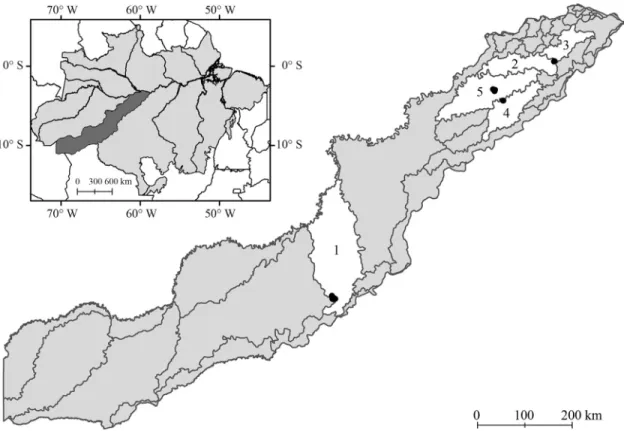
col-lection campaigns were undertaken in April/May and July 2007, and access to sampling locations was limited to the surroundings of the focal areas.
The study area, located on Solimões Formation sedi-ments, has soils predominantly of the red-yellow podzolic type and the climate is equatorial, hot, and hu-mid (Radambrasil, 1978). Average annual temperatures show fluctuations limited by isotherms of 24 °C and 26 °C. The rainy season usually starts in October, the highest precipitation rates being observed in January, February, and March (Radambrasil, 1978).
2.2. Basins
Basins have a hierarchical organization structure, and one difficulty in generalizing its influence on distri-bution patterns, is to understand at which levels of subdi-visions this influence persists. Most studies analyzing the effects of basins on fish composition mention just the names of the major rivers to which sampled streams be-long, but other information about the size and location of the basins are not. The hierarchic level considered in this study was the level fourth basins, based on an official classification of Brazilian basins (Plano Nacional de Re-cursos Hídricos, 2003).
It was not possible to locate springs in advance, and therefore, small bodies of water with relatively closed canopies were sought during sampling site selection. A
total of 22 streams were sampled located around the two focal areas, probably of the first to third order, but it was not possible to distinguish these categoriesa priori. Due
to limitations related to the time available for sampling and access to sampling sites, the sampling design was not completely balanced. Based on a map of level fourth bas-ins from the Plano Nacional de Recursos Hídricos (2003), of the 22 streams sampled belonging to five drainage basins (Figure 1), 11 belonged to basin code 4923 (herein referred to as basin 1), which was the only draining into the Purus River, two to 4724 (basin 2), two to 4722 (basin 3), three to 4727 (basin 4), and four to 4726 (basin 5). These four last basins drain into the Ma-deira River.
2.3. Data collection
The sampling procedure employed was based on the protocol developed by Mendonça et al. (2005). In each of the selected streams, a 50 m stretch was outlined and blocked at both ends using fine mesh nets (5 mm between opposing knots) to prevent fish from escaping during col-lection. Fish were collected only during the day using a 2 m long sieve (2 mm mesh) and dip nets. Collection ef-fort in each sample was standardized by using three col-lectors over two hours.
The collected fish were euthanized in clove oil solu-tion (eugenol, two drops per liter) (Canadian Council on
Animal Care, 2010), then fixed in 10% formalin. The fish were sorted and identified with the help of experts, and by using dichotomous keys and/or relevant literature. Samples of the collected material were deposited in the Instituto Nacional de Pesquisas da Amazônia (INPA) Fish Collection in Manaus (see Barros et al., 2011). Fish were collected with permission from the Instituto Bra-sileiro do Meio Ambiente e dos Recursos Naturais Reno-váveis (IBAMA license # 10199-1).
For measurement of environmental variables, each 50 m stretch along the stream from which fish were sam-pled was divided into four equidistant sections. The fol-lowing data were gathered from each section: channel width (m), depth (cm), determined from nine equidistant probes along each of the four cross-sections established to measure width), and substrate composition, evaluated in the same points as the depth measurements.
Substrate composition was based on the frequency of occurrence of the following classes: sand, clay, fine litter (fine particulate matter), litter (leaves and twigs), roots (mostly fine, from vegetation on the banks), peb-bles, and trunks (wood with a diameter greater than 10 cm). Other substrate types were also found, includ-ing algae, ferrobacteria, silt, macrophytes, and rocks. However, these substrates showed very low frequencies of occurrence (£2%) and were classified as “other” in the analysis.
The velocity of the current (m/s) was estimated by measuring the time that a loose floating object on the sur-face of the water took to travel a predetermined distance (1.0 m) in the center of the channel. Three water velocity measurements were performed along each cross section of the stream. The average flow rate (m3/s) was obtained from the velocity, width, and depth values, as calculated using the following formula:Q=A*Vm, where:Q= vol-ume;A= average cross-sectional area; andVm= average velocity of the current.
The physical-chemical characteristics of the water were measured at the most downstream point of each sec-tion. A portable Aqua-CheckTMWater Analyzer Opera-tor potentiometer/conductivity meter (O.I. Analytical, College Station, TX, USA) was used to measure conduc-tivity (mS/cm) and pH (potential Hydrogen). Dissolved oxygen (mg/l) and temperature (°C) were measured us-ing a Model 58 portable Yellow Sprus-ings InstrumentsTM thermometer (Yellow Springs, OH, USA).
Canopy openness (%) was estimated based on analy-sis of four digital photographic images of the forest can-opy that were taken above the stream next to each section. Subsequently, the images were imported into ArcView 3.2, transformed intorasterfiles, and the Grid
Analyst extension (Saraf, 2000) was used to calculate the proportion ofpixels (spots) in the lighted areas (bright spots) and vegetated areas (dark spots). A threshold of 50% was used to distinguish bright and dark spots. The canopy openness value (%) was determined by calculat-ing the ratio between the number of bright spots and the total number of spots in the image.
2.4. Data analysis
Analysis of the fish community composition was based on values of relative abundance for the species in each stream (dividing the number of individuals of each species by the total at each site). The samples were sorted by Non-Metric Multidimensional Scaling (NMDS) anal-ysis in two dimensions. The association index used was the Bray-Curtis distance. Analysis of the relative species position along the ordination gradient was performed us-ing the average weight of each species along the respec-tive NMDS dimension (Legendre and Legendre, 1998).
To reduce the dimensionality of the structural and physico-chemical characteristics of the streams but maintaining the statistical independence of the variables, environmental variables were summarized by Principal Component Analysis (PCA). Due to the variety of sub-strates with low representation among the streams, only those that occurred at a frequency greater than 70% in the samples were included as PCA variables. To perform this analysis, the proportions of each substrate in the samples were arcsine transformed, as recommended by Legendre and Legendre (1998). Based on the number of records of all types of substrates found in each stream, substrate evenness and richness were also calculated and used in the PCA.
Two different models were used to test for the influ-ence of environmental variables and of level 4 basins on the fish communities. The first model intended to test for the effects of environmental variables on fish communi-ties and was a Canonical Correlation Analysis, which in-cluded the scores of the first two NMDS dimensions (species composition) as dependent variables and the first three axes of the PCA (environmental variables) as independent variables, generating the model NMDS1, NMDS2= Constant + PCA1 + PCA2 + PCA3.
The second model intended to include the effects of drainage basins, which is a categorical variable. As it in-cluded both continuous and categorical among the inde-pendent variables, it was was a multiple covariance anal-ysis (MANCOVA), which included species composition (also represented by the scores of the first two NMDS di-mensions) as a dependent variable, and structural and in-dependent variables were physico-chemical characteris-tics (continuous, represented by PCA axes), and “drainage basins”, as a categorical variable. Because sampling was performed in a relatively small number of streams (n = 22), we decided to use the maximum of three environmental variables for inferential analyses. For this reason, we evaluated various combinations of models in-cluding drainage basins and PCA. After these evalua-tions, the model adopted, representing the best combina-tion found, was NMDS1, NMDS2= Constant + PCA1 + PCA3 + Basins.
weights of the models (wAIC). According to model se-lection theory, better models have smaller AIC values and a model can be considered clearly superior when its weight is over 90% (Burnham and Anderson, 2002).
3. Results
We caught 5,508 fish belonging to six orders, 22 families, and 78 species. Characiformes was the most di-verse and abundant group, with 39 species, comprising 81.6% of the collected specimens. The next largest groups in terms of the number of species were Gymno-tiformes (15), Siluriformes (12), Perciformes (8), Cypri-nodontiformes, and Synbranchiformes (2 species each). Gymnotiformes were the second most abundant group, with 6.3% of the specimens, followed by Perciformes (4.8%), Siluriformes (4.2%), Cyprinodontiformes (2.7%), and Synbranchiformes (0.4%). Nine species were common to all basins: Apistogramma agassizii
(Steindachner, 1875), Carnegiella strigata (Günther,
1864), Erythrinus erythrinus (Bloch and Schneider,
1801),Gymnotus coropinaeHoedeman, 1962,Hoplias malabaricus (Bloch, 1794), Hypopygus lepturus Hoe-deman, 1962, Pyrrhulina brevis Steindachner, 1876,
Rivulussp., andSynbranchussp.
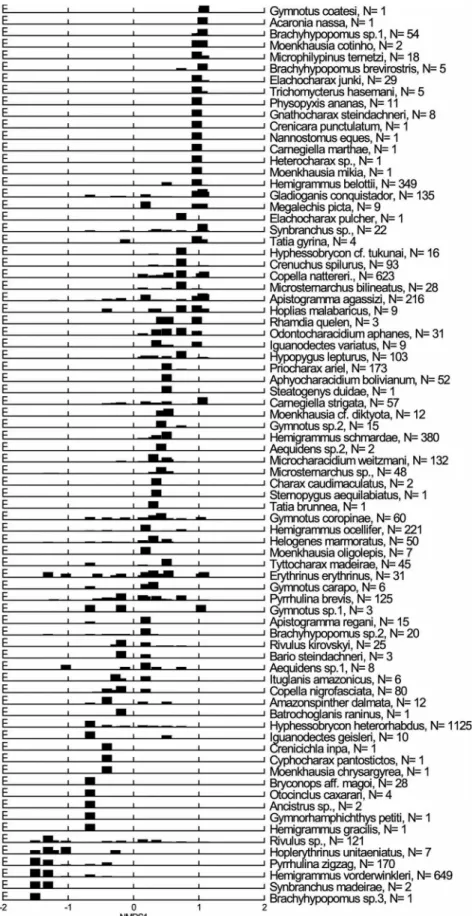
The species composition based on abundance data (NMDS, Stress = 0.17) revealed a separation of the streams sampled in basin 1 relative to the other basins along the first dimension (NMDS1; Figure 2A). A trend toward clustering by basin was also evident, with the ex-ception of basin 2, which presented a more heteroge-neous dispersion.
Hemigrammus vorderwinkleri Géry, 1963,
Hoplerythrinus unitaeniatus(Spix and Agassiz, 1829),
Pyrrhulina zigzagZarske and Géry, 1997, and Rivulus
sp. were the main species associated to the smallest
val-ues along the first ordinate dimension (NMDS1; Figu-re 3), and help to explain the separation of the stFigu-reams in basin 1 from the others in two-dimensional space (Figure 2A). The highest values along the first ordinate dimen-sion (NMDS1) were associated with streams of basin 5 (Figure 2A), which is characterized by the presence of
Brachyhypopomus sp.1, Elachocharax junki (Géry,
1971), Microphilypnus ternetzi Myers, 1927, and Physopyxis ananas Sousa and Rapp Py-Daniel, 2005 (Figure 3).
The first three PCA axes explained 63.7% of the ac-cumulated variance related to structural and physico-chemical characteristics of streams (Table 1). Axis 1 (PCA1) explained 30% of the variance and was strongly and positively related to structural aspects of the channel, such as flow rate, average width, average depth, average maximum depth, and dissolved oxygen (Table 1; Figu-re 2B). Axis 2 (PCA2) captuFigu-red 22.2% of the variance and was primarily related to canopy openness, litter, and trunks (negatively) and to clay and substrate evenness (positively) (Table 1; Figure 2B). Axis 3 explained 11.4% of the variance and presented a single physi-cal-chemical factor (conductivity) as an important vari-able (Tvari-able 1).
The first model relating species composition to envi-ronmental characteristics was statistically significant (Wilks’ lambda = 0.32; F = 3.18; p = 0.008; AIC(corrected)= 117.09). In this model, species composition was signifi-cantly related to stream structural characteristics, espe-cially width, depth, and flow rate, which were repre-sented by the first PCA axis (Wilks’ lambda = 0.70; F = 3.65; p = 0.048), as well as those represented by the second PCA axis (substrate type and canopy openness, Wilks’ lambda = 0.45; F = 10.43; p = 0.001). The third PCA axis showed no significant relationship to species
composition (Wilks’ lambda = 0.96; F = 0.30; p = 0.739). The second model was also significant (Wilks’ lambda = 0.20; F = 5.11; p < 0.001; AIC(corrected)= 106.97). In this model, only the basin variable was significantly related to species composition (Wilks’ lambda = 0.28; F = 21.49; p = 0.000), and none of the tested PCA axes exhibited a significant relationship with species composition (PCA1: Wilks’ lambda = 0.82; F = 1.86; p = 0.186; PCA3: Wilks’ lambda = 0.79; F = 2.24; p = 0.136). Analysis of the rela-tive weights of the different models indicated a weight of 0.6% for the first model and 99.4% for the second, clearly indicating that the model including the basins was better.
4. Discussion
In the first model applied, the environmental vari-ables that most influenced species composition were stream width, depth, and flow rate. The observed influ-ence of physical variables on species composition is sim-ilar to findings obtained in other studies conducted in temperate (Gorman and Karr 1978; Martin-Smith, 1998; Oberdorff et al., 2001) and tropical streams (Angermeier and Schlosser, 1989; Barrella and Petrere Jr., 1994; Araújo-Lima et al., 1999; Uieda and Barretto, 1999; Mendonça et al., 2005) and is in accordance with the river continuum concept (Vannotte et al., 1980), where species abundance and richness increase with enlarge-ment of the stream channel due to greater heterogeneity or increased habitat availability. The observation of
phy-sical variation related to the size of the sampled water bodies, although an expected result, is strongly depend-ent on the selection of streams for sampling. In this study, logistical constraints, related to both movement between areas and sampling time, limited the choice of the streams sampled, leading to large variation in the size of the water bodies sampled within each basin.
The first model also showed that the ichthyofauna was significantly affected by substrate type and canopy openness. The occurrence of several species in streams depends on the characteristics of different habitat types, with the proportions of individual substrate types being an important component (Pires et al., 1999; Humpl and Pivnicka, 2006). In this study, it was found that fish com-munity composition was mainly influenced by the pre-dominance of litter, which was inversely related to the amount of clay. Banks with litter are used by many spe-cies of tropical stream fishes as shelter and foraging areas (Henderson and Walker, 1986; Sabino and Zuanon, 1998). Canopy openness is another important habitat component in structuring fish assemblages (Merigoux et al., 1998). High entrance of light decrease protection against solar radiation, causing increases in water tem-perature and reducing inputs of allochthonous material, which is widely used as food and shelter by aquatic fauna in neotropical stream systems (Sabino and Castro, 1990; Sabino and Zuanon, 1998; Lowe-McConnell, 1999).
In the second model, which included both drainage basins and environmental variables, it was evident that drainage basins had a stronger effect on fish communities than environmental variability. According to the Akaike Information Criterion and the analysis of the relative weights among the models, the second model had a better fit to and greater support from the data than the first, indi-cating that inclusion of the “drainage basin” categorical variable significantly contributed to understanding fac-tors associated with species composition. It is possible that the inclusion of basins captured some other type of environmental variability that was not measured and ana-lyzed in this study, such as the nutrient concentrations in various streams. However, this type of variation is usu-ally reflected in other physico-chemical variables, such as pH, conductivity, and temperature (Townsend et al., 1983; Taylor et al., 1993; Clenaghan et al., 1998; Méri-goux et al., 1998; Cetra and Petrere Jr., 2006), which were all measured. Thus, although we cannot confirm that the difference in ichthyofauna between basins stems from the effect of historical factors, due to the clear supe-riority of the model including drainage basins, and differ-entiation in ichthyiofaunal between contiguous basins, this is the most plausible explanation for the observed differences in species composition between basins.
Basin 1 exhibited the most distinct composition among the basins sampled. This difference may be due to its greater geographical distance from the other basins, considering that long distances between regions are gen-erally associated with less similar fauna (Jackson and Harvey, 1989; Marsh-Matthews and Matthews, 2000). As there was little variability in the distances between all
Table 1- List of environmental variables, including the first three Principal Component Analysis (PCA) axes, their ca-nonical weights (“loadings”), and the explained and cumula-tive variance percentages.
Environmental variables PCA1 PCA2 PCA3
pH 0.515 0.480 0.146
Temperature (°C) 0.226 0.278 0.317 Conductivity (mS/cm) 0.250 0.288 -0.709 Dissolved oxygen (mg/L) 0.687 0.063 0.503
Current velocity (cm/s) 0.571 0.095 0.536 Average width (m) 0.741 -0.253 -0.291 Average flow (m3/s)
0.838 -0.284 0.035
Average depth (m) 0.861 -0.306 -0.014
Maximum depth (m) 0.856 -0.321 0.008 Canopy openness (%) -0.283 -0.678 0.440
Clay (%) 0.021 0.685 0.219
Litter (%) -0.289 -0.870 0.008
Trunks (%) 0.465 -0.654 -0.372
Evenness 0.450 0.643 -0.240
Richness 0.169 0.243 -0.151
the other basins, any analysis involving distances would result in the streams on basin 1 having a high leverage value, potentially leading to spurious results. Besides, stronger differences in basin 1 may have also been due to the fact that this was the only basin that drains into the Purus River (the others drain into the Madeira River), a result in accordance with other studies, which have also found differences in ichthyofauna composition between basins that drain into different large rivers (Matthews and Robison, 1988; Carlson and Daniels, 2004; Mendonça et al., 2005; Ingenito and Buckup, 2007). As basin 1 was different both in terms of distance and drainage direction, and there was no replicates for these differences, it was not possible also to analyze the relative effects of dis-tance and drainage direction on composition, and to as-sess what of these factors would be responsible for the greater differentiation of the basin 1.
Fish distribution is usually related to climatic, geo-morphological, and historical factors (Roth et al., 1996; Poff and Allan, 1995). According to Hoeinghaus et al. (2007), historical processes, such as speciation and dis-persal, strongly affect local communities. In this study, despite the logistical difficulties that prevented better sampling point distribution, the clear superiority of the model including drainage basins supports the idea that isolation is more important than local habitat characteris-tics for the structuring of fish communities in the Ma-deira-Purus interfluve. Basins 2-5 were sampled during the same period (drought), exhibit relatively small geo-graphic distances from each other, and all drain into the Madeira River. Despite these similarities, and variation in structural and physico-chemical characteristics among samples within basins, the ichthyofauna composition was different between these basins. These results indi-cate that smaller drainage basins, at level fourth on the basin classification system, can significantly influence the stream fish community composition. However, to generalize these results and gain more confidence in the representativeness of these findings, additional studies are required at this scale.
Because fish communities in streams are structured along the fluvial continuum and vary between sections with different structural characteristics (Vannote et al., 1989), it is recommended that reserves for conservation of stream fauna include continuous stretches that repre-sent different orders of streams (Abell et al., 2007). Fur-thermore, considering the differences observed between the drainage basins, it is necessary that streams from the greatest possible number of basins be represented in pro-tected areas, which is a criterion that has not always been included in conservation plans for Amazonian freshwater systems (e.g. Thieme et al., 2007).
Acknowledgments
We thank the GEOMA project for financial and lo-gistical support in our field and laboratory work. We also thank Mario Cohn-Haft for coordinating the project, PETROBRAS for lending the helicopter that made
ac-cess to study areas possible, and IBAMA for providing the license for biological material collection. The first au-thor would like to thank the Instituto Internacional de Educação do Brasil (IIEB) - BECA program, for finan-cial support through a Masters fellowship and the Gradu-ate Program in Environmental Sciences, associGradu-ated with the UFPA-MPEG-EMBRAPA institutions.
References
ABELL, R., ALLAN, DJ. and LEHNER, B., 2007. Unlocking the Potential of Protected Areas for Freshwaters’. Biologi-cal Conservation, vol. 134, p. 48-63.
ANGERMEIER, PL. and KARR, JR., 1984. Fish communities along environmental gradients in a system of tropical streams. In ZARET, TM. (Ed.).Evolutionary ecology of neotropical freshwater fishes. Netherlands: Dr. W. Junk Publishers. p. 39-57.
ANGERMEIER, PL. and SCHLOSSER, IJ., 1989. Species-area relationship for stream fishes.Ecology, vol. 70, no. 5, p. 1450-1462.
ANGERMEIER, PL. and WINSTON, MR., 1998. Local vs. Re-gional influences on local diversity in stream fish commu-nities of Virginia.Ecology, vol. 79, no. 3, p. 911-927.
ARAÚJO-LIMA, CARM., JIMÉNEZ, LF., OLIVEIRA, RS., ETEROVICK, PC., MENDONZA, U. and JEROZOLIM-KI, A., 1999. Relação entre o número de espécies de peixes, complexidade de hábitat e ordem do riacho nas cabeceiras de um tributário do rio Urubu, Amazônia Cen-tral. Acta Limnologica Brasiliensia, vol. 11, no. 2, p. 127-135.
BARRELA, W. and PETRERE JR., M., 1994. The influence of environmental factors on fish community structure in Jacaré Pepira River, Brazil. In COWX, IG. (Org.). Reha-bilitation of Freshwater Fisheries. Bodman: Fishing
News Books. p. 161-170
BARROS, DF., ZUANON, J., MENDONÇA, FP., ESPÍRITO-SANTO, HMV., GALUCH, AV. and ALBERNAZ, ALM., 2011. The fish fauna of streams in the Ma-deira-Purus interfluvial region, Brazilian Amazon.Check List, vol. 7, no. 6, p. 768-773.
BURNHAM, KP. and ANDERSON, DR., 2002.Model
selec-tion and multimodel inference: a practical informa-tion-theoretic approach. New York: Springer. 488 p.
CANADIAN COUNCIL ON ANIMAL CARE. 2010.CCAC
guidelines on: euthanasia of animals used in science. Ot-tawa. 32 p.
CARLSON, DM. and DANIELS, RA., 2004. Status of Fishes in New York: Increases, Declines and Homogenization of Watersheds.The American Midland Naturalist, vol. 152, no. 1, p. 104-139.
CETRA, M. and PETRETE JR, M. 2006. Fish-assemblage structure of the Corumbatai river basin, São Paulo State, Brazil: characterization and anthropogenic disturbances.
Brazilian Journal of Biology, vol. 66, no. 2A, p. 431-439. CLENAGHAN, C., GILLER, PS., O’HALLORAN, J. and
HERNAN, R., 1998. Stream macroinvertebrate commu-nities in a conifer-afforested catchment in Ireland: rela-tionships to physico-chemical and biotic factors. Fresh-water Biology, vol. 40, no. 1, p. 175-193.
DIAS, MS., MAGNUSSON, WE. and ZUANON, J., 2009. Ef-fects of Reduced-Impact Logging on Fish Assemblages in Central Amazonia.Conservation Biology, vol. 24, no. 1,
FEARNSIDE, PM. and GRAÇA, PMLA., 2006. BR-319: Bra-zil’s Manaus-Porto Velho Highway and the potential im-pact of linking the arc of deforestation to central Amazonia.
Environmental Management, vol. 38, no. 5, p. 705-716. GORMAN, OT. and KARR, JR., 1978. Habitat structure and
stream fish communities.Ecology, vol. 59, no. 3, p. 507-515.
HENDERSON, PA. and WALKER, I., 1986. On the leaf litter community of the Amazonian black water stream Taru-mãzinho.Journal of Tropical Ecology, vol. 2, p. 1-17. HOEINGHAUS, DJ., WINEMILLER, KO. and BIRNBAUM,
JS., 2007. Local and regional determinants of stream fish assemblage structure: inferences based on taxonomic vs. functional groups. Journal of Biogeography, vol. 34, no. 2, p. 324-338.
HUMPL, M. and PIVNICKA, K., 2006. Fish assemblages as in-fluenced by environmental factors in streams in protected areas of the Czech Republic.Ecology of Freshwater Fish,
vol. 15, no. 1, p. 96-103.
INGENITO, LFS. and BUCKUP, PA., 2007. The Serra da Mantiqueira, south-eastern Brazil, as a biogeographical barrier for fishes.Journal of Biogeography, vol. 34, no. 7, p. 1173-1182.
JACKSON, DA. and HARVEY, HH., 1989. Biogeographic as-sociations in fish assemblages: local vs. regional pro-cesses.Ecology, vol. 70, p. 1472-1484.
LEGENDRE, P. and LEGENDRE, L., 1998.Numerical ecol-ogy. Amsterdan: Elsevier. 870 p.
LOWE-MCCONNELL, RH. 1999.Estudos ecológicos de co-munidades de peixes tropicais. São Paulo: Editora da Universidade de São Paulo. 534 p.
LUNDBERG, JG. 1993. African-South American freshwater fish clades and continental drift, problems with a para-digm. In GOLDBLATT, P. (Ed.). Biological relation-ships between Africa and South America. New Haven: Yale University Press. p. 156-198.
MARSH-MATTHEWS, E. and MATTHEWS, WJ., 2000. Geo-graphic, terrestrial and aquatic factors: which most influ-ence the structure of stream fish assemblages in the mid-western United States? Ecology of Freshwater Fish, vol. 9, no. 1-2, p. 9-21.
MARTIN-SMITH, KM., 1998. Relationships between fishes and habitat in rainforest streams in Sabah, Malaysia. Jour-nal of Fish Biology, vol. 52, p. 458-482.
MATHEWS, WJ. and ROBISON, HW., 1988. The distribution of the fishes of Arkansas: a multivariate analysis.Copeia, vol. 2, p. 358-374.
MATTHEWS, WJ., 1998.Patterns in Freshwater Fish Ecology.
New York: Chapman and Hall. 756 p.
MENDONÇA, FP., MAGNUSSON, WE. and ZUANON, J., 2005. Relationships between habitat characteristics and fish assemblages in small streams of central Amazonia.
Copeia, vol. 4, p. 751-764.
MÉRIGOUX, S., PONTON, D. and MÉRONA, B., 1998. Fish richness and species-habitat relationships in two coastal streams of French Guiana, South America.Environmental Biology of Fishes, vol. 51, no. 1, pp. 25-39.
OBERDORFF, T., PONT, D., HUGUENY, B. and CHESSEL, D., 2001. A probabilistic model characterizing riverine fish communities of French rivers: a framework for envi-ronmental assessment. Freshwater Biology, vol. 46, p. 399-415.
PLANO NACIONAL DE RECURSOS HÍDRICOS. 2003.
Divisão hidrográfica nacional: Ottorbacias do Brasil. Brasília.
PIRES, AM., COWX, IG. and COELHO, MM., 1999. Seasonal changes in fish community structure of intermittent streams in the middle reaches of the Guadiana basin, Por-tugal.Journal of Fish Biology, vol. 54, p. 235-249. POFF, NL. and ALLAN, JD., 1995. Functional organization of
stream fish assemblages in relation to hydrological vari-ability.Ecology, vol. 76, no. 2, p. 606-627.
RADAMBRASIL. 1978.Mineral, D. N. P. Folha SB. 20 Purus:
geologia, geomorfologia, pedologia, vegetação e uso potencial da terra. Rio de Janeiro. 566 p.
REIS, RE., KULLANDER, SO. and FERRARIS JR., CJ., 2003.
Check list of the freshwater fishes of South and Central America. Porto Alegre: Edipucrs, 742 p.
ROTH, NE., ALLAN, JD. and ERICKSON, DL., 1996. Land-scape influences on stream biotic integrity assessed at multiple spatial scales.Landscape Ecology, vol. 11, no. 3, p. 141-156.
SABINO, J. and CASTRO, RMC., 1990. Alimentação, período de atividade e distribuição espacial dos peixes de um riacho da floresta Atlântica (sudeste do Brasil).Revista Brasileira de Biologia, vol. 50, no. 1, p. 23-36. SABINO, J. and ZUANON, J., 1998. A stream fish assemblage
in Central Amazônia: distribution, activity pattern and feeding behaviour. Ichthyological Exploration of Freshwaters, vol. 8, no. 3, p. 201-210.
SANTOS, GM. and FERREIRA, JG., 1999. Peixes da bacia Amazônica. In LOWE-MCCONNEL, RH. (Ed.).Estudos ecológicos de comunidades de peixes tropicais. São Pau-lo: Editora da Universidade de São Paulo. p. 345-373. SARAF, AK. 2000.Grid analyst extension. India: University of
Roorkee.
SIOLI, H. 1984. The Amazon and its main afluents: Hydro-graphy, morphology of the river courses, and river types. In SIOLI, H. (Ed.).The Amazon: limnology and land-scape ecology of a mighty tropical river and its basin. Dordrecht: Dr. W. Junk Publishers. p. 127-166. SYSTAT SOFTWARE, INC. 2009.Systat(Ver. 13). TAYLOR, CM., WINSTON, MR. and MATTHEWS, WJ.,
1993. Fish species-environment and abundance relation-ships in a Great Plains river system.Ecography, vol. 16, no. 1, p. 16-23.
THIEME, M., LEHNER, B., ABELL, R., HAMILTON, SK., KELLNDORFER, J., POWELL, G. and RIVEROS, JC., 2007. Freshwater conservation planning in data-poor ar-eas: An example from a remote Amazonian basin (Madre de Dios River, Peru and Bolivia).Biological Conserva-tion, vol. 135, p. 500-517.
THOMAS, SM., NEILL, C., DEEGAN, LA., KRUSCHE, AV., BALLESTER, VM. and VICTORIA, RL., 2004. Influ-ences of land use and stream size on particulate and dis-solved materials in a small Amazonian stream network.
Biogeochemistry, vol. 68, no. 2, p. 135-151.
TOWNSEND, CR., HILDREW, AG. and FRANCIS, J., 1983. Community structure in some southern English streams: the influence of physicochemical factors.Freshwater Bi-ology, vol. 13, p. 521-544.
UIEDA, VS. and BARRETO, MG., 1999. Composição da ictio-fauna de quatro trechos de diferentes ordens do rio Capi-vara, bacia do Tietê, Botucatu, São Paulo.Revista Brasi-leira de Zoociências, vol. 1, no. 1, p. 55-67.