VOCAL SELF-PERCEPTION OF PROFESSIONAL SINGERS
Autopercepção vocal de coristas proissionais
Fernanda Salvatico de Aquino(1), Lídia Cristina da Silva Teles(2)
(1) Speech-Language Pathologist; Master’s Degree Student in the Speech-Language Pathology Graduate Studies Pro-gram at the Pontiical Catholic University of São Paulo - PUC-SP, São Paulo, SP, Brazil.
(2) Speech-Language Pathologist; Ph.D. Faculty Member at the Speech-Language Pathology Department at the Dental College of Bauru of the University of São Paulo - FOB/USP, Bauru, SP, Brazil.
Conlict of interest: non-existent
In order to sing, one uses the same structures used in the spoken voice, but with adjustments that are necessary to musical interpretation. In singing, breathing is trained and is faster than the breathing in speech, with predetermined cycles according to the musical phrases. In singing a greater volume o fair is used, that must be controlled on its way out, as the thorax walls move. The vibration cycles of the vocal folds have a higher closing than opening coeficient, which provides the singer with longer lasting time and a sound that is richer in harmonics. During singing, the larynx tends to remain in a lower and more stable position, even in notes with higher frequencies. The singer’s resonance is usually high, concentrated in the upper part of the vocal tract. Singers have better control of the expiration airlow which results in a rich variation of loudness and allows for greater vocal projection. Another important aspect for the singer is having an ample vocal frequency extension, usually around two and a half octaves, greater than the one used to speak. All of these factors alongside the singers’ vocal training
INTRODUCTION
Singing has been present for thousands of years in several cultures, and has been related to magic, health, religious ceremonies, feasts and wars. It is one of the most beautiful forms of art, that many times expresses that which words alone are unable to say. However, singing is not only about a form of expression, but also of a value-changing kind of social interaction. The singular way in which the artist sees the world inluences the judgments made about him or herself. The pleasure coming from this kind of work motivates the singer1.
ABSTRACT
Purpose: to identify the vocal self-perception level of the vocal aspects, on the singers of a professional chorus. Method: participated 44 choristers, with ages between 20 and 75 years ( 51.5 ± 14.36) of both genders. All answered a questionnaire with 30 objective questions about complaints and self-perception of singing and speaking voice; experience in singing and vocal habits related to vocal health. Results: all the choristers self-deined your voices with positive characteristics, no statistically signiicant difference between spoken and singing voice. The choristers identiied characteristics negatives to spoken voice and to singing voice, with statistical difference. Vocal complaints rate was 31% and 25% for spoken voice and singing voice respectively, but no statistical difference.
43% of participants were singing classes with an average time of 1.95 years (± 2.29 years) and the time of participation in chorus was 17.74 years (± 18.45 years). About the habits, the average daily water intake was 1.7 liters (± 0.92 liters); 50% of the choristers drinks alcohol regularly; the numeric index of smokers was 4.5% and 22% of the choristers reported to have abandoned the use of cigarettes.There were no statistical correlation between smoking, drinking and singing experience with vocal complaints. Conclusion: conclude that the choristers analyzed have good level of self-perception of their vocal aspects, which suggests that chorus singing have importance in promotion of vocal health.
contribute so that the vocal quality in singing is more stable. Therefore, singing may be considered an excellent tool for vocal training.
There are authors who allude that voice disorders may be corrected through singing, which directly inluences voice quality2,3. According to Fuchs et al.
(2009)4, singing aids in vocal self-perception and
may be one of the factors that leads the individual to better care for his voice and not commit as many abuses, avoiding screaming and using their voice in a more sophisticated manner than those who don’t sing. Thus, singing experience directly inluences vocal performance, as well as the individual’s vocal self-perception.
According to Bicalho et al. (2010)5, voice
profes-sional may attribute different values and weights to the self-perception of their voice quality.
Vocal self-perception has been of great value in clinical practice nowadays, as it captures the individ-ual’s perspective in regards to the impact that he/she believes their voice has on listeners. Kasama and Brasolotto (2007)6 suggest that vocal self-perception
is intimately tied to quality of life, and may be used as a tool in the detection of communication-related problems. However, there are no reports in literature about the vocal self-perception of singers, who are professionals who use their voices a great deal with high demands regarding vocal quality.
The purpose of this study was to identify the level of self-perception of vocal aspects of singers in a professional choir.
METHOD
This study was approved by the Research Ethics Committee at the Dental College of Bauru FOB-USP under protocol number nº 109/204. All the ethical principles that compose resolutions number 196/96 and 257/97 on ethics in studies involving human beings and the guidelines of the Research Ethics Committee at the FOB-USP.
This is a cross-sectional descriptive study, that has analyzed data obtained from the question-naire completed in the research Project entitled “Characteristics of phonetography in choir singers of different vocal classiications” 7.
The analyzed data were obtained from the questionnaire completed by 44 individuals from a professional choir of the city of Bauru/SP, 16 men and 28 women with ages ranging in between 20 and 75 years ( 51.5 years ± 14.36 years).
The participating choir singers completed a questionnaire (Figure 1) containing 30 objective questions. This procedure was conducted verbally and the answers were taken down by the researcher in order to ind information regarding:
I) Singing voice: self-perception of voice (ive positive characteristics and ive negative characteristics observed in their voices); singing voice complaints (if there is vocal discomfort after singing) and singing experience (singing education, for how long and time singing in choirs).
II) Spoken voice: self-perception of voice listing the vocal characteristics observed, ive positive (beautiful, pleasant, clear, strong and soft) and ive negative (ugly, stingy, muffed, weak and rough) and voice complaints (hoarseness, voice loss, pain
III) Habits related to vocal health: amount of water intake throughout the day, frequent use of alcohol and smoking.
The positive or negative vocal self-perception was classiied as low, medium or high, according to the number of characteristics reported by the choir singers, where up to two reported characteristics is considered low, three medium and four or ive is considered a high level.
The statistical analysis of the obtained data was conducted using the Hypothesis test that adopted 95% as a signiicance level. The conidence intervals of the scores for spoken voice and singing voice in their different levels were compared, both for positive and negative, as well as for the complaint index.
Name: ____________________________________________________________
Sex: _____ Age: _____ Time of experience in choir singing:_____________
I. In regards to your SINGING voice, do you consider it:
1. Beautiful Y ( ) N ( ) 2. Pleasant Y ( ) N ( ) 3. Clear Y ( ) N ( ) 4. Strong Y ( ) N ( ) 5. Soft Y ( ) N ( ) 6. Ugly Y ( ) N ( ) 7. Stingy Y ( ) N ( ) 8. Muffed Y ( ) N ( ) 9. Weak Y ( ) N ( ) 10. Rough Y ( ) N ( )
11. Do you feel any vocal discomfort after singing? Y ( ) N ( ) 12. Have you taken or do you take singing lessons? Y ( ) N ( ) 13. If so, for how long? ______________
II. In regards to your SPOKEN voice, do you consider it:
1. Beautiful Y ( ) N ( ) 2. Pleasant Y ( ) N ( ) 3. Clear Y ( ) N ( ) 4. Strong Y ( ) N ( ) 5. Soft Y ( ) N ( ) 6. Ugly Y ( ) N ( ) 7. Stingy Y ( ) N ( ) 8. Muffed Y ( ) N ( ) 9. Weak Y ( ) N ( ) 10. Rough Y ( ) N ( )
11. Do you feel hoarseness in your voice? Y ( ) N ( )
12. Do you feel pain in the vocal fold region (throat)? Y( ) N ( )
13. Do you have frequente aphonia (do you lose your voice frequently)? Y ( ) N ( )
III. Habits related to vocal health:
1. Do you smoke? Y ( ) N ( )
2. Have you been a smoker in the past? Y ( ) N ( )
3. Do you drink alcoholic beverages frequently (at least once a week)? Y ( ) N ( ) 4. What is your daily water intake?___________
RESULTS
All of the choir singers had a positive vocal self-perception for both singing and spoken voice, where
62% of them reported four or more positive vocal characteristics, being classiied as a high positive self-perception of voice (Figure 2).
Figure 2 – Percentages of the number of positive vocal characteristics of spoken and singing voice reported by the choir singers in this study
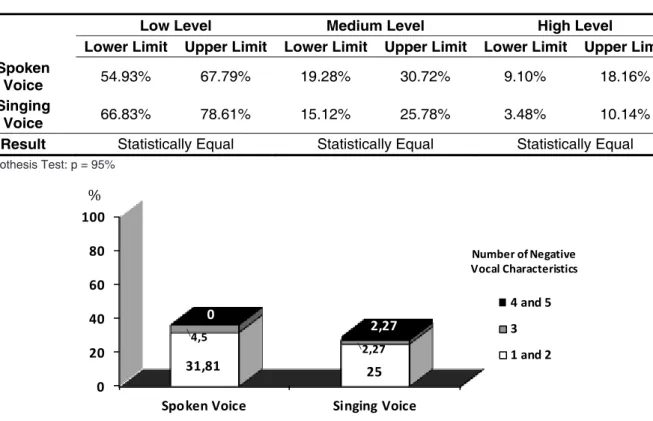
The statistical analysis found that the self-perception indexes did not evidence differences in between spoken voice and singing voice (Table 1).
Negative vocal self-perception was found in 36% of the choir singers for their spoken voice, and in
30% for their singing voice, and most of them (32% spoken voice and 25% singing voice) reported only one or two negative characteristics, accounting for a low negative vocal self-perception (Figure 3).
Table 1 – Conidence intervals of the obtained scores of positive self-percetion of spoken and singing
voices
Hypothesis Test: p = 95%
Figure 3 – Percentages of the number of negative vocal characteristics of spoken voice and singing voice reported by the choir singers in this study
Low Level Medium Level High Level
Lower Limit Upper Limit Lower Limit Upper Limit Lower Limit Upper Limit Spoken
Voice 54.93% 67.79% 19.28% 30.72% 9.10% 18.16%
Singing
Voice 66.83% 78.61% 15.12% 25.78% 3.48% 10.14%
Result Statistically Equal Statistically Equal Statistically Equal
0 20 40 60 80 100
Spoken Voice Singing Voice
13,63 6,81 25
20,45
61,36 72,72
Number of Positive Vocal Characteristics
4 and 5
3
1 and 2 %
0 20 40 60 80 100
Spoken Voice Singing Voice
31,81 25
4,5
2,27
0
2,27
Number of Negative Vocal Characteristics
4 and 5
3
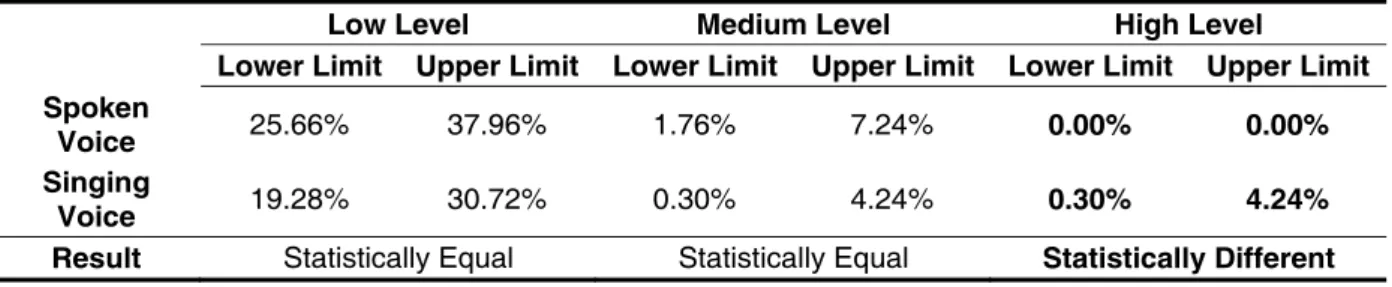
The statistical analysis showed that the low and medium levels of negative vocal self-perception did not evidence differences in between spoken and singing voices. However, the high level had a statis-tically signiicant difference (Table 2).
Spoken voice disorders were reported by 31% of the subjects, who reported presence of hoarseness, aphonia and/or pain. In singing voice, 25% of the participants reported presence of vocal discomfort after singing. The statistical analysis showed no difference in between the complaints reported in spoken and singing voice. The conidence intervals were 19.28% and 30.72% for singing voice and 25.66% and 37.96% for the spoken voice.
When questioned, the subjects did not report laryngeal disorders, found in a otorhynolaryngo-logical examination.
Singing experience was analyzed considering the participation in singing lessons and time of choir singing. Nineteen (43%) of the 44 choir singers take or are taking singing lessons, over a period that varied from three months to four years ( 1.95years ± 2.29years). The time singing in choirs varied from 6 months to 66 years, with mean time of 17.74 years (± 18.45 years).
As far as habits related to vocal health, it was observed that the choir singers have a mean intake of 1.7liters of water (± 0.92 liters). In regards to negative habits, 50% reported frequent intake of alcoholic beverages (once a week or more); 4.5% are smokers and 22.7% have stopped smoking.
As for the correlation among negative vocal habits, time of experience in choir singing and taking singing lessons and spoken voice complaints, the indexes were not statistically signiicant (Table 3).
Low Level Medium Level High Level
Lower Limit Upper Limit Lower Limit Upper Limit Lower Limit Upper Limit Spoken
Voice 25.66% 37.96% 1.76% 7.24% 0.00% 0.00%
Singing
Voice 19.28% 30.72% 0.30% 4.24% 0.30% 4.24%
Result Statistically Equal Statistically Equal Statistically Different
Spoken Voice Complaints Result Smoking and Alcohol 0.009 Not Significant Time of Choir Singing Experience 0.005 Not Significant Singing Lessons 0.004 Not Significant
Table 2 – Conidence Intervals of the obtained scores of negative self-perception of spoken and
singing voices
Hypothesis Test: p = 95%
Table 3 – Correlation between negative vocal habits, time of experience in choir singing and singing lessons with spoken voice complaints
R-Square: p = 1.0
DISCUSSION
Choir singing is a human activity that, in addition to providing group interaction, involving all of its social aspects, provides better self-perception, develops the choir singer’s self-esteem and values their individuality1,8.
The present study showed that the main part of the singers of the participating choir have high positive vocal self-perception and low negative
vocal self-perception for both spoken and singing voices. This fact may be attributed to a better vocal performance, expected in singers. This data is similar to that found in the study by Fuchs (2009)4,
that concludes that singing experience directly inlu -ences vocal performance, as well as the individual’s self-perception of voice.
According to Amato (2007)8, the group interaction
that choir singing provides stimulates the singers’ motivation, and they show great personal growth, establishing a social and cultural network from further valuing their individuality. Furthermore, this experience transforms the choir singer’s view of the world, since choir singing is a social practice that works as an asset to the individual1.
In regards to the participation in singing lessons, it was observed that only 43% of the studied choir singers sought improvement of their vocal techniques through singing lessons. Even if not presenting statistical correlation with complaints, this fact may concern professional who care for the vocal well-being of singers and must hence guarantee information and guidance to these individuals.
Another aspect is that, in the statistical comparison in between spoken voice and singing voice, the only index that proved to be different was the high level of negative vocal self-perception, greater for the singing voice, as shown in Table 2. The perception of negative vocal characteristics, especially in regards to the singing voice, suggests that choir singers have a reined sensitivity in identi-fying small disorders, proving to be critical of their voice quality, due to the demand that they have.
This inding may also be indirectly related to laryngeal, respiratory and vocal tract adjustments that the choir member uses during singing, which gives him a better vocal performance, but also a greater demand. In regards to this, Bicalho et al. (2010)5 reported that voice professional may
atribute different importances and values in their self-perceptions, and are higher-demanding in certain aspects.
This data conirms the fact that singers have vocal complaints, even if there is no signiicant difference in between spoken and singing voices.
It was especially observed that there was no complaint or report of laryngeal disorders among women undergoing menopause. In a study by Machado et al. (2005)9, the authors suggest that
women identify the changes in voice that occur in consequence of menopause. However, it should be taken into account that there was no laryngeal assessment in order to conirm the obtained data. Literature reports an increase in complaints and voice disorders in women in in menopause, as well as those related to aging, in non-singing elderly9-11. It may be inferred that singing, for these
choir members, may have strengthened laryngeal structures, thus preventing or minimizing vocal disorders related to hormonal changes or aging. To Brown et al. (1990)3, singing may directly inluence
vocal quality in elderly people. In their study, the voice of elderly singers and of young adults had
better performance when compared to non-singing elderly. Hazlett and Ball (1996)2 reported that the
time of singing experience and the effects of voice training of singers may set back the voice changes that occur due to aging.
In regards to the habits related to vocal well-being, the choir singers’ mean intake of 1.7liters of water throughout the day showed that they are aware of the need for hydration. Literature reports indicate that this is a positive aspect, since good levels of hydration is important for all living creatures, and especially for the individual with professional voice use, since it prevents vocal fatigue12.
In regards to the negative habits, these have also not shown statistical correlation to vocal complaints. However, regular alcohol intake by 50% of the participating subjects is an aspect that deserves special attention, especially in guidance information stating that this intake should not occur before singing.
The results regarding smoking pointed towards the greater knowledge that this group has about the harmful effects of tobacco, since only 4.5% of the participants are smokers, and 22% have given up this habit. Goulart et al. (2010)13 reported that, in
Brazil, the prevalence of smoking dropped from 35% to 18% in the period in between 1989 and 2003, and in 2006 this index suffered yet another reduction, dropping to 16%. Public Health programs, as well as National Voice Campaigns are actions that encourage citizens to stop smoking, the National Health Department and the National Cancer Institute (INCA) have taken on the role of organizing the National Program for Tobacco Control.
The results observed in this study suggest that choir singing has played an important role in the self-perception of voice, and possibly in the prevention of voice disorders.
CONCLUSION
Based on the data obtained in this study, it may be concluded that the evaluated choir singers had a high level of self-perception of their vocal aspects, and may suggest that choir singing plays an important role in promoting vocal well-being.
ACKNOWLEDGMENTS
To Tatiane Camargo and Daniela Barbosa for making the data of their research available for analysis.
REFERENCES
1. Pereira E, Vasconselos M. O processo de Socialização no canto coral: Um estudo sobre as dimensões pessoal, interpessoal e comunitária. Música Hodie. 2007;7(1):99-120.
2. Hazlett D, Ball MJ. An acoustic analysis of the effects of ageing on the trained singer’s voice. Logopedics Phoniatrics Vocology. 1996; 21(2):101-7.
3. Brown WS, Morris RJ, Michel JF. Vocal jitter and fundamental frequency characteristics in aged, female professional singers. J. Voice. 1990; 4(2):135-41.
4. Fuchs M, Meuret S, Thiel S, Täschner R, Dietz A, Gelbrich G. Inluence of singing activity, age, and sex on voice performance parameters, on subjects’ perception and use of their voice in childhood and adolescence. J. Voice. 2009;23(2):182-9.
5. Bicalho AD, Behlau M, Oliveira O. Termos descri-tivos da própria voz: comparação entre respostas apresentadas por fonoaudiólogos e não-fonoaudió-logos. Rev. CEFAC. 2010;12(4):543-50.
6. Kasama ST, Brasolotto AG. Percepção vocal e qualidade de vida. R. Pró-Fono Atual. Cient. 2007;19(1):19-28.
7. Camargo TF, Barbosa DA, Teles LCS. Características da fonetograia em coristas de diferentes classiicações vocais. Rev. Soc. Bras. de Fonoaudiologia. 2007;12(1):10-7.
8. Amato RF. O canto coral como prática sócio-cultural e educativo-musica. Opus. 2007;13(1):75-96. 9. Machado MAMP, Aldrighi JM, Ferreira LP. Os sentidos atribuídos à voz por mulheres após a menopausa. Rev. Saúde Pública. 2005;2(39):261-9. 10. Menezes LN, Vicente LCC. Envelhecimento vocal em idosos instucionalizados. Rev. CEFAC. 2007;9(1):90-8.
11. Cerceau JSB, Alves CFT, GAMA ACC. Análise acústica da voz de mulheres idosas. Rev. CEFAC. 2009;11(1):142-9.
12. Kubota ML. Considerações sobre a hidratação das pregas vocais [monograia]. São Paulo: CEFAC – Centro de Especializações em Fonoaudiologia Clínica; 1997.
13. Goulart, Engroff P, Ely LS, Sgnaolin V, Santos EF, Terra NL, Carli GA. Tabagismo em idosos. Rev. Bras. Geriatr. Gerontol. 2010;13(2):313-20.
RESUMO
Objetivo: identiicar o nível de autopercepção vocal de cantores de um coral proissional. Método: participaram 44 coristas, com idades entre 20 e 75 anos ( 51,5 ± 14,36), de ambos os sexos. Estes responderam a um questionário com 30 questões objetivas sobre autopercepção vocal e quei-xas da voz cantada e falada; experiência com o canto e hábitos relacionados ao bem estar vocal. Resultados: todos os coristas auto deiniram suas vozes com características positivas, não apre-sentando diferença estatística entre voz falada e cantada. Os coristas identiicaram também caracte-rísticas vocais negativas para voz falada e cantada, sendo que foi encontrada diferença estatística. O índice de queixas vocais foi de 31% para voz falada e 25% para voz cantada, sem apresentar diferença estatística. 43% dos participantes realizaram aulas de canto, com tempo médio 1,95 anos (± 2,29 anos) e o tempo de participação em corais variou de seis meses a 66 anos, com tempo médio de 17,74 anos (± 18,45 anos). Quanto aos hábitos relacionados ao bem estar vocal, o índice médio de ingestão diária de água foi de 1,7 litros (± 0,92 litros); 50% dos coristas fazem ingestão de álcool com frequência; o índice numérico de tabagistas foi de 4,5% e 22% dos coristas são ex-tabagistas. Não foram encontradas correlações estatísticas entre tabagismo, etilismo e experiência no canto com queixas vocais. Conclusão: os coristas avaliados apresentaram um nível elevado de autopercepção de seus aspectos vocais, podendo sugerir que o canto coral desempenha um papel importante na promoção do bem estar vocal.
DESCRITORES: Voz; Envelhecimento; Hábitos; Autoimagem
Received on: June 28, 2012 Accepted on: April 15, 2013
Mailing Address:
Fernanda Salvatico de Aquino Rua Inácio Taveira, 18 São Paulo – SP CEP 04658-110