KNOWLEDGE ABOUT VOICE AND THE IMPORTANCE
OF VOICE AS AN EDUCATIONAL RESOURCE IN THE
PERSPECTIVE OF UNIVERSITY PROFESSORS
Conhecimento vocal e a importância da voz como recurso
pedagógico na perspectiva de professores universitários
Emilse Aparecida Merlin Servilha(1), Aline Teixeira Fialho da Costa(1)
(1) Pontifícia Universidade Católica de Campinas –
PUC-Cam-pinas, CamPUC-Cam-pinas, SP, Brasil. Funding: PUC-Campinas
Conlict of interest: non-existent
presentations has been the most commonly used strategy in classrooms1, elevating vocal demand2,3, the voice must be intelligible, accessible, motiva-tional as well as assertive and effective, since the ability to keep student’s attention may be harmed if the voice is monotonous, weak or systemati-cally tense and also if the teacher’s speech has a
deviation in speed or luency. Thus, the voice in
its professional use is highly demanding regarding communication and its good functioning is a basic requirement for the profession4.
Teaching requires a high vocal demand that aims
to socialize and build knowledge with the students who are many times noisy5 and in not always healthy work conditions6-8 that favor concentration9,10, in
INTRODUCTION
The voice is a crucial element that enables the
work of teachers and the knowledge that this
profes-sional has of his voice is extremely important in
order to recognize its qualities and limitations, and the consequence of these in class development.
Appropriate vocal functioning favors the effec-tiveness of communication in the classroom, aids in building teachers’ self-esteem and contributes with students’ learning skills. Considering that oral
ABSTRACT
Purpose: to investigate the knowledge about voice and its importance as an educational resource in university professors. Methods: the subjects were 112 teachers, mean age 46.60, 35.7% males
and 64.3% females, 66.1% Ph.D. The Vocal Production Conditions–Teacher questionnaire was used
with adaptations by the researcher proposing new questions of the interest to research and they used an analogic zero to ten scale. Collected a sample of voice teachers and analyzed by speech therapy assessment. Closed questions were analyzed statistically where the mean of self-reported scores
were considered in each studied variable. The results were correlated using the variables gender and presence/absence of voice disorder. The answers to open-ended questions were organized according
to content similarity and frequency of occurrence. Results: there was a signiicant association in
between female sex and high-pitched voice, fatigue and voice loss; voice disorder and weak voice, hoarseness, insuficient voice for work and vocal fatigue. The professors partook in the study in order
to cooperate and improve voice in teaching; they would change their voices as far as intensity, tone and modulation; the most frequently used vocal resources in the classroom were tone and intensity variation, modulation and pauses; and when there is a voice disorder, they undergo vocal rest and
hydration. The score attributed to voice as an educational resource was 9.42. Conclusion: the participants’ knowledge about voice was appropriate and it was evaluated as an essential educational resource.
resources used by the teachers. It was found that the teacher who spoke with more pauses in a clear
and objective way had her expression evaluated by the students as motivational, irm, pleasant and capable of keeping students’ attention. The teacher whose oral expression was considered unpleasant,
uninteresting and hesitant, transmitting a feeling of insecurity to the students, used a high pitched voice
that was extremely loud. It was concluded that the
students valued parameters such as speech rate, pause employment, voice quality and vocal intensity, and that their perception may aid in the preparation of the voices of teachers for education.
In this teaching and learning context, the purpose
of this study was to investigate the vocal knowledge and its importance as an educational resource in university professor.
METHODS
This is a cross-sectional study that is part of a broader project named “Voice, Job Ability and Quality of Life of University Professors” that was
approved by the institutional Ethics Committee for Research with Human Beings in 09/05/2011, under number 0654/11.
The subjects of the study were 112 university
professor aged between 24 and 76 years, with a mean of 46.6 years (standard deviation 10.91). Of these, 72 (64.3%) were females and 40 (35.7%) males, 78 (69.6%) of whom were married. As for their
level of education, ive (4.5%) are specialists, 23
(20.5%) have a Master’s Degree, 74 (66.1%) have a Ph.D. and 10 (8.9%) did not answer to this question.
In regard to the knowledge ield according to the
National Research Council (CNPq), 35 (31.3%)
were in the Health ield, 27 (24.1%) in Human Sciences and Linguistics, Literature and Arts, 23
(20.5%) in Applied Social Sciences, 15 (13.4%)
in Exact and Earth Sciences and Engineering, 10
(8.9%) in biological sciences and two (1.8%)did not respond.
The professors were personally contacted and
invited to participate in the study by the researchers, during events sponsored by the institution and in the teachers’ lounge. At this time the purpose of the study was presented and they were asked whether they would be willing to participate.
The inclusion criteria were: being a professor
at the university where the study was conducted, manifesting acceptance to participate by signing the
Free Consent Term and providing answers to the instruments used. The teachers who did not meet these criteria were excluded.
The professors illed out the Conditions of Voice Production – Teacher (CPVP)27 questionnaire in a addition to trying to maintain discipline so that the
program contents may be met.
Another aspect that should be considered regarding these professional is the fact that there is a predominance of women in teaching in basically all educational levels, and they should be given
speciic attention since they have different vocal
characteristics from men and are, from a laryngeal standpoint, more vulnerable to voice dosorders11,12.
Therefore, the knowledge about the differences between voice use in both sexes is of interest to Speech-Language Pathologists.
Although it is not a consensus among studies
in the ield of Speech-Language Pathology, some
investigations have shown that teachers do have knowledge of their own voices13,14 and that their
harmed vocal qualities, exteriorized as hoarseness
and self-perceived throat sensations15 restrict their communication skills and may harm their teaching and quality of life16-20. Other studies have focused on investigating how the students evaluate the teachers’ voices21-23 with the purpose of understanding the dialogical relationship that occurs in the classroom.
The way in which the teacher assesses his
own voice, the knowledge he has of it and how to deal with it at work as well as his vocal habits have been subjects of interest of many researchers4,13,24,25.
An exploratory and descriptive study was
conducted with university professors, with the purpose of investigating these professionals’ verbal
and non-verbal expressive resources in an experi
-mental situation26. A semi-structured question-naire was used, and in order to analyze verbal
expressivity a recognition test of different facial expressions was used as well as the emission of
a sentence with different intonations, in addition to
a ilm footage of the professors talking about a real or imaginary situation representing six emotions. It
was seen that the factors that most contributed to
a better performance of the teachers’ expressivity
were pitch and loudness parameters, regarding
speech rate, pauses and luency. It was also found
that the type of class ministered and the teacher’s communicative strategies used to socialize educa-tional content may interfere in the teaching-learning process of the students.
With the purpose of verifying how students
characterize the oral expression of teachers23, a conducted study was composed of three stages,
where the irst was the selection of teachers and
recording of speech during class, followed by a voice evaluation performed by the students and the completion of a questionnaire about the impres-sions on each speech sample, and a
perceptive-auditory analysis done by four Speech-Language
Vocal demands (asks for silence, uses incisive voice
(gives order), uses melodious voice, pauses during
speech, speaks excessively, speaks in a closed
environment, speaks in a room with air conditioning, speaks too fast, speaks too slowly, uses very long sentences, uses a voice that is different from the
habitual voice); Vocal characteristics indicated
by the teacher (clear, ugly, thin, low, pleasant,
annoying, hoarse, strong, weak, sexy, monotonous, lexible, enough for the job, mellow, childish, other
– which?, and what grade do you give your voice?). Open questions were added asking the teachers about what they would change in their voices, vocal resources used in the classroom and their attitudes when their voice is not normal.
In addition to the insertion of new questions, an analogic scale from 0 to 10 was proposed to evaluate the dimensions present in the instrument (Figure 1).
modiied version to which other questions contem
-plating the purposes of this study were attached. From the questionnaire mentioned above, the
following items were used: Identiication (date of birth, sex, marital status and education) and Voice (Vocal demands (speaks standing up, speaks sitting down, speaks excessively, speaks while carrying
weight, speaks in an open environment, speaks while
performing physical activity; and Vocal symptoms
(vocal fatigue, dry throat, shortage of breath, sore throat, strained speech, globus sensation, pain when speaking, dry cough, cough with phlegm, phlegm, voice loss, weak voice, low-pitched voice, high-pitched voice).
The following questions were added: Reason(s)
for being interested in the study, as it was important to investigate if only the professors with voice disorders would look for the researcher; Self-reported voice evaluation and its use in teaching with the sub-items:
I – Identiication
Date of birth:
Sex: ( ) female ( ) male
Relationship Status: ( ) single ( ) married or any form of union ( ) separated or divorced ( ) widow Education: ( ) Specialist ( ) Masters’ Student ( ) Master’s Degree ( ) Ph.D. Student ( ) Ph.D.
( ) post-Doctorate Course teaching:
II. Reason(s) for the interest in this study
III – Work Conditions
For how long have you been a teacher?
How many hours a week do you work?
Assess your work environment 0= none 10 = very much
Noise 0 1 2 3 4 5 6 7 8 9 10
Dust 0 1 2 3 4 5 6 7 8 9 10
Smoke 0 1 2 3 4 5 6 7 8 9 10
Temperature 0 1 2 3 4 5 6 7 8 9 10
Lighting 0 1 2 3 4 5 6 7 8 9 10
Ventilation 0 1 2 3 4 5 6 7 8 9 10
Cleanliness 0 1 2 3 4 5 6 7 8 9 10
Comfort 0 1 2 3 4 5 6 7 8 9 10
Assess your work organization 0= none 10 = very much Autonomy in planning and executing
activities 0 1 2 3 4 5 6 7 8 9 10
Relationship with co-workers, boss,
Material availability 0 1 2 3 4 5 6 7 8 9 10 Quality of material 0 1 2 3 4 5 6 7 8 9 10
Stress 0 1 2 3 4 5 6 7 8 9 10
Calm 0 1 2 3 4 5 6 7 8 9 10
Monotony 0 1 2 3 4 5 6 7 8 9 10
Violence 0 1 2 3 4 5 6 7 8 9 10
Satisfaction in work accomplishment 0 1 2 3 4 5 6 7 8 9 10
IV – Voice
Assess your vocal demands 0= never 10 = always
Speaks in noisy environment 0 1 2 3 4 5 6 7 8 9 10
Speaks loudly 0 1 2 3 4 5 6 7 8 9 10
Uses microphone 0 1 2 3 4 5 6 7 8 9 10
Speaks while standing 0 1 2 3 4 5 6 7 8 9 10
Speaks while sitting 0 1 2 3 4 5 6 7 8 9 10
Asks for silence 0 1 2 3 4 5 6 7 8 9 10
Uses incisive voice (orders) 0 1 2 3 4 5 6 7 8 9 10
Uses melodious voice 0 1 2 3 4 5 6 7 8 9 10
Uses pauses during speech 0 1 2 3 4 5 6 7 8 9 10
Speaks excessively 0 1 2 3 4 5 6 7 8 9 10
Speaks while carrying weight 0 1 2 3 4 5 6 7 8 9 10
Speaks in open environment 0 1 2 3 4 5 6 7 8 9 10
Speaks in closed environment 0 1 2 3 4 5 6 7 8 9 10
Speaks while performing physical
activity 0 1 2 3 4 5 6 7 8 9 10
Speaks in air-conditioned
environment 0 1 2 3 4 5 6 7 8 9 10
Yells 0 1 2 3 4 5 6 7 8 9 10
Speaks very fast 0 1 2 3 4 5 6 7 8 9 10
Speaks very slowly 0 1 2 3 4 5 6 7 8 9 10
Uses very long sentences 0 1 2 3 4 5 6 7 8 9 10
Uses different voice from habitual
voice 0 1 2 3 4 5 6 7 8 9 10
Assess your vocal habits 0= never 10 = always
Spares voice when not at work 0 1 2 3 4 5 6 7 8 9 10
Drinks water while using voice 0 1 2 3 4 5 6 7 8 9 10
Clears throat 0 1 2 3 4 5 6 7 8 9 10
Yells 0 1 2 3 4 5 6 7 8 9 10
Does voice impressions 0 1 2 3 4 5 6 7 8 9 10
Coughs excessively 0 1 2 3 4 5 6 7 8 9 10 Assess your vocal characteristics
0= never 10 = always
Clear 0 1 2 3 4 5 6 7 8 9 10
Ugly 0 1 2 3 4 5 6 7 8 9 10
High-Pitched 0 1 2 3 4 5 6 7 8 9 10
Low-Pitched 0 1 2 3 4 5 6 7 8 9 10
Pleasant 0 1 2 3 4 5 6 7 8 9 10
Annoying 0 1 2 3 4 5 6 7 8 9 10
Hoarse 0 1 2 3 4 5 6 7 8 9 10
Strong 0 1 2 3 4 5 6 7 8 9 10
Weak 0 1 2 3 4 5 6 7 8 9 10
Sexy 0 1 2 3 4 5 6 7 8 9 10
Flexible 0 1 2 3 4 5 6 7 8 9 10 Suficient for work 0 1 2 3 4 5 6 7 8 9 10
Mellow 0 1 2 3 4 5 6 7 8 9 10
Childish 0 1 2 3 4 5 6 7 8 9 10
Other. Which one? 0 1 2 3 4 5 6 7 8 9 10
What grade would you give your
voice? 0 1 2 3 4 5 6 7 8 9 10
What would you change in it? Assess the importance of your voice
as an educational resource 0 1 2 3 4 5 6 7 8 9 10
What vocal resources do you use in the classroom?
Voice Disorder ( ) Never had one ( ) Have had and underwent reatment
( ) I have had and have only when I catch cold ( ) I currently have one If you have a voice disorder, how long
ago did it begin? ( ) 0 to 5 months ( ) 6 to11 months ( ) 1 year or more What grade would you give to the
seriousness of your voice disorder? 0 1 2 3 4 5 6 7 8 9 10
Assess your vocal symptoms 0= never 10 = always
Vocal fatigue 0 1 2 3 4 5 6 7 8 9 10
Dry throat 0 1 2 3 4 5 6 7 8 9 10
Lack of air
Sore throat 0 1 2 3 4 5 6 7 8 9 10
Strained speech 0 1 2 3 4 5 6 7 8 9 10
Globus 0 1 2 3 4 5 6 7 8 9 10
Pain when speaking 0 1 2 3 4 5 6 7 8 9 10
Dry cough 0 1 2 3 4 5 6 7 8 9 10
Cough with secretion 0 1 2 3 4 5 6 7 8 9 10
Phlegm 0 1 2 3 4 5 6 7 8 9 10
Hoarseness 0 1 2 3 4 5 6 7 8 9 10
Voice loss 0 1 2 3 4 5 6 7 8 9 10
High/low-pitch varying voice 0 1 2 3 4 5 6 7 8 9 10
Out of tune voice 0 1 2 3 4 5 6 7 8 9 10
Weak voice 0 1 2 3 4 5 6 7 8 9 10
Low-pitched voice 0 1 2 3 4 5 6 7 8 9 10
High-pitched voice 0 1 2 3 4 5 6 7 8 9 10
Have you ever missed work due to a voice disorder? ( ) No ( ) Yes How many days, on average, were
you away from work?
Have you ever received any guidance about vocal health care? ( ) No ( ) Yes What do you usually do when your voice is not normal?
Are there cases of voice disorder in your family? ( ) No ( ) Yes
Figure 1 – Adapted Conditions of Voice Production – Teacher ol (Ferreira et al, 2007)
Furthermore, a speech sample from each professor was recorded, composed by a counting of numbers from one to 20, months of the year,
sustained emission of ive vowels and the answer to
the question “what do you think of your voice during
your work performance?. This material was recorded
at the professors’ workplace, in an appropriate
setting for this purpose. Then, the voices were
analyzed according to the presence or absence of voice disorder, using the GRBASI scale28 that is widely used in studies and voice therapy and offers data about the Grade (G) of dysphonia, roughness (R), breathiness (B), asthenicity (A), strain (S) and
demand, characteristics and self-reported symptoms
and Speech-Language Pathology evaluation. The data were described according to mean, standard deviation, median, minimum and maximum
values for quantitative data, and absolute and relative frequencies for the qualitative values, using the Mann-Whitney test to assess the association
between the variables and sex. The adopted level of signiicance was 0.05%.
RESULTS
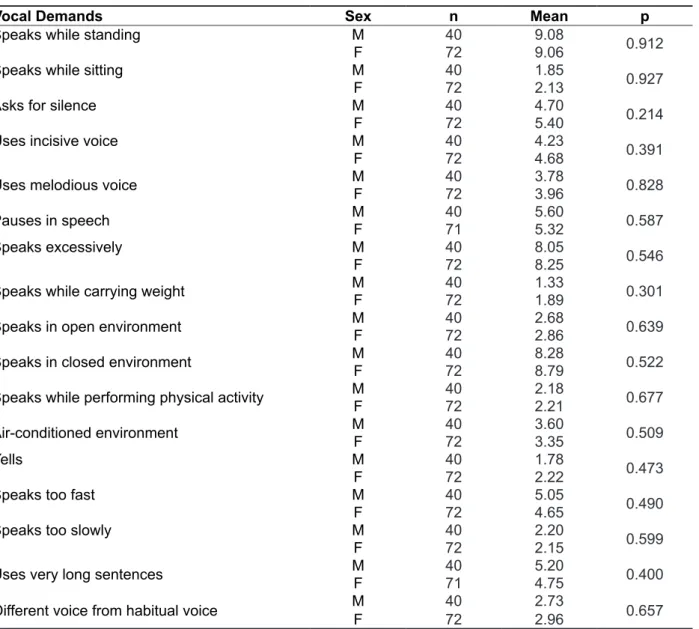
In the association between vocal demands
and variable sex (Table 1) there was no distinction
between the groups. zero to three where 0=absent, 1=mild, 2=moderate
and 3=severe. The voices classiied as a zero
were considered healthy or adapted, and those with grades one to three were considered a voice disorder.
The data obtained were organized and
submitted to socio-demographic characterization of the subjects, descriptive and quantitative analysis of the closed questions and qualitative analysis of
the open ones. The voices were analyzed and those
with presence or absence of voice disorder were
identiied according to the criteria of the scale that
was used.
Statistical analyses were conducted in order to verify associations between the data of vocal
Table 1 – Association between self-reported vocal demands and the variable sex
Vocal Demands Sex n Mean p
Speaks while standing M 40 9.08
0.912
F 72 9.06
Speaks while sitting M 40 1.85
0.927
F 72 2.13
Asks for silence M 40 4.70
0.214
F 72 5.40
Uses incisive voice M 40 4.23
0.391
F 72 4.68
Uses melodious voice M 40 3.78 0.828
F 72 3.96
Pauses in speech M 40 5.60 0.587
F 71 5.32
Speaks excessively M 40 8.05
0.546
F 72 8.25
Speaks while carrying weight M 40 1.33 0.301
F 72 1.89
Speaks in open environment M 40 2.68 0.639
F 72 2.86
Speaks in closed environment M 40 8.28 0.522
F 72 8.79
Speaks while performing physical activity M 40 2.18 0.677
F 72 2.21
Air-conditioned environment M 40 3.60 0.509
F 72 3.35
Yells M 40 1.78
0.473
F 72 2.22
Speaks too fast M 40 5.05
0.490
F 72 4.65
Speaks too slowly M 40 2.20
0.599
F 72 2.15
Uses very long sentences M 40 5.20 0.400
F 71 4.75
Different voice from habitual voice M 40 2.73 0.657
F 72 2.96
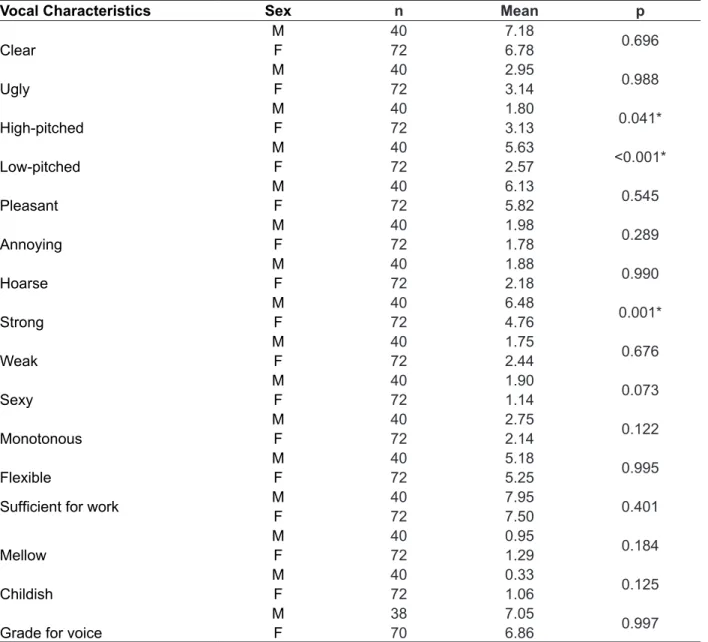
Table 2 shows the association between self-reported vocal characteristics and sex. Women had signiicantly greater means regarding the character
-istic of thin voice and mean of grades attributed to
their voices that were signiicantly lower regarding
low and strong voice when compared to men.
Table 2 – Association between self-reported vocal characteristics and the variable sex
Vocal Characteristics Sex n Mean p
M 40 7.18
0.696
Clear F 72 6.78
M 40 2.95
0.988
Ugly F 72 3.14
M 40 1.80
0.041*
High-pitched F 72 3.13
M 40 5.63
<0.001*
Low-pitched F 72 2.57
M 40 6.13
0.545
Pleasant F 72 5.82
M 40 1.98
0.289
Annoying F 72 1.78
M 40 1.88
0.990
Hoarse F 72 2.18
M 40 6.48
0.001*
Strong F 72 4.76
M 40 1.75
0.676
Weak F 72 2.44
M 40 1.90
0.073
Sexy F 72 1.14
M 40 2.75
0.122
Monotonous F 72 2.14
M 40 5.18
0.995
Flexible F 72 5.25
Suficient for work M 40 7.95 0.401
F 72 7.50
M 40 0.95
0.184
Mellow F 72 1.29
M 40 0.33
0.125
Childish F 72 1.06
M 38 7.05
0.997
Grade for voice F 70 6.86
*Mann-Whitney Test – p≤0.05
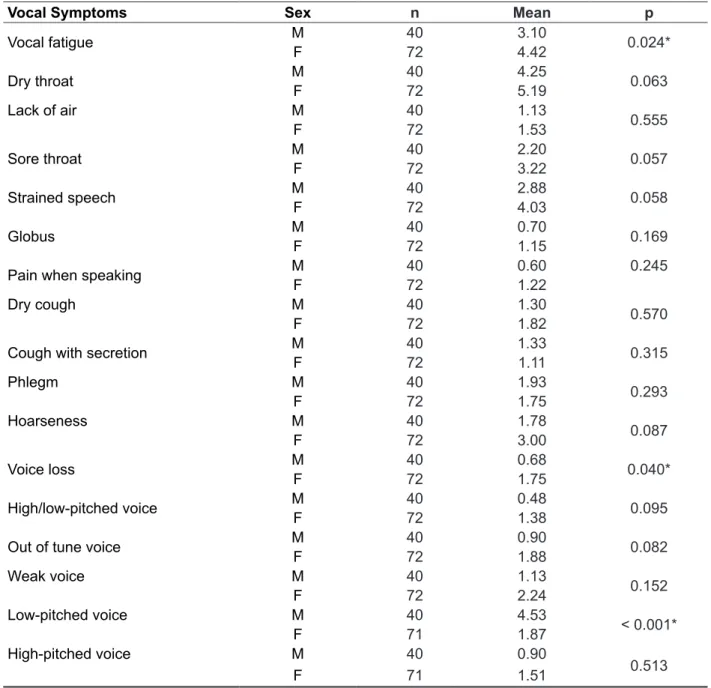
In the comparison between vocal symptoms
and sex, there were signiicant values among vocal fatigue, voice loss and low voice (Table 3) that
distinguished the groups of men and women.
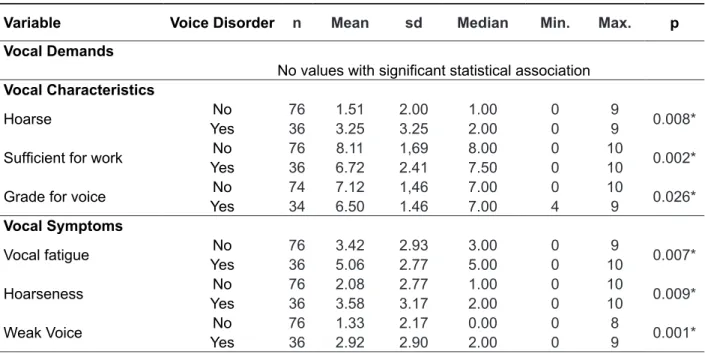
Table 4 shows the associations between
vocal demands, characteristics and self-reported symptoms and the perceptive-auditory
Table 3 – Association between vocal symptoms and the variable sex
Vocal Symptoms Sex n Mean p
Vocal fatigue M 40 3.10 0.024*
F 72 4.42
Dry throat M 40 4.25 0.063
F 72 5.19
Lack of air M 40 1.13
0.555
F 72 1.53
Sore throat M 40 2.20 0.057
F 72 3.22
Strained speech M 40 2.88 0.058
F 72 4.03
Globus M 40 0.70 0.169
F 72 1.15
Pain when speaking M 40 0.60 0.245
F 72 1.22
Dry cough M 40 1.30
0.570
F 72 1.82
Cough with secretion M 40 1.33 0.315
F 72 1.11
Phlegm M 40 1.93
0.293
F 72 1.75
Hoarseness M 40 1.78
0.087
F 72 3.00
Voice loss M 40 0.68 0.040*
F 72 1.75
High/low-pitched voice M 40 0.48 0.095
F 72 1.38
Out of tune voice M 40 0.90 0.082
F 72 1.88
Weak voice M 40 1.13
0.152
F 72 2.24
Low-pitched voice M 40 4.53
< 0.001*
F 71 1.87
High-pitched voice M 40 0.90
0.513
F 71 1.51
about voice, four (3.6% preserving their vocal health, three (2.7%) had interest in the subject, three (2.7%) in order to have a vocal assessment and three (2.7%) because they have or have had a
voice disorder. This question was not answered by
44 (39.3%) professors.
The vocal resources used by the professors in the classroom are shown in Table 4, as well as parts
of the speeches mentioned by them.
There were several reasons why the professors
adhered to the study and 32 (28.6%) declared their intention in cooperating, 17 (15.2%) improving their
voices while teaching, six (5.4%) sought knowledge
Table 4 – Positive associations between results of the Speech-Laguage Pathology Assessment and the variables of vocal demands, characteristics and symptoms that were self-reported by the professors
Variable Voice Disorder n Mean sd Median Min. Max. p
Vocal Demands
No values with signiicant statistical association
Vocal Characteristics
Hoarse No 76 1.51 2.00 1.00 0 9 0.008*
Yes 36 3.25 3.25 2.00 0 9
Suficient for work No 76 8.11 1,69 8.00 0 10 0.002*
Yes 36 6.72 2.41 7.50 0 10
Grade for voice No 74 7.12 1,46 7.00 0 10 0.026*
Yes 34 6.50 1.46 7.00 4 9
Vocal Symptoms
Vocal fatigue No 76 3.42 2.93 3.00 0 9 0.007*
Yes 36 5.06 2.77 5.00 0 10
Hoarseness No 76 2.08 2.77 1.00 0 10 0.009*
Yes 36 3.58 3.17 2.00 0 10
Weak Voice No 76 1.33 2.17 0.00 0 8 0.001*
Yes 36 2.92 2.90 2.00 0 9
*Mann-Whitney Test- p≤ 0,05
Table 5 – Vocal resources used by the professors in the classroom
Vocal Resource Professor Reports n %
Non-verbal resources “microphone”, “drinking water”, “multimedia kit, “slides” 29 26
Did not respond 23 20
None “none”; “nothing” 21 19
Intonation “I speak irmly and change tone”; “I change intonation” 12 11
Only speech “I use only speech”; “natural voice”; “my own voice” 8 7
Remains silent/uses pause “I remain silent” ; “I use pauses”; 6 5
Intensity variation “I speak louder”; “I speak stronger”;” I speak lower” 5 4
I don’t know “I don’t know” 1 1
Vocal exercises before/after class “I exercise before and after class” 1 1
Better enunciation and pauses “enunciation, pauses, I don’t use reserve air” 1 1
Projection “Projection” 1 1
Pause and intonation variation “I use pauses and change tones to emphasize” 1 1
Pause and intensity variation “volume and pause” 1 1
Intensity and tone variation “Varying intonation, tone and intensity” 1 1
Rhythm and intonation variation “rhythm changes, pauses, different intonations”. 1 1
propolis spray, two (1.8%) drink tea, two (1.8%) have honey, two (1.8%) take throat drops, one (0.9%) sees a speech-language pathologist, one
(0.9%) seeks treatment for gastroesophageal relux
and one (0.9%) eats better.
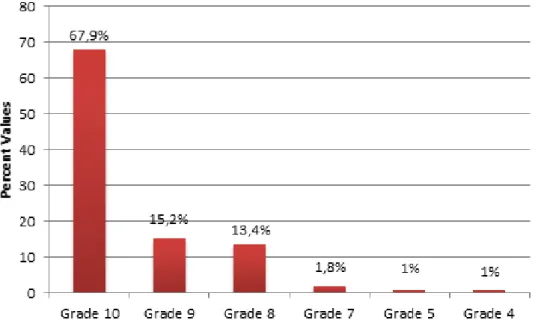
The grades attributed by the professors to
the importance of the voice as a resource in the teaching-learning process are shown in Figure 3. Figure 2 shows the professors’ answers regarding
the aspects they would change in their voices. On the question regarding their attitudes when the voice is not normal 55 (49.1%) professors opt for voice rest, 51 (45.5%) for hydration, 11 (9.8%) don’t do anything, seven (6.3%) go to the doctor, seven
(6.3%) did not answer, six (5.4%) take medicines, six (5.4%) perform vocal exercises, four (3.6%)
eat apples, three (2.7%) gargle, three (2.7%) use
Figure 2 – Percent values concerning the changes reported by the professors regarding their voices
concerning the voice of teachers have found that women have a greater number of voice complaints36,37, possibly due to the fact that they accumulate the workloads regarding teaching and caring for their children and homes6.
The professors classiied as having a voice disorder in the Speech-Language Pathology
assessment were not distinguished from their colleagues with healthy voices regarding voice demands, that is, posture while speaking, type of environment where teaching occurs, type of voice used, need to speak, forms of voice use in speech,
among others (Table 4). This inding shows that
these factors were not important to the point of
causing voice disorders. The deterioration of the
voice qualities of teachers are a process and derive from a tightly linked group of elements that are not always pre-established.
The association between voice disorders in the Speech-Language Pathology assessment and
self-reported voice characteristics was present for
hoarse voice, insuficient voice for work and low
grades attributed to one’s voice. Hoarseness is one of the most present and most frequently mentioned characteristics in vocal self-assessment15,25, and
thus the perception that the voice is below expecta -tions for its performance during teaching is evident, and has the teacher evaluating it negatively13,29,
which is in agreement with the Speech-Language Pathology assessment. There was a signiicant
association between self-reported vocal symptoms of fatigue, hoarseness and weak voice and the
Speech-Language Pathology evaluation, as the
teachers attributed higher grades to these items.
This group of data shows that the professors in
the present study are able to identify vocal problems and their symptoms, as well as relating them with the ways in which they may harm their work
perfor-mance. The knowledge that the teacher has of his
own voice has been a controversial issue in studies
in the ield of Speech-language Pathology, where
some studies indicate a lack of perception in this professional category, which would lead to
insuf-icient care and not seeking professional help15,24,25,
while others identify a speciic vocal knowledge,
resulting from the perspective of the professional who uses his voice2,13,20. The data obtained in this study are aligned with these last thoughts.
The reason for the professors’ interest in partici -pating in the study shows that they are interested in knowing and perfecting their vocal aspects, as well as in cooperating with the development of studies
in this ield. Thus, it may be said that there is value
attributed to the voice as a work tool38.
When asked about what they would change in their voices, part of the teachers proved to be
DISCUSSION
The results of this study show the several
possibilities of analyses of the data offered by the
professors and by Speech-Language Pathology
Assessment.
The vocal demands most frequently reported
by the professors were speaking while standing,
speaking excessively and in a closed environment (Table 1), which correspond to the most frequent
characteristics found in education, that is, the
teacher in a typical classroom, in which he exposes
institutional content and, therefore, has a great vocal demand, indicating that the most frequent class dynamics in education, including university
education is the verbal exposition1,29. It is known that this kind of educational strategy, albeit
consoli-dated by its eficiency, requires voice usage in a
strong intensity, given the number of students and background noise4,30-33.
The association between vocal demands and sex did not prove positive in any of the investigated
items, showing that the professors are very similar regarding the research variables and that, each in their own way, uses resources to teach.
It was veriied that the professors used higher grades to evaluate their voices as suficient for their jobs and with a clear quality (Table 2). When relating vocal characteristics to the variable sex, there was an association between thin voice and female sex and low-pitched and strong voice with males. The female larynx, due to its speciic architecture and
dimensions34, favors the production of a higher pitch
than the male larynx, justifying the association found
in this study. A strong voice was also correlated to the
male sex, possibly because of the speciic stature of
men that usually proves higher than in women and consequently provide greater pulmonary size and volume, that are directly related to vocal intensity35.
There were associations between the symptoms of vocal fatigue, voice loss and the female sex (Table
3), possibly deriving from the association between the need to speak a lot and lower vital capacity, when compared to men. A study14 has shown that teachers believe that the ideal voice for their job performance has a low pitch and increased loudness; therefore, in order for women to reach this pattern, they must demand more of their vocal functions, which may
cause damages to their voices. The association between low-pitched voice and the male sex may be justiied by the physical characteristics that are particular of men, as speciied above.
In spite of what has been exposed, this issue deserves to be clariied with the use of research instruments that allow for its qualiication from
out is that eating apples was not one of the most mentioned alternatives, which seems to indicate that teachers no longer consider the ingestion of this fruit as responsible for solving any vocal problem. On the other hand, seeking an appointment with
a Speech-Language Pathologist had a minimum
frequency of answers, possibly due to the fact that teachers minimize their vocal problems or consider their symptoms temporary, not requiring profes-sional help17-19.
Finally teachers value their voices as a work tool and give it a high grade (Figure 3), which shows that they know that in addition to the educational content
being socialized, the way of expressing it through
the voice is pivotal to engage the student and favor the teaching-learning process14, 22,26.
CONCLUSION
Professors value the voice as a work tool, have shown appropriate knowledge regarding its charac-teristics and resources as well as the attitudes to preserve it, showing that the knowledge conveyed
by Speech-Language Pathologists is already a part
of their daily lives at work.
In regard to the aspects of voice use and the
variable sex, an association was found between the identiication of voice disorder in the Speech-Language Pathology assessment and self-reported
voice characteristics such as hoarse voice,
insuf-icient for work and low grade attributed to voice
quality; in addition to vocal symptoms such as
fatigue, hoarseness and weak voice. There was
no association between vocal demands and voice
disorder identiied through Speech-Language
Pathology assessment.
satisied, while others indicated aspects that could
be improved such as tone of voice, intensity, modulation, resistance, among others (Figure 2).
Likewise, it was found that the vocal resources used
by teachers in the classroom include variations in intonation, intensity and rhythm, use of pauses
and even vocal exercises performed before and after class (Table 5). Thus, it may be seen that
these teachers prove to have vocal knowledge
including its use and terms speciic to the ield of Speech-Language Pathology, as well as vocal
strategies that may be employed during teaching, for both its improvement and keeping their students’
attention. The use of prosody elements, manipu -lated by the speaker, increase the quality of the content of speech by showing their assertions and stressing more important issues, which favors the listener’s understanding and guarantees a more effective communication39. This knowledge may be
a product of Speech-Language Pathology actions disseminated among teachers that qualiies them to
preserve their voices, as well as the dissemination
of Speech-Language Pathology care by the media
and annual voice-awareness campaigns40. Thus it
is observed that Speech-Language Pathology is a
part of the daily life of teachers and that they are aware that the way through which they socialize the instructional content may interfere in the teaching-learning process of students26.
When faced with voice disorders, the professors’ attitudes have also proven to be varied, with the predominance of voice rest, hydration and even
vocal exercises, in contradiction with the indings
qualidade de vida docente. Rev Bras Ed Médica. 2010; 34(1):65-73.
8. Ahlander VL, Rydell R, Lofqvist A. How do
teachers with self-reported voice problems differ from their peers with self-reported voice health?. J
Voice. 2012; 26(4):149-61.
9. Ramma L. Knowledge and attitudes of teachers
regarding the impact of classroom acoustics on
speech perception and learning. The South African
J Commun Disord. 2009;56:35-47.
10. Woolner P, Hall E. Noise in Schools: A Holistic Approach to the Issue. Int. J. Environ. Res Public Health. 2010;7:3255-69.
11. Grillo MHMM, Penteado RZ. Impacto da voz na qualidade de vida de professore(a)s do ensino fundamental. Pró-Fono R Atual Cient. 2005;(17)3:321-30.
12. Rabelo AO. O gênero e a proissão docente:
impactos na memória das normalistas. Rev Ártemis. 2007;6:58-67.
13. Servilha EAM, Bernardo BG. Qualiicação vocal
por professores e fonoaudiólogos: similitudes e divergências. Distúrb Comun. 2009;21(1):47-53.
14. Luchesi KF, Mourão LF, Kitamura S, Nakamura HY. Problemas vocais no trabalho: prevenção na
prática docente sob a óptica do professor. Saúde Soc. 2009;18(4):673-81.
15. Lima-Silva MFB, Ferreira LP, Oliveira IB,
Silva MAA, Ghirardi ACAM. Distúrbio de voz em
professores: autorreferência, avaliação perceptiva
REFERENCES
1. Servilha EAM, Monteiro APS. Estratégias para
obter a atenção discente no contexto universitário:
o papel da voz do professor. Distúrb Comun. 2007;19(2): 225-35.
2. Ferreira LP, Penha PJ, Caporossi C, Fernandes ACN. Professores universitários: descrição de
características vocais e posturais. Distúrb Comun. 2011;23(1):43-9.
3. Bassi IB, Assunção AA, Gama ACC, Gonçalves LG. Características clínicas, sociodemográicas e
ocupacionais de professoras com disfonia. Distúrb Comun. 2011;23(2):173-80.
4. Ilomaki I, Lippmann K, Kleemola L, Tyrmi J, Laukkanen AM, Vilkman E. Relationships between
self-evaluations of voice and working conditions,
background factors, and phoniatric indings in female teachers. Logop. Phoniatric. Vocol. 2009;34:20-31. 5. Simberg S, Sala E, Vehmas K, Laine A. Changes
in the prevalence of vocal symptoms among
teachers during a twelve-year period. J Voice.
2005;19(1):95-102.
6. Vedovato TG, Monteiro MI. Peril sociodemográico e condição de saúde e trabalho dos professores de
nove escolas estaduais paulistas. Rev Esc Enferm USP. 2008;42(2):290-7.
7. Silvério MR, Patrício ZM, Brodbeck IM, Grosseman
S. O ensino na área da saúde e sua repercussão na
RESUMO
Objetivo: investigar o conhecimento vocal e sua importância como recurso pedagógico em profes-sores universitários. Métodos: participaram 112 docentes, média de 46,60 anos, 35,7% do sexo
masculino e 64,3% do feminino, 66,1% doutores. Utilizou-se o questionário Condições de Produção
Vocal–Professor, adaptado pela pesquisadora, além da inserção de novas questões abertas e fecha
-das de interesse para o estudo, as quais foram assinala-das em uma escala analógica de zero a dez.
Foram coletadas amostras de voz dos professores e analisadas por avaliação fonoaudiológica. As questões fechadas receberam tratamento estatístico, considerando-se a média das notas autorreferi
-das, em cada variável pesquisada. Os resultados foram correlacionados a partir das variáveis: sexo e
presença/ausência de alteração vocal. Organizaram-se as respostas das questões abertas por simi
-laridade de conteúdo e frequência de ocorrência. Resultados: constatou-se associação signiicante
entre sexo feminino e voz ina, fadiga e perda da voz; presença de distúrbio de voz e autorreferência à voz fraca, rouquidão, voz insuiciente para o trabalho e fadiga vocal. Os professores participaram da
pesquisa para colaborar e melhorar a voz na docência; mudariam suas vozes nos aspectos de
inten-sidade, tom e modulação; os recursos vocais mais utilizados em sala de aula foram variação de tom e intensidade, modulação e pausas; e quando a voz está alterada, recorrem ao repouso vocal e à hidra
-tação. Atribuiu-se a média de 9,42 para a voz como recurso pedagógico. Conclusão: o conhecimento vocal dos participantes foi apropriado e eles avaliaram a voz como recurso pedagógico essencial.
Received on: August 08, 2013 Accepted on: January 07, 2014
Mailing address:
Emilse Aparecida Merlin Servilha Avenida John Boyd Dunlop, s/n, Jardim Ipaussurama
Campinas – SP – Brasil CEP: 13059-900
E-mail: [email protected] da voz e das pregas vocais. Rev Soc Bras Fonoaudiol. 2012;17(4):391-7.
16. Chen SH, Chiang SC, Chung YM, Hsiao LC, Hsiao TY. Risk factors and effects of voice problems for teachers. J Voice. 2010;24(2):183-92.
17. Musial PL, Dassie-Leite AP, Zaboroski AP,
Casagrande RC. Interferência dos sintomas vocais
na atuação proissional de professores. Distúrb
Comun. 2011;23(3):335-41.
18. Villanueva-Reyes A. Voice disorders in the metropolitan area of San Juan, Puerto Rico: proiles of occupational groups. J Voice. 2011;25(1):83-7. 19. Costa V, Prada E, Roberts A, Cohen S. Voice Disorders in Primary School Teachers and Barriers to Care. J Voice. 2012;26(1):69-76.
20. Servilha EAM, Roccon PF. Relação entre voz
e qualidade de vida em professores universitários. Rev CEFAC. 2009;11(3):440-8.
21. Rogerson J, Dodd B. Is there an effect of dysphonic teacher’s voices on children’s processing
of spoken language? J Voice. 2005;19(1):47-60. 22. Romano CC, Alves LA, Secco IAO, Ricz LNA, Robazzi MLCC. A expressividade do docente universitário durante sua atuação na sala de aula:
análise dos recursos verbais utilizados e suas
implicações para a enfermagem. Rev Latino-Am
Enfermagem. 2011;19(5):1188-96.
23. Ferreira LP, Arruda AF, Marquezin DMSS. Expressividade oral de professoras: análise de
recursos vocais. Distúrb Comun. 2012:24(2):223-37.
24. Fabrício MZ, Kasama ST, Martinez EZ. Qualidade de vida relacionada à voz de professores
universitários. Rev CEFAC. 2010;12(2)280-7.
25. Morais EPG, Azevedo RR, Chiari BM.
Associação entre voz, autoavaliação vocal e
qualidade de vida em voz de professoras. Rev CEFAC. 2012;14(5):892-900.
26. Barbosa N, Cavalcanti ES, Neves EAL, Chaves TA, Coutinho FA, Mortimer EF. A expressividade
do professor universitário como fator cognitivo
no ensino-aprendizagem. Ciência e Cognição.
2009;14(1):75-102.
27. Ferreira LP, Giannini SPP, Latorre MRDO,
ZenariMS. Distúrbio de voz relacionado ao trabalho:
proposta de um instrumento para avaliação de
professores. Disturb Comun. 2007;19(1):127-36. 28. Behlau M, Damazio G, Feijó D, Pontes P.
Avaliação de Voz. In: Behlau, M. Voz. O livro do Especialista. Vol. 1. Rio de Janeiro: Revinter, 2001,
p. 85- 245.
29. Servilha EAM, Pereira PM. Condições de
trabalho, saúde e voz em professores universitários. Rev Ciên. Méd. 2008;17(1):21-31.
30. Luchesi KF, Mourão LF, Kitamura S. Ações de promoção e prevenção à saúde vocal de professores: uma questão de saúde coletiva. Rev
CEFAC. 2010;12(6): 945-53.
31. Hunter EJ, Titze IR. Variations in intensity,
fundamental frequency, and voicing for teachers in occupational versus nonoccupational settings. J
Speech Lang Hear Res. 2010;(53):862-75.
32. Servilha EAM, Delatti MA. Percepção de ruído
no ambiente de trabalho e sintomas auditivos e
extra-auditivos autorreferidos por professores. J
Soc Bras Fonoaudiol. 2012;24(3):233-8.
33. Guidini RF, Bertoncello F, Zanchetta S, Dragone
MLS. Correlações entre ruído ambiental em sala de
aula e voz do professor. Rev Soc Bras Fonoaudiol. 2012;17(4):398-404.
34. Ximenes Filho JA, Melo ECM, Carneiro CG,
Tsuji DH, Sennes LU. Associação entre a altura e as dimensões das pregas vocais. Rev Bras
Otorrinolaringol. 2003;69(3):371-4.
35. Fabron EMG, Sebastião LT, Oliveira GAG,
Motonaga SM. Medidas da dinâmica respiratória em idosos participantes de grupos de terceira idade. Rev CEFAC. 2011;13(5):895-901.
36. Chong EYL, Chan AHS. Subjective health
complaints of teachers from primary and secondary
school in Hong Kong. International J Occup Safety
and Erg (JOSE). 2010;16(1):23-39.
37. Marçal CCB, Peres MA. Alteração vocal
auto-referida em professores: prevalência e fatores associados. Rev Saúde Pública. 2011;45(3):503-11.
38. Rezende Netto B. Concepções de professores
de IES sobre o desempenho comunicacional
e expressivo articuladas à avaliação de
discentes sobre esta performance. Rev CEFAC. 2013;15(1):25-39.
39. Borrego MCM e Behlau M. Recursos de ênfase utilizados por indivíduos com e sem treinamento de voz e fala. Rev Soc Bras Fonoaudiol. 2012;17(2):216-24.
40. Ueda KH, Santos LZ, Oliveira IB. 25 anos de cuidados com a voz proissional: avaliando ações.