(1) Departamento de Fonoaudiologia da Universidade Estadual do Centro-Oeste, Irati, Paraná, Brasil.
(2) Faculdade de Odontologia de Bauru, Universidade de São Paulo, São Paulo, SP, Brasil.
(3) Universidade Federal do Paraná, Curitiba, PR, Brasil.
Conlict of interest: non-existent
Vocal self-assessment of women in menopause
Autoavaliação vocal de mulheres na menopausa
Bianca Natani Basilio(1) Vanessa Veis Ribeiro(2) Eliane Cristina Pereira(3) Ana Paula Dassie Leite(1)
Received on: July 30, 2015 Accepted on: November 10, 2015
Mailing address: Bianca Natani Basilio
R. Professor Assis Gonçalves nº 1429 – Água Verde
Ediicio Germano Brunatto – 4º andar – Apto 42
Curitiba – PR – Brasil CEP: 80620-250
E-mail: [email protected]
ABSTRACT
Purpose: to analyze the data of vocal self-assessment of menopausal women and compare them to those obtained by a control group.
Methods: cross-sectional, observational and analytical study in which 42 women aged between 19 and 60 years, divided into control group (21 women in reproductive age) and study group (21 women in menopause). Each participant answered a questionnaire developed by the researchers, which contained data on: general health, treatments carried out, smoking, alcohol use, professional use of voice and gyne
-cological data, and vocal self-assessment protocols Voice Symptom Scale, Voice Handicap Index and Voice-Related Quality of Life. Data were analyzed using the non-parametric Mann-Whitney and Pearson correlation, considering the signiicance level of 5%.
Results: the study group had signiicantly higher levels in the functional domain of the Voice Handicap Index and signiicantly lower in the social-emotional domain Voice-Related Quality of Life. Nevertheless, the scores of these domains were as expected for healthy voices. There was no correlation between the results of vocal self-assessment and the time when women stopped menstruating.
Conclusion: it appears that women in menopause, despite having differences with regard to women in reproductive age as the vocal self-assessment, present symptoms, quality of life in voice and voice handi
-cap compatible with those presented by individuals with healthy voices. Keywords: Health Evaluation; Menopause; Quality of Life; Voice
RESUMO
Objetivo: analisar os dados da autoavaliação vocal de mulheres na menopausa e compará-los aos obti -dos por um grupo controle.
Métodos: estudo transversal, observacional e analítico no qual participaram 42 mulheres com idades entre 19 e 60 anos, divididas em grupo controle (21 mulheres na menacme) e grupo de estudo (21 mulheres na menopausa). Cada participante respondeu a um questionário elaborado pelas pesquisado
-ras, que continha dados referentes a: saúde geral, tratamentos realizados, tabagismo, etilismo, utilização proissional da voz e dados ginecológicos, e aos protocolos de autoavaliação vocal Escala de Sintomas Vocais, Índice de Desvantagem Vocal e Qualidade de Vida em Voz. Os dados foram analisados por meio dos testes não-paramétricos Mann-Whitney e Correlação de Pearson, considerando-se o nível de signii
-cância de 5%.
Resultados: o grupo estudo apresentou índices signiicantemente maiores no domínio funcional do Índice de Desvantagem Vocal e signiicantemente menores no domínio socioemocional de Qualidade de Vida em Voz. Apesar disso, os escores desses domínios estavam dentro do esperado para vozes sau
-dáveis. Não houve correlação entre os resultados da autoavaliação vocal e o tempo em que as mulheres
pararam de menstruar.
INTRODUCTION
Brazil’s life expectancy is progressively increasing, but researches show that male mortality rates are bigger than female rate1,2. This data may be the reason women search more medical care, yet it does not mean women enjoy better life conditions1,3.
Therefore, the interest in researching the relation between women’s health and quality of life increases, since they may live more than one third of life after menopause4,5.
Menopause has been experienced more with the women population in expansion in the country6. It is considered an important mark in woman’s life because
menopause promotes signiicant changes in biologic,
social and emotional scope and may also cause some general and vocal symptoms7,8.
Women’s life may be divided in some phases as childhood, puberty, menacme, and climacteric9.
Menacme starts in the irst period, when the reproductive
phase starts, and goes up to the last period, known as menopause, after one year of hormone amenorrhea9,10. Climacteric is characterized by the decrease of ovarian function and hormone production, closing the repro-ductive phase in women11. Climacteric may be divided in phases as perimenopause, the decrease of fertility reaching menopause, and postmenopausal, all the time after the last period9,10.
Voice disturbances may occur in this phase as the decrease in fundamental frequency, vital capacity,
loudness, and voice extension, with dificulty to reach
high notes, decreasing pitch, roughness voice quality, and the presence of noise in acoustic assessment12-15.
Voice changes may occur in this period, and may
inluence women quality of life, however, the way each
woman will face the period will depend on the psycho-logic and socio-cultural contexts13,16.
Therefore, it is necessary to understand the transfor-mation due to voice change in menopause in women daily life and its relation to quality of life4.
The health sciences started to value the subject perception in assessment and treatment by the World
Health Organization deinition of health in 1997,
allowing, in voice attendance by speech-language pathology, the analysis of voice impact in subject’s quality of life, taking the individual perception about physical, psychologic and social state17-19. These data are interesting in voice clinic, once the objective assessment provide data about pathology and allow to plan the treatment, but do not allow the investigation
under the patient point of view which are important to patient’s adherence and treatment success20-25.
Therefore, the voice self-assessment description and analysis are important to the specialist to guide the clinic, and to promote voice and quality of life actions
during this phase of women’s life, based on scientiic
data.
Thus, the purpose of the current study is to analyze women in menopause voice self-assessment data and to compare it to the control group.
METHODS
This is a cross-sectional, observational and analytical study approved by the Ethics in Research Committee of Universidade Estadual do Centro-Oeste, protocol number 777248. The responsible of Municipal Health Cabinet of the city in which the research was carried out was informed about the research and signed the statement of consent. The subjects with interest in participate received the needed information and signed the informed consent.
Target population of the study was woman seeking for attendance in Municipal Gynecology Services in
Paraná state countryside during the second semester of 2014. The women were divided in two groups: Study Group (SG) – with women in menopause, and Control Group (CG) – with women in menacme (women with regular menstruation cycles). Inclusion and exclusion
criteria were deined in order to compose the sample.
Inclusion criterion to SG was: to report menopause without menstruation periods for one year. To CG the criteria were: to report menacme and regular menstru-ation cycles. Inclusion criteria to both groups were: woman, age from 19 to 60 years, in order to exclude the
voice change period and possible structure modiica -tions due to aging, and signing the informed consent.
exclusion criteria a questionnaire was addressed to the
participants with identiication, general health, previous
treatments, smoking and alcoholism, use of profes-sional voice and gynecologic data.
94 women passed by the selection of SG, 18 were excluded for smoking; 17 for age range, 7 for using voice professionally, four due to hormone therapy, two for breathing disorders, one for previous voice treatment, one for head and neck surgery, and two for incomplete data. After applying the selection criteria to SG and stablishing the number of participants, the convenience sampling of CG was performed, pairing the number of subjects. Age pairing was not possible once the CG participants were younger than SG.
Therefore, the inal sample was 42 women, 21 in SG
(mean age 53.66 years) and 21 in CG (mean age 42.47
years), without any signiicant difference between the
participants’ age in two groups (p=0.694).
Data collect was addressing the voice self-assessment questionnaires: Voice Symptoms Scale (VoiSS), Voice Handicap Index (VHI), and
Voice-Related Quality of Life (V-RQOL), and also the identii -cation questionnaire.
The self-assessment questionnaires were intro-duced to the subjects individually, and they received instructions to answer it. The researchers were at disposal to clarify any doubt during the process. All the questionnaires were addressed in the waiting room of Health Basic Unit while women waited for attendance.
The identiication questionnaire, made by the
researchers, had descriptive and objective questions
about identiication, general health, previous treatment,
smoking and alcoholism, voice professional use, and
gynecologic data. The questionnaire inal data was
used to selection criteria.
The irst questionnaire addressed was VoiSS. The questionnaire has 30 questions that are illed
according to the occurrence: never (zero), occasionally (one point), some of the time (two points), most of the time (three points), and always (four points). The maximum total score is 120 points calculated by simple summation26,27. The scale has three domains:
a. Impairment (cutoff 11.5) with ifteen questions (“Is your voice hoarse?” / “Do you lose your voice?”); b. Emotional (cutoff 1.5) with eight questions (“Are you
embarrassed by your voice problem?” / “Do people
seem irritated by your voice?”; and c. Physical (cutoff
6.5) with seven questions (“Do you cough or clean your throat?” / “Is your throat sore?”). Each domain
has a maximum total score: 60 for impairment, 32 to emotional, and 28 to physical.
The second questionnaire addressed was VHI that has 30 questions. Punctuation may vary from zero (never) to four (always) and the calculation is done by simple summation with maximum score of 120 points28,29. This questionnaire has three subscales: emotional (cutoff 3.0), functional (cutoff 7.5), and organic (cutoff 10.5) each one has ten questions24.
V-RQOL was the last questionnaire addressed. It has ten questions and punctuation vary from zero (never) to four points (always). The calculation is
performed by speciic algorithm and maximum score
is 100 points28,30. The questionnaire has two domains:
physical (cutoff 89.60) (“I run out of breath and need to take frequent breaths when talking” / “I do not know
what will come out when I begin speaking”) and the
socio-emotional (cutoff 65) (“I am anxious or frustrated” / “I avoid going out socially”), more the total score. The
expected score to people without voice complaint is above 91.25 points24.
The data were analyzed descriptive and statisti-cally using non-parametric tests of Mann-Whitney and
Pearson Correlation. The signiicance level was 5%.
RESULTS
Table 1 show women in menopause have voice
handicap in functional domain (p=0.028) and signiicant
higher values than control group in voice symptoms total domain. In addition, the socio-emotional domain
scores of V-RQOL were signiicantly lower in study
group than control group (p=0.018).
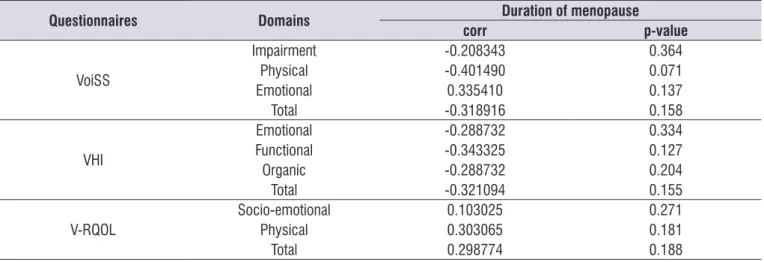
Table 2. correlation between menopause duration and voice self-assessment questionnaires domains
Questionnaires Domains Duration of menopause
corr p-value
VoiSS
Impairment -0.208343 0.364
Physical -0.401490 0.071
Emotional 0.335410 0.137
Total -0.318916 0.158
VHI
Emotional -0.288732 0.334
Functional -0.343325 0.127
Organic -0.288732 0.204
Total -0.321094 0.155
V-RQOL Socio-emotionalPhysical 0.1030250.303065 0.2710.181
Total 0.298774 0.188
Experimental group analysis only.
* Signiicant values (p≤0.05) – Pearson’s correlation test
Subtitles: corr= correlation coeficient; VoiSS= Voice symptom scale; VHI= voice handicap index; V-RQOL= voice-related quality of life.
Table 1. Comparison of self-assessment questionnaires domains between study and control groups
Questionnaire Domain Group n Mean Median SD p-value
VoiSS
Impairment GC 21 2.14 3 1.93 0.059
GE 21 9.00 0 1.93
Physical GCGE 2121 1.523.71 31 0.710.71 0.099
Emotional GC 21 0.04 0 0.67 0.068
GE 21 1.76 0 0.67
Total GCGE 2121 14.473.76 71 3.043.04 0.045*
VHI
Emotional GC 21 0.00 0 0.69 0.075
GE 21 1.66 0 0.69
Functional GC 21 0.19 0 0.86 0.028*
GE 21 2.40 0 0.86
Organic
GC 21 0.72 0 0.92
0.835
GE 21 3.12 0 0.92
Total GCGE 2121 0.927.19 00 2.432.43 0.576
V-RQOL
socio-emotional GC 21 100.00 100 1.91 0.018*
GE 21 94.45 100 1.91
Physic GCGE 2121 96.9591.64 100100 2.522.52 0.618
Total GCGE 2121 98.1195.3 100100 1.811.81 0.887
* Signiicant value (p≤0.05) – “Mann-Whitney” Test.
because the scores of V-RQOL were signiicantly lower
in menopausal women.
Voice handicap index, in functional domain, is related to the voice symptoms perception and the disturbances in voice behavior caused by the physi-ologic changes in vocal fold mucosa. The research analyzing 32 women after menopause using hormone therapy to replace estrogen, nasal (11 women) and oral (12 women), and a control group (nine women),
showed signiicant decrease in VHI functional score
after nasal therapy, attributed by the authors to the decrease of voice perceptual analysis of roughness and hoarseness, and the presence of voice complaint35, which corroborated the found in the present study.
Nevertheless, literature indicates one of the limita-tions imposed by voice disorder is the subjects do not perceive their voices at the same way, regardless of having the same diagnose24.
A recent study sought to obtain the cutoff values to determine the presence of dysphonia of the voice self-assessment questionnaires VoiSS, VHI, V-RQOL and Vocal Performance Questionnaire. Therefore, the questionnaires were addressed to 975 adult subjects, 468 with dysphonia, and 489 vocally health. The ROC
curve showed the more eficient questionnaires were
VoiSS and VHI, with cutoff values for vocally health subjects lower than 16 point in VoiSS, lower than 19 points in VHI, and higher than 91.25 point in V-RQOL24.
Hence the differences between the SG and CG regarding the voice self-assessment in the current study (Table 1), the obtained scores in VoiSS, VHI and V-RQOL are within the expected to health voices24. Therefore, the menopausal women studied, despite the difference with the women in menacme, are probably due to the physiologic changes during climacteric and do not have big impact in daily life. Still, it is not
possible to afirm the participants of the study to have
or not dysphonia based on self-assessment, without the proper voice and laryngoscope evaluation, because there is not a direct and strong correlation between the voice clinic evaluation and patient’s perception24.
Despite the subjectivity of impairment or handicap perception due to voice disorder, studies analyzing subjects with and without dysphonia show subjects using voice professionally24,36 or having already done
treatment to voice disorders26 usually have more
perception of the voice disorder impact on daily life. Therefore, the scores according to the expected to vocally health subjects, regardless the difference between groups, may occurred because the subjects
DISCUSSION
Voice symptoms self-assessment showed the score
of SG signiicantly higher in total domain than CG
(Table 1).
There is an increase in follicle-stimulation hormone (FSH) and luteinizing hormone (LH) in women during climacteric causing changes in male hormones secre-tions and increase in androgens secresecre-tions31, and are responsible for the several physic changes, inclusive in larynx13. These physiologic changes occurs in LP layers in climacteric resulting in the increase of mass and thickening the vocal folds, atrophying the vocal muscle, and stiffening the larynx cartilages13, which may cause pneumo-phono-articulation incoordination and decrease of vocal extension12-14,32.
These changes in larynx may be the responsible for the voice symptoms starting in climacteric and present during menopause. Literature shows the main voice symptoms reported by menopausal women are vocal
fatigue, dificulty to reach high notes, dificulty to talk
loud, and hoarseness12,13,32,33.
In the current study, the difference found in the group comparison show in the study group the women in menopause have more symptoms than the ones in menacme, probably due to physiologic changes in larynx.
As consequence of signiicantly higher voice
symptoms in SG it was observed they had more handicaps in functional domain of VHI and lower socio-emotional score in V-RQOL than CG (Table 1).
Researches using closed questionnaires to self-assessment of the impact of dysphonia on daily life in menopausal women were not found in literature.
Regarding studies with similar population, one analyzed 106 adult women divided in two groups, 46 women still having ovarian function (G1), and 60 women without ovarian function (G2), using voice perceptual analysis (GRBASI scale), vowels and fricative conso-nants maximum phonation time, acoustic analysis (Voxmetria software), V-RQOL questionnaire and voice
self-classiication. G2 showed signiicantly higher levels
of general grade of dysphonia, roughness, strain and instability, lower fundamental frequency and /s/ MPT, but, there was no difference in quality of life scores and
most of G2 subjects classiied their voices as pleasant.
using voice professionally or previously had voice treatment were excluded from the sample, and the participants do not have high voice load.
The results show there is no correlation between the duration of menopause in SG and the voice self-assessment scores (Table 2). Literature points out the physiologic voice changes are progressive and do not negatively impact the quality of life related to voice in subjects that do not have high voice load37.
There was limitation in the current study regarding the size and selection of sample, and the division based on self-reported data. Random and controlled studies comparing women in menacme, climacteric and menopause and relating the self-assessment data to the voice clinic evaluation, and also the analysis of menopause women in hormone therapy are
recom-mended in order to conirm the present data.
CONCLUSION
Menopause women have more voice symptoms in total domain, higher voice handicap in functional domain, and lower score in socio-emotional domain in Voice-Related quality of voice questionnaire than women in menacme have. But, the scores found are expected to health voices subjects.
REFERENCES
1. Santos JS, Fialho AVM, Rodrigues DP. Inluências das famílias no cuidado às mulheres climatéricas. Rev Eletr Enf. 2013;15(1):215-22.
2. Luizaga CTM, Gotlieb SLD. Mortalidade masculina
em três capitais brasileiras. Rev Bras Epidemiol.
2013;16(1):87-99.
3. Gallon CW, Wender MC. Osório. Estado nutricional e qualidade de vida da mulher climatérica. Rev Bras Ginecol Obstet. 2012;34(4):175-83.
4. Berlezi EM, Bem AD, Antonello C, Leite MT, Bertolo
EB. Incontinência Urinária em mulheres no período
pós-menopausa: um problema de saúde pública. Rev Bras Geriatr Gerontol. 2009;12(2):159-73. 5. Tairova OS, De Lorenzi DRS. Inluência do
exercício físico na qualidade de vida de mulheres na pós-menopausa: um estudo caso-controle. Rev Bras Geriat Gerontol. 2011;14(1):135-45.
6. Araujo IA, Queiroz ABA, Moura MAV, Penna LHG. Representações sociais da vida sexual de mulheres no climatério atendidas em serviços públicos de saúde. Texto contexto – enferm. 2013;22(1):114-22.
7. Miranda JS, Ferreira MLS, Corrente JE. Qualidade de vida em mulheres no climatério
atendidas na Atenção Primária. Rev Bras Enferm.
2014;67(5):803-9.
8. Feltrin RB, Velho LMLS. Entre o campo e o laboratório: a dinâmica de produção de conhecimento no Ambulatório de Menopausa do
Caism/Unicamp. His Ciênc Saúde-Manguinhos.
2014;21(4):1283-300.
9. Leal TB, Rocha LS, De Queiroz MM, Campos MCC, Gontijo BG, Barral ABCR. Risco cardiovascular em mulheres na pós-menopausa. Revista Multidisciplinar das FIPMoc. 2014;12(20):51-7. 10. Valença CN, Germano RM. Concepções de
mulheres sobre a menopausa e climatério. Rev Rene. 2010;11(1):161-71.
11. Lanferdini IIZ, Portella MR. Signiicado do climatério
para a mulher octogenária rural. Estud Interdiscipl
Envelhec. 2014;19(1):173-88.
12. Magno LCL. A voz na menopausa [monograia]. Porto Alegre (RS): Centro de Especialização em Fonoaudiologia Clínica – CEFAC; 1999.
13. Machado MADP, Aldrighi JM Ferreira LP. Os sentidos atribuídos à voz por mulheres após a menopausa. Rev Saúde Pública. 2005;39(2):261-9. 14. Meurer ME, Wender MCO, Corleta HVE, Capp E.
Voz e fala no menacme e na pós menopausa. Rev Bras Saúde Mater Infant. 2004;4(3):281-6.
15. Raj A, Gupta B, Chowdhury A, Chadha S. A study of voice changes in various phases of menstrual cycle and in postmenopausal women. J Voice. 2010;24(3):363-8.
16. Ferreira VN, Chinelato RSC, Castro MR, Ferreira MEC. Menopausa: marco biopsicossocial do envelhecimento feminino. Psicologia & Sociedade. 2013;25(2):410-9.
17. Morais EPG, Azevedo RR, Chiari BM. Correlação entre voz, autoavaliação vocal e qualidade de vida em voz de professoras. Rev CEFAC. 2012;14(5):892-900.
18. Gomes JCP, Burns GF, Coelho GF, Costa PN, Aroeira KP, Endringer DC. Estudo comparativo
entre hábitos vocais, sedentarismo e qualidade
de vida em idosos frequentadores da Unidade de Saúde Vila Nova. Espaç Saúde. 2013;14(1-2):18-28. 19. World Health Organization. Programme on Mental
20. Paoliello K, Oliveira G, Behlau M. Desvantagem vocal no canto mapeado por diferentes protocolos de autoavaliacão. CoDAS. 2013;25(5):463-8.
21. Ugulino AC, Oliveira G, Behlau M. Disfonia na percepção do clínico e do paciente. J Soc Bras Fonoaudiol. 2012;24(2):113-8.
22. Costa ÉBM, Pernambuco L. A. Autoavaliação vocal e avaliação perceptivo-auditiva da voz em mulheres com doença tireoidiana. Rev CEFAC. 2014;16(3):967-73.
23. Bastilha GR., Lima JPM, Cielo CA. Inluência
do sexo, idade, proissão e diagnóstico
fonoaudiológico na qualidade de vida em voz. Rev CEFAC. 2014;16(6):1900-8.
24. Behlau M, Madazio G, Moreti F, Oliveira G, Santos
LMA, Paulinelli BR, Couto Junior EB. Eficiency and
cutoff values of self-assessment instruments on the impact of a voice problem. J Voice. 2015 [ahead of
print].
25. Ricarte A, Oliveira G, Behlau M. Validação do
protocolo Peril e Participaçao em Atividades
Vocais no Brasil. CoDAS. 2012;25(15):242-9.
26. Moreti F, Zambon F, Oliveira G, Behlau M. Adaptação transcultural da versão brasileira da Voice Symptom Scale: VoiSS. J Soc Bras Fonoaudiol. 2011;23(4):398-400.
27. Moreti F, Zambon F, Oliveira G, Behlau M. Cross-cultural adaptation, validation, and cutoff values of the brazilian version of the voice symptom scale – VoiSS. J Voice. 2014;28(4):458-68.
28. Behlau M, Oliveira G, Santos LMA, Ricarte A. Validação no Brasil de protocolos de autoavaliação do impacto de uma disfonia. Pró-Fono R Atual Cient. 2009;21(4):326-32.
29. Behlau M, Santos LMA, Oliveira G. Cross Cultural adaptation and validation of the Voice Handicap Index into Brazilian Portuguese. J Voice. 2009;25(3):354-9.
30. Gasparini G, Behlau M. Quality of life: validation of the Brazilian version of the Voice-Related Quality of Life (V-RQOL) measure. J Voice. 2009;23(1):76-81. 31. Behlau M, Rehder MI, Valente O. Disfonias
endócrinas. In: Behlau M (Org). Voz. O livro do especialista. 2nd ed. Rio de Janeiro: Revinter; 2005. p. 51-78.
32. Tonisi GBR. Os efeitos do climatério na frequência
fundamental [monograia]. São Paulo (SP): Centro
de Especialização em Fonoaudiologia Clínica - CEFAC; 1998.
33. Meurer ME, Wender MCO, Corleta HVE, Capp E. Female suprasegmental speech parameters in reproductive age postmenopause. Maturitas. 2004;48(1):71-7.
34. Ferraz PRR, Bertoldo SV, Costa LGM, Serra ECN, Silva EM, Brito LMO et al. Vocal parameters and voice-related quality of life in adult women with and without ovarian function. J Voice. 2013;27(3):355-60.
35. Firat Y, Engin-Ustun Y, Kizilay A, Ustun Y, Akarcay M, Selimoglu E et al. Effect of intranasal estrogen on vocal quality. J Voice. 2009;23(6):716-20.
36. Leite APD, Carnevale LB, Rocha HL, Pereira CA, Lacerda Filho L. Relação entre autoavaliação vocal e dados da avaliação clínica em indivíduos disfônicos. Rev CEFAC. 2015;17(1):44-51.