Revista Gaúcha
de Enfermagem
DOI: http://dx.doi.org/10.1590/1983-1447.2014.02.44370
Patient safety: analysis of the incidents
notifi ed in a hospital, in south of Brazil
a Nurse, specialized in Management Nursing, Masters in Health Sciences. Post-Graduate in Nursing at the Universidade Federal do Rio Grande do Sul. Member of the study group in Nursing Management /NEGE-UFRGS. Porto Alegre (RS), Brazil.
b Nurse, Faculdade Nossa Senhora de Fátima. Caxias do Sul (RS), Brasil.
c Nurse, Specialized in Risk Management and Hos-pital safety. Lecturer at the Nursing Department in Faculdade da Serra Gaúcha (FSG). Caxias do Sul (RS), Brazil.
Elisiane Lorenzinia
Juliana Annita Ribeiro Santib
Ana Cristina Pretto Báoc
Segurança do paciente: análise dos incidentes
notifi cados em um hospital do sul do Brasil
Seguridad del paciente: análisis del incidente
notifi cado en un hospital en el sur de Brasil
ABSTRACT
This study aimed to evaluate the incidents reported between the years 2008 and 2012, in a large hospital in southern Brazil. This is a retrospective study of documentary analysis, transverse and descriptive with a quantitative approach. Data was collected in march 2013, analyzed and presented as absolute and relative frequency. We identifi ed 755 cases; this represented 1.1% of total hospital-izations. The higher frequency of reporting in inpatient units was 64.8%. The incident with the highest prevalence in this study was 45.4% falls, followed by medication error 16.7% and 16.2% other incidents. The low number of notifi cations can be related to the system adopted by the institution where the professional who notifi es the incident needs to be identifi ed.
Keywords: Patient safety. Medication errors. Accidental falls. Safety management.
RESUMO
Objetivou-se avaliar os incidentes notifi cados entre os anos 2008 e 2012, em um hospital de grande porte da região Sul do Brasil. Trata-se de um estudo retrospectivo de análise documental, transversal, descritivo, com abordagem quantitativa. Os dados foram coletados em março de 2013, analisados e apresentados em frequência absoluta e relativa. Identifi caram-se 755 casos, que repre-sentaram 1,1% do total de internações. A maior frequência de notifi cação ocorreu nas unidades de internação (64,8%). O incidente de maior prevalência neste estudo foi a queda (45,4%), seguida do erro de medicação (16,7%) e outros incidentes (16,2%). O baixo número de notifi cações pode estar relacionado ao sistema adotado pela instituição, onde o profi ssional que notifi ca o incidente precisa ser identifi cado.
Descritores: Segurança do paciente. Erros de medicação. Acidentes por quedas. Gerenciamento de segurança.
RESUMEN
El objetivo fue evaluar los incidentes reportados entre los años 2005 y 2012 en un gran hospital en el Sur de Brasil. Se trata de un estudio retrospectivo de análisis documental, transversal, descriptivo, con enfoque cuantitativo. Los datos fueron recolectados en marzo de 2013, analizados y presentados como frecuencia absoluta y relativa. Se identifi caron 755 casos, estos representaron 1,1% del total de hospitalizaciones. La mayor frecuencia de informes en las unidades de hospitalización fue del 64,8%. El incidente de mayor prevalencia en este estudio fue la caída 45,4%, seguida por error de medicación 16,7% y 16,2% de otros incidentes. El bajo número de notifi caciones puede estar relacionado con el sistema adoptado pela institución, donde el profesional que notifi ca el incidente debe ser identifi cado.
INTRODUCTION
The occurrence of incidents that compromise the safe-ty of the patient has become a pressing challenge for all health service institutions. The incident may or may not in-volve injury. The injury incidents are called Adverse Events (AEs)(1). The patient safety issue has become more and
more widespread within health institutions and amongst health professionals with respect to the constant search for the quality of care given and minimizing the number of avoidable incidents.
Everyday basic health care procedures are highly com-plex and despite the higher quality standards currently in place, AEs take place daily. Worldwide there are between 2.9% and 16.6% of inpatients aff ected by AEs, such as com-plications during or post-operation, medication errors, health care associated infections (HAI) or patients falling from their beds(2-3).
The publication of the study The Error is Human in 1999 by the Institute of Medicine (IOM) showed that between approx. 44,000 to a 98,000 people died every year in Amer-ican hospitals , victims of AEs(4). The occurrence of AEs is
a signifi cant worldwide issue and it also represents huge fi nancial loss.
In response to this global necessity, WHO, launched in 2004, The World Alliance for Patient Safety. The programme has strategies, guidelines and international targets which aim to disseminate and ensure practices that enable the safety of patients in diff erent countries(5). The Alliance acts
in diff erent areas, from hand washing, safe surgery to tax-onomy which aims to organize taxonomical aspects per-taining to the theme of patient safety(6).
In Brazil there are more than 200 thousand healthcare establishments in place where sick people are routinely treated using health technologies and with the assistance of health professionals, and therefore are subject to AEs(7). A
study undertaken in three university hospitals in the State of Rio de Janeiro showed that 7.6% of the total of 1,103 inpatients in 2003 suff ered from AEs and of these 66.7% could have been avoided(8). These fi ndings suggest that
possible problems regarding patient safety are more fre-quent in Brazilian hospitals than in developed countries(8).
This comparative encouraged, in the last decade, the promotion of diff erent initiatives to provide safer health-care. Among these initiatives, stands out the creation of in-dicator-based programmes for the monitoring the quality and safety. In April 2013, a National Programme for Patient Safety was created in Brazil, with the view, amongst other objectives, to monitoring and the prevention of damage in healthcare(9). Taking into consideration the lack of available
data which makes it diffi cult to defi ne accurately the mag-nitude of the problem of AEs in Brazil, the current study is justifi ed because it allows for the possibility of an increased understanding of this internationally discussed theme, patient safety. The measurement of data provides fi gures for formulating plans and strategies with the objective of signifi cant improvement in patient safety. Hence, the key question of this study is put forward: What are the incidents which occur during the provision of healthcare in a large hospital? Therefore, the objective of this study is to assess the recorded incidents between 2008 and 2012, in a large hospital situated in the South of Brazil.
METHOD
It is a retrospective documental analysis, transversal and descriptive study with a quantitative approach.
This study was developed in a large institution, with a philanthropic character, which attends to the users of SUS – Unifi ed Health System and Supplementary Heath Agen-cy situated in the South of Brazil. No exclusion criteria were considered, so all notifi ed incident records were included and analysed for the period between 2008 and 2012. Data collection was carried out in March 2013, by the research-er, through the electronic records of the incidents notifi ed in the institution. This data was collected in a regular way and digitized into a Microsoft Offi ce Excel 7 spreadsheet. Another identical spreadsheet was produced by the re-searcher.
For the statistical analysis we considered the following variables: data, incident, place of occurrence department, age and gender. The Statistical Package for Social Sciences programme (SPSS) 17.0 version was used. All the categorized data was presented in absolute and relative frequency.
The research complied with the guidelines of Resolu-tion 196/96(10) of the National Council for Health; it was
au-thorized by the institution where the research took place and approved by the Ethics Committee in the Virvi Ramos Research with the protocol number 224.450 and CAAE 12266513.7.0000.5523.
RESULTS
In this study we analysed 755 notifi ed cases of incidents between 2008 and 2012. According to results obtained, the year of 2008 presented the smallest percentage of notifi ed cases – 103 (13.6%), while 2012 was the year with the high-est percentage 239 (31.7%), as shown in Figure 1.
the increase was 5.8%; from 2009 to 2010 the increase was 7.3%; from 2010 to 2011 – 59.8% and from 2011 to 2012 the proportional increase of cases was 27.8%. Therefore the data shows a proportional average increase between 2008 and 2012 of 25.2%.
Taking as a base the quantitative admissions for each year, there were a total of 71,037 admissions. Carrying out the weighting of the number of incidents notifi ed against the number of admissions, we found that actually the in-crease was 142% of the incidents in 2008 (0.7%) compared to (1.7%) in 2012. Regarding the total of incidents these represent 1.1% of the total admissions.
As to the place of occurrence shown in Table 1, the inci-dents were more frequent in the internship units; 487 ( 64.8%).
The diverse types of incidents with medical products, Table 2, represent 151 (20%). The incidence of highest prev-alence observed in this study was for falls 343 (45.4%) of cases, Table 3, followed by medication errors 126 (16.7%) of the total incidents and other events 123 (16.2%) as shown in Table 2.
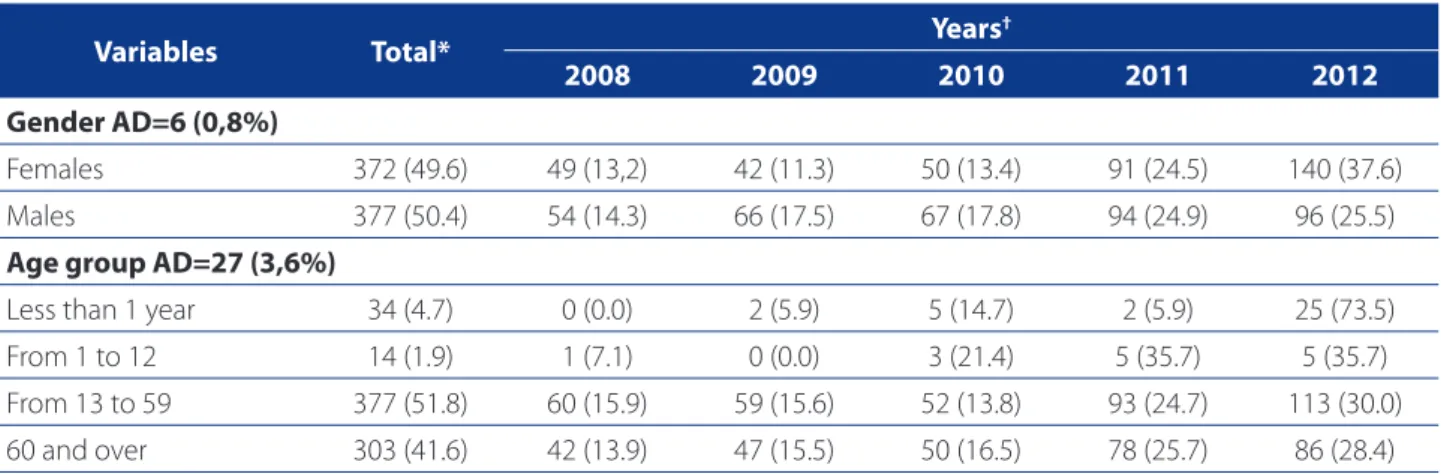
When analysing the incidents notifi ed regarding gender, Table 4 , we observed that for the total amount of incidents notifi ed, there was no signifi cant diff erence in the distribu-tion between men 377 ( 50.4%) and women 372 (49.6%).
With regards to age, Table 4 , for the total amount of in-cidents the ages from 13 to 59 years old predominate 377 (51.8%) and from 60 years or more 303 (41.6%) of incidents notifi ed.
DEBATE
The results of this study show that the occurrence of incidents notifi ed were 1.1% of the total admissions, less than what was found in another Brazilian study of 1.47% (11).
Another more recent research made in three Brazilian school hospitals in Rio de Janeiro identifi ed a 7.6% inci-dence of patients suff ering from AEs, although only 66.7% of them were considered avoidable(12).
The international method most used to detect inci-dents and AEs is voluntary notifi cation. However, this meth-od contains some limitations, sub notifi cation due to time limits, lack of appropriate information system, fear of litiga-tion, reluctance of people to confront their own mistakes, lack of understanding of the importance of the event and a lack of action after notifi cation. However this method of communication is the most useful for the induction of be-haviour changes, showing the benefi ts of the production of AE’s records, because it allows us to learn from our own mistakes. The presence of a voluntary safety team which is multidisciplinary can help to elaborate on the reports(6).
The results of this study shows a considerable increase in the number of incidents notifi ed 103 (13.6%) in 2008, against 239 (31.7%) in 2012. It is important t highlight that the institution that provided the data for this study, has been developing its safety policies, fi rstly by joining the Hospital Accreditation System and secondly by the promotion of the campaign for safety of patients in 2010. Figure 1. Absolute distribution of the incidents notifi ed between 2008 and 2012. Caxias do Sul, RS, 2012.
Source: Research data
0 50
2008
103 109
187
239
2009 2010 2011 2012
100 150 200 250 300
Total of incidents
Incidents
Even though there was an increase in the total number of notifi cations yearly, the numbers found are still very low, which suggests that the notifi cation system adopted by the institution – where the professional who notifi es the
incident must identify them self – can greatly help increase the number of sub notifi cation.
In general, although there is an obvious increase in the number of incidents notifi ed, national and international
Departments
(AD=3 (0,4%)) Total*
Year†
2008 2009 2010 2011 2012
Internship Unit 487 (64.8) 91 (18.7) 90 (18.5) 75 (15.4) 115 (23.6) 116 (23.8) Intensive and Intensive Care Unit 50 (6.6) 4 (8.0) 2 (4.0) 4 (8.0) 16 (32.0) 24 (48.0) Neonatal Intensive Care Unit 26 (3.5) 1 (3.8) 3 (11.5) 4 (15.4) 18 (69.2)
Emergency Room 27 (3.6) 1 (3.7) 5 (18.5) 4 (14.8) 5 (18.5) 12 (44.4)
Emergency Care Unit 8 (1.1) 3 (37.5) 3 (37.5) 2 (25.0)
Operating Room 35 (4.7) 1 (2.9) 2 (5.7) 7 (20.0) 11 (31.4) 14 (40.0)
Recovery Room 11 (1.5) 4 (36.4) 5 (45.5) 2 (18.2)
Obstetrics Centre 12 (1.6) 1 (8.3) 1 (8.3) 1 (8.3) 9 (75.0)
Nephrology Institute 14 (1.9) 1 (7.1) 2 (14.3) 5 (35.7) 6 (42.9)
Cancerology Institute 40 (5.3) 10 (25.0) 17 (42.5) 13 (32.5)
Sector 230 30 (4.0) 1 (3.3) 1 (3.3) 4 (13.3) 4 (13.3) 20 (66.7)
Others 12 (1.5) 1 (8.3) 2 (16.3) 3 (25.0) 2 (16.3) 2 (16.3)
Table 1. Absolute and relative distribution of the incidents notifi ed occurred in each department against the total of inci-dents analysed per year. Caxias do Sul, RS, 2012.
Source: Research data.
Key words: AD: Absent Data 3 (0.4%); Others: X-Ray room, Laboratory, Diagnostic Imaging Department , Nursery, Outpatient Care.
*Results are shown in percentage ( %), obtained over the total incidents †Results are shown in percentage (%), obtained over the total of each coded classifi cation.
Medication-related incidents Total* Years
†
2008 2009 2010 2011 2012
Drug administration using wrong method 8 (3.1) 1 (12.5) 4 (50.0) 3 (37.5) Drug administration at the wrong time 9 (3.4) 1 (11.1) 3 (33.3) 5 (55.6)
Chemotherapy Spillage 16 (6.1) 2 (12.5) 14 (85.7)
Wrong medication
Deteriorated medication 10 (3.8) 2 (20.0) 3 (30.0) 5 (50.0)
Medication wrongly administrated 5 (1.9) 1 (20.0) 3 (60.0) 1 (20.0)
Wrong dosage 29 (11.1) 6 (20.7) 12 (41.4) 11 (37.9)
Wrong medication 126 (48.3) 7 (5.6) 18 (14.3) 20 (15.9) 39 (31.0) 42 (33.3)
Omission mistake 35 (13.4) 1 (2.9) 10 (28.6) 10 (28.6) 14 (40.0)
Prescription mistake 2 (0.8) 2 (100.0)
Chemotherapy overfl ow 21 (8.0) 7 (33.3) 14 (66.7)
Table 2. Absolute and relative distribution of the medical product related incidents notifi ed against the total of medical product related incidents analysed per year. Caxias do Sul, RS, 2012.
Source: Research data.
studies show that fear and concern are still present in situ-ations of wrong-doing with or without sub notifi cation(2,6). Despite all the campaigns and incentives from WHO for no-tifi cation of mistakes, aiming towards a process of analysis of those situations, so allowing action plans to be creat-ed to prevent new occurrences, In Brazil, unfortunately, a culture of professional punishment still prevails(2). The lack of understanding of what is considered wrong-doing and possible irregularities in dealing with the patient and fear regarding their professional future are factors which make workers not report any kind of error caused or related to the patient(13).
In this study, the place where the most frequently re-ported occurrence of incidents took place was in the In-ternship Units 487 (64,8%), which can be related to the higher number of beds and inpatients in these units. In
second place, with regard to frequency of occurrences, were the Intensive Treatment Units and Intensive Care Units for adults 50 (6.6%). An assessment study on AEs in three public school hospitals in the State of Rio de Janei-ro, Brazil, revealed that AEs are most often found – 36.2% of the total cases – in surgical procedures. The operating room was the second place with higher frequency of AEs – 34.7% of the cases(8).
With regards to wrong medication errors (ME) a rate of 126 (16.7%) of the total incidents was found, making it the second most frequent in this study. In other research, the fi ndings were, however, that the medication errors (ME) were 62.7%. Understanding the types of errors which pre-vail in a hospital and the system of sub layers involved is paramount for the improvement of drug administration in that hospital. However we should highlight that there
Incidents Total* Year
†
2008 2009 2010 2011 2012
Cross breast-feeding 14 (1.9) 1 (7.1) 1 (7.1) 12 (85.7)
Others 123 (16.2) 8 (6.7) 9 (7.5) 21 (16.7) 37 (30.0) 48 (39.4)
Access loss 14 (1.9) 3 (21.4) 11 (78.6)
Falls 343 (45.4) 86 (25.1) 81 (23.6) 56 (16.3) 61 (17.8) 59 (17.2)
Table 3. Absolute and relative distribution of the incidents notifi ed against the total of incidents analysed per year. Caxias do Sul, RS, 2012.
Source: Research data.
Key words: Others (Catheter obstruction. Accidental extubation. Faulty preparation. Wrong log entry. Escape, etc...)
*Results are shown in percentage ( %), obtained over the total incidents. †Results are shown in percentage (%), obtained over the total of each classifi cation of event.
Variables Total* Years
†
2008 2009 2010 2011 2012
Gender AD=6 (0,8%)
Females 372 (49.6) 49 (13,2) 42 (11.3) 50 (13.4) 91 (24.5) 140 (37.6)
Males 377 (50.4) 54 (14.3) 66 (17.5) 67 (17.8) 94 (24.9) 96 (25.5)
Age group AD=27 (3,6%)
Less than 1 year 34 (4.7) 0 (0.0) 2 (5.9) 5 (14.7) 2 (5.9) 25 (73.5)
From 1 to 12 14 (1.9) 1 (7.1) 0 (0.0) 3 (21.4) 5 (35.7) 5 (35.7)
From 13 to 59 377 (51.8) 60 (15.9) 59 (15.6) 52 (13.8) 93 (24.7) 113 (30.0) 60 and over 303 (41.6) 42 (13.9) 47 (15.5) 50 (16.5) 78 (25.7) 86 (28.4)
Tabela 4. Absolute and relative distribution of notifi ed incidents for gender and age, for total incidents and for the year evaluated. Caxias do Sul, RS, 2012.
Source: Research data.
is evidence that shows that professionals do not know all medication errors, which leads to a lower notifi cation(14).
Some literature shows that ME can occur at any stage of medical therapy, it represents approximately 65% of all the AEs(15). In this investigation, the most frequent ones were medication errors, omission errors, dosage errors, drug administration at the wrong time and drug adminis-tration using the wrong method. This indicates that these mistakes don’t constitute, eminently, mistakes performed by the professionals, on the contrary, they can also be a result of the medication chain as a whole.
A study done in Spain shows that ME has a rate of 5.21%, revealing it to be one of the most frequent incident types(16). Another study undertaken in fi ve Brazilian univer-sity hospitals reveals that one of the main causes for ME is drug administration using methods diff erent to those prescribed with 92 (6.5%) of the total of 1,425 MEs. These mistakes were assigned to items listed in the medical pre-scription, such as codes or abbreviations in the dosage list, and also occurred when the prescription was in an elec-tronic form.
A study of invasive monitoring of the use of antimi-crobial agents in a hospital in Parana identifi ed the occur-rence of 91 AEs, however 3.3% were adverse reaction to the medication and 7.7% were mistakes in the notifi cation. In a university hospital in Ribeirão Preto, in the state of São Paulo , 925 prescriptions were analysed, 21% of them had erasures and 28.2% had unclear information on them(14). The researched literature assigned low scientifi c technical knowledge and a lack of updating in the nursing staff as one of the main causes of ME(13).
It should be pointed out that the relationship between the subject and the organization where they work can have a negative eff ect on the health carers performance, and this can contribute to the occurrence of incidents and AEs. Some factors such as high numbers of patients, high levels of noise and light and long working hours can also contribute to AE numbers, as well as changing shifts and the occurrence of confl icts(17).
Among the main incidents which could be prevented in health institutions, falls, represented the incident with the greatest occurrence in this study 343 (45.4%). For elder-ly inpatients or patients with home carers, falls are one of the most common sources of injury, causing skin trauma, fractures and also death(18)..
Constant patient surveillance is an important factor in preventing falls. There is also evidence that an appropriate number of infi rmary nursing staff helps obtain better re-sults in care and, consequently, a reduction in the rate of falls of hospitalized patients(19). A study in a tertiary hospital,
in the South of Brazil, revealed that increasing patient num-bers for a nursing team over 24hrs, elevated the incidence of falls from beds among the attended patients (3)..
Cross breast-feeding was present in 14 (1.9%) of the cases. It is considered an old practice, but is still around to-day, and is breast feeding of a newly born baby by another mother to help in weight gain or comfort of the recently born. Cross breast feeding can be off ered by mothers of interned babies or by professionals who have children at this period(20). It is know that cross breast feeding can cause diseases which could harm the baby. With regards to risk management and patient safety, this type of incident is considered avoidable. Records of these incidents are para-mount for the implementation of strategies to avoid reoc-currence. The intervention of nurses holds a central role in directing the infi rmary team and breast feeding mothers, so promoting health education.
When analysing the incidents notifi ed in relation to gender, we observed that there was no signifi cant diff er-ence between men 377 (50.4%) and women 372 (49.6%), confi rming the Spanish study that didn’t fi nd any signifi -cant diff erence between the genders(16).
In this study notifi ed incidents predominated in the age group from 13 to 59 years 377 (51.8 %), while patients over 60 years old were 303 (41.6%) of the notifi ed incidents. These statistics don’t match with the data found in other research where incidents predominated in patients of more than 62 years old(16).
CONCLUSION
From the total of 755 incidents notifi ed between 2008 and 2012 , we observed an increase of 142% in 2008 inci-dents (0.7%) compared to 2012 (1.7%). The prevalence was 1.1% over the total number of admissions, falls being 45.4% and errors with medication 16.7% of the total number of incidents notifi ed. A low number of notifi cations might be due to the system adopted by the institution, where, the professional reporting the incident must be identifi ed.
This study contributes in widening the understanding of this much discussed worldwide theme, Safety of the Patient. Through an analysis of notifi ed incidents, it is sug-gested that health institutions work towards a culture of safety, considering as a starting point, the planning of ac-tions to promote the safety of the patient. To achieve this, it is necessary that all are involved, from managerial staff through to staff at all the various operational levels.
study was undertaken in one institution only, so does not guarantee a generalization of results. For this reason, we suggest that other studies are made, with diff erent meth-ods, in diff erent institutions, so that new strategies can be drawn up to help avoid the occurrence of incidents and advert events.
REFERENCES
1. Runciman W, Hibbert P, Thomson R, Van Der Schaaf T, Sherman H, Lewalle P. To-wards an international classifi cation for patient safety: key concepts and terms. Int J Qual Health Care. 2009;21(1):18-26.
2. Silva EF, de Faveri F, Lorenzini E. Errores de medicación en el ejercicio de la enfer-maría: la revisión integrativa. Enfermería Global. 2014;13(34):330-7. 3. Magalhães AMM, Dall’Agnol CM, Marck PB. Carga de trabalho da equipe de
en-fermagem e segurança do paciente: estudo com método misto na abordagem ecológica restaurativa. Rev Latino-Am Enfermagem. 2013;21(nesp):146-54. 4. Kohn LT, Corrigan JM, Donaldson MS, editors. To err is human: building a safer
health system. Washington: The National Academy Press; 2000.
5. World Health Organization. World alliance for patient safety. [mentioned in 15 aug. 2012] Available in: http://www.who.int/patientsafety/worldalliance/en/. 6. Garrouste-Orgeas M, Philippart F, Bruel C, Max A, Lau N, Misset B. Overview of
medical errors and adverse events. Ann. Intensive Care. 2012 Feb 16;2(1):2. 7. Agência Nacional de Vigilância Sanitária (BR). Assistência segura: uma refl exão
teórica aplicada à prática. Brasília; 2013. Available in: http://www.anvisa.gov. br/hotsite/segurancadopaciente/documentos/junho/Modulo%201%20-%20 Assistencia%20Segura.pdf
8. Mendes W, Martins M, Rozenfeld S, Travassos C. The assessment of adverse events in Brazilian hospitals. Int J Qual Health Care. 2009;21(4):279-84. 9. Ministério da Saúde (BR). Portaria nº 529, de 1º de abril de 2013. Institui o
Pro-grama Nacional de Segurança do Paciente (PNSP) [citado em 11 fev. 2014].
Bra-sília (DF). Available in: http://bvsms.saude.gov.br/bvs/saudelegis/gm/2013/ prt0529_01_04_2013.html.
10. Ministério da Saúde (BR). Conselho Nacional de Saúde. Resolução n. 196/96. Dispõe sobre diretrizes e normas regulamentadoras de pesquisa com seres hu-manos. Brasília (DF); 1996.
11. Paiva MC et al. Caracterização das quedas de pacientes segundo notifi cação em boletins de eventos adversos. Rev Esc Enferm USP. 2009;44(1):134-8. 12. Gouvêa CSD, Travassos C. Indicadores de segurança do paciente para hospitais de
pacientes agudos: revisão sistemática. Cad Saúde Pública. 2010;26(6):1061-78. 13. Telles PC, Praxedes MF, Pinheiro ML. Erros de medicação: análise do conheci-mento da equipe de enfermagem de uma instituição hospitalar. Rev Gaúcha Enferm. 2011;32(3):539-45.
14. Camerini GF, Silva DL. Segurança do paciente: análise do preparo de me-dicação intravenosa em hospital da rede sentinela. Texto Contexto Enferm. 2011;20(1):41-9.
15. Gimenes FR. Administração de medicamentos, em vias diferentes das prescritas, relacionada à prescrição médica. Rev Latino-Am Enfermagem. 2011;19(1):7 telas.
16. Merino P, Álvarez J, Martín MC, Alonso, Gutiérrez S. Adverse events in Spa-nish intensive care units: the SYREC study. Int J Qual Health Care. 2011;24 (2):105-13.
17. Azoulay E, Timsit JF, Sprung CL, Soares M, Rusinova K, Lafabrie A, et al. Preva-lence and factors of intensive care unit confl icts: the confl icts study. Am J Respir Crit Care Med. 2009;180(9):853-60.
18. Tinetti ME, Baker DI, King M, Gottschalk M, Murphy TE, Acampora D, et al. Eff ect of dissemination of evidence in reducing injures from falls. N Engl J Med. 2008;359(3):252-61.
19. Lorenzini E, Deckman LR, Costa TC, Silva EF. Dimensionamento de pessoal de enfermagem: revisão integrativa. Cienc Cuid Saúde. 2014;13(1):166-71. 20. Pedron CD, Bonilha ALL. Práticas de atendimento ao neonato na
implanta-ção de uma unidade neonatal em hospital universitário. Rev Gaúcha Enferm. 2008;29(4):612-8.
Author’s address:
Elisiane Lorenzini
Rua Felipe dos Santos, 77/201 A, Padre Reus 93020-180, São Leopoldo, RS
E-mail: [email protected]