ORIGINAL ARTICLE
The time has come to stop rotations for the identification
of structures in the Hamilton Depression Scale (HAM-D
17
)
Per Bech,
1Claudio Csillag,
1Lone Hellstro¨m,
1Marcelo Pio de Almeida Fleck
21Psychiatric Research Unit, Frederiksborg General Hospital, Copenhagen University, Hillerød, Denmark.2Departamento de Psiquiatria e
Medicina Legal, Universidade Federal do Rio Grande do Sul (UFRGS), Porto Alegre, RS, Brazil.
Objective:To use principal component analysis (PCA) to test the hypothesis that the items of the Hamilton Depression Scale (HAM-D17) have been selected to reflect depression disability, whereas some of the items are specific for sub-typing depression into typical vs. atypical depression. Method:Our previous study using exploratory factor analysis on HAM-D17has been re-analyzed with PCA and the results have been compared to a dataset from another randomized prospective study. Results:PCA showed that the first principal component was a general factor covering depression disability with factor loadings very similar to those obtained in the STAR*D study. The second principal component was a bi-directional factor contrasting typical vs. atypical depression symptoms. Varimax rotation gave no new insight into the factor structure of HAM-D17.
Conclusion:With scales like the HAM-D17, it is very important to make a proper clinical interpretation of the PCA before attempting any form of exploratory factor analysis. For the HAM-D17, our results indicate that profile scores are needed because the total score of all 17 items in the HAM-D17does not give sufficient information.
Keywords: Hamilton Depression Scale; principal component analysis; exploratory factor analysis
Introduction
Factor analysis refers to a variety of psychometric techniques employed with the objective of reducing the original universe of items in a rating scale to a smaller number of components or factors without losing the information stored in the individual items. If the research-ers have no clear hypothesis as to how many factors there are for a given rating scale, factor analysis might be used as a means of exploring the data for a small set of factors. This form of factor analysis is called exploratory factor analysis.1 If, however, factor analysis is used to test some hypotheses or expectations about factors and their clinical nature, it is then called confirmatory factor analysis. In this case, the number of factors and their loadings are tested on the same data, i.e., within the frame of the investigation under examination.2
The principal component analysis (PCA) method, which is essentially not a factor analysis,3 is often considered as an initial stage in factor analysis to identify by eigenvalues the number of factors to be considered in an exploratory factor analysis.4However, as stressed by
Hotelling,5if we have a hypothesis based on the principle on which the items of the scale have been constructed, then PCA can be considered sufficient for testing this
hypothesis. Thus, when constructing intelligence tests (ability scales) or depression scales (disability scales), the items are carefully selected to be more or less positively correlated, resulting in the expectation that PCA will identify the first principal component as a general factor of intelligence (ability) or depression (disability). Hamilton actually selected the 17 items in his depression scale (HAM-D17) to capture general depression
disabil-ity.6In intelligence tests, the second principal component is expected to contrast verbal vs. non-verbal intelligence by a bi-directional factor (positive vs. negative loadings), whereas in the HAM-D17, it is expected to contrast typical
vs. atypical depression.6-8However, the literature on the
HAM-D17is very unclear on studies using factor analysis,
because different authors have used different techniques within their exploratory factor analyses, i.e., different forms of rotation.9 In the study by Fleck et al.,10 PCA
identified a general factor in the HAM-D17. Such a general
factor is often considered as an argument for the total score being a sufficient statistic measure (unidimension-ality), e.g., in Lewis et al.11However, the individual items of the HAM-D17 within this general factor have very
different loadings, implying that more than one dimension is present. Therefore, Fleck et al.10 then performed varimax rotation of the dataset in an attempt to identify other factors in an exploratory analysis in accordance with Kim & Mueller.1In this report, we will show the full outcome of PCA in the study by Fleck et al.10 as an example of using this method to test the hypothesis that the HAM-D17 contains the general factor of depression
disability as well as a second principal component Correspondence: Per Bech, Psychiatric Research Unit,
Frederiksborg General Hospital, Dyrehavevej 48, DK-3400 Hillerød, Denmark.
E-mail: [email protected]
Submitted Feb 22 2013, accepted May 19 2013.
Revista Brasileira de Psiquiatria. 2013;35:360–363
ß2013 Associac¸a˜o Brasileira de Psiquiatria
separating the wings or subscale factors within the A,B,C version of HAM-D17,7in which (A) refers to HAM-D6(the
core items of depression), (B) refers to the HAM-D9(the
unspecific arousal symptoms of depression), and (C) refers to HAM-D2 (suicidal thoughts and insight). These
three subscales (A,B,C) have been selected on a purely clinical basis, not by factor analysis.7
Methods
Patients
The patients were all admitted to Psychiatric University Hospitals in Paris for depressive illness and were diagnosed according to DSM-III-R12using the Composite International Diagnostic Interview (CIDI), version 1.0.13 Exclusion criteria were as follows: serious medical disorder, organic mental disorder according to DSM-III-R, substance or alcohol disorders according to DSM-III-R, schizophrenia according to DSM-III-R, speech or hearing problems, or intelligence defect, i.e., an IQ of 70 or less.
The Hamilton Depression Scale (HAM-D17)
The interview guide for HAM-D1714was used. All patients
were assessed by the same interviewer (MFAF). The patients were all interviewed for HAM-D17within the first 3
days of hospitalization. At the end of this initial period, all patients were then interviewed with CIDI to arrive at a DSM-III-R diagnosis.
Statistical analysis
In the first publication of this study,10PCA was directly connected with an exploratory factor analysis using varimax rotation. In the report presented herein, we performed a PCA in accordance with Hotelling,3,5 Dunteman,15and Child.4We considered PCA as a purely
mathematical analysis. When two items are correlated, the variance of each can be divided into two parts, one of which is common to both items (i.e., the general disability of depressive states) while the other is specific to each item and independent (i.e., orthogonal) of the common variance and the other specific variance. This indepen-dent, second component captures the specific variance, resulting in a bi-directional factor which contrasts by its negative vs. positive loadings.
When interpreting the symptom pattern of the second factor, we followed Child4in considering all loadings (not only loadings with ‘‘statistical significance’’), because they help capture the ‘‘flavor’’ of the factor loadings, emphasizing that PCA is a mathematical rather than a statistical model. The PCA results from this report have been compared with the three-factor varimax factor analysis done by Fleck et al.,10 and with the post-hoc PCA analysis of STAR*D study results.6
Results
In total, 60 patients fulfilled the inclusion vs. exclusion criteria. The mean (SD) HAM-D17score was 26.6 (7.3).
The mean (SD) age was 47.0 (13.2) years. Females comprised 77% of the sample.
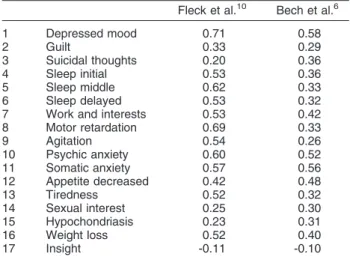
Six components with an eigenvalue of 1 or more were identified by PCA. The first principal component was a general factor (Table 1) with an eigenvalue of 4.16. The second principal component was a bi-directional factor (Table 2) with an eigenvalue of 2.22. Together, these two components explained 37.5% of the variance.
Table 1 shows the factor loadings of the first principal component. In both the present study and the STAR*D study, all HAM-D17items apart from insight had positive
loadings, implying that the first principal component is a general factor of depressive disability.
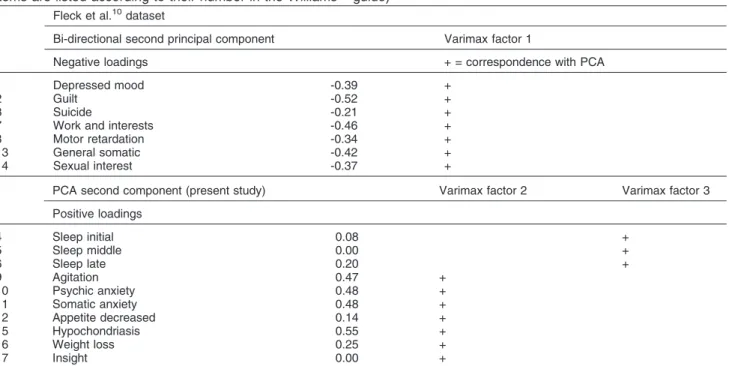
Table 2 shows the negative and positive loadings for the second principal component. For comparison, the results of the three-factor varimax exploratory factor analysis published by Fleck et al.10 are also shown in Table 2. The negatively loaded items in the present study had 100% concordance with the factor 1 identified by Fleck et al.,10 including seven items, of which five are contained in the HAM-D6 factor of specific depression
symptoms (depressed mood, guilt, suicide, work and interests, motor retardation, and tiredness [general somatic]). The remaining item of psychic anxiety was actually identified by Fleck et al.16in the Brazilian part of their study. The item of suicidal thoughts had the lowest loading among the negatively loaded items in Table 2. The positively loaded items cover factor 2 and factor 3 in the varimax rotation. Here, the insight item had the lowest loading.
Discussion
To the best of our knowledge, this re-analysis of the study by Fleck et al.10 is the first investigation to show the importance of clinically interpreting the results of a PCA before moving on to the various forms of factor analysis, as recommended by Kline.17
In a symposium on psychological factor analysis, Peel18 made an attempt to consider PCA as a method
Table 1 Principal components analysis: first principal component
Fleck et al.10 Bech et al.6
1 Depressed mood 0.71 0.58
2 Guilt 0.33 0.29
3 Suicidal thoughts 0.20 0.36
4 Sleep initial 0.53 0.36
5 Sleep middle 0.62 0.33
6 Sleep delayed 0.53 0.32
7 Work and interests 0.53 0.42
8 Motor retardation 0.69 0.33
9 Agitation 0.54 0.26
10 Psychic anxiety 0.60 0.52
11 Somatic anxiety 0.57 0.56
12 Appetite decreased 0.42 0.48
13 Tiredness 0.52 0.32
14 Sexual interest 0.25 0.30
15 Hypochondriasis 0.23 0.31
16 Weight loss 0.52 0.40
17 Insight -0.11 -0.10
Structures in HAM-D17 361
to test hypotheses within intelligence tests and person-ality inventories with reference to a general principal component reflecting ability (general factor of intelli-gence) or disability (general factor of neuroticism), as well as to a specific principal component of ability (verbal vs. non-verbal intelligence) or disability (extraversion vs. introversion). As regards the two-component personality hypothesis, Peel18 referred to Eysenck’s Personality Inventory. In 1969, Eysenck et al.19 concluded on their work with the Eysenck Personality Inventory: ‘‘A principal component solution on the two central factors (neuroti-cism and extraversion/introversion) gives a perfectly adequate approximation; a varimax rotation of the first two factors extracted may or may not improve this approximation’’. Therefore, Eysenck et al.19 preferred PCA results from the higher-order factor. This is most clearly discussed by Child,4who states that the decrease of explained variance within PCA from the first to the last component and the simultaneous increase of error variance as one progresses from the first to the last component implies strongly that only the first and the second principal component are the objects for clinical interpretations.
Within the three-fold A,B,C HAM-D17version,7,8which
has been developed on a purely clinical basis, the HAM-D9or (B) contains the unspecific arousal symptoms which
are to a large extent covered by the positively loaded items in the second PCA component (Table 2). In the varimax solution (Table 2), factor 3 covers sleep items, whereas factor 2 covers the remaining unspecific arousal items (HAM-D9) or (B). The insight item had the lowest
loadings in both the varimax solution and the PCA solution. The C wing of the HAM-D17 includes the two
items with the lowest loadings among both the negatively loaded items (suicide) and the positively loaded items
(insight). These two items (HAM-D2) contain the most
idiographic HAM-D items.7,8
With our analysis of the HAM-D17 dataset from the
study by Fleck et al.,10 we have shown that a varimax rotation did not improve the approximation of identifying a general factor covering general depressive disability and a bi-directional factor covering typical vs. atypical depression. This finding is in concordance with the PCA of the STAR*D dataset in which the same version of the HAM-D17was used.6
As discussed by Kline,17 the demonstration of a
general factor of disability is tautological, because it is a simple consequence of how Hamilton selected the items in the HAM-D17, but should not be considered as an
artefact of the PCA algebra. The clinical importance of PCA is the identification of the second principal compo-nent in which the items with negative loadings reflect the specific content of depression, whereas items with positive loadings reflect the unspecific symptoms of depression. The items not so clearly loaded (suicide and insight) are the idiographic (HAM-D2) items.
As discussed by Salum et al.,20 we need to use the typical HAM-D17items when measuring the
antidepres-sive effects of drugs in the treatment of mild to moderate depression. The HAM-D6 items are among the seven
items Santen et al.21found able to discriminate between paroxetine and placebo.
In conclusion, our analysis of the Fleck et al.10dataset has shown that rotated factors can be seen as an artefact of factor analysis by changing the pattern of loadings already found clinically meaningful within the PCA approach. Our results thus indicate that profile scores are needed because the sum total score of all 17 items in the HAM-D17 does not provide sufficient information
about the structure of depression symptomatology.
Table 2 Principal components analysis with the second principal component and varimax rotation in the Fleck et al.10study (items are listed according to their number in the Williams14guide)
Fleck et al.10dataset
Bi-directional second principal component Varimax factor 1
Negative loadings + = correspondence with PCA
1 Depressed mood -0.39 +
2 Guilt -0.52 +
3 Suicide -0.21 +
7 Work and interests -0.46 +
8 Motor retardation -0.34 +
13 General somatic -0.42 +
14 Sexual interest -0.37 +
PCA second component (present study) Varimax factor 2 Varimax factor 3
Positive loadings
4 Sleep initial 0.08 +
5 Sleep middle 0.00 +
6 Sleep late 0.20 +
9 Agitation 0.47 +
10 Psychic anxiety 0.48 +
11 Somatic anxiety 0.48 +
12 Appetite decreased 0.14 +
15 Hypochondriasis 0.55 +
16 Weight loss 0.25 +
17 Insight 0.00 +
P Bech et al. 362
Disclosure
The authors report no conflicts of interest.
References
1 Kim J, Mueller C. Factor analysis: statistical methods and practical issues. Berverly Hills: Sage Publications; 1978.
2 Long JC. Confirmatory factor analysis. Beverly Hills: Sage publica-tions; 1983.
3 Hotelling H. Analysis of a complex of statistical variables with principal components. J Educ Psychol. 1933;24:417-41.
4 Child D. The essentials of factor analysis. 3rd ed. London : Cassel Educational; 2006.
5 Hotelling H. Rotations in psychology and the statistical revolution. Science. 1942;95:504-7.
6 Bech P, Fava M, Trivedi MH, Wisniewski SR, Rush AJ. Factor structure and dimensionality of the two depression scales in STAR*D using level 1 datasets. J Affect Disord. 2011;132:396-400. 7 Bech P. The ABC profile of the HAM-D17. Rev Bras Psiquiatr.
2011;33:109-10.
8 Bech P. Clinical psychometrics. Oxford: Wiley Blackwell; 2012. 9 Bech P. Fifty years with the Hamilton scales for anxiety and depression.
A tribute to Max Hamilton. Psychother Psychosom. 2009;78:202-11. 10 Fleck MP, Poirier-Littre MF, Guelfi JD, Bourdel MC, Loo H. Factorial
structure of the 17-item Hamilton Depression Rating Scale. Acta Psychiatr Scand. 1995;92:168-72.
11 Lewis G, Pelosi AJ, Araya R, Dunn G. Measuring psychiatric disorder in the community: a standardized assessment for use by lay interviewers. Psychol Med. 1992;22:465-86.
12 American Psychiatric Association. Diagnostic and statistical manual of mental disorders - DSM-IV-TRH. 3th ed. Washington: American Psychiatric Publishing; 1987.
13 World Health Organization (WHO). Composite International Diagnostic Interview (CIDI), Version 1.0. Geneva: WHO; 1990. 14 Williams JB. A structured interview guide for the Hamilton
Depression Rating Scale. Arch Gen Psychiatry. 1988;45:742-7. 15 Dunteman GH. Principal components analysis. Newbury Park:
SAGE Publications; 1989.
16 Fleck MP, Chaves ML, Poirier-Littre MF, Bourdel MC, Loo H, Guelfi JD. Depression in France and Brazil: factorial structure of the 17-item Hamilton Depression Scale in inpatients. J Nerv Ment Dis. 2004;192:103-10.
17 Kline P. The handbook of psychological testing. London: Routledge; 1993.
18 Peel EA. Factorial analysis as a psychological technique. In: Nordisk Psykologis Monograph Series No. 3. Stockholm: Almquist and Wiksells; 1953. p. 7-90.
19 Eysenck HJ, Henricksen A, Eysenck SBG. The orthogonality of personality structure. In: Eysenck HJ, Eysenck SBG, editors. Personality structure and measurement. London: Eysenck, Routledge & Kegan Paul; 1969. p. 155-70.
20 Salum GA, Manfro GG, Fleck MP. What is not ‘‘effective’’ in mild to moderate depression: antidepressants or the Hamilton Rating Scale for Depression? [Internet]. 2013 Apr [cited 2013 October 08] CNS Spectrums. 2011. http://www.docguide.com// node/1337177
21 Santen G, Gomeni R, Danhof M, Della Pasqua O. Sensitivity of the individual items of the Hamilton depression rating scale to response and its consequences for the assessment of efficacy. J Psychiatr Res. 2008;42:1000-9.
Structures in HAM-D17 363