PSYCHIATRICCOMORBIDITYINDIABETESTYPE 1: ACROSS-SECTIONALOBSERVATIONALSTUDY
REV ASSOC MED BRAS 2014; 60(1):59-62 59
ORIGINAL ARTICLE
Psychiatric comorbidity in diabetes type 1: a cross-sectional
observational study
ANA CLAUDIA C. DE ORNELAS MAIA1,ARTHURDE AZEVEDO BRAGA1,FLÁVIA PAES1,2, SERGIO MACHADO1,2,3,4,5, ANTONIO EGIDIO NARDI1,2, ADRIANA CARDOSO SILVA1,2
1Laboratory of Panic and Respiration – Institute of Psychiatry of Federal University of Rio de Janeiro, Rio de Janeiro, RJ, Brazil 2National Institute of Translational Medicine (INCT-TM), Rio de Janeiro, RJ, Brazil
3Institute of Philosophy, Federal University of Uberlândia, Uberlândia, MG, Brazil
4Chiropractic program of the Faculty of Medical Sciences, Central University (UCEN), Santiago, Chile 5Physical Activity Sciences Postgraduate Program - Salgado de Oliveira University, Niterói, RJ, Brazil
S
UMMARYStudy conducted at the Federal University of Rio de Janeiro, Rio de Janeiro, RJ, Brazil
Article submitted: 08/13/12
Accepted for publication: 05/06/13
Correspondence:
Institute of Psychiatry Federal University of Rio de Janeiro –
INCT Translational Medicine Rua Visconde de Pirajá, 407/702 – Rio
de Janeiro – RJ – Brazil ZIP Code: 22410-003 Phone: +55 21 2521-6147 Fax: +55 21 2523-6839 [email protected]
http://dx.doi.org/10.1590/1806-9282.60.01.013
Conflict of interest: none
Objective:This study aims to investigate the prevalence of psychiatric disorders, i.e., the presence of signs and symptoms of anxiety and depression in type 1 di-abetic patients, as well as to investigate the prevalence of psychiatric disorders in insulin dependent patients.
Methods: A cross-sectional observational study of 110 diabetic outpatients (mean = 58.3, SD = 14.5; 50 male and 60 female) was conducted in a public health clinic with patients diagnosed with diabetes mellitus who were under the medical super-vision of an endocrinologist. The patients were evaluated through the Mini Interna-tional Neuropsychiatric Interview and the Hospital Anxiety and Depression Scale (HADS). Results: With respect to anxiety symptoms, we found a prevalence of 60% (n = 66) among patients, while in depression symptoms we found a prevalence of 53.6% (n = 59) concerning the 110 patients evaluated. More speciically, we found 28.2% (n = 31) of patients without depression or anxiety, 13.6% (n = 15) of pa-tients with depression, 16.4% (n = 18) of papa-tients with anxiety and 41.8% (n = 46) of patients with depression combined with anxiety. The most remarkable data were generalized anxiety disorder (22.7%), dysthymia (18.2%), panic disorder (8.2%) and social phobia (5.5%).
Conclusion: The need for accurate assessments about the presence of symp-toms related to psychopathology in patients with type 1 diabetes is evident.
Key words: Anxiety. Depression. Prevalence and Diabetes.
I
NTRODUCTIONStudies indicate that groups of chronic diseases, such as type 1 diabetes, can present severe psychiatric disorders. Faced with direct relationship of type 1 diabetes with men-tal health, studies demonstrate that the prevalence of psychiatric disorders in diabetic patients may reach 84% for mood disorders and 80% for anxiety disorders1. A
pre-vious study2 evaluated the presence of psychiatric
comor-bidities both in patients with diabetes types 1 and 2. The irst group showed higher values for the presence of gene-ral anxiety disorder (24%), dysthymia (20%), social phobia (6%), depression (9% for current and 5% for lifelong), pa-nic disorder (5%) and suicide risk (3%), all values were higher than those found in the general population or in patients with type 2 diabetes. The instrument used in this study
was the Mini International Neuropsychiatric interview, which is aimed to detecting psychiatric disorders2.
Patients with a high prevalence of psychiatric disor-ders have further compromising their mental health when assessed in terms of signs and symptoms. The presence of psychiatric signs and symptoms, and more speciically depression and anxiety, can increase morbidity, and lead to worse clinical prognosis.
O
BJECTIVEMAIA ACCO ETAL.
6 0 REV ASSOC MED BRAS 2014; 60(1):59-62
M
ETHODSA cross-sectional observational study was conducted, con-sisting of 110 diabetic outpatients (mean = 58.3, SD = 14.5; 50 male and 60 female) from a public health clinic with diagnoses of type 1 diabetes mellitus who were under the medical supervision of an endocrinologist. To conirm the indings of a previous study2 regarding the
prevalen-ce of psychiatric disorders, patients were assessed with the Mini International Neuropsychiatric Interview (MINI). To evaluate the prevalence of depression and anxiety signs
and symptoms the Hospital Anxiety and Depression Sca-le (HADS) was used. Patients signed a consent form and were aware of the experimental protocol (approved by the Ethics Committee at the Federal University of Rio de Ja-neiro) before participation commenced.
R
ESULTSDescriptive data from participants diagnosed as having type 1 diabetes, including sex, age, education, occupation, religion, children, and the use of psychotropic drugs, are shown in Table 1.
TABLE 1 Characteristics of type 1 diabetic patients
Patients with type 1 diabetes
Sex
Female 60 (54.5%) Male 50 (45.5%)
Age 58.3 (±14.5%)
Minimum=18; Maximum=82
Marital status
Single 17 (15.5%) Married 60 (54.5%) Divorced 11 (10%) Widow/Widower 22 (20%)
Occupation
Student or housewife 22 (20%) Unemployed 3 (2.7%) Working 35 (31.8%) On leave 5 (4.5%) Retired 45 (40.9%)
Religion
Atheist 4 (3.6%) Catholic 74 (67.3%) Evangelic 24 (21.8%) Other 8 (7.3%)
Education
Elementary school 74 (67.3%) High school 25 (22.7%) College or Higher education 11 (10%)
Children
Yes 95 (86.4%) No 15 (13.6%)
Use of Psychotropic Drugs
Yes 20 (18.2%) No 90 (81.8%)
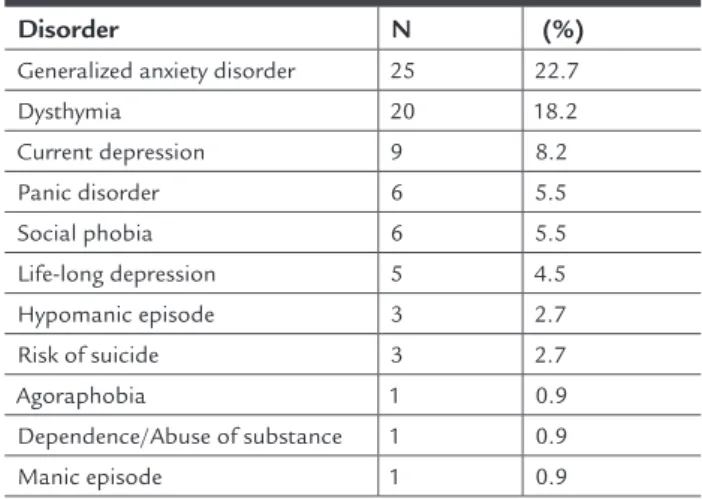
With regard to prevalence of psychiatric disorders, table 2 shows the total number of patients with diabetes who presented each of the psychiatric disorders identiied in the sample, with percentages in decreasing order.
TABLE 2 Prevalence of psychiatric disorders in type 1 diabetic patients
Disorder N (%)
Generalized anxiety disorder 25 22.7 Dysthymia 20 18.2 Current depression 9 8.2 Panic disorder 6 5.5
Social phobia 6 5.5 Life-long depression 5 4.5 Hypomanic episode 3 2.7
Risk of suicide 3 2.7 Agoraphobia 1 0.9 Dependence/Abuse of substance 1 0.9
Manic episode 1 0.9
Considering that some patients may present signs and symptoms without necessarily meet the criteria for a diag-nosis of a psychiatric disorder, we also considered impor-tant to assess the presence of anxiety and depression sings and symptoms, which may or may not be superimposed, at this level. According to HADS, 60% (n = 66) and 53.6% (n = 59) of the patients have signs and symptoms of an-xiety and depression, respectively. Evaluating the clini-cal picture, considering possible superposition, we found only 28.2% of patients (n = 31) without depression or an-xiety, 13.6% of patients (n = 15) with depression, 16.4% of patients (n = 18) with anxiety and the larger group, 41.8% of patients (n = 46), with depression combined with an-xiety setting the most serious situation.
D
ISCUSSIONWe observed that the prevalence of psychiatric comorbi-dity (mainly anxiety and depression) in type 1 diabetes, as a disorder as well as a set of signs and symptoms, is sig-niicantly higher in diabetic patients than those found in the general population.
Sample characteristics found in this study for vari-ables such as sex, age, marital status, occupation, educa-tion and even religion were similar to those found in a previous study2 as well as prevalence rates for psychiatric
deinite-PSYCHIATRICCOMORBIDITYINDIABETESTYPE 1: ACROSS-SECTIONALOBSERVATIONALSTUDY
REV ASSOC MED BRAS 2014; 60(1):59-62 61
ly higher than those found in the non-clinical popula-tion. When mental health was evaluated only by disorder, the higher prevalence found was for GAD (22.7%) and Dysthymia (18.2%) while all other disorders had preva-lence below 10%. Thus, understanding the presence of psychiatric impairment at the level of signs and symp-toms enables us to better understand the actual mental health status of the patient.
Considering that anxiety and depression are factors that affect the clinical picture of diabetes and also com-promise treatment adherence, fundamental for these pa-tients, the severity of mental health impairment in these patients is clear. This is especially true when we realize that only 28.2% of them show no anxiety or depression, according to the HADS, while 41.8% of the subjects pres-ent both anxiety and depression combined.
The prevalence of depression in patients with diabe-tes is about 2 to 4 times greater than that seen in the ge-neral population, which may affect up to 30% of diabe-tics, and a meta-analysis conirmed the double risk of depression in diabetics, as well as demonstrated that dia-betic women have a higher risk of depression (28%) than diabetic men (18%)3. Another relevant factor is anxiety
in type 1 diabetic patients, which can be related to glyce-mic control. The contingency to be in balance with health can generate greater concern compared to people who don’t have the disease3,4.
With respect to depression, some studies demonstra-ted that type 1 diabetic patients have a probability 3 or 4 times higher to develop suicidal ideation, compared to non-diabetic patients (13.3% vs. 3.5%, respectively; p = 0.001)5. Moreover, the indings in research6 showed that
there is a high prevalence of psychiatry disorders in type 1 diabetic patients (e.g., 1% of agoraphobia, 3% of hypo-manic episode, and 1% of hypo-manic episode) associated with anxiety-phobia and depression disorders, which supports our results. The study7 revealed that among 224 type 1
diabetic patients with hypoglycemic episodes, for instan-ce, 74% had agoraphobia. Other studies indicated that the prevalence of mood disorders is signiicantly higher in type 1 diabetic patients8 (i.e., 15% of dysthymia, 11% of
current depression and 5% of panic disorder), reaching up to 67%9. A possible explanation for such high
preva-lence, more speciically in the case of dysthymia, was pro-bably due to the inadequacy of psychological and psychia-tric treatment performed in the study. Dysthymia, which is usually accompanied by signiicant functional impair-ment, is related to estimative of individuals who are ma-naging it at any given time, reaching around 4% to 6% of the general population10,11. In line with this, the study12
demonstrated that dysthymic patients are at increased risk for poor general health, and when compared with the general population, they frequently use medical services and are among patients with several medical disorders.
Another important evidence comes from a meta-analy-sis13 that the odds of depression in type 1 diabetic patients
were twice that of the non-diabetic patients (OR, 2.0; 95% CI, 1.8-2.2). With regard to anxiety disorders, panic disor-der, a severe and devastating condition marked by recur-rent and unexpected attacks of sudden onset and short duration related to physiological anxiety sensations (such as subsequent hyperventilation, palpitations, chest pain, nausea, numbness)14,15 seems similar to the symptoms of
hypoglycemia, frequently observed in type 1 diabetes. In addition to the signs and symptoms of anxiety and depression in type 1 diabetes, both the physiological chan-ges in the chronic course of the disease: weight gain, pain, hypertension, heart disease, loss of motor skills, or blind-ness directly affect the emotional state2.
C
ONCLUSIONTherefore, we observed high prevalence of psychiatric di-sorders in type 1 diabetes. Moreover, we observed that 60% and 53.6% of the patients have signs and symptoms of anxiety and depression, respectively. More speciically, taking into account the clinical picture and possible su-perposition, we found only 28.2% of patients without de-pression or anxiety, 13.6% of patients with dede-pression, 16.4% of patients with anxiety, and the larger group, 41.8% of patients, with depression combined with anxiety set-ting the most serious situation. Thus, we propose that physiological symptoms of hypoglycemia and hyperglyce-mia, such as, weight gain, pain, hypertension, heart di-sease, loss of motor skills, or blindness, can be associated with anxiety disorders, due to the generation of sensa-tions similar to anxiety disorders, which can also change the mood of individuals.
The need for accurate assessments for the presence of symptoms related to psychopathology in patients with diabetes is evident, as well as the development of thera-peutic protocols that consider the physical, psychologi-cal and social conditions of this population.
R
ESUMOComorbidade psiquiátrica no diabetes tipo 1: um estudo transversal observacional.
in-MAIA ACCO ETAL.
62 REV ASSOC MED BRAS 2014; 60(1):59-62
R
EFERENCES1. Chaudhry R, Mishra P, Mishra J, Parminder S, Mishra BP. Psychiatric morbidity among diabetic patients: a hospital-based study. Ind Psychiatry J. 2011;19(1):47-9.
2. De Ornelas Maia AC, Braga Ade A, Brouwers A, Nardi AE, De Oliveira e Silva AC. Prevalence of psychiatric disorders in patients with diabetes types 1 and 2. Compr Psychiatry. 2012;53(8):1169-73.
3. Musselman DL, Betan E, Larsen HE, Phillips LS. Relationship of depression to diabetes types 1 and 2: Epidemiology, biology, and treatment. Biol Psychiatry. 2003;54(4):317-29.
4. Brieger P, Marneros A. Dysthymia and cyclothymia—serious consequences of rarely diagnosed disorders. Versicherungsmedizin. 1998;50(6):215-8. 5. Engum A. The role of depression and anxiety in onset of diabetes in a large
population-based study. J Psychosom Res. 2007;62(1):31-8.
6. Berlin I, Bisserbe JC, Eiber R, Balssa N, Sachon C, Bosquet F, et al. Phobic symptoms, particularly the fear of blood and injury, are associated with poor glycemic control in type I diabetic adults. Diabetes Care. 1997;20(2):176-8. 7. Costea M, Ionescu-Tîrgoviote C, Chela D. Mincu I. Fear of hypoglycemia in type 1 (insulin-dependent) diabetic patients. Rom J Intern Med. 1993;31(4):291-5.
8. Magee WJ, Eaton WW, Wittchen HU. Agoraphobia, simple phobia and social phobia in the national comorbity survey. Arch Gen Psychiatry. 1996;53(2):159-68.
9. Eren I, Erdi O, Ozcankaya R. Relationship between blood glucose control and psychiatric disorders in type II diabetic patients. Turk Psikiyatri Derg. 2003;14(3):184-91.
10. Noyes R, Moroz F, Davidson JRT, Liebowitz MR, Davidson A, Siegel J, et al. Moclobemide in social phobia: a controlled dose-response trial. J Clin Pharmacol. 1997;17(4):247-54.
11. Clavijo M, Carvalho JJ, Rios M, De Oliveira IR. Psychiatric disorders in patients with diabetes type 2 at medical care and training district of Rio Branco-Acre, Brazil. Arq Neuropsiquiatr. 2006;64(3B):807-13.
12. Howland RH. General health, health care utilization, and medical comorbidity in dysthymia. Int J Psychiatry Med. 1993;23(3):211-38.
13. Anderson RJ, Freedland KE, Clouse RE, Lustman PJ. The prevalence of comorbid depression in adults with diabetes: a meta-analysis. Diabetes Care. 2001;24(6):1069-78.
14. Gannon MA, Qaseem A, Snow V, Turner B. Raising achievement: educating physicians to address effects of at-risk drinking on common diseases. Qual Prim Care. 2011;19(1):43-7.
15. Gannon M, Qaseem A, Snow V. Community-based primary care: improving and assessing diabetes management. Am J Med Qual. 2010;25(1):6-12. vestigar as principais prevalências psiquiátricas que os
acometem.
Métodos: Pesquisa realizada em 110 pacientes diabéti-cos atendidos em ambulatórios (média = 58.3, D = 14.5; 50 masculinos e 60 femininos) conduzida em Postos de Saúde Pública nos momentos de consulta médica com endocrinologista. A avaliação transcorreu com as escalas Mini International Neuropsychiatric Interview and Hospital Anxiety and Depression Scale (HADS).
Resultados: Os sintomas de ansiedade tiveram prevalên-cia de 60% (n = 66), enquanto para depressão encontra-mos resultados de 53.6% (n = 59), considerando que 110 pacientes foram avaliados. Mais especiicamente, nós en-contramos 28,2 (n. 31) pacientes sem depressão ou ansie-dade, 13,6 (n. 15) pacientes com depressão, 16,4 pacien-tes (n. 18) com ansiedade e 41,8 (n. 46) pacienpacien-tes com depressão combinada com ansiedade. Outros transtor-nos comórbidos tiveram prevalência de ansiedade gene-ralizada (22,7%), distimia (18,2%), pânico (8,2%) e fobia social (5,5%).
Conclusão: Sintomas ansiosos e depressivos são comuns em pacientes diabéticos do tipo 1, porém há prevalência de psicopatologias diversas nesse grupo de pacientes, le-vando em conta novas necessidades de pesquisas futuras para validar protocolos de tratamentos mais adequados para diabéticos do tipo 1.