AR
TIGO
AR
TICLE
1 Programa de Pós-Graduação em Saúde Coletiva, Universidade do Vale do Rio dos Sinos. Av. Unisinos 950, Cristo Rei. 93022-000 São Leopoldo RS Brasil.
The role of emotional states
in fruit and vegetable consumption in Brazilian adults
O papel dos estados emocionais
no consumo de frutas e vegetais em adultos brasileiros
Resumo O objetivo foi verificar a associação en-tre a autopercepção do estado emocional com o consumo adequado de frutas, verduras e legumes (FVL). Este é um estudo transversal de base popu-lacional com uma amostra probabilística de 1100 adultos residentes na zona urbana de um municí-pio de médio porte do Brasil. Considerou-se como consumo adequado uma ingestão ≥ 3 frutas con-comitante com ≥ 5 colheres de verduras/legumes ao dia. O estado emocional foi avaliado através da autopercepção do nervosismo/stress e distúrbios psiquiátricos menores (DPM). Potenciais fatores de confundimento incluíam variáveis demográfi-cas, socioeconômicas e comportamentais. Foram observadas associações significativas entre a auto-percepção de nervosismo/stress e DPM com o con-sumo adequado de FVL. Após o controle de fatores de confusão, adultos relatando ausência de nervo-sismo/stress possuíam uma chance de apresentar um consumo adequado duas vezes maior do que aqueles relatando nervosismo/stress. Similar-mente, participantes com ausência de distúrbios psiquiátricos possuíam uma chance de consumo adequado FVL 52% mais elevada quando com-parados àqueles que relataram presença desses sintomas. Quando estratificada por gênero, esse efeito aumentou e manteve-se com significância estatística apenas entre as mulheres.
Palavras-chave Autopercepção de nervosismo/ stress, DPM, Consumo de frutas, verduras e legu-mes
Abstract The objective was to investigate the as-sociation between emotional states with adequate fruit and vegetable consumption (FVC). This is a population-based cross-sectional study with 1,100 adults from a medium-sized city in Southern Bra-zil. Adequate FVC was defined as concomitant intake ≥ 3 fruits and ≥ 5 tablespoons of vegetables per day. Exposures were self-perception of ner-vousness/stress and minor psychiatric disorders (MPD). Data analysis used logistic regression. After controlling for demographic, socioeconomic and behavioral variables, adults reporting lack of nervousness/stress were twice more likely to report adequate FVC than those who reported it. Simi-larly, those reporting not having MPD symptoms were 52% more likely to have adequate FVC than those who did not. These effects increased and re-mained significant among women.
Key words Self concept, Mental health, Minor psychiatric disorders, Fruit and vegetable intake
Helena Beatriz Rower 1
Maria Teresa Anselmo Olinto 1
Tonantzin Ribeiro Gonçalves 1
R
o
w
er HB
Introduction
The rapid changes in population dietary patterns along with reductions in malnutrition and in-creases in obesity rates elicit global concern1,2. In
Brazil, large national surveys such as the National Survey of Household Expenditure in 1974-1975, the National Survey on Health and Nutrition in 1989 and the Consumer Expenditure Surveys in 2002-2003 and 2008-2009 have shown that, in all regions of the country and in all age and income categories, the percentages of overweight and obese people have increased continuously and substantially1,3. There has been a concomitant
in-crease in the consumption of processed products, which are rich in reined carbohydrates and fats, and a decrease in the consumption of fruits and vegetables (FV)1,2.
There is considerable evidence for the pro-tective roles of an adequate consumption of FV in the prevention of obesity and of chronic non-communicable diseases (NCDs) such as di-abetes4 and, cardiovascular diseases5. It has also
been shown that regular consumption of FV fa-cilitate the prevention of asthma, iron deiciency anaemia6 and mental disorders7,8.
Previous studies also indicate that FV intake is strongly inluenced by demographic and eco-nomic aspects. Generally, women, married and white people, those with better education and income, physically active, non-smokers, and with moderate alcohol consumption habits tend to consume adequately FV9-12.
There has also been increasing interest on the role of emotional states on eating behaviour. As-pects such as anger, sadness, daily stressors and other stressful situations may affect the whole process of intake (e.g., motivation to eat, food choices, chewing, time spent eating, amount of food intake), as well as metabolism and diges-tion13. Several studies have reported the
associ-ation between adequate consumption of FV and favourable mental states7,8,14-17. Absence of
asso-ciation has also been reported18. The aim of this
study was to investigate the association between emotional states and FV intake in adults from a medium-sized city in southern Brazil.
Materials and methods
Design and procedure
This is a population-based cross-sectional study of a representative sample of adults aged
18 years or more who live in the city. In 2010, the municipal area included 214,087 inhabitants, of whom 109,845 (51.3%) were females and 104,242 (49.7%) were males19.
The data were collected in 2006 and 2007 through structured interviews with a standard-ized and pre-tested questionnaire that comprised demographic, socioeconomic, behavioural, and mental health variables. A pilot study of the in-strument with 100 people and a quality control with approximately 10% of the sample was per-formed.
Sampling
The sample size calculation was based on data from the pilot study, using the method for proportions with conglomerate randomization20
and taking the self-perception health outcome. The sample size was calculated to have 85% pow-er (1- = 0.85) to detect a diffpow-erence of 7% in the prevalence of poor self-perceived health, with 95% conidence. A number of 35 households per sector and an intra-class correlation coefi-cient of 0.05 were adopted. From this, a sample of 1,260 households in 36 sectors was estimat-ed. The sample size was increased by 20% in the number of households and 10% in the number of sectors, due to possible losses and the control of confounding factors in the data analysis. Thus, it was necessary to access a total of 1,512 house-holds in 40 census tracts.
Participant selection occurred in 2 stages. First, a random selection of census tracts was conducted among the 270 existing tracts in the urban city area. Next, blocks were randomly se-lected within the sectors, and all households were visited. If, after completing the block, a suficient number of households had not been visited, the interviewer would complete another block of the previously drawn sector. Questionnaires were administered at home to the person responsible for the household at the time of the interview. Persons under the age of 18 were excluded.
Outcome
aúd
e C
ole
tiv
a,
22(2):489-497,
2017
was used in this study, only 40 participants could participate in the analysis, which would signii-cantly decrease the statistical power with which to detect associations. Therefore, it was decided to conduct the analysis according to the criteria used in studies from countries where the recom-mendations suggested the consumption of 5 FV portions22,23. Therefore, adequate consumption
was deined as the concomitant intake of 3 or more fruits (or natural fruit juices) and 5 or more tablespoons of vegetables per day.
Exposures
The exposures were assessed as the self-per-ceptions of nervousness/stress and the presence of minor psychiatric disorders (MPD). The for-mer was assessed by the perceptions of nervous-ness/stress using the following question: “Do you see yourself as a nervous person?” The possible answers were “no”, “sometimes” and “yes”. The latter, used the Self-Report Questionnaire (SRQ-20), which consists of 20 questions and permits the tracking of MPDs (e.g., depression, anxiety, somatoform disorders and neurasthenia). The SRQ-20 has shown high sensitivity (83%) and speciicity (80%) for the Brazilian population24.
Despite the fact that its results do not mean a clinical diagnosis, the World Health Organization recommends the SRQ-20 for this purpose and this tool has been shown to be effective in MPD detection25. The cut-off points were six positive
responses for males and seven for females.
Confounding factors
The confounding factors included demo-graphic, socioeconomic and behavioural variables. The demographic variables were age (10-year-range age groups), race (white, black and other) and marital status (married, single or divorced/ alone). The socioeconomic variables were family income (in R$) and education (years of school-ing), which were further categorized into high (highest 25% of the individual scores), medium (intermediate 50% of the scores) and low (lowest 25% of the scores). The behavioural variables in-cluded smoking (non-smoker or smoker), phys-ical activity (insuficiently active: do not practice physical activity or practice for up to 150 minutes/ week or active:> 150 minutes/week)26 and alcohol
consumption (do not consume/consume mod-erately: < 24AU/month for women and < 40AU/ month for men or yes/excess: > 24AU/month for women and > 40AU/month for men)27.
Data analysis
Double data entry was performed with the Epi Info 6 program, version 6.0 (Center for Dis-ease Control and Prevention, Atlanta, GA, USA) to identify typos. Data analysis was performed with the Stata 11.0 program (Stata Corp., College Station, TX, USA) in 2012. A controlled logis-tic regression for complex samples was used to provide estimate of the crude and adjusted odds ratios (OR) and their respective 95% conidence interval ranges (95% CI). Only the potential con-founding factors were entered in the multivari-able analysis. The varimultivari-able must have been asso-ciated with both the exposure and the outcome at a signiicance level < 20% (p <0, 20) to be con-sidered a confounding factor. After conducting the analysis, the interactions between expositions and gender were tested. The gender variable was found to be a potential modiier of the exposure effect on the outcome (P = 0.128 and P = 0.132). Therefore, analyses were conducted separately for males and females.
Ethics
The research project was approved by the Research Ethics Committee of Vale do Rio dos Sinos University, and all participants signed an informed consent.
Results
A total of 1,100 people were interviewed from 38 census tracts in the city. Eight per cent of the selected places were uninhabited or were trading points. Overall, 4% of the individuals refused to participate and those responsible for the house-holds were not found in 2% of the cases, even after the interviewer returned on 3 separate oc-casions.
Adequate FV consumption
R
o
w
er HB
Self-concept and mental disorders
Adults who reported a lack of nervousness/ stress were approximately twice more likely to
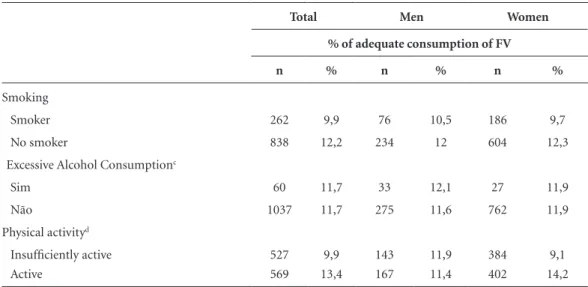
re-port adequate FV consumption than those who reported nervousness/stress Similarly, partici-pants with no MPD indicators were 53% more likely to report adequate FV consumption when Table 1. Prevalence of adequate fruit and vegetable consumption according to demographic, socioeconomic and behavioral variables.
Total Men Women
% of adequate consumption of FV
n % n % n %
Fruit and Vegetable Consuption
Adequate 128 11,6 36 11,6 92 11,6
Inadequate 972
Selfperception nervousness/stress
Yes 310 7,7 49 12,2 261 6,9
Sometimes 319 10,3 85 4,7 234 12,4
No 470 15,1 175 14,9 295 15,3
Minor Psychiatric Disorders
Yes 349 8,9 71 11,3 278 8,3
No 748 13,0 239 11,7 509 13,6
Skin color
White 922 12,1 260 11,2 662 12,5
Other 101 8,9 25 12 76 7,9
Black 58 6,9 17 5,9 41 7,3
Age group
18-29 247 8,1 69 5,8 178 9,0
30-39 182 9,3 46 8,7 136 9,6
40-49 258 10,5 66 7,6 192 11,5
50-59 217 16,6 62 21,0 155 14,8
>=60 196 14,3 67 14,9 129 14,0
Marital status
Married 615 12,8 180 13,9 435 12,4
Single 267 9,0 86 9,3 181 8,8
Divorced/Alone 218 11,5 44 6,8 174 12,6
Incomea
Low 235 7,7 27 0,0 208 8,7
Medium 565 11,2 154 10,4 411 11,4
High 268 16,4 117 15,4 151 17,2
Schoolingb
Low 204 9,3 39 5,1 165 10,3
Medium 697 10,6 203 12,3 494 9,9
High 166 16,9 51 9,8 115 20,0
aúd
e C
ole
tiv
a,
22(2):489-497,
2017
compared to those who reported the presence of MPD. After controlling for confounding factors, these expositions remained independently asso-ciated with the outcome and maintained their effect measures with the same clinical and statis-tical effects (Table 2).
The stratiied analysis by gender showed that the effects of psychological variables increased and remained statistically signiicant only in women. After controlling for socioeconomic, demographic and behavioural variables, women who reported a lack of nervousness/stress were 2.32-fold more likely to report adequate FV con-sumption than those who reported nervousness/ stress. Likewise, women with no MPD were 68% more likely to report adequate FV consumption when compared to those who reported the pres-ence of MPD indicators.
Discussion
The present study aimed to investigate the asso-ciation between self-perceptions of nervousness/ stress and MPD with FV consumption. The main indings suggest that there is a signiicant asso-ciation between favourable mental states and adequate FV consumption, particularly among women.
Several other studies in different countries found similar results. Five large cross-sectional studies that were conducted between 2000 and 2009 and included more than 250,000 Canadi-ans found a strong inverse association between FV consumption and the presence of depression symptoms, mood swings and anxiety16. In the
same light, a cohort study of 3,486 participants showed that people with dietary patterns based on FV and ish had lower rates of depression symptoms7. Another cohort study of 9,272 men
and 3,132 women, aged between 45 and 60 years old, showed that a higher FV intake was associ-ated with a lower likelihood of depressive symp-toms14. Other large cross-sectional studies of
elderly subjects in China17 and college students15
demonstrated that lower FV consumption was associated with the presence of stress and depres-sive symptoms. Finally, a cross-sectional study that included more than 18,000 people in the former Soviet Union reported that participants who reported fewer depressive symptoms also reported higher FV consumption28.
The results of this study suggest that, in the study population, the associations were limited to women. This suggests that men and wom-en might react differwom-ently to stressful situations and emotional demands and those psycholog-ical symptoms tend to more directly inluence
Total Men Women
% of adequate consumption of FV
n % n % n %
Smoking
Smoker 262 9,9 76 10,5 186 9,7
No smoker 838 12,2 234 12 604 12,3
Excessive Alcohol Consumptionc
Sim 60 11,7 33 12,1 27 11,9
Não 1037 11,7 275 11,6 762 11,9
Physical activityd
Insuficiently active 527 9,9 143 11,9 384 9,1
Active 569 13,4 167 11,4 402 14,2
a Income in Brazilian Reals (R$): Low (lowest 25% of the individual scores), Medium (intermediate 50% of the scores), High (highest 25% of the scores). b Educational level in years: Low (lowest 25% of the individual scores), Medium (intermediate 50% of the scores), High (highest 25% of the scores). c Do not consume/consume moderately: < 24AU/month for women and < 40 AU/month for men; yes/excess: > 24AU/month for women and > 40 AU/month for men. d Insuficiently active: do not practice physical activity or practice for less than 150 min/week; active: > 150 min/week.
R
o
w
er HB
women’s eating habits. It has been suggested that women might be more likely to eat in response to stressful situations14,29,30, at which times they
would increase the total amount of consumed food31 or, in particular, the consumption of
car-bohydrates and fats32. However, women tend to
consume more fruits when they are not under stress32,33. In contrast, men tend to eat unhealthy
foods regardless of the emotional situation32, and
the greatest reported inluence on men is related to socioeconomic aspects31. Simultaneously, in
stressful situations, there is evidence that men are more likely to use alcoholic beverages, cigarettes and other drugs34.
The action mechanisms behind the asso-ciation between mental states and adequate FV consumption are complex and thus require further studies15,35,36. On one hand, individually
stressful situations are presented as those that cause increased excretion of corticosteroids and adrenergic hormones, which are associated with a high consumption of foods with saturated fat, and decreased FV intake. Accordingly, it has been suggested that the intake of foods rich in fats and sugars, which are considered palatable, satiogenic or comfort foods (affective foods), decrease the activity of neuronal circuits involved in stress mechanisms and thus act as protectors against the harmful effects of stress15,35,36. Repetitive
hor-monal and alimentary stimuli can act as exter-nal opioids that generate feelings of satisfaction and consequent overeating37-39. Additionally, an
increase in leptin production (which is responsi-ble for the sense of satiety), a mechanism of hor-monal regulation, might be associated with the decreased consumption of comfort food40.
Table 2. Unadjusted and adjusted odds ratios for adequate fruit and vegetable consumption associated with emotional states.
Unadjusted Adjusted
OR (IC 95%) p OR (IC 95%) p
Selfperception nervousness/stress
Total sample 0,006 0,010
Yes 1 1a
Sometimes 1,38 (0,84-2,25) 1,38 (0,80-2,38)
No 2,12 (1,25-3,59) 1,99 (1,17-3,37)
Men 0,210 0,310
Yes 1 1b
Sometimes 0,35 (0,09-1,32) 0,31 (0,08-1,26)
No 1,25 (0,48-3,23) 1,03 (0,35-3,00)
Women 0,003 0,006
Yes 1 1c
Sometimes 1,91 (1,03-3,59) 1,95 (1,02-3,74)
No 2,43 (1,37-4,32) 2,32 (1,25-4,28)
Minor Psychiatric Disorders
Total sample 0,018 0,016
with MPD 1 1d
without MPD 1,53 (1,08-2,16) 1,52 (1,10-2,10)
Men 0,918 0,882
with MPD 1 1b
without MPD 1,05 (0,45-2,40) 1,07 (0,41-2,82)
Women 0,029 0,074
with MPD 1 1e
without MPD 1,74 (1,06-2,86) 1,68 (0,96-2,94)
aúd
e C
ole
tiv
a,
22(2):489-497,
2017
Dietary changes are also considered to result from emotional eating. In this case, the eating behaviour is motivated by emotional and/or stressful situations and now operates in a feed-back system related to emotions and food13. This
process of regulation between food and emotions is also inluenced by the individual’s coping strat-egies with regard to the stressful situations41, as
well as endocrine factors15,35,36, the context of the
individual’s life and/or aspects of his/her person-ality42. In regard to negative mental states such as
depressive symptoms, for example, the literature has shown that there is an overall deterioration in the quality of consumed food, which may lead, in some cases, to a lack of appetite7,8,16.
A two-way relationship between food and mental states may exist, in which emotions affect both the quantity and quality of consumed food, and, in turn, the consumed food may affect the emotional wellbeing of the individual43. In
addi-tion, it could be considered that self-perceptions of nervousness, might be associated with meth-ods of coping with milder and more transient stressful emotional states, while the MPD indi-cators may provide clues about the chronicity of negative emotional states. Therefore, further studies could investigate how the different coping strategies of individuals mediate the association between adequate FV consumption and mental health indicators.
One of the main weaknesses of this study refers to its cross-sectional nature. Because ex-posure and outcome were measured at the same time point, reverse causality may be present. Thus, it could be reasoned that, because emotions can affect the quality and quantity of consumed food, consumption could also affect emotional wellbe-ing7,14,43. Thus, longitudinal studies are needed to
elucidate the causal relationships. Furthermore, new studies could address gender differences with respect to this association in greater depth. On the other hand, this is a relatively unexplored ield in the Brazilian context, the study was based on a representative sample of adults, the procedures adhered to high standards of methodological
rigor and the analyses controlled for important confounding factors such as demographic, socio-economic and behavioural variables.
Our indings could inform public policies targeting the promotion of healthy habits and therefore, fostering the protective role of FVL intake in preventing diseases. In addition, health professionals should take into account emotional states in designing and implementing programs targeting healthy eating. To sum up, although our results suggest that mental health may play an important role in adequate FV consumption, especially among women, other aspects such as reducing production and consumer costs of FVL for the whole population are essential to shape eating habits of the whole population44.
Collaborations
HB Rower originated the study, participated in data collection, reviewed the literature and wrote the manuscript. TR Gonçalves and MTA Olinto critically reviewed the article. MP Pattussi designed and supervised the study and data anal-ysis. All authors interpreted results and approved the inal version of the article.
Acknowledgements
R
o
w
er HB
References
1. Schmidt MI, Duncan BB, Azevedo-e-Silva G, Menezes AM, Monteiro CA, Barreto SM, Chor D, Menezes PR. Chronic non-communicable diseases in Brazil: burden and current challenge. Lancet 2011; 377(9781):1949-1961.
2. Popkin BM, Adair LS, Ng SW. Global nutrition transi-tion and the pandemic of obesity in developing coun-tries. Nutrition Reviews 2012; 70(1):3-21.
3. Instituto Brasileiro de Geograia e Estatística (IBGE).
Pesquisa de Orçamentos Familiares 2008-2009. Rio de Janeiro: IBGE; 2010.
4. Schulze MB, Liu S, Rimm EB, Manson JE, Willett WC, Hu FB. Glycemic index, glycemic load, and dietary iber intake and incidence of type 2 diabetes in younger and middle-aged women. Am J Clin Nutr 2004; 80(2):348-56.
5. Hooper L, Summerbell CD, Higgins JP, Thompson RL, Capps NE, Smith GD, et al. Dietary fat intake and pre-vention of cardiovascular disease: systematic review. Br Med J 2001; 322(7289):757-763.
6. Ruel G, Shi Z, Zuo H, Kroger E, Siriois C, Lévesque JF, Taylor AW. Association between nutrition and the evo-lution of multimorbidity: the importance of fruits and vegetables and whole grains products. Clin Nutr 2014; 33(3):513-520.
7. Akbaraly TN, Brunner EJ, Ferrie JE, Marmot MG, Kivimaki M, Singh-Manoux A. Dietary pattern and de-pressive symptoms in middle age. Br J Psychiatry 2009; 195(5):408-413.
8. Jacka FN, Mykletun A, Berk M, Bjelland I, Tell GS. The association between habitual diet quality and the com-mon mental disorders in community-dwelling adults: the Hordaland Health study. Psychosom Med 2011; 73(6):483-490.
9. Azagba S, Sharaf MF. Disparities in the frequency of fruit and vegetable consumption by socio-demograph-ic and lifestyle characteristsocio-demograph-ics in Canada. Nutr J 2011; 10:118.
10. Dubowitz T, Heron M, Bird CE, Lurie N, Finch BK, Basurto-Dávila R, Hale L, Escarce JJ. Neighborhood socioeconomic status and fruit and vegetable intake among whites, blacks, and Mexican Americans in the United States. Am J Clin Nutr 2008; 87(6):1883-1891. 11. Myint P, Welch A, Bingham S, Surtees P, Wainwright N,
Luben R, Wareham NJ, Smith RD, Harvey IM, Day NE, Khaw KT. Fruit and vegetable consumption and self-re-ported functional health in men and women in the Eu-ropean Prospective Investigation into Cancer-Norfolk (EPIC-Norfolk): a population-based cross-sectional study. Public Health Nutr 2007; 10(1):34-41.
12. Sieri S, Krogh V, Saieva C, Grobbee DE, Bergmann M, Rohrmann S, Tjønneland A, Ferrari P, Chloptsios Y, Dilis V, Jenab M, Linseisen J, Wallström P, Johansson I, Chirlaque MD, Sanchez MJ, Niravong M, Clavel-Chapelon F, Welch AA, Allen NE, Bueno-de-Mesquita HB, van der Schouw YT, Sacerdote C, Panico S, Parr CL, Braaten T, Olsen A, Jensen MK, Bingham S, Riboli E, Slimani N. Alcohol consumption patterns, diet and body weight in 10 European countries. Eur J Clin Nutr
2009; 63(Supl. 4):S81-100.
13. Macht M. How emotions affect eating: a ive-way mod-el. Appetite 2008; 50(1):1-11.
14. Le Port A, Gueguen A, Kesse-Guyot E, Melchior M, Le-mogne C, Nabi H, Goldberg M, Zins M, Czernichow S. Association between Dietary Patterns and Depressive Symptoms Over Time: A 10-Year Follow-Up Study of the GAZEL Cohort. PLoS One 2012; 7(12):e51593. 15. Liu C, Xie B, Chou CP, Koprowski C, Zhou D, Palmer
P, Sun P, Guo Q, Duan L, Sun X, Anderson Johnson C. Perceived stress, depression and food consumption frequency in the college students of China Seven Cities.
Physiol Behav 2007; 92(4):748-754.
16. McMartin SE, Jacka FN, Colman I. The association between fruit and vegetable consumption and mental health disorders: Evidence from ive waves of a national survey of Canadians. Prevent Med 2013; 56(3-4):225-230.
17. Woo J, Lynn H, Lau WY, Leung Jea. Nutrient intake and psychological health in an elderly Chinese population.
Int J Geriatr Psychiatry 2006; 21(11):1036-1043. 18. Fulkerson JA, Sherwood NE, Perry CL,
Neumark-Sz-tainer Dea. Depressive sumptoms and adolescent eat-ing and health behaviors: a multifaceted view in a pop-ulation-based sample. Prev Med 2004; 38(6):865-875. 19. Instituto Brasileiro de Geograia e Estatística (IBGE).
IBGE Cidades. 2010. [cited 2013 Feb 25]. Available from: http://www.ibge.gov.br/cidadesat/painel/painel. php?codmun=431870.
20. Hsieh FY. Sample size formulae for intervention stud-ies with the cluster as unit of randomization. Stat Med
1988; 7(11):1195-1201.
21. Brasil. Ministério da Saúde (MS). Guia Alimentar para a População Brasileira. Brasília: MS; 2005.
22. USDA Services, editor. Dietary Guidelines for Ameri-cans. Government Printing Ofice: Washington; 2010. 23. The British Dietetic Association. Fruit and vegetables
- how to get ive-a-day. 2011. [cited 2013 Sep 4]. Avail-able from: http://www.bda.uk.com/foodfacts/. 24. Mari JJ, Williams P. A validity study of a psychiatric
screening questionnaire (SRQ-20) in primary care in the city of Sao Paulo. Br J Psychiatry 1986; 148:23-26. 25. Mari JJ, Iacopini E, Williams P, Simões O, Silva JBT.
De-tection of Psychiatric Morbidity in the Primary Med-ical Care Settings in Brazil. Rev Saude Publica 1987; 21(6):501-507.
26. Hallal PC, Victora CG. Reliability and validity of the International Physical Activity Questionnaire (IPAQ).
Med Sci Sports Exerc 2004; 36(3):556.
27. Silveira CM, Silveira CC, Silva JG, Silveira LM, An-drade AG, AnAn-drade LHSG. Epidemiologia do beber pesado e beber pesado episódico no Brasil: uma revisão sistemática da literatura. Rev Psiquistria Clínica 2008; 35(1):31-38.
28. Hinote BP, Cockerham WC, Abbott P. Psychological distress and dietary patterns in eight post-Soviet re-publics. Appetite 2009; 53(1):24-33.
29. Forsyth AK, Williams PG, Deane FP. Nutrition status of primary care patients with depression and anxiety. Aust J Prim Health 2012; 18(2):172-176.
30. Grunberg NE, Straub RO. The role of gender and taste class in the effects of stress on eating. Health Psychol
aúd
e C
ole
tiv
a,
22(2):489-497,
2017
31. Zellner DA, Saito S, Gonzalez J. The effect of stress on men’s food selection. Appetite 2007; 49(3):696-699. 32. Wardle J, Haase AM, Steptoe A, Nillapun M,
Jonwuti-wes K, Bellisle F. Gender differences in food choice: the contribution of health beliefs and dieting. Ann Behav Med 2004; 27(2):107-116.
33. Laitinen J, Ek E, Sovio U. Stress-related eating and drinking behavior and body mass index and predictors of this behavior. Prevent Med 2002; 34(1):29-39. 34. Torres S, Nowson C. Relationship between stress,
eating behavior and obesity. Nutrition 2007; 23(11-12):887-894.
35. Anton SD, Miller PM. Do negative emotions predict alcohol consumption, saturated fat intake, and physi-cal activity in older adults? Behavior Modification 2005; 29(4):677-688.
36. Cartwright M, Wardle J, Steggles N, Simon AE, Croker H, Jarvis MJ. Stress and dietary practices in adolescents.
Health Psychology 2003; 22(4):362-369.
37. Adam TC, Epel ES. Stress, eating and the reward sys-tem. Physiol Behav 2007; 91(4):449-458.
38. Foster MT, Warne JP, Ginsberg AB, Horneman HF, Pecoraro NC, Akana SF, Dallman MF. Palatable foods, stress, and energy stores sculpt corticotropin-releas-ing factor, adrenocorticotropin, and corticosterone concentrations after restraint. Endocrinology 2009; 150(5):2325-2333.
39. Laugero KD, Falcon LM, Tucker KL. Relationship be-tween perceived stress and dietary and activity patterns in older adults participating in the Boston Puerto Ri-can Health Study. Appetite 2011; 56(1):194-204. 40. Tomiyama AJ, Schamarek I, Lustig RH, Kirschbaum C,
Puterman E, Havel PJ, Epel ES. Leptin concentrations in response to acute stress predict subsequent intake of comfort foods. Physiol Behav 2012; 107(1):34-39. 41. Lazarus RS, Folkman S. Stress, appraisal and coping.
New York: Springer Publishing Company, Inc; 1984. 42. Folkman S, Lazarus RS. If it changes it must be a
pro-cess: study of emotion and coping during three stag-es of a college examination. J Pers Soc Psychol 1985; 48(1):150-170.
43. Polivy J, Herman CP. Mental health and eating be-haviours: a bi-directional relation. Can J Public Health
2005; 96(Supl. 3):S43-6, S9-53.
44. Cobiac LJ, Vos T, Veerman JL. Cost-Effectiveness of In-terventions to Promote Fruit and Vegetable Consump-tion. PLoS One 2010; 5:11.
Artigo apresentado em 05/10/2015 Aprovado em 10/05/2016