Introduction
Obesity and overweight are considered a worldwide health problemof pandemic proportions1 that affects approximately 35% of the world’s adult population2. It is estimated that at least 2.8 million people die each year from complications of obesity, such as hypertension, hypercholesterolemia, hypertri-glyceridemia, and diabetes2. Weight gain occurs when energy intake exceeds the daily energy requirements of an individual, resulting in energy storage in the form of adipose tissue. Thus, dietary control associated with physical activity is extremely important for the maintenance of healthy weight and/or weight-loss. This importance was observed in studies that performed physical activity interventions with and without concomitant nutritional control3,4.
In a peer-reviewed report on weight maintenance,Elfhag Rössner5 claimed that most people who lose weight will regain it. Given this, it is possible to estimate that although a beneicial result may occur on an intervention period, everlasting changes
in lifestyle are required to actually improve health and reduce life-threatening complications. The authors created a table of the main factors that lead to successful weight-loss, including self-control, autonomy, ability to cope with cravings, better conidence, ability to relate to others, self-eficacy, “healthy narcissism,” and stability in life. Such aspects are indeed speciic to each person andhighlighting the need for an individualized approach to weight management.
In 2007, Varela et al.6 conducted a study to assess whether an intervention with physical activity, nutritional control ses-sions, and group therapy would be effective to reduce the body mass index (BMI) of overweight women. Their results showed a signiicant reduction in BMI and body fat percentage of the individuals. However, there was no control group, making it dificult to tell if the psychology sessions were directly related to the observed outcomes.
After a review of the literature regarding individual and grouped treatments, Duchesne, Appolinario, Rangé, Fandiño, Moya, Freitas7 stated that the cognitive-behavioral therapy (CBT) Original Article (short paper)
A multidisciplinary weight-loss program: the
importance of psychological group therapy
Gustavo Duarte Ferrari Milton Azevedo Leonardo Medeiros Carmem Beatiz Neufeld Rosane Pilot Pena Ribeiro
Universidade de São Paulo, Ribeirão Preto, SP, Brasil
Bernard Pimentel Rangé
Universidade Federal do Rio de Janeiro, Rio de Janeiro, RJ, Brasil
Carlos Roberto Bueno Júnior
Universidade de São Paulo, Ribeirão Preto, SP, Brasil
Abstract — In addition to dietary factors and sedentary habits, there is a relationship between obesity and psychological variables, even without a clear distinction between cause, effect, and correlation. Despite this relationship, weight-loss programs are limited to a combination of nutrition and physical education, leaving psychological intervention out of the treatment plan. Self-esteem issues, depression, and anxiety are just some of the emotional conditions related to obesity. However, there is no information in the literature about the importance of psychological counseling in a multidisciplinary program for weight-loss in adults. In this context, the main objective of this study was to analyze the effect of cognitive-behavioral therapy in groups (CBTG) combined with nutrition and physical education within a multidisciplinary approach to treat obesity. 46 individuals (7 men and 39 women) were divided into two groups: control (GC) and psychology (GP). Baseline and intervention measures were obtained prior to intervention and before the inal meeting,including physical capacity tests and the administering the International Physical Activities Questionnaire (IPAQ). Both groups attended weekly lectures given by a nutritionist and two physical education professionals for 12 weeks. In addition, the GP participated in weekly sessions of CBTG for the same period. After the program, there were signiicant changes in body mass index, waist circumference, body fat percentage, and strength of the lower limbs in both groups. In addition to these changes, the GP also showed improvements in diastolic blood pressure and IPAQ scores, being the only one that increased its time of weekly physical activity. Thus, it was concluded that the psychological treatment might play an important role in a multidisciplinary weight-loss program.
was shown to be most effective psychological approach in the treatment of binge eating.Despite the lack of weight reduction of the participants, those who underwent the CBT reported a reduc-tion of binge eating symptoms and other associated psychological issues (anxiety and depression). These data are corroborated by Neufeld, Moreira, Xavier8 and Meyer9.Speciically, the central belief systems of obese individuals maintain inadequate feelings and behaviors triggered by dysfunctional thoughts regarding weight, feeding, and self-appreciation10. In this regard, the evaluation and correction of such inadequate thoughts may contribute to the treatment of obesity.
The effectiveness of brief CBT interventions on weight-loss among overweight and obese individuals, and the possibility to insert such treatment on primary healthcare has been documented in the literature11-13. Bernardi, Cichelero, Vitolo14 also suggested the use of CBT on a multidisciplinary weight-loss program. Cavalcanti.15 and Cooper16 reported similar data regarding the effectiveness of CBT interventions for the reduction and later maintenance of body weight. Strategies for the elaboration of CBT programs for weight-loss have also been proposed. Duarte and Piccoloto17 suggest an intervention based upon a model used as treatment for bulimia. The intervention includes strate-gies for the control of binge-eating episodes, modiication of the eating habits, development of techniques towards physical exercise accession, and gradual weight reduction. Moreover, self-esteem, appearance-related anxiety, and modiication of dysfunctional beliefs were addressed.The fact that CBT is a strategy that congregates these characteristics on psychological interventions, along with the presented evidences, indicates that it is an adequate choice for our study.
Although psychotherapy can play an important role in psychological issues identiied as eligible factors that inluence weight gain, such as anxiety, depression, and binge-eating18, we were unable to ind any clinical trial that isolatedthe psychology variablewithin a multidisciplinary weight-loss program without the direct application of exercise and dietary control.In this context, the aim of this study was to evaluate the role that ses-sions of cognitive-behavioral group therapy (CBGT) play in the outcome of an educational multidisciplinary weight-loss program.
Methods
This study was approved by the Ethics Committee in Research of the Faculty __________________Participants were informed of the procedures of the intervention and signed informed consent was obtained. It was expressed to them that they were free to stop participating in the study at any time without consequence.
Participants
The program lasted 12 weeks, and started with 75 individuals from the urban area of ______________, invited by folders and email in a public university. Inclusion criteria were BMI>25.9 kg/m2and age ≥18 years. Individuals with uncomplete primary
education were excludedbecause they may not comprehend the questionnaires. In order to complete the intervention, a frequency of 75% was required. After 12 weeks, 46 individuals (7 men and 39 women) completed the program with a baseline and intervention measure.
Intervention
Participants were divided into two groups, psychology (PG) and control (CG). The psychology group (PG) attended a weekly meeting lasting two and a half hours with three distinct parts. The irst hour consisted of a CBGT session held bytwo psychol -ogy students.The second part consisted of a one-hour lecture performed by a nutritionist, and in the last 30 min, patients attended to a lecture regarding physical education with two professionals from the ield of exercise physiology. The control group (CG) followed the same steps, except for the irst one-hour session of CBGT.
Psychology
All meetings were conducted by two psychology undergraduate students, duly trained and supervised weekly. During treatment, patients received interventions on cognitive modeling, automatic thoughts, intermediate beliefs, compensatory strategies, core beliefs, cognitive distortions, social skills, and fallback preven-tion. For more information about the intervention program in CBGT consult Neufeld, Moreira, Xavier8.
At the end of each session, patients were given a task to accomplish on the discussed topic. Before the introduction of a new topic the following week, a discussion concerning the last topic was raised and the given task was discussed to assess the understanding and commitment of the participants. Themes not fully absorbed were revised to ensure understanding and enforcement of the proposed interventions.
Nutrition
The nutritional sessions were conducted by a certiied nutrition -istfor aperiod of one-hour. At the beginning of every session, the patients had their waist circumference and weight measured and received guidance on how to improve their eating habits based upon their weekly eating report.
During the sessions, the main topics discussed were food calories, light and diet products, label reading, trans fat, infor-mation about and food pyramid assembly, artiicial and natural sweeteners, “good” and “bad” fats, protein and carbohydrates, and optimal meal choices.
Physical Education
each session, participants were asked about their weekly exercise routine and how they felt during practice. The maintopics of the sessions were the beneits of exercise, medical exams prior to exercise, basal metabolic rate (BMR), measurement and adjust-mentof the intensity of exercise at home training, the importance of attendance, workout volume, myths about exercise, metabolic syndrome, esthetics versus health, and stretching.
Prior to the irst and last meeting, participants were adminis -tered theInternational Physical Activities Questionnaire (IPAQ) and completed the physical capacity tests listed below.
Data Assessment
All data were collected at two time points, at the beginning of the study (one week before the irst session) and at the twelfth session. Participants who did notmeet the criteria ofa 75%at-tendance rate were not included in the analysis.
6-min walk
Aerobic capacity was assessed by the 6-min walk test19. Patients were instructed to walk in a rectangular path (45.7 meters) as fast as possible without running. They were motivated throughout the test and received warnings about the time at the three, four, and ive-minutemark.
IPAQ (short version)
Physical activity during leisure time and at work were evaluated using the International Physical Activity Questionnaire-short version (IPAQ) held in the form of an interview. This method was chosen based upon the reports ofHallalet al.20, who stated that the interview method produced more reliable responses than the self-administered method. The results were used to calculate the weekly amount of physical activity performed by each participant.
BMI, weight, height, and waist circumference
Body composition data were obtained by a bioelectrical imped-ance analysis (BF-900 Maltron, Rayleigh, UK). Weight, height, and waist circumference (WC) were evaluated by a nurse with a stadiometer and a digital scale. waist circumference was measured at the narrowest part between the lower rib and the iliac crest, as proposed by Bigaard, Spanggaard, Thomsen, Overvad, Tjønneland21.
Flexibility and strength
Flexibility were evaluated by the test proposed by Wells and Dillon22-the patients were instructed to remain barefoot and reach as far as possible on the Wells bench without bending their knees.
A sit-to-stand test was performed to evaluate the strength of lower limbs-patients were instructed to do the maximum repetitions possible in 30 seconds23.
The strength of the upper limbs was assessed by handgrip strength with a dynamometer; participants performed three at-tempts with each hand and the mean of three atat-tempts was used24.
Statistical Analysis
The statistical analysis of the collected data was performed us-ing the GraphPad Prism 5 software (GraphPad Software Inc., San Diego, CA, USA). All data obtained from questionnaires and tests were analyzed with a two-way ANOVA for repeated measures. TheBonferronipost-hoc was applied if necessary. The student t-test for independent samples was used to analyze the age of individuals at baseline. Effect size was calculated us-ing the Cohen’s d test using means and stand-deviation within groups. The signiicance level of 0.05 was adopted.
Results
At baseline, the groups differed only in blood pressure values, as shown in Table 1, but this difference disappeared after the intervention when PG diastolic blood pressure values were sub-sequently reduced to levels considered normal25. Both groups showed signiicant changes in BMI, WC, and body fat percent -age from pre- to post-intervention. Changes in PG were higher (but not statistically signiicant) than those observed in the CG.
Table 1: Systolic and diastolic blood pressure (SBP, DPB), body mass index (BMI), wait circumference (WC), body fat percentage (FAT %), metabolic basal rate (MBR).
n
Control group n
Psychology group
Pre Post Pre Post
Age
(years) 19 46,7±14,1 - 27 46,2±11,5 -SPB
(mmHg) 18 115,6±13,5 115,6±12,9 26 125,2±11,2† 120±8,9 DPB
(mmHg) 18 78±8,3 77,8±7,5 26 85,4±12,3† 79,8±7,2*
BMI
(kg/m²) 19 31,2±4,4 30,3±4,4* 27 31,9±5,3 30,8±5,0* WC
(cm) 19 99,8±10,8 97,9±10,3* 27 102,5±10,1 100,3±10,3*
FAT % 19 40,8±7,3 39,8±6,1* 26 41,5±6,6 38±8,8*
MBR (Kcal/ day)
19 1440±194 1422±191 26 1420±206 1427±212
Data expressed in mean±SD; Two-way ANOVA for repeated measures;
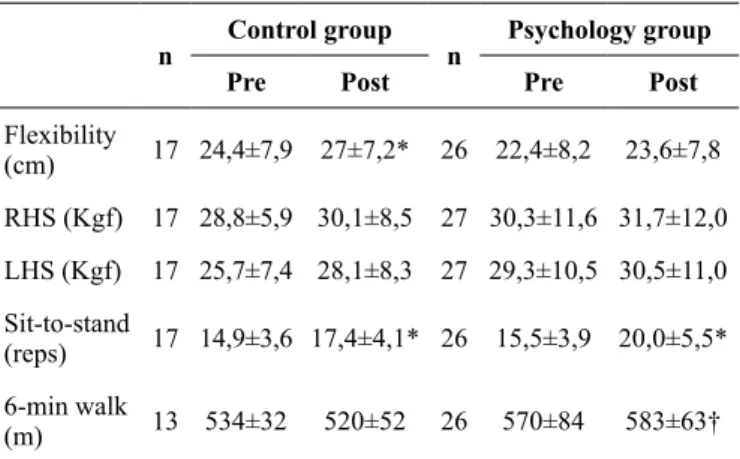
The results of lexibility, handgrip, sit-to-stand, and 6-min walk tests are shown in Table 2. The PGperformed slightly better in the 6-min walk test between the two evaluations, while the control group showed a small decrease in meters traveled (not statistically signiicant). Both groups also signiicantly improved in the sit-to-stand test, again with a little advantage for the PG (+4.5 repetitions; Cohen’s d=1.24) compared tothe CG (+2.5 repetitions; Cohen’s d=0,83). The CG also showed a statisti-cally signiicant variation in pre- to post-values in lexibility.
Table 2: Flexibility, right-hand handgrip strength (RHS), left-hand handgrip strength (LHS), sit-to-stand and 6-min walk.
n
Control group n
Psychology group
Pre Post Pre Post
Flexibility
(cm) 17 24,4±7,9 27±7,2* 26 22,4±8,2 23,6±7,8 RHS (Kgf) 17 28,8±5,9 30,1±8,5 27 30,3±11,6 31,7±12,0
LHS (Kgf) 17 25,7±7,4 28,1±8,3 27 29,3±10,5 30,5±11,0 Sit-to-stand
(reps) 17 14,9±3,6 17,4±4,1* 26 15,5±3,9 20,0±5,5* 6-min walk
(m) 13 534±32 520±52 26 570±84 583±63†
Data expressed in mean±SD; Two-way ANOVA for repeated measures;
n = sample size. *Signiicant difference within group (P<0.05). † Signiicant difference between groups (P<0.05).
Table 3: Walking time (T.Walk), moderate physical activity time (T.Mod), vigorous physical activity time (T.Vig), Weekend sitting time (T.Seat).
n
Control group n
Psychology group
Pre Post Pre Post
T.Walk
(min/week) 19 110±165 140±129 27 119,8±118 220,6±164* T.Mod
(min/week) 19 173±126 173±140 27 147±331 303±340*
T.Vig
(min/week) 19 67±130 48±68 27 34±66 101±193 T.Seat
(min/week)
19 268±143 314±151 27 340±200 307±162
Data expressed in mean±SD; Two-way ANOVA for repeated measures; n =
sample size. *Signiicant difference within group (P<0.05).
this resulted in the variability of the sample size in physical capacity tests.
Discussion
The aim of our study was to evaluate the importance of psy-chological counseling within a multidisciplinary approach to weight reduction in obese adults without the direct application of exercise sessions and dietary control. A number of studies have tested the importance of nutritional counseling along with exercise routines for weight loss purposes4,26-28, but none have tested a psychological intervention as part of the program. This seems to be an important gap in the literature as it has been shown that there are many psychological issues surrounding weight gain and obesity5,18.
In particular, Perez and Roman28 argue that the psychologi-cal issues involved in depression and compulsive eating can be limiting factors in the treatment of metabolic syndrome andstate that a multipronged approach is required during development of a weight loss program. In addition, there are many adver-tising stimuli related to food and diets, which may affect the individual from an early age and can play an important role in the formation of individual preferences and eating habits29. Such stimulation can translate into unhealthy and hypercaloric food choices,making it more dificult for individuals to make healthy choices throughout their life. This makes a psychological inter-vention critical to provide changesin the lifestyle of individuals and the way they think and interact with food.
However, Caetano, Carvalho, Galindo18found no signiicant differences in the psychological proile of obese and non-obese individuals. The authors argue that the causes of obesity cannot be generalized and that not every obese person has psychologi-cal problems or personality traits related to their weight gain or dificulty with weight-loss. The relationship between obesity and psychological factors seem to be referenced in the literature30, but the direction and the type of relationship remains a point under study.
Further, Freitas, Santiago, Viana, Leão, Freyre31 asked a group of 120 adults to describe their main reasons for maintaining a regular exercise routine. In order to be as accurate as possible, they split the options into seven main categories: exercise; health; welfare; environment; psychosocial; gym staff; and esthetic reasons. The reasons considered the most important in each group were “feeling good,”“to maintain health,”“to increase the ability of the body,” “I feel fulilled,”“to receive team motivation,” and “keep it.”When looking at the answers, especially“feel fulilled” and “to receive team motivation,” we can see that there is an important psychosocial factor around physical activity. When asked about the main reason to start an exercise program, 61.4% of women selected “improve self-image” as the main factor, while 45.9% of men indicated that “peer pressure
wasan important factor. Note that such both factors are also closely linked to psychosocial reasons. Indeed, an active lifestyle is an important factor in weight-loss and there are psychological According to IPAQ values, a signiicant difference in walk
-ing time and time of moderate activity on weekdayswas noted only in the PG. No difference was found in the control group for any of the variables evaluated by the questionnaire (Table 3).
and social aspects surrounding the choice to be active.Therefore, in order to ight the epidemic of obesity, psychological counseling should be of utmost importance in an individual treatment plan.
Our working hypothesis is that the collaborative work between the physical education professional, nutritionist, and psychologist encompass greater health beneits when compared to an intervention without psychological intervention.Such a collaboration creates a more eficient weight-loss program by addressing the psychological factors that inluence obesity and weight-loss. Curiously, it seems to be a pattern in the literature that female individuals tend to participate more than males in health and weight-loss interventions32-34.
Both PG and CG showed signiicant improvements in BMI, WC, and fat percentage, but changes in the GP group were higher across all variables, especially in body fat percentage (Δ = −1%; Cohen’s d=0.40 in CG and Δ = −3.5%; Cohen’s d=1.07 inPG).
Currently, the WC is considered a risk factor for cardiovas-cular diseases CVD, and an essential factor for the character-ization of metabolic syndrome according to the International Diabetes Federation (IDF) criteria.Therefore, the reduction of this measure is important in a weight-loss and health program35. The multidisciplinary approach without exercise application has already been identiied as capable of promoting weight-loss and reduction of CVD36, but the greatest beneit of weight-loss is obtained when there is only a reduction of body fat without losing muscle mass. In this context, a reduction of BMI and WC without concomitant reduction in basal metabolic rate (BMR) is indicative of weightlost without loss of muscle mass, since the latter is the main inluencer of MBR levels37.
In addition to the anthropometric variables, the PG also showed an improvement in diastolic blood pressure levels. It is currently recommended that the diastolic blood pressure (DBP) levels are less than 90 mmHg. Despite initial levels of DBP in both groups below this threshold, the PG values were higherthan the GC levels. After the intervention, the GP showed a reduc-tion in DBP to lower than 80 mmHg, on average. Currently the recommended values of DBP are between 70–89 mmHg for protection against CVD25. The systolic blood pressure (SBP) levels also showed a decrease of 5 mmHg on average, without reaching the level of statistical signiicance. Improvement in lower limb strength was observed for both groups.This shows that an intervention without the application of direct physical activity can increase the itness of individuals. This phenom -enon may be due to enhanced motivation to practice that was generated by the encounters. When correlating these indings with walking time and moderate activity time measured by the IPAQ, it is clear that even without an increase in exercise time, there was an improvement in strength. One possible response to this phenomenon can be an improvement in exercise intensity rather than volume. It is possible that the information passed on to participants concerning correct exercise practice enabled them to perform more eficiently without necessarily increasing practice time.
Although several studies have observed the inluence of exercise on WC, BP, and lower limb strength36,38,39, we were unable to ind any that included a multidisciplinary program without the direct application of exercise, diet, or drug treatment.
Thus, this work seems to be the irst to demonstrate that anin -formativeprogram is able to generate changes in the lifestyle of individuals,providing them with the tools needed to apply the interventionon their own.
More studies are necessary to establish the importance of psychological intervention within a multidisciplinary program for weight-loss. The literature is sparse in this area. Psychological studies related to obesity are plentiful, but the collaborative work in the areas of physical education, nutrition, and psychology is not being adequately addressed. In conclusion, results indicate that psychological counselingmight play an important role in a multidisciplinary weight-loss program without the direct ap-plication of exercise sessions and dietary control.
References
1. Quinn A, Doody C, O'Shea D. The effect of a physical activity education programme on physical activity, itness, qual -ity of life and attitudes to exercise in obese females. J Sci Med Sport. 2008;11(5):469–72.
2. World Health Organization. Obesity and overweight. Fact sheet N°311. 2015. Available from:http://www.who.int/mediacentre/ factsheets/fs311/en/
3. Ghroubi S, Elleuch H, Chikh T, Kaffel N, Abid M, Elleuch MH. Physical training combined with dietary measures in the treatment of adult obesity. A comparison of two protocols. Ann Phys Rehabil Med. 2009;52(5):394–413.
4. Monteiro R de C de A, Riether PTA, Burini RC. Efeito de um programa misto de intervenção nutricional e exercício físico sobre a composição corporal e os hábitos alimentares de mulheres obesas em climatério The effects of a mixed program of nutritional. Rev Nutr. 2004;17(4):479–89.
5. Elfhag K, Rössner S. Who succeeds in maintaining weight loss? A conceptual review of factors associated with weight loss main-tenance and weight regain. Obes Rev. 2005;6(1):67–85. 6. Varela AL, Quintans CC, Tranqueira APM, Gasparotto R, Isaac
IA da S, Estrela RAM, et al. Revista Brasileira de Obesidade, Nutrição e Emagrecimento. Rev Bras Obesidade, Nutr e Emagrecimento. 2007;1(6):12–27.
7. Duchesne M, Appolinario JC, Rangé BP, Fandiño J, Moya T, Freitas SR. The use of a manual-driven group cognitive behavior therapy in a Brazilian sample of obese individuals with binge-eating disorder . Rev. Bras. Psiquiatr. 2007; 23–5.
8. Neufeld CB, Moreira CAM, Xavier GS. Terapia Cognitivo-Comportamental em Grupos de Emagrecimento: O Relato de Uma Experiência. Psico. 2012;43(1):93–100.
9. Meyer E. Terapia Cognitivo-Comportamental na prática psiquiátrica. Porto Alegre: Artmed; 2004. 430-438 p.
10. Abreu CN, Roso M. Psicoterapias cognitiva e construtivista: novas fronteiras da prática clínica. Porto Alegre: Artmed; 2003. 11. Leal I, Branco J, Pimenta F, Maroco J. O peso da mente – Uma
12. Palavras MA, Kaio GH, de Jesus Mari J, Claudino AM. Uma revisão dos estudos latino-americanos sobre o transtorno da com-pulsão alimentar periódica. Rev Bras Psiquiatr. 2011;33(1):81–94. 13. Tavares Filho TE, Magalhães PMDS, Tavares BM. Terapia cogni-tivo-comportamental e seus efeitos no tratamento dos transtornos do comportamento alimentar. Rev Psicol da. 2009;1(2):160–8. 14. Bernardi F, Cichelero C, Vitolo MR. Comportamento de restrição
alimentar e obesidade. Rev Nutr. 2005;18(1):85–93.
15. Cavalcanti AP. Crenças e inluências sobre dietas de emagre -cimento entre obesos de baixa renda Beliefs and inluences on weight loss diets among low-income obese individuals. Soc Psychol (Gott). 2005;1567–74.
16. Cooper Z, Doll HA, Hawker DM, Byrne S, Bonner G, Eeley E, et al. Testing a new cognitive behavioural treatment for obesity: A randomized controlled trial with three-year follow-up. Behav Res Ther. 2010;48(8):706–13.
17. Duarte ALC, Piccoloto LB. A Terapia CognitivoComportamental no Transtorno de Compulsão Alimentar Periódica (TCP). Tópicos especiais em terapia cognitiva. São Paulo: Casa do Psicólogo; p. 161–80.
18. Caetano C, Carvalho AMP, Galindo EMC. Obesidade e Aspectos Psicológicos : Maturidade Emocional , Auto-conceito , Locus de Controle e Ansiedade. Psicol Relexão e Crítica. 2005;18(1):39–46.
19. Guyatt GH, Sullivan MJ, Thompson PJ, Fallen EL, Pugsley SO, Taylor DW, et al. The 6-minute walk: A new measure of exercise capacity in patients with chronic heart failure. Can Med Assoc J. 1985;132(8):919–21.
20. Hallal PC, Gomez LF, Parra DC, Lobelo F, Mosquera J, Florindo AA, et al. Lições Aprendidas Depois de 10 Anos de Uso do IPAQ no Brasil e Colômbia. J Phys Act Health. 2010;7(2):259–64. 21. Bigaard J, Spanggaard I, Thomsen BL, Overvad K, Tjønneland A.
Self-reported and technician-measured waist circumferences dif-fer in middle-aged men and women. J Nutr. 2005;135(9):2263–70. 22. Wells KF, Dillon EK. The sit and reach: A test of back and leg
lexibility. Am Assoc Heal Phys Educ Recreat. 1952;23(1):115–8. 23. Bohannon RW. Sit-to-stand test for measuring performance of
lower extremity muscles. Percept Mot Skills. 1995;80:163–6. 24. Geraldes AAR, Oliveira, Angysnoelia R M O Albuquerque
RB, Carvalho JM. A Força de Preensão Manual é Boa Preditora do Desempenho Funcional de Idosos Frágeis : um Estudo Correlacional Múltiplo. Rev Bras Med do Esporte. 2008;14(2):12–6.
25. Franklin SS, Gokhale SS, Chow VH, Larson MG, Levy D, Vasan RS, et al. Does low diastolic blood pressure contribute to the risk of recurrent hypertensive cardiovascular disease events?: The framingham heart study. Hypertension. 2015;65(2):299–305. 26. Bertz F, Brekke HK, Ellegard L, Rasmussen KM, Wennergren M,
Winkvist A. Diet and exercise weight-loss trial in lactating over-weight and obese women 1 – 3. Am J Clin Nutr. 2012;96:698–705. 27. Somerset SM, Markwell K, Al-Foraih M. A systematic review of baseline psychosocial characterisation in dietary randomised con-trolled trials for weight loss. Eur J Clin Nutr. 2013;67(7):697–702. 28. Perez GH, Romano BW. Comportamento alimentar e síndrome metabólica: aspectos psicológicos. Rev da Soc Cardiol do Estado São Paulo. 2004;14(4):544–50.
29. Quaioti TCB, Almeida S de SA. Determinantes psicológicos do comportamento alimentar: uma ênfase em fatores ambientais que contribuem para a obesidade. Psicol USP. 2006;17(4):193–211. 30. Vasques F, Martins FC, De Azevedo AP. Aspectos psiquiátricos do
tratamento da obesidade. Rev Psiquiatr Clin. 2004;31(4):195–8. 31. Freitas CMM, Santiago M de S, Viana A, Leão AC, Freyre C. Motivational aspects that inluence the elderly to enroll on and continue participanting in physical exercise programs. Rev Bras Cineantropo Desemp Hum. 2007;9(1):92–100.
32. Coelho-Ravagnani CDF, Pereira AF, Ravagnani FCDP, Michelin E, Corrente JE, Burini RC. Impacto de um programa de interven-ção para mudança do estilo de vida sobre indicadores de aptidão física, obesidade e ingestão alimentar de indivíduos adultos. Rev Bras Atividade Física e Saúde. 2010;15(1):21–7.
33. Viana LV, Paula TP de, Leitão CB, Azevedo MJ. Fatores deter-minantes de perda de peso em adultos submetidos a intervenções dietoterápicas. Arq Bras Endocrinol Metabol. 2013;57(9):717–21. 34. Colombo CM, Macedo RM De, Fernandes-silva MM, Caporal
AM, Stinghen AE, Costantini CR, et al. Efeitos de curto prazo de um programa de atividade física moderada em pacientes com síndrome metabólica. Rev Einstein. 2013;11(3):324–30. 35. International Diabetes Federation. The IDF consensus worldwide
deinition of the metabolic syndrome. IDF Consens Worldw Dein Metab Syndr. 2006;28:1–7.
36. Ferreira FB, Fraga JC da S, Nunes JP, Liberali R, Navarro F. Alterações antropométricas de pacientes obesos submetidos a um tratamento multidisciplinar da obesidade em Porto Alegre. Rev Bras Obesidade, Nutr e Emagrecimento. 2009;3(16):290–7. 37. Cunningham JJ. A reanalysis of the factors inluencing basal meta
-bolic rate in normal adults. Am J Clin Nutr. 1980;33(11):2372–4. 38. Medina FL, Lobo FDS, Souza DR De, Kanegusuku H, Forjaz CLDM. Atividade física : impacto sobre a pressão arterial. Rev Bras Hipertens. 2010;17(2):103–6.
39. Silva TO, Glisoi SF das N, Ansai JH, Izzo H. Grupo de assistência multidisciplinar ao idoso ambulatorial : efeitos da abordagem isioterapêutica. Rev da Soc Bras Clínica Médica. 2014;12(1):2–7.
Acknowledgments
We thank the National Council for Scientiic and Technological Development (CNPq) for the inancial support for this research.
Corresponding author
Gustavo Duarte Ferrari
Escola de Educação Física e Esporte de Ribeirão Preto. Av. Bandeirantes, 3900 - Monte Alegre, Ribeirão Preto – SP.
Email: [email protected]
Manuscript received on June 04, 2016 Manuscript accepted on August 29, 2016