D
E
B
A
T
E
D
E
B
A
T
E
1 Departamento de Ciências Sociais, Escola Nacional de Saúde Pública, Fiocruz. Rua Leopoldo Bulhões 1.480/ 913, Manguinhos. 21045-210 Rio de Janeiro RJ. [email protected]
Social protection in Brazil:
universalism and targeting in the FHC and Lula administrations
A proteção social no Brasil:
universalismo e focalização nos governos FHC e Lula
Resumo O artigo analisa a configuração do
siste-ma de proteção social no Brasil após a Constituição Federal de 1988 (CF 1988). Demonstra que a CF 1988 favoreceu a institucionalização de políticas públicas universalistas. Esta institucionalização foi realizada em conflito com os pressupostos da estabi-lização do Plano Real. O trabalho argumenta que a institucionalização protegeu o gasto público na área social da proposta minimalista da gestão macroe-conômica. Identifica também a implementação de programas sociais focalizados nos pobres ao longo da década de 1990. A focalização é uma inovação diretamente associada à agenda do ajuste. Revela que nos governo FHC e Lula ocorreu uma idêntica adesão aos programas sociais focalizados. A focali-zação da proteção social não teve o poder de vetar as propostas universalistas originadas da democrati-zação dos anos 1980. Demonstra que o Programa Bolsa Família (PBF), principal marca do governo Lula, é uma adaptação, em larga escala, dos progra-mas focalizados de transferência direta de renda do período FHC. A combinação de universalismo e fo-calização ampliou o escopo da política social. O ex-pressivo crescimento do gasto público social não tem, entretanto, produzido resultados sociais abrangen-te, ainda que os pobres no Brasil tenham sido bene-ficiados pela focalização do PBF.
Palavras-chave Universalismo, Focalização, Lula, Bolsa Família, Brasil
Abstract This article analyzes the organization of Brazil’s social protection system after the Federal Con-stitution of 1998 (CF 1988). It also demonstrates that 1988 Federal Constitution favored the institutional-ization of universalist public policies. This institu-tionalization took place amidst conflict with the sta-bilization goals of the Real Plan. The paper argues that such an institutionalization protected public spending in the social area of the macroeconomic management’s minimalist project. It also identifies the implementation of social programs targeting the poor during the 1980’s decade. Targeting is an inno-vation directly associated with the adjustment agen-da. It reveals that under the FHC and Lula adminis-trations there was an identical adoption of targeted social programs. The targeting of social protection did not possess power of veto over the universalist proposals arising from the democratization in the 1980’s. It demonstrates that the Bolsa Família Pro-gram (Family Grant ProPro-gram - PBF), the main mark of the Lula administration, is a large scale adapta-tion of the targeted programs of direct transfer of in-come in the FHC administration. The combination of universalism and targeting expanded the scope of social policy. However, the significant growth in so-cial public spending has not been producing broad social results, although the poor in Brazil have ben-efited from the PBF’s targeting.
Key words Universalism , Targeting, Lula, Bolsa Família, Brazil
Introduction
In this article I examine the dynamics of the Brazil-ian social protection system post 1988 Federal Constitution (CF 1988). The hypothesis adopted in this paper is that, in the beginning of the 1990’s decade, there was a significant normative dispute to define the scope and range of the Brazilian social protection system. Two agendas competed for con-duction of the social policy: the minimalist per-spective of the conductors of macroeconomic ad-justment and the universalist perspective of pro-tection. In the former, social protection would be secondary to the fiscal adjustment policy. In this view, the social protection system would be an ex-ternal aspect of the macroeconomic adjustment effort, generating targeting in the poorer strata.
In the universalist perspective, the public policy of protection should respond to the need to repay the social debt via a social security system prom-ised by the redemocratization in the 1980s decade. The paper presents arguments and evidence to support the thesis that there was the institutional construction of a social protection system in Bra-zil, in spite of the limitations of the macroeconom-ic adjustment initiated in the 1990s. It also sup-ports the thesis that the macroeconomic adjust-ment determined an agenda of innovation in terms of social policies in the implementation of targeted social programs for the poor. The targeting strate-gy produced important innovations through ac-tions of direct income transfer, such as the Bolsa Família Program (Family Grant Program—PBF), implemented in 2003 by the Lula administration. The survival of the strategy targeting the poor, by the PBF, without affecting substantially the uni-versalist social policies created by the Federal Con-stitution of 1988, indicated that there was also a significant continuity in terms of social agenda in the FHC and Lula administrations.
In order to reach such conclusions, this article refers back to a point already highlighted by Draibe regardin g disagreem en t as to the “form at an d range” of the country’s social protection. The au-thor states that: the reform agenda took place dur-ing the 1980s, particularly with the 1988 Federal Constitution. But, paradoxically, the moment the constitutional provisions are still being implement-ed, a new discussion agenda on the format, scope and likely outcomes of the social programs is becoming more important. In other words, a new reform move-ment is arising, a new ideological setting which rec-ognizes both the impossibilities regarding impropri-eties of previously valid concepts […] They added to the suspicions regarding both the possibility as well
as the convenience of basing our social policies on rigidly universal criteria of directing public spend-ing and distributspend-ing social assets and services. In addition to the financial limitations, what seems to be under questioning is the capacity to face worsen-ing social conditions through universalist and egal-itarian concepts of social justice1.
Macroeconomic adjustment and social security
Draibe, in highlighting the arising new “ideological mood”, refers to narrowing options of public pol-icies of national orientation in the 1980-1990s, mainly in non-developed economies or those de-pendent on external funding.
In the field of economic policy in the 1980s, the Brazilian economy was resistant to the spread and learning process of normative guidelines of the macroeconomic adjustment. The economic policy decisions responded with a high degree of autono-my with regard to the guidelines and conditions in policies defined by the international financial com-munity.
With the establishment of stabilization pro-posed by the Real Plan in 1994, it could be said that the set of economic tools and policies possessed by the government suffered a centralization which was organized aiming at stabilizing public spending, with important effects on the economy’s insertion in the global market.
This new orientation of the macroeconomic management might result in an important subor-dination of the social protection agenda to the fis-cal adjustment and macroeconomic stabilization processes. Attempts by previous plans were faced with internal political problems, in addition to tech-nical inconsistency in making their own plans and the lack of international conditions which enabled its success.
In the new scenario, a logical conclusion is that the formation of the social protection system was dependant on change in the development model integrated with the economy’s globalization. In fact, such changes would bring a significant decrease in the level of freedom of the domestically targeted policies and greater effort in the search for external approval to guarantee investments and credit and internal approval through inflation control via fis-cal discipline2.
S
aú
d
e C
o
le
tiv
a, 1
4
(3
):6
9
3
-7
0
6
, 2
0
0
9
mainly through control of primary performance of the whole public sector. The austerity in public spending would produce, consequently, serious limitations to expenditures with social programs in the countries subject to the macroeconomic ad-justment agenda.
In the Brazilian case, the major topics which dominated the public policy agenda after the Real Plan were: encouragement to centralization and isolation of the macroeconomic policies, especially the monetary policy, through the Central Bank’s autonomy in relation to the Executive and the Leg-islative; control of non-financial spending of the federal government; the federal and subnational governments’ administrative reform; the privati-zation of activities related to the offer of public services; clearance of foreign trade and other re-forms aiming to open the internal market; the adop-tion of targeted policies and selective protecadop-tion for groups more vulnerable to the adjustment pro-cess in the development model.
In the mid-1990s decade, the intentional agen-da of integration to the globalization dynamics seemed to be extremely successful in creating ma-jor cosmopolitan alliances for implementing a new public policy agenda derived from the macroeco-nomic adjustment policy. Redirecting the develop-ment policy increased the external vulnerability of the national economy, as shown by the significant increase of the country’s net public debt between 1994 and 20022.
Since the developmentist model of the acceler-ated growth decades of the Brazilian economy was unable to offer convincing answers to repay the social debt, for the latter was often accompanied by inflation, the new public policy agenda, which was allowed before the need for adjustment, sought to introduce an important set of innovations in the social sector.
One could, thus, consider the possibility that this new scenario did not allow providing for broad solutions for the social public policies due to the goals of integration of the Brazilian economy with the globalization. Such goals would lead to denial of the universalist agenda in certain social areas, the targeting of programs and the specialization of social financing.
For example, the federal government’s docu-ment for the social area entitled “A Strategy for Social Development”, of 1996 (Presidency of the Federative Republic of Brazil), in stating that “the growth standard of protected industrialization, conducted by the government and based on im-port substitution, has left a complex system of so-cial protection” which would be a part of “a
prob-lem to be handled by the Brazilian social policy in the near future”3 – seems to have defined an agen-da congruent with the new development model with inflation and public spending control.
The document emphasized essentially regres-sive aspects of the social protection system – pro-gressive and unequal incorporation of profession-al corporations, high spending, administrative cen-tralization, lack of democratic control, operational inefficiency and concentration of benefits on groups of lower income – and considered it as a simple manifestation of “a complex network of interests and acquired rights, involving privileged politicians, workers, suppliers and beneficiaries”.
Faced with this network of interests, the FHC adm inistration allegedly was “com m itted to re-structuring and deeply reforming these sectors aim-ing to eliminate waste, increase efficiency, promote decentralization, universalize its cover whenever necessary and legitimate, and, above all, to restruc-ture benefits and services in order to increase its redistribution impact”3 (italics from original text). Thus, it seemed more than obvious that eco-nomic stability with external integration would lead to the restructuring of the social protection system born with the Federal Constitution. This percep-tion was accepted by Castro & Cardoso Júnior4 when they described the implications of the mone-tary stabilization strategy post-1994 to the financ-ing of social spendfinanc-ing from 1995-2002. Accordfinanc-ing to the authors, it could be said that the social strat-egy of the governments which handled the Brazil-ian social policies during the 1990s was also a strat-egy to solve the problem of financing social poli-cies, even if it was implicit and never express. Re-stricted universalization, targeting poverty, fiscal decentralization, social participation and privati-zation of profitable parts of the social policies would have contributed, together and structurally, to limit the financing needs of the social public spending, especially in the federal sphere, which would also be coherent and necessary to the gov-ernment’s more general strategy of fiscal restric-tion faced with macroeconomic limitarestric-tions (self) imposed by the monetary stabilization’s superior-ity over any alternative economic policy4.
social nature, and favored relatively the total finan-cial expenditures, including interests and fees4.
Fagnani’s work presents additional arguments to the perspective of limitations to the macroeco-nomic adjustment agenda: the environment which arose in the 90s was absolutely hostile to the recently acquired citizenship. The embryo of a Social State, universal and equal, sketched by the 1988 Constitu-tion, was practically doomed. In this adverse con-text, against the broader structural processes in the internal and external levels, it was possible to ob-serve, from 1990, the definitive downfall of the re-formist project. In the social field, the privileged focus of this counter-reform was the deconstruction of rights provided for by the 1988 Constitution5.
The Constitution was gradually disfigured and the reformist project was destroyed. The princi-ples which govern the neoliberal paradigm in the social issue were absolutely opposite to those in the 1988 Constitution: the Welfare State is replaced with the Minimum State; social security with social insurance; universalization with targeting; direct offer of social services by the government with the Regulatory State and privatization; and labor rights with deregulation and flexibilization5.
This take on the linear relationship between the macroeconomic adjustment and social policy is in accordance with the theoretical matrix of the polit-ical economy which emphasizes absolute subordi-nation of the subordi-national policies to the globalization processes of financial m arkets and com m ercial flows6.
Kaufm an draws attention to the hypothesis that the main agents in the globalization process have no specific social agenda. International agents (banks, multinational companies, investors and multilateral cooperation agencies, besides local cos-mopolitan elites), would emphasize more the de-centralization aspects through the local and regional governments’ increased role in providing services and other public assets than the definition of the countries’ social protection regim e6. Kaufm an’s observation fails because it does not take into ac-count that such agents, in defending fiscal disci-pline as the normative principle of the macroeco-nomic management, are indirectly assigning pub-lic spending a function in the social area.
Th e argu m en ts proposed by H aggard an d Kaufman7 seem more appealing. They identify four factors which condition the behavior of non-de-veloped economies when facing the macroeconom-ic adjustment agenda: (i) the timing when starting the macroeconomic adjustment, which reflected the different level of urgency in responding to the sta-bilization initiatives; (ii) the national political
alli-ances’ ability to support the adjustment guidelines; (iii) the government’s administrative ability in de-veloping sector reform policies; and (iv) the type of political regimen, whether democratic or author-itarian, which sponsored the stabilization policies. Those factors highlighted by the authors are useful to understand the social protection dynam-ics in the context of adjustment in Brazil. In the early 1990s, the stabilization was faced with the construction of the new democracy, established in 1985, which defined an agenda targeting domestic interests.
The social policy institution in Brazil in the 1990s decade
During the redemocratization, organization of the Brazilian social protection agenda was substan-tially different from that defended by the stabiliza-tion agenda. The democratizastabiliza-tion strengthened the mediation of municipal and state Executives over public spending and diversified the range of social interventions of the public sphere. 8 The new social protection conditions became official in the Feder-al Constitution of 1988, which defined the field for action of the government sectors and the market in financing and offer of services.
Draibe suggested that the 1988 Federal Consti-tution broke with the social protection system built during the military regime (1964-1985) due to the emphasis given to the “social security” dimension in the set of social policies. The social security di-mension defined institutional rules which in turn defined the financing conditions for public fund-ing and established certain universality criteria for access to the benefits. Such an arrangement was made possible by the discussion between the gov-ernmental and private spheres; by the strengthen-ing of municipal and state governments in the so-cial area and by the innovations brought by the income transfer programs. In that sense, the de-velopment of the social policy gained relative au-tonomy in relation to the economic policy, the pri-ority now being the issue of fighting poverty, mis-ery and social inequities8.
S
aú
d
e C
o
le
tiv
a, 1
4
(3
):6
9
3
-7
0
6
, 2
0
0
9
Draibe, “express in the new Constitution of 1988, such a guideline was undoubtedly successful dur-ing the 90s”8.
Considering the fiscal adjustment policy, the tendencies and features of the reforms of social programs would not have shown that the old na-tional system of social policies had “crumbled” or even remained8.
The construction of a wide social protection system was one of the central demands of the Bra-zilian redemocratization process in the decades of 1980 and 1990. The cover limitations and low ef-fectiveness of the current policy were the distor-tions pointed out in the social policy. The meaning of merit, understood as the position in the occupa-tional structure, was the base on which the condi-tion of access to the Brazilian social system was defined9,10. The persistent economic growth ob-served in the 50s, 60s and 70s decades was not suc-cessful in forming the bases for a protection sys-tem which broke with the excluding limits of con-tribution criteria to the social protection. The stag-nation of social conditions in the 80s decade wors-ened the residual and selection aspects of govern-mental action in the social sector, with strong fea-tures of corporatism and clientelism1.
Considering those limitations, the construction of a wide institutional structure of protection was considered a desirable option for the social devel-opment when faced with the evidence that the mere economic growth did not generate redistribution or social inclusion in the previous decades. The economic development observed in the 50s, 60s and 70s decades produced significant social mobility through growth of industrial and urban employ-ment, but offered no consistent responses to the social question.
In the Brazilian debate in the early 1990s de-cade, the proposal to overcome social crisis through simply returning to the national-developmentist agenda, also largely accentuated by the authoritar-ian regime post-64, then sounded like an “anach-ronism”1. In addition to the distortions in the so-cial protection system, the authoritarian regime (1964-1995) added the strong centralization of de-cisions in a federal level, by expropriation of tools of social action of states and municipalities; block-ing social and political participation in the deci-sion-making process, with the suppression of ways of social control; the institutional fragmentation which made it impossible to build an integrated social policy and closing down people’s access to social assets and services8.
From the income redistribution and social is-sue’s points of view, the 1980s decade was perceived
as a “lost decade”11. The “legacy of mistakes” of the 1980s projected a shadow over the future. It would be necessary to “coordinate projects, decisions and actions involving organically, all relevant social agents” aim ing at repaying the Brazilian social debt12. There is no doubt that the complex struc-ture of social protection set forth by the Federal Constitution of 1988 responded to the Brazilian elite’s discomfort with the social situation in Brazil after 20 years of conservative modernization pro-duced by the military regime established in 1964.
Democracy and social protection
It is important to ask what the real institutionality of the new rules defined by the 1988 Federal Consti-tution for the Brazilians’ social protection was con-sidering the strong arguments favorable to the par-alyzing effect of the macroeconomic adjustment presented by the political economy. According to Draibe’s view, the protection system’s institutional-ity would have generated an institutional path to the public policies’ sustainability. This institutional-ity is usually difficult to reverse when the gains of the institutional decisions are perceived as increas-ing13. The institutions are considered the rules of the game which define the conditions and opportu-nities for action by the agents. In the context of the Brazilian redemocratization, the institutionalization of the social protection system created a wide range of distribution opportunities for the new alliances between the Federal Government, States and Mu-nicipalities’ Legislatives and Executives.
Such alliances, associated with the sectoral bu-reaucracies and the benefits of social policies, di-rectly influenced the public policies of protection due to gains in income and political power. Ames states that most of Brazilian politics concentrates on attempts by politicians to appoint supporters to bureaucratic positions and to provide individual-ized or geographically specific public assets [...] per-sonal gain and excessive patronage guide the forma-tion of policies. Politicians do not sustain themselves as such taking care of the prosperity of their states and of maintaining public assets, but distributing funds, services and jobs to individuals14. Although it must be admitted that, as Pereira points out, the positive aspects of exchanges between the Execu-tive and the LegislaExecu-tive in Brazil. Such exchanges play an integral role in the Executive’s ability to approve its agenda in congress, as well as in its governability15.
only by the perspective of construction of a redis-tributive regime of social security, but it is also fa-vored by the elite’s structural option for diffuse distributism. In that case, the distributive public policy would be the one which generated diffuse costs and often benefits which are also diffuse16.
The successful mediation ability of those spon-sorship and personal gain interests was a decisive factor for the consolidation of new sectoral public arrangements created by the 1988 Federal Consti-tution. This broadening in the scope of action of organized interests in the public sphere was per-ceived clearly by Vianna when he identifies in the “fractioning of organized interests” the reason be-hind what he names “failure of social security” in the 1990s decade17. The social protection system had, in spite of the collective action’s fragmenta-tion, a notable institutional development and di-versification of clientele.
It can be said, thus, that the Brazilian social protection system is a result of a normative con-flict between the search for fiscal discipline for public expenditures and the search for more funds for distributive ends… This explains why the Brazil-ian social protection system presents an immense variety of organizational arrangements, sources of financing and clientele, summarized by Castro & Cardoso Júnior4 and characterized by Arretche18.
The influence of the distributive orientation has been especially important in the sectors of social politics with alliances which are mobilized and unit-ed around an agenda, as is the case in the health sector, as we are reminded by Draibe19. The insti-tutionality of the health policy has had success in stabilization by controlling sources and indexing of federal public spending to mobilization of mu-nicipal and state governments’ funds. The health policy has been effective in ensuring access by poorer groups to the diffuse benefits of public action, al-t h ou gh m ain al-t ain in g h igh in equ ial-t y sal-t an d ar d s among the income strata and inefficiency of allo-cation.
In such conditions, the new institutionality of the social protection system would have reinforced other distortions which affected systematically the dynamics of the social area in Brazil: the problems of inefficacy, poor targeting of goals and low effec-tiveness of spending8.
Social policy in the FHC administration
The innovations in the FHC administration’s agen-da (1995-2002) for social policies sought to respond to the problems in allocation of social
expendi-tures on poorer and more vulnerable groups. The initiatives which arose in that context resulted from the effort to determine the target population for social intervention and define clear strategies for access to the benefits conferred by social protec-tion programs. However, the FHC administraprotec-tion did not act as an active institutional authority with veto power over the agenda created by the 1988 Federal Constitution. Tsebelis draws attention to the obstruction power which the Executive has not only in forming the agenda, but especially in im-plementing public policy decisions20. The latter is a point often overlooked in the analyses of recent governments in Brazil, that is, what the scale pro-duced by their veto power is over constitutional decisions associated with social rights. In the FHC administrations, this scale was certainly close to zero9.
The paper “Econom ic Policy and Structural Reforms”, published by the Ministry of Finance in April, 2003, in expressing discomfort with the con-ditions of allocation of federal funds, reinforces the profound diversity of the protection system resultant from the FHC administration.
Despite the amount of funds allocated to social programs by the central government […], its effica-cy in alleviating poverty, is still very limited. The government’s social expenditures’ little capacity to reduce inequities in income arises from the fact that most of the funds are directed to the non-poor 21.
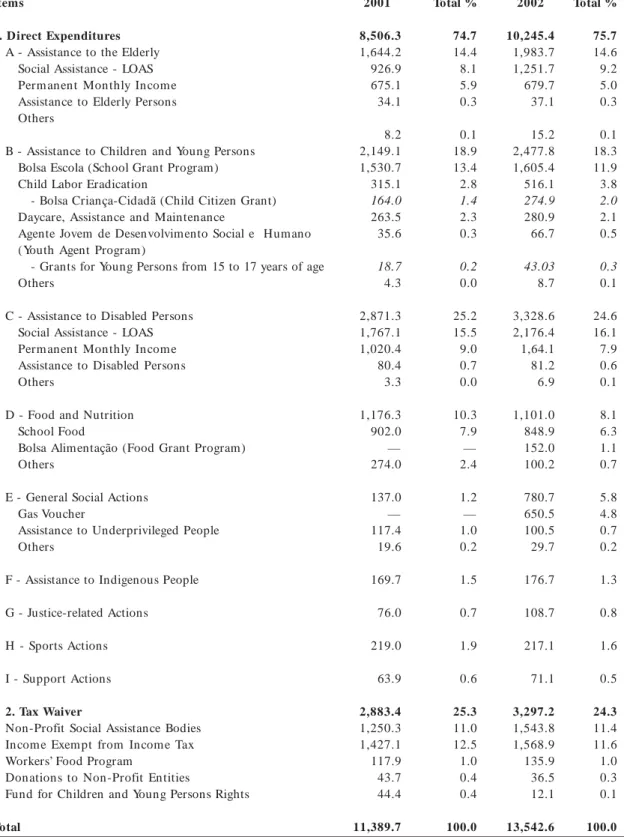
The Ministry of Finance’s paper, in the context of the Lula administration, for example, ignored that, since the end of the 1990s decade, some im-portant programs governed by the targeting per-spective renewed the Brazilian social assistance scene - Bolsa Escola, Child Labor Eradication, Bolsa Al-imentação, among others. These programs were, together with the programs derived from the Or-ganic Act of Social Assistance (LOAS), such as the Assistance to the Elderly and the Assistance to Dis-abled Persons, a relevant and diffuse set of assis-tance benefits granted regardless of any contribu-tions made, as demonstrated by Table 1.
It can be seen in Table 1 that assistance expen-ditures already represented 5.5% of the federal gov-ernment’s spending in 2002.
Of all expenditures on social assistance, as dem-onstrated by Table 1, 40% were directed at pro-grams defined by the LOAS’s rules of access, that is, they arose from the social protection agenda made official in the 1988 Federal Constitution.
S aú d e C o le tiv a, 1 4 (3 ):6 9 3 -7 0 6 , 2 0 0 9
expenditures in 2002. It is worth noting that social security only represented 65.8% of the total social expenditures in 2002.
Few studies gave proper recognition to the complexity of the structure of the Brazilian social protection in the early 2000 decade. One of the few
Table 1. Central Government Spending on Social Assistance.
Items
1. Direct Expenditures A - Assistance to the Elderly
Social Assistance - LOAS Perm anent Monthly Incom e Assistance to Elderly Persons Others
B - Assistance to Children and Young Persons Bolsa Escola (School Grant Program) Child Labor Eradication
- Bolsa Criança-Cidadã (Child Citizen Grant)
Daycare, Assistance and Maintenance
Agente Jovem de Desenvolvimento Social e Humano (Youth Agent Program)
- Grants for Young Persons from 15 to 17 years of age Others
C - Assistance to Disabled Persons Social Assistance - LOAS Perm anent Monthly Incom e Assistance to Disabled Persons Others
D - Food and Nutrition School Food
Bolsa Alimentação (Food Grant Program) Others
E - General Social Actions Gas Voucher
Assistance to Underprivileged People Others
F - Assistance to Indigenous People
G - Justice-related Actions
H - Sports Actions
I- Support Actions
2. Tax Waiver
Non-Profit Social Assistance Bodies Incom e Exempt from Incom e Tax Workers’ Food Program
Donations to Non-Profit Entities
Fund for Children and Young Persons Rights
Total 2001 8,506.3 1,644.2 926.9 675.1 34.1 8.2 2,149.1 1,530.7 315.1 164.0 263.5 35.6 18.7 4.3 2,871.3 1,767.1 1,020.4 80.4 3.3 1,176.3 902.0 — 274.0 137.0 — 117.4 19.6 169.7 76.0 219.0 63.9 2,883.4 1,250.3 1,427.1 117.9 43.7 44.4 11,389.7 Total % 74.7 14.4 8.1 5.9 0.3 0.1 18.9 13.4 2.8 1.4 2.3 0.3 0.2 0.0 25.2 15.5 9.0 0.7 0.0 10.3 7.9 — 2.4 1.2 — 1.0 0.2 1.5 0.7 1.9 0.6 25.3 11.0 12.5 1.0 0.4 0.4 100.0 2002 10,245.4 1,983.7 1,251.7 679.7 37.1 15.2 2,477.8 1,605.4 516.1 274.9 280.9 66.7 43.03 8.7 3,328.6 2,176.4 1,64.1 81.2 6.9 1,101.0 848.9 152.0 100.2 780.7 650.5 100.5 29.7 176.7 108.7 217.1 71.1 3,297.2 1,543.8 1,568.9 135.9 36.5 12.1 13,542.6
Source: Ministério da Fazenda21.
was Melo’s work22. He acknowledges the great rel-evance of innovative federal social programs in the 1990s decade. Bolsa Escola Program, the Fund for Basic Education Development and for Enhancing the Value of the Teaching Profession – Fundef, and the Fund Against Poverty. He states that the changes which took place in the Brazilian social protection system in this decade “are contradictory”. He says: how can we explain the changes which happen in the pattern of social policies, if we take into account the formidable fiscal and institutional obstacles to change in the country, at least in the way in which the latter is analyzed in the dominant view in liter-ature? Such obstacles were not restricted to severe fiscal limitations, but would also include the fact that Brazil had a fragmented political system22.
Melo’s thesis is that such changes can be ex-plained fundamentally by the reorganization of the relationship patterns between the Federal Execu-tive in the Fernando Henrique Cardoso adminis-tration and the state and municipal governments due to the federal government’s incentives and in-stitutional capacity leading to the end of the social area’s reorganization by the federative decentrali-zation. This is a point often emphasized in Ar-retche’s analysis18.
Another new aspect in Melo’s work is the ac-knowledgement that the macroeconomic adjust-ment agenda in the FHC administration included a successful social agenda. In Melo’s view, the first gen eration reform in the FH C adm in istration (monetary stabilization and fiscal adjustment) was followed by second generation reforms in the so-cial area. To the second reform there would be as-sociated “contradictory” changes in the Brazilian social protection. The author states that: the big bang strategy adopted, due to which support to its
monetary stabilization program extended to its oth-er initiatives, was also a part of the support given to the social policies reform program in both of Fernan-do Henrique CarFernan-doso’s terms of office22.
The successful reorganization of the social pol-icy was, according to Melo, a result of the condi-tions of macroeconomic stability ensured by the new conditions of the opening economy and inter-national integration. But what was the scope and range of the FHC administration’s social policy?
There is evidence that the social reform agenda of the Fernando Henrique Cardoso administra-tion concentrated on strengthening and consoli-dating focal programs to reduce poverty, on social security reform and on regulating federal transfers to education (Fundeb) and health (Funds Trans-fer for Basic Care) and Family Health Care Pro-gram). Melo states that both the reduction of pov-erty and the allocation of resources to health and education were the credible commitments to the allocation of funds in social areas which could be associated with the second generation of macro-economic reforms22.
This conclusion by the author should, howev-er, be analyzed carefully. It would be more appro-priate not to make a direct connection between the macroeconomic adjustment agenda and the devel-opm en t of decen tralization in edu cation an d health, for exam ple, by m eans of allocating re-sources. It is worth noting that the good gover-nance of the adjustment agenda identified, in the debate then, the control of public funds as a threat to the efficiency of public spending23.
The FHC administration’s guidelines in the first two terms of office were enforced by clear target-ing of priority social programs and by the special-ization of social financing. However, this innova-tion, which was coherent with the macroeconomic adjustment agenda, was not opposite to the feder-alist agenda of traditional social areas, such as ed-ucation and health. This is one of the core aspects of the development of the Brazilian social protec-tion in the FHC administraprotec-tions which was not adequately understood by the macroeconomic re-striction approach. In the early 1990s decade, the social protection system had already taken a com-plex shape, by the coexistence of institutional struc-tures which arose in the 1988 Federal Constitution with the innovations of programs targeting pover-ty. The FHC administration embraced the target-ing agenda and, at the same time, expanded the federative decentralization in health and education. The decentralization agenda, in those areas, is close-ly related, in Brazil, to the democratization and criticism to the authoritarian centralization of the Table 2. Allocation of Social Spending by the Federal
Government (not including tax waiver and subsidies) by area of spending. 2002 (%).
(%)
Social Security Health
Social Assistance Education and Cultura Em ploym en t
Rural Organization Housing and Sanitation Other Expenditures
65.8% 12.8% 5.5% 5.3% 5.1% 2.0% 0.6% 2.9%
S
aú
d
e C
o
le
tiv
a, 1
4
(3
):6
9
3
-7
0
6
, 2
0
0
9
military regime, and not to the State reform agenda of the 1990s.
Social policy
in the Lula administration (2003-2008)
The political alliance which takes office under Lula’s leadership did not have a defined, explicit social agenda. The lack of a social agenda can be explained by the lack of understanding of the real structural complexity of the social protec-tion system in the country by the Partido dos Trabalhadores (Labor Party) and its intellectu-als. The Brazilian left-wing’s reasoning, in gen-eral, agreed with the political economy’s theses: social protection was only an external aspect of the macroeconomic adjustment which the Bra-zilian economy went through. Both FHC terms of office would have done nothing more than impose a liberal agenda to the country’s social area, submitting social protection to the mac-roeconomic adjustment.
The Fome Zero Program would then occu-py, at first, the space in the government’s social policy agenda because it referred back to the movement headed by the Partido dos Trabal-hadores and civil society to Fight Hunger in the early 1990s. From this perspective, the State’s actions on social policy would be centralized on regulating distribution and fighting hunger prob-lems. The new income transfer programs were defined, at that moment, as “policies of direct assistance to the unprivileged population”24.
The Fome Zero Program would reinstate the fight against hunger and poverty agenda through proposing a food security policy for Brazil. The proposal was presented for public discussion in October 2001, in a paper drawn up by the Insti-tute for Citizenship, together with NGO repre-sentatives, research institutes, unions, popular organizations, social movements and experts on the country’s food security issue. The Fome Zero Program had as its main goal the formulation of a Food and Nutrition Security Policy for the Brazilian people. The document was signed upon its presentation by then candidate Luiz Inácio Lula da Silva25.
The Fome Zero Program proposed to: en-list solutions for the problem through expanding the demand for food, lowering costs of food and emergency programs to cater for the population excluded from the market, acknowledging that it is n ecessary to chan ge the econ om ic m odel (growth with distribution of income)26.
Although it presented a broad, and thus diffuse, intervention strategy – the Fome Zero Program’s agen-da was the major mark of the Lula administration’s social action in the first year of his term of office27.
The creation, in 2003, of the Extraordinary Minis-try for Food Security and the Fight Against Hunger (MESA), directly subordinate to the Presidency of the Federative Republic, had great impact on the federal government’s organizational structure. MESA’s dif-fuse agenda became evident in the endless govern-mental action agenda for the sector in 2003: structur-al policies (7); specific policies (8); locstructur-al policies (4); policies for small and midsize cities (4) and policies for rural areas (6)28. The initiative to transfer income appeared as one of the “structural policies” enforced by means of the Bolsa Escola Program (School Grant Program) and minimum income28. The income trans-fer was a top priority in the social policy agenda in the first year of the Lula administration 27.
MESA – and its diffuse agenda – were short-lived. They became extinct in 2004. In that year the Ministry of Social Development and the Fight Against Hunger was created. The adoption of the “social development” agenda meant a new direction for the Lula adminis-tration’s agenda: breaking with the tradition of move-ments to fight hunger and food security which gov-erned the government’s social intervention in the first year29.
The central position given to the Bolsa Família Program represented a significant change in social agenda in the second year of Lula’s term of office. Created in the end of 2003, PBF from the start subject to the Presidency of the Federative Republic – thus, directly subordinate to President Lula. In January 2004, it merged with the recently created Ministry of Social Development and the Fight Against Hunger.
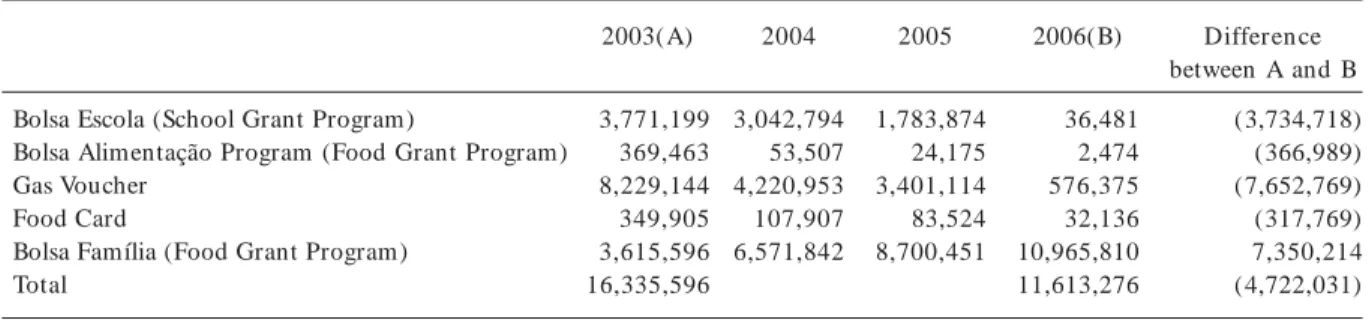
There is evidence – see Table 3– that the Lula ad-ministration’s new line of action consolidated, via unification, the income transfer programs created by the Fernando Henrique Cardoso adm inistration -Bolsa Escola, -Bolsa Alimentação, Cartão Alimentação Program (Food Card Program) – and some of the Fome Zero Program’s initiatives30.
One example of how the Lula administration in-corporated targeting tools was the Unified Registry, a tool used to identify potential beneficiaries of all pro-grams of the then-called Social Protection Network 31. As pointed out by Castro, the income transfer programs developed by different levels of government in Brazil during a number of years replaced the old food basket with money directly to the families, via magnetic cards and access to the baking system, and consolidated in society as a new way to intervene with the social issue31.
Program) was a result of that change. It was, in that sense, one of the sources of institutional learn-ing for the Lula adm inistration in providlearn-ing a model for allocation of resources directly to the families through the federal baking network and in close cooperation with the Municipal Executives in registering the families.
Created by the Ministry of Health in 2001, in the FH C adm inistration, it sought to prom ote health conditions and nutrition of pregnant wom-en and those breastfeeding their childrwom-en from the age of 6 (six) months to 6 (six) years and eleven months, under nutritional risk, who belonged to families with no income or whose income was un-der R$ 90.00 per capita. The grant was paid using a magnetic card at Caixa Econômica Federal (Feder-al Savings Bank) agencies or bank representatives (businesses with the sign “Caixa Aqui”). Once reg-istered in the Program, the family compromised to follow a health Commitment Schedule, which con-sisted of basic actions such as pre-natal exams, vac-cination, monitoring child growth and development and educational activities in health and nutrition32. The implementation of the Bolsa Família Pro-gram was greatly assisted by the institutional learn-ing acquired by Bolsa Alimentação and other pro-grams in the Social Protection Network. The regis-tration of beneficiaries activity by the Municipal Executives may have been one of the most interest-ing innovations of the Bolsa Alimentação Program. The Mayor’s registration function made it possi-ble to share the credit for the Bolsa Alimentação Program’s benefits between the federal and local governments. The Bolsa Família Program kept this essential feature. Thus, for example, the realization that the Federal Executive does not get all the credit for the Bolsa Família Program in municipalities.
This sharing of credit between the federal and local governments in terms of implementation makes it difficult, for example, to directly transfer credit and votes to candidates supported directly by the Fed-eral Executive33.
In summary, the Lula administration’s social intervention from 2004 was guided by targeting the poor. The Bolsa Família Program expressed this priority. Paradoxically, Table 3 shows that the set of income transfer programs, unified and re-duced under the brand Bolsa Família Program, reduced the number of beneficiaries of Income Transfer Programs by 4,722,031 from 2003 and 2006. The Bolsa Família Program’s great success, despite this reduction, can be associated with tar-geting the poor strata, predominantly poor fami-lies in the Northeast, and also to the evident in-crease in the average amount paid34.
Such extension in the scale of population cov-ered by the PBF would produce an important side-effect on the federal government’s protection func-tions from 2004. Federal funds allocated to tradi-tional social policies, such as health, education and sanitation, were greatly limited. Table 4 shows the reduction in health and education expenditures, in relation to the Gross Domestic Product, especially in the first years of Lula’s first term of office when compared to the first two FHC terms of office.
Souza and Costa prove, additionally, the ex-trem ely n egative im pact of chan ges in federal spending policy in the sanitation sector during the decades of 1990 and 2000. The authors reinforce the thesis that the sanitation sector was one of the main losers in terms of public decisions in the coun-try regarding the social area35.
Such constraint in basic social spending during the Lula administration is associated with three
Bolsa Escola (School Grant Program)
Bolsa Alimentação Program (Food Grant Program) Gas Voucher
Food Card
Bolsa Família (Food Grant Program) Total
2003(A)
3,771,199 369,463 8,229,144 349,905 3,615,596 16,335,596
2004
3,042,794 53,507 4,220,953 107,907 6,571,842
2005
1,783,874 24,175 3,401,114 83,524 8,700,451
2006(B)
36,481 2,474 576,375 32,136 10,965,810 11,613,276
Differen ce between A and B
(3,734,718) (366,989) (7,652,769) (317,769) 7,350,214 (4,722,031)
Source: Ministério do Desenvolvimento Social. Análise comparativa de programas de proteção social. Brasília: Ministério do Desenvolvimento Social; 2004. [Data from 2003]
*Reference: December
S
aú
d
e C
o
le
tiv
a, 1
4
(3
):6
9
3
-7
0
6
, 2
0
0
9
factors: growth of irreducible expenditures with Social Security; the process of large scale income transfer through the Bolsa Família Program, and the fiscal austerity policy of the Lula administra-tion through the elevaadministra-tion of the fiscal surplus from 2003. Table 5 shows the behavior of the central government’s primary effort in the last few years, emphasizing the notable effort by the Lula admin-istration in its first term of office.
The detailed analysis of the Brazilian public
spending behavior in the last two decades is natu-rally beyond the scope of this paper. The data an-alyzed before, however, show that the Lula admin-istration promoted change in the federal govern-ment’s social policy priorities, expanding an im-portant innovation of targeting the poor, with ev-ident limitations to the growth of expenses with universalist policies, implemented in the democra-tization wave, especially the health, sanitation and education policies.
Table 4. Federal Spending in Health and Education, % of the Gross Domestic Product in the FHC and Lula (first) Terms of Office. Brazil, 1995-2006.
Year
1995 1996 1997 1008 1999 2000 2001 2002 2003 2004 2005 2006
Education
1.31 1.11 1.03 1.10 1.08 1.13 1.11 1.13 1.07 0.95 0.93 1.03
Average % per Term of Office
1.14
1.11
1.0
Health
1.94 1.95 1.66 1.69 1.85 1.82 1.85 1.85 1.73 1.78 1.76
Average per Term of Office
1.81
1.84
1.76
Terms of Office
FHC’s First Term of Office
FHC’s Second Term of Office
Lula’s First Term of Office
Source: IPEA34;http://www.ripsa.org.br
Table 5. Tendency towards Primary Financing of the Brazilian Public Sector in the FHC and Lula (first) Terms of Office. Brazil, 1995-2006.
Year
1995 1996 1997 1008 1999 2000 2001 2002 2003 2004 2005 2006
Primary Fin an cin g
0.36 (0.09) (0.91) 0.01 3.28 3.50 3.70 4.01 4.38 4.64 4.35 3.90
Average % of Primary Balance per Term of Office
(0.15)
3.62
4.32
Terms of Office
FHC’s First Term of Office
FHC’s Second Term of Office
Lula’s First Term of Office
Conclusion
The macroeconomic adjustment program of the Brazilian Federal Executive by means of monetary stabilization and fiscal discipline, since the Real Plan, merged the fiscal adjustment agenda with the ex-pansion of the country’s debt burden. From 1999, when the Federal Executive was compelled to pro-duce primary surplus, threatened by the Sate’s in-solvency, the debt burden grew together with the search for public saving.
Balance in public finances was obtained by means of a skilful combination of effort toward surplus and growth of the country’s debt burden. The Federal Executive in the FHC and Lula admin-istrations was never actually under severe fiscal lim-itation to a degree which prevented them from implementing the democratization commitments and creating new social protection programs37.
It can be said that criticism to the lack of direc-tion and inefficiency of the Brazilian social public policies had an important role in defining new in-terventions to transfer income directly to the poor who were not contemplated by the 1988 Federal Constitution. There is no doubt that this agenda was strongly influenced by the macroeconomic adjustment orientation which sought to reduce social spending and target poorer groups.
The current Brazilian social protection system is a direct result of this unique combination of uni-versalist traditional policies with income transfer programs for groups considered to be vulnerable. The text demonstrates that there is a notable continuity in the scope of social protection created by the new Brazilian democracy. The Lula admin-istration – despite its left-wing tradition of criti-cism to the Brazilian social model – has maintained and expanded the essential bases of the arrange-ment implearrange-mented by the FHC administration. If it is possible to speak of innovation in the Lula administration, this was the expansion of the range of income transfer mechanisms by the PBF.
As in the macroeconomic management, the FHC and Lula administrations maintained the in-stitutional guidance of the social protection regime practically the same during nearly two decades.
It is worth noting that the development of social policies in Brazil is still limited by a secondary economy in nominal deficit. The Federal Executive has been obliged to make a complex fiscal effort to o r gan ize p u b lic fin an ces co n sid er in g t h e commitments of the public financial debt, which is around 7% of the GDP annually, in the current decade38. This means that the expansion of public
spending has been constrained by the effort of primary surplus, despite the tax burden of the three levels of government have reached more than 1 / 3 of Gross Domestic Product in 2003.
The creation of a program as large as the PBF affected directly the availability of resources of the central government for basic social areas – health, education , an d san itation . The progression of expenditures in those areas reveals that there has been a significant stagnation of federal supplies in the last 7 years. In the health sector only, it can be noted that the reduction in federal spending has been compensated by growth in Municipal and State spending. Still, the expansion of the financing role by municipal and state governments has not generated substantial change in the role of private spending in healthcare in the country.
S
aú
d
e C
o
le
tiv
a, 1
4
(3
):6
9
3
-7
0
6
, 2
0
0
9
Acknowledgements
I would like to thank all comments and sugges-tions made by Deborah Uhr, Carlos Pereira and Jeni Vaitsman. The author is the sole responsible for opinions expressed in this article.
Refer en ces Refer en ces Refer en ces Refer en ces Refer en ces
Dr aibe SM. As p olíticas sociais e n eo liber alism o.
Revista da USP 1993; 17:86-100.
Costa NR. Política social e ajuste m acroecon ôm ico.
Cad Saúde Pública 2003; 18(Supl.):13-21.
Brasil. Presidência da República Federativa. Um a
es-tratégia de desenvolvim ento social. Brasília: Govern o
Federal; 1996.
Castro JA, Cardoso Jú n ior JC. Políticas Sociais n o Brasil: Gasto Social do Govern o Federal de 1988 a
2002. In: IPEA. A questão social e as políticas sociais no
Brasil contemporâneo. Brasília: IPEA; 2005.
Fagnani E. Política Social no Brasil (1964-2002): entre a
Cidadania e a Caridade. [tese]. Cam pinas (SP):
Uni-cam p: Instituto de Econom ia; 2005.
Kau fm an R. A Política da Reform a do Estado: u m
exame de abordagens teóricas. Revista do Serviço
Pú-blico 1998; 49(1):43-69.
H aggard S, Kau fm an R R. T he Politics of Econom ic
Adjustm ent. New Jersey: Prin ceton Un iversity Press;
1992.
Draibe SM. Há tendências e tendências: com que estado
de bem -estar social haverem os de conviver? São Paulo:
NEPP/UNICAMP; 1999. [Cadernos de Pesquisa n.10]
Draibe S. A Política Social no governo FHC e o
Siste-m a d e Pr o t eção So cial. Tem po Social USP 2003;
15(2):63-101.
Draibe SM, Aureliano L. A especificidade do Welfare
State Brasileiro. In: Dain S, editor. A política social em
tempo de crise, economia e desenvolvimento. v. 3, Parte 1.
Brasília: MPAS/CEPAL; 1989
Albuquerque RC, organizador. O Brasil social:
realida-des e opções. Rio de Janeiro: DIPES/IPEA; 1993. [Série
IPEA n. 139]
Albu querqu e RC, Santos RAZV. O Br asil social: u m
balan ço de duas décadas. In : Albuquerque RC,
orga-nizador. O Brasil social: realidades e opções. Rio de
Janei-ro: DIPES/IPEA; 1993. p. 7-124. [Série IPEA n. 139]
Pierson P. Politics in Tim e: History, Institutions, and
Social A nalysis. N ew Jer sey: Pr in cet on Un iver sit y
Press; 2004.
Am es B. Os entraves da dem ocracia no Brasil. Rio de
Janeiro: FGV; 2003.
Pereira C, Mueller B. Comportamento estratégico em presiden cialism o de coalizão: as relações en tre exe-cutivo e legislativo na elaboração do orçam ento
bra-sileiro. Dados 2002; 45(2):265-301.
Lowi TJ. American Business, Public Policy,
Case-Stud-ies and Political Theory. World Politics 1964;
26(7):677-715.
Vianna MLW. A americanização perversa da seguridade
social no Brasil. Rio de Janeiro: Revan/IUPERJ/UCAM;
1998.
Arretche M. Financiam ento federal e gestão local de políticas sociais: o difícil equilíbrio en tre regulação,
responsabilidade e autonomia. Cien Saude Colet 2003;
8(2):331-345.
Draibe S. Brasil – a proteção social após vin te an os
de experim en tação reform ista. In: Taller
inter-regio-nal protección social en una era insegura: un intercam-bio sur-sur sobre politicas sociales alternativas en res-puesta a la globalización. Santiago: PNUD; 2002.
Tsebelis G. Veto-Players. How Political Institut ions
Work. New Jersey: Princeton University Press; 2002.
1.
2.
3.
4.
5.
6.
7.
8.
9.
10.
11.
12.
13.
14.
15.
16.
17.
18.
19.
Brasil. Min istério da Fazen da. Política Econôm ica e Reform as Estruturais. Brasília: Min istério da Fazen
-da; 2003.
Melo MA. o sucesso inesperado das reform as de se-gunda geração: federalismo, reformas constitucionais
e política social. Dados 2005; 48(4):845 -889.
Tan zi V, Sch u kn ech t L. Public Spending in the XX
Century – A Global Perspective. Cambridge: Cambridge
University Press; 2000.
Belik W, Silva J G, Takagi M. Políticas de com bate à
fome no Brasil. São Paulo Perspectiva 2001;
15(4):119-129.
Instituto de Cidadania. O Projeto Fome Zero. São
Pau-lo: Instituto de Cidadania; 2002.
Yasbek MC. O program a fom e zero no contexto das
políticas sociais brasileiras. São Paulo Perspectiva 2004;
18(2):104-112.
Betto F, organizador. Fom e Zero: textos fundam entais.
Rio de Janeiro: Garam ond; 2004.
Brasil. Presidên cia da República Federativa. Política
alimentar para o Brasil. Brasília: Presidência da
Repú-blica Federativa; 2003.
Silva G. Segurança alimentar: uma construção
comu-nitária. In: Betto F, organizador. Fome Zero: textos
fun-damentais. Rio de Janeiro: Garamond; 2004.p. 13-20.
Alm eid a MH T. Polít icas Sociais n o Gover n o Lu la.
Novos Estudos - CEBRAP 2004; 2:7-17.
Castr o MH G. A política de com bate à pobr eza do
governo do estado de São Paulo. São Paulo
Perspecti-va 2004; 18(4):3-7.
Costa NR. A proteção aos pobres e ajuste da prote-ção social: a experiência do Program a Bolsa Fam ília.
In: Anais do III Congresso Latino Americano de Ciência
Política – ALACIP; 2006; Cam pinas.
Hunter W, Power TJ. Rewarding Lula: Executive Pow-er, Social Policy, and the Brazilian Elections of 2006.
Latin American Politics and Society 2007; 49(1):1-300.
Instituto de Pesquisa e Econom ia Aplicada. Políticas
sociais – acompanhamento e análise. Brasília: IPEA; 2006.
Souza ACA, Costa NR. A crise do setor de saneamento
básico no Brasil: um a revisão bibliográfica. In press.
Fundação Getúlio Vargas. Conjuntura Econômica 2007;
61(11):11-100.
Castr o AC, Ribeir o J A, Du ar te BC. Gasto social e
política macroeconômica: trajetórias e tensões no perío-do 1995-2005 [Texto para discussão n. 1324]. Brasília:
IPEA; 2008.
Giam biagi F. A política fiscal do governo Lula [Texto
para discussão n. 1169]. Brasília: IPEA; 2006.
Instituto Brasileiro de Geografia e Estatística. Pesquisa
Nacional de Análise Domiciliar – PNAD. Rio de
Janei-ro: IBGE; 2007. 21.
22.
23.
24.
25.
26.
27.
28.
29.
30.
31.
32.
33.
34.
35.
36.
37.
38.