AR
TICLE
1 Departamento de Estudos sobre Violência e Saúde Jorge Careli/Claves, Escola Nacional de Saúde Pública, Fiocruz. Av. Brasil 4036/7º, Manguinhos. 21040-210 Rio de Janeiro RJ Brasil. [email protected]
Treatment for cases of violence by Brazilian emergency services
focusing on family relationships and life cycles
Abstract This article analyzes data regarding ca-ses of domestic violence treated by the emergency services through the following: the sociodemogra-phic characteristics of the people who were treated; the events themselves; the evolution of care (from childhood to old age by gender); and the factors that differentiate cases of domestic violence com-pared to those committed by non-family mem-bers. Data from 24 Brazilian state capitals and the Federal District were analyzed, comprising 86 emergency services: a total of 4,893 individuals were surveyed. Of those people who were treated by emergency services, 26.6% suffered domestic violence: 40.0% were children/adolescents, 57.2% were adults and 2.8% were elderly. The adjusted model, which compared victims of violence com-mitted by other family members with those who were not family members, showed that males were less likely to suffer from domestic violence; those that had fewer years of education were at increa-sed risk; and that women were more likely to com-mit domestic violence compared to the category of “both genders”. This study reinforces the fact that health sector professionals need to be able to deal with domestic violence by providing support, per-forming good practices, abiding by care protocols, taking care of injuries, and facilitating access to other services.
Key words Domestic violence, Surveys, Emergency health services
Joviana Quintes Avanci 1
Liana Wernersbach Pinto 1
A
vanci JQ
Introduction
This article is the result of epidemiological re-search that incorporates the monitoring com-ponent of the “Violence and Accidents Survey
Conducted in Sentinel Emergency Departments1.
This recent, and highly relevant, monitoring sys-tem is a governmental response to the serious context of violence that exists in Brazil, which requires consistent policies from the Ministry of Health. In response to this social demand, the Ministry of Health prioritized attention on the impacts of violence on the health of the popula-tion, implementing the following policies: “The National Policy for the Reduction of Morbidity
and Mortality due to Accidents and Violence”2,
“The National Policy for Emergency Care”3 and
“The National Health Promotion”4.
From the health sector perspective, violence can be conceptualized as “the use of force against a group or a community that results in, or has any possibility of causing, injury, death, psychological damage, developmental disability or deprivation”. A distinction is drawn between violence that is directed at oneself, interpersonal violence, and collective violence. Of the different forms of in-terpersonal violence, the following stand out: (1) domestic violence, which generally occurs within the home, but not exclusively; and (2) communi-ty violence, which occurs between people without kinship (consanguineous or otherwise), known or unknown, and which usually occurs outside
the home5. The concept of domestic violence
fo-cuses on conflicts between family members that are transformed into intolerance, abuse and op-pression, but which do not necessarily have the
domestic unit as a priority area of occurrence6.
Domestic violence and community violence are very common worldwide and they affect peo-ple in an unequal way in relation to gender, race/
color, age and socioeconomic condition5.
Chil-dren, adolescents, females (of all ages) and the elderly are the groups which are most affected by domestic violence due to their physical, social and economic dependence, as well as the continuation
of patriarchal cultural norms7-10. Young, black
men are most affected by community violence5.
In childhood, domestic violence overlaps with community violence and is usually caused by those who are responsible for the children. It affects younger children most, and boys are gen-erally more likely to be victims of physical ag-gression, while girls are more likely to suffer from sexual violence. Poverty has a significant impact on domestic violence through its effects on
pa-rental behavior and family dynamics, together with factors such as the prescence of many chil-dren in the home, the use of alcohol and drugs by parents or guardians, and the violence that
occurs between the latter. In adolescence, the
vic-timization of community violence is highlighted, as well as the authorship of situations of violence. For boys, poor school performance, difficulty in dealing with family and friends, as well as hav-ing only one parent at home and havhav-ing to deal with family conflicts, are all factors that lead to a
predisposition to violence in this phase. In adult
life, domestic violence is mainly perpetrated by
intimate partners, with a significant pecentage committed against women, while community vi-olence affects young men more and often results in homicides. Factors such as being young, alco-hol abuse, mental health problems, unemploy-ment, poverty and traditional gender norms all undepin both these types of violence. Among the elderly, the violence of children against their par-ents is evident. In these cases, the nature of the former relationship between caregiver and the elderly, depression among caregivers, as well as alcoholism and financial difficulties are all
trig-gers for violence at this stage in life5,11.
Fractures and bruises, lacerations and trau-mas, palpitations, breathlessness and chronic pain are some of the symptoms expressed by people in situations of violence requiring
emer-gency care12. Melo et al.13 point out that for many
individuals, being involved in violent situations is often their first contact with a health unit. The aforementioned authors argue that there should be an appropriate approach by a multiprofes-sional team, which is geared to the needs of indi-viduals, in order to provide access to protection services. In general, very little is known about the health services at the emergency level which
at-tend to victims of extreme cases of violence14-16.
The aim of this article is to analyze data re-garding domestic violence provided by the emer-gency services in relation to: (1) the sociodemo-graphic characteristics of the people attended to, the event, and the evolution of care (from child-hood to old age by gender); and (2) the factors that differentiate domestic violence from vio-lence comitted by non-family members.
Materials and methods
aúd
e C
ole
tiv
a,
22(9):2825-2840,
2017
emergency services every three years that ana-lyzes the trend of accidents and violence in the country, as well as profiling the victims who are attended. The survey was conducted in 24 Brazil-ian state capitals, the Federal District and in 11 selected municipalities, making up 114 partici-pating services. However, in this article only data from the state capitals and the Federal District are used, which comprised 86 emergency services.
The data were collected over 30 consecutive days, between September and December 2014; they were divided into 60, 12-hour shifts and selected by probabilistic lottery. The sample size was calculated to obtain a coefficient of variation of less than 30% and a standard error of less than three; a minimum of 2,000 cases that were at-tended due to external causes in the state capitals were calculated. The number of shifts in each es-tablishment was calculated by the ratio between the established minimum size (2,000) and the average number of cases dealt with by the estab-lishment in previous years.
The instrument used to collect the data con-tained the following five blocks: (1) general data, with information about the municipality, the location of the care center, date, time, and the consent to participate in the study; (2) the data of the person attended to, with variables such as age, gender, race, education, employment and any disabilities; (3) the victim’s residence data; (4) incident-specific data, with questions about the type of violence or accident, specifying the means used, the likely perpetrators, whether the event was intentional or not, and whether the as-sailant had consumed alcohol; and (5) data re-garding injuries and development, including is-sues such as the body parts affected, as well as the nature of the injury and the outcome of the case. The variable outcome analyzed in this article was “domestic violence”, which was defined as any form of violence inflicted by a father/mother, partner or any other family member. Focusing on domestic violence, in the statistical analyses these cases were then compared to cases where the aggressors were not members of the family, i.e. friends/ acquaintances, public legal agents, unknown etc. Cases that were classed as accidents were not included in this study.
For the description of the data, the frequency distributions of the variables according to gender were constructed for each of the following age groups: childhood and adolescence (0-19 years),
adult (20-59) and elderly (60 and over). In order to verify the associations, the Rao-Scott test was used with a 5% significance level.
In the modeling stage, separate models were initially adjusted for each of the studied age groups. The first stage of this process involved bi-variate analysis of the outcome (having suffered from domestic violence) in relation to all of the following variables: race/skin color (white; black/ mixed race; Asian/indigenous); disability (yes/
no); vulnerability (gypsy, living in a quilombola,
living in a village, living on the street); years of education; employment (yes/no); nature of vio-lence (physical, psychological, sexual, negligence and other); use of alcohol (yes/no); aggressor (father/mother; partner; former partner; oth-er family memboth-er; friend/acquaintance; public legal agent; unknown; other); gender of the ag-gressor (male, female, both); means used (bodily force; firearm; poisoning; sharp object; blunt ob-ject; threat; hot substance/item; other); place of occurrence (home; school; recreation area; pub-lic road; other); type of injury (no injury; bruise/ sprain/dislocation; cuts/lacerations; fracture/ amputation/trauma; intoxication/burns/oth-er); part of the body affected (head/neck; spine/ thorax/abdomen; genitals/anus; lower and upper limbs; multiple organs/regions) and outcome of the case (discharge; hospital admission, outpa-tient referral; other).
The modeling was subsequently performed only using the variables whose p-values were less than 0.20. We then proceeded to model the outcome of all the age groups together. As in the previous stage, the first step consisted of bivar-iate analysis between the outcome and the oth-er variables. The evaluation of the fit quality of the models was performed using McFadden’s R-squared statistic, whose values varied from 0 to 1. All the analyses were performed using the Complex Samples module of the 20.0 SPSS sta-tistical package.
A
vanci JQ
Results
A total of 4,893 individuals were surveyed in re-lation to access to Brazilian emergency services during the period under investigation. Of these, 26.6% suffered domestic violence (40.0% chil-dren and adolescents, 57.2% adults and 2.8% el-derly) and 73.4% were victims of violence com-mitted by a non-family member.
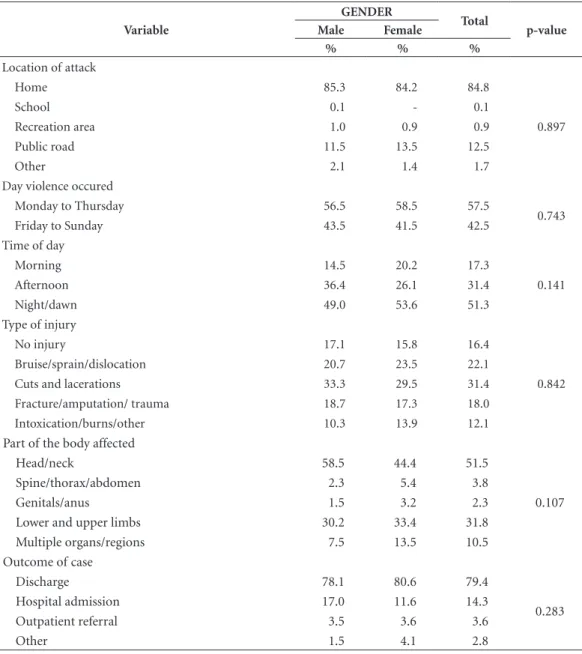
Table 1 shows that of the 413 children and adolescents who suffered violence caused by relatives, 50.5% were male, 54.5% were black or mixed race, and 89.1% had up to eight years of education. In a gender analysis, it was verified that 16.1% of the female cases reported having 9-12 years of education, compared with only 3.6% of males (p = 0.010). Regarding the type of violence, negligence (58.5%) and physical vi-olence (37.7%) were most common. It is note-worthy that 6.9% of the cases involving female children and adolescents resulted from sexual violence and 0.7% from psychological violence; in comparison practically no male was involved with these types of violence (p = 0.001). Alcohol use was reported by 4.4% of the victims in this age group and 33.4% stated that the violence was intentional. Fathers or mothers were the main ag-gressors in relation to domestic violence against children and adolescents (59.9%), especially fe-males (p = 0.026). The most frequent location in relation to violence between family members was the home (84.8%); 57.5% of cases occurred between Monday and Thursday, and 51.3% oc-curred in the night or at dawn.
Beatings and bodily strength were used by 24.4% of aggressors. It is noteworthy that 33.5% of female children and adolescents were victims of beatings, compared with 15.6% of males (p = 0.004). In relation to males, the use of sharp objects (10.4%) and blunt objects (8.0%) stood out, compared to 6.8% and 3.1% respectively for females. It should also be pointed out that threats were made to 2.6% of females but none were re-ported for males.
Cuts and lacerations occurred in 31.4% of cases and the head/neck were affected in 51.5% of cases. The outcomes of the cases showed that 79.4% were discharged after attendance by the emergency services.
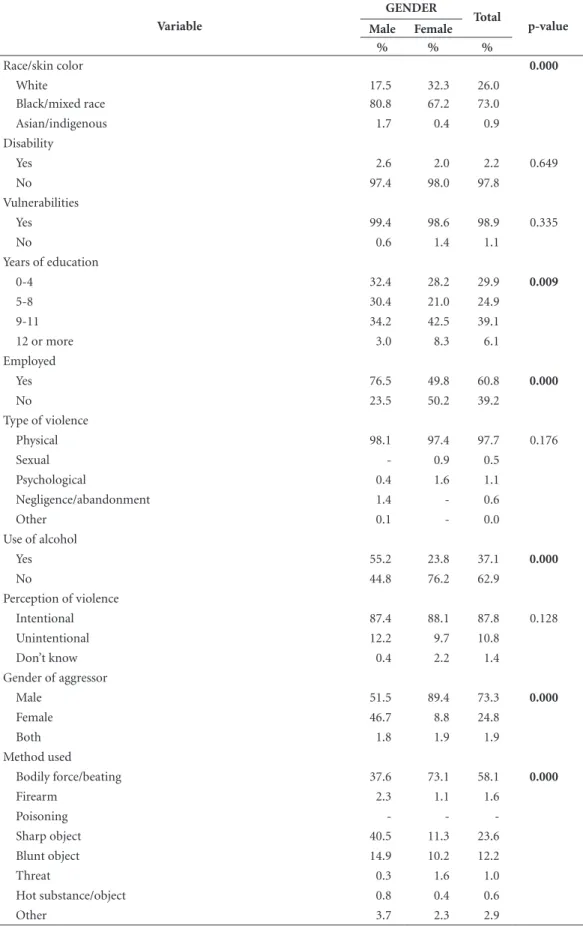
Table 2 shows the characteristics of the 725 adults who were assisted by emergency services due to domestic violence. It was found that 57.7% were female; 73.0% were black/mixed race; 39.1% had 9-11 years of education; and approxi-mately 60% were in employment. In the
compar-ison based on gender, there was a predominance of black and mixed race men, of people with less years of education, and those who worked (p <0.001, p = 0.009 and p < 0.001 respectively).
Physical violence occurred in 97.7% of the cases and 37.1% of individuals reported having consumed alcohol; a much higher percentage among men (55.2% compared with 23.8% of women) (p < 0.001). In a total of 87.8% of cases the event was intentional; in 61.4% of cases the aggressor was the victim’s partner, and in 73.3% of cases the aggressor was male. In the case of female victims, 89.4% of the offenders were male (p < 0.001). Beatings and physical force were used in 58.1% of cases and violence against women was highlighted (73.1% compared with 37.6% of men). In the case of male assailants the use of a sharp object predominated (40.5% compared with 11.3% for women) (p < 0.001). A total of 76.4% of cases occured in the home. Contrary to what was observed in the cases of children and adolescents, violence occurred from Friday to Sunday in 60.2% of cases and 51.8% occured during the night or at dawn. As was the case for the younger age group, there was a large frequency of cuts and lacerations (47.7%) and the head and neck were mainly affected (38.3%). Women were more affected by bruises/sprains/ dislocations; fractures/amputations/ trauma; and intoxication/burns; while men were more subject to cuts and lacerations (p < 0.001). The parts of the body that were affected also differed accord-ing to gender: there was a predominance in rela-tion to the spine/thorax/abdomen among men, and multiple organs among women (p < 0.001). It is interesting to observe that discharge after treatment by emergency services was more fre-quent among women (83.4% compared to 69.4% of men), while hospitalizations were more com-mon acom-mong men (21.3% compared to 11.8% for women) (p = 0.005).
aúd
e C
ole
tiv
a,
22(9):2825-2840,
2017
Table 1. Characterization of children and adolescents who were victims of domestic violence, and who were
assisted by emergency services in Brazilian state capitals participating in the VIVA project, by gender in 2014(N = 413*).
Variable
GENDER
Total
p-value
Male Female
% % %
Race/skin color
White 41.0 45.8 43.4
0.430
Black/mixed race 56.0 52.9 54.5
Asian/indigenous 3.0 1.3 2.2
Disability
Yes 2.3 - 1.2
0.055
No 97.7 100.0 98.8
Vulnerabilities
Yes 0.3 2.0 1.2
0.102
No 99.7 98.0 98.8
Years of education
0-4 70.9 52.6 61.2
0.010
5-8 24.2 31.1 27.9
9-11 3.6 16.1 10.2
12 or more 1.2 0.2 0.7
Employed
Yes 4.2 5.9 5.0
0.508
No 95.8 94.1 95.0
Type of violence
Physical 35.7 39.8 37.7
0.001
Sexual 0.1 6.9 3.5
Psychological - 0.7 0.3
Negligence/abandonment 64.2 52.6 58.5
Use of alcohol
Yes 2.7 6.2 4.4
0.137
No 97.3 93.8 95.6
Perception of violence
Intentional 29.2 37.6 33.4
0.236
Unintentional 68.4 57.6 63.0
Don’t know 2.4 4.8 3.6
Gender of aggressor
Male 25.7 41.9 33.7
0.026
Female 58.5 47.5 53.1
Both 15.8 10.6 13.2
Method used
Bodily force/beating 15.6 33.5 24.4
0.004
Firearm 0.9 0.1 0.5
Poisoning 0.4 1.0 0.7
Sharp object 10.4 6.8 8.6
Blunt object 8.0 3.1 5.6
Threat - 2.6 1.3
Hot substance/object 1.6 2.9 2.3
Other 63.0 50.0 56.6
A
vanci JQ
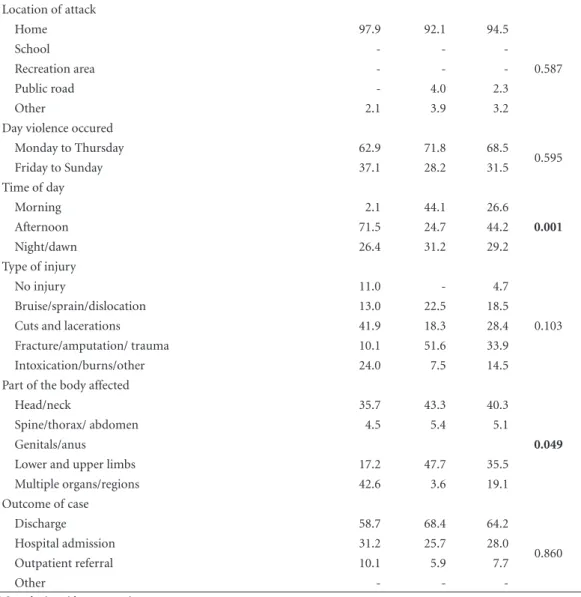
men suffered cuts and lacerations and 51.6% of women suffered from fractures/amputations/ trauma. Among the elderly, injuries affecting multiple organs were most common (42.6%). For females, the upper and lower limbs were most common (47.7%) (p = 0.049). Regarding the outcomes of the cases, 64.2% were discharged after attendance, with no distinction in terms of gender.
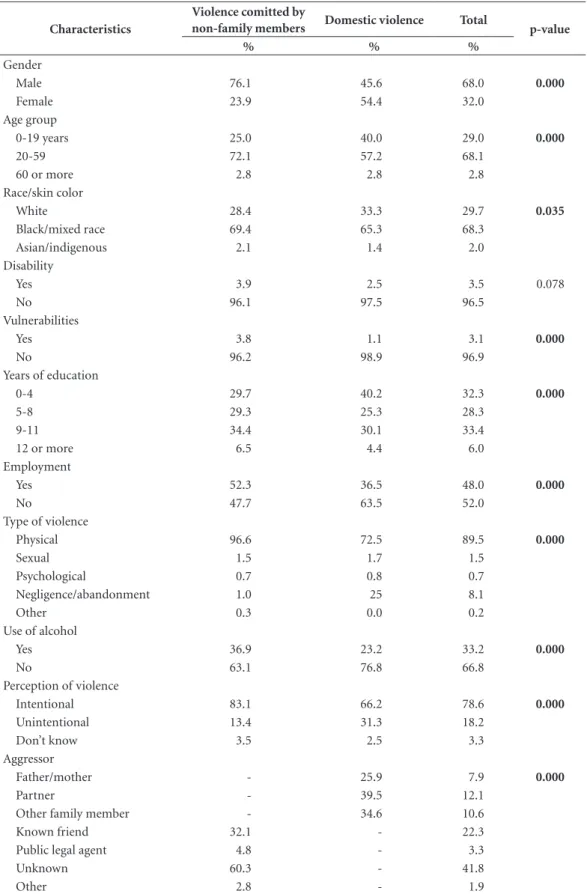
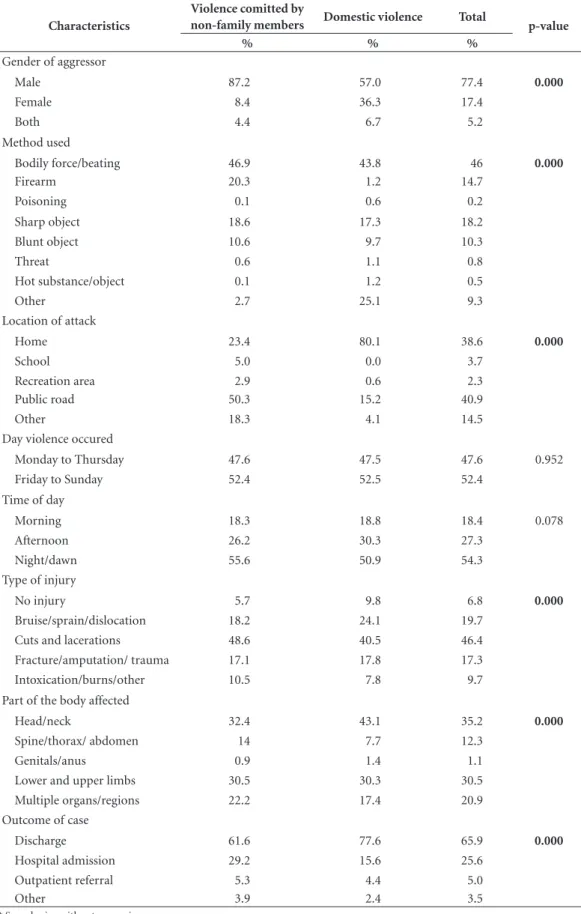
Table 4 presents the results of the bivariate analysis regarding the cases of domestic violence, and the cases of violence by people not belong-ing to the victim’s family. There was statistically
significant difference for all the variables except the following: day of occurrence (p = 0.952); dis-ability (p = 0.078); and time of day (p = 0.078). Nevertheless, the last two variables were included in the logistic regression model because they pre-sented a p-value lower than the defined cut-off point (0.2).
Table 4 also shows the characteristics of those who suffered violence committed by non-fami-ly members, which approximates to a profile of community violence: 76.1% were male; 72.1% were aged 20-59; 69.4% were black or mixed race; about 41% had nine or more years of
ed-Variable
GENDER
Total
p-value
Male Female
% % %
Location of attack
Home 85.3 84.2 84.8
0.897
School 0.1 - 0.1
Recreation area 1.0 0.9 0.9
Public road 11.5 13.5 12.5
Other 2.1 1.4 1.7
Day violence occured
Monday to Thursday 56.5 58.5 57.5
0.743
Friday to Sunday 43.5 41.5 42.5
Time of day
Morning 14.5 20.2 17.3
0.141
Afternoon 36.4 26.1 31.4
Night/dawn 49.0 53.6 51.3
Type of injury
No injury 17.1 15.8 16.4
0.842
Bruise/sprain/dislocation 20.7 23.5 22.1
Cuts and lacerations 33.3 29.5 31.4
Fracture/amputation/ trauma 18.7 17.3 18.0
Intoxication/burns/other 10.3 13.9 12.1
Part of the body affected
Head/neck 58.5 44.4 51.5
0.107
Spine/thorax/abdomen 2.3 5.4 3.8
Genitals/anus 1.5 3.2 2.3
Lower and upper limbs 30.2 33.4 31.8
Multiple organs/regions 7.5 13.5 10.5
Outcome of case
Discharge 78.1 80.6 79.4
0.283
Hospital admission 17.0 11.6 14.3
Outpatient referral 3.5 3.6 3.6
Other 1.5 4.1 2.8
* Sample size without expansion.
aúd
e C
ole
tiv
a,
22(9):2825-2840,
2017
Table 2. Characterization of adults who were victims of domestic violence and who were assisted by emergency
services in Brazilian state capitals participating in the VIVA project, by gender in 2014(N = 725*).
Variable
GENDER
Total
p-value
Male Female
% % %
Race/skin color 0.000
White 17.5 32.3 26.0
Black/mixed race 80.8 67.2 73.0
Asian/indigenous 1.7 0.4 0.9
Disability
Yes 2.6 2.0 2.2 0.649
No 97.4 98.0 97.8
Vulnerabilities
Yes 99.4 98.6 98.9 0.335
No 0.6 1.4 1.1
Years of education
0-4 32.4 28.2 29.9 0.009
5-8 30.4 21.0 24.9
9-11 34.2 42.5 39.1
12 or more 3.0 8.3 6.1
Employed
Yes 76.5 49.8 60.8 0.000
No 23.5 50.2 39.2
Type of violence
Physical 98.1 97.4 97.7 0.176
Sexual - 0.9 0.5
Psychological 0.4 1.6 1.1
Negligence/abandonment 1.4 - 0.6
Other 0.1 - 0.0
Use of alcohol
Yes 55.2 23.8 37.1 0.000
No 44.8 76.2 62.9
Perception of violence
Intentional 87.4 88.1 87.8 0.128
Unintentional 12.2 9.7 10.8
Don’t know 0.4 2.2 1.4
Gender of aggressor
Male 51.5 89.4 73.3 0.000
Female 46.7 8.8 24.8
Both 1.8 1.9 1.9
Method used
Bodily force/beating 37.6 73.1 58.1 0.000
Firearm 2.3 1.1 1.6
Poisoning - -
-Sharp object 40.5 11.3 23.6
Blunt object 14.9 10.2 12.2
Threat 0.3 1.6 1.0
Hot substance/object 0.8 0.4 0.6
Other 3.7 2.3 2.9
A
vanci JQ
ucation; and 52.3% were working at the time of the study. Regarding the type of violence, physi-cal violence was most prevalent (96.6%); alcohol consumption was reported by 36.9% of individ-uals; and 83.1% considered that the violence was intentional. In 60.3% of cases the identity of the offender was unknown and in 87.2% of cases the offender was male. The means of violence em-ployed included physical force/beating (46.9%), firearms (20.3%) and the use of sharp objects (18.6%). In 50.3% of cases the event occured in a public road and in 55.6% of cases it occurred at night or at dawn. Cuts and lacerations occurred
in 48.6% of cases of this type of violence. The most common injuries were those to the head and neck (32.4%) and upper and lower limbs (30.5%); 61.6% of cases resulted in discharge after attendance by the emergency services. The profile of those who suffered domestic violence (all ages) was predominantly female, adult, black or mixed race, with elementary education, un-employed and who were victims of physical vio-lence by male aggressors.
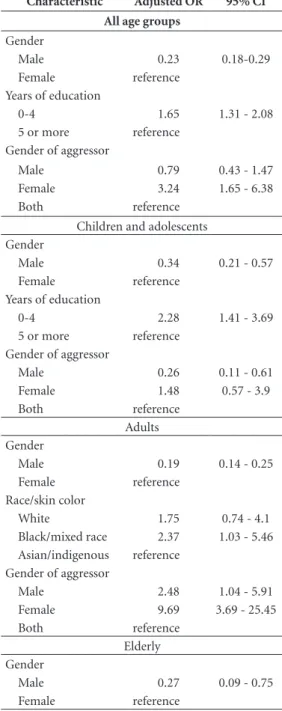
The results of the adjusted model according to age range (Table 5) shows the following vari-ables that were significant and which remained
Variable
GENDER
Total
p-value
Male Female
% % %
Location of attack
Home 76.1 76.6 76.4 0.977
School
Recreation area 0.3 0.4 0.4
Public road 17.6 17.4 17.5
Other 6.1 5.5 5.7
Day violence occured
Monday to Thursday 36.4 42.2 39.8 0.224
Friday to Sunday 63.6 57.8 60.2
Time of day
Morning 19.7 19.0 19.3 0.358
Afternoon 25.2 31.7 28.9
Night/dawn 55.1 49.3 51.8
Type of injury
No injury 3.8 6.5 5.4 0.000
Bruise/sprain/dislocation 16.5 32.6 25.9
Cuts and lacerations 65.4 34.8 47.7
Fracture/amputation/ trauma 11.3 21.0 16.9
Intoxication/burns/other 2.9 5.1 4.2
Part of the body affected
Head/neck 38.1 38.4 38.3 0.000
Spine/thorax/ abdomen 15.7 6.0 10.2
Genitals/anus 0.8 1.1 1.0
Lower and upper limbs 31.8 26.9 29.0
Multiple organs/regions 13.6 27.6 21.5
Outcome of case
Discharge 69.4 83.4 77.5 0.005
Hospital admission 21.3 11.8 15.8
Outpatient referral 5.7 3.5 4.4
Other 3.6 1.3 2.3
* Sample size without expansion.
aúd
e C
ole
tiv
a,
22(9):2825-2840,
2017
Table 3. Characterization of elderly people who were victims of domestic violence and who were assisted by
emergency services in Brazilian state capitals participating in the VIVA project, by gender in 2014(N = 36*).
Variable
GENDER
Total
p-value
Male Female
% % %
Race/skin color
White 47.0 40.6 43.3
0.768
Black/mixed race 53.0 57.9 55.8
Asian/indigenous - 1.5 0.9
Disability
Yes 7.3 41.4 26.2
0.030
No 92.7 58.6 73.8
Vulnerabilities
Yes - -
-No 100.0 100.0 100.0
Years of education
0-4 55.9 86.2 72.4
0.235
5-8 13.1 8.0 10.3
9-11 31.0 5.8 17.2
12 or more Employed
Yes 31.6 5.9 17.4
0.037
No 68.4 94.1 82.6
Type of violence
Physical 60.9 44.3 51.4
0.556
Sexual - -
-Psychological
Negligence/abandonment 39.1 54.1 47.7
Other - 1.6 0.9
Use of alcohol
Yes 18.2 8.4 13.0
0.419
No 81.8 91.6 87.0
Perception of violence
Intentional 91.3 55.5 70.7
0.222
Unintentional 8.7 28.2 19.9
Don’t know - 16.3 9.4
Gender of aggressor
Male 32.5 50.8 43.2
0.153
Female 33.1 44.7 39.9
Both 34.3 4.4 16.9
Method used
Bodily force/beating 21.6 34.0 28.6
0.093
Firearm 2.0 - 0.9
Poisoning 24.0 - 10.5
Sharp object 10.6 - 4.6
Blunt object 25.5 12.7 18.3
Threat
Hot substance/object - 2.2 1.2
Other 16.3 51.1 35.9
A
vanci JQ
Location of attack
Home 97.9 92.1 94.5
0.587
School - -
-Recreation area - -
-Public road - 4.0 2.3
Other 2.1 3.9 3.2
Day violence occured
Monday to Thursday 62.9 71.8 68.5
0.595
Friday to Sunday 37.1 28.2 31.5
Time of day
Morning 2.1 44.1 26.6
0.001
Afternoon 71.5 24.7 44.2
Night/dawn 26.4 31.2 29.2
Type of injury
No injury 11.0 - 4.7
0.103
Bruise/sprain/dislocation 13.0 22.5 18.5
Cuts and lacerations 41.9 18.3 28.4
Fracture/amputation/ trauma 10.1 51.6 33.9
Intoxication/burns/other 24.0 7.5 14.5
Part of the body affected
Head/neck 35.7 43.3 40.3
0.049
Spine/thorax/ abdomen 4.5 5.4 5.1
Genitals/anus
Lower and upper limbs 17.2 47.7 35.5
Multiple organs/regions 42.6 3.6 19.1
Outcome of case
Discharge 58.7 68.4 64.2
0.860
Hospital admission 31.2 25.7 28.0
Outpatient referral 10.1 5.9 7.7
Other - -
-* Sample size without expansion.
Table 3. continuation
in the final model for the group of children and
adolescents: gender (male); gender of aggressor (female); and education (lower). In relation to those who suffered violence from non-family members, being male constituted a protection or reduced risk of suffering from domestic violence, when compared to being female. As for educa-tion, it was verified that less years of education increased the chance of suffering from domestic violence (p = 0.001). There was a lower chance that aggressors who committed domestic vio-lence were male, when compared to the category “both” and violence committed by non-family members.
For the adult group, gender, race/skin color
aúd
e C
ole
tiv
a,
22(9):2825-2840,
2017
Table 4. Characterization of victims of violence who were assisted by emergency services in Brazilian state
capitals participating in the VIVA project in 2014(N = 4.893*).
Characteristics
Violence comitted by
non-family members Domestic violence Total p-value
% % %
Gender
Male 76.1 45.6 68.0 0.000
Female 23.9 54.4 32.0
Age group
0-19 years 25.0 40.0 29.0 0.000
20-59 72.1 57.2 68.1
60 or more 2.8 2.8 2.8
Race/skin color
White 28.4 33.3 29.7 0.035
Black/mixed race 69.4 65.3 68.3
Asian/indigenous 2.1 1.4 2.0
Disability
Yes 3.9 2.5 3.5 0.078
No 96.1 97.5 96.5
Vulnerabilities
Yes 3.8 1.1 3.1 0.000
No 96.2 98.9 96.9
Years of education
0-4 29.7 40.2 32.3 0.000
5-8 29.3 25.3 28.3
9-11 34.4 30.1 33.4
12 or more 6.5 4.4 6.0
Employment
Yes 52.3 36.5 48.0 0.000
No 47.7 63.5 52.0
Type of violence
Physical 96.6 72.5 89.5 0.000
Sexual 1.5 1.7 1.5
Psychological 0.7 0.8 0.7
Negligence/abandonment 1.0 25 8.1
Other 0.3 0.0 0.2
Use of alcohol
Yes 36.9 23.2 33.2 0.000
No 63.1 76.8 66.8
Perception of violence
Intentional 83.1 66.2 78.6 0.000
Unintentional 13.4 31.3 18.2
Don’t know 3.5 2.5 3.3
Aggressor
Father/mother - 25.9 7.9 0.000
Partner - 39.5 12.1
Other family member - 34.6 10.6
Known friend 32.1 - 22.3
Public legal agent 4.8 - 3.3
Unknown 60.3 - 41.8
Other 2.8 - 1.9
A
vanci JQ
Characteristics
Violence comitted by
non-family members Domestic violence Total p-value
% % %
Gender of aggressor
Male 87.2 57.0 77.4 0.000
Female 8.4 36.3 17.4
Both 4.4 6.7 5.2
Method used
Bodily force/beating 46.9 43.8 46 0.000
Firearm 20.3 1.2 14.7
Poisoning 0.1 0.6 0.2
Sharp object 18.6 17.3 18.2
Blunt object 10.6 9.7 10.3
Threat 0.6 1.1 0.8
Hot substance/object 0.1 1.2 0.5
Other 2.7 25.1 9.3
Location of attack
Home 23.4 80.1 38.6 0.000
School 5.0 0.0 3.7
Recreation area 2.9 0.6 2.3
Public road 50.3 15.2 40.9
Other 18.3 4.1 14.5
Day violence occured
Monday to Thursday 47.6 47.5 47.6 0.952
Friday to Sunday 52.4 52.5 52.4
Time of day
Morning 18.3 18.8 18.4 0.078
Afternoon 26.2 30.3 27.3
Night/dawn 55.6 50.9 54.3
Type of injury
No injury 5.7 9.8 6.8 0.000
Bruise/sprain/dislocation 18.2 24.1 19.7
Cuts and lacerations 48.6 40.5 46.4
Fracture/amputation/ trauma 17.1 17.8 17.3
Intoxication/burns/other 10.5 7.8 9.7
Part of the body affected
Head/neck 32.4 43.1 35.2 0.000
Spine/thorax/ abdomen 14 7.7 12.3
Genitals/anus 0.9 1.4 1.1
Lower and upper limbs 30.5 30.3 30.5
Multiple organs/regions 22.2 17.4 20.9
Outcome of case
Discharge 61.6 77.6 65.9 0.000
Hospital admission 29.2 15.6 25.6
Outpatient referral 5.3 4.4 5.0
Other 3.9 2.4 3.5
* Sample size without expansion.
aúd
e C
ole
tiv
a,
22(9):2825-2840,
2017
Table 5. Adjusted odds ratios with respective
confidence intervals for the variables associated with the outcome of domestic violence according to age groups, Brazil, 2014.
Characteristic Adjusted OR 95% CI
All age groups
Gender
Male 0.23 0.18-0.29
Female reference Years of education
0-4 1.65 1.31 - 2.08
5 or more reference Gender of aggressor
Male 0.79 0.43 - 1.47
Female 3.24 1.65 - 6.38 Both reference
Children and adolescents Gender
Male 0.34 0.21 - 0.57
Female reference Years of education
0-4 2.28 1.41 - 3.69
5 or more reference Gender of aggressor
Male 0.26 0.11 - 0.61
Female 1.48 0.57 - 3.9 Both reference
Adults Gender
Male 0.19 0.14 - 0.25
Female reference Race/skin color
White 1.75 0.74 - 4.1
Black/mixed race 2.37 1.03 - 5.46 Asian/indigenous reference
Gender of aggressor
Male 2.48 1.04 - 5.91
Female 9.69 3.69 - 25.45 Both reference
Elderly Gender
Male 0.27 0.09 - 0.75
Female reference
9.69 chance that the aggressor would be female when compared to being attacked by people of both genders, and a 2.48 chance that the aggres-sor would be male compared to both genders.
For the elderly group, only the variable of
gender remained in the final model and, as for
the other age groups, there was protection for males in terms of suffering from violence by fam-ily members (OR = 0.27, 95% CI = 0.09-0, 75).
The model adjusted for all the age groups
to-gether showed that the variables of gender, edu-cation of the victim, and gender of the aggressor remained in the final model and that the latter were key factors in the occurrence of domestic violence. Males were less likely to suffer from domestic violence (OR = 0.23; 95% CI = 0.18 - 0.29); people with fewer years of education had an increased risk of suffering from domestic vi-olence (OR = 1.65; 95% CI = 1.31 - 2.08); and females were more likely to commit domestic vi-olence compared to the category of “both sexes” (OR = 3.24; 95% CI = 1.65 - 6.38) (Table 5).
Discussion
The demand for care provided by emergen-cy medical services due to violence, especially domestic violence, is an area that is still largely unknown, under-exploited and under-utilized, despite the fact that violence constitutes an im-portant public health problem in Brazil and worldwide, as well as being responsible for high
levels of morbidity and mortality in Brazil17,18.
Consequently, the present study provides a rich, unprecedented approach to the study of domes-tic violence; it investigates, separately, the stages of the life cycle affected by violence that arrive at the emergency services of various Brazilian state capitals. The findings of this study make it possi-ble to identify key factors in the characterization of cases of domestic violence which have caused injuries and are therefore treated as emergencies. In addition, it is worth mentioning that the in-vestigation of this phenomenon in the context of the provision of emergency services is unprece-dented in Brazil. Greater knowledge regarding domestic violence, especially when compared to cases of community violence, makes it possible to perform strategic planning and also provides pointers for action that can adequately deal with the results of this violence and promote access to other services.
A
vanci JQ
the presence of previous violent episodes; the fear of providing information; the pact of silence in families regarding the issue; as well as aspects re-lated to social, cultural and community issues all have a profound impact on the way in which re-ception, care, referral and resolution of situations are provided at the various levels of health care.
One of the most notable findings of this study is that a quarter of the cases brought to emergen-cy services were caused by aggressions from fam-ily members. More specifically, mothers were the main aggressors in childhood and adolescence; partners were the main aggressors in terms of adults; and children were the main aggressors in relation to the elderly. A high prevalence of cases of women who were victims of violence by their partner was found, which was in line with
the findings of a study by Stark and Flitcraft19
. The aforementioned study identified conjugal violence as the major cause of bodily injuries encountered by emergency services, and the au-thors warn that the dimensions of this problem are not being considered in medical treatment because the same diagnosis and procedures are prescribed to women who suffer fractures from a fall and women who suffer fractures that result from beatings by their partners. It is estimated that 16,993 femicides occurred in Brazil from 2009-2011, which is equivalent to an annual mortality rate of 5.82 deaths per 100,000
wom-en20. In the United States, it is estimated that each
year more than half a million injuries requiring medical care result from this form of violence, and that more than 145,000 cases require hospi-talization. Nearly one in three female patients are
victims of violence from their partner21.
Another relevant finding of the present study was that being female was an important factor in relation to domestic violence for practically the entire period of life, which is linked to cultural gender issues that are strongly present in family relations, where being a girl or a woman or an elderly woman impose inferiority and inequali-ty for female family members and can result in
punches, humiliation and even death22. Less
ed-ucation is another aspect that deserves attention5
because education fosters a culture of tolerance and respect for human rights.
Due to the punctual and sporadic character-istics of the services offered by emergency care, physical violence is the main cause of attention during all the stages of the life cycle. However, it is worth noting the frequency of sexual violence among girls in childhood/ adolescence and ne-glect among the elderly. Regarding sexual vio-lence, despite the fact that it is often under-re-ported, data from the Special Secretariat for
Hu-man Rights23 show that from May 2003 to May
2004 there were approximately 5,000 complaints related to sexual violence and about 4,000 related to sexual exploitation. Among the elderly, neglect and family abandonment are the most common forms of violence during this stage of life, which are often caused by the stress and emotional ex-haustion of caregivers and the dependency of the
elderly24,25.
Regarding the context of care provided by emergency services, the following are some of the factors that create barriers to providing more in-depth care regarding cases involving domestic violence: an emphasis on flow, rapid interven-tion and the technological aspects of care; an overload of work for healthcare professionals; disarticulation in relation to referral services; the frustration of healthcare professionals regard-ing their inability to solve problems or provide help; as well as the helplessness and isolation of emergency teams and the lack of preparation of healthcare professionals to deal with the issue of
violence, particularly domestic violence26-29.
aúd
e C
ole
tiv
a,
22(9):2825-2840,
2017
References
1. Brasil. Ministério da Saúde (MS). Portaria MS/GM no. 1.356, de 23 de junho de 2006. Institui incentivo aos estados, ao Distrito Federal e aos municípios para a Vi-gilância de Acidentes e Violências em Serviços Sentine-la, com recursos da Secretaria de Vigilância em Saúde.
Diário Oficial da União 2006; 24 jul.
2. Brasil. Ministério da Saúde (MS). Portaria MS/GM no. 737, de 16 de maio de 2001. Dispõe sobre a Política Na-cional de Redução da morbimortalidade por Acidentes e Violências. Diário Oficial da União 2001; 17 maio. 3. Brasil. Ministério da Saúde (MS). Portaria MS/GM no.
1.863, de 29 de setembro de 2003. Institui a Política Na-cional de Atenção às Urgências, a ser implantada em todas as unidades federadas, respeitadas as competên-cias das três esferas de gestão. Diário Oficial da União
2003; 30 set.
4. Brasil. Ministério da Saúde (MS). Portaria MS/GM no. 687, de 30 de março de 2006. Aprova a Política de Pro-moção da Saúde. Diário Oficial da União 2006; 31 mar. 5. Krug EG, organizador. Relatório mundial sobre violên-cia e saúde. Genebra: Organização Mundial da Saúde; 2002.
6. Lima DC. Homens autores de violência doméstica e fa-miliar contra a mulher: desafios e possibilidades [disser-tação]. Florianópolis: Universidade Federal de Santa Catarina; 2008.
7. Rates SMM, Melo EM, Mascarenhas MDM, Malta DC. Violência infantil: uma análise das notificações compulsórias, Brasil, 2011. Cien Saude Colet 2015; 20(3):655-666.
8. Mascarenhas MDM, Andrade SSCA, Neves ACM, Pedrosa AAG, Silva MMA, Malta DC. Violência con-tra a pessoa idosa: análise das notificações realizadas pelo setor saúde - Brasil, 2010. Cien Saude Colet 2012; 17(9):2331-2342.
9. Rodrigues CS, Malta DC, Godinho T, Mascarenhas MDM, Silva MMA, Silva RE. Acidentes e violências entre mulheres atendidas em Serviços de Emergên-cia Sentinela - Brasil, 2009. Cien Saude Colet 2012; 17(9):2319-2330.
10. Conceição TB. Assimetria e simetria de gênero na vio-lência por parceiro íntimo em pesquisas realizadas no Brasil[dissertação]. Florianópolis: Universidade Fede-ral de Santa Catarina; 2016.
11. NjaineK, Assis S, Constantino P, organizadores. Impac-tos da Violência na Saúde. Rio de Janeiro: Fiocruz; 2014. 12. Donnelly EA, Oehme K, Melvin R. What do EMS per-sonnel think about domestic violence? An exploration of attitudes and experiences after participation in training. J Forensic Leg Med 2016; 38:64-69.
13. Melo RA, Peralva TR, Araújo AKC, Souza DDO, Bezer-ra CS, Rafael LDC. Violência doméstica na percepção de enfermeiros de serviço de emergência. Revista Ciên-cia & Saberes-Facema 2016; 2(3):221-228.
14. Cavalcanti MLT, Deslandes SF, Minayo MCS. Análise da Implementação do Atendimento Hospitalar. In: Mi-nayo MCS, Deslandes SF, organizadores. Análise diag-nóstica da Política Nacional de Saúde para Redução de Acidentes e Violências. Rio de Janeiro: Fiocruz; 2007. p. 139-158.
15. Minayo MCS, Deslandes SF. Análise diagnóstica da Polí-tica Nacional de Saúde para Redução de Acidentes e Vio-lências. Rio de Janeiro: Editora Fiocruz; 2007.
Collaborations
A
vanci JQ
16. Assis SG, Deslandes SF, Minayo MCS. O atendimento de pessoas em situação de violência no Sistema Único de Saúde - SUS. Uma revisão da bibliografia da área da saúde 2001-2013. Rio de Janeiro: Editora Fiocruz. No prelo 2017.
17. Brasil. Ministério da Saúde (MS). Informações de saú-de [dados na Internet]. Brasília: MS [acessado 2016 saú-dez 20]. Disponível em: http://www.datasus.gov.br. 18. Mascarenhas MDM, Silva MMAD, Malta DC, Moura
LD, Gawryszewski VP, Costa VC, Morais Neto OLD. Atendimentos de emergência por acidentes na Rede de Vigilância de Violências e Acidentes: Brasil, 2006. Cien Saude Colet 2009; 14(5):1657-1668.
19. Stark E, Flitcraft A. Women at risk. Domestic violence and Women´s health. Thousand Oaks: Sage Publica-tion; 1996.
20. Garcia LP, Freitas L, Silva G. Violência contra a mulher: feminicídios no Brasil. Rio de Janeiro: Instituto de Pes-quisa Econômica Aplicada; 2013.
21. Department of Health and Human Services. Costs of intimate partner violence against women in the United States. Washington: Centers for Disease Control and Prevention; 2003.
22. Vieira LJES, Pordeus AMJ, Ferreira RC, Moreira DP, Maia PB, Saviolli KC. Fatores de risco para violência contra a mulher no contexto doméstico e coletivo. Saú-de Soc 2008; 17(3):113-125.
23. Secretaria Especial dos Direitos Humanos. (2007).
Dados atualizados do disque denúncia nacional. [aces-sado 2017 jul 11]. Disponível em: http://www.unb.br/ cet/turismoeinfancia/textos.dados/indice%20por%20 Uf%20de%20denuncias.pdf
24. Jayawardena KM, Liao S. Elder abuse at end of life. J Paillat Med 2006; 9(1):127-136.
25. Queiroz ZPV, Lemos NFD, Ramos LR. Fatores poten-cialmente associados à negligência doméstica entre idosos atendidos em programa de assistência domici-liar. Cien Saude Colet 2010; 15(6):2815-2824.
26. McGarry J, Nairn S. An exploration of the perceptions of emergency department nursing staff towards the role of a domestic abuse nurse specialist: a qualitative study. Int Emerg Nurs 2015; 23(2):65-70.
27. Yonaka L, Yoder M, Darrow J, Sherck J. Barriers to screening for domestic violence in the emergency de-partment. J Contin Educ Nurs 2007; 38(1):37-45 28. Andersson H, Jakobsson E, Furaker C, Nilsson K. The
everyday work at a Swedish emergency department: the practitioners perspective. Int Emerg Nurs 2012; 20(2):58-68.
29. Oliveira LRD, Mello Jorge MHPD. Análise epidemio-lógica das causas externas em unidades de urgência e emergência em Cuiabá/Mato Grosso. Rev Brasileira de epidemiologia 2008; 11(3):420-430.
Article submitted 10/1/2017 Approved 18/4/2017