Materials Research, Vol. 8, No. 4, 391-394, 2005 © 2005
*e-mail: [email protected]
Processing of Bulk Bi-2223 High-Temperature Superconductor
Alexander Polaseka*, Luiz Antonio Saléha, Hortêncio Alves Borgesb, Eduardo Novaes Heringb,
Bojan Marinkovicc, Fernando C. Rizzo Assunçãoc, Eduardo Torres Serrad, Glória Suzana de Oliveirae a
Special Technologies Dpt, CEPEL, Electric Power Research Center, Rio de Janeiro - RJ, Brazil
bDepartment of Physics, Pontifical Catholic University of Rio de Janeiro, Rio de Janeiro - RJ, Brazil
Pontifical Catholic University of Rio de Janeiro, Rio de Janeiro - RJ, Brazil
c
Departament of Materials Science and Metallurgy,
Pontifical Catholic Universuty of Rio de Janeiro, Rio de Janeiro - RJ, Brazil
d
R&D Directorate, CEPEL, Electric Power Research Center, Rio de Janeiro - RJ, Brazil
eHead of the Departamento de Instalações e Equipamentos, CEPEL,
Electric Power Research Center, Rio de Janeiro - RJ, Brazil
Received: July 19, 2004; Revised: September 28, 2005
The Bi2Sr2Ca2Cu3O10+x (Bi-2223) is one of the main high temperature superconductors for applications. One of these applications is the Superconductor Fault Current Limiter (SCFCL), which is a very promising high temperature superconducting device. SCFCL’s can be improved by using bulk superconductors with high critical currents, which requires a sufficiently dense and textured material. In the present work, a process for improving the microstructure of Bi-2223 bulk samples is investigated. Pressed precursor blocks are processed by sintering with a further partial melting step, in order to enhance the Bi-2223 grain texture and to healing cracks induced by pressing. In order to improve the microstructure, the precursor is mixed with silver powder before pressing. Samples with and without silver powder have been studied, with the aim of investigating the influence of silver on the microstructure evolution. The phase contents and the microstructure obtained have been analyzed through XRD and SEM/EDS. The electromagnetic characterization has been performed by Magnetic Susceptibility Analysis. We present and discuss the process and the properties of the superconducting blocks. High fractions of textured Bi-2223 grains have been obtained.
Keywords:high temperature superconductor, Bi-2223, partial melting, bulk
1. Introduction
The Superconducting Fault Current Limiter (SCFCL) is one of the most promising electric power applications based on high temperature superconductors (HTSC)1. Such device is very fast and reliable for
limiting current peaks in grid lines. The current limiting process is based on the superconductor/normal state transition occurring in the presence of a current peak. Superconductors presenting relatively high critical currents (Ic) are required to improving the FCL performance and cost/benefit. Bulk parts can transport high currents, but the transport properties are strongly influenced by the microstructure. The critical current density (Jc) increases with the texture degree and with the den-sity of the ceramic material2,3. The oxide Bi
2Sr2Ca2Cu3O10+x (Bi-2223)
is one of the most suitable HTSC materials for applications3. However,
Bi-2223 sintered bulk samples normally present high porosity and low texture degrees. On the other hand, hot-pressed samples have already been shown to attain Jc values so high as 8000 A/cm24. Nonetheless,
this method may be not suitable for large-scale production. In the present work, we investigate a method for processing bulk Bi-2223, analyzing the resulting microstructure and phase contents. Pressed precursor blocks were sintered, with a further partial melting step to enhancing the Bi-2223 grain texturing and to healing cracks induced by pressing. The addiction of silver powder has also been studied. Silver was added to the precursor powder, due to the high ductility of this metal, as well as to its physical and chemical compat-ibility with the Bi-2223 phase3.
2. Experimental
A commercial precursor powder (Merck) with an optimal nominal composition Bi1.84Pb0.35Sr1.91Ca2.05Cu3.06Ox was employed. Lead is an
essential dopant for improving Bi-2223 formation. Two precursor batches were employed: one mixed with 10 wt. (%) of silver powder (Alfa Aesar 99.9%) and another without silver powder. The silver powder was mixed to the precursor in an agate mortar with pestle. The precursor batches were packed into silver tubes (Alfa Aesar, 99.9%) measuring 4.35 mm (ID), 6.35 mm (OD) and 50 mm (length). One end of each tube was previously welded while the other was mechanically closed after the powder insertion. The silver-sheathed precursors were uniaxially cold pressed under about 300 MPa into blocks measuring 7.50 mm (width) and 3.90 mm (thickness), fol-lowed by sintering at 830-850 °C / 180 hours, in 7.5% O2/N2 (opti-mum atmosphere for Bi-2223 formation) with intermediate uniaxial cold pressing steps under 300 MPa. A further heat treatment with a partial melting step was employed. All heat treatments were carried out with alumina crucibles in a tubular furnace. The phase contents and the microstructure were analyzed through X-ray Diffraction (XRD), with λCuKα radiation, and Scanning Electron Microscopy (SEM/EDS). Low field AC magnetic susceptibility was measured in a Lake Shore inductive susceptometer, in a field of 20 Oersted and a frequency of 125 Hz.
3. Results and Discussion
392 Polasek et al. Materials Research
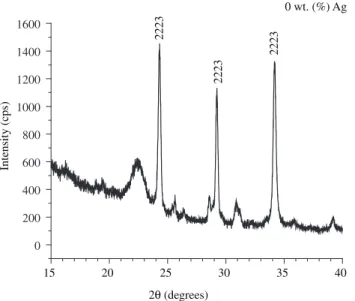
indicating a high fraction of textured Bi-2223. The grain alignment is indicated by the predominance of the three main 2223 peaks, while the other reflections of this phase are practically absent. The smaller peaks could not be identified, but may belong to secondary phases. The sample with silver powder addiction exhibits a higher signal to background ratio, suggesting a better grain alignment. Silver is known to promote the alignment and growth of 2223 grains, partly due to the reduction of the 2223 melting point in the presence of that element5,6.
Samples of each block were powdered and analyzed through XRD, as shown in Figure 2. These patterns reveal other 2223 peaks that were not present in the previous figure due to the texture effect. The high 2223 fraction observed by the XRD analysis of the pow-dered samples shows that the core of the blocks contained mainly 2223, leading to the conclusion that the 830-850 °C range, in 7.5% O2/N2, lies within the optimal range to forming that phase, as shown in previous works7-10.
15 20 25 30 35 40
Intensity (cps)
2 (degrees)
0 wt. (%) Ag
2223
2223
2223
1600
1400
1200
1000
800
600
400
200
0
15 20 25 30 35 40
10 wt. (%) Ag
2223
2223
2223
Intensity (cps)
2 (degrees) 5000
4000
3000
2000
1000
0
Figure 1. XRD patterns of sintered blocks with 0 wt. (%) Ag and 10 wt. (%) Ag.
15 20 25 30 35 40
0 wt. (%) Ag
2223
2223
2223
2223
2223
2223
Intensity (cps)
2 (degrees)
2223
700
600
500
400
300
200
100
15 20 25 30 35 40
10 wt. (%) Ag
Ag
2223
2223
2223
2223
2223
2223
2223
Intensity (cps)
2 (degrees) 800
700
600
500
400
300
200
100
0
Figure 2. XRD patterns of powdered sintered samples with 0 wt. (%) Ag and 10 wt. (%) Ag.
In according to Figure 3, the Magnetic Susceptibility Analysis confirmed the presence of the Bi-2223 phase, which can be proved by the transitions to the superconducting state occurring around 105 K (Bi-2223 critical temperature - Tc = 105-110 K). However, for both samples, the transition is not sharp, suggesting the presence of inhomogeneities in the Bi-2223 phase. The large transitions might also be indicative of the presence of the Bi-2212 phase (Tc < 96 K). Before sintering, Bi-2212 is the main phase in the precursor powder. The apparent contradiction between these results and that presented by XRD (Figures 1 and 2) might be attributed to the high sensibility of the Magnetic Susceptibility Analysis.
Vol. 8, No 4, 2005 Processing of Bulk Bi-2223 High-Temperature Superconductor 393
in the matrix. However, high bulk porosity can be observed for the same sample, though the silver particles were expected to improve the powder compaction, in function of the high ductility of silver. The micrograph of the sample without silver addiction apparently suggests a higher bulk density. Nonetheless, lower magnification images showed a heterogeneous microstructure for both samples, so that the sample without silver addiction also presented porous regions. Besides, both samples presented cracks, as illustrated in Figure 5, which are attributed to the intermediate cold pressing steps. Also, both porosity and cracks can arise from the expansion of the samples, due to Bi-2223 grain growth. Such grains are plate-shaped and grow very anisotropically, forming long plates with high aspect ratio3,6. This growing feature induces a volume increase, reducing
thus the bulk density. In addiction, the constraints imposed by the silver-sheath to the expansion of the ceramic core tend also to induce crack formation during heat treatment.
After sintering at 830-850 °C, a further heat treatment with a partial melting step at 850-860 °C for 10 minutes, in 7.5% O2/N2, was carried out. This partial melting consists of a partial decomposition of the Bi-2223 phase into liquid and solid phases9,11,12. After partial melting,
the samples were slowly cooled (1.2 °C/h) to about 770 °C and further cooled (1 °C/min) to room temperature. The use of partial melting has already been proved to improve the microstructure and electrical transport properties of silver-sheathed Bi-2223 tapes7-10. Hence, the
partial melting step was expected to improve the microstructure of the Bi-2223 blocks, by forming a liquid phase that could reduce porosity and heal cracks. However, in the present study, the partial melting has not shown the expected advantages. Controlling the partial melting parameters is very critical, in order to find the optimal temperature and dwelling time where a sufficient liquid amount could be obtained without excessive decomposition of the Bi-2223 phase into secondary phases9. This decomposition can generate large precipitates, which
80 90 100 110 120 130
- 2.0 x 10⁻⁴ - 1.5 x 10⁻⁴ - 1.0 x 10⁻⁴ - 5.0 x 10⁻⁵ 0.0
5.0x 10⁻⁵ 0 wt. (%) Ag
X
(u
.a
.)
Temperature (K)
80 90 100 110 120 130
- 1.5 x 10⁻⁶ - 1.0 x 10⁻⁶ - 5.0 x 10⁻⁷ 0.0
5.0x 10⁻⁷ 10 wt. (%) Ag
X (u.a.)
Temperature (K)
Figure 3. AC Magnetic Susceptibility Analysis of sintered blocks with 0 wt. (%) and 10 wt. (%) Ag (H = 20 Oe, f = 125 Hz).
Ag
20 m
Figure 4. SEM images of the sintered blocks with 0 wt. (%) Ag (left) and 10 wt. (%) Ag (right). For both samples, the EDS analysis indicated: a matrix with
394 Polasek et al. Materials Research
Figure 5. SEM images of the sintered blocks with 0 wt. (%) Ag (left) and 10 wt. (%) Ag (right), showing regions with high porosity, voids and cracks.
tends to remain stable, being not consumed to reform Bi-2223, even after a long post-annealing11,12. Therefore, the partial melting has to be
more intensively studied, with the aim of improving the microstructure of Bi-2223 blocks. This is a challenging and crucial task, necessary to make such blocks suitable for applications.
4. Conclusions
The processing of Bi-2223 blocks has been investigated. Sintering at optimum conditions formed high fractions of Bi-2223 and highly textured grains of this phase. The appropriate texture degree is es-sential for attaining high critical currents. The addiction of silver to the precursor powder might have been beneficial to the formation of textured Bi-2223. On the other hand, the microstructure of the samples (with and without silver addiction) was heterogeneous presenting densified regions, as well as regions with high porosity, voids and cracks. The use of a partial melting treatment after sintering has not yet shown microstructure improvements. Such improvements were expected due to the formation of a liquid phase that could densify the samples and heal cracks. However, a better understanding of the partial melting process is still required, in order to find the optimal temperature and dwelling time where a sufficient liquid amount could be obtained without excessive decomposition of the Bi-2223 into secondary phases. Therefore, the investigation of a suitable partial melting treatment and the development of the whole processing are being undertaken by our group, in order to enhance the microstructure of Bi-2223 superconducting blocks.
References
1. Hassenzahl W, et al. Electric power applications of superconductivity. Proceedings of the IEEE. Special Issue on Applications of Superconduc-tivity. 2004; 92(10):1655-1674.
2. Jiang J, et al. Evolution of core density of Ag-Clad Bi-2223 tapes
dur-ing process. IEEE Transactions on Applied Superconductivity. 2001;
11(3):3561-3564.
3. Kitaguchi H, Kumakura H. Advances in Bi-Based High-Tc
superconduct-ing tapes and wires. MRS BULLETIN. 2001 February.
4. Caillard R, Gomina M. Influences of sinter-forging parameters and texture on the critical transport current density of Bi-Pb-Sr-Ca-Cu-O
(2223) superconductors. Superconductor Science and Technology.2001;
14(9):712-716.
5. Feng Y, et al. Microstructural analysis of high critical current
density Ag-clad Bi-Sr-Ca-Cu-O (2:2:1:2) tapes. Physica C.1992;
192(3-4):293-305.
6. Majewski P. Phase diagram studies in the system Bi-Pb-Sr-Ca-Cu-O-Ag. Superconductor Science and Technology. 1997; 10:453-467.
7. Xia SK, Lisboa MB, Serra ET, Rizzo F. Continuous cooling
sinter-ing: a new method for Bi-2223/Ag tape processing. Physica C. 2001;
354(1-4):463-466.
8. Xia SK, Serra ET, Rizzo F. Enhancement of heat-treatment temperature window and reduction of sintering time of Bi-2223/Ag tapes by
continu-ous cooling sintering. Physica C. 2001; 361(3):175-180.
9. Xia SK, Lisboa MB, Serra ET, Rizzo F. Bi-2223/Ag tapes prepared at
temperatures above the Bi-2223 decomposition temperature.
Supercon-ductor Science and Technology. 2001; 14(2):103-108.
10. Xia SK, Polasek A, Saléh LA, Marinkovic B, Rizzo F, Serra E T.
Prepara-tion of Bi-2223/Ag tapes by the partial melting route. Physica C. 2004;
408-410:911-912.
11. Polasek A, Majewski P, Serra ET, Rizzo F, Aldinger F. Phase relations study on the melting and crystallization regions of the Bi-2223 high
temperature superconductor. Materials Research. 2004; 7(3):393-408.