*e-mail: [email protected]
1. Introduction
The need for materials that are biodegradable and have appropriate characteristics for speciic purposes is ever increasing due to the lack of resources and increasing levels of environmental pollution. Thus, several researches are proceeding to develop composites using various recycled wastes1,2, especially environmental friendly agro-wastes (lignocellulosic materials) as reinforcing fillers and thermoplastic polymers as matrix. Lignocellulosic materials are widely available from annual plants in most developing countries. They present several interesting advantages, particularly their low density, high speciic stiffness and strength, biodegradability, their renewable character, their low processing energy in the case of chopped natural ibers, and their availability everywhere at modest cost and in a variety of morphologies and dimensions. All these properties make them convenient materials for matrix reinforcement, such as polymer composites, as witnesses the signiicant number of recent reviews and publications3-9.
Coffee (Coffea sp.) is one of the most important agricultural commodities in the world, and Brazil is the largest producer10. The coffee husk is the residue of the coffee bean extraction and is constituted of carbohydrates, proteins, minerals and approximately 30% of cellulose ibers. The parchment is a ibrous endocarp that surrounds and
separates the coffee beans, and is constituted of about 49% of cellulose11. There is scarce information in the literature about the use of coffee residues as iller in plastics. Just a previous work12 tested PHB/HV composites prepared by casting reinforced with coffee wastes and showed some increment in the mechanical properties. Therefore, further investigation is merited in order to target the scarcity of knowledge on this topic. The convenience of the bio-based composites lies in the fact that the ingredients are obtained easily from vegetable wastes and hence the composites can be used to resolve environmental problems and to manufacture products with various physical properties and effective functions. Lignocellulosic materials can be used as alternative to the inorganic and synthetic ibers normally used as reinforcing illers in plastics. Then, at the end of their life they can be easily naturally decomposed without harming the environment. They are a renewable resource with production requiring little energy and carbon dioxide neutral, i.e. they do not return excess carbon dioxide into the atmosphere when they are composted or combusted13.
Polyhydroxybutyrate – PHB is biodegradable thermoplastic polyester produced by bacterial fermentation, whose biodegradation time is considered short compared with traditional polymers resultant from petroleum, which are not biodegradable. PHB has high potential for industrial applications due to its high crystallinity (50-70%), excellent
Particles of Coffee Wastes as Reinforcement in Polyhydroxybutyrate (PHB)
Based Composites
Kelen Cristina Reisa*, Lucinéia Pereirab, Isabel Cristina Nogueira Alves Meloc,
José Manoel Marconcinid, Paulo Fernando Trugilhoc, Gustavo Henrique Denzin Tonolic
aPrograma de Pós-Graduação em Engenharia de Biomateriais, Departamento de Ciências Florestais,
Universidade Federal de Lavras - UFLA, CP 3037, CEP 37200-000, Lavras, MG, Brazil
bDepartamento de Química, Universidade Federal de Minas Gerais - UFMG, Belo Horizonte, MG, Brazil cDepartamento de Ciências Florestais, Universidade Federal de Lavras - UFLA,
CP 3037, CEP 37200-000, Lavras, MG, Brazil
dLaboratório Nacional de Nanotecnologia para o Agronegócio - LNNA, Embrapa
Instrumentação - CNPDIA, CP 741, CEP 13560-970, São Carlos, SP, Brazil
Received: August 18, 2014; Revised: May 17, 2015
The objective of the present study was to evaluate lignocellulosic particles from sub-products of the coffee industry (coffee parchment - CP and husk - CH) into polyhydroxybutyrate (PHB) as a promising reinforcing iller in the biocomposites. The effects of type (CP or CH) and content (neat, 10% and 20%) of coffee wastes on the thermal, mechanical, microstructural and physical properties of the ensuing composites were evaluated. Thermal stability of the composites was improved by the coffee residues at different contents, while degree of crystallinity was decreased with the inclusion of CP. The addition of 10% of CP has not inluenced signiicantly the tensile strength (TS) and Izod strength (IS), in relation to the neat PHB. Tensile strength (TS), MOE and Izod strength (IS) of the composites have increased signiicantly with the inclusion of 20% of CP. The increase in the content of coffee waste particles increased the water absorption of the composites.
gas barrier (water vapor permeability around 560 g.μm/m2/day) and physical properties similar to those of polypropylene14. PHB has elastic modulus and tensile strength in the range of 2-13 GPa and 15-50 MPa respectively6,15,16. However, the use of PHB is limited because of its thermal instability, excessive brittleness, and high production cost compared with plastics from petroleum17. Incorporating lignocellulosic particles into PHB is expected to be a cost-effective and promising solution to improve mechanical properties and thermal stability of these composites. The incorporation of lignocellulosics can also behave as a nucleating agent during the crystallization and interfere on their supermolecular structure18,19. Therefore, the present study aims to evaluate lignocellulosic particles from coffee industry sub-products (coffee parchment - CP and husk - CH) into polyhydroxybutyrate (PHB) as promising reinforcing iller in the biocomposites. The effects of type (CP or CH) and content (neat, 10% and 20%) of coffee wastes on the mechanical, physical, thermal and microstructural properties of the ensuing composites were evaluated.
2. Experimental
2.1. Materials
Coffee parchment (CP) and coffee husk (CH) were previously oven dried at 80 °C for 24 h and milled (Tecnal TE 650, Brasil). The particle sizes of CP and CH used were that retained in the screens of 60 and 80 mesh respectively20. The CP and CH were used without any subsequent treatment. PHB (Biocycle) was obtained from PHB Industrial S/A,
Brazil, in white powder form. This polymer is produced from sugarcane by microorganisms of the Alcaligenes sp. species. The PHB presents density of 1.2 g/mL and a melt low index of 10.8 g/10 min. No plasticizer or other additive was used for PHB processing. Typical properties of the PHB used are: tensile strength of 36 MPa and melting point of 165–170 °C.
2.2. Production of the composites
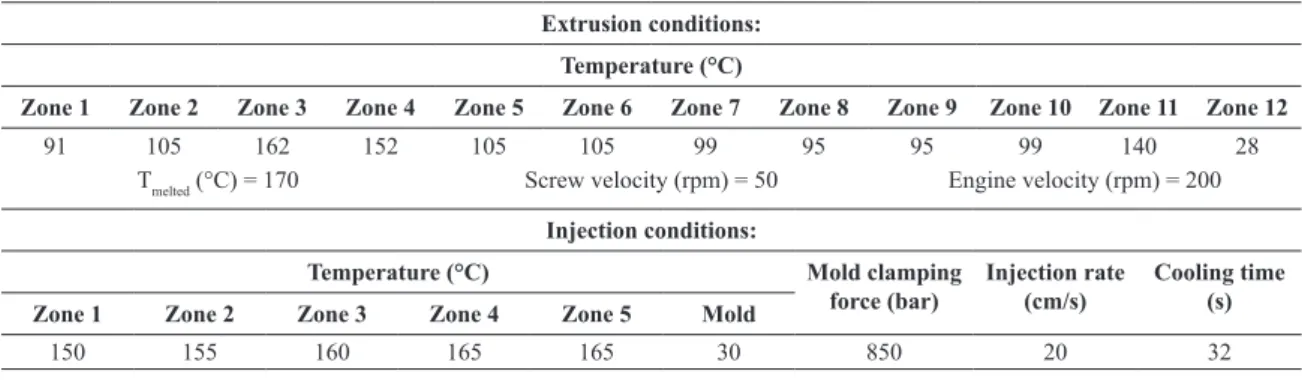
Compounding mixtures with 0%, 10% and 20% (by mass) of coffee parchment (PHB+CP) and coffee husk (PHB+CH) were produced by extrusion. The mixtures were extruded in a co-rotatory twin-screw extruder (Imacom model DRC 30:40 IF). The processing conditions are presented in Table 1. After compounding, all the compositions were pelletized in
a Jethro pelletizer. To improve the pelletization procedure, the extruded materials were allowed to rest for thirty days to enhance their crystallinity21.
The neat PHB, PHB+CP and PHB+CH composites were then injected in an Arburg Allrounder 270V 300-120 injector,
using an ASTM 638-03[22] specimen tests injection mold for tensile and ASTM 256-05[23] for impact tests. The conditions employed for the injection of the PHB, PHB+CP and PHB+CH composites are described in Table 1.
2.3. Composite characterization
Limit of proportionality (LOP), tensile strength (TS) and modulus of elasticity (MOE) of the composites were determined in a universal testing machine following the procedures of ASTM D638-03[24]. The limit of proportionality (LOP) was described as the stress corresponding to the upper point of the linear portion of the stress-strain curve and it is related to the point where the irst crack happens in the composite, i.e. the irst crack strength. Speciic energy (SE) was deined as the energy absorbed during the tensile test divided by the cross-sectional area of the specimen under investigation. The absorbed energy was obtained by integration of the area below the load versus delection curve at the point corresponding to a reduction in load carrying capacity to 10% of the maximum reached. Izod impact test was performed in a Tinius Olsen Impact 104 according the procedures of ASTM D256-05[25].
The composites were subjected to thermogravimetric analysis (TG) in a DTG Shimadzu 60AH. Samples of around 10 mg were heated in a Tin crucible from 25 to 600 °C in nitrogen lowing at 50 mL/min. The heating rate was 10 °C/min. The critical weight loss temperatures (Tonset) were obtained from the onset points of the TG curves, and this was represented by the intersection of the extrapoling line, at the beginning of the thermal event, with the tangent of the curve in the thermal event26.
The differential scanning calorimetry (DSC) was performed in a Shimadzu DSC 60 AH instrument; approximately 2 mg of sample was placed in an aluminum crucible, which was heated from room temperature (25 °C) to 550 °C at a heating rate of 10 °C/min and constant low of nitrogen of 50 mL/min. From the analysis of DSC was obtained the melting temperature (Tm) of the composites. The degree of crystallinity (Xc) of the PHB composites was estimated
Table 1. Extrusion and injection conditions for neat PHB and its composites with coffee wastes (coffee parchment - CP and husk - CH).
Extrusion conditions:
Temperature (°C)
Zone 1 Zone 2 Zone 3 Zone 4 Zone 5 Zone 6 Zone 7 Zone 8 Zone 9 Zone 10 Zone 11 Zone 12
91 105 162 152 105 105 99 95 95 99 140 28
Tmelted (°C) = 170 Screw velocity (rpm) = 50 Engine velocity (rpm) = 200
Injection conditions:
Temperature (°C) Mold clamping
force (bar)
Injection rate (cm/s)
Cooling time (s)
Zone 1 Zone 2 Zone 3 Zone 4 Zone 5 Mold
using the enthalpy of fusion of the sample, as reported in Thiré et al.27.
Scanning electron microscopy (SEM) with secondary electron (SE) detector, operated at 20 kV accelerating voltage, was used to visualize the fractured surfaces of the neat PHB and composites after the tensile text. Fractured surfaces were gold coated in a Bal-Tec SCD050 coating system before being analyzed in a Zeiss LEO Evo 40 microscope.
The evaluation of water absorption and stability of the composites was determined according to ASTM D570[28]. The stability of the composites was determined by the mass loss during the test period. For evaluation of the water absorption, the samples were irst dried at 65 °C for 4 h before being immersed in distilled water. The degree of water absorption was determined on the average of three specimens and the results expressed as a percentage. This test was carried out for seven weeks.
3. Results and Discussion
3.1. Thermal analysis
The inclusion of CP particles increased the onset degradation temperature (Tonset) of the composites (Figure 1a and Table 2), as also observed elsewhere by Melo et al.29 for composites with carnauba ibers. This is because of the higher thermal stability of the lignocellulosic particles in relation to PHB. Thermal analysis (TG) of the composites showed one main thermal degradation stage at temperatures of 230–270 °C, with mass loss of around 90% for neat PHB and PHB+CH and 75–80% for PHB+CP. For neat PHB and all the composites, there is another loss of mass, between 270 and 700 °C, due to residual organic matter and ashes. All these data agree with previous reported values30,31.
For the composites with CP the maximum rate of mass loss occurred at around 350 °C probably due to the decomposition of hemicelluloses (normally in the range of 225–325 °C), residual lignin (in the range of 250–500 °C) and cellulose (in the range of 305–375 °C) as reported by Prins et al.32 and Melo et al.29. According to Pachekoskia et al.33 the thermal degradation of PHB is caused almost exclusively by a random scission on the ester bond at high temperatures (starting at 200 °C). Decomposition of the neat PHB occurred before the PHB composites with addition of the CP particles (PHB+CP). This observation may suggest that the use of CP particles improve thermal stability of PHB.
Figure 1b shows the DSC thermograms of the neat PHB and its composites with coffee pulp (PHB+CP) and husks (PHB+CH). The temperature and intensity of the transitions are affected by the coffee residues at different contents. Values vary between studies depending on the preparation and storage conditions of the samples34. The Tm values of the neat PHB and composites are in agreement with those of Reis et al.35. The Tm of the composite depends on many factors such as morphology and size of the particles, kinetics of crystallization and compounding process36. The endothermic peaks, at around 170-172 °C, can be observed for all the formulations. Furthermore, it can be noticed that at approximately 150 °C the formulations begin to melt, which is completed at around 173 °C. Complete coalescence or conglutination of the crystals in all the samples takes place at around 178 °C. It should also be noted that the enthalpy of fusion depends on the area under the DSC curve37 and is related with the calculated degree of crystallinity (Xc) of the samples, as presented in Table 2. The sample prepared with CP has a narrow fusion range and lower fusion enthalpy, which led to lower Xc. CH particles
Table 2. Thermal properties obtained from TG and DSC heating curves of second heating scan for neat PHB and its composites with
coffee wastes (coffee parchment - CP and husk - CH).
Sample Tonset (°C) Tm (°C) ΔHm (°C) Xc (%)
PHB 232 171.2 93.5 64.0
PHB+CP10% 253 171.0 52.9 40.2
PHB+CP20% 256 171.1 57.9 49.5
PHB+CH10% 237 170.5 84.2 64.1
PHB+CH20% 238 170.7 72.9 62.4
Tonset = critical weight loss temperatures; Tm = melting temperature; ΔHm = enthalpy of fusion; Xc = degree of crystallinity.
Figure 1. TGA and DSC curves of the neat PHB and PHB composites
have not greatly affected Xc. The neat PHB sample presents a large peak with high fusion enthalpy38. The lower degree of crystallinity (Xc) of the PHB+CP composites suggest a less-perfect arrangement of the PHB polymer crystal structures as the CP particles are added to the PHB matrix. This may be related to a slight reduction in crystal size and lower Xc as a result of the restricted polymer chain mobility39,40 in the presence of the CP particles, which are very larger than the CH particles studies have shown that lignocellulosic particles act as a nucleating agent, promoting the formation of transcrystalline structures along particle surfaces during crystallization from the melt41. When PHB crystallizes in the presence of the particles, crystals could grow on the particle surfaces42. The reductions in overall polymer crystallinity are expected to have occurred from the introduction of discontinuities in the matrix crystal structure caused by the disordered growth of crystals at the particle-matrix interface43. The apparent double peak of the neat PHB melting endotherm suggests evidence of the formation of multiple morphological crystal structures and/or the phenomena of melt recrystallization that has been shown to occur during the melting process of the neat polymers44.
3.2. Mechanical properties
Figure 2 depicts the stress vs. strain curves of neat PHB and composites. Table 3 presents the average mechanical properties obtained during tensile and Izod impact tests. The addition of 10% of CP has not inluenced signiicantly the tensile strength (TS) and Izod strength (IS), in relation to the neat PHB. Despite the slight decrease of TS, the MOE
and the IS of the composites have increased signiicantly with the inclusion of 20% of CP particles. This is probably due to the higher size (low contact area) and smooth surface of the CP particles, favoring poor anchoring to the matrix (as stated by the lower tensile strength in relation to neat PHB) and considerable incidence of pulled out particles (arrows 1 in Figure 3), as previously reported elsewhere for PHB composites reinforced with 44% (by mass) of lax ibers29. The high IS values for composites with 20% of CP is therefore the result of the frictional slip process during the pulling out of these CP particles. Contrarily, IS values decreased signiicantly by addition of CH particles. In this case, the fracture of the particles prevails over their pull out, since these latter are more adhered to the matrix as a consequence of the higher contact area (because they are smaller) of the CH particles. Garkhail et al.45 and Barkoula et al.46 also have not found improvements in the mechanical properties of PHB composites when using lax ibers as reinforcement. The addition of both coffee waste particles to PHB decreased the speciic energy (SE) of the composites in relation to the neat PHB (Table 3). This is because the particles decrease the ductility of the PHB matrix when the inclusion of the particles leads to more defects in the specimens and could be also attributed to the formation of agglomerates, as shown by SEM micrographs in the next section. The reductions in TS and SE in the specimens with high particles content (20%) are attributed to an embrittlement caused by improper particle wetting that resulted in a deicient particle-matrix interface. Pores and imperfections at the particles interface can induce fracture in highly crystalline polymers43,46. According to Wong et al.47, the crystallites in the matrix located away from the iber show a reduction in size, which can contribute to the reduction of brittleness of the matrix in the sense that cracks were often observed when crystals were large.
3.3. Microstructure of the composites
The scanning electron microscopy provides information on the microstructure of the composites, and permits the observation of the interaction and dispersion of the particles on the polymer matrix. Micrographs of the fracture surface of the composites are shown in Figure 3 to 5. The fracture surface of the neat PHB specimens (Figure 3) appears homogeneous, compact and without visible voids and laws. The fracture surfaces of both PHB+CP composites (10 and 20% of CP) show that CP particles were pulled out from the PHB matrix (Figure 3 and 5), as a result of the less strong interaction between CP and PHB matrix. The increase of failures (voids and laws) occurred as
Table 3. Average values and standard deviation of the mechanical properties of the neat PHB and composites in the different conditions.
Composites LOP (MPa) TS (MPa) MOE (GPa) SE (KJ/m2) IS (J/m)
PHB 15.9 ± 1.5 31.9 ± 0.9 1.8 ± 0.1 73.4 ± 7.1 26.1 ± 4.7
PHB + CP10% 14.4 ± 1.8 30.8 ± 0.7 1.9 ± 0.1 65.2 ± 6.8 26.8 ± 2.7
PHB + CP20% 14.1 ± 1.0 27.7 ± 0.5 2.1 ± 0.1 44.1 ± 4.5 29.5 ± 2.7
PHB + CH10% 14.7 ± 1.3 29.8 ± 0.6 1.7 ± 0.1 62.3 ± 6.8 20.3 ± 2.6
PHB + CH20% 13.3 ± 1.2 26.1 ± 1.2 1.6 ± 0.1 50.5 ± 9.0 21.1 ± 0.9
LOP: limit of proportionality; TS: tensile strength; MOE: modulus of elasticity; SE: speciic energy; IS: Izod strength.
particles concentration increases. In the composites with 20% of CP, it can be observed that particles agglomerate and some pores were formed (arrow 2 in Figure 5). This is probably the explanation for the lower TS observed for the higher content of CP (Table 3).The fracture surface of the PHB+CH composites is more homogeneous, showing the greater interaction of the CH particles with PHB matrix. The particles in the PHB+CH10% composites were not easily observed, while in the PHB+CH20% composites, the CH particles were observed in some agglomeration but more homogenously distributed in the matrix than others.
3.4. Water absorption and mass loss
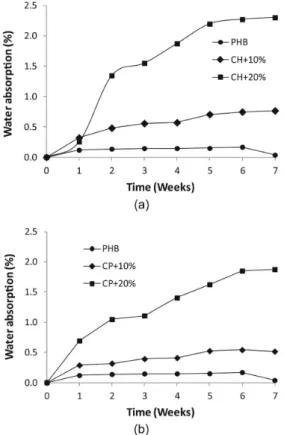
Water absorption was signiicantly (p>0.05) inluenced by the type and content of particles (Figure 6). The neat PHB specimens present lower water absorption than the PHB+CP and PHB+CH composites. Composites with CH particles absorb more water than those reinforced with CP particles. As already mentioned, the neat PHB specimens absorbed lower water than the particle reinforced composites, since the former is hydrophobic47. The water absorption
Figure 3. SEM micrographs of the fracture surface of the PHB
composites reinforced with: (a,b) 10% of coffee parchment (CP); and (c,d) 20% of coffee parchment (CP). Arrows 1 show the spaces left by the pulled-out parchment particles. Arrows 2 and 3 show the agglomeration of the parchment particles and the defects due to particle agglomeration, respectively.
Figure 4. SEM micrographs of the fracture surface of the neat
PHB (after injection).
Figure 5. SEM micrographs of the fracture surface of the PHB
composites reinforced with: (a,b) 10% of coffee husk (CH); and (c,d) 20% of coffee husk (CH). Arrows 1 show the spaces left by the pulled-out husk particles. Arrows 2 and 3 show the agglomeration of the parchment particles and the defects due to particle agglomeration, respectively.
Figure 6. Water absorption in function of time: a) PHB+CH and
(b) PHB+CP composites.
4. Conclusion
The present study evaluated lignocellulosic particles from sub-products of the coffee industry (coffee parchment - CP and husk - CH) as reinforcing iller in PHB biocomposites. The inclusion of CP and CH particles increased the onset degradation temperature (Tonset) of the composites. Thermal analysis (TG) of the composites showed one main thermal degradation stage at temperatures of 230–270 °C, with mass loss of around 90% for neat PHB and PHB+CH and 75-80% for PHB+CP. The lower degree of crystallinity (Xc) of the PHB+CP composites suggest a less-perfect arrangement of the PHB polymer crystal structures as the CP particles are added to the PHB matrix. The addition of 10% of CP has not inluenced signiicantly the TS and IS values, in relation to the neat PHB. Tensile strength (TS), MOE and Izod strength (IS) of the composites have increased signiicantly with the
inclusion of 20% of CP. The increase in the content of both coffee waste particles increased the water absorption of the composite. The present work contributes to the scarcity of information about use of coffee residues to engineer polymeric composites for myriad applications.
Acknowledgements
The authors would like to thank FAPEMIG, FAPESP, CAPES and CNPq (Brazil) for their inancial support. We are also indebted with PHB Industrial S/A for supplying the PHB and with Prof. Dr. Agnelli, Biodegradable Polymer Laboratory (Biocycle) - UFSCAR, for the supporting in the samples processing. Thanks also to PGCTM (UFLA), LME (UFLA) and Brazilian Research Network in Lignocellulosic Composites and Nanocomposites - RELIGAR.
References
1. Son JI, Kim HJ and Lee PW. Role of paper sludge particle size and extrusion temperature onperformance of paper sludge-thermoplastic polymer composites. Journal of Applied Polymer Science. 2001; 82(11):2709-2718. http://dx.doi.org/10.1002/
app.2123.
2. Son JI, Yang HS and Kim HJ. Physico-mechanical properties of paper sludge-thermoplastic polymer composites. Journal of Thermoplastic Composite Materials. 2004; 17(6):509-522.
http://dx.doi.org/10.1177/0892705704038471.
3. Belgacem MN and Gandini A. Monomers, polymers and composites from renewable resources. Elsevier; 2008.
4. Sabu T and Pothan L. Cellulose ibre reinforced polymer composites. Philadelphia: Old City Publishing; 2008.
5. Campos A, Tonoli GHD, Marconcini JM, Mattoso LHC, Klamczynski A, Gregorski KS, et al. TPS/PCL composite reinforced with treated sisal fibers: property, biodegradation and water-absorption. Journal of Polymers and of Environment.
2013; 21(1):1-7. http://dx.doi.org/10.1007/s10924-012-0512-8. 6. Angelini S, Cerruti P, Immirzi B, Santagata G, Scarinzi G and
Malinconico M. From biowaste to bioresource: Effect of a lignocellulosic filler on the properties of poly(3-hydroxybutyrate).
International Journal of Biological Macromolecules. 2014; 71:163-173. http://dx.doi.org/10.1016/j.ijbiomac.2014.07.038. PMid:25086181.
7. Priya B, Gupta VK, Pathania D and Singha AS. Synthesis, characterization and antibacterial activity of biodegradable starch/PVA composite films reinforced with cellulosic fibre.
Carbohydrate Polymers. 2014; 109(30):171-179. http://dx.doi.
org/10.1016/j.carbpol.2014.03.044. PMid:24815414. 8. Naghmouchi I, Espinach FX, Mutjé P and Boufi S. Polypropylene
composites based on lignocellulosic fillers: how the filler morphology affects the composite properties. Materials & Design. 2015; 65:454-461. http://dx.doi.org/10.1016/j. matdes.2014.09.047.
9. Rosa SML, Santos EF, Ferreira CA and Nachtigall SMB. Studies on the properties of rice-husk-filled-PP composites: effect of maleated PP. Materials Research. 2009; 12(3):333-338. http:// dx.doi.org/10.1590/S1516-14392009000300014.
10. Pandey A, Soccol CR, Nigam P, Brand D, Mohan R and Roussos S. Biotechnological potential of coffee pulp and coffee husk for bioprocesses. Journal of Biochemistry Engineering. 2000;
6(2):153-162. http://dx.doi.org/10.1016/S1369-703X(00)00084-X. PMid:10959086.
11. Esquivel P and Jiménez VM. Functional properties of coffee and coffee by-products. Food Research International. 2012; 46(2):488-495. http://dx.doi.org/10.1016/j.foodres.2011.05.028. 12. Machado ART, Martins PFQ, Fonseca EMB and Reis KC.
Compósitos biodegradáveis a base de polihidroxibutirato-hidroxivalerato (PHB-HV) reforçados com resíduos do beneficiamento do café. Revista Matéria. 2010; 15(3):400-404. http://dx.doi.org/10.1590/S1517-70762010000300002. 13. Yang H-S, Kim H-J, Son J, Park H-J, Lee B-J and Hwang T-S.
Rice-husk flour filled polypropylene composites; mechanicaland morphological study. Composite Structures. 2004; 63(3-4):305-312. http://dx.doi.org/10.1016/S0263-8223(03)00179-X. 14. Sharma R and Ray AR. Polyhydroxybutyrate, its copolymers
and blends. Journal of Macromolecular Science – Rev. Macromolecular Chemistry and Physics. 1995; 35(2):327-359.
http://dx.doi.org/10.1080/15321799508009640.
15. Modi S, Koelling K and Vodovotz Y. Assessment of PHB with varying hydroxyvalerate content for potential packaging applications. European Polymer Journal. 2011; 47(2):179-186.
http://dx.doi.org/10.1016/j.eurpolymj.2010.11.010.
16. Hoffmann A, Kreuzberger S and Hinrichsen G. Influence of thermal degradation on tensile strength and Young’s modulus of poly(hydroxybutyrate). Polymer Bulletin. 1994; 33(3):355-359. http://dx.doi.org/10.1007/BF00314274.
17. El-Hadi A, Schnabel R, Straube E, M¨uller G and Henning S. Correlation between degree of crystallinity, morphology, glass temperature, mechanical properties and biodegradation of poly (3-hydroxyalkanoate) PHAs and their blends. Polymer Testing. 2002; 21(6):665-674.
http://dx.doi.org/10.1016/S0142-9418(01)00142-8.
18. Canetti M and Bertini F. Supermolecular structure and thermal properties of poly(ethyleneterephthalate)/lignin composites.
Composites Science and Technology. 2007;
67(15-16):3151-3157. http://dx.doi.org/10.1016/j.compscitech.2007.04.013. 19. Weihua K, He Y, Asakawa N and Inoue Y. Effect of lignin
particles as a nucleating agent on crystallization of poly(3-hydroxybutyrate). Journal of Applied Polymer Science. 2004; 94(6):2466-2474. http://dx.doi.org/10.1002/app.21204. 20. Association of Official Analytical Chemists - AOAC. Oficial
International. In: Hortiwis W, editor. 17th ed. Arlington: AOAC;
2000.
21. Pachekoski WM, Agnelli JAM and Belem LP. Thermal, mechanical and morphological properties of poly(hydroxybutyrate) and polypropylene blends after processing. Materials Research. 2009; 12(2):159-164. http://dx.doi.org/10.1590/S1516-14392009000200008.
22. American Society for Testing and Materials - ASTM. ASTM 638-03: standard test method for tensile properties of plastics. West Conshohocken; 2001.
23. American Society for Testing and Materials - ASTM. ASTM D256-05: standard test methods for determining the izod pendulum impact for plastics. West Conshohocken; 2001. 24. American Society for Testing and Materials - ASTM. ASTM
D638-03: standard test method for tensile properties of plastics. West Conshohocken; 2003.
25. American Society for Testing and Materials - ASTM. ASTM D256-05: standard test methods for determining the izod pendulum impact for plastics.West Conshohocken; 2005. 26. Tonoli GHD, Teixeira EM, Corrêa AC, Marconcini JM, Caixeta
LA, Pereira-da-Silva MA, et al. Cellulose micro/nanofibres from Eucalyptus kraft pulp: preparation and properties. Carbohydrate Polymers. 2012; 89(1):80-88. http://dx.doi.org/10.1016/j. carbpol.2012.02.052. PMid:24750607.
27. Thiré RMSM, Arruda LC and Barreto LS. Morphology and thermal properties of poly(3-hydroxybutyrate-co-3hydroxyvalerate)/ attapulgite nanocomposites. Materials Research. 2011; 14(3):340-344. http://dx.doi.org/10.1590/S1516-14392011005000046. 28. American Society for Testing and Materials - ASTM. ASTM
D570-98: standard test method for water absorption of plastics. West Conshohocken; 1998.
29. Melo JDD, Carvalho LFM, Medeiros AM, Souto CRO and Paskocimas CA. A biodegradable composite material based on polyhydroxybutyrate (PHB) and carnauba fibers.
Composites. Part B, Engineering. 2012; 43(7):2827-2835.
http://dx.doi.org/10.1016/j.compositesb.2012.04.046. 30. Machado MLC, Pereira NC, de Miranda LF and Terence MC.
Estudo das propriedades mecânicas e térmicas do polímero poli-3-hidroxibutirato (PHB) e de compósitos PHB/pó de madeira. Polímeros: Ciência e Tecnologia. 2010; 20(1):65-71.
31. Hong SG, Hsu H-W and Ye M-T. Thermal properties and applications of low molecular weight Polyhydroxybutyrate.
Journal of Thermal Analysis and Calorimetry. 2013; 111(2):1243-1250. http://dx.doi.org/10.1007/s10973-012-2503-3. 32. Prins MJ, Ptasinski KJ and Janssen FJJG. Torrefaction of wood.
Part 1. Weight loss kinetics. Journal of Analytical and Applied Pyrolysis. 2006; 77(1):28-34. http://dx.doi.org/10.1016/j. jaap.2006.01.002.
33. Pachekoskia WM, Dalmolina C and Agnelli JAM. The Influence of the Industrial processing on the degradation of Poly(hidroxybutyrate) – PHB. Materials Research. 2013; 16(2):327-332.
34. Slade L and Levine H. The glassy state phenomenon in food molecules. In: Blanshard JMV and Lillford PJ, editors. The glassy state in foods. Nottingham: Nottingham University
Press; 1992. p. 35-101.
35. Reis KC, Pereira J, Smith AC, Carvalho CWP, Wellner N and Yakimets I. Characterization of polyhydroxybutyrate-hydroxyvalerate (PHB-HV)/maize starch blend films. Journal of Food Engineering. 2008; 89(4):361-369. http://dx.doi. org/10.1016/j.jfoodeng.2008.04.022.
36. Ghaffar A. Development material based on poly(3-hydroxybutyrate) PHB. [Dissertation]. Saale: Martin-Luther-Universität
Halle-Wittenberg; 2002.
37. Murayama T. Dynamic mechanical analysis of polymeric material. New York: Elsevier; 1978. v. 1. 231 p.
38. Pinto CES, Arizaga GGC, Wypych F, Ramos LP and Satyanarayana KG. Studies of the effect of molding pressure and incorporation of sugarcane bagasse fibers on the structure and properties of poly (hydroxy butyrate). Composites. Part A, Applied Science and Manufacturing. 2009; 40(5):573-582.
http://dx.doi.org/10.1016/j.compositesa.2009.02.004. 39. Jiménez G, Ogata N, Kawai H and Ogihara T. Structure
and thermal/mechanical properties of poly (-caprolactone)-clay blend. Journal of Applied Polymer Science. 1997;
64(11):2211-2220. http://dx.doi.org/10.1002/(SICI)1097-4628(19970613)64:11<2211::AID-APP17>3.0.CO;2-6. 40. Di Maio E, Iannace S, Sorrentino L and Nicolais L. Isothermal
crystallization in PCL/clay nanocomposites investigated with thermal and rheometric methods. Polymer. 2004; 45(26):8893-8900. http://dx.doi.org/10.1016/j.polymer.2004.10.037. 41. Javadi A, Srithep Y, Pilla S, Lee J, Gong S and Turng LS.
Processing and characterization of solid and microcellular phbv/ coir fiber composites. Materials Science and Engineering C. 2010; 30(5):749-757. http://dx.doi.org/10.1016/j.msec.2010.03.008. 42. Botana A, Mollo M, Eisenberg P and Torres Sanchez RM.
Effect of modified montmorillonite on biodegradable PHB nanocomposites. Applied Clay Science. 2010; 47(3-4):263-270.
http://dx.doi.org/10.1016/j.clay.2009.11.001.
43. Srubar WV 3rd, Pilla S, Wright ZC, Ryan CA, Greene JP, Frank CW, et al. Mechanisms and impact of fiber–matrix compatibilization techniques on the material characterization of PHBV/oak wood flour engineered biobased composites.
Composites Science and Technology. 2012; 72(6):708-715.
http://dx.doi.org/10.1016/j.compscitech.2012.01.021. 44. Avella M, Bogoeva-Gaceva G, Buzõarovska A, Emanuela Errico
M, Gentile G and Grozdanov A. Poly(3-hydroxybutyrate-co-3-hydroxyvalerate)-based biocomposites reinforced with Kenaf fibers. Journal of Applied Polymer Science. 2007;
104(5):3192-3200. http://dx.doi.org/10.1002/app.26057.
45. Garkhail SK, Heijenrath RWH and Peijs T. Mechanical properties of natural fiber- mat-reinforced thermoplastics based on flax fibers and polypropylene. Applied Composite Materials. 2000; 7(5–6):351-372.
46. Barkoula NM, Garkhail SK and Peijs T. Effect pg Compounding and Injection Molding on the Mechanical properties of flax fibers polypropylene composites. Journal of Reinforced Plastics and Composites. 2010; 29(9):1366-1385. http://dx.doi. org/10.1177/0731684409104465.