
Evaluation of the behavior of concrete gravity dams
suffering from internal sulfate attack
Comportamiento de presas de gravedad de hormigón
con problemas de ataque interno por sulfatos
ARAÚJO, G. S.a [email protected]
CHINCHÓN, S.b [email protected]
AGUADO, Ac [email protected]
Abstract
Resumen
Herein is described a methodology developed to evaluate concrete expansion and consequent abnormal behavior in gravity dams suffer
-ing from internal sulfate attack. The work presented here encompasses the analysis, in different phases, of three Spanish dams plagued by sulfate reactions.
The aggregate and concrete of the Torán dam were characterized at a microscopic level. The principal iron sulides and the products result
-ing from oxidation of the aggregate, and the products of the subsequent sulfate attack of the concrete were all identiied. Moreover, macro
-structural studies of the upstream displacement observed in the Graus and Tavascán dams were performed using a mathematical model.
Keywords: internal sulfate attack, expansion, gravity dam, pyrrhotite, aggregate.
En este trabajo se presenta la metodología seguida con vistas a evaluar la expansión del hormigón debido al ataque sulfático interno y su repercusión en el comportamiento anómalo de presas de hormigón de gravedad. Para ello se presenta el análisis, en distintas fases del estudio, de tres presas españolas afectadas por las reacciones sulfáticas.
ARAÚJO, G. S. | CHINCHÓN, S. | AGUADO, A
1. Introduction
Evaluating anomalies in the behavior of a concrete structure re
-quires a irm understanding of the characteristics of the concrete and of its constituents. For projects that require large volumes of concrete, such as dams, special attention must be paid to the aggregate used, which may contain minerals that are potentially unstable during meteorization, and can thus react with cement components to give rise to expansive compounds. These com
-pounds include iron sulides, which, with the right amount of humidity and oxygen, can oxidize to give species which cause concrete expansion. In structures such as concrete gravity dams, said expansion is char
-acterized by mapped cracks, changes in concrete surface color, breakdown of moving parts, and displacements. The work presented proposes a methodology to study con
-crete dams that suffer from internal sulfate reactions, and explains that behavioral anom
-alies observed are a relection of anomalies observed at the microstructural level. The work encompassed distinct phases, using three dams located in the Catalan Pyrenees (Spain) as case studies. The source of expansion was irst determined by characterizing the aggre
-gate and concrete of the Tórán dam through an arsenal of techniques: scanning electron
microscopy (SEM) with microanalysis (EDAX); X-ray diffraction (XRD); and X-ray luorescence (XRF). The macrostructural con
-sequences of the expansion were then evaluated by applying a mathematical model to the upstream displacement of the Graus and Tavascán dams.
2. Experimental methods
This section summarizes the results from laboratory analyses of rock and concrete from the Torán dam, which were performed to determine the precise cause of the abnormal behavior observed. Rock samples were taken from the dam area where the aggre
-gate used for the dam concrete is located. Moreover, products from possible reaction between the aggregate and the cement matrix were searched for in samples taken from the dam.
2.1 Characterization of
the aggregate
This section summarizes the results of the experimental por
-tion of the project in which the aggregate used in the Torán dam was analyzed—above all—for the presence of poten
2.2 Characterization of the iron sulides
Once the presence of sulfur compounds was conirmed, the re
-spective minerals which contained them were identiied by scan
-ning electron microscopy (SEM) with microanalysis (EDAX), and X-ray diffraction (XRD). During sample preparation, the samples were observed to be attracted to a magnet. As opposed to py
-rite, pyrrhotite crystals exhibit permanent internal magnetism [1]. Hence, this simple observation was a irst sign that the sample contained a signiicant quantity of pyrrhotite.
XRD of the sample yielded the difractogram shown in Figure 4, in which the major peaks corresponding to pyrite and to pyrrhotite are observed. The presence of quartz, chlorite and other clay minerals is a result of the mineralogy of the schists which accompany the iron sulides in the analyzed samples.
The samples were then studied by SEM; the results of which are shown in Figure 5. The constituent elements in the sample were identiied by microanalysis using SEM coupled to an X-ray spectrometer. Semi-quantitative analysis of the studied zone was likewise performed. A non-metallic sampled was used for these studies to avoid interference shows the samples taken from the quarry and subjected to labora
-tory analysis.
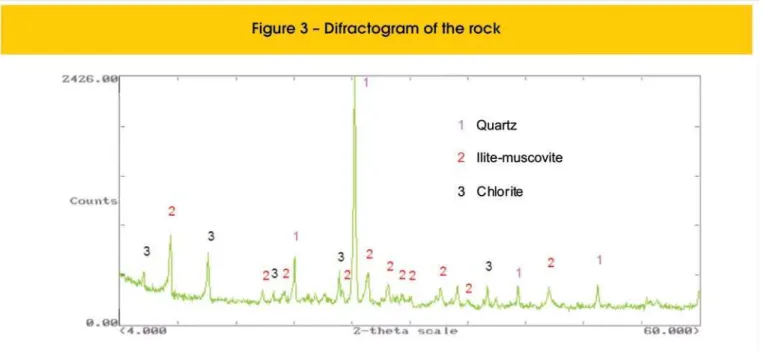
First, XRD was used to identify crystalline compounds in the rock. Figure 3 shows the difractogram of the rock, which reveals that the rock is composed of quartz, mica and an apparently non-expan
-sive type of clay.
The schists were thus expected to be primarily made up of compounds containing oxides such as SiO2, Al2O3, Fe2O3, as well as calcium, mag
-nesium, potassium and sodium oxides from clay and mica.
To detect and quantify other compounds in the rock, the sample was chemically analyzed using XRF. The results of this analysis are shown in Table 1. In addition to inding the expected compounds, we also observed a certain percentage of sulfur compounds that were not in the mineral phases identiied by XRD. XRF revealed that 2% of said compounds must stem from the iron sulides (py
-rites and/or pyrrhotites) contained in the schists.
In agreement with the aforementioned results, the ground rock used as aggregate was found to contain large quantities of sulfur compounds—the compounds responsible for the formation of ex
of the gold peak from the metallization with the sulfur peak.
The magnetism of the studied material, and its sulfur to iron ratio of 0.62, which most closely resembles that of pyrrhotite, indicate that iron sulides are the predominant species. Nonetheless, observa
-tion by XRD of characteristic pyrite peaks meant that the presence of this mineral could not be ruled out.
2.3 Alteration of the aggregate
Once we identiied the primary iron sulide in the rock, we set about to study its oxidation, including the external factors that inluence the reaction.
2.3.1 Chemical species resulting from the oxidation of sulfur compounds
Oxygen and ferric ions (Fe3+) are major oxidants of pyrites and pyr
-rhotites [2]. At pH levels above 4, oxygen is the primary oxidant of sulfur compounds [3]. Given that the normal pH of concrete is 12.5 to 13.5, and of carbonated concrete, 9, we concluded that oxygen is the primary oxidant of the iron sulides found in the aggregate of the Torán dam. Thus, under high levels of oxygen and ambient humidity, these sulfur compounds can undergo oxidation to gener
-ate hydroxide ion, iron sulf-ate, and sulfuric acid. The acid causes the system pH to become less alkaline (H+) [4].
In addition to oxygen and humidity, which are required for oxida
-tion of iron sulides, factors such as temperature can accelerate the process. Steger [5] concluded that an increase in temperature leads to a major increase in the extent of oxidation of pyrrhotite. Apart from causing oxidation, Fe3+ can, under certain conditions
and provided that it is not the primary oxidant, catalyze the pro
-cess. [2].
2.3.2 Characterization of the products generated by alteration of the aggregate
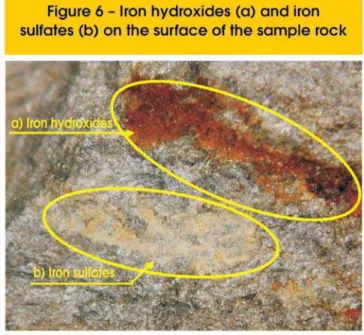
To determine if the compounds formed in the alteration of the rock are present in the aggregate used in the Torán dam, we studied the rock samples taken from the quarry by XRD and by EDAX-coupled SEM (Figure 2). Analysis of the fragments enabled us to identify surface spots indicating the presence of altered sulfur compounds. Figure 6 provides close detail of a grayish-brown product charac
-teristic of iron hydroxides (a), and another, lighter green stain typi
-cal of iron sulfates (b).
The difractogram shown in Figure 7, and the spectrum shown in Figure 8, revealed the presence of iron hydroxide in the form of goethite, FeO(OH).
ARAÚJO, G. S. | CHINCHÓN, S. | AGUADO, A
um as illustrated in Figure 10, indicated that the predominant iron sulfate in the sample is jarosite, KFe3(SO4)2(OH)6.
Likewise, we studied the effloescence found in the rock from the Torán dam quarry (Figure 11), the appearance of which can observed in detail in the Figure. The XRD difractogram (Figure 12), the needle-shaped crystals, and the presence calcium identified by microanalysis (Figure 13) all indicated that the rock had undergone sulfate attack to produce gyp -sum (CaSO42H2O). The filaments that appear in the Figure
are due to spider webs deposited together with the alteration products.
The results obtained from the characterization of the altera
-tion products in the Torán dam area rock are in agreement with those of McGregor and Blowes [6], and Valente and Leal Gomes [7]. These researchers studied the physical, chemical and mineralogical properties of rocks containing pyrrhotite, and determined that alteration of these rocks by sulfate at
-tack produces gypsum, goethite and jarosite.
2.4 Sulfate attack of concrete
In the presence of oxygen and humidity, the pyrrhotite that ex
-ists in aggregates can be oxidized in a primary reaction to form the alteration compounds described in the previous section. If this oxidation occurs in aggregate used in concrete, said com
-pounds can undergo a secondary reaction with the products of the cement paste hydration, to produce sulfate attack. This in turn generates expansive compounds according to the follow
-ing reactions [8]:
Reactions (R.1) and (R.2) can be considered intermediate reac
-tions in concrete expansion, given that the gypsum formed in the presence of water will go on to react with tricalcium aluminate
(C3A) to generate expansive secondary ettringite, as shown below
in (R.3) [9]:
Once we identiied the oxidation products in the rock used for the Torán dam aggregate, we set about to determine if these prod
-ucts indeed react with cement paste compounds to form second
-ary ettringite. This was accomplished by studying samples of concrete taken from the dam by optical microscopy and EDAX-coupled SEM.
Optical microscopy revealed important details about the dam samples. Figure 14.a shows the internal area of a rock sample, in which non-oxidized pyrrhotite is observed. However, Figure 14.b shows that, in a more external area of the same sample close to the face, oxidation has begun at the aggregate edges, as revealed by the change in local coloration.
Optical microscopy also enabled discovery of needle shaped crys
-tals in the pores (Figure 15.a) and paste-aggregate interfaces (Fig
The results of the SEM-EDAX studies on the needle-shaped crys
-tals (shown in Figure 15) conirmed the presence of ettringite, 3CaO.Al2O3.3CaSO431H2O (Figure 16).
The formation of secondary ettringite is characteristic of sulfate at
-tack. In the case of the Torán dam, this attack stems from oxida
-tion of iron sulides in the aggregate of the concrete. The oxida-tion leads to hydroxides and sulfates of iron, as well as sulfuric acid, in a primary reaction. Once inside the concrete mass, these products enter a secondary reaction with cement paste compounds to form expansive secondary ettringite.
3. Expansion associated with oxidation
of iron sulides and sulfate attack
The products from the oxidation of iron sulides, as well as those gen
-erated in the subsequent attack on the cement paste, have greater
to an increase in volume. Finally, in the third phase, the increases in volume begin to fall off and, at a certain point onwards, the expansions stop.
– The expansion becomes stabilized. This is quite logical given that, once all potentially reactive minerals are consumed, the oxidation reactions—and consequently, the expansions—cease. In certain cases it is of special interest to characterize the unit deforma
-tions that occur in the different direc-tions analyzed based on the in
-crease in volume of the material. Said deformations can be isotropic or anisotropic. As such, the spatial distribution of the potentially expansive minerals in the structure of interest must be studied using geometric models. A concrete structure with expansion problems may suffer from behavioral effects depending on factors such as design, and the avail
-ability of oxidizing agents and potentially reactive minerals.
ARAÚJO, G. S. | CHINCHÓN, S. | AGUADO, A
mesostructural stage, a numerical model is used to predict the de
-formations and tensions that correspond to distinct coninement conditions. These deformations, which stem from expansion at the mesostructural level, are then used as starting data in the inal stage, the macrostructural analysis stage.
5. Movements observed in dams
suffering from internal sulfate attack
As previously explained, the abnormal behavior seen in concrete dams is a consequence of phenomena occurring at the material
level. Before analyzing the real behavior of a given structure, it is utile to determine the expected movements of a gravity dam suffer
-ing from expansive reactions caused by aggregate oxidation. For concrete gravity dams, geometry is the principal factor that de
-termines the extent of the oxidation reactions, as it dictates the availability of oxidizing agents. Hence, in the upstream face of the dam, which is submerged for long periods of time, the availability of oxygen is much lower than in the downstream face.
-face area of the downstream -face can leave it more exposed to higher temperatures. As such, the downstream face is exposed to conditions which favor faster, more intense oxidation reactions than those in the upstream face. It can therefore be concluded that expansions in the former will also be more dramatic than in the lat
-ter. Consequently, dams are expected to move in the upstream di
-rection. Indeed, disalignment towards the upstream side is a direct consequence of expansions observed at the material level. Figure 19 shows a schematic of the non-linear distribution of the expansions of a representative section of the dam [12]. It must be pointed out that inwards expansion from the downstream face tends to stabilize with time. This is because the availability of oxi
-dizing agents decreases from the most exposed areas of the dam towards the interior.
A mathematical model can be used to study the remaining disalign
-ments observed in concrete dams suffering from sulfate attack. To adjust an equation that adequately represents the abnormal be
-havior of these structures, Aguado et al. [13] proposed the follow
-ing exponential function:
measurement records of over 400 months. These structures suf
-fer from internal concrete expansion problems due to alteration of iron sulides in the aggregate used for the concrete mix. Similarly to the Torán dam, both dams exhibit symptoms of mapped cracks, changes in surface coloring, and upstream displacements. Using the least-squares methods, we adjusted the function (E.1) to obtain the parameters required for distinct stabilization times of the process. Upon analyzing the results, we concluded that, of the var
-ious adjusted curves, that which best represents the movements is the curve with the inlection point near 350 months. Figures 20 and 21 show actual movement measurements (solid lines), and adjusted curves at 350 months (dashed lines), for the Graus and Tavascán dams, respectively.
As seen in the igures, the curves provide a highly satisfactory rep
-resentation of the horizontal movements observed in each of the analyzed dams. In addition to the stabilization times of the remain
ARAÚJO, G. S. | CHINCHÓN, S. | AGUADO, A
the order of magnitude of the maximum expected movements. The advantage of this type of function is that it represents move
-ments observed in the structures as an exponential component of the equations that dictate concrete expansion (as explained in Section 3).
6. Final considerations
This study led us to the following major conclusions:
- The alteration products resulting from oxidation of iron sulides in aggregate pyrrhotite, and from subsequent sulfate attack of the concrete paste, are the principal agents responsible for the expan
-sions observed in the Torán dam.
- The primary symptoms of expansion are mapped cracks and non-recoverable movements.
- The more dramatic expansion observed in the downstream face of the dams is responsible for upstream displacement of the crest. - The mathematical model described herein has allowed adequate representation of the displacements observed in the Graus and Tavascán dams, also enabling prediction of the stabilization times for this behavior, and of the maximum movements.
7. Acknowledgements
The authors thank ENDESA GENERACIÓN, S.A. for their support and for allowing the publication of certain data, and Don Felipe Río for providing access to information needed for this study.
8. References
[01] Bowen, R. Geology in engineering. Elsevier Applied Science Publishers, Londres, 411 p. (1984),
[02] Janzen M. P., Nicholson, R. V.; Scharer, J. N. Pyrrhotite reactions kinetics: reaction rates for oxidation by oxygen, ferric iron, and for nonoxidative dissolution. Geochimica et Cosmochimica Acta, 64 (2000) 1511-1522.
[03] Mikhlin, Y. L.; Kuklinskiy, A. V.; Pavlenko, N.
I.; Varnek, V. A.; Asanov, I. P., Okotrub, A.V.; Selyutin,
G. E.; Solovyev, L. A. Spectroscopy and XRD studies of the air degradation of acid-reacted pyrrhotites, Geochimica et Cosmochimica Acta, 66 (2002) 4057-4067.
[04] Ayora, C.; Chichón, S.; Aguado, A.; Guirado, F. Weathering of iron sulides and concrete alteration: thermodynamic model and observation in dams from Central Pyrenees, Spain. Cem and Concr Res, 28 (1998) 1223-1235.
[05] Steger, H. F.; Oxidation of sulide materials, VII. Effect of temperature and relative humidity on the oxidation of pyrrhotite. Chemical Geology, 35 (1982) 281-295
[06] McGregor, R. G.; Blowes, D. W., The physical, chemical and mineralogical properties of three cemented layers within sílide-bearing mine tailings. Journal of geochemical exploration, vol. 76, (2002) 195-207.
[07] Valente, T., Leal Gomes, C. Tipologia e evolução dos materiais de neoformação supergénica detectados na escombreira da mina de Valdarcas (Vila Nova da Cerveira – N Portugal) – Implicações ambientais. Cadernos Lab. Xeológico de Laxe. Coruña, vol. 23, (1998), 43-58.
[08] Shayan, A. Deterioration of a concrete surface due to oxidation of pyrite contained in pyritic aggragates. Cement and Concrete Research, 18 (1988) 723-730. [09] Tagnit-Hamou, A.; Saric-Coric, M; Rivard, P. Internal deterioration of concrete by oxidation of pyrrhotitic aggregates. Cem Concr Res, 35 (2005) 99-107. [10] Casanova, I.; Agulló, L.; Aguado, A. Aggragate expansivity due to sulide oxidation – I. Reaction system and rate model. Cem Concr Res, 26 (1996) 993-998.
[11] Aguado, A., et al. Incidencia de la microestructura en la respuesta macroestructural de elementos de hormigón. V Congreso Nacional de Propiedades Mecánicas de Sólidos. E.T.S. Ingenieros Industriales de Barcelona, Barcelona (1996) 12 pp
[12] Aguado, A.; Rodrígues-Ferran, A.; Casanova, I.; Agulló, L. Modeling time evolution of expansive phenomena in concrete dams as a decision-making tool. Comission Internationale des Grands Barrages, Montreal, (2003).
![Figure 19 shows a schematic of the non-linear distribution of the expansions of a representative section of the dam [12]](https://thumb-eu.123doks.com/thumbv2/123dok_br/18859411.417640/13.892.65.829.172.505/figure-shows-schematic-linear-distribution-expansions-representative-section.webp)
