Morphometry Mri in the diferential
diagnosis of parkinsonian syndromes
Rômulo L. Gama1, Daniel F.G. Távora1, Rodrigo C. Bomim1,Cruif E. Silva2,Veralice M. de Bruin3, Pedro F. de Bruin3
ABSTRACT
This study evaluates the diagnostic value of morphometric magnetic resonance imaging (MRI) in the differential diagnosis among Parkinson’s disease (PD), progressive supranuclear palsy (PSP) and multiple system atrophy (MSA). We studied 21 PD cases, 11 MSA-c, 8 MSA-p and 20 PSP cases. Midbrain area (Ams), pons area (Apn), middle cerebellar peduncle (MCP) and superior cerebellar peduncle (SCP) were measured using MRI. Comparisons were made between PD, MSA-p, MSA-c and PSP. Apn, MCP and SCP morphometry dimensions
presented differences among groups. Ams below 105 mm2 and SCP smaller than 3 mm
were the most predictive measures of PSP (sensitivity 95.0 and 80.0%, respectively). For the group of MSA-c patients, Apn area below 315 mm2 showed good specificity and positive
predictive value (93.8% and 72.7%, respectively). In conclusion, dimensions and cut off values obtained from routine MRI can differentiate between PD, PSP and MSA-c with good sensitivity, specificity and accuracy.
Key words: Parkinson, multiple system atrophy, progressive supranuclear palsy, magnetic resonance imaging, pons, midbrain.
Morfometria por ressonância magnética no diagnóstico diferencial das síndromes parkinsonianas
RESUMO
Morfometria pela ressonância magnética (RM) no diagnóstico diferencial entre doença de Parkinson (DP), paralisia supranuclear progressiva (PSP) e atrofia de múltiplos sistemas (AMS). Este estudo avaliou a RM no diagnóstico diferencial de 21 casos com DP, 11 AMS-c, 8 AMS-p e 20 com PSP. A área sagital do mesencéfalo (Ams), área sagital da ponte (Apn), largura do pedúnculo cerebelar médio (PCM) e pedúnculo cerebelar superior (PCS) foram medidas pela RM e realizadas comparações entre destes pacientes. A Ams <105 mm2
e a largura média do PCS <3 mm foram preditivas para PSP (sensibilidade de 95,0 e 80,0%, respectivamente). Nos casos de AMS-c a área pontina <315 mm2 apresentou boa
especificidade e valor preditivo positivo para o diagnóstico (93,8% e 72,7%). Em conclusão, as dimensões e valores de cortes obtidos a partir da RM podem diferenciar PD, PSP e AMS-c, com sensibilidade, especificidade e precisão.
Palavras-chave: doença de Parkinson, atrofia de múltiplos sistemas, paralisia supranuclear progressiva, ressonância magnética, ponte, mesencéfalo.
Correspondence Rômulo Lopes Gama
Av. Presidente Juscelino Kubitschek 4500 60861-630 Fortaleza CE - Brasil E-mail: [email protected]
Received 11 November 2009
Received in final form 17 December 2009 Accepted 28 December 2009
1Department of Radiology, Sarah Network of Hospitals for Rehabilitation, Fortaleza CE, Brazil; 2Department of Statistics,
Sarah Network of Hospitals for Rehabilitation, Fortaleza CE, Brazil; 3Department of Medicine, Federal University of Ceará,
Fortaleza CE, Brazil.
he clinical recognition among the var-ious parkinsonian syndromes cannot al-ways be made with accuracy. Some char-acteristic clinical features are useful in the diferential diagnosis.
Parkinson’s disease (PD) can be
with falls in the irst year of onset, supranuclear gaze pal-sy and slowing of vertical saccades. Other characteris-tics include fast rate of disease progression and poor re-sponse to levodopa1,2.Multiple system atrophy (MSA) is usually associated with fast rate of disease progression, autonomic dysfunction, cerebellar signs and upper motor neuron signs3. In MSA cases, patients have been classiied as MSA-c or MSA-p depending on the predominance of cerebellar ataxia or parkinsonian features, with dysauto-nomia being a constant feature in both subtypes4. In spite of these suggestive features, in many cases, all these clin-ical indings are not as clear cut as it ideally could be and a great deal of overlap exists.
In this context, biological markers can be of utility for the diferential diagnosis of these movement disor-ders. Previously, conventional magnetic resonance imag-ing (MRI) revealed important characteristic indimag-ings that can be used in clinical practice to diferentiate among par-kinsonian syndromes5.Objective quantiications of mid-brain and pons using linear, surface and volumetric mea-surements have been reported before6-10. In these studies, two-point comparisons were made correlating each par-kinsonian syndrome and PD. However, multiple compar-isons including cases of PD, PSP and MSA-c and MSA-p have not been performed.
We hypothesized that morphometry MRI can be used clinically to distinguish among PD, PSP, MSA-c and MSA-p with good sensitivity, speciicity and accuracy. he aim of this study was to evaluate the diagnostic val-ue of structural anatomic changes identiied by MRI and propose MRI-based criteria to help the clinician to rec-ognize these parkinsonian syndromes.
METHOD Patients
his is a cross-sectional study of sequential patients
with clinical diagnosis of PD, PSP or MSA. Twenty-one consecutive patients with a clinical diagnosis of PD, de-ined according to the United Kingdom PD Brain crite-ria11, 11 consecutive patients with MSA-c, eight patients with MSA-p, according to MSA consensus3, and 20 pa-tients with clinical criteria for PSP2 were examined. All patients were clinically evaluated by a neurologist and submitted to brain MRI. Cases with previous history of stroke, trauma, and signs of cerebrovascular pathology, brain tumor or severe unrelated neurological or physi-cal disease were excluded. his study was approved by the Ethics Research Committee of the Sarah Network of Hospitals of Rehabilitation and written informed consent was obtained from all patients.
Magnetic resonance imaging protocol
MRI was performed with a high-ield MR equipment Horizon Signa 1.5-T scanner (General Electric®, Milwau-kee, USA), using a standard head coil. All MR imaging ex-aminations included sagittal T1-weighted spin echo (SE), transverse T2-weighted fast spin echo (FSE), transverse luid-attenuated inversion-recovery (FLAIR), transverse T2-weighted gradient-echo (GR), coronal T2-weighted FSE and T1-weighted volumetric spoiled gradient-echo (SPGR) sequences.
he mid-sagittal image of the T1-weighted SE sequence was used for measurements of the midbrain area (Ams) and pons area (Apn)12-14 (Fig 1). hese areas were obtained according to the following parameters: two straight lines were drawn. he irst line was drawn so as to pass through the superior pontine notch and the inferior edge of the quadrigeminal plate. he second line was drawn paral-lel to the irst line so as to pass through the inferior pon-tine notch. he area of the midbrain was traced plotting the delta-shaped part above the irst line. he area of the pons was traced as the area between the ventral margin
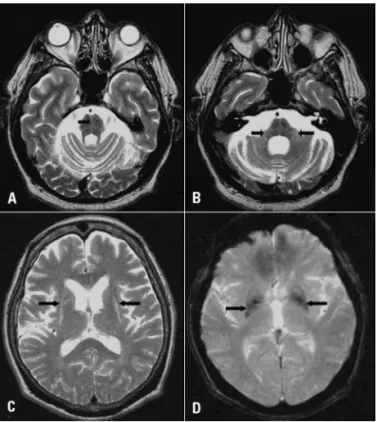
of the pons, the dorsal margin of the pons, irst and sec-ond lines. he transverse T2-weighted FSE sequence was used for the measurement of the diameter of the superior cerebellar peduncles (SCP) and middle cerebellar pedun-cles (MCP) (Fig 1). he linear distances between the right and left borders of the SCP and MCP were measured, de-limited by the peripeduncular cerebrospinal luid spac-es of the pontocerebellar cisterns. Each SCP and MCP width (left and right) was measured, and a mean value for the two SCP and MCP was calculated. All measurements were performed using a workstation (GE Radworks 5.1). Conventional brain MRI of MSA and PD patients were analyzed for the presence of putaminal atrophy, pu-taminal hypointensity, slitlike hyperintensity in the pos-terolateral margin of the putamen, hyperintensity of the MCP, and cruciform hyperintensity of the pons (Fig 2).
Statistical analysis
Results are given as means±standard deviation (SD) or as median values. In order to identify possible confound-ing variables, we used the chi-square in contconfound-ingency tables, ANOVA, Tukey post test, and Student’s t-test. For non-symmetric variables distribution, we used the Kruskall-Wallis; Mann-Whitney test and Bonferroni corrections when appropriate. In order to evaluate intraobserver agreement, the same operator performed all measure-ments twice in diferent days. hey were also performed
by two diferent operators and the interobserver agree-ment was calculated. he Cronbach’s Alpha coeicient was used to evaluate the consistency of inter and intrao-bserver variability. Multiple logistic regressions were used to determine measures that were predictors of diagnosis. After the determination of variables that were sig-niicant predictors, a Receiver Operating Characteristic (ROC) curve was built and took as reference the standard clinical diagnosis. A cut-of point for the diferentiation between groups was determined by the ROC curve. Sta-tistical analysis was performed with the Statistic Package for Social Sciences (SPSS-13) software for Windows.
he level of signiicance was set at p<0.05.
For diferentiation between MSA-c and MSA-p using imaging indings, we used the chi-square test, or Fisher’s exact test when indicated.
RESULTS
Twenty-one cases with clinical diagnosis of PD (12 fe-male, mean age=62.1±11.06, disease duration=6.0±3.66), 11 cases with clinical diagnosis of MSA-c (7 female, mean age=59.0±6.00, disease duration=3.9±1.62), eight MSA-p (ive female, mean age 61.2±4.79; disease duration 5.0±3.2) and 20 cases with clinical diagnosis of PSP (13 female, mean age=70.4±7.54, disease duration=5.6±2.28) were studied. In all cases, age varied from 39 to 84 (mean age 64±9). Patients with PSP were signiicantly (p<0.01) older than those with PD and MSA.
Table 1 depicts values of cerebral and midbrain struc-tures according to clinical diagnosis. All morphometric dimensions were signiicantly diferent between groups (p<0.001). Generally, PD patients showed higher values for all measures including the Apn (median 556.6 mm2). his same measure of the pons was observed as the low-est in MSA-c patients (median 303.4 mm2). Half of the MSA-p cases presented Ams value below 117.8 mm2, in opposition to PD cases, that showed the higher values (median 154.8 mm2). he analysis of MCP dimensions showed that MSA-c and PD cases had the lowest and the highest median values (9.7 mm and 17.1 mm, respective-ly). he analysis of SCP dimensions showed that PSP and PD cases had the lowest and the highest median values (2.0 mm and 3.7 mm, respectively).
Measurements comparisons among groups are repre-sented in Table 2. All values of PD cases were signiicant-ly higher than PSP cases. Except for Ams, this was also true in relation to MSA-c (p<0.01). Cases with PD pre-sented lower values of Apn, Ams and MCP in relation to MSA-p cases. All comparisons between morphometric dimensions of PSP and MSA-c were signiicantly diferent (p<0.01). he majority of the measures, with the exception of MCP, were signiicantly diferent between cases with PSP and MSA-p (p<0.01). Most of the measured structures
from cases with MSA-c and MSA-p did not difer. How-ever, values of Ams was signiicantly diferent (p<0.05).
Logistic regression analysis represented in Table 3 showed that in PD cases all values were useful (p<0.01). In PSP, the Ams and SCP values signiicantly predicted
the diagnosis (p<0.01). In MSA-c cases, the Apn, Ams and MCP measures were signiicantly diferent (p<0.05). In MSA-p cases none of the results were signiicant.
To diferentiate between PD and other parkinsonian syndromes, Apn value over 477 mm2 showed the highest
Table 1. Comparisons among measurements obtained**.
Parkinson PSP MSA-c MSA-p
Apn
(mm2) (472.9-622.2)556.6 (321.1-508.4)443.4 (235.4-408.6)303.4 (195.1-468.2)331.6 Ams
(mm2) (129.3-190.9)154.8 (52.5-113.4)82.1 (126.7-166.2)151.4 (88.3-154.8)117.8 MCP
(mm) (14.8-19.0)17.1 (10.4-16.9)14.5 (7.2-12.5)9.7 (6.5-19.3)11.7
SCP
(mm) (3.1-4.2)3.7 (1.5-2.9)2.0 (2.5-3.7)3.3 (1.5-4.4)3.3
MSA-c: Multiple system atrophy with cerebellar signs; MSA-p: Multiple system atrophy with parkinsonian features; PSP: Progressive supranuclear palsy; Ams: Midbrain area; Apn: Pons area; MCP: Middle cerebellar peduncle; SCP: Superior cerebellar peduncle. **p<0.0001.
Table 2. Signiicance levels between groups for structure measures.
Ams Apn MCP SCP
Parkinson vs. PSP <0.010 <0.010 <0.010 <0.010
Parkinson vs. MSA-c NS <0.010 <0.010 <0.010
Parkinson vs. MSA-p <0.010 <0.010 <0.010 NS
PSP vs. MSA-c <0.010 <0.010 <0.010 <0.010
PSP vs. MSA-p <0.010 <0.010 NS <0.010
MSA-c vs. MAS-p <0.010 NS NS NS
MSA-c: multiple system atrophy with cerebellar signs; MSA-p: multiple system atrophy with parkinsonian features; PSP: progressive supranuclear palsy; Ams: midbrain area Apn: pons area; MCP: middle cerebellar peduncle; SCP: superior cerebellar peduncle; NS: non-signiicant.
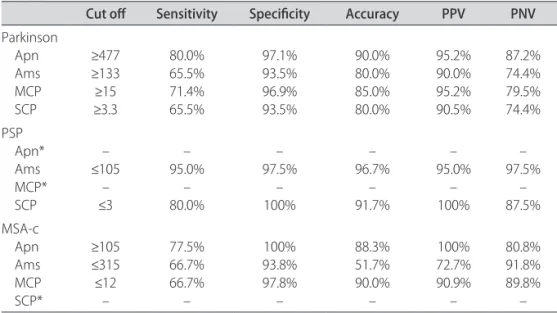
Table 3. Cut of, sensitivity, speciicity, accuracy, positive and negative predictive values regarding Parkinson’s disease, PSP and MSA-c.
Cut of Sensitivity Speciicity Accuracy PPV PNV
Parkinson Apn Ams MCP SCP
≥477
≥133
≥15
≥3.3
80.0% 65.5% 71.4% 65.5%
97.1% 93.5% 96.9% 93.5%
90.0% 80.0% 85.0% 80.0%
95.2% 90.0% 95.2% 90.5%
87.2% 74.4% 79.5% 74.4% PSP
Apn* Ams MCP* SCP
–
≤105
–
≤3
– 95.0%
– 80.0%
– 97.5%
– 100%
– 96.7%
– 91.7%
– 95.0%
– 100%
– 97.5%
– 87.5% MSA-c
Apn Ams MCP SCP*
≥105
≤315
≤12
–
77.5% 66.7% 66.7%
–
100% 93.8% 97.8%
–
88.3% 51.7% 90.0%
–
100% 72.7% 90.9% –
sensitivity value (80.0%), with good speciicity (97.1%). he cutof point of Ams was determined to be 133 mm2, with sensitivity of 65.5% and speciicity of 93.5%. MCP and SCP cut of values showed negative predictive val-ues of 79.5% and 74.4%, respectively.
The midbrain results most predictive of PSP were Ams and SCP. An Ams measure below 105 mm2 and SCP less than 3 mmshowed a major probability for the diag-nosis of PSP with a sensitivity of 95.0 and 80.0%, respec-tively. he cutof point of Ams was the best measure for PSP diagnosis with a probability of false negative of 2.5% and positive and negative predictive values of 95.0 and 97.5%, respectively.
For the group of MSA-c patients, a cutoff point of Ams >105 mm2 showed high specificity (100%) and a negative predictive value of 80.8%. An Apn value below 315 mm2 showed a positive predictive value of 72.7%. MCP measure <12 mm showed sensitivity and speciici-ty (66.7% and 97.8%, respectively) to diferentiate between MSA-c and all other diagnosis, and positive and negative predictive value of 90.9% and 89.8%, respectively.
Among MSA-p cases, four (50%) had cruciform hy-perintensity, ive (62.5%) had slitlike hyperintensity of the posterolateral margin of the putamen, six (75%) had atro-phy of the putamen, seven (87.5%) had putaminal hypoin-tensity, and ive (62.5%) had hyperintensity of the MCP. hese results were signiicantly diferent (p<0.05) from MSA-c cases. MSA-p cases showed more frequently hy-perintensity of the posterolateral margin of the putamen, putaminal hypointensity and putaminal atrophy. MSA-c cases showed more frequently cruciform hyperintensi-ty and hyperintensihyperintensi-ty of the MCP. One PD case showed slitlike hyperintensity of the posterolateral margin of the putamen, a second showed putaminal hypointensity and a third had both of these alterations.
DISCUSSION
Our data show that several MRI-derived brain mea-sures may be useful for the diferential diagnosis of the parkinsonian syndromes. Multiple comparisons were made among PD, MSA-p, MSA-c and PSP and dem-onstrated that Apn, Ams, MCP and SCP morphomet-ric measurements have clear cut diferences. hese mor-phometric parameters were capable of accurately difer-entiating among these syndromes with good sensitivity and speciicity. Of interest, we demonstrate that several cutof points can be used to distinguish cases of PD, PSP and MSA-c. A sagittal midbrainarea ≤105 mm2 indicates the diagnosis ofPSPand a pons sagittal measure ≤315 mm2 indicates the diagnosis ofMSA-c with good sensi-tivity and speciicity.
he most crucial measure diferentiating PSP from PD, MSA-c and MSA-p was the Ams (median value 82.1
mm2). his is in agreement with other reports7. Also, in agreement with previous studies, we showed that SCP width was signiicantly reduced in PSP patients (p<0.01) and a cut of ≤3.0 mm demonstrated good sensibility and speciicity (80% and 100%, respectively)12. We suggest a cut of of Ams ≤105 mm2, with good sensitivity and spec-iicity (95% and 97.5%, respectively). In our study, the es-tablished cut of was higher than in other studies13. We postulate that this inding may contribute to identify sus-pected cases precociously; a higher cut-of or the identii-cation of cases with less midbrain atrophy and early dis-ease can be more useful for prompt diagnosis. In another study, a lower cut-of was found and this could potential-ly be a limitation such as the diagnosis would be restrict-ed to cases with more advancrestrict-ed illness. It is worth point-ing that we used similar parameters of measurement and our cases were of similar age and had similar disease du-ration comparing to previous reports.
Due to scarcity of data, the value of conventional MRI in early stages of these diseases, when the clinical diagno-sis is even more uncertain, remain undetermined. Stud-ies assessing morphometric parameters of midbrain, pons and middle and superior cerebellar peduncles at earlier stages of disease remain to be done and could be valuable, not only for the diagnosis, but also for supplementary as-sessment of disease progression.
In agreement with previous findings, PSP cases showed SCP values signiicantly diferent from PD, MSA-c and MSA-p10. Morphometric values of the middle cerebe-lar peduncles had the greatest practical value. hey can be measured in a standard axial sequence as the width of the MCP at the level of the trigeminal nerve, tracing a line perpendicular to its longer axis. his measure failed only to diferentiate between cases of MSA-c and MSA-p.
everyday medical care. More importantly, and in agree-ment with our indings, some PD cases present similar indings, adding diiculty to the diagnosis.
Some important aspects about the use of MRI in par-kinsonian syndromes must be considered. For instance, in Parkinson’s disease, diagnosis can frequently be assumed on clinical basis only and the overall ability for routine MRI to diferentiate patients with PD from controls is modest. hus, the major relevance of certain MRI ind-ings is to discriminate among other parkinsonian disor-ders14-16. Other relevant consideration is the fact that the linear and morphometric measures employed here can be easily performed. More importantly, these measures were obtained by routine MRI and can be incorporated in ev-eryday practice. Linear measures of the middle and su-perior cerebelar peduncles and simple sagittal measures of midbrain and pons areas can be easily obtained from routine MRI. hus, these objective measures of the mid-brain, pons and middle and superior cerebellar peduncles can be reproduced and compared.
here were some limitations to this study considering that the diferentiation of these clinical entities may be challenging, particularly in the early stages of the illness. We used clinical criteria for the diagnosis of the diseas-es which are accepted in the absence of anatomopatho-logical studies.
In conclusion, we demonstrate that measurements and cut of values obtained from routine MRI can difer-entiate among PD, PSP and MSA-c with good sensitivity, speciicity and accuracy with data potentially applicable to our population. According to MRI results, the diferen-tial diagnosis between MSA-c and MSA-p remains a chal-lenge. We suggest that the combination of morphological and conventional analyses could contribute for the difer-ential diagnosis between MSA-c and MSA-p.
REFERENCES
1. Litvan I, Agid Y, Calne D, et al. Clinical research criteria for the diagnosis of progressive supranuclear palsy (Steele-Richardson-Olszewski syndrome): re-port of the NINDS-SPSP international workshop. Neurology 1996;47:1-9. 2. de Bruin VM, Lees AJ. Subcortical neuroibrillary degeneration presenting
as Steele Richardson-Olszewski and other related syndromes: a review of 90 pathologically veriied cases. Mov Disord 1994;9:381-389.
3. Gilman S, Wenning GK, Low PA, et al. Second consensus statement on the diagnosis of multiple system atrophy. Neurology 2008;71:670-676. 4. Bhidayasiri R, Ling H. Multiple system atrophy. Neurologist 2008;14:224-237. 5. Schrag A, Good CD, Miszkiel K, et al. Diferentiation of atypical parkinsonian
syndromes with routine MRI. Neurology 2000;54:697-702.
6. Cosottini M, Ceravolo R, Faggioni L, et al. Assessment of midbrain atrophy in patients with progressive supranuclear palsy with routine magnetic reso-nance imaging. Acta Neurol Scand 2007;116:37-42.
7. Nicoletti G, Fera F, Condino F, et al. MR imaging of middle cerebellar pedun-cle width: diferentiation of multiple system atrophy from Parkinson’s dis-ease. Radiology 2006;239:825-830.
8. Paviour DC, Price SL, Jahanshahi M, et al. Longitudinal MRI in progressive su-pranuclear palsy and multiple system atrophy: rates and regions of atrophy. Brain 2006;129:1040-1049.
9. Righini A, Antonini A, De Notaris R, et al. MR imaging of the superior proile of the midbrain: diferential diagnosis between progressive supranuclear palsy and Parkinson disease. AJNR Am J Neuroradiol 2004;25:927-932.
10. Paviour DC, Price SL, Stevens JM, et al. Quantitative MRI measurement of superior cerebellar peduncle in progressive supranuclear palsy. Neurology 2005;64:675-679.
11. Hughes AJ, Ben Shlomo Y, Daniel SE, et al. What features improve the accu-racy of clinical diagnosis in Parkinson’s disease: a clinicopathologic study. 1992. Neurology 2001;57:S34-S38.
12. Oba H, Yagishita A, Terada H, et al. New and reliable MRI diagnosis for pro-gressive supranuclear palsy. Neurology 2005;64: 2050-2055.
13. Quattrone A, Nicoletti G, Messina D, et al. MR imaging index for diferentia-tion of progressive supranuclear palsy from Parkinson’s disease and the Par-kinson variant of multiple system atrophy. Radiology 2008;246:214-221. 14. Asato R, Akiguchi I, Masunaga S, et al. Magnetic resonance imaging
distin-guishes progressive supranuclear palsy from multiple system atrophy. J Neu-ral Transm 2000;107:1427-1436.
15. Yekhlef F, Ballan G, Macia F, et al. Routine MRI for the diferential diagnosis of Parkinson’s disease, MSA, PSP, and CBD. J Neural Transm 2003;110:151-169. 16. Seppi K, Schocke MF, Wenning GK, et al. How to diagnose MSA early: the role
of magnetic resonance imaging. J Neural Transm 2005;112:1625-1634. 17. Bhattacharya K, Saadia D, Eisenkraft B, et al Brain magnetic resonance