CliniCal features of Dystonia
in atypiCal parkinsonism
Clecio Godeiro-Junior, Andre C. Felício, Orlando G.P. Barsottini,
Patricia M. de Carvalho Aguiar, Sonia M.A. Silva, Vanderci Borges, Henrique B. Ferraz
Abstract – Background: The association between Dystonia and Parkinson’s disease (PD) has been well described especially for foot and hand dystonia. There is however few data on dystonic postures in patients with atypical parkinsonism. Objective: To evaluate the frequency and pattern of dystonia in a group of patients with atypical parkinsonism (multiple system atrophy – MSA, progressive supranuclear palsy – PSP, and corticobasal degeneration – CBD) and to investigate whether dystonia could be the first presenting symptom at disease onset in those patients. Method: A total of 38 medical charts were reviewed (n=23/MSA group; n=7/CBD group; n=8/PSP group) and data values were described as means/standard deviations. The variables evaluated were sex, age at onset, disease duration, first symptom, clinical features of dystonia and other neurological signs, response to levodopatherapy, Hoehn&Yahr scale >3 after three years of disease, and magnetic resonance imaging findings. Results: The overall frequency of dystonia in our sample was 50% with 30.4% (n=7) in the MSA group, 62.5% (n=5) in the PSP group, and 100% (n=8) in the CBD group. In none of these patients, dystonia was the first complaint. Several types of dystonia were found: camptocormia, retrocollis, anterocollis, blepharoespasm, oromandibular, and foot/hand dystonia. Conclusion: In our series, dystonia was a common feature in atypical parkinsonism (overall frequency of 50%) and it was part of the natural history although not the first symptom at disease onset. Neuroimaging abnormalities are not necessarily related to focal dystonia, and levodopa therapy did not influence the pattern of dystonia in our group of patients.
KeY worDS: dystonia, atypical parkinsonism, multiple system atrophy, progressive supranuclear palsy, corticobasal degeneration, Parkinson’s disease.
Características clínicas da distonia no parkinsonismo atípico
Resumo – Introdução: A associação de distonia e doença de Parkinson (DP) já foi bem estabelecida, principalmente para distonia focal em pé ou mão. entretanto, há poucos dados quanto a distonia em pacientes com parkinsonismo atípico. Objetivo: Avaliar a freqüência e o padrão da distonia em um grupo de pacientes com parkisnonismo atípico (atrofia de múltiplos sistemas – AMS; paralisia supranuclear progressiva – PSP; degeneração corticobasal – DCB) e investigar se a distonia pode ser a manifestação inicial neste grupo. Método:
Um total de 38 prontuários médicos foi revisado (n=23/grupo AMS; n=8/grupo PSP; n=7/grupo PSP) e os dados foram apresentados em médias/desvios padrões. As variaveis avaliadas foram: sexo, idade de início, duração da doença, primeiro sintoma, características clínicas da distonia e outros sinais neurológicos, resposta ao tratamento com levodopa, escala de Hoehn & Yahr >3 em 3 anos de doença, e achados de ressonância magnética. Resultados: A frequência total de distonia em nosso grupo foi 50%, sendo 30,4% (n=7) no grupo AMS, 62.5% (n=5) no grupo PSP e 100% (n=8) no grupo DCB. em nenhum dos pacientes, distonia foi o primeiro sintoma. Várias apresentações de distonia foram observadas: camptocormia, anterocólis, retrocólis, distonia oromandibular, em pé e mão. Conclusão: em nossa série, distonia foi uma característica comum em pacientes com parkinsonismo atípico (freqüência de 50%) e fez parte da história natural em todos os grupos, embora não tenha sido o sintoma inicial em nenhum deles. Anormalidades no exame de neuroimagem não necessariamente estão relacionadas a distonia focal, e o tratamento com levodopa não influenciou o padrão da distonia em nosso grupo de pacientes.
PAlAVrAS-CHAVe: distonia, parkinsonismo atípico, atrofia de múltiplos sistemas, paralisia supranuclear progressiva, degeneração corticobasal, doença de Parkinson.
Movement Disorders Unit, Department of Neurology and Neurosurgery, Federal University of São Paulo, São Paulo SP, Brazil. received 29 July 2008. Accepted 26 September 2008.
Most patients who are referred to specialized move-ment disorders clinics with akinetic-rigid forms of parkin-sonism are generally diagnosed as having Parkinson’s dis-ease (PD). The second most common group of parkinso-nian patients is clinically categorized as having parkinson-ism-plus disorders or atypical parkinsonism, such as mul-tiple system atrophy (MSA) and progressive supranuclear palsy (PSP)1. Parkinsonism is considered atypical when the condition evolves rapidly, responds poorly or transient-ly to levodopa therapy or has other clinical and neuro-imaging-associated features2. A previous series of parkin-sonian patients in Brazil found a lower frequency of MSA (1.8%) and PSP (2%) that could relect a short follow-up period, since it is known that many patients initially di-agnosed with PD later are found to have parkinsonism-plus disorders3.
Postmortem studies reveal that a substantial propor-tion of patients thought to have PD in life were, in fact, afflicted with other sporadic degenerative conditions such as MSA and PSP4. Dystonia, most often in the form of foot and hand posturing, occurs in untreated patients with clinical diagnosis of PD5. However, there is few data on the occurrence of the typical intermittent dystonic spasms that characterize idiopathic dystonia in MSA and PSP. Anterocollis certainly occurs in MSA, but may not be a true dystonia and more likely represents a special im-balance of rigidity in neck muscles producing a sustained posturing. Frequently, the MSA patients exhibit orofacial dystonia associated with a characteristic high-pitched dysarthria In patients with PSP, late dystonic posturing of the limbs could represent contractures, and eye-lid el-evator inhibition may have been confused with blepha-roespasm5. on the other hand, asymmetrical limb dysto-nia is a typical feature of patients with Corticobasal de-generation (CBD). Although uncommon at presentation, 60–70% of patients with CBD develop limb dystonia dur-ing the clinical course6. other study found a high preva-lence of joint and skeletal deformities in PD, MSA, and PSPincluding “striatal” hand, foot deformities, involuntary trunk lexion, anterocollis and scoliosis7.
our aim was to retrospectively investigate the fre-quency and clinical features of dystonia in a group of pa-tients with atypical parkinsonism (MSA, PSP and CBD), and also highlights the clinical presentation of each group at irst neurological visit.
methoD
we reviewed the medical charts of twenty-three patients with probable MSA, eight patients with probable PSP and seven patients with probable CBD, according to the criteria of Gilman et al.8, litvan et al.9, and Gibb et al.10, respectively.
we searched for the presence of dystonia and its clinical pattern in all patients. we also described demographic and
clin-ical features of all groups: sex, age at onset, disease duration be-fore irst neurological visit, irst symptom, clinical signs at the neurological exam, response to levodopatherapy, Hoehn&Yahr scale >3 after three years of disease, and brain magnetic reso-nance imaging (MrI) abnormalities.
Data were described as mean±standard deviation, and when-ever possible percentages.
This protocol was submitted to and approved by the local ethical committee.
results
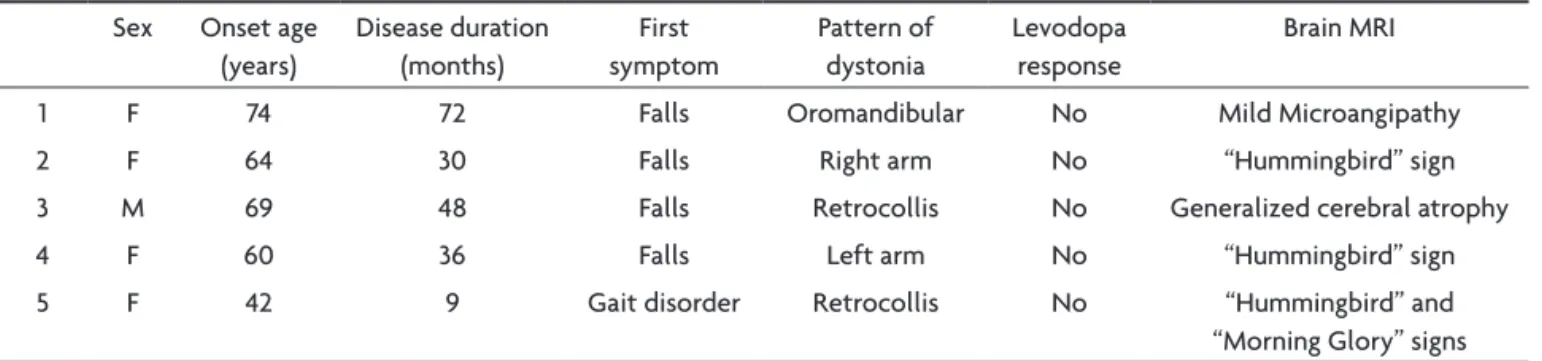
on Table 1, we present the clinical features of the pa-tients evaluated in the three groups: MSA, PSP, and CBD. on Tables 2, 3 and 4 we detailed the speciic indings on dystonia in those groups aforementioned.
The frequency of dystonia in our group of patients with atypical parkinsonism was: 30.4% (7 patients) in the MSA group, 62.5% (5 patients) in the PSP group, and 100% (8 pa-tients) in the CBD group. overall, the frequency of dysto-nia in our series was 50%. In none of these patients, dys-tonia was their irst complaint. we did not ind among the patients with dystonia and brain MrI abnormalities a top-ographic correlation between brain lesions and dystonia.
DisCussion
In this retrospective study of patients with atypical parkinsonism the overall frequency of dystonia found was high (50%) if we compare to the frequency of patients with PD. Another interesting inding was that dystonia was not the irst symptom at onset disease in any patient with atypical parkinsonism.
A common form of dystonia in patients with MSA is a severe, isolated anterocollis5,11. In our group of patients with MSA, only three subjects presented cervical dystonia (2 anterocollis and 1 retrocollis). Cervical dystonia, con-tralateral arm, hand and foot dystonias, occurring alone or in various combinations, may be the manifestation of a structural lesion involving the head of the caudate nucle-us12. In only one of our patients (patient 7 in MSA group) we were able to ind an MrI abnormality that could jus-tify dystonia. In fact, MrI is a useful diagnostic tool in the early course of MSA and it can be used to differentiate parkinsonian disorders13,14, but there is no clinical radio-logical correlation to dystonia phenomenom.
Table 1. Clinical proile of patients with atypical parkinsonism and dystonia.
Multiple system atrophy (MSA)
N=23
Progressive supranuclear palsy (PSP)
N=8
Corticobasal degeneration (CBD)
N=7
Male/Female 13/10 3/5 3/4
onset age (year–old) 57.1±9.3 64.7±10.3 62.7±6.8 Disease duration before diagnosis (months) 30.4±12.6 36.3±26.2 52.3±26.1 Dystonia 7 (30.4%) 5/8 (62.5%) 7 (100%) First symptom
Gait disorder Falls rigidity Bradikynesia Tremor Dystonia
11 4 1 6 1 0
2 5 0 0 1 0
1 0 4 2 0 0 Asymmetric parkinsonism 2 (8.6%) 3 (37.5%) 7 (100%) H&Y ≥3 in 3 years 20 (86.9%) 8 (100%) 6 (85.7%) response to levodopa 4 (17.3%) 0 1 (14.3%) Bradikinesia 23 (100%) 8 (100%) 6 rigidity 22 (95.6%) 8 (100%) 7 (100%) Tremor 4 (17.3%) 2 (25%) 1 (14.3%) Postural unsteadiness 22 (95.6%) 7 (87.5%) 2 (28.5%) ocular movement abnormalities 8 (34.7%) 8 (100%) 3 (42.8%) Postural hypotension 20 (86.9%) 1 (12.5%) 1 (14.3%) Sphincters disorders 15 (65.2%) 1 (12.5%) 0 erectile dysfunction 11 (47.8%) 0 0 Cold blue hands 6 (26%) 0 1 (14.3%) Pyramidal signs 12 (52.1%) 3 (37.5%) 4 (57.1%) Cerebellar signs 5 (21.7%) 0 0 DSM-IV dementia 3 (13%) 0 1 (14.3%) Dysphagia 14 (60.8%) 7 (85.5%) 3 (42.8%) Dysartria 16 (69.5%) 8 (100%) 3 (42.8%)
Alien hand 0 0 4 (57.1%)
Table 2. Patients with MSA and dystonia.
Sex onset age (years)
Disease duration (months)
First symptom
Pattern of dystonia
levodopa response
Brain MrI
1 F 54 36 Falls Anterocollis No Pons and cerebellum atrophy 2 F 64 12 Gait disorder Camptocormia No Normal
3 F 62 36 rigidity left foot No Normal 4 M 50 24 Bradikinesia left foot No Normal 5 F 76 36 Falls Anterocollis No Normal 6 M 64 36 Gait disorder retrocollis Yes Mesencephalum atrophy 7 M 43 24 Gait disorder left arm No Putamen atrophy and
in PSP tends to be ixed and does not alter with posture or activity as idiopathic dystonia does. Patients fail to show sensory tricks for improving the posturing, diurnal variation is absent (“morning beneit”), and painful neck spasms and hypertrophic muscles are not seen17. Two of our patients (patients 3 and 5) presented retrocollis and MrI abnormalities in brainstem. The MrI indings in pa-tients with atypical parkinsonism relect the involvement of many structures. The midbrain atrophy is particularly well demonstrated on midline sagittal images (“Humming-bird sign”), showing reduced midbrain diameter, enlarged cerebral aqueduct and thinned quadrigeminal plate. Sig-nal abnormalities are mild and consist of hyperintensity in the periaqueductal region on T2-weighted sequences (“Morning Glory sign”)18,19. The most widely reported dys-tonic manifestation on PSP is blepharospasm20, but none of our patients presented such manifestation. Two of our patients (patients 2 and 4) presented limb dystonia. It is possible that limb dystonia in PSP is an indicator of con-comitant cortical and basal ganglia neuropathological changes. It is becoming increasingly recognized that such cortical pathology does occur in PSP17. Interestingly, oro-mandibular dystonia was observed in one of our patients and it was not related to levodopa therapy. The potential
role of medication, especially levodopa, must be consid-ered when dealing with dystonia in patients with PSP17. A Brazilian series of PSP patients observed that 13% had tran-siently good response to levodopa, but it did not point out whether these patients also presented dystonia21. None of our patients with PSP responded to levodopa, including those who presented dystonia.
Classically, typical features of CBD can be categorized into movement disorders (akinesia, rigidity, postural in-stability, limb dystonia, cortical myoclonus and postur-al/intention tremor) and cortical signs such as cortical sensory loss, apraxia and Alien hand phenomenon22. A rigid, dystonic posture arm with some ingers extended and others forcibly lexed into the palm causing skin mac-eration characteristically develops early in the course of the illness in a substantial minority of patients5,22. Jerking of the affected limb due to action-induced and stimu-lus sensitive focal relex myoclonus commonly precedes or accompanies the development of such dystonic pos-tures and, if rhythmic, may mimic tremor23. In our series, all patients with CBD presented limb dystonia, and ive of them also had associated myoclonus. The brain MrI was abnormal in four patients, all presenting asymmetri-cal brain atrophy (Table 4). In these patients the side with Table 3. Patients with PSP and dystonia.
Sex onset age (years)
Disease duration (months)
First symptom
Pattern of dystonia
levodopa response
Brain MrI
1 F 74 72 Falls oromandibular No Mild Microangipathy 2 F 64 30 Falls right arm No “Hummingbird” sign 3 M 69 48 Falls retrocollis No Generalized cerebral atrophy 4 F 60 36 Falls left arm No “Hummingbird” sign 5 F 42 9 Gait disorder retrocollis No “Hummingbird” and “Morning Glory” signs
Table 4. Patients with CBD and dystonia.
Sex onset age (years)
Disease duration (months)
First symptom
Pattern of dystonia
Myoclonic jerks
levodopa response
Brain MrI
1 F 65 60 Gait disorder left arm Yes No right frontal lobe atrophy 2 M 50 84 rigidity right arm Yes No Normal 3 F 60 24 rigidity left arm No No right parietal and
tempotal lobes atrophy 4 F 62 72 Bradikinesia right arm Yes No Normal 5 F 71 72 Bradikinesia right arm and
retrocollis
Yes No left frontal lobe atrophy 6 M 62 36 rigidity left arm and
blepharoespasm
more prominent atrophy was opposite to the side of limb dystonia. MrI indings of atrophy in the perirolandic gyri, atrophy of the basal ganglia, and T2 prolongation in the posterolateral putamen are useful evidence supporting the clinical diagnosis of corticobasal degeneration24. As expected, dystonia was not the chief complaint in any patient and did not respond to levodopa therapy.
Clinico-pathologic studies are needed to disclose the relationship between these dystonic manifestations and the pathological substrates of these atypical parkinson-isms. we did not have a longer follow-up that could allow the observation of dystonia progression, and of those pa-tients who initially did not have dystonic features but lat-er developed these signs correlating to levodopa thlat-erapy. In conclusion, in our series dystonia was a common feature in atypical parkinsonism (overall frequency 50%) and it was part of the natural history although not the irst symptom at disease onset. Moreover, neuroimaging abnormalities are not necessarily related to focal dysto-nia, and levodopa therapy did not inluence the pattern of dystonia in our group of patients. Prospective studies of natural history and post-mortem brain pathological analy-sis are necessary to disclosure a better comprehension of dystonia phenomenology in atypical parkinsonism.
referenCes
1. Jankovic J, Rajput A, McDermott MP, Perl DP. The evolution of diagno-sis in early Parkinson disease. Arch Neurol 2000;57:369-372. 2. Brooks DJ. Diagnosis and management of atypical parkinsonian
syn-dromes. J Neurol Neurosurg Psychiatry 2002;72(Suppl 1):110-116. 3. Cardoso F, Camargos ST, Silva GA Jr. Etiology of parkinsonism in a
Bra-zilian Movement Disorders Clinic. Arq Neuropsiquiatr 1998;56:171-175. 4. Albanese A, Colosimo C, Bentivoglio AR, et al. Multiple system atro-phy presenting as parkinsonism: clinical features and diagnostic crite-ria. J Neurol Neurosurg Psychiatry 1995;59:144-151.
5. Rivest J, Quinn N, Marsden CD. Dystonia in Parkinson’s disease, mul-tiple system atrophy, and progressive supranuclear palsy. Neurology 1990;40:1571-1578.
6. Rinne JO, Lee MS, Thompson PD, et al. Corticobasal degeneration: a clinical study of 36 cases. Brain 1994;117:1183-1196.
7. Ashour R, Jankovic J. Joint and skeletal deformities in Parkinson’s dis-ease, multiple system atrophy, and progressive supranuclear palsy. Mov Disord 2006;21:1856-1863.
8. Gilman S, Low PA, Quinn N, et al. Consensus statement on the diag-nosis of multiple system atrophy. J Neurol Sci 1999;163:94-98. 9. Litvan I, Agyd Y, Calne D, et al. Clinical Research criteria for the
diag-nosis of progressive supranuclear palsy (Steele-Richardson-Olszewski syndrome): report of the NINDS-SPSP International Workshop. Neu-rology 1996;47:1-9.
10. Gibb WRG, Luthert PJ, Marsden CD. Corticobasal degeneration. Brain 1989;112:1171-1192.
11. Quinn N. Disproportionate anterocollis in multiple system atrophy. Lancet 1989;1:844.
12. Obeso JA, Gimenez-Roldan S. Clinicopathological correlation in symp-tomatic dystonia. Adv Neurol 1988;50:113-122.
13. Seppi K, Schocke MF Wenning GK, Poewe W. How to diagnose MSA early: the role of magnetic resonance imaging. J Neural Transm 2005;112:1613-1624.
14. Albuquerque AV, Freitas MRG, Cincinatus D, Harouche MBB. Multiple system atrophy: clinical-radiological correlation. Arq Neuropsiquiatr 2007;65:512-515.
15. Steele JC, Richardson JC, Olszewski J. Progressive supranuclear palsy. Arch Neurol 1964;10:333-359.
16. Fukushima-Kudo J, Fukushima K, Tashiro K. Rigidity and dorsilexion
of the neck in progressive supranuclear palsy and the interstitial nucle-us of Cajal. J Neurol Neurosurg Psychiatry 1987;50:1197-203. 17. Barclay CL, Lang AE. Dystonia in progressive supranuclear palsy. J
Neurol Neurosurg Psychiatry. 1997;62:352-356.
18. Barsottini OG, Ferraz HB, Maia AC Jr, Silva CJ, Rocha AJ. Differenti-ation of Parkinson’s disease and progressive supranuclear palsy with
magnetic resonance imaging: the irst Brazilian experience. Parkinson -ism Relat Disord. 2007;13:389-393.
19. Schrag A, Good CD, Miszkiel K, et al. Differentiation of atypical par-kinsonian syndromes with routine MRI. Neurology 2000;54:697-702. 20. Pfaffenbach DD, Layton DD, Kearns TP. Ocular manifestations
man-ifestations in progressive supranuclear palsy. Am J Ophthalmol 1972;74:1179-1184.
21. Carrilho PEM, Barbosa ER. Progressive supranuclear palsy in a sam-ple of Brazilian population: clinical features of 16 patients. Arq Neu-ropsiquiatr 2002;60:917-922.
22. Riley DE, Lang AE, Lewis A, et al. Cortical-basal ganglionic degenera-tion. Neurology 1990;40:1203-1212.
23. Thompson PD, Shibasaki H. Myoclonus in corticobasal degeneration and other neurodegenerations. Adv Neurol 2000;82:69-82.