Keywords: Context-Awareness, Heterogeneous Mobile Systems, Multiparty Communications, Network Management, Session Management, Telecommunications Technology
Session and Network Support
for Autonomous Context-Aware
Multiparty Communications in
Heterogeneous Mobile Systems
Josephina Antoniou, University of Cyprus, Cyprus
Christophoros Christophorou, University of Cyprus, Cyprus
Augusto Neto, Federal University of Goiás (UFG), Brazil
Susana Sargento, University of Aveiro, Portugal
Filipe Cabral Pinto, University of Aveiro, Portugal
Nuno Filipe Carapeto, Portugal Telecom Inovação, Portugal
Telma Mota, Portugal Telecom Inovação, Portugal
Jose Simoes, Technical University of Berlin, Germany
Andreas Pitsillides, University of Cyprus, Cyprus
AbStrACt
The increase of networking complexity requires the design of new performance optimization schemes for de-livering different types of sessions to users under different conditions. In this regard, special attention is given to multi-homed environments, where mobile devices cross areas with overlapping access technologies (Wi-Fi, 3G, WiMax). In such a scenario, eficient multiparty delivery depends upon the grouping operation, which must be done based on several parameters. In this paper, the authors propose context-aware sub-grouping of content-based service groups so that the same service session can be delivered using different codings of the same content, adapting to current network, users, session, and environment context. The context-aware information is used to improve the sub-grouping process. This paper aims to describe these sub-grouping techniques, and in particular how they improve network performance and user experience in the future Internet by focusing on the improved network-level and session-level mechanisms.
INtroduCtIoN
Increasing demands in group-based multimedia sessions, new technologies and market forces are fuelling the design of the future Internet, which is expected to fundamentally change the networking landscape in the upcoming years. In order to preserve profitability while increasing revenues, network/service providers must op-timize costs and provide new types of sessions operating in a mixture of access technologies (wired and wireless), which is not trivial and demand complex control. Special attention must be given towards group-based multime-dia sessions, since the strong requirements on Quality of Service (QoS) must be fulfilled simultaneously for all users of the same group and be kept during the entire session lifetime.
In terms of group-based sessions, efficiency of session setup requires a correct definition of user groups. Nowadays, most mobile devices are produced with multi-homed capabilities, and it is common to cross areas where there exists overlapping of different network access tech-nologies, such as Wi-Fi, 3G and WiMax. The efficiency of the grouping operation (creation of a set of users to receive a given session) may depend on a few parameters, including the ac-cess technology. For instance, 3G networks have lower bandwidth capabilities in comparison to Wi-Fi and WiMax networks, thus, depending on network conditions, for 3G users to be able to join a session, capacities should be carefully considered. Thus, sub-grouping could be per-formed and the same service session could be delivered with different throughput (e.g., using different codings of the same content) to adapt the throughput to the current network capabili-ties. In addition to network traffic, other types of context information should also be used to improve sub-grouping, such as noise, terminal location and speed, user’s priority and network preferences, user’s terminal capabilities, qual-ity of signal strength received, environmental conditions etc. Moreover, history context information can also be used for improving sub-grouping. For example, previously received context can be compared with current context for
patterns to be located. Using some intelligence, forecasts of undesirable events are possible and sub-groups may be created so that such events are avoided.
The paper, based on work performed in (PT Inovacao, n.d.), proposes such innova-tive sub-grouping process to enable context-awareness and consequently self-optimization in multiparty, converged mobile environments. These sub-grouping techniques, and in particu-lar how they improve network performance in the future Internet, are described in the scope of cognitive self-managed networks. The ses-sion and network-level grouping processes proposed in this paper take as a base support, the description of the base functionalities of each element in the architecture, described in (Antoniou, Christophorou, Neto, Sargento, Pinto, Carapeto, Mota, Simoes, & Pitsillides, 2009), going further on the complete framework for multi-level context-aware sub-grouping. In (Antoniou, Christophorou, Janneteau, Kelil, Sargento, Neto, Pinto, Carapeto, & Simoes, 2009) it was presented a first attempt on the support of context-aware sub-grouping. In this paper, it is provided a thorough description of the sub-grouping mechanism and a full solution for its support, including how session modifi-cation and network selection are handled and how they impact sub-grouping. Moreover, we provide information on how such a framework is implemented and evaluated.
Related work is briefly presented next, followed by an overview section discussing a context-aware multicasting architecture and introducing the sub-grouping mechanism. The following two sections diverge into the self-management through sub-grouping as designed at the session and network layers. A presentation of how context is used by the content comes next, and finally the last section offers conclu-sions and directions for future work.
related Work
provide rich-media content to mobile com-munities in an effective way. In Amran and Fuchs (2006), Zafar (2006), Antoniou (2007), and Zafar (2008), a converged, multi-bearer service architecture that supports broadcast and multicast services was defined. Context information was used as input for service group creation influencing the formation of multime-dia sessions. Enhanced signaling procedures for an effective IMS and MBMS integration were presented in (Pinto, Knappmeyer, & Al-Hezmi, 2008) supporting the provisioning of multimedia sessions to mobile communities using unicast, multicast and broadcast bear-ers. In (Al-Hezmi, Magedanz, Pallares, & Riede, 2008), architecture for IPTV services is proposed over IMS-based NGN networks enabling the delivery of converged multimedia services over unicast, multicast, and broadcast transmission modes following the approaches from ITU-T and TISPAN. A hierarchical group management framework is proposed in Zafar, Fuchs, and Baker (2008) enabling management of transcoding based groups. It is demonstrated that there is an advantage for using more efficient codecs, by subgrouping multicast groups based on supported codec, as they become widely available in the network. Thus, in Handorean, Sen, Hackmann, and Gruia-Catalin (2005) strategies are exploited, which involve the use of contextual information, strong process migration, context-sensitive binding, and lo-cation agnostic communilo-cation protocols for “follow-me” sessions. Finally, in Antoniou, Riede, Pinto, and Pitsillides (2009) the ses-sion management functionality is extended for multiparty sessions to consider context triggers in the creation, modification and teardown of sessions. With the proposed enhanced session manager, multiparty content distribution will be done in the most efficient way, resulting in new “personalized” sessions.
Personalized sessions (Simoes, Sargento, Antoniou, Christophorou, Janneteau, Carapeto, & Neto, 2009) can be influenced by varying context, thus, allowing users access sessions based on their location, preferences, profile and capabilities (Bygdas, Malm, & Urnes, 2000).
In next generation networks, multiple access networks will coexist, therefore, an access selec-tion process, using algorithms based on context, preferences and capabilities, should be in place to enable the optimization of both terminal and network (Jesus, Sargento, & Aguiar, 2008).
Paradigms where hosts have access to multiple networks are not new: multi-homing is used to improve resilience, dependability and performance. However, multi-access network selection is currently rudimentary and automa-tion is not usual. However dynamic network access selection, considering QoS requirements and instantaneous context is not yet possible in real networks; currently in 3GPP there are standardization efforts on multi-access network connectivity. As currently specified by 3GPP in (3GPP, 2006; 3GPP, 2009), two modes of opera-tion are supported; Automatic and Manual. In automatic network selection mode the mobile terminal automatically uses a set of rules to find the network to register with. In manual network selection mode, the mobile terminal displays a list of available networks to the user. The user selects one of them and the mobile terminal attempts registration onto that network. If the registration is not successful, the mobile terminal shows the list of networks to the user once again. In manual mode, the user selects a particular network with no or few information about the available networks.
namely the Consumer Surplus (Ormond, Perry, & Murphy, 2005), the Profit function (Liu, Li, & Zhang, 2006), and Game Theory (Niyato & Hossain, 2006). Many other proposals base the decision process on radio signal properties; however this is only one of the many criteria in such selection schemes. Thus, some propos-als suggest context-aware decisions (Jesus, Sargento, & Aguiar, 2008). Moreover, the majority of related work focuses entirely on network selection algorithms, not concerning other important mechanisms crucial to sup-port the decisions, e.g., QoS management, to enable the complete network re-configuration triggered by context. In this paper, we consider the support of context-aware network access selection, in a multicast environment, where the group membership is a main issue, but be-ing flexible enough to support any parameter envisioned. Intelligence and context-awareness is integrated in our algorithm facilitating it to be autonomous, self-adaptable and self-controlled. By considering the instantaneous context of the users and the network’s, the intelligence integrated in the algorithm predicts trends in users’ and network’s behaviour and dynamically adapts the network access selection thresholds and the algorithm’s operations to any situation, aiming to provide the end users with seamless service continuity and best possible QoS while at the same time use as less radio resources as possible and avoid any undesirable event that can influence the network performance (like congestion, overloading, QoS degradation, etc.) or the quality experienced by the users (i.e., call drop, QoS degradation, etc.). Thus, the main objective of our algorithm is to benefit the users and the Network Operators, alike.
On the session layer, most of the solutions proposed use the Session Initiation Protocol (SIP) as main signaling protocol on IP net-works. Much effort has been put recently on the autonomic network concepts (Antoniou, Christophorou, Neto, Sargento, Pinto, Carap-eto, Mota, Simoes, & Pitsillides, 2009), where autonomic processes can perceive network conditions, plan, decide, and act on these conditions. They can learn from the impact of
former adaptations and accordingly make future decisions, while considering end-to-end goals. Autonomic networks are promising for wire-less networks, which are highly dynamic and complex to manage. Our approach is towards the autonomic concept by enabling the dynamic optimization of the use of the network taking into account also the history and instantaneous context of the users, network, sessions and environment. This is manifested through an ap-propriately designed architecture that efficiently allows context-aware, multiparty delivery, as described in (Antoniou, Christophorou, Jan-neteau, Kelil, Sargento, Neto, Pinto, Carapeto, & SImoes, 2009).
CoNtext-AWAre MultIpArty
ServICe provISIoN
This section presents the overall context-aware multiparty architecture, able to support context from the user, network, sessions and surrounding environment in future multiparty mobile com-munications. We also show how the context can influence grouping and sub-grouping of users at different levels from the environment and user-levels, to the session and network-layers.
System Architecture
entities of the multiparty delivery process and we subsequently focus the description on the session and network interactions.
Context Providers (CxP) – These entities ob-tain contexts from sensors and networks, map them to information in an interpre-table manner and deliver this information to the several components.
IP Transport (IPT) – This entity controls the integrated QoS and IP multicast enforce-ment in the nodes along a communication path for the efficient delivery of multi-party sessions to groups of users with QoS-guaranteed over the time. Moreover, IPT is able to dynamically build delivery trees in heterogeneous environments. The performance limitations of existing pro-posals motivated the design of IPT with support to distributed per-class resource control. For scalability, network edges co-ordinate resource allocations and interior routers remain simple, by reacting only upon both signaling and network dynamic events (e.g., link failures, re-routing or
mobility), where these events can be local or triggered by context changes.
Multiparty Transport Overlay (MTO) – This functional entity provides a generic, scal-able, and efficient transport service for group communications by applying the overlay paradigm at the transport layer. It hides the heterogeneity of underlying networks in terms of IP multicast capa-bilities or IPv4/v6 support, enabling the dynamic creation of an overlay tree at the transport level, between the source and the group members.
Network Management (NM) – This functional entity performs context-aware decision of the best connection of multimode terminals in heterogeneous networks. It makes use of user, environment, network, and session context, to drive intelligent network selection, in terms of communi-cation path, terminal interface and access technologies. Moreover, it is expected to achieve more efficient resource utiliza-tion, as well as more uniform distribution of data load, while fulfilling the QoS re-quired by sessions and experienced by the
users. For instance, the Wi-Fi incoming interface of a terminal should be changed to the WiMax during congestion periods, or after terminal mobility to an area without Wi-Fi coverage area. In addition, the NM, associated with MTO, allows generalized transport by assigning MTO trees and controlling packet transport along them. Thus, end-to-end multiparty content transport over network segments with different transport technologies (i.e., unicast and multicast) is deployed with context-driven, scalable self-organization and seamless resilience support.
Session Management (SM) – This entity man-ages user-to-content and content-to-user relationships, through session control. It is intelligently designed to enable the use of context information for ses-sion control, using the SIP, in terms of network-specific, environment-specific and user-specific contexts, without in fact knowing the actual network, environ-ment or service details through Session Management Enabler (SME) and Session Use Management (SUM).
Mobility Controller – This entity applies the decisions issued by the NM related to the network interface to be used in the terminal, for vertical handover decisions.
Concerning session and network interac-tions and context-aware support, the following paragraphs detail the interactions and function-ality of both SM and NM.
SM interacts with network modules to require transmission quality specifications, en-suring that the network has enough resources to make the transmission effective without quality loss. For this requirement the SM needs to know the capabilities of the access network assigned to a user, a task undertaken by the NM. The SM also considers context information, e.g. user profile and preferences, terminal capabilities e.g. in term of codec support, to choose the correct parameters for the session, such as media codecs and video display resolution, and to perform groups of users according to the
context parameters. Overall, SM participates in dynamic changes such as switching between different contents.
NM then receives from the SM different pa-rameters, including session ID code (with QoS requirements in terms of maximum throughput and tolerance to delay, loss and jitter) and user ID list, where NM uses the latter to retrieve context of each user from a Context Broker (CxB in Figure 1). Based on instantaneous user and network context, NM selects the best wireless network interface and proposes initial sub-grouping of users accordingly. Afterwards, NM matches in a local database (carrying over-all network topology) the best overlay nodes (the edge nodes of the MTO trees) that will be part of the MTO Tree for each sub-group. In addition, it triggers IPT to select the best com-munication path1 (multicast or unicast) between
these overlay nodes and further enforces both QoS (per-class bandwidth reservations) and, if applicable, IP multicast (IP multicast address allocation, Multicast Routing Information Base (MRIB) population and multicast routing pro-tocol triggering at the egress overlay nodes). After succeeding, IPT triggers MTO with the IP multicast addresses of multicast MTO branches to MTO component, allowing MTO to create multiparty transport connections and start multiparty data delivery. When all these processes are successful, SM is triggered to resume session setup.
Context-based Sub-Grouping
the context information, the best access tech-nologies for the users in the same group may be different, since user context and environ-ment is also taken into account. The different networks may have different guarantees, which may require the content to be delivered with different quality and codecs, hence requiring users sub-grouping.
The Session Management is the element that accepts context information through requests or triggers and answers by creating/ modifying/terminating the sub-group sessions. Once it determines the matching between avail-able content formats and user capabilities in terms of supported content formats, resulting in candidate files per user in the service group, it is responsible of first inviting the users to a session and to invite the content provider to deliver the content to these users.
When some context changes, and this change is relevant to the way the service is consumed, the session management should be capable of adapting the user’s session accord-ingly (move a user to a different sub-group, or eventually create or delete sub-groups). The trigger can have different sources (network con-ditions change, device change, handovers, etc). The Session Management should be able to notify the Network Management to modify sub-groups/sessions based on the above noti-fications. This might make the Session Man-agement terminate the SIP and Media session both with the client and the content provider. It should also be able to modify sessions based on notifications coming from other components, through changes in context. According to the trigger, when only sub-groups are affected, it is important to modify the multiparty session as well. Therefore, it will communicate all changes to the Network Management to adapt the trees (and the correspondent overlays) accordingly, and possibly change the network and technol-ogy to the new sub-groups.
On the network side, each of the created sub-groups represents a multicast delivery tree or, in case of a single user, a unicast connection, that requires network resources. The network Context Provider improves the network operator
view about network resource usage, to optimize network resource management and QoS. It is then possible for the network to provide dif-ferent QoS levels to the members of a group that consume identical content, but experience various network contexts. This is the process of network level sub-grouping.
The Network Management is triggered through network level context, or by the Ses-sion Management to adapt the network and users in the network. It performs an optimiza-tion process whose output is the decision of the networks/technologies to be used and the content coding that will be received by the several users. If the users in the same group change the attached network, and the levels of QoS cannot be fulfilled in the networks of a group, sub-grouping is performed at network level, and different QoS, and possibly different codecs, will be assigned to the different sub-groups. For some cases, where not all the users or links have the required multicast capabilities, overlay nodes are enabled to abstract the group-ing decision of these considerations. Moreover the sub-grouping flexibility allows, for instance, in the same session, two users to receive the same audio, but different video streams with different codecs or rates, just depending on the available resources or preferences. In this case both would be in the same audio sub-group, but in different video sub-groups.
The following two sections will describe in detail the context-aware sub-grouping pro-cesses, both at the session and network levels.
eNAblING
CoNtext-AWAreNeSS
At tHe SeSSIoN level
Session Management overview
heteroge-neous mobile system. Specifically, the session management deals with context that is relevant in order to select the right content for its con-sumers. Therefore, the first step for enabling context-awareness in the multicast-enabled, converged network is to recognize and use content-related context. Such context may be categorized as Device Context (e.g., supported coding options) and User Context (e.g., user preferences). Thus, the Session Management entity will be able to recognize context triggers, as well as be able to make additional requests for context when necessary to the appropriate functional entity within the system architecture.
Context-Aware Session Management
The context-awareness in the Session Man-agement entity comes from the recognition of context as triggers or the capability to receive any context requested, e.g., for initiating a context-aware session. Therefore, the Session Management entity has the functionalities de-scribed in the subsequent paragraphs (based on interfaces with other system functional entities), necessary to enable this awareness of context information.
Primarily, the Session Management needs to interact with the entity responsible for identi-fying the service groups, i.e., the groups of users that will receive the same content. Through this interface the Session Management must receive identification for the service group, together with separate identifications for the individual users that comprise the particular group.
Consequently, the Session Management must be able to interact with the entity respon-sible for Content Processing and Delivery. The Session Management sends the group identi-fication received in the step described above, to the Content Processing and Delivery entity, and the identification is used by this entity to collect some general content information for the group, e.g., whether the content that will be received by the particular group is video or audio, as well as some more specific informa-tion, e.g., the coding(s) and bitrate(s) in which
the particular content is available. Thus, the Session Management entity acquires descrip-tive information on the content that will be transmitted to the group.
Once the content description has been ac-quired, the Session Management needs to check which of the available content codings the users are capable (device context) and willing (user context) to support. Device and User context in-formation is collected at a broker system entity, i.e., an entity in the converged architecture that accumulates all context information received from various context producing entities (for instance the user terminals in this case). The Context Broker entity contains the required device and user context, therefore the Session Management entity requests for each user in the service group its capabilities and preferences, including coding options supported/preferred by the user device (e.g., resolution, coding op-tions supported).
Once this particular context information is obtained per user, the Session Management entity can match the content codings/formats in which the content is available, i.e., received from the Content Processing and Delivery (CtPD) entity, to the content codings/formats that each of the group users is capable or will-ing to support. This matchwill-ing results in a list of particular content codings per each user, which may be viewed as an initial refinement of the original service group to sub-groups of users according to the supported content. This is the first step of the grouping process. The sub-grouping will continue in the network where further refinements will additionally consider network and environment context (e.g., current QoS capabilities based on user location and current network load).
Management entity will send the list of users and their supported content codings (once the matching of content availabilities and content capabilities is performed), and will receive the finalized context-based sub-grouping of the original service group by which only one content coding will be selected for each user in the original service group. This will enable a context-aware session for each multicast sub-group to be setup.
Initiating a Context-Aware Session
In this section, we describe the session initiation by focusing on the Session Management func-tionalities as described above. In the subsequent discussion, the Session Management functional entity is separated in two functional modules: The Session Management Enabler (SME) and the Session Use Management (SUM). In terms of functionality the SME is the Session Man-agement functional module that accepts context information through requests or triggers and responds by creating/modifying/terminating the sub-group sessions. In other words, it handles the interfaces between the SME and the entity providing the identification of the original ser-vice groups, the entity responsible for matching a group context to the appropriate content, the SME and Network Management, the entity that knows the network, the SME and the Context Broker entity, where all context information subsides, as well as the SME and CtPD, the content processing and delivery entity. Finally, the SME needs to interact with the SUM, which is the sub-module responsible for handling the SIP-specific tasks of the Session Manager, such as inviting the users and the Media Delivery Function to sessions. Once the Core Entity of the SME determines the matching between available content formats and user capabilities in terms of supporting content formats, resulting in candidate files per user in the service group, SUM takes over, which is responsible of first inviting the users to a session and to invite the CtPD to deliver the content to these users.
Figure 2 illustrates the messages exchanged during session initiation that are relevant to Session Management (both the SME and SUM). SME receives group identification and immediately requests group content informa-tion from the CtPD. For each group user the terminal capabilities and user preferences are collected from the Context Management System and particularly from the Context Broker entity. The matching between this information results in a list of users and corresponding available content codings, which is sent to the Network Management to proceed with more refined sub-grouping. The returned user list has one coding per user, with all users that support the same content coding to form a subgroup. Then, the SME interacts with the SUM to open a new session for each subgroup by inviting the users that belong to that sub-group to join the session, and by inviting the Media Delivery function (part of the CtPD) to deliver the particular content coding for that sub-group.
ModIfICAtIoN of A
CoNtext-AWAre SeSSIoN
trIGGered by CoNtext
CHANGe
The Session Management is capable of adapting itself and the existing sessions whenever there is a trigger containing a new context that requires the session to be updated to a new state. This trigger can come spontaneously from another component (such as Network Management) or can derive from previously subscribed context information. In case the Network Management is involved, all the resource reservation must be reconfigured. Figure 3 shows the interaction between the involved entities.
Specifically, session modification when new context information is available (Figure 3) is achieved in the following manner:
subscribed to this context). According to the existing sub-groups, it decides to downgrade the user to another sub-group containing the same media files but coded in a lower bitrate version. Optionally, it can inform the NM to reconfigure the overlay tree and QoS settings accordingly. We are also assuming that the newly de-cided sub-group media type was already setup for the current group.
Step 2: When all decisions are taken, the SME sends a SIP INVITE (through the SUM) message towards the involved user, con-taining the new multicast address to join. Step 3: Before joining the new multicast ad-dress, the user leaves the previously joined address.
Steps 4 and 5: The user joins the new multicast address and informs the SME that the process went without any problems. At this point in time, the user should be
re-ceiving the new low bitrate media stream (B instead of A).
eNAblING CoNtext
AWAreNeSS At tHe
NetWork level
Network Management overview
The Network Management (NM) component is the element that provides intelligent end-to-end path and network selection. This is achieved by considering user, network and environment context, allowing terminals to be always best connected and receive content over multiparty sessions while benefiting from satisfactory Quality of Experience (QoE). It takes advan-tage of diverse context information obtained from multiple sources and allows multimode terminals to be always “best” connected. By making use of context, NM successfully drives
intelligent network optimization, be it in terms of communication path, terminal interfaces or access technologies selection. NM assumes complex, dynamic and heterogeneous scenarios, where network events (link failures, handovers and traffic conditions) take place randomly over time. Such network dynamism and complexity requires a new concept of network architecture in order to efficiently support management of users in sub-groups. Similarly to the way SM is separated into the functional entities SME and SUM, the NM is separated in the Network Management Enabler (NME) and the Network Use Management (NUM).
Context-Aware Network Management
This section describes in detail the NM by elabo-rating separately on the NME and the NUM, specifically on their functionalities and roles in terms of context usage and sub-grouping.
The NME is the module that enables net-work support and provides the interface with the SME and the upper layers. It has the main responsibility of sorting out network level groups. Actually it divides the service groups into smaller sub-groups according to the qual-ity on the stream they will be receiving, based on the user, the network, the operator policies, and a large set of context information. NME can be triggered and receive requests from the Session Management, concerning resource setup, modification and teardown, i.e., service groups are refined according to content avail-abilities matched with user capavail-abilities. After a session request, NUM is triggered to execute the network selection process of an intelligent access technology (using network, user and environment context dynamically obtained). Furthermore, it also requests NUM for the selection of possible near-optimal multiparty communication paths, (multicast and/or uni-cast) which can provide sufficient resources
throughout the network and support the network interfaces. At this point, and with the possible end-to-end communication paths, the best network interfaces, the user and operator prefer-ences plus a set of diverse context information, NME divides the users into different sub-groups. This whole process can be extended with new sets of context information that can be used to better refine sub-grouping. This way, each specific unicast/multicast subgroup will reflect a unique (to that content) quality of service. In addition, these mechanisms were defined to cope with modifications due to network prob-lems or context changes. Once the sub-groups are created and provisioned by the underlying modules, this information is returned to the Ses-sion Management entity with the respective IP addresses and ports and selected content coding for each sub-group.
The NUM is essentially the module responsible for managing network resource allocation functions, for the whole end-to-end path, access, aggregation, and core networks. It encompasses the network selection, aiming at providing intelligent Radio Access Technology (RAT) selection based on context-aware infor-mation to groups of users, as well as selection of communication paths, which is done based on network information. The network selection function deploys intelligent context-aware RAT selection for the users of a group, both at the session setup and also periodically during the session. NUM, by taking into account current networking and environment user context (i.e., noise, interference, RATs within reach, signal strength received, signal strength alteration rate, terminal’s capabilities, user’s preferences, etc.), as well as the current network context (i.e. QoS capabilities of RATs, available capacity and current load in RATs, etc.), selects the RAT that will serve each user and the content coding that each user will receive in such a way that enhanced capacity and network performance is achieved. Upon selecting the RAT and content coding for each user, NUM triggers the NME to control the network resources, also informing each terminal about the selected interface from which multiparty content will be provided (i.e.,
Wi-Fi, WiMAX, UMTS, LTE, DVB, etc.). The network selection process also provides support during the multiparty sessions transport, i.e., us-ers of on-going sessions can receive multiparty content from a different network interface, due to changing network conditions or even vertical handovers (with the support of the Mobility Controller (MoC) installed in the Terminal).
NUM is also responsible for selecting the best communication path within the network. It receives requests from the NME to decide on the best path for the multiparty connection. To do that, NUM maps the QoS requirement of the multiparty session into an available class of service, also taking into account all the network status when selecting the path. In this sense, it deploys admission control operations along the network communication path. Afterwards, it returns them to the NME, which finally takes the decision of enforcing the reservation. Consequently, NUM receives the enforcement order and commits the resource reservation by triggering each router to enforce both QoS and multicast. QoS enforcement consists of indi-cating the amount of bandwidth and class of service for resource reservation, and Multicast enforcement comprises of populating the MRIB with the information about nodes of the selected path. At the end, NME is informed about the success of the operation.
Grouping as a part of Network Management
Network role in
Context-Aware Group Setup
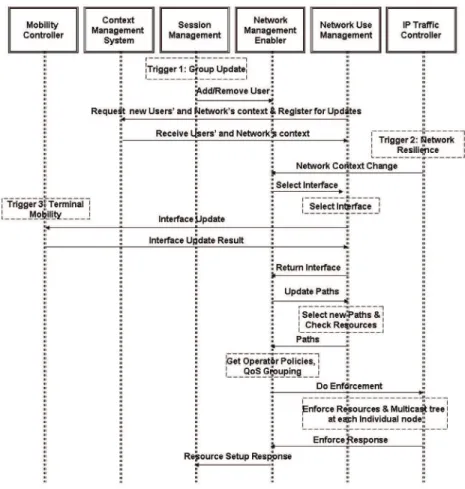
The Session Management, once the matching of content availabilities and users’ content capabilities is performed, sends the list of us-ers and their supported content codings to the NME. This starts the sub-grouping process in the NME that is composed of three steps.
Firstly, NME triggers NUM to select for each user the interface (i.e., the RAT) that will be supported and the content coding that will receive. Upon this trigger, NUM acquires from the Context Management system the current networking and environment context of the users as well as the current network context. Based on this context, NUM forms different “possible” transmission arrangements (i.e., different combinations of groups of users that will be served using a specific RAT and receive a specific content coding) that can be used for the multicast content provision and the capacity requirement of each transmission arrangement is estimated. Then, based on some rules that the transmission arrangement must obey during the content provision within the network, the “acceptable” transmission arrangements are identified and the one with the least amount of capacity requirements is selected and adopted. “Possible” transmission arrangements are those that can provide the content to the users with the required QoS. On the other hand, “acceptable” transmission arrangements are a subset of the “possible” transmission arrangements that con-form to the rules that should be obeyed during the content provision within the network. These rules are defined dynamically by the NUM by using some intelligence and by considering both the current and the history context information of the network and users collected through time. For example, previously received context is compared with current context for similar pat-terns to be located. Based on the similar patpat-terns located, using some intelligence, NUM detect trends and forecasts of undesirable events are possible to occur in a short time (e.g., congestion in the Network, overloading of certain RATs, users’ QoS degradation, etc.) and sets some rules
that the transmission arrangement must obey in order for these events to be avoided. Once the transmission arrangement to be adopted is selected, NUM triggers each Terminal for an interface and IP address update. Once the new IP addresses of the Terminals are received, NUM informs NME about its decision.
Secondly, NME decides on the multicast groups based on the user’s and operator’s con-text, and it chooses the optimal way to group the users based on optimization policies that can maximize the QoE of the user.
Lastly, NME will send this result and up-dated interfaces to NUM and check for available paths between the source and users that respect the QoS constraints and optimize the resource allocation. This process is partially cyclic and may require some sub-iterations or adaptations of a decision previously taken. Still it allows the separation and simplification of processes to-wards the autonomy of the system. Afterto-wards, each of the multicast subgroups will trigger the resource reservation and multicast routing. In the end NME pushes the Session Management (SME and SUM) to invite all the users to the multicast groups and the content provider to start streaming. The process is depicted in Figure 4.
Network role in Context-Aware Group Modification
The group modification capabilities and thus the system adaptability is one of the major strengths of this architecture since it is able to rapidly adapt to various environment changes and maintain the user experience. In fact, the architecture must firstly be able to quickly detect any changes, to evaluate the impact on the ongoing sessions and be prepared to en-force modifications on the subgroup possibly switching the streams some of the users are receiving. Three major triggering possibilities were considered: updates of the group members, modifications on network elements which may influence the experienced QoS, and changes due to user’s mobility.
in the user context implying that a different content is received by the user. This represents the ability of users to join or leave the group session. This is initiated at higher levels in the group manager and content selector and passed to the SME that propagates it to the Network Management and other modules in a way, very similar to session initiation. The removal of users can reduce size or even terminate an existing sub-group. Plus, addition of users has to take into consideration that the stream is already progressing and the content will only be viewed from that point forward. This is only considered when the new user viewing
experi-ence is not compromised, since no user wants to be watching a TV show and suddenly jump 3 or 5 minutes in time.
The second type is related with the Sub-Group Modification, which only affects the actual QoS of a set of users and allows them to be switched between sub-groups. This actu-ally incorporates two triggering possibilities, one related with the network nodes and the paths between them, some network issue may modify the QoS weights on each network track, and another related with the user mobility and its re-attachment on a different service. This way, the actual session group is preserved and
only the concerned sub-groups are updated. Whenever this happens, some users get “pro-moted” (or “de“pro-moted”) to a group with different quality of service. This can be triggered by the implemented IPT traffic resilience mechanisms, where the network conditions are significantly altered: a link or a router may go offline or back online, the QoS conditions may be altered, the access network may become overloaded, or the terminal may be forced to move into a different network with different conditions.
Eventually, session mobility between terminals with different characteristics and updates of operator policies will also trigger sub-group modifications. The process is de-picted in Figure 5.
propAGAtING CoNtext to
CoNteNt
In the previous sections we presented how context-awareness was enabled at the session and network levels, describing the proceedings on how sub-groups are formed, the usage of context information in this process and further describing mechanisms activated in order to assure QoS across the whole transport and network layers. In this section we describe the mechanisms involved in delivering the correct media types to the right users and explain the importance of this process in the overall value chain of the content to context management and distribution.
Motivation: Same user, different Media types, different Sub-groups
Although the sub-grouping is mainly done in the Network Management functional entity, the Session Manager is the entity responsible for managing the content-to-user and user-to-content relationships. Therefore, based on the sub-grouping information provided from the Network Manager, the Session Manager must initiate SIP sessions towards the end users as well as the CtPD entity (Media Delivery Func-tion). Despite the complexity of this process, by using SIP, the session establishment, renegotia-tion, termination and mobility becomes quite straightforward.
Although all users will be receiving the same content, the media types may vary ac-cording to their preferences, needs or current conditions, allowing each user to receive its own personalized stream. Moreover, note that a subset of the users might belong to the same sub-group concerning one media type and dif-ferent sub-groups in others (example depicted in Figure 6).
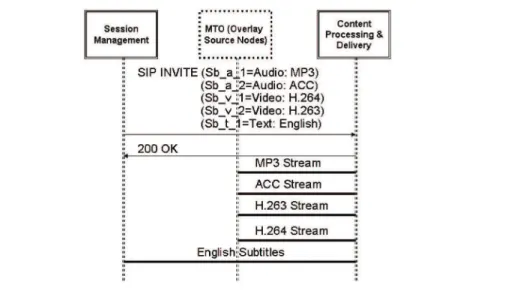
After identifying the required sub-groups for a specific content (group with similar con-text) the Session Management entity initiates the session establishment process with the CtPD. Figure 7 shows an example of the SIP INVITE
message for a specific audio sub-group (audio capabilities).
On the other hand, Figure 8 shows a se-quence flow from the messages between the Session Management entity and the CtPD concerning all sub-groups session initiation and corresponding session establishment. Simulta-neously, Session Management triggers the
session initiation towards the end user. Figure 9 exemplifies the message that is sent to user
x.
When this message reaches the user ter-minal, according to the network capabilities, the behavior may vary. If the terminal/network is multicast capable, the device will send a JOIN
message towards the multicast addresses in-cluded in the initial INVITE message. If the device only supports unicast connections, it will answer the request with a 200 OK message containing the ports it will be expecting media from. Consequently the Session Management entity will forward this information towards the Network Management entity, which will have the responsibility of updating the overlay leaf node with this information.
After the session is established towards the end user, Session Management activates the CtPD delivery process, which consists in creating unicast sessions with the overlay source nodes on the overlay trees. This step activates the media transmission across the entire mul-ticast overlay trees. Consequently, the media flows are established, finalizing the process of context to content propagation.
the Importance of Sub-Grouping
The importance of personalization in multiparty multimedia services strongly motivates content providers, operators and other players to adapt the user experience of these services. Often, adaptation raises scalability and performance concerns, which need to be addressed efficiently. Creating different sub-groups for different media types, allows users to receive the mul-timedia content that is most suitable to them,
not only according to their personal, device and environmental contexts but also considering the current network context information. This compromise allows both users and operators to achieve an optimal point in what concerns personalization vs. scalability. Furthermore, this will boost the user perceived QoE as the sub-grouping mechanisms allow personalization, contextualization and adaptation of content/ services, facilitating further interactivity and mobility tasks. By simultaneously allowing, the operators to optimize and save network
resources, services become cheaper and conse-quently more attractive to the end user.
evAluAtING CoNtext-AWAre
MultIpArty SeSSIoNS
testbed details
After describing the architecture, it is important to understand how system components can be tested against initial requirements. Consider-ing the amount of developed components, the
Figure 7. SDP information from INVITE message towards CtPD (adapted from Antoniou et al., 2009)
complexity of the network elements, and the different configurations required for the tests, the environment was setup using virtual ma-chines (VMware ESXi Hypervisor).
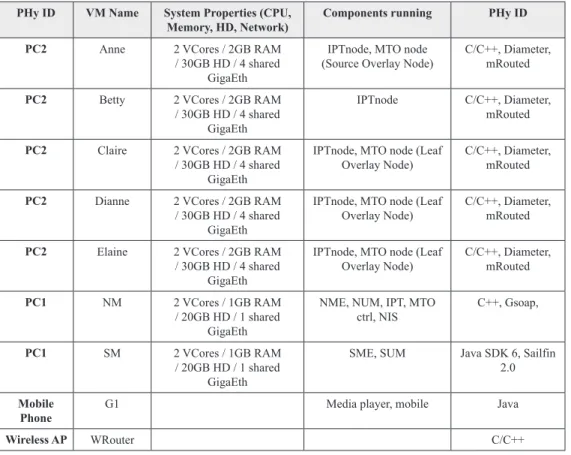
Although the overall C-CAST archi-tecture (PT Inovacao, n.d.) involves several components, we only focus on the entities responsible for the session and network layers used to support autonomous context-aware multiparty communications in heterogeneous mobile systems. For this testbed we used a number of virtual machines, with Ubuntu Linux. The characteristics and other implementation details of these can be found in Table 1.
It is important to understand how the dif-ferent components communicate between themselves. Table 2 presents the different in-terfaces and respective technologies used in these communications. Furthermore, Figure 1 depicts the network topology of the testbed.
System and Components evaluation
In order to evaluate the proposed solution, it is important to validate all the pre-defined func-tional requisites described in C-Cast (PT Inova-cao, n.d.). Moreover, it is necessary to evaluate the following non-functional requisites:
• Performance: response times between components, CPU, memory for both the algorithms used and the interface com-munication between modules.
• Reaction time to context changes: the time it takes for context to content adaptation.
• Scalability: how the system usage can scale, (how many simultaneous users, groups and multimedia sessions can be achieved in a scenario).
• Flexibility: how easily can the architec-ture adapt to different context types and how generic are the interfaces so that the modules and algorithms can be replaced, extended or improved.
Personalization vs. Efficiency: the impact personalization has on the overall efficiency of the multimedia delivery
Economical Issues: correlating the previ-ous points with real-life scenarios, what would be the economical impact of such innovation (e.g., optimized, self-adapted and real-time network dimensioning). Could operators save or gain more money from it?
Quality of Experience: whether the user’s perceived experience improves with the introduction of such solution and if the system
performs the same or better that current system in problematic situations.
At this point in time, only the functional tests have been performed, and it was possible to verify that the communications between the identified entities were correctly performed.
Nevertheless, all the previously mentioned requisites will be tested in the following way:
• See how CPU, memory and response times vary according to the number of users, types of context or multimedia content
Table 1. Virtual machines, components and technologies description
PHy ID VM Name System Properties (CPU,
Memory, HD, Network)
Components running PHy ID
PC2 Anne 2 VCores / 2GB RAM
/ 30GB HD / 4 shared GigaEth
IPTnode, MTO node (Source Overlay Node)
C/C++, Diameter, mRouted
PC2 Betty 2 VCores / 2GB RAM
/ 30GB HD / 4 shared GigaEth
IPTnode C/C++, Diameter,
mRouted
PC2 Claire 2 VCores / 2GB RAM
/ 30GB HD / 4 shared GigaEth
IPTnode, MTO node (Leaf Overlay Node)
C/C++, Diameter, mRouted
PC2 Dianne 2 VCores / 2GB RAM
/ 30GB HD / 4 shared GigaEth
IPTnode, MTO node (Leaf Overlay Node)
C/C++, Diameter, mRouted
PC2 Elaine 2 VCores / 2GB RAM
/ 30GB HD / 4 shared GigaEth
IPTnode, MTO node (Leaf Overlay Node)
C/C++, Diameter, mRouted
PC1 NM 2 VCores / 1GB RAM
/ 20GB HD / 1 shared GigaEth
NME, NUM, IPT, MTO ctrl, NIS
C++, Gsoap,
PC1 SM 2 VCores / 1GB RAM
/ 20GB HD / 1 shared GigaEth
SME, SUM Java SDK 6, Sailfin
2.0
Mobile Phone
G1 Media player, mobile Java
Wireless AP WRouter C/C++
Table 2. Technologies involved in the interfaces between different entities
Components Description of Interface Technology
SM - CtPD Request content info HTTP Rest Interface
SM - CxB User context acquisition and subscription HTTP Rest Interface
SM - NM Resource reservation and sub-group management Web Service
SM - CtPD Signaling management of multimedia communications Session Initiation Protocol (SIP)
SM - Client Signaling management of multimedia communications Session Initiation Protocol (SIP)
involved (Tigris.org, 2008; JUnit, n.d.; Source Forge, 2010).
• By using different context triggers, evaluate minimum, maximum and average response times.
• Vary number of users involved in the tests to allow understanding of how good the system can scale.
• Identify the balance point between what users and operators want, need and desire.
• Verify how much bandwidth can be spared, how many new Quality of Service (QoS) classes can be introduced and evaluate how this offer can be translated into new and differentiated business offers within the operators client base.
• Make surveys to understand what users want, desire and need and compare with what our solution offers. If possible, use a small set of users to test our testbed and prototype implementations.
CoNCluSIoNS ANd
future Work
In this paper we present an innovative way to achieve self-optimization through context-awareness in multiparty converged mobile systems. This is achieved through the dynamic
re-definition of service groups (sub-grouping) in a converged architecture.
A general overview of the sub-grouping process was given with reference to the system architecture, to place the proposed innovation within a system scope. Subsequently, the focus shifted to particular aspects of the sub-grouping process and the use of the reference architecture in this process; in particular, we have shown how the process begins at the session level, is refined at the network level, and is finally propagated at the service level to the content. As a result, the content received by each de-fined sub-group has been adapted to the users’ preferences, situations and contexts on the one hand, and on their network capabilities on the other hand, improving both network resource usage and user experience.
Future work aims to implement this archi-tecture in a testbed setup in order to test specific scenarios that can be supported, in order to demonstrate the network and session enhance-ments. More specifically, the elements required to perform and enforce sub-grouping both at the session and network level will be imple-mented: context providers, session and network management, multiparty transport overlay and IP Transport. Relevant performance measures will be collected and specific sub-modules
participating in this self-optimization process will be individually enhanced and evaluated.
ACkNoWledGMeNt
This work is funded by EU ICT C-CAST (Context Casting) project.
refereNCeS
3GPP. (2006). TR 22.811 V7.2.0: Technical Specifi-cation Group Services and Systems Aspects; Review of Network Selection Principles, Release 7.
3GPP. (2009). TS 23.122 V9.0.0: Technical Speci-fication Group Core Network and Terminals; Non-Access-Stratum (NAS) functions related to Mobile Station (MS) in idle mode, Release 9.
Al-Hezmi, A., Magedanz, T., Pallares, J., & Riede, C. (2008). Evolving the Convergence of Telecom-munication and TV Services over NGN. Interna-tional Journal of Digital Multimedia Broadcasting. .doi:10.1155/2008/843270
Amram, N., & Fuchs, M. (Eds.). (2006). C-MOBILE Deliverable: Detailed Research Objectives and Requirements for the Core Network Enhancements and New Entities. Retrieved from http://c-mobile. ptinovacao.pt/documents.html
Antoniou, J. (Ed.). (2007). C-MOBILE Deliverable: Specification of Enhanced Core Network Elements. Retrieved from http://c-mobile.ptinovacao.pt/docu-ments.html
Antoniou, J., Christophorou, C., Jannetau, C., Kelil, M., Sargento, S., Neto, A., et al. (2009, October).
Architecture for Context-Aware Multiparty Delivery in Mobile Heterogeneous Networks. Paper presented at the International Conference on Ultra Modern Telecommunications (ICUMT ’09), St. Petersburg, Russia.
Antoniou, J., Christophorou, C., Neto, A., Sargento, S., Pinto, F. C., Carapeto, N. F., et al. (2009, Octo-ber). Context-Aware Self-Optimization in Multiparty Converged Mobile Environments. Paper presented at 3rd International Conference on Autonomic Comput-ing and Communication Systems (Autonomics ’09), Limassol, Cyprus.
Antoniou, J., Riede, C., Pinto, F. C., & Pitsillides, A. (2009, April). Context Aware Multiparty Session Support for Adaptive Multicasting in Heterogeneous Mobile Networks. Paper presented at Mobile Wireless Middleware, Operating Systems, and Applications Conference, Berlin.
Bygdas, S. S., Malm, P. S., & Urnes, T. (2000, September). A simple architecture for delivering context information to mobile users. Paper presented at Workshop on Infrastructure for Smart Devices - How to Make Ubiquity an Actuality, Bristol, UK.
Handorean, R., Sen, R., Hackmann, G., & Gruia-Cata-lin, R. (2005). Context Aware Session Management for Services in Ad Hoc Networks. In Proceedings of the 2005 IEEE International Conference on Services Computing (Vol. 1, pp. 113-120).
Inovacao, P. T. (n.d). C-CAST: Provide and end-to-end communication network. Retrieved from http:// www.ist-ccast.eu
Jesus, V., Sargento, S., & Aguiar, R. L. (2008, September). Any-constraint personalized network selection. In Proceedings of the 19th International Symposium on Personal, Indoor and Mobile Radio Communications (pp. 1-6).
JUnit.org. (n.d). JUnit: Resources for test driven development. Retrieved from http://www.junit.org/ Liu, V. O., Li, K., & Zhang, P. (2006). NXG04-4: Joint radio resource management through vertical handoffs in 4G networks. In Proceedings of the IEEE Global Telecommunications Conference (GLOBE-COM ‘06) (pp. 1-5).
Niyato, D., & Hossain, E. (2006). WLC04-5: Band-width allocation in 4G heterogeneous wireless ac-cess networks: A non cooperative game theoretical approach. In Proceeding of IEEE Global Telecom-munications Conference 2006 (GLOBECOM ‘06)
(pp. 1-5).
Ormond, O., Perry, P., & Murphy, J. (2005, Sep-tember). Network selection decision in wireless heterogeneous networks. In Proceedings of 16th International Symposium on Personal, Indoor and Mobile Radio Communications 2005 (PIMRC ‘05)
(Vol. 4, pp. 2680-2684).
Romero, J. P., Sallent, O., Agusti, R., & Diaz-Guerra, M. A. (2005). Radio Resource Management Strategies in UMTS. London: John Wiley & Sons. doi:10.1002/0470022795
Simoes, J., Sargento, S., Antoniou, J., Christophorou, C., Janneteau, C., Carapeto, N., & Neto, A. (2009, September). Context-Aware Control for Personal-ized Multiparty Sessions in Mobile Multihomed Systems. Paper presented at 5th International Mobile Multimedia Communications Conference, London.
Source Forge. (2010). CppUnit – C++ port of JU-nit. Retrieved from http://sourceforge.net/projects/ cppunit/
Taha, A.-E. M., Hassanein, H. S., & Mouftah, H. T. (2006). Exploiting Vertical Handoffs in Next Genera-tion Radio Resource Management. In Proceedings of International Conference on Communications,
5, 2083–2088.
Tigris.org. (2008). CxxTest: Project Home. Retrieved from http://cxxtest.tigris.org/
Tolli, A., Hakalin, P., & Holma, H. (2002). Per-formance Evaluation of Common Radio Resource Management (CRRM). In Proceedings of IEEE International Conference on Communications (pp. 3429-3433).
Zafar, M. (Ed.). (2006). C-MOBILE Deliverable: Draft Specification & Requirements of Enhanced Core Network Elements. Retrieved from http://c-mobile.ptinovacao.pt/documents.html
Zafar, M. (Ed.). (2008). C-MOBILE Deliverable: Evaluation Results of Enhanced Core Network Ele-ments. Retrieved from http://c-mobile.ptinovacao. pt/documents.html
Zafar, M., Fuchs, M., & Baker, N. (2008, June).
Supporting Transcoding-based Multicast Groups. Paper presented at the 15th International Conference on Telecommunications, St. Petersburg, Russia.
eNdNote
1 The dynamic over-provisioning mechanism of
IPT ensures that IP routing path candidates are QoS-capable. Also, NUM and IPT collaborate to ensure QoS preservation on branches of the MTO despite context change.
Josephina Antoniou received her B.A. degree (summa cum laude) in Computer Science and Mathematics (Wartburg College, IA, USA, May 2002), her M.Sc degree in Advanced Computer Technologies (University of Cyprus, June 2004) and her Ph.D. degree in Computer Science (University of Cyprus, January 2010), in the area of mobile networks. She has been a Research Associate for the University of Cyprus since June 2002, for the IST/ICT funded projects: SEA-CORN, B-BONE, C-MOBILE and CCAST dealing with Enhanced UMTS, MBMS over UMTS, enhanced MBMS over converged networks and currently context-aware multicasting over con-verged, next generation networks. Her research interests include radio resource management and session management in mobile networks, specifically in next generation mobile networks using game theoretic approaches.
Augusto Neto is currently adjunct professor in the Informatics Institute (INF) of Federal University of Goiás (UFG), Goiania, Brazil. His first post-doc was at the Telecommunication Institute (IT) at University of Aveiro, Portugal. He taught informatics disciplines in the Polytechnic Institute of Coimbra, and in the Informatics Engineering Department of University of Coimbra. In 2008, he received his Ph.D. in Informatics Engineering at University of Coimbra. He received his M.Sc. in Computer Science, from Federal University of Santa Catarina (2001), post graduation in Computer Networks from the Federal University of Pará (1998), and B.S. degree is in Data Processing Technologies from the University of Amazon (1996), all in Brazil. He authored and co-authored several publications in national and international journals and conferences of net-working. Moreover, he is member of Technical Program Committee, as well as regular reviewer, in several networking conferences. He participated in many Portuguese and European research projects. His research interests include Cognitive/Autonomic Wireless (mesh/sensor) Networks, Context-Awareness, pervasive networks and Next Generation/Future Networks.
Susana Sargento (PhD in 2003 in Electrical Engineering) joined the Department of Computer Science of the University of Porto in September 2002, and is in the University of Aveiro and the Institute of Telecommunications since February 2004. She has been involved in several national and European projects, taking leaderships of several activities in the projects, such as the QoS and ad-hoc networks integration activity in the FP6 IST-Daidalos Project. She is currently in-volved in several research projects, European Projects FP7 (4WARD, Euro-NF, C-Cast), national projects, and from Portugal (DRIVE-IN with Carnegie Melon University). Her main research interests are in the areas of next generation and heterogeneous networks, infrastructure, mesh and ad-hoc networks, where she has published more than 150 scientific papers. She regularly acts as an Expert for European Research Programmes.
Filipe Cabral Pinto graduated from the University of Coimbra in Electrical Engineering in 1998, received his MSc degree from the Queen Mary University of London in Telecommunications En-gineering in 2004, his work focused on common radio resource management issues. Since March 2008 he is working in multiparty session management issues in ICT C-CAST project. From 2006 to 2008 he was working on MBMS and IMS integration under the IST C-MOBILE project. From January 2004 till December 2006 he was the PTIN responsible for the IST EVEREST project and he was also working on IST B-BONE project. From 2002 till 2004 he participated in the IST OPIUM project. During the years 2002 and 2003, he worked on a gateway between UMTS and GSM interfaces, under the IST NETGATE project.
Nuno Filipe Carapeto graduated from Coimbra’s Polytechnic Institute of Engineering in Computer Science and Systems Engineering on 2005. Since then he has been working as a researcher for Portugal Telecom Inovação in the Applied Research and Knowledge Dissemination Department. He’s been involved in several internal and EC/ICT co-funded projects such as EuQoS (2005), Hurricane (2008) and C-Cast (2008). His main research topics are Quality of Service and of Experience plus Context awareness in Multicast and Mobility. Furthermore he is progressing in his PhD in Context aware mobility with University of Coimbra.
Planning Department of the Portuguese Telephone Company and in 1994 she joined PT Inovação (the research center of Portugal Telecom) where she got expertise in the most relevant service and network architectures such as IN, IN evolution, TINA, Parlay, IMS, TISPAN and MBMS. Since then she has been responsible for PTI participation in several ACTS/IST and EURESCOM projects. Currently, she is the head of the “Platforms and Multiservice Networks” group in PTI.
Jose Simoes has graduated with distinction in Telecommunications and Computer Engineering in 2006 at Instituto Superior das Ciencias do Trabalho e da Empresa (ISCTE), Portugal. He also studied at Universidade Federal de Santa Catarina in Brazil. In the past he has worked for Netcall (1st VoIP Provider in Portugal) as Network Engineer and Business Consultant. Cur-rently he is a Ph.D student at Technical University of Berlin and a research fellow at Fraunhofer Institute FOKUS in the competence center for next generation network infrastructures - NGNI. His current interests are User Quality of Experience (QoE) applied to next generation services (personalization, contextualization, adaptation, mobility and interactivity) and advertising, focusing on architectures for next generation heterogeneous networks. His work research also includes social networks, reality mining and context-aware technologies.