Hydroxyapatite of natural origin - zirconia composites, preparation
and reactions within the system
Jadwiga Brzezi´nska-Miecznik,
Krzysztof Haberko
,Mirosław M. Bu´cko,
Grzegorz Grabowski,
Maciej Sitarz
∗AGH-University of Science and Technology, Faculty of Materials Science and Ceramics, Al. Mickiewicza 30, 30-059 Krakow, Poland
Received 14 July 2016; Received in revised form 4 October 2016; Accepted 12 November 2016
Abstract
The effect of 5 and 10 vol.% addition of zirconia (3Y-TOSOH) to hydroxyapatite of natural origin was in-vestigated. The hydroxyapatite (HAp) material was extracted from the bovine bones by treatment under hy-drothermal conditions with distilled water. The pure HAp and HAp-ZrO2 composites were manufactured by pressureless sintering and hot pressing. The reactions taking place in these systems were observed using the X-ray diffraction, infrared spectroscopy and dilatometric observations. It was confirmed that the extent of the reactions was essentially dependent on the heat treatment method. Under the hot pressing conditions dense samples containing high fraction of unreacted HAp could be prepared at 1200 °C. Mechanical properties of the pure HAp and HAp-ZrO2composites were also investigated. Zirconia inclusions lead to the increased strength, hardness and fracture toughness of the composites compared to the pure HAp polycrystalline materials.
Keywords: natural hydroxyapatite, zirconia, composites, reactions, sintering
I. Introduction
Biocompatibility, bioactivity and the lack of carcino-genic properties promote hydroxyapatite (HAp) as a bone implant material. Hydroxyapatite of natural ori-gin is essentially different from the synthetic material. It differs from the stoichiometric Ca/P ratio (1.67) and contains CO3–2groups. Moreover, in the HAp of natural origin some other cations are present (Na, Mg, etc.). It can be extracted from animal bones by three techniques: i) the bone calcination [1–7], ii) the bone treatment with sodium hydroxide [4,5,8–11] at elevated temperatures and iii) the bone treatment with water or sodium hy-droxide under hydrothermal conditions [5,12].
The pure HAp polycrystalline materials show poor mechanical properties [13]: low strength and low frac-ture toughness. That is why different inorganic addi-tives have been introduced to the HAp matrix in or-der to improve these properties. Among others, zirco-nia [6,12,14–19], alumina [6,20], titazirco-nia [6,19], yttria [19], Ti3SiC2 [21] and zinc oxide [7] should be men-tioned. Zirconia is characterized by excellent
biocom-∗Corresponding author: tel:+48 6172395,
fax:+48 126337161, e-mail:[email protected]
patibility and durability in the physiological environ-ment [22]. The zirconia inclusions make densification during sintering less effective than in the case of the pure HAp material [12,14]. This is due to the effect of inclusions as such and due to the reaction of zirconia and HAp matrix. It was found [6,12,14–19] that this re-action leads to the HAp decomposition resulting in for-mation ofβ-TCP, a solid solution of CaO in ZrO2 and the water vapour emission caused by HAp dehydroxy-lation. Water vapour leads to the pore formation which was observed both during pressureless sintering [15,18] and hot pressing [16].
The aim of the present work was to investigate the
HAp-ZrO2 composites, manufactured by pressureless
sintering and hot pressing. Zirconia (TOSOH) powder containing 3 mol% Y2O3 was used as source of ZrO2 and HAp component was extracted from the bovine bones by their treatment with distilled water under hy-drothermal conditions.
II. Experimental
2.1. Materials
bones. 3-year-old animals were selected. The bone ends were cut off and spongy parts were removed together with marrow. The bones prepared in this way were hy-drothermally treated in an autoclave at 220 °C for 10 h in distilled water. Then the material was washed sev-eral times with hot distilled water and dried at 110 °C.
Precursor of zirconia was ZrO2 TOSOH powder with
3 mol% Y2O3(3YTZP) further denoted as ZrO2. Homogenization of zirconia and HAp powders was performed in a ball mill using the zirconia grinding me-dia of 10 mm me-diameter in propanol for 5 h. The homog-enized composite powders were dried at 120 °C. Two compositions with different ZrO2 contents of 9.1 and 14.5 wt.% were prepared, which corresponds to HAp-5Z and HAp-10Z samples containing 5 and 10 vol.% of ZrO2, respectively (assuming zirconia density to be 6.01 g/cm3and HAp density to be 3.16 g/cm3). The uni-axial compaction of the powders under 35 MPa with the subsequent isostatic repressing under 300 MPa al-lowed us to prepare cylindrical samples of 20 mm diam-eter and about 3 mm thickness. Such samples underwent pressureless sintering in air atmosphere at 1400 °C and 1500 °C, with the rate of temperature increase 2 °C/min up to 600 °C and then 5 °C/min. The soaking time at the final temperature was 1 h. The sample shrinkage was followed using the NETZSCH dilatometer (Dil 402 C) up to 1500 °C with the rate of temperature increase of 5 °C/min. Since the pressureless sintering did not al-low us to get the state of sufficient densification the hot pressing was also applied. It was performed by means of the Thermal Technology HP50-7010G equipment. The temperature of 1200 °C with 30 min. soaking time, the temperature increase rate of 15 °C/min and the pressure of 25 MPa were used. The process was performed in Ar atmosphere.
2.2. Methods
The chemical composition of hydroxyapatite was de-termined using the X-ray fluorescence method (spec-trometer WDXRF Axios Max PANanalytical). The Om-nian package (Panalytical) was used for the standardless analysis of all types of samples. The standardless anal-ysis, in nutshell is based only on the initial calibration with pure element standards and further deconvolution of spectra that allows the determination of all elements in whatever sample matrix. Standardless method com-bines: i) matrix effect calculation using a FP algorithm solving the Sherman equation (intensities) and ii) in-strumental sensitivity determination by standards mea-surements (relationship between intensity and elemental mass). As instrumental sensitivity is determined once, this allows analysis of any sample without a need of any matrix-matched calibration standards leading to so-called “standardless analysis”.
The infrared spectroscopy (MIR) was used to charac-terize the hydrothermally treated hydroxyapatite (BIO-RAD FT6000). The specific surface area of the pow-ders was determined by the nitrogen adsorption with
the BET isotherm (Nova 1200e, Quantachrome In-struments). Morphology of the starting HAp powder was observed under transmission electron microscope (JEOL-JEM 1011). The phase composition of the pow-ders and sintered materials was characterized by the X-ray diffraction applying CuKα irradiation (X’PERT PRO). The quantitative composition was determined by the Rietveld method. The DTA/TG combined with the chemical analysis (Mass Spectrometer QMD 300 Ther-mostar) of gases emitted by the hydroxyapatite was use-ful in its characterization. The effects of gasses emis-sion and DTA analysis were related to 1 mg of sample. Dilatometric measurements (NETSCH DIL 402C) al-lowed us to follow shrinkage of the powder compacts vstemperature.
The Archimedes method was used to measure the density of the samples. The SEM observations (Nova Nano SEM 200) were applied to evaluate the mi-crostructure of the sintered materials. Hardness and fracture toughness were determined by indentation with the Vickers pyramid (FV700Future Tech Corp, Japan). The Palmqvist cracks model [23] was used to calculate fracture toughness. Bending strength was determined by the two-axis bending (Zwick/Roell Z150) of the disc samples supported on 3 balls (ISO 6872:2008E).
III. Results and discussion
The chemical analysis of the starting hydroxyapatite powder shows that this is not a stoichiometric material. Thus, Ca/P molar ratio equals to 1.76 (as compared to 1.67 in the stoichiometric material) and, moreover, it contains Mg (0.72 wt.%) and Na (0.51 wt.%). Morphol-ogy of the starting HAp powder is presented in Fig. 1. Plate-like morphology of the powder is evident.
According to the ICDD cards, X-ray diffraction anal-ysis (Fig. 2) indicates that the material extracted from the bone corresponds to hydroxyapatite. Its specific sur-face area corresponds to 59.3 m2/g and is much higher than that of the zirconia powder (15.0 m2/g). X-ray diffraction shows that ZrO2 powder contains 70.3 wt.% of the tetragonal phase and 29.7 wt.% of the monoclinic phase.
Figure 2. XRD pattern of the hydrothermally extracted HAp powder
Figure 3. MIR spectrum of the hydrothermally extracted HAp powder
Figure 4. DTA/TG curves and analysis of the H2O and CO2
emitted by the hydrothermally extracted HAp powder
Some further information was delivered from the IR spectra (Fig. 3). The absorption bands at 879 cm-1, 1415 cm-1, 1457 cm-1 and 1549 cm-1 indicate the pres-ence of the CO3–2 groups in the material of natural
ori-gin. The absorption bands at 629 cm-1 and 3571 cm-1 should be attributed to the hydroxyapatite OH–groups. The remaining bands at 1091 cm-1and 1032 cm-1 origi-nate from doubly degenerated asymmetric stretching vi-brationsν3P−O and symmetric stretching vibrations of
ν1 P−O corresponds to 961 cm-1. The absorption
max-ima at 602 cm-1 and 563 cm-1 can be attributed to the triply degenerated bending vibrationsν4O−P−O.
Figure 4 demonstrates DTA/TG curves of the hy-drothermally extracted HAp powder. At low tempera-tures (about 100 °C) water molecules, most probably adsorbed on the particle surfaces is emitted. At higher temperatures (above 200 °C) we observe the emission of H2O and CO2accompanied by the exothermic effect and mass decrease. This should presumably be related to the oxidation of the rest of organic matter remained in the material after its hydrothermal treatment. At a higher temperature intensive emission of CO2 (about 800 °C) and H2O (above 1000 °C) occurs.
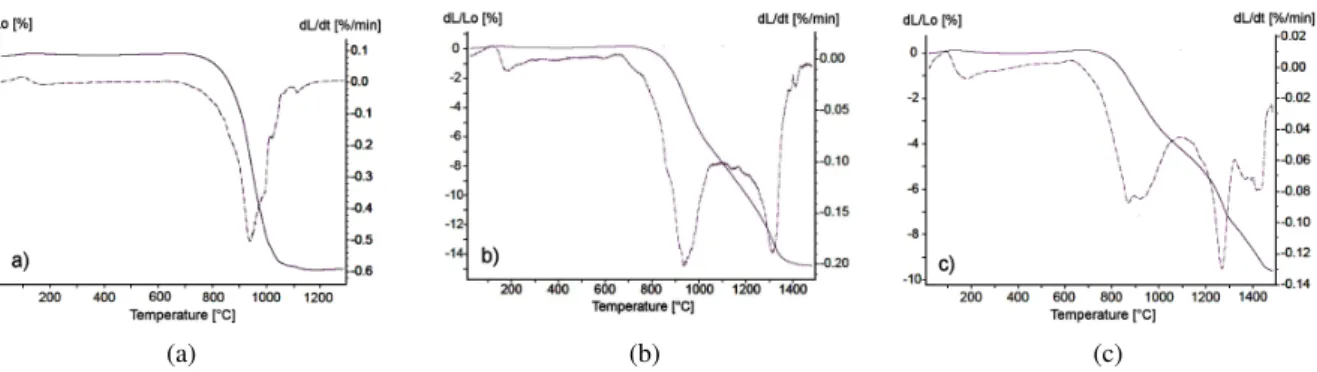
The dilatometric curves illustrate shrinkage of the pure HAp powder compact and HAp-5Z and HAp-10Z mixtures (Fig. 5). In the case of the pure HAp pow-der compact a “smooth” shrinkage curve occurs. The shrinkage terminates at about 1100 °C. But in the case of the composites shrinkage ended at much higher tem-peratures. Most probably this phenomenon should be at-tributed to the interfering effect of the reaction between zirconia and decomposed HAp (CaO+β-TCP). The re-action is manifested by the shrinkage slowdown, which is more distinct in HAp-10Z than HAp-5Z composite, due to the higher zirconia content in the former mate-rial.
The reaction between zirconia and decomposed HAp is also proved by measurements of the phase compo-sition of the pressureless sintered and the hot pressed materials (Table 1). The investigation was performed by X-ray diffraction of the sample surfaces as well as the samples powdered in a mortar. Pressureless sintering leads to the composite materials whose phase composi-tion differs from those subjected to hot pressing proce-dure. In the case of the pressureless sintered materials, traces of HAp are present on the sample surface only in the HAp-5Z composite heat treated at 1400 °C. In other cases the entire HAp phase disappears. It is worth noting that phase composition of the HAp-10Z samples pres-sureless sintered and hot pressed at 1200 °C are similar, but pressureless sintering does not lead to high densi-fication as hot pressing does. In the former case an in-crease of reaction degree with sintering temperature is evident, but there is only slight increase of sample den-sity (Tables 2 and 3).
(a) (b) (c)
Figure 5. Dilatometric curves of: a) pure HAp powder compact, b) HAp-5Z powder compact and c) HAp-10Z powder compact
Figure 6. MIR spectra of pure HAp material pressureless sintered (PS) and hot pressed (HP)
from the HAp thermal decomposition and the reaction between HAp and ZrO2 is limited. This is proved by the lower degree of HAp decomposition in the sample volume (represented in this case by the powdered ma-terial), than on its surface. The decomposition of HAp leads to the formation ofβ-TCP. Since the extension of the HAp decomposition in the hot pressed material is lower, a lower amount ofβ-TCP in the hot pressed pro-cessed material can be observed.
The data in Table 1 indicate the occurrence of the cu-bic zirconia solid solution, most probably due to the saturation of this oxide with CaO. Free CaO results
from the decomposition of HAp at high temperature and its reaction with zirconia. When the concentration of CaO in ZrO2 exceeds a certain level, calcium zir-conate (CaZrO3) appears. Since the degree of reaction under the hot pressing conditions is low, an insufficient amount of CaO becomes available. That is why CaZrO3 is not observed in the hot pressed composites. An open question appears: what happens with Y2O3 present in the starting TOSOH powder. Most probably it retains in zirconia and/or enters the HAp structure. We observed the latter possibility in an unpublished study on sinter-ing of the HAp-Y2O3mixture.
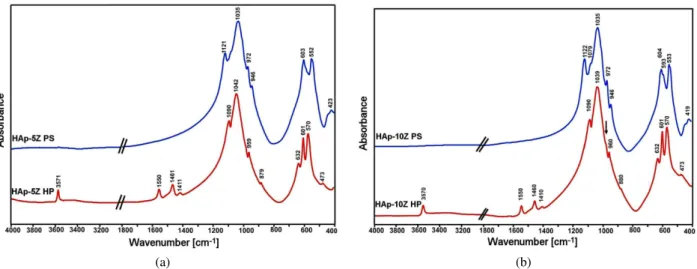
The investigations performed with the powdered ma-terials are also shown in Table 1. The X-ray diff rac-tion patterns show hydroxyapatite as the only phase. However, the IR spectroscopy indicates that under the pressureless sintering conditions carbonate groups dis-appear from the material, but the hot pressing process leads to the body with the carbonate groups retained in the material structure (Fig. 6). In each case hydroxyap-atite structure is still preserved no matter of heat treat-ment conditions.
The spectroscopic measurements (MIR) of the pow-dered composite samples for both the pressureless sin-tered and the hot pressed samples are presented in Fig. 7. The hot-pressed materials show the existence of the CO3–2and OH–groups. The former ones are presented by the absorption bands at about 880, 1410, 1460 and
Table 1. Phase composition of the pressureless sintered materials and hot pressed samples (measured on the surface or with powdered sample)
Sample
Phase composition [wt.%] Pressureless sintering Hot pressing
Phase 1200 °C 1400 °C 1500 °C 1200 °C 1200 °C
(surface) (surface) (surface) (surface) (ground sample)
HAp 100 - - 100 100 HAp
HAp-5Z
- 6 0 81.7 84.6 HAp
- 82.7 83.1 7.7 5.7 β-TCP
- 0 0 10.6 9.7 c-ZrO2
- 11.3 16.9 0 0 CaZrO3
HAp-10Z
61.5 0 0 60.5 73.3 HAp
19.6 77.3 75.2 16.3 8.2 β-TCP
17.3 6.4 5.7 23.2 18.2 c-ZrO2
Table 2. Apparent densities of the pressureless sintered and hot pressed samples
Sample Apparent density
a[g/cm3]
1200 °C PS 1400 °C PS 1500 °C PS 1200 °C HP
HAp 3.11±0.01 - - 3.08±0.02
HAp-5Z - 3.19±0.07 3.16±0.02 3.28±0.02 HAp-10Z 2.23±0.02 2.57±0.02 2.72±0.02 3.37±0.05
aConfidence interval at confidence level of 0.95
Table 3. Open porosities of the pressureless sintered and hot pressed samples
Sample Open porosity
a[%]
1200 °C PS 1400 °C PS 1500 °C PS 1200 °C HP
HAp 0 - - 0
HAp-5Z - 0.6±0.1 1.8±0.02 0
HAp-10Z 34.4±0.02 22.6±1.6 15.9±0.8 0
aConfidence interval at confidence level of 0.95
1550 cm-1. The existence of the hydroxyl groups is con-firmed by absorption bands at about 3570 and 632 cm-1. We can conclude that under the hot pressing conditions none or a very limited decomposition of HAp occurs in the material volume as it is indicated by a small shoulder at about 975 cm-1in the HAp-10Z material (indicated by an arrow in Fig. 7b).
A lower ZrO2 content leads to the higher densifica-tion of the pressureless sintered materials, but presence of open porosity is also characteristic of these materials. In the case of the higher zirconia content (10 vol.%), the pressureless sintered samples are far from fully dense materials as it is demonstrated by a relatively high vol-ume fraction of the open porosity. Essentially higher densification without open porosity was observed (Ta-bles 2 and 3) in the case of hot-pressed material com-pared to the pressureless sintered one. The results pre-sented in Tables 2 and 3 demonstrate also essentially higher densification of the pressureless sintered mate-rial with no zirconia additive.
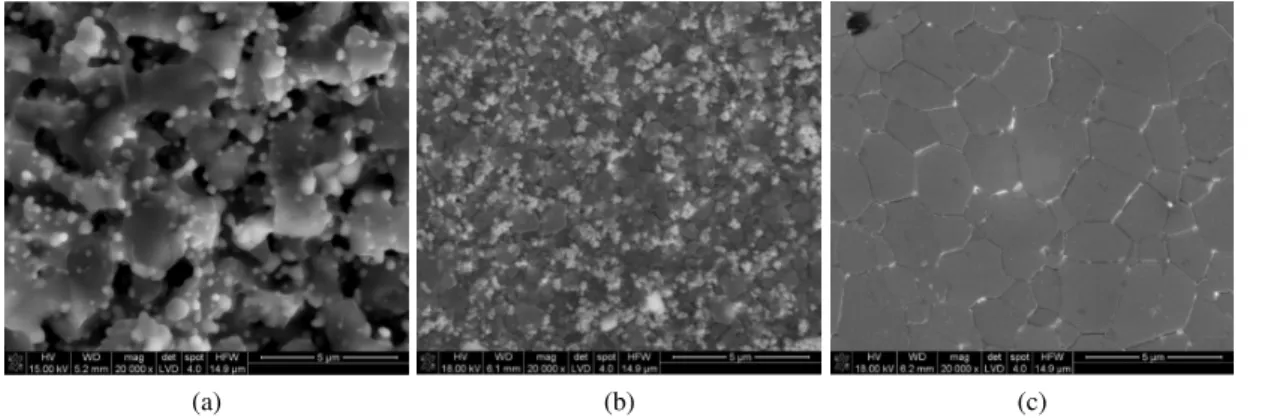
The microstructures of the hot pressed and pressure-less sintered composite materials are shown in Fig. 8. The essential difference in their densification is evident and agrees well with the data given in Tables 2 and 3. It is also evident that zirconia additive restrains grain growth of the HAp matrix.
Table 4 shows only mechanical properties of the hot pressed composite materials as pressureless sintered composites do not reach high enough density. How-ever, pressureless sintering results in high density of the pure HAp powder compacts. Thus, their mechani-cal properties are shown also in Table 4 together with the properties of the hot pressed pure HAp compacts. Hot pressing of the pure HAp powder improves only slightly bending strength and hardness of the resulting polycrystalline materials. However, strength, hardness and fracture toughness of composites are higher than those of the pure HAp materials, although reduced con-tent of hydroxyapatite occurs in composites due to the matrix/zirconia reaction (Table 3).
(a) (b)
(a) (b) (c)
Figure 8. Microstructure of the pressureless sintered and the hot pressed materials: a) HAp-10Z composite - pressureless sintered at 1400 °C, b) hot pressed at 1200 °C HAp-10Z composite and c) hot pressed at 1200 °C pure HAp
Table 4. Bending strength (σ), hardness (HV) and fracture toughness (KIc) of the materials
Sample Sintering HV σ KIc
conditions [GPa] [MPa] [MPa m1/2] HAp PS 1200 °C - 2 h 4.6±0.3 60±20 0.6±0.1 HAp HP 1200 °C - 0.5 h 4.9±0.2 105±22 0.5±0.1 HAp-5Z HP 1200 °C - 0.5 h 5.7±0.5 149±27 0.7±0.1 HAp-10Z HP 1200 °C - 0.5 h 5.6±0.2 134±25 1.0±0.2
IV. Conclusions
Presented data indicate that bovine bones treatment with distilled water under hydrothermal conditions at 220 °C allowed us to extract hydroxyapatite with inter-esting properties. It was demonstrated that this is not a stoichiometric material (Ca/P-1.76) and contains some CO3–2 groups. No traces of decomposition of this ma-terial at elevated temperatures under pressureless nor hot pressing conditions occur. The dilatometric inves-tigation indicated that the reaction between zirconia and HAp results in slowing down the shrinkage. It is ac-companied by the emission of H2O and CO2 from the system. This reaction and HAp decomposition is essen-tially less advanced under hot pressing conditions and leads to a much higher densification of the materials. In the hot-pressed composites the CO3–2 and OH– groups are retained in the HAp structure. This is most proba-bly due to the limited possibility of H2O and CO2 emis-sion from the tight graphite die. It was also confirmed that the higher zirconia content in the composite mate-rial leads to the higher degree of the HAp decomposi-tion. Under pressureless conditions, complete or almost complete HAp decomposition occurs. Zirconia additive improves mechanical properties of the materials com-pared to the pure polycrystalline HAp ceramics.
Acknowledgement: The present study was supported
by The Polish National Science Centre under project no N N507 606738
References
1. C.Y. Ooi, M. Hamdi, S. Ramesh, “Preparation of hy-droxyapatite produced by annealing of bovine bone”,
Ceram. Int.,33(2007) 1171–1177.
2. A. Sobczak-Kupiec, Z. Wzorek, “The influence of calcination parameters on free calcium oxide content in natural hydroxyapatite”, Ceram. Int., 38 (2012) 641–664.
3. M. Figueiredo, A. Fernando, G. Martins, J. Freitas, F. Judas, H. Figueiredo, “Effect on the composition and microstructure of hydroxyapatite derived from hu-man and animal bone”,Ceram. Int.,36(2010) 2383– 2393.
4. J. Venkatesan, Z.J. Qian, B.M. Ryu, N.V. Thomas, S.K. Kim, “A comparative study of thermal calcina-tion and an alkaline hydrolysis method in the isola-tion of hydroxyapatite from Thunnus obesus bone”, Biomed. Mater.,6(2011) 035003.
5. N.A.M. Barakat, K.A. Khalil, F.A. Sheikh, A.M. Omran, B. Gaihre, S.M. Khil, H.Y. Kim, “Phys-iochemical characterizations of hydroxyapatite ex-tracted from bovine bones by three different meth-ods: extraction of biologically desirable HAp”, Mater. Sci. Eng. C,28(2008) 1381–1387.
6. F. Mezahi, A Harabi, S. Zouai, S Achour, D Bernache-Assollant, “Effect of stabilized ZrO2, Al2O3and TiO2on sintering hydroxyapatite”,Mater. Sci. Forum,492-493(2005) 241–248.
7. O. Gunduz, E.M. Erkan, S. Dagliar, S. Agathopou-los, F.N. Oktar, “Composites of bovine hydroxya-patite (BHA) and ZnO”, J. Mater. Sci., 43 (2008) 2536–2540.
8. J. Brzezi´nska-Miecznik, K. Haberko, M. Sitarz, M.M. Bu´cko, B. Macherzy´nska, “Hydroxyapatite from animals bone - Extraction and properties”, Ce-ram. Int.,41(2015) 4841–4846.
M. Haberko, W. Mozgawa, T. Panz, A. Pyda, J. Zar ˛ebski, “Natural hydroxyapatite - its behaviour during heat treatment”, J. Eur. Ceram. Soc., 26 (2006) 537–542.
10. K. Haberko, M.M Bu´cko, W. Mozgawa, A. Pyda, J. Brzezi´nska-Miecznik, J. Carpentier, “Behaviour of bone origin hydroxyapatite at elevated temperatures and in O2 and CO2 atmospheres”,Ceram. Int., 35 (2009) 2537–2540.
11. ¸S. Gören, H. Gökbayrak, S. Altinta¸s, “Production of hydroxyapatite from animal bone”, Eng. Mater.,
264-268(2004) 1949–1952.
12. J. Brzezi´nska-Miecznik, B. Macherzy´nska, R. Lach, B. Nowak, “The effect of calcination and zirconia ad-dition on HAp hot pressed materials”,Ceram. Int.,
40(2014) 15815–15819.
13. Ch. Benaqqaa, J. Chevalier, M. Saadaoui, G. Fan-tozzi, “Slow crack growth behaviour of hydroxyap-atite ceramics”,Biomaterials,26(2005) 6106–6112.
14. W. Pyda, A. ´Slósarczyk, M. Haberko, Z.
Paszkiewicz, A. Rapacz-Kmita, A. Pyda, “Ef-fect of chemical composition and morphology of zirconia particles on properties of HAp-zirconia particulate composites”,Key Eng. Mater., 206-213 (2002) 1567–1570.
15. Z. Evis, “Reaction in hydroxylapatite–zirconia com-posites”,Ceram. Int.,339(2007) 987–991.
16. Z. Evis, R.H. Doremus, “Hot pressed
hydroxylap-atite/monoclinic zirconia composites with improved mechanical properties”, J. Mater. Sci., 42 (2007) 2426–2431.
17. E. Adolfsson, P. Alberius-Henning, L. Hermansson, “Phase analysis and thermal stability of hot isostati-cally pressed”,J. Am. Ceram. Soc.,83(2000) 2798– 2802.
18. K.A. Khail, S.W. Kim, H.Y. Kim, “Consolida-tion and mechanical properties of nanostructured hydroxyapatite-(ZrO2+3 mol% Y2O3) - bioceramics by high frequency induction heat sintering”,Mater. Sci. Eng. A,456(2007) 368–372.
19. M.A. Auger, B. Savoini, A. Munoz, T. Leguey, M.A. Monge, R. Pareja, J. Victoria, “Mechanical charac-teristics of porous hydroxyapatite/oxide produced by post-sintering hot isostatic pressing”,Ceram. Int.,35 (2009) 2373–2380.
20. J. Li, B. Fartash, L. Hermanson, “Hydroxyapatite-alumina composites and bone-bonding”, Biomateri-als,16(1995) 417–422.
21. S.L. Shi, W. Pan, M.H. Fang, Z.Y. Fang, “Reinforce-ment of hydroxyapatite bioceramic by addition of Ti3SiC2”,J. Am. Ceram. Soc.,89(2006) 743–745. 22. C. Piconi, G. Maccauro, “Zirconia as a ceramic
bio-material”,Biomaterials,20(1999) 1–25.