Recovery of Tetragonal Phase from Previously Transformed Y-TZP
Bruno Galvão Simbaa,e*, Claudinei dos Santosa,b, Kurt Streckerc, Antonio Alves de Almeida Juniord,
Gelson Luis Adabod
aUniversidade de São Paulo – USP, Escola de Engenharia de Lorena – EEL, Pólo Urbo-Industrial, s/n,
Gleba AI-6, CEP 12.600-000, Lorena, SP, Brazil
bUniversidade do Estado do Rio de Janeiro – UERJ, Faculdade de Tecnologia – FAT, Rod. Presidente
Dutra, km 298, CEP 27.537-000, Resende, RJ, Brazil
cUniversidade Federal de São João del-Rei – UFSJ, Campus Sto Antônio, Praça Frei Orlando, 170,
Centro, CEP 36.307-352, São João del-Rei, MG, Brazil
dUniversidade Estadual Paulista – UNESP, Faculdade de Odontologia de Araraquara – FOAr, R.
Humaitá, 1680, CEP 14.801-903, Araraquara, SP, Brazil
eUniversidade Estadual Paulista – UNESP, Faculdade de Engenharia de Guaratinguetá – FEG, Av.
Ariberto Pereira da Cunha, 333, Portal das Colinas, CEP 12.516-410 Guaratinguetá, SP, Brazil
Received: July 24, 2015; Revised: May 4, 2016; Accepted: May 23, 2016
ZrO2(Y2O3)-based ceramics are widely used as biomaterials due to high fracture toughness, resulting from the tetragonal-monoclinic phase transformation in which the ceramic is submitted during crack propagation. In this context, studies involving the possibility of optimization of the tetragonal phase are important for the properties improvement of this ceramic. This study investigated the recovery of tetragonal phase from a previously transformed ZrO2(3 mol% Y2O3) ceramic. Zirconia samples were sintered at 1450 °C, at 1530 °C - 2 h and at 1600 °C - 4 h, in order to obtain materials with distinct
microstructural features. The sintered samples were characterized by relative density, X-ray difraction
and scanning electron microscopy. Samples sintered at 1450 °C, 1530 °C - 2 h and 1600 °C - 4 h, presented relative densities of 94.2, 99.6 and 99.7% with grains size averages of 0.28, 0.49 and 1.31
μm, respectively. All samples were submitted to milling to induce the tetragonal→monoclinic phase
transformation presenting 5, 50 and 65 vol% of monoclinic phase. Subsequently, heat treatments between 400 °C and 1200 °C were conducted to retransform monoclinic in tetragonal phase. It has been found that the smaller the grain size after sintering, the lower the necessary annealing temperatures for fully
recovering of tetragonal phase. Annealing temperatures of 950, 1100 and 1200 °C were suicient to
recover almost fully the tetragonal phase.
Keywords: ZrO2(Y2O3) ceramics, sintering, phase transformation, microstructure
1. Introduction
Yttria-stabilized tetragonal zirconia polycrystalline, Y-TZP, exhibits excellent mechanical properties due to the martensitic (tetragonal-monoclinic, t→m) phase transformation, accompanied by 3 to 5% volume change, which results in the well-known transformation toughening mechanism. In this way, it is possible to obtain a high strength and high toughness ceramic material1,2. Because of its excellent mechanical
properties, biocompatibility and aesthetical appearance,
Y-TZP has been widely used for ixed dental prostheses3.
During the fabrication of indirect zirconia-based restorations, small adjustments of the zirconia may be necessary to guarantee its perfect adaption to the patient’s teeth. These adjustments by grinding may induce prematurely the t→m phase transformation, thus reducing its mechanical properties4,5.
Mochales et al.4 demonstrated that tetragonal-monoclinic
transformation occurs on the surface layers of Y-TZP during grinding. Furthermore, Borchers et al.5 evaluated
the inluence of diferent environments and loads on the
phase transformation and showed that up to 10% conversion occurs in Y-TZP sintered at 1500 °C and stored in distilled water at 80 °C for 64 h.
Denry et al.6 presented possible factors which
leads to precocity on tetragonal-monoclinic phase transformation. Based on consideration that zirconia-based dental restorations consist of a zirconia core (3Y-TZP) layered with veneering porcelain to render clinically acceptable esthetics, they cite that veneering porcelain is sintered through a short baking cycle in the temperature range 800 - 900 °C. Furthermore, occasionally, the restoration core can be adjusted by grinding and dental implant abutments also frequently require grinding before placement7-9. Another important factor related
to tetragonal-monoclinic phase transformation is the hydrothermal degradation10.
The purpose of this study was to investigate the efect
of heat treatment on the reversibility of t-m transformation in 3Y-TZP, correlating the grain size of the sintered samples with this phenomenon.
2. Material and Methods
2.1. Processing and measurements
Commercial pre-sintered Y-TZP(ZrO2 - 3 mol% Y2O3) blocks with 100 mm diameter and 10 mm height (ProtMat Advanced Materials - Brazil) were used in this study. 30 samples of 10x10x10 mm3 were prepared and sintered
(heating and cooling rate of 10 °C/min) under three diferent
temperatures: 1450 °C, 1530 °C with an isothermal holding time of 2 h (sintering parameters recommended by the
manufacturer to achieve better densiication results) and at
1600 °C with isothermal of 4 h.
The relative density of pre-sintered samples was evaluated by geometric method because of high open porosity of the samples. Relative density of the sintered samples was determined using the Archimedes principle. The microstructure of the sintered samples was analyzed by scanning electron microscopy, using a LEO 1450VP microscope. Polished surfaces were thermally etched at 1400 °C for 20 min, using a heating and cooling rate of 25 °C/min. The average grain size of the samples was determined using image analyzer software, ImageJ, and measuring a grain population of more than 1000 grains.
2.2. Crushing of the sintered samples
In order to provide the largest possible amount of martensitic transformation, the sintered samples were crushed using agate-mortar,and sieved (32 μm) to obtain a uniform
particle size for diferent sintered samples.
2.3. hermal treatments
The obtained powders were heat treated at temperatures of 400, 600, 800, 900, 950, 1000, 1100, 1150 and 1200 °C, for 15 min, using a heating and cooling rate of 20 °C/min.
2.4. Phase analysis
The phase composition of the pre-sintered blocks, sintered samples and crushed sintered samples, was analyzed by
X-ray difraction, Shimadzu XRD-6000, with CuKα radiation (λ=1.5406 Å) 2θ from 20 ° to 50 ° at an exposure time of 3
seconds per position and step size of 0.05 °.The phases were
identiied by comparison of the peaks with the JCPDS iles11.
The amount of monoclinic phase was determined from
the X-Ray powder pattern itting technique, using model
proposed by Toraya et al.12 for ZrO
2(Y2O3) samples: The
monoclinic phase fraction (XM) was estimated in integrated intensity ration between (111)M and (111)M monoclinic phase peaks, and the (101)T tetragonal peak, according to Equation (1).
( ) X
111 111 101
111 111
1 M
M M T
M M
=
+ +
+
] ]g g] ]g g] g
The volumetric fraction (VM) of the monoclinic phase was then calculated by Equation (2) which is based on crystallographic correlations studied by Toraya et al.12.
.
. ( )
V
X X
11 3110 311 2
M
M M
= +
The depth of the X-ray penetration into the sample surface was calculated considering the absorption by the material, given by Equations (3) and (4)13:
( ) sin ln
h II
2 3 0 t n t i
=-c m : D
with:
... ( )
w1 w 4
1 2 2 t n t n t n = + +
c m c m c m
Where: ρ µ
= mass absorption coeicient [cm2/g] (Zr =
143; O = 11.5; Y = 134); h = penetration depth [µm]; θ = difraction angle; I = intensity of the difracted X-ray
beam; I0 = intensity of X-ray beam; μ = mass absorption;
w = weight fraction of the element or component; ρ = density [g/cm3] (Zr=6.511, O=1.354, Y=4.472, ZrO
2 - 3
mol% Y2O3 = 6.051).
3. Results and Discussion
3.1. Pre-sintered block characterization
The pre-sintered blocks present 80.2% of relative density aiming to facilitate the machining of dental parts. Figure 1 presents XRD pattern of the pre-sintered block. The result of the XRD analysis indicates the presence of tetragonal ZrO2 as major crystalline phase, while 12 vol% of monoclinic phase is observed.
3.2. Characterization of the sintered samples
Sintered samples exhibited relative density of 94.2 ± 0.5%, 99.6 ± 0.4% and 99.7 ± 0.3% after sintering at 1450 °C, 1530 °C - 2 h or 1600 °C - 4 h, respectively. An increasing of
densiication is observed as function of sintering temperature
increasing. Samples sintered at 1530 °C - 2 h and 1600 °C - 4
h lead to full densiication, while samples sintered at 1450
°C present 94.2% of relative density, indicating no complete pores elimination in this sintering condition.
Figure 2 presents X-ray difraction of sintered samples.
The results indicate only tetragonal ZrO2 as crystalline phase in all cases. The results indicate that, after sintering, monoclinic phase present in pre-sintered samples, Figure 1, was integrally transformed in tetragonal phase.
Figure 2: XRD patterns of the sintered samples.
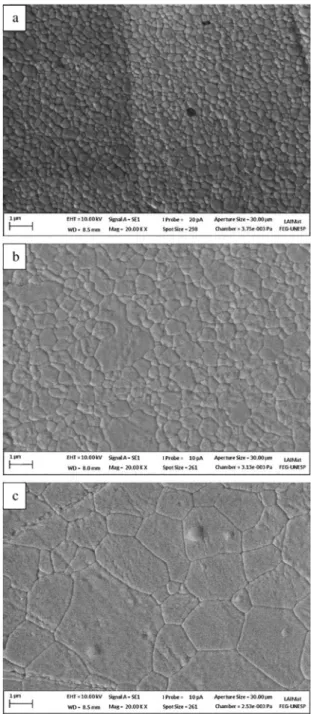
Figure 3 shows SEM images of the sintered samples. Microstructural characterization indicated average grain
sizes of 0.28 ± 0.08, 0.49 ± 0.20 and 1.31 ± 0.67 µm for
samples sintered at 1450 °C, 1530 °C - 2 h and at 1600 °C - 4 h, respectively. As expected, considerable grain growth occurred with increasing sintering temperature and time.
3.3. Characterization of the crushed samples
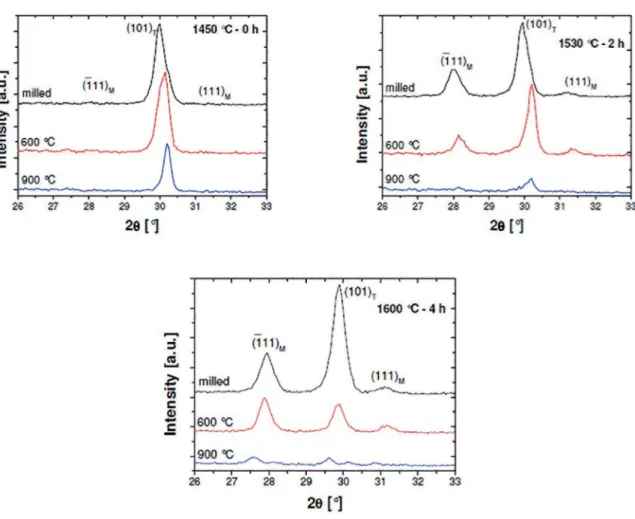
Figure 4 presents representative XRD patterns of the crushed and heat-treated Y-TZP samples.
The fragmentation of the sintered samples allows simulating extreme conditions of phase transformation experienced by the material during application of mechanical stress. It can be observed that the increasing of heat treatment leads to a reduction of the monoclinic peak intensities in all sintering conditions experimented for zirconia samples.
Figure 5 shows the results of volume percentage of the monoclinic phase, determined by Equation (2), formed after crushing the samples (as milled) and after subsequent heat treatments from 400 up to 1200 °C.
The results of the phase analysis of sintered and crushed samples indicate that the amount of monoclinic phase formed depends on the grain size of the samples and, therefore, on the sintering temperature. Lower sintering temperatures result in a smaller grain size of tetragonal phase, making
Figure 3: SEM micrographs showing diferent average grain size of samples sintered at: a)1450 °C, b)1530 °C - 2 h and c)1600 °C - 4 h.
the t→m transformation diicult, because the actual grain size is much smaller than the critical size for spontaneous transformation2.
The amount of recovery of tetragonal phase during the subsequent heat treatments also depends on the grain size achieved during sintering. While in the samples sintered at 1450 °C a full recovery of tetragonal phase is observed at temperatures as low as 950 °C, the same for samples sintered at 1530 or 1600 °C is true only after treatments at 1100 and 1200 °C.
The percentages of monoclinic phase shown in Figure 5 are based on the percentage of grains analyzed by X-ray
Figure 4: Representative XRD patterns of powder (crushed) samples before and after heat treatments.
Figure 5. Amount of monoclinic phase formed after crushing the sintered samples (as milled) and after subsequent heat treatments.
Because the depth of penetration of X-rays, estimated to
be in the order of 4.5 µm, it is reasonable to assume that the
materials with larger grain sizes, as the samples sintered at
1600 ºC - 4 h (1.31 µm grain size) are much more inluenced
by the transformation at the fracture surface than samples with smaller grain sizes.
Therefore, volume fraction of monoclinic phase is a better representation of processing conditions experienced by the
material within detection limit of about 4.5 µm depth of the
difractometer. Analyzing this graph, the samples sintered at 1450
°C exhibit the lowest volumetric percentage transformed during crushing, about 6 vol%, which corresponds to approximately one tenth of the amount transformed in the material sintered at
1600 °C for 4 h. This diference is signiicant because a higher
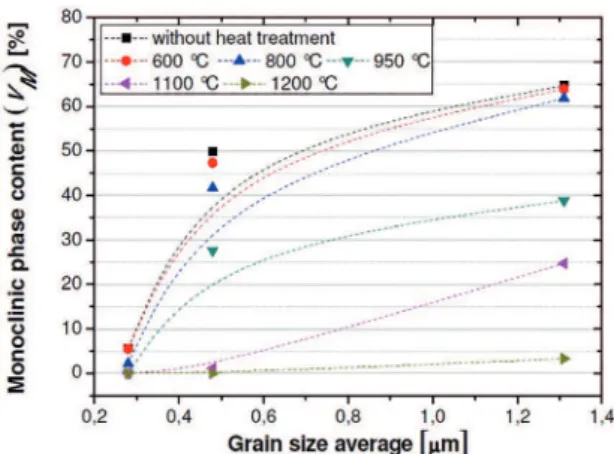
retention of tetragonal phase implies a higher life expectancy, especially when used in dental prostheses which are constantly under cyclic loading of mastication. A correlation between grain size and volume fraction of transformed monoclinic phase is showed in Figure 6.
It is possible to observe an increase of the amount of
monoclinic phase with increasing grain size for diferent
Figure 6: Volume fraction of monoclinic phase (VM) as function of grain size for diferent heat treatments applied.
For the development of this procedure, the thermal treatments for which the zirconia will be submitted by the application of the porcelain veneer should be known. Thus, the following items should be considered:
The sintered material may be subject to machining using diamond drills to optimize the adaptation to the patient’s teeth, which will cause localized martensitic transformation.
In case of ixed partial prosthesis, mechanical stress on
the prosthesis is critical and it is essential to optimize the percentage of tetragonal phase.
All zirconia used for dental prosthesis are covered by a feldspathic porcelain layer which allows to mimetic the color of a tooth. This porcelain layer is applied in 2 to 5 steps involving thermal treatments at about 950 ± 50 °C.
3. Conclusion
The results indicated that sintering conditions of Y-TZP
inluenced tetragonal to monoclinic phase transformation due to the diferent microstructures. With the increasing
sintering temperature and, therefore, the increasing
grain size, the greater is the diiculty for the recovery
of tetragonal phase. For a full recovery of the tetragonal for samples sintered at 1450 °C with an average grain
size of 0.28 µm, heat treatment at 950 °C for 15 min is suicient while heat treatments exceeding the martensitic
transformation temperature of 1170 °C are required for samples sintered at 1600 °C for 4 h with an average grain
size of 1.31 µm.
4. References
1. Stevens R. An introduction to zirconia: Zirconia and zirconia ceramics. 2nd ed. Twickenham: Magnesium Elektron; 1986. 2. Piconi C, Maccauro G. Zirconia as a ceramic biomaterial.
Biomaterials. 1999;20(1):1-25. PMID: 9916767 DOI: http:// dx.doi.org/10.1016/S0142-9612(98)00010-6
3. Rosenblum MA, Schulman A. A review of all-ceramic restorations. Journal of the American Dental Association. 1997;128(3):297-307. DOI: http://dx.doi.org/10.14219/jada.archive.1997.0193 4. Mochales C, Maerten A, Rack A, Cloetens P, Mueller WD,
Zaslansky P, et al. Monoclinic phase transformations of zirconia-based dental prostheses, induced by clinically practised surface manipulations. Acta Biomaterialia. 2011;7(7):2994-3002. DOI: http://dx.doi.org/10.1016/j.actbio.2011.04.007
5. Borchers L, Stiesch M, Bach FW, Buhl JC, Hübsch C, Kellner T, et al. Inluence of hydrothermal and mechanical conditions on the strength of zirconia. Acta Biomaterialia. 2010;6(12):4547-4552. DOI: http://dx.doi.org/10.1016/j.actbio.2010.07.025 6. Denry IL, Peacock JJ, Holloway JA. Efect of heat treatment after
accelerated aging on phase transformation in 3Y-TZP. Journal of Biomedical Materials Research Part B: Applied Biomaterials. 2010;93(1):236-243. DOI: http://dx.doi.org/10.1002/jbm.b.31580 7. Guazzato M, Quach L, Albakry M, Swain MV. Inluence of
surface and heat treatments on the lexural strength of Y-TZP dental ceramic. Journal of Dentistry. 2005;33(1):9-18. PMID: 15652163 DOI: http://dx.doi.org/10.1016/j.jdent.2004.07.001 8. Blue DS, Griggs JA, Woody RD, Miller BH. Efects of bur
abrasive particle size and abutment composition on preparation of ceramic implant abutments. The Journal of Prosthetic Dentistry. 2003;90(3):247-254. PMID: 12942058 DOI: http:// dx.doi.org/10.1016/S0022-3913(03)00368-8
9. Sawase T, Wennerberg A, Hallgren C, Miyamoto I, Albrektsson T. Atomic force microscopic study of commercially available implant abutments. Clinical Implant Dentistry and Related Research. 1999;1(2):92-97. DOI: http://dx.doi.org/10.1111/j.1708-8208.1999. tb00097.x
10. Kawai Y, Uo M, Wang Y, Kono S, Ohnuki S, Watari F. Phase transformation of zirconia ceramics by hydrothermal degradation. Dental Materials Journal. 2011;30(3):286-292. DOI: http:// dx.doi.org/10.4012/dmj.2010-175
11. JCPDS - Joint Committee on Powder Difraction Standards. Inorganic Materials. Swarthmore: International Centre for Difraction Data; 1979.
12. Toraya H, Yoshimura M, Somiya S. Calibration curve for quantitative analysis of the monoclinic-tetragonal ZrO2 system by X-ray difraction. Journal of the American Ceramic Society. 1984;67(6):C-119-C-121. DOI: http://dx.doi. org/10.1111/j.1151-2916.1984.tb19715.x
13. Klug HP, Alexander LE. X-Ray Difraction Procedures For