The Portuguese AML System and its Evolution
Candidate:
Maria Margarida Viegas Aleixo de Matos [email protected]
Supervisor:
Prof.Miguel Trindade Rocha [email protected]
September 2011
Universidade Católica Portuguesa Católica Lisbon School of Business and Economics
Dissertation submitted in partial fulfillment of requirements for the Degree of MSc in Business Administration at Universidade Católica Portuguesa
ACRONYMS AND ABREVIATIONS
AG - Attorney General
AML - Anti-Money Laundering
ASAE - Authorithy for the Food and Economy Security BdP - Banco de Portugal
CDD - Customer Due Dilligence
CMVM - Portuguese Security Market Commission CTF - Counter-Terrorism Financing
CTR - Currency Transactions Reported
DCIAP - Departamento Central de Investigação e Acção Penal
DGAIEC - General Directorate for Customs and Special Taxes on Consumption DGPJ - General Directorate for Justicy Policy
DNFBPs - Designated Non-Financial Businesses and Professions FATF- Financial Action Task Force
FIU - Financial Intelligence Unit IMF - International Monetary Fund ISP - Instituto de Seguros de Portugal ML - Money Laundering
NC - Non- compliant PC - Partially compliant
PEP - Politically Exposed Person
RNPC - National Register of Legal Persons SRO - Self- Regulatory Organizations STRs - Suspicious Transactions Reported TF - Terrorism Financing
ABSTRACT
The Portuguese AML System and its Evolution
Margarida Matos, Universidade Católica Portuguesa
This study explores the aspects beyond the Portuguese AML system/framework, trying to provide an overview about this subject, being also analyzed the compliance with the FATF recommendations (since 2006 to 2010).
In order to study the evolution of the several countermeasures adopted by the Portuguese competent authorities, with the aim to culminate recommendations in which Portugal was considered NC in 2006, a descriptive study was conducted. After a carefully literature review, in which the most important aspects concerning the Money Laundering thematic were addressed, a number of reports from credible institutions in the field of ML prevention and fight were analyzed (namely the ones from the FATF and UIF). After that the measures adopted were discussed with the objective to know if they were enough or not and in the last case what can be done in order to improve.
TABLE OF CONTENTS
ACRONYMS AND ABREVIATIONS...2
ABSTRACT...3
ACKNOWLEDGEMENTS...6
I. INTRODUCTION...7
1.1 Research Topic...7
1.2 Paper Structure...8
II. LITERATURE REVIEW...9
2.1 Money Laundering...9
2.1.1 Vienna Convention...9
2.1.2 Palermo Convention...10
2.1.3 Portuguese Penal Code...11
2.2 Money Laundering Cycle...11
2.2.1 Placement...12
2.2.2 Layering...13
2.2.3 Integration...13
2.3 The Impact of Financial Crime in Organizations...14
2.4 Money Laundered per Year...15
2.4.1 Macroeconomic Estimates...15
2.4.2 Microeconomic Estimates...16
2.5 Money Laundering Consequences and Impacts...17
2.5.1 Economic Growth...18
2.5.2 Contamination Effect...18
2.5.3 Private Sector...19
2.5.4 Confidence in Markets (Reputation Risk)...19
2.5.5 Tax Evasion (Loss of Revenue)...20
2.5.6 Emerging Economies...20
2.5.7 Loss of Control...20
2.5.8 Socio-Economic Effects...21
2.6 United Nations (Office on Drugs and Crime)...21
2.7 FATF...22
2.9 The Portuguese AML System...24
2.10 Supervision Entities...26
2.10.1 Banco de Portugal (BdP)...26
2.10.2 Instituto de Seguros de Portugal (ISP)...26
2.10.3 Comissão do Mercado de Valores Imobiliários (CMVM)...27
2.11 Control Entitites...28
2.11.1 ASAE...28
2.11.2 Inspecção Geral de Jogos...28
2.12 Unidade de Informação Financeira (UIF)...29
2.13 Departamento Central de Investigação e Acção Penal (DCIAP)...29
2.14 Research Questions...30
III. METHODOLOGY...32
IV. COMPLIANCE LEVEL VERIFICATION AND ANALYSIS...34
4.1 Consumer Due Dilligence and Record Keeping...34
4.2 Acess to Beneficial Ownership and Control Information...37
4.3 Designated Non-Financial Business and Professions...38
4.4 Suspicious Transaction Reports...42
4.5 Regulayion, Supervision and Monitoring...44
4.6 Legal Persons and Arrangements e Non Profit Organizations...46
4.7 Statistics...49
V. CONCLUSIONS...53
VI. BIBLIOGRAPHY...54
ACKNOWLEDGEMENTS
I would first like to thank to professor Miguel Trindade Rocha for his guidance, knowledge and support that were crucial for the elaboration of this project.
I also have to thank to my dear friend Hugo that helped me a lot in the elaboration of this thesis and gave me the necessary strength when I didn’t have it.
I can’t forget my family that always believe in me and were patients during the last months.
Finally, I would like to thank to all my friends that make me laugh and encourage me even when the things didn’t happen as I expected.
I. INTRODUCTION
The concept of Money Laundering is normally described as a process that is used to disguise and hide the true origin of criminal proceeds. This crime involves several stages (placement, layering and integration) and it to occur doesn’t require actual money, it happens whenever a transaction involving an illegal property/benefit (that can be tangible or not) takes place (Hopton, 2009).
Due to globalization is easier to launder the criminal procedures, because it is simpler to integrate it in the legitimate economy (Vitor Tanzi, 1994) and due to the technological advances, transferring money from one place to another is relatively simple, so in order to combat and prevent this crime an effective, efficient and coordinate AML system (the international collaboration is also extremely important) is crucial in order to avoid and minimize possible devastating consequences that arise from the association with ML.
There are several entities that join forces with the objective to fight ML activities, being the FATF one of the most important. This entity launches a series of recommendations, intending to be a set of the best practices in order to give an appropriate answer to ML.
1.1 Research Topic
This dissertation project has as main objective to explore the Portuguese AML system analyzing its compliance with the FATF recommendations (from 2006 to 2010) and to achieve this objective a descriptive study was conducted (recurring to reports from credible institutions, such as the FATF and UIF, which ones represented an important information source to analyze the measures adopted by the competent authorities whit the aim to culminate failures in several recommendations in which Portugal was considered NC or PC in 2006).
1.2 Paper Structure
In what concerns the structure of this dissertation, and after a carefully literature review in which some of the most important and relevant points related with ML are mentioned and analyzed, the research questions and methodology used to study it are presented. Finally, is discussed if the measures adopted by Portugal are enough to fully respect the FATF recommendations.
II. LITERATURE REVIEW
2.1 Money Laundering Definition
There are an important number of consequences that result from Money Laundering and every aspect involving its prevention, detection and prosecution are extremely relevant. Despite of the complexity related with this thematic the definition of this concept is quite simple.
There are several definitions of Money Laundering. The majority of the countries apply the definition provided by two important conventions: the United Nations Convention Against Illicit Traffic in Narcotic Drugs and Psychotropic Substances (1988) (Vienna Convention); The United Nations Convention Against Transnational Organized crime (2000) (Palermo Convention) (this convention aimed “to promote cooperation to prevent and combat transnational organized crime more effectively.”). In the Portuguese case the offenses related with ML represent a large range and are defined under the UN Vienna and Palermo conventions.
2.1.1 Vienna Convention
According to the article 2 of the Vienna Convention this convention aims to bring an international dimension in order to combat in a more effective way the problems related with illicit traffic of narcotic drugs and psychotropic substances. Due to this approach is possible to establish a set of solutions for problems that normally occur in international cooperation (namely the ones relating the characteristic slowness associated with this type of burocratic procedure and it also avoids possible cooperation refusals that may occur). Due to the international mandatory confiscation assistance, defined in this convention, is possible to address problems that result from the fact that sometimes drug traffickers invest their illicit funds in other countries that are not their origin country where they commit these activities.
2.1.2 Palermo Convention
In the Palermo Convention, Money Laundering, criminal association, obstruction of justice and corruption constitute four offenses that need to be included in the States domestic law. Regarding the definition of Money Laundering this one is given in Article 6 of the convention and is defined as “The conversion or transfer of property, knowing that such property is the proceeds of crime, for the purpose of concealing or disguising the illicit origin of the property or of helping any person who is involved in the commission of the predicate offence to evade the legal consequences of his or her action”. Another important aspect that is defined in this convention is related with the measures to combat Money Laundering, which includes the reporting of suspicious transactions, customer identification and record keeping.
• Money Laundering has as main objective concealing or disguising the origin of certain types of property that are obtain trough an illicit act (drug trafficking) and at the same time hide the identity of the persons that participate in this type of offense.
• Every act that tries to conceal/disguise the “true nature, source, location, disposition, movement, rights with respect to, or ownership of property “ (Schott, 2006) when the person involved is aware of the property’s illegal origin.
• According to the Vienna and Palermo Conventions Money Laundering is related with “ the acquisition, possession or use of property” when the elements involved have prior knowledge about the true nature of the property in question that results from an offense(s) or from the participation in it. Unfortunately Money Laundering occurs all over the world. However, the more attractive countries/sectors are the ones where the legislation and programmes (AML and CFT infrastructures) regarding this thematic are not so effective and where consequently the risk of detection is lower.
In the Portuguese Law Money Laundering is punished under the Article 368ª - A of the Portuguese Penal Code. According to this article funds are a result from activities related to pimping, sexual abuse of children or dependent minors, extortion, trafficking narcotic drugs and psychotropic substances, arms trafficking, trafficking human organs or tissues, protected species trafficking, tax fraud, influence peddling and corruption. Anyone that tries to dissimulate the illegal origin of the funds is punish by law as well as anyone that tries to conceal or disguise the true nature, source, location, disposition, movement or ownership of the illicit funds. The sanctions applied are valid even if the facts underlying the crime don’t occur in Portuguese National Territory or even if the place where these occurred is unknown.
2.2 Money Laundering Cycle
Regarding the processes involved in Money Laundering there are three main phases: placement; layering; integration. Independently of the type of crime Money Launderers resort to the phases mentioned before in order to integrate funds from illegal activities into the financial system. It is extremely difficult to estimate the amount of money involved in this laundry cycle and since the integration in the international banking system is getting deeper is more difficult to discover it’s origin1. Concerning the different stages of the process, they may occur in different countries, because this type of complex international financial transactions facilitates the activities related with Money Laundering schemes2.
1 http://www.unodc.org/unodc/en/money-laundering/globalization.html 2 Id.
Fig. 1. The Money Laundering Cycle (adapted from World Bank [2003] ).
2.2.1 Placement
In this initial stage the illegal funds are introduced in the financial system by the launderer and normally this is done trough a financial institution. This can be done in several ways: one of the most common techniques is the division of a large amount of cash into smaller amounts and then making several deposits in a bank account (in a single financial institution or in several ones) or another type of dissimulation is done trough the purchase of checks (or another kind of monetary instruments like money orders for instance) that are deposited in different locations3. The purchase of a security or a form of an insurance contract is another way of acting in this initial stage of the process. Tony (2000) considered that due to the increasing law enforcement, in which concerns the report that banks need to made about suspicious transactions, this stage of Money Laundering cycle is getting more risky.
3 http://www.fatf-gafi.org/document/29/0,3746,en_32250379_32235720_33659613_1_1_1_1,00.html Cash fr om Cr iminal Act Place ment Cash is deposited into accounts Layer ing Funds moved to other institutions to obscure origin Inte gr at ion Funds used to acquire legitimate assets
2.2.2 Layering
After the stage mentioned before (in which the funds are introduce in the system) the layering phase begins. Now the launderer’s main objective is to create the illusion that the funds have a legal origin. In order to accomplish this task the launderer can distribute the money in several accounts around the world (subject to different jurisdictions) or in a more complex scheme it’s also possible to apply the same funds in the purchase/sale of investment instruments (securities, insurance contracts that can be sold recurring to another financial institution). The use of a wide range of accounts (is in this phase that is normal to recur to offshore mechanisms) in order to launder money is more common in those countries that don’t cooperate in anti-Money Laundering investigations/policies4.
Different types of negotiable instruments are used to incorporate these illegal funds which ones can be, as mentioned above, transferred to several accounts in different areas of the globe.
2.2.3 Integration
In this last phase the funds are generally invested in different types of business that may vary between “real estate, luxury assets or business ventures (shares in
companies)” 5 and due to this they become part of the legitimate economy. Usually entities like casinos, hotels and restaurants are targets for this type of investment, because in this kind of businesses dirty money can be easily laundered (Tony, 2000).
The ML phases described above take place in different parts of the world. The first stage of the process, generally takes place in the fund’s place of origin and an activity close to the underlying one is used to process the illegal cash.
4http://www.fatf-gafi.org/document/29/0,3746,en_32250379_32235720_33659613_1_1_1_1,00.html 5
In the next phase (layering) it’s necessary to opt for a financial or business infrastructure. So, a choice must be done between “an offshore financial centre, a large regional business centre, or a world banking centre” 6.
At the integration stage, if the funds are originated from an unstable economy in which the investment opportunities are few they are later transferred and invested in a more attractive country.
2.3 The Impact of Financial Crime in Organizations
Reputational risk - The reputation of an institution can be easily damaged and lose its credibility if their business practices are inappropriate and this fact can have a negative impact in the confidence of their clients, creditors and the market place as a whole. This type of risk is especially propitious to occur in banks due to the nature of their business, which is considered as one of the principal vehicles used by their customers for criminal activities7.
Operational risk - As occurs with the reputational risk this one can also have an impact in the business of the bank and remaining financial and non-financial institutions. An accurate management of the operational risk need to be done because is extremely important to have effective control procedures in order to avoid losses that can result from the absence of the adequate control procedure and the application of a non correct due diligence procedure8.
Legal risk – An entity is exposed to this risk when it doesn’t respect the mandatory standards defined by the FATF against Money Laundering activities and as a consequence their operations can suffer from the costs that result from lawsuits9.
6 Id. 7 https://www.imolin.org/doc/amlid/Bangladesh/Bangladesh_Guidence_Notes_on_Prevention_of_Mon ey_Laundering.pdf 8Id. 9Id.
2.4 Money Laundered per year
Several efforts were made by some entities (namely the IMF and the United Nations) in order to provide an estimate concerning the amount of Money that is laundered. In 1996, and according to the IMF, an attempt to answer this question fixed this amount in a range between $ 590 billion to $ 1,5 trillion (representing 2% - 5% of the world’s gross domestic product). In the recent years the UN gave an estimate between $ 500 million to $ 1 trillion.
In what concerns the demand for Money Laundering there are only few estimates, the Macroeconomic and the Microeconomic and the same can be seen only as indicative due to their limitations (the first method conduct to unrealistic high figures and the second one doesn’t have a solid empirical base). However these estimates are sufficient to prove the dimension of ML and to call the public policy attention for this phenomenon (Levi and Reuter, 2006).
2.4.1 Macroeconomic Estimates
In this specific case when a tax is not paid (being this one from a legal or illegal activity) it’s assumed that this amount will need to be laundered. There is a relationship between the monetary component of the underground economy and ML. Actually when macroeconomists, during the 1980s, tried to quantify the first one they were actually measuring ML, because they analysed the variations in currency demand linked with higher taxes and consequently tax evasion (Quirk, 1997).
Schneider and Enste (2000) provide a comparison between the sizes of the underground economy in relation to the GDP in different countries (developing, transaction and OECD), recurring for this purpose to a currency demand approach. According to these authors, and using this type of methodology, the underground economy in OECD countries represents a significant percentage of their economy (for example, and assuming the period between 1990-93, the underground economy in Portugal represented 24% - 30% the GDP). Concerning the size of the underground
economy their magnitude is smaller in countries with relatively few public sectors and with a strong tax moral (like the US and Switzerland). In this study, this figure represents more than 10% of global GDP, which is contradictory and substantially bigger than the percentage presented by the IMF (2% - 5%) that is taken as the most correct one.
Blades and Roberts (2002) criticize this macroeconomic approach presented by Schneider and Enste (2000), which one conducted to high estimations. From their point of view the main question is related with the fact that this non-observed economy is mainly concentrated in few sectors that are considered the “susceptible” ones (home repairs, retail trade, taxis, trucking, cafes and restaurants) while in others (power generation, heavy industry, rail and air transport, government services, banking and telecommunications) due to the inexistence of incentives to hide and don’t report revenues,the “shadow” economydoesn’t represent a high percentage of the total economy.According to Blades and Roberts this conduct to some incredible numbers, where in the susceptible sectors the weight of the underground economy raises numbers close to 70% and this doesn’t seems plausible.
2.4.2 Microeconomic Estimates
This approach can be considered as a complement to the previous one, that doesn´t give attention to the estimation to the total earnings from criminal activities that go beyond tax evasion (Reuter and Truman, 2004). The microeconomic estimative are build according to different crime categories and is “based on street knowledge; sampling; and detailed medical, social, and financial/tax records” (Quirk, 1997). In order to proceed to a microeconomic estimative there are two different stages. In the first one is made an estimative concerning the earnings generated by a specific crime (for example, tax evasion or drug dealing). After that, and recurring to
prosecution data and latency estimates, the number of crimes committed is estimated (Takáts, 2008).
Concerning the estimation of criminal earnings the known numbers are not credible. Blades and Roberts (2002) attempted to provide estimates, for OECD and transaction economies, and the numbers presented represent around 0.5% to 1.0 % of GDP. However, these percentages are not easily related with ML. What happens is that certain amounts of criminal revenues (until $25,000 annually) are used directly without recurring to a financial intermediary and due to this procedure it’s not possible to provide an accurate estimation of the amount of these earnings that will be subject to ML.
According to Reuter and Truman (2004), the main problem associated with this approach is the lack of data and the fact that the existing one is not reliable.
Despite of all the efforts made to estimate the dimension of the problem several authors, like Tanzi (1994), defend that due to the nature of the criminal activities that generate earnings, which need to be launder, it’s impossible to have a precise idea of the amounts of net financial gains generated.
2.5 Money Laundering Consequences and Impacts
The impacts resulting from ML are felt in the economy, security and society as a whole.
This criminal activity carry out several costs for governments that need to make investments in health care (to combat the effects that result from drug trafficking, a major issue in what concerns predicate offenses) and also need to go through with law enforcement procedures10.
Due to the impact that Money Laundering has in the macroeconomic environment is crucial to implement and improve measures in order to fight this problem.
10
https://www.imolin.org/doc/amlid/Bangladesh/Bangladesh_Guidence_Notes_on_Prevention_of_Money_Laund ering.pdf
There are sets of activities that are difficult to measure due to their dimension/scale (Money Laundering, crime and underground activities), but it is crucial that policymakers be aware of their existence and take their effect in consideration.
2.5.1 Economic Growth
Quirk (1997) and McDowell (2008) defend that there are income distribution effects that result from ML and this effects are visible in the transference of capital that the criminal activity send from high savers to low savers, or from sound investments to
risky, low quality investments and this behavior will contribute to an economic distortion and instability affecting the economic growth.
Tanzi (1994) describes the behavior of Money Launders as contradictory, because these individuals move capital from countries with higher rates of return to countries with lower rates of return and this affects the optimal level of investments of the world capital (this allocation of resources contributes for the decrease of the world rate growth) and as a consequence of this contradictory movement a confusion regarding the policies to be pursued can occur.
2.5.2 Contamination Effect
According to Quirk (1997) a contamination effect can occur, because illegal transactions can affect the legal ones and this fact results in an indirect macroeconomic effect. A good illustration of this effect is related with the fact that some transactions, in which participants from other countries are involved, are seen as less attractive due to a possible association with Money Laundering procedures. It’s also important to mention that if one law is not respected is easier to break others and this situation can create an unstable environment.
2.5.3 Private Sector
The private sector can be seriously affected by Money Laundering activities and some of the most relevant microeconomics effects are felt in this sector.
McDowell (2008) justifies the serious effects felt in this sector with the existence of a series of front companies which have access to illicit funds and that are used by criminals as a way to hide their ill-gotten gains. This type of company is able to offer products with a lower (due to their access to the illicit funds that finance their products/services) price when comparing with legal firms. A negative macroeconomic effect results from this situation, because for a legal company is almost impossible to compete against a front company that doesn’t respect the free market principle.
2.5.4 Confidence in markets (Reputation Risk)
It’s also important mentioning that the confidence in markets is directed affected by the association to Money Laundering and financial crimes activities. This type of negative association to a country contributes to call the attention of criminal organizations and a decrease in the economic growth, global opportunities and development occurs (McDowell, 2008).
Tanzi (1994) describes the effects of ML criminal activities in the transparency and soundness of financial markets, which ones can be affectedimmediately but it takes a long time to recovery. However this type of negative reputation can be avoided trough an effective anti-money-laundering policy and due to its correct implementation governments can save resources that otherwise would have to invest in the recovery of their financial reputation11.
11
https://www.imolin.org/doc/amlid/Bangladesh/Bangladesh_Guidence_Notes_on_Prevention_of_Money_Laund ering.pdf
2.5.5 Tax evasion (Loss of Revenue)
Another consequence that is driven from the practice of Money Laundering crimes is the loss of revenue associated with a decreasing in government’s tax revenue, which is translated in higher tax rates affecting honest taxpayers that will be subject to living higher costs (McDowell, 2008). Quirk (1997) describes tax evasion as the illegal activity that causes a bigger macroeconomic impact and this author also mention that this type of illegal activity occurs mainly in countries whose economy is growing, because the small business sector has a strong connection to this crime related with Money Laundering.
2.5.6 Emerging Economies
According to McDowell (2008) financial systems in smaller economies are the ones mainly affected by the association of financial institutions with ML. There are inevitable risks that arise from that association, namely the ones related with monetary instability and systemic crises (which can lead to the destabilization of the financial system due to the low credibility and lack of confidence in the financial institutions).
Tanzi (1994) refers that there is also an effect in the exchange and interest rates that result from capital movements, which one can also have an impact in the price of the assets where the money from criminal activities is invested (for example land and houses).
2.5.7 Loss of control
As previously mentioned it’s almost impossible to know the truly extensions of
Money Laundered around the world, but according to the IMF it represents a significant percentage of the world gross domestic product. These large amounts conduct to an economic policy loss of control by governments, which in some countries, these illicit procedures dwarf government budgets, which results in a loss of control of economic policy by their governments.
2.5.8 Socio-economic effects
McDowell describes several socio-economic effects that can be felt in different levels (market, government and citizens) due to the power transference that occurs and favors criminals.
All society members can be corrupted by criminals that commit ML crimes, having huge economic power they try to bribe government elements and persons with important positions and this situation leads to social and political costs.
With a solid and well-designed AML framework the impacts above described can be minimized.
2.6 United Nations (Office on Drugs and Crime)
The United Nations office on drugs and crime has a unit responsible for dealing with AML and organized crime, which one was created with the aim to provide an adequate response to the Vienna convention.
The Global Programme against ML has as main objective to ensure that the MS put in practice the right measures to fight ML and TF and help in the detection, seizing and confiscation of criminal proceeds trough the necessary and adequate technical assistance12. This program also creates a bigger awareness about this thematic and at
12
the same time stimulates the development of a framework designed to combat ML by the MS which ones are called to proceed with monitoring of this crime13.
It is also responsible for the coordination of several initiatives carried out by the UN and other international organizations.
2.7 FATF
The Financial Action Task force was founded, in Paris, in 1989 by the G-7 Summit. There was a need to create this entity due to the increasing number of crimes involving Money Laundering practices and the need to establish a co-ordinate international response was a priority. In 2001, the combat to terrorist financing entered in the FATF scope of intervention (and at that time 9 special recommendations were created with the objective to prevent, detect and suppress this crime that was growing in the beginning of the century)14.
The Financial Action Task Force works at two different levels (the national and international) and develops/promotes a series of policies whit the purpose to combat Money Laundering and terrorism financing. The FATF is an inter-governmental body that that is responsible for regulatory reforms in the areas mentioned before. One of its main tasks was the development of 40 recommendations to fight Money Laundering that are, at the same time, a support to national governments that need to implement and put in practice effective anti-Money Laundering programmes (these recommendations are also used by non-FATF member countries in order to address this problem)15.
The FATF recommendations (40+9) are designated for universal application and define the basic framework to face this two crime typologies. There are three main objectives that the FATF tries to give an adequate response (Thony, 2000):
13 http://www.unodc.org/unodc/en/money-laundering/programme-objectives.html?ref=menuside 14 http://www.fatf-gafi.org/pages/0,3417,en_32250379_32236836_1_1_1_1_1,00.html 15 http://www.fatf-gafi.org/dataoecd/48/11/45139480.pdf
• Improve national systems to combat Money Laundering - this is done trough the implementation of an effective confiscation procedure and also by punishing all the different types of Money Laundering crimes (not only the ones directly associated with drugs) in accordance with the Vienna Convention.
• Strengthen the role of the financial system - As previously mentioned the financial entities need to proceed to client’s identification and also need to analyze if there are any suspicious transactions (this type of illegal transaction can decrease significantly if the financial institution implement a set of measures/techniques promoting secure transaction).
• Strengthen international cooperation - this cooperation can be done trough the adoption of programs that promote a reciprocal assistance in the field of justice (namely concerning the confiscation of funds, extradition processes and investigations) and the different countries should also share information about the international foreign currency flows
The Financial Action Task Force is comprised by 34 member jurisdictions (which represent the most important financial centers in the world) and 2 regional organizations (which results in a 36 member inter-governmental body).
It’s important to mention that the FATF doesn’t work alone. A good illustration of this is their collaboration with some international bodies, like OECD, with the aim to exchange information and support the efforts made to prevent and detect crimes involving bribery and corruption. The IMF, the World Bank, the UN and FATF- style regional bodies are also important units that work closely with the FATF.
2.8 The Egmont Group of Financial Intelligence Units
The FIUs are central bodies in the AML programs, establishing the exchange of
only responsible for this exchange of information in a national level but also in an international one due to the international nature of ML (Schott, 2006).
The Egmont Group was created in 1995 and it consists in a group of FIUs that decided to collaborate between them recognizing the importance of co-operation, which contributes for their individual efficacy and support the global fight against ML and TF16.
This group organizes meetings in which several questions are discussed namely the ones shared by the several members, is also provided assistance/advises to their AML programs and the international collaboration is also promoted. Some of the Egmont Group objectives include the improvement and incentive to the information exchange, the creation of a website in order to facilitate the communication among FIUs, stimulate the staff training and finally promote the developing of FIUs (these points constitute the so called Permanent Administrative support)17.
In order to achieve its mission of development, cooperation, and sharing of expertise the Egmont Group create five working groups and a committee (See Annex 1)18.
2.9 The Portuguese AML System • Law no. 25/2008
In the Portuguese AML system (defined in Law no.25/2008) the financial entities (credit institutions, credit companies and insurance companies among others) and the non-financial entities (casinos and real state agencies for instance) are the obliged entities that are subject to the law that addresses the prevention and repression of Money Laundering and terrorism financing.
There are several duties/obligations that the entities mentioned before have to respect.
16
Statement of Purpose, Egmont Group. 17
Statement of Purpose, Egmont Group. 18
The identification procedure needs to be done by the financial entities when the amount associated to the transactions is equal or greater than 15 000 €, when there is a doubt regarding a possible relation between the operation and a Money Laundering/terrorism financing crime or when the information about the client is not clear enough.
The due diligence19 is another measure that the financial institutions need to implement and adopt. According to this recommendation Financial entities should perform customer identification and verifications of it’s identity whenever they enter in a business relationship with the same (being this one occasional or not), when there is a possible association with a ML or TF and CDD should be applicable to the existing customers. It’s important to perform an ongoing due diligence in order to guarantee that the level of risk associated with that customer’s business remains the same and at the same time verify that the transactions realized are under the parameters defined when the same began.
The referred CDD procedures should be put in practice, but the risk involved in the different types of transactions and customers should be taken into consideration (enhancing due diligences for higher risk relationships and reducing due diligences should be applied to the ones with low risk).
Regarding Record Keeping, about domestic and international transactions, these are recommended to be kept during a minimum period of five years in order to give an appropriated answer to authorities requirements.
The obliged entity also needs to take in account the nature, frequency, purpose, complexity and singularity of the operation/activity as well as it should know the amount, origin and final destiny. Another obligation is related with the communication that the obliged entities need to do when they observed any suspicious transaction (being the STRs report one of the fundamental pillars in the prevention of ML).
19
In order to successfully prevent and respond to this type of financial crime a series of procedures and internal policies need to be implemented and taken into account (internal control, assessment / management of risk and internal audit assessments).
2.10 Supervision Entities 2.10.1 Banco de Portugal (BdP)
As previously mentioned, financial crime can have serious impacts in an organization (increasing the reputation, operation, finance and legal risks which can seriously damage a financial institution) and due to the adoption of an internal control system, defined by the BdP, these impacts can be minimized (due to an effective prevention and detection) as well as the ML/TF operations involving these institutions, can be avoided.
Therefore, the prevention and monitoring of ML in financial institutions is BdP responsibility and this supervision entity has also an active role in the elaboration of the normative framework concerning this thematic. Finally, the Bank of Portugal is also responsible for the imposition of sanctions when the supervised entities don’t comply with the duties imposed by the AML/CTF system20
2.10.2 Instituto de Seguros de Portugal (ISP)
The ISP is a supervisory authority responsible for verifying if the insurance and pension fund sector is in compliance with the AML framework. If the supervised entities don’t respect their obligations (provide the complete information and report to the ISP; give all the relevant and necessary documentation requested; notify the ISP about entity’s shareholder structure) it’s ISP responsibility to apply the adequate sanction. 20 http://www.bportugal.pt/pt- PT/Supervisao/SupervisaoPrudencial/BranqueamentoCapitaisFinanciamentoTerrorismo/Paginas/branq ueamentodecapitais.aspx
Among these are the powers to:
• Verify company’s activities, in a technical, financial, legal level and also fiscal correctness in insurance and reinsurance;
• Thoroughly check other information regarding the situation of insurance companies and their operations as a whole, for instance through the collection of data, the inspection of documents related to the insurance business or inspections carried out on the insurer’s premises;
• Adopt measures involving the insurance companies, their directors or controlling interests, sufficient and necessary to ensure that their operations are within the legal and regulatory parameters applicable to them, specifically regarding the their activities programmes, and also to avoid or eliminate any irregularity that could jeopardize the interests of policyholders and beneficiaries21.
2.10.3 Comissão do Mercado de Valores Mobiliários (CMVM)
CMVM is a supervision entity that is responsible for some regulations concerning AML provisions (this ones related with ML prevention in securities operations and customer record keeping) that are binding to financial intermediaries in the securities market and these entities have to provide all the information and documentation requested by the CMVM.
There are several entities in the securities market (public bids, settlement systems,
centralised securities) that are subject to CMVM supervision and monitoring,
regarding their compliance with AML legislation, and the same happens with the financial intermediary system. Beyond it’s regulatory and supervision role, CMVM also reports to the AG operations potentially related with ML activities, linked with securities management companies.
21
Financial entities that are listed in the stock exchange have the obligation to notify the CMVM about suspicious transactions that need to be inspected by the last one22.
2.11 Control Entities 2.11.1 ASAE
ASAE is the national administrative authority specialized in the economic and food supervision being responsible for carrying out inspections related with the food and non-food sectors, analyzing its risks, verifying if the sectors mentioned before respect the law and communicating any anomaly or risk detected.23
This national authority is also responsible, since 1 January 2006, for verifying the compliance with the ML obligations of several businesses: real estate business and
the purchase and sale of properties, to dealers in goods of high unit value, companies providing money transport services and companies operating on behalf of a client performing the operations in Article 20 f) of Law 11/2004.24
2.11.2 Inspecção Geral de Jogos
The IGJ (Inspecção Geral de Jogos) is the entity responsible for the supervision of all the activities related with gambling.
In the field of the ML prevention IGJ verifies if the entities in question (like for instance casinos) respect their obligations defined by law, namely in what concerns customers identification25.
22 FATF- Third Mutual Evaluation Report on Anti-Money Laundering and Combating the Terrorism
Financing, Portugal 2006
23
http://www.asae.pt/ 24
FATF- Third Mutual Evaluation Report on Anti-Money Laundering and Combating the Terrorism Financing, Portugal 2006
25 Id
2.12 Unidade de Informação Financeira (UIF)
The Financial Intelligence Unit, shortly designated by the acronym FIU is the national entity responsible for collecting, centralizing, processing, analyzing and disseminating information concerning the prevention and investigation of crimes of laundering, terrorist financing and tax crimes at a national level, ensuring the internal cooperation and coordination with the judicial and supervision authorities and with the financial and non financial entities (according to the Law No. 25/2008 of June 5). At an international level the cooperation and exchange information, with financial intelligence units or similar structures (respecting the conditions set in it’s domestic law), is in the UIF scope of intervention26.
In the field of their legal competences, defined in the Law No. 25/2008 of June 5, the diffusion of information about trends in order to prevent Money Laundering and terrorism financing is their responsibility.
The UIF also needs to provide an exchange of information about the suspicious activities concerning ML and TF that the obliged entities and the supervision authorities communicated27 (See Annex 2).
The statistical data, preparation and update, about this thematic (suspicious transactions reported) is also UIF´s responsibility that should report to the Direcção-Geral da Política de Justiça28.
2.13 Departamento Central de Investigação e Acção Penal (DCIAP)
DCIAP´s main responsibility is the investigation’s direction and coordination, as well as the prevention and fight against violent crimes associated with a high complex and organized criminality. In order to pursuit their objectives this entity acts in two distinct areas: criminal prevention, direction of criminal investigations that have a
26 http://www.pj.pt/PortalWeb/page/%7BE6E29429-8228-44A5-8338-9A3F3BCC3986%7D 27 Law No. 25/2008, article 43
territorial spread and coordination of the investigation’s direction at a national level (which contribute to a distribution of the coordination hierarchical power)29.
Money Laundering is, among other crimes (for instance terrorism, drug trafficking and corruption), one of the illegal activities which DCIAP´s have the coordination of its investigation30.
In order to have more efficient, simple and rational procedures the articulation between DCIAP and the other departments/services (namely the criminal policy) is crucial. It’s also DCIAP responsibility the elaboration of studies concerning the trends, nature and volume of criminality as well as the results of the efforts made in prevention, detection and control.
Regarding the criminal prevention there are sets of crimes that belong to the DCIAP scope of intervention and Money Laundering is included. Is this department responsibility to receive and analyze all the communications (provided by the obliged entities and the UIF) regarding suspicious transactions that can be associated with Money Laundering / terrorism financing and to suspend the suspicious operation if necessary (notifying the obliged entity for that).
2.14 Research Questions
Trough the analysis of the literature review it was clear the extreme importance of an adequate AML system in the successfully prevention and combat to ML, which one can bring enormous costs to the entire society.
Therefore, and having the Portuguese AML system as case study, various aspects concerning its system were analyzed not forgetting the important contribution of the Law no.25/2008.
29 http://www.pgr.pt/grupo_pgr/Dciap/apresentacao.html 30 Directive no.2005/60/CE and 2006/70/CE
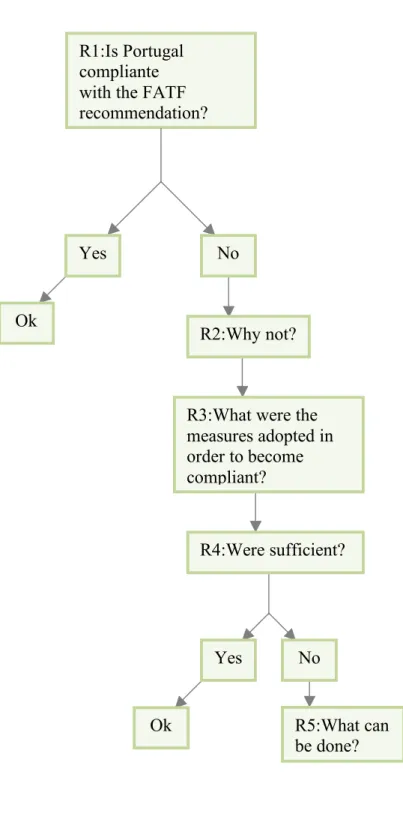
The diagram bellow indicates the Research questions explored as well as the structure used for that.
Fig. 2. Research Questions.
R1:Is Portugal compliante with the FATF recommendation?
Yes No
Ok
R2:Why not?
R3:What were the measures adopted in order to become compliant? R4:Were sufficient? Yes No Ok R5:What can be done?
III. METHODOLOGY
In order to analyze the level of compliance of Portugal and the efficiency of its AML system a descriptive study, based on several reports, was conducted.
The principal source of information was the FATF Mutual Evaluation of Portugal (in which the level of compliance with the 40 recommendations is discussed). The reason for chosen this source is mainly related with the credibility that the same has in the international community, that sees in the FATF a solid organization in the fight against ML with well defined standards and methodologies.
The recommendations analyzed were only the ones that presented a NC or PC rating with the final aim of understanding if Portugal was able to answer to the FATF standards (studying for that purpose the various measures adopted, provided in the update report of 2008 and 2010).
During this study and whenever it was possible the FATF reports were confronted with reports provided by the UIF and with studies conducted by KPMG in the field of the prevention of ML.
Forty Recommendations Rating
Recommendation 6
Politically exposed persons NC
Recommendation 7 Correspondent banking PC Recommendation 12 DNFBP – R.5, 6, 8-11 PC Recommendation 16 DNFBP – R.13-15 & 21 PC Recommendation 24
DNFBP - Regulation, Supervision and Monitoring
PC
Recommendation 25
Guidelines & Feedback PC
Recommendation 32
Statistics PC
Recommendation 33
Legal persons – beneficial owners PC Recommendation 34
Legal arrangements – beneficial owners PC
Source: FATF- Third Mutual Evaluation Report on Anti-Money Laundering and Combating the Terrorism Financing, Portugal 2006
IV. COMPLIANCE LEVEL ANALYSIS AND DISCUSSION
4.1 Customer Due Diligence and Record Keeping (Recommendation 6 & Recommendation 7)
Recommendation 6 (2006)
According to the recommendation 6 of the FATF (FATF 40 recommendation), financial institutions should have special attention and put in practice some special measures (in addition to the normal due diligence procedure) when they are dealing with politically exposed persons (PEP). In order to fully respect this recommendation the financial institution should have an efficient risk management system that allows a proper PEP´s identification31 (PEP’s are persons who hold or have held, twelve months before of the date of the transaction, public or political functions, in spite of the place of residence, and that their immediate family members or known persons, to be closed associates through a business or commercial relationship. The definition of PEP’s can be found in the Article 2 (6) of Law no. 25/2008); it needs to have an approval in order to initiate a business relationship with this type of client; the financial institution also needs to know the source of the funds and finally this business relationship needs to be subject of a constant monitoring.
Concerning the Portuguese case the FATF considered that this recommendation is non-compliant (NC)32. However is important to mention that at that time the Directive 2005/60/EC (on the prevention of the use of the financial system for the purpose of ML and TF) was not transposed to the Portuguese law and some aspects concerning the PEP´s will only be completely respected with the transpositions of this directive. One of the aspects that conducted to this evaluation is, according to the FATF, the
31
According to a KPMG/UIF study (2008), concerning the AML system in Portugal, there are significant differences in the PEP concept (which one varies across different countries). However this can be overcomeif a more generic definition is adopted,based in a risk approach evaluation, which contributes to a higher consistence.
32FATF- Third Mutual Evaluation Report on Anti-Money Laundering and Combating the Terrorism
confusion concerning what are the national and the international PEP´s which are not differentiated in the Portuguese law (for instance the distinction is not taken into account in the lists of suspicious activities referred in the BdP Instruction 26/2005). According to the Bdp and ISP, a customer’s risk profile should be defined and if there is a higher risk of ML, an additional diligence should be conducted. However, the FATF recommendation is not fully respected because a supplementary CDD is not performed, when the financial institution is dealing with a PEP, and the senior management approval is not required by law.
Recommendation 6 (2008)
The Law no. 25/2008 (AML/CTF Law) introduced in the Portuguese legal framework some important measures that contributed to a more complete compliance with some of the FATF´s recommendations. Due to the introduction of this law there was a reinforcement of the PEP´s due diligence requirements and the definition is clearer. The reinforcement of the due diligence 33, provided by this law, includes the four main points mentioned by the FATF in recommendation 6 and also establishes an enforcement of the due diligence duty in operations involving non-resident PEPs. In order to define the risk profile of their clients, the financial institutions need to gather information about them like required by the supervision authorities (BdP, CMVM and the ISP).
In conclusion, and according to the Portuguese authorities, the present AML/CTF law fully addresses the FATF recommendation 6 and is clear the important contribution of the Law no. 25/2008.
2006 2008
33
The due dilligence is crucial in order to obtain precise information about the counterpart that is considered a high risk client (due to the reputational question that can arise from the establishment of this type of relation ) (KPMG, 2008).
Recommendation 6
Politically exposed persons NC C
Recommendation 7 (2006)
According to the FATF, recommendation 7 is Partially Compliant (PC).
In this recommendation the FATF suggests that financial institutions should have sufficient and relevant information about the cross-border correspondent banking. The Portuguese AML/CTF is not totally compliance with that, because what is defined in the BdP instruction 26/2005 as mandatory is only the obligation to “enhanced due
diligence and take precautionary measures against the risk of being involved in ML, whenever such relationships are with institutions from countries which are not EU member states or FATF members”, which according to the FATF should be valid to
all respondent institutions whether or not it is an EU or FATF member.
Another aspect that is not in compliance with this recommendation is the fact that the Portuguese law does not provide the obligation regarding the need for senior management approval before the establishment of a new relationship.
There is no regulation regarding to the payable-through accounts34 that satisfies the conditions established by Recommendation 7. This Recommendation can be satisfied when the correspondent bank is able to provide relevant customer identification data upon request, which verifies the identity of the customers having direct access to accounts and assures the performed on-going due diligence on these accounts.
Recommendation 7 (2008)
In the law no. 25/ 2008 (Article 26) the due diligence duty is reinforced and because of the new obligations, defined in the previous law, the Portuguese Authorities are now in compliance with Recommendation 7 (concerning the quality and amount of information collected, the necessary senior approval and the payble-throught
34 “
correspondent accounts that are used directly by third parties to transact business on their own
behalf”. (
accounts).
2006 2008
Recommendation 7
Correspondent banking PC C
4.2 Legal Arrangements – Access to beneficial ownership and control information (Recommendation 34)
Recommendation 34 (2006)
The recommendation in question says that countries should provide to the legal authorities the information on time and guarantee that the same is appropriated and precise. In the Portuguese case, and according to the FATF evaluation, the law is PC with this recommendation. This rating is justified by the limited power that the authorities have in what concerns the “timely access to information on the beneficial
ownership and control of trusts”35.
The Portuguese legal system doesn’t recognize the legal concept of trust, but there is an exception that is applied in the Madeira Free Trade zone. In this case the international trusts (which one is subject to a foreign law) can be legally accepted and the AML regime is applied. However, the truly extension to which those norms are applied to these arrangements was not available in first hand to the evaluation team and the nature of their economic activity was not well defined. This situation conducted to a non-positive evaluation regarding the information access of this type of arrangement.
Recommendation 34 (2008)
The Law no. 25/2008 introduced some important clarifications in the trusts regime, namely in what concerns measures specially develop for trusts regarding the
35 FATF- Third Mutual Evaluation Report on Anti-Money Laundering and Combating the Terrorism
obligation to identify customers and the beneficial owner of the international trust (Article 7 (4) of the Law no. 25/2008). This new law guarantees that the competent authorities (Conservador of the Commercial Register and Judiciary Authorities) have, as stated in recommendation 34, timely access to information on the beneficial ownership and control of trusts.
There were no significant differences in the number of registered foreign trusts in 2010 and Portugal is now compliant with this recommendation.
2006 2008
Recommendation 34 Legal arrangements Beneficial owners
PC C
4.3 Preventive Measures – Designated Non-Financial Business and Professions
Customer Due Diligence and Record-Keeping (Recommendation 12) (Applying R.5, 6, and 8 to 11)
2006 Evaluation
The Designated Non-Financial Businesses and Professions (DNFBPs) - casinos, real estate agents/auctioneers, precious metals and stones dealers, lawyers, solicitadores and accountants - are also object of the CDD and record-keeping established in Recommendations 5, 6, and 8 to 11. However, according to the FATF mutual evaluation (2006), Portugal is PC with recommendation 12.
This rating is justified by the lack of adjustment of the recommendations 5, 6, 8, 10 and 11, because in the Portuguese law there is no appropriate/specific legislation respecting CDD measures (which varies, in a risk perspective approach, according to the type of customer, business relationship or transaction) concerning DNFBPs. Another point mentioned by the FATF is related with the fact that the subject of PEPs
on the case of DNFBPs entities in not clearly addressed due to the lack of specific AML/CTF measures focused in that particular case.
The regulation concerning non-face to face relationships (Article 3.4 and Article 6 of Law 11/2004) establishes the obligation to proceed with the identification and examination of all operations that may have a higher risk of ML, but the DNFBPs don’t have any specific policy to act in situations of misuse of technological developments (Recommendation 8).
According to the FATF the obligations of DNFBPs are not well defined and the Portuguese legislation should clarify it and include aspects related with the CDD on existing customers.
Finally, Portugal should make an effort in order to improve the adoption and monitoring of FATF recommendations by DNFBPs, this recommendation was made due to the low number of STR reports.
Recommendation 5 (2008-2010)
The introduction of Law no. 25/2008 reinforced the obligation of DNFBPs to comply with all the measures to prevent ML and TF (“customer identification and verification
requirements, the duty to refuse carrying out suspicious transactions in certain legal conditions, to keep documents and records, to scrutiny the operations, to report suspicious operations to the Financial Intelligence Unit and to the Attorney-General, to cooperate with the competent authorities, to maintain secrecy in relation to the customer on the reports they have made, to have internal control mechanisms to comply with the AML/CFT Law and to train their staff to be able to comply with the legal preventive duties to avoid Money Laundering and terrorist financing”36).
In this new regulation the DNFBPs are obliged to considered the level of risk, of ML or TF involved, when they are proceeding to the identification of the beneficial owner. The new regime applicable to DNFBPs is in compliance with recommendation
5 according to the Portuguese authorities.
2008-2010 Recommendation 5
Costumer due diligence and record keeping C
Recommendation 6 (2008-2010)
The Article 12 (4) of Law no. 25/2008 clarifies which are the legal obligations that DNFBPs have in a business relation with PEPs - a) that DNFBPS have systems in
place to determine whether the customer is a PEP b) senior management approval to establish a business relationship with a PEP, c) take measures to establish the source of wealth of funds that are involved in the business relationship with a PEP37.
Regarding to the approval of the mentioned law applicable to DNFBPs Portugal is in compliance with FATF recommendation 6.
2008-2010 Recommendation 6
Costumer due diligence and record keeping C
Recommendation 8 (2008-2010)
The non face-to-face relationships can raise problems concerning customer identification (due to the use of new technology is easier to stay anonymous) and this has distinct impacts that vary depending on the DNFBPs business.
Is defined, by the Law no. 25/2008, a specific due diligence to be used in this type of business relationship as well as extra procedures that aim to guarantee the identity of the customer and/or their representative.
The non-face-to-face relationships have characteristics that favor Money Laundering or terrorism financing. It’s important to have in mind the risks associated with that
type of crime. According to Article 15 of the mentioned Law, there should be given special attention to the means of payments and the type of products or transactions of these relationships.
Regarding to the Portuguese adopted measures is stated that the legal framework is compliant with this Recommendation.
2008-2010 Recommendation 8
Costumer due diligence and record keeping C
In order to create a greater awareness, concerning AML/CTF regime, DNFBPs supervision authorities published a series of guidelines where the preventive duties of the entities supervised by them are explained. It is also important mentioning that an investment in training is being held38.
The FIU and the Attorney General receive the STRs reported by all DNFBPs and these entities are compliant with this obligation.
Having in mind, the measures adopted, the compliance of DNFBPs with recommendation 12 was guaranteed.
2006 2008-2010
Recommendation 12
DNFBP – R.5, 6, 8-11 PC C
4.4 Suspicious Transaction Reporting (Recommendation 16) (Applying R.13 to 15 & 21)
38
Training is crucial for a successful prevention of ML and TF. In order to be aware about trends related with these two crimes and know the best practices concerning AML/CTF it is crucial to have a constant update supported by the most adequate training. (KPMG, 2010)
Recommendation 16 (2006)
According to the FATF 2006 evaluation Portugal is PC with recommendation 16. Among other aspects, this classification is justified by the low number of suspicious transactions transmitted by DNFBPs or the competent supervisory authorities (between 2003 to 2005 only 10 STRs were received). However, is important to mention that lawyers and solicitadores are obliged to report any suspicious transactions according to recommendation 16, but this was a recent duty at the time of this evaluation (it was establish on Law 11/2004 in March 2004).
Another point mention is related with the lack of co-operation between the Bar Association and the Chamber of Solicitadores (lawyers and solicitadores should report STRs to those entities) and the DCIAP or FIU. No STRs have been reported by this mechanism since this requirement was approved which is also comproved by the UIF 2006 report in which is provided with detail the number of STRs by the various entities (See Annex 3).
Recommendation 16 (2008-2010)
In order to give an appropriate answer to the lack of co-operation problem mentioned before, the Article 35 of the AML Law defines the enhancement of the duty of reporting STRs that the Bar Association and the Chamber of Solicitadores have to the FIU and the Attorney General of the Republic.
Law no.25/2008 was an important regulation that was used to clarify the functions of Lawyers and Solicitadores in order to ensure their compliance with AML/CTF Law. Applying Recommendation 15 (2006)
Regarding the training in areas related with AML/CTF measures this is not enough (casinos are an exception to this evaluation in which there are programs in order to improve the AML awareness).
reporting and training that these entities should give to their staff allowing them to recognize transactions involving ML. At the time of the evaluation in analyzes, none training or guideline was given to the DNFB sector, lawyers and solicitadores. However, ASAE was created with the objective of establishing preventive measures from that point on and to provide training.
Recommendation 15 - Training provided to DNFBPs (2008-2010)
A series of initiatives were taken in order to clarify the DNFBPs about their obligations concerning communication of suspicious activities and at the same time increasing its compliance.
Now due to the seminars offered about AML/CTF, Solicitadores are finally aware about their duties in this field and the same happened with other entities (like lawyers and accountants that since 2006 started to comply with their duty of communicate to the authorities the STRs).
Applying Recommendation 21 (2006)
An aspect that contributes to the present rating, is the non-obligation of DNFBPs to analyze carefully and report the truly nature/origin of transactions involving countries that don’t put in practice the FATF recommendations.
Regarding Recommendations 15 and 21 in respect of DNFBPs, significant improvements are required for them to reach FATF standards.
Recommendation 21 - Warnings related to non-cooperative countries or jurisdictions (2008-2010)
The countries that don´t properly apply the FATF 40 recommendations are also subject to the Article 42 of Law no. 25/2008 according to which the supervisory authorities should provide notifications in order to prevent ML and TF. The DNFBPs with the mentioned notifications reinforced the due dillegence in operations involving non-cooperative countries in ML and TF.
As already mentioned in the previous points several improvements and initiatives were done and at this point due to them Portugal can be considered compliant with the Recommendation 16.
2006 2008-2010
Recommendation 12
DNFBP – R.5, 6, 8-11 PC C
4.5 Regulation, Supervision and Monitoring (Recommendation 24 & 25) Portugal was considered PC with recommendation 24 and 25.
Recommendation 24 (2006)
In order to guarantee the compliance of DNFBPs entities (Casinos; Real estate agencies, buying and selling of real estate, selling of precious stones and metals; Registers and Notaries; Lawyer; Solicitadores) with the norms concerning AML/CTF a set of SRO (Self-Regulatory Organizations) and government authorities should verify their degree of application of the AML Law. However, only the competent authorities responsible for the supervision and monitoring of casinos and Real estate (IGJ and IGAE/ASAE respectively) complied with their functions (See Annex 3) (communicating 4,058 STRs to the FIU between 2002 and 2005) and this fact is used as one of this justification for the present rating.
Recommendation 24 (2008-2010)
Between 2008 and 2010 Portugal adopted a series of measures in order to answer to the FATF recommendations about what the country should do to be compliant with recommendation 24.
According to the FATF Portugal should bet in creating a bigger DNFBPs awareness around the AML/CTF preventive system and should guarantee that the measures are adopted and efficient.
![Fig. 1. The Money Laundering Cycle (adapted from World Bank [2003] ).](https://thumb-eu.123doks.com/thumbv2/123dok_br/15678911.1063227/13.892.140.739.111.365/fig-money-laundering-cycle-adapted-world-bank.webp)