TrAC – Trends in Analytical Chemistry
Manuscript: “Comprehensive multidimensional liquid chromatography for advancing
environmental and natural products research” (Pedro F. Brandão, Armando C. Duarte, Regina M. B. O. Duarte*)
Highlights
> Progress and issues in 2D-LC for profiling complex organic matrices
> Best separation mechanisms in LC×LC for decoding the heterogeneity of complex samples
> Revisiting peak capacity and orthogonality in environmental & natural products research > Hyphenated LC×LC in targeted/untargeted environmental & natural products research
1
Comprehensive multidimensional liquid chromatography for
2
advancing environmental and natural products research
3
4 Pedro F. Brandão, Armando C. Duarte, Regina M. B. O. Duarte*
5 Department of Chemistry & CESAM, University of Aveiro, 3810-193 Aveiro, Portugal
6
7 * Corresponding Author: [email protected]
8
9
10
Abstract
11 Chromatography is the separation method of choice in most laboratories worldwide.
12 Nonetheless, the increasing need to decode complex samples has created a demand for
13 better separation skills. The addition of extra separation dimensions to a conventional
14 liquid chromatography system was one of the ways to answer to this demand. Although
15 very common in proteomics and polymer research, the use of Multidimensional Liquid
16 Chromatography (MDLC) coupled to high-resolution detectors for separation and
17 analysis of environmental and natural products samples has yet to receive the deserved
18 attention. This article presents a critical review on the most prominent of these
19 comprehensive MDLC methods for targeted and untargeted analysis of complex
20 environmental and natural products samples. This article also discusses the practical
21 aspects of applying peak capacity and orthogonality concepts in MDLC analysis of
22 complex matrices. It also addresses the limitations and challenges ahead for advancing
23 environmental and natural products research using comprehensive MDLC.
24
26
Keywords
27 Multidimensional liquid chromatography; 2D-LC; LC×LC; Targeted and untargeted
28 analysis; Complex samples profiling; Separation mechanisms; Natural organic matter;
29 Wastewaters; Traditional Chinese medicines; High resolution detectors
30
31
32
1. Introduction
33 In laboratories worldwide, liquid chromatography (LC) methods, particularly those based
34 on one-dimensional operation mode, are still the quintessential separation techniques.
35 Depending on the detection method employed, significant information on the
36 composition of analytes or eluting fractions can be achieved by using one-dimensional
37 LC, 1D-LC (Figure 1). Even though these methods possess many advantages, they are
38 still unable to fully resolve all the different co-eluting compounds in more complex
39 matrixes, such as those of environmental and natural products samples. In order to solve
40 this issue, alternative separation methods with higher peak capacity based on
41 multidimensional liquid chromatography (MDLC) systems have been shaped to resolve
42 as many compounds as possible. Of these, those based on two-dimensional liquid
43 chromatography (2D-LC) have been widely applied, with direct impact on the overall
44 separation (Figure 1). Nevertheless, there are no obvious limitations to increase the
45 dimensionality for three or more dimensions, except for the successive increasing dilution
46 of the sample. As depicted in Figure 1, and regardless of the employed separation method,
47 the chemical information extracted from the analytical process is always dependent upon
48 the detectors used.
50 Multidimensional chromatography may seem a modern advancement in separation
51 technology; nonetheless, it was first described in 1944 [1]. More than three decades later,
52 the first comprehensive two-dimensional liquid chromatography (LC×LC) method was
53 reported by Erni and Frei [2]. When compared to conventional 1D-LC, the addition of an
54 extra separation dimension poses additional complexity that lead to new challenges,
55 including the selection of suitable chromatographic stationary phases (i.e., separation
56 mechanisms), compatibility of separation modes, mobile phases, detection techniques
57 (i.e., detection sensitivity), as well as optimization of separation conditions, and data
58 analysis (i.e., new algorithms for processing 2D chromatograms). The extensive research
59 using 2D-LC has also resulted in a range of different terminologies, which justified the
60 need to suggest proper and unambiguous nomenclature and symbols to facilitate
61 communication between analysts [3]. Indeed, since the seminal work of Erni and Frei [2],
62 2D-LC has emerged as a front-line tool for targeted analysis of samples of diverse
63 complexity in a variety of areas. In this regard, readers interested in specific application
64 areas are advised to consult the recent reviews, and references therein, on the use of
2D-65 LC in biopharmaceutical analysis and lipidomics [4-6], Traditional Chinese Medicines
66 [7], food analysis [8], proteomics [9], and polymer analysis [10]. In most of the existing
67 research and review works, there has been a huge effort to streamline the applicability of
68 2D-LC to efficiently and effectively resolve challenging complex samples. Recently, two
69 excellent review works were published where a great deal of attention has been given to
70 the fundamental principles [6] as well as technical progress, method development and
71 optimization strategies [4], which are pivotal for the design of efficient 2D-LC separation
72 approaches in the targeted analysis of complex samples. Although the present review may
73 seem to overlap the review works of Stoll and Carr [6] and Pirok et al. [4] in a few topics
75 Medicine, later discussed), there are still important gaps and a few caveats when using
76 2D-LC, particularly LC×LC, for the comprehensive fingerprint of complex
77 environmental and natural products samples. Under this scenario, to advance the frontiers
78 of knowledge within this research field, it is mandatory to provide the scientific
79 community with an up-to-date and critical assessment on the use of 2D-LC strategies
80 coupled to high-resolution detectors for the separation, targeted and untargeted profiling
81 of complex environmental and natural products samples. This review builds upon those
82 earlier reviews and it aims to be an important guide for planning fit-for-purpose 2D-LC
83 strategies within this research field. Due to space limitations, this is not an exhaustive
84 review of previous studies using 2D-LC in environmental and natural products research,
85 but instead it provides the scientific community with a new perspective on the benefits of
86 using 2D-LC strategies for gaining new insights into the nature of those complex organic
87 matrices. The final section of this review addresses the challenges ahead to strengthen
88 and improve the current knowledge on the use of 2D-LC-based approaches online
89 coupled to high-resolution detectors to resolve the heterogeneity and thus advance
90 environmental and natural products research.
91
92 1.1. Heart-cutting and comprehensive 2D-LC strategies: setting up the scene
93 It is of common knowledge to chromatographers in many application areas that there are
94 two main modes of operation in 2D-LC: heart-cutting and comprehensive [6].
Heart-95 cutting 2D-LC, denoted in the literature as LC-LC, is a multidimensional methodology
96 comprising two or more chromatographic columns connected by a switching valve, which
97 ensures the selective and online transfer of specific fractions (e.g. a single peak, a specific
98 time segment, a portion of a peak) from one to another column. The LC-LC methodology
100 requires the definition of the collection time of the fractions, according to the elution
101 times of the components of interest. Thus, the main advantage of this method is that after
102 knowing the elution time of the components under study in the different columns, it
103 becomes possible to optimize a procedure sufficiently selective to separate a given
104 component independently of the complexity of the environmental matrix in which is
105 embedded. However, this advantage turns out to be its major limitation: when either the
106 components are unknown, or the standards required for the optimization process are not
107 available, then the application of this method becomes impracticable. Consequently, this
108 advantage/limitation makes this technique ideal for target analysis of a limited number of
109 compounds instead of a global characterization of the sample, regardless of the detection
110 system. This fact helps to understand the reason why this technique is associated to a low
111 degree of completeness of chemical information when compared to 1D-LC-based
112 techniques, as schematically shown in Figure 1. Besides, the selectivity of LC-LC limits
113 the overall information that can be obtained from other components in the sample. This
114 technique has been used in the last decades for the analysis of compounds present in
115 biological and environmental samples at low concentrations, such as trace-level
116 determination of low-molecular mass carbonyl compounds in air [11], determination of
117 acidic pesticides in soils [12], determination of endocrine disrupting compounds in water
118 [13] and determination of estrogens in sediments [14].
119 On the other hand, when the main objective is to carry out a non-targeted screening of a
120 given sample, comprehensive MDLC, namely LC×LC, is a more adequate option. In
121 order to attain a true comprehensive 2D separation, a few set of conditions must be
122 fulfilled; 1) the whole sample must be subjected to two independent separation
123 mechanisms within the same run; 2) the whole sample components passes through the
125 chromatogram is representative of the entire sample; and 3) the resolution attained in the
126 first dimension should be kept (as much as possible) in the second dimension [15-17].
127 These three main criteria were defined by Giddings and are also generally accepted for
128 LC×LC [15-17].
129 Since some detectors provide information that can be considered as “multidimensional”,
130 as is the case of multichannel Mass Spectrometry (MSn) or Diode Array (DAD) detectors,
131 few researchers may consider the detection step as an additional dimension. Nonetheless,
132 in MDLC, when one refers to “dimensions”, usually it refers to “separation dimension”
133 (e.g. separation columns). Although high degrees of orthogonality can be achieved in
134 LC×LC by using suitable columns selectivities in the two dimensions (i.e., different
135 retention mechanisms), the use of an additional dimension represented by the detection
136 step may pose difficulties to retrieve useful information from the 2D chromatograms.
137 Understandably, the use of an extra dimension leads to a more complex graphic
138 representation of the acquired chromatographic data since these are typically represented
139 as 2D contour plots or three-dimensional surfaces. This 2D chromatographic data
140 typically contains a vast amount of information that needs to be further processed through
141 different algorithms in order to be readily accessible to the analyst. In this field, three
142 main approaches have been proposed to deal with LC×LC data structures [18]. In the first
143 approach, data from the LC×LC is viewed as a set of consecutive one-dimensional
144 chromatograms. These chromatograms are then treated individually, taking advantage of
145 all the knowledge and large amount of software already available for data treatment in
146 1D chromatography. The second approach consists in dealing directly with the data
147 matrix, which requires knowledge and expertise on complex chemometric algorithms.
148 This approach is especially suited to deal with three or higher order data structures, such
150 MSn and DAD). Finally, the third approach, converts the 2D matrix data into an image
151 and uses the high diversity of image processing algorithms and tools for data handling
152 and treatment [18]. These different types treatment methods have been discussed in the
153 literature in detail and we suggest the works of Matos et al. [18] and Pierce et al. [19] for
154 the interested readers. It should also be mentioned that LC×LC coupled to high-resolution
155 detectors is an analytical tool much more entwined with qualitative rather than
156 quantitative analysis and, consequently, there are relatively few LC×LC studies in which
157 quantitative analysis is discussed [20]. Although the use of LC×LC systems seem to be
158 difficult by non-experts, the introduction of a commercial version of this equipment and
159 the development of more “user-friendly” data processing and treatment software, are very
160 likely to boost a growing interest for including these LC×LC techniques in laboratories
161 in order to deal with the complexity of environmental and natural products samples.
162 It is also important to note that LC×LC can be carried out either in online or offline modes.
163 In offline mode, sample is injected in a single conventional 1D-LC system, and fractions
164 of the effluent are manually collected and injected, at a later time, into a 1D-LC system
165 with a different separation column. As highlighted by Stoll and Carr [6], a couple of
166 interesting features can be assigned to offline LC×LC approach: (i) it does not require
167 very high speed separations in the second-dimension as in online LC×LC; (ii) the 2D
168 separation could be carried out using a single 1D-LC instrument; and (iii) high peak
169 capacities can be achieved, although at the cost of a high time of analysis. Nevertheless,
170 offline LC×LC is considerably more prone to sample contamination and losses than
171 online mode, which is of particular concern when dealing with complex samples, such as
172 those of environmental and natural products samples. Online LC×LC, on the other hand,
173 is much more technically challenging than its offline counterpart because it generally
175 interfaces the first and second dimension columns, and collects fractions of
first-176 dimension effluent and injects them into the second-dimension column. Indeed, most of
177 the efforts and progress achieved in LC×LC research field, have been devoted towards
178 the development of adequate interfaces (modulator) between the two separation
179 dimensions. The modulation interface is really the center piece for a successful LC×LC
180 separation, in parallel to the challenge of combining two solvent systems in order to
181 prevent detrimental effects of first-dimension effluent into the second-dimension
182 separation. We refer interested readers to Pirok et al. [4] work for further details on
183 modulation and solvent compatibility issues. It is not surprising that automation offered
184 by online LC×LC systems leads to more accurate, reproductive, repeatable 2D
185 separations, being also less labor intensive than the offline mode. This is of particular
186 interest for environmental and natural products research, since online LC×LC coupled to
187 high-resolution multichannel detectors offers new opportunities to effectively and
188 efficiently profile and map the entire sample, whose complexity is very difficult to
189 address using 1D-LC or LC-LC.
190
191
192
2. Targeted versus untargeted analysis: finding the best separation conditions
193 LC×LC is adaptable to both targeted and untargeted analysis, but there are significantly
194 different characteristics between both types of analysis. The concepts of peak capacity
195 and orthogonality, that will be discussed later in more detail, are much more important in
196 untargeted analysis than in targeted analysis. Targeted analysis aims at identifying some
197 known compounds or confirming their presence in a sample. This type of analysis
198 requires some pre-knowledge of the physicochemical properties of the compounds to be
200 compounds. Since this type of analysis is very selective, and the compounds of interest
201 are known, the chromatographic conditions can easily be optimized using standard
202 solutions. Targeted analysis thus becomes very useful in environmental studies and
203 attempts to find the best separation conditions is usually focused in increasing the
204 sensitivity and selectivity of the analytical method to quantitively determine the analytes
205 of interest. Untargeted analysis, on the other hand, is a non-selective search aiming at the
206 identification of unknown components in a sample. In principle, this procedure is carried
207 out without any a priori knowledge and information on the compounds to be identified.
208 As highlighted by Matos et al. [21], it is impossible to achieve a complete untargeted
209 analysis in chromatography, because all the choices made in terms of experimental
210 conditions (e.g. the selection of stationary phases, the gradient and composition of mobile
211 phases, and the detectors used) will be restricted to the scope of the analytical work as
212 well as the range of properties associated to the compounds that can be separated and
213 detected. Thus, finding the best separation conditions in untargeted analysis usually aims
214 to increase the number of compounds that can be successfully detected and identified.
215 Taking into account these constrains, the untargeted analysis can be further classified into
216 two groups, depending on the analytical challenge or environmental problem to be solved:
217 “fully untargeted” (now on referred just as untargeted), where there can be a vast number
218 of unknown analytes present in the sample; and “semi-targeted”, where some specific
219 classes of compounds or some analytes are expected to be found [22]. Obviously, this
220 classification between “fully untargeted” and “semi-targeted” must be kept in mind when
221 developing new analytical LC×LC procedures to address a given problem.
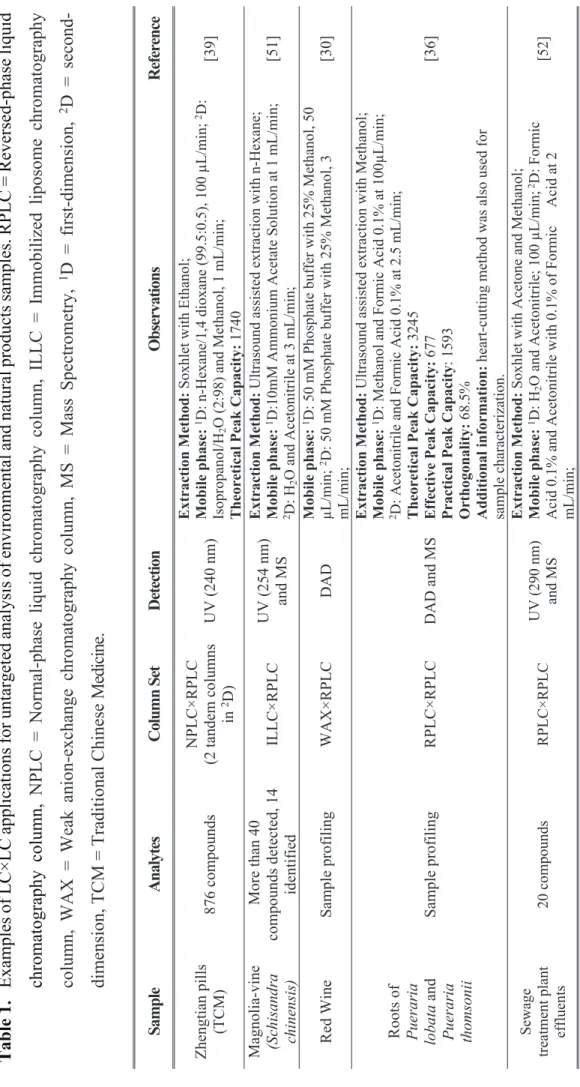
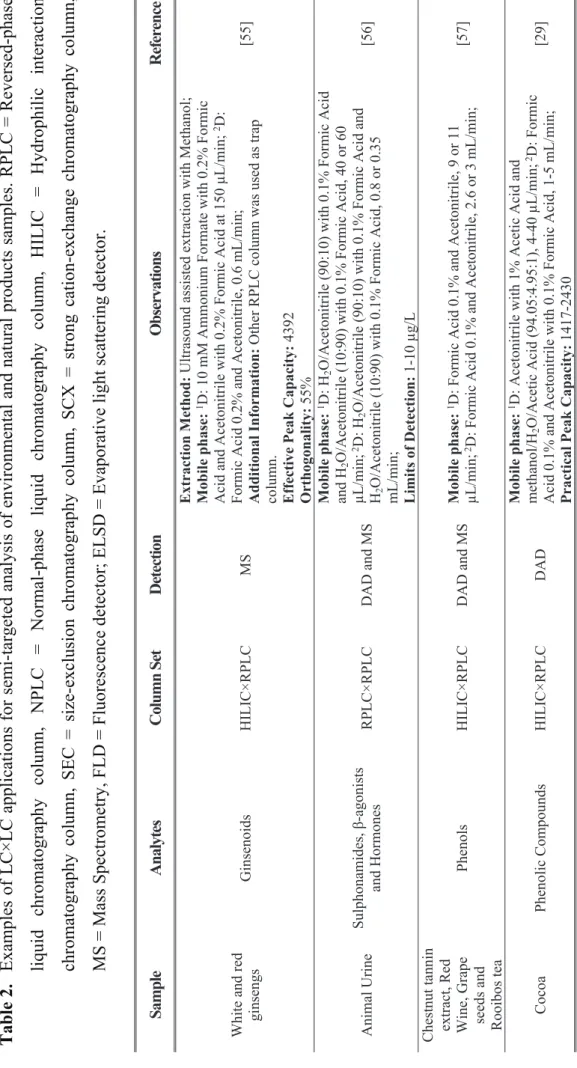
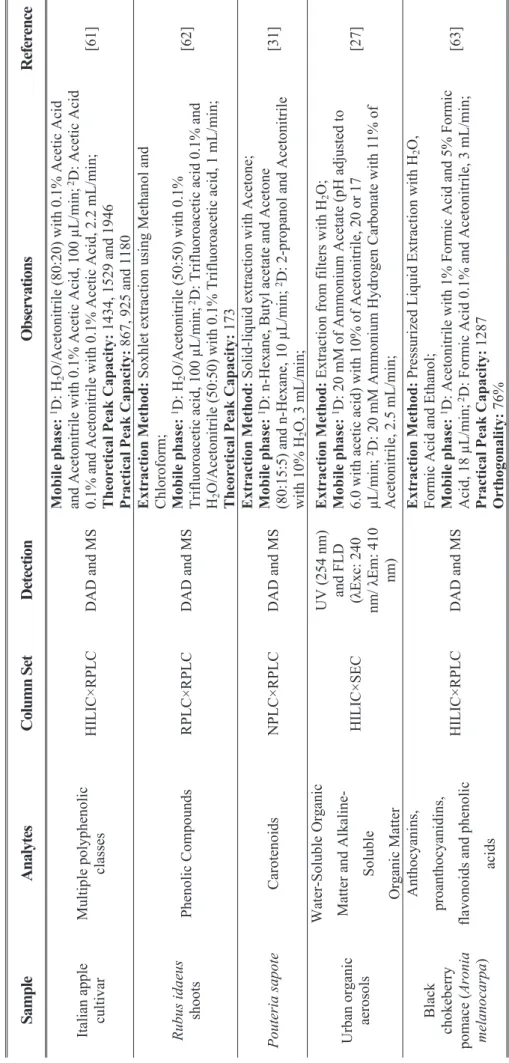
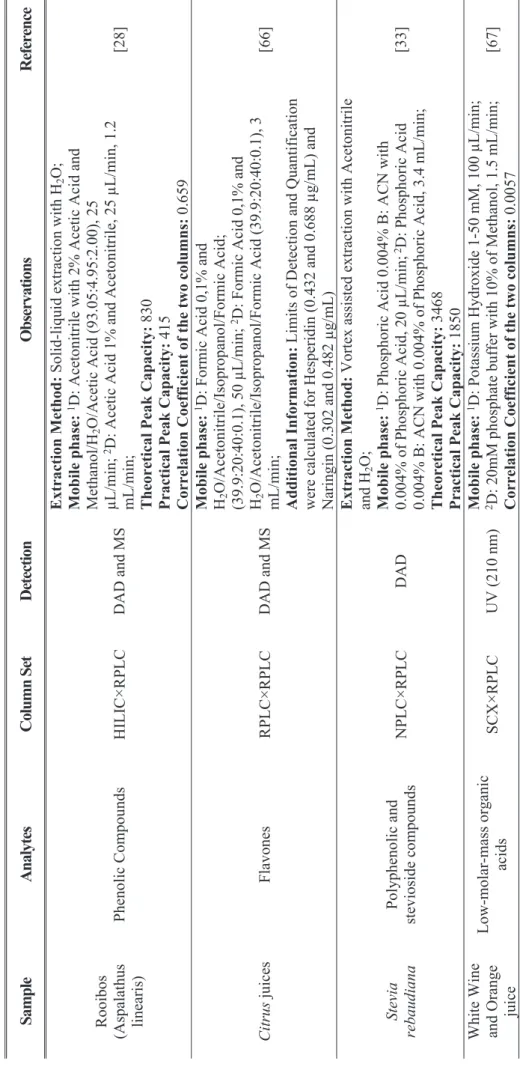
222 Tables 1 and 2 summarize some important examples of LC×LC applications for the
223 analysis of environmental and natural products samples from an untargeted and
225 LC×LC application is the profiling of natural products in plant extracts, particularly those
226 used in Traditional Chinese Medicine (e.g. ginseng and other plants extracts). This is due
227 to the complexity of these samples, encompassing hundreds or thousands of constituents
228 with very different properties, and possibly with synergistic effects, where the quality
229 control of these samples is a demanding issue [23]. When addressing the samples of
230 interest from a semi-targeted point of view (in Table 2), LC×LC is commonly applied
231 into the separation, with subsequent determination, of phenolic and polyphenolic
232 compounds, also in natural products. Although there is great potential to apply LC×LC
233 to environmental samples, this area has not developed that much at this point in time.
234 Online LC×LC coupled to MS detector has been used for semi-targeted analysis of
235 wastewater samples, allowing the identification of 23 to 65 compounds, including
236 analgesics such as Paracetamol and Tramadol, herbicides Diuron and Monuron,
237 Benzotriazole a knownCorrosion inhibitor, and antidepressants such as Venlafaxine and
238 Sertraline (references [24] and [25] in Table 2). LC×LC coupled to three detectors in
239 series [UV, fluorescence detector (FLD), and evaporative light-scattering detector
240 (ELSD)] was also applied to resolve the chemical heterogeneity of Suwannee River fulvic
241 acid standard material and Pony Lake fulvic acid reference material (reference [26] in
242 Table 2). Due to the complex nature of these samples, incompletely resolved fractions
243 were still portrayed. Nevertheless, in cases where samples separation was accomplished
244 (hydrophobicity × molecular weight), it was concluded that smaller molecular weight
245 group fractions seem to be related to a more hydrophobic nature. Following this seminal
246 work with complex natural organic matter, online LC×LC coupled to either a DAD and
247 FLD in series [27], or a single DAD [21] was applied to exploit the compositional changes
248 over a molecular size continuum and associated light-absorption properties of chemically
250 and alkaline-soluble organic matter (ASOM)]. The results obtained in these two later
251 studies highlight the potential of MLDC techniques, namely of online LC×LC coupled to
252 high resolution detectors, for unravelling the complexity of the substructures present in
253 complex environmental organic matrices. This fact constitutes a huge advantage in
254 comparison to the traditional 1D-LC. Moreover, even if one tries to replicate these results
255 using only 1D-LC techniques, this would need at least several chromatographic analysis
256 and tedious procedures for collection of fractions.
257 <TABLE 1 here>
258 <TABLE 2 here>
259 In any chromatographic method, the optimization of the separation conditions is crucial,
260 and LC×LC is no exception. Considerable efforts must be devoted in finding the best
261 LC×LC separation conditions because there are many different factors that can
262 significantly influence the final peak capacity. Selection of mobile phase composition in
263 both dimensions and their respective compatibility and flow rates, the type of switching
264 valve and the volume of the sampling loop, as well as selection of a fit-for-purpose
265 detection system, are important factors to have in mind when developing a LC×LC-based
266 method. Nonetheless, the most important factor when designing a LC×LC method is
267 arguably the selection of the separation mechanisms (i.e., columns) to be employed in
268 both dimensions, taking into account the analytical problem to be answered and whether
269 the selected separation mechanisms are distinct from each other, but compatible at the
270 same time. If successful in reaching this condition, enhanced orthogonality and peak
271 capacity will be achieved. In this regard, the analytical problem to be solved plays in fact
272 an important role in column selection. If dealing with a targeted analysis, the
273 orthogonality is not a crucial outcome of the LC×LC procedure. The separation columns
275 successful in answering the scientific question set a priori. In targeted analysis, there is
276 only a few sets of compounds of interest, and a small difference between stationary phases
277 can be enough to reach the desired separation. On the other hand, in semi-targeted and
278 untargeted analysis, the scenario is completely different, and the train of thought must be
279 necessarily different.
280 In the case of semi-targeted analysis, where the main purpose typically encompasses
281 studying different sets of classes of compounds, it is important to take into account the
282 structure of these analytes. For instance, if the compounds of interest all have low polarity,
283 then it would be a wise choice to use a reversed-phase LC (RPLC) column in one of the
284 dimensions, instead of a normal-phase LC (NPLC) column or even a hydrophilic
285 interaction chromatography (HILIC) column (which can behave as a RPLC or NPLC,
286 depending on mobile phase composition). Furthermore, the use of a RPLC×RPLC system
287 can be suitable for the separation of some specific classes of compounds, such as phenolic
288 compounds in Rooibos plants and Cocoa (references [28, 29], in Table 2), as long as the
289 two stationary phases have different properties (e.g. different particle size, composition
290 or different bonded phase). Other clear orthogonal combinations might be more difficult
291 to accomplish, such as HILIC×SEC, SCX×RPLC, and NPLC×RPLC, due to possible
292 mobile phase incompatibility. However, HILIC×SEC was already successfully used for
293 resolving and profiling the chemical heterogeneity of natural organic matter from aquatic
294 [26] and atmospheric matrices [21], whereas SCX×RPLC was employed for separation
295 of low-molar-mass organic acids in different matrices [30] (Table 2). NPLC×RPLC is
296 perhaps the least likely practical combination in terms of mobile phase compatibility,
297 although exhibiting a high orthogonality from a theoretical point of view. As shown in
298 Table 2, NPLC×RPLC has been applied for the separation of carotenoids [31, 32]
300 compounds [33] [reported peak capacities of 1850 (practical) and 3468 (theoretical)].
301 This NPLC×RPLC combination was only possible because the first-dimension
302 encompassed columns either exhibiting characteristic features of HILIC systems (acting
303 as NPLC) [33],or cyano microbore columns that offer normal-phase separations [31, 32].
304 On the other hand, if the desired type of analysis is untargeted, then using a RPLC×RPLC
305 would probably not be enough to achieve the best orthogonality and peak capacity.
306 However, the most common combinations in terms of separation mechanisms in natural
307 products and environmental research is RPLC×RPLC, as shown in Table 1. In an
308 untargeted analysis, it is questionable at first whether the combination of two or more
309 RPLC columns, that would probably have similar separation characteristics, will yield a
310 high orthogonality and peak capacity. Similar concerns are also valid when dealing with
311 combination of any other stationary phases that separate compounds by
312 polarity/hydrophobicity, such as HILIC, RPLC, and NPLC. Nonetheless, if aiming to
313 achieve the maximum orthogonality with these sort of columns, then the separation
314 conditions of the selected columns must be as much uncorrelated as possible. As shown
315 in Table 1, this premise was successfully accomplished in the untargeted analysis of
316 natural products [34-37] and household dust and laundry dryer lint [38] using
317 RPLC×RPLC, where the reported orthogonality were as high as 93%. However, an
318 interesting NPLC×RPLC combination is also noteworthy in the untargeted analysis of a
319 traditional Chinese medicine [39] (Table 1). A silica column was chosen for NPLC in the
320 first-dimension, and water-soluble non-polar 1,4-dioxane was selected as mobile phase
321 modifier in NPLC. As a result, 876 peaks were detected, and the total peak capacity
322 reached 1740 [39]. Since NPLC is suitable for group separation, and RPLC exhibits high
323 resolution for less polar compounds, the potential of NPLC×RPLC combination for the
325
3. Updating and trends in peak capacity and orthogonality
326 The main point behind the use of two (or more) separation columns on a chromatographic
327 system is to increase the maximum number of well resolved peaks, thus increasing the
328 number of compounds that can be separated and further identified in a single
329 chromatographic run. To accomplish this goal in LC×LC, a careful selection of the best
330 combination of separations columns must be made. As discussed in Section 2, if the
331 separation mechanisms in each chromatographic dimension are too similar, no significant
332 advantage will be gained by using more than one dimension, mostly because the
333 separation achieved with just one dimension will be basically the same, or lower in the
334 following dimensions. In such situations, it may be better to use the conventional 1D-LC
335 system, since there will be no loss of sensitivity caused by dilution of analytes in the
336 following second or third chromatographic dimension. Accordingly, the ideal possible
337 combination of columns should be those with completely uncorrelated separation
338 mechanisms.
339 Full orthogonality is theoretically achieved if the separation mechanisms in all
340 chromatographic dimensions are completely independent from each other [40]. In
341 LC×LC, orthogonality varies between 0 and 100%, where 100% means that full
342 orthogonality has been achieved [41]. In practice, however, it is very difficult to achieve
343 full orthogonality in LC×LC, because this depends not only on the separation
344 mechanisms in use, but also on the best separation conditions (e.g., mobile phase
345 composition and flow rates) and samples characteristics [42]. In this regard, even the
346 combination of two completely different separation mechanisms, such as SEC×RPLC,
347 can show some correlation [42]. If we consider the concept of orthogonality in a more
348 “visual” way, then a chromatogram where peaks are more disperse in the 2D space is
350 to the diagonal of the 2D chromatogram (Figures 2A and 2F, respectively). It should be
351 also noted that orthogonality is a concept specific of each sample. Two distinct separation
352 columns that present high orthogonality for one given sample may not be adequate for
353 achieving an orthogonal separation of other samples. Therefore, chromatographic
354 separation conditions should be extensively studied in order to ensure a successful
355 separation outcome. Figure 2 illustrate possible consequences of a poor choice of column
356 combinations in LC×LC. Although exhibiting low correlation coefficient between the two
357 separation columns, second-dimension column in chromatograms B and C represents two
358 situations of an excessive and low interaction, respectively, between the analytes and the
359 stationary phase, which is not desirable for successful LC×LC separations. The same is
360 true in chromatograms D and E, where a poor choice of the first-dimension separation
361 column has a similar effect on the LC×LC separations.
362 <FIGURE 2 here>
363 When orthogonality is estimated, the value refers to the degree of separation of all
364 analytes in one specific sample. In fact, if samples are too different, it is difficult to carry
365 out a straightforward comparison of the orthogonality achieved. For example, if the
366 sample preparation step discards the polar compounds, then orthogonality obtained using
367 the common RPLC×RPLC system will be much higher than it would be if the polar
368 compounds had not been removed. The use of a standard mixture of dozens or even
369 hundreds of different compounds, with very distinct characteristics (e.g., molecular size,
370 polarity, structure) should be a more reliable way to estimate an “universal orthogonality”
371 for a given LC×LC system. The concept of peak capacity was defined by Giddings, in
372 1969, as “the upper limit of resolvable components for a given technique under prescribed
373 conditions” [43]. In LC×LC, it is generally accepted that the theoretical peak capacity is
375 theoretical peak capacity value represents the “best case scenario”. For example, it
376 implies that no undersampling phenomena occurs and the resolution attained in one
377 dimension is never lost in the subsequent dimension. Nonetheless, the process of sample
378 transfer, from the first- to the second-dimension, will always lead to some resolution loss.
379 Furthermore, even though peak capacity should be seen as a noteworthy way to measure
380 the success of a separation process, we should also keep in mind that evenly spaced peaks
381 in a 2D chromatogram are extremely unlikely to be found in any real samples.
382 Interestingly, it has been shown that the number of well resolved peaks, in a given sample,
383 is unlikely to be higher than 18% of total peak capacity of a LC×LC system [44]. As a
384 consequence, the concepts of effective and practical peak capacity were developed as
385 criteria to more accurately estimate the maximum number of peaks that can be effectively
386 separated in a single 2D chromatographic run. The process of calculating the effective
387 peak capacity is relatively simple. Briefly, a correction factor due to undersampling
388 phenomena is applied to the theoretical peak capacity value, which will lead to a more
389 realistic value for the effective peak capacity [45]. On the other hand, the concept of
390 practical peak capacity is a bit more complex. As aforementioned, in LC×LC, it is almost
391 impossible to achieve full orthogonality; therefore, by definition, in a 2D chromatogram
392 there will exist always some areas that will never be occupied by any peak. This will
393 obviously lead to a decrease in the available 2D chromatographic area where peaks can
394 be separated, which will yield a practical peak capacity lower than the theoretical peak
395 capacity [40].
396 The concepts of orthogonality and theoretical peak capacity, as well as those of practical
397 and effective peak capacity, are important notions to have in mind when finding the best
398 chromatographic conditions for implementing a LC×LC method. If the objective of
400 applied in profiling real complex samples, thus a good way these different LC×LC
401 methods can be compared is through those metrics. Obviously, these metrics should not
402 be the only criteria for comparing and optimizing different LC×LC methods;
403 nevertheless, the orthogonality and theoretical peak capacity should both be estimated in
404 any LC×LC method development. Unfortunately, these metrics are not often reported in
405 the literature [46], although in the last years some good examples of orthogonality and
406 theoretical, effective and practical peak capacity have been described, particularly in the
407 field of Chinese herbal medicine screening [35-37] (Table 1).
408
409
410
4. Finding the best detection conditions
411 In conventional 1D-LC, when a large number of analytes is present in a given sample,
412 their identification based on the comparison with a mixture of standard compounds is no
413 longer a feasible option. The coupling of chromatographic methods with a MS detector
414 is an excellent way to overcome this situation and attain the desired analytes
415 identification. Generally, studies summarized in Tables 1 and 2 employ as detection the
416 UV absorbance (either DAD or single UV wavelength), MS, or both detectors in series,
417 with the exception of two studies on natural organic matter that also use fluorescence and
418 evaporative light scattering detectors (Table 2) [26, 27]. Although a more comprehensive
419 identification of the analytes is overwhelmingly more frequent using MS, this does not
420 mean that the use of any other type of detector becomes pointless. It is possible to obtain
421 rather important information with the use of a DAD detector, since chromophores present
422 in a sample may have distinct absorption maxima that can be used to differentiate between
424 Hence, in LC×LC, the use of a MS detector is rather common, and an enhanced separation
425 before the MS detection has various advantages when compared to 1D-LC-MS. Some of
426 these advantages include the reduction of matrix effects resulting from coeluting analytes
427 due to the increased separation power of the LC×LC system, increased ionization
428 efficiency and minimization of ion suppression [16]. On the other hand, the coupling of
429 a MS detector to a LC×LC system is not as straightforward as in 1D-LC and some specific
430 modifications have to be made. In LC×LC-MS, the mobile phase constituents,
431 particularly in the second-dimension, must be volatile in order to be compatible with the
432 MS source [16]. Thus, the second-dimension separation column must be compatible with
433 mobile phases whose composition includes high percentage of organic solvents, such as
434 methanol or acetonitrile, and volatile additives, such ammonium acetate and formic acid.
435 In this regard, NPLC columns, or any other column that does not meet these requirements,
436 can hardly be used as the last separation dimension before the MS detector.
437 Notwithstanding this situation, the work developed by P. Dugo’s research group is an
438 excellent example of the use of NPLC in the first-dimension combined with RPLC in the
439 second-dimension, and an MS as detector [31, 32, 48] [].
440 Another important requirement when coupling LC×LC to a MS detector is the sampling
441 rate. It has been demonstrated by Murphy and co-workers [49], that the sampling rate of
442 the first-dimension effluent has a significant influence on the resolution achieved in the
443 second-dimension, suggesting that each peak in the first-dimension should be sampled at
444 least three times. Therefore, the flow rate in the second-dimension is typically much
445 higher than those used in the first-dimension. The extremely high flow rates in the
second-446 dimension (up to 5 mL min-1) are completely incompatible with any sort of MS detection.
447 In the case of electrospray ionization (ESI), the maximum flow rate can be, at most, 1 mL
449 flow rate is 2 mL min-1. In practice, however, these flow rate values should be much lower
450 than the maximum values allowed [25, 50].The most common way to solve this issue in
451 LC×LC-MS is to use a flow splitter before the MS detector. This solution will allow the
452 detection of the analytes in the MS but will also greatly decrease the sensitivity of the
453 method. A more sophisticated response to this problem is the miniaturization of the entire
454 LC×LC system, which is more common in proteomics, but has also been successfully
455 employed by Haun and co-workers in wastewater analysis [25] (Table 2). The main
456 objective of this specific study was the construction of a miniaturized 2D-LC system,
457 coupled to a Quadrupole/Time-of-Flight Mass Spectrometric detection, for wastewater
458 profiling without the need to split the flow [25]. To decrease the time of analysis in the
459 second-dimension, high pressure and temperature conditions as well as a stationary phase
460 of superficially porous sub-3-µm were employed. The miniaturization of the LC×LC
461 system leads also to much lower solvent consumption. Using a standard mixture of 99
462 target compounds, the miniaturized LC×LC-MS system allowed the detection and
463 identification of 65 standard compounds in the wastewater samples. Despite the obvious
464 advantages over other LC×LC-MS systems, the work of Haun et al. [25] exhibits a real
465 possibility of an excessive decrease in system sensitivity when compared to a 1D-LC-MS
466 system, due to the dilution effect in the second-dimension separation. It should also be
467 taken into account that MS identification does not strictly require a complete
468 chromatographic separation of the analytes. To assess these points, another work, using
469 the same miniaturized LC×LC-MS system, was later published, with the objective of
470 comparing its sensitivity to that of a conventional 1D-LC-MS system in the analysis of
471 wastewater samples [24]. It was reported that the absolute intensity of the signal in the
472 LC×LC-MS system was ten times lower of that of the 1D-LC-MS system. However, this
474 only around 1.5 times lower when using the miniaturized LC×LC-MS. It was also
475 reported that the number of identified compounds was always higher in the miniaturized
476 MS system. Nevertheless, the main problem with miniaturization of the
LC×LC-477 MS system is probably its cost due to the use of expensive nanoLC pumps. However, the
478 simple decrease of the mobile phase flow rate in the second-dimension, to the range of
479 1-2 mL min-1, should have beneficial effects. Even if this means that a flow splitter is still
480 necessary, at least the second-dimension effluent does not have to be split as much as in
481 other LC×LC-MS systems, which will lead to better results in terms of sensitivity.
482
483
484
5. Conclusions
485 Over the past 10-15 years, the emergence of more effective systems and analytical
486 methodologies based on online LC×LC separations has become a clear trend in natural
487 products research. Surprisingly, and despite the advent of LC×LC-based methods, the use
488 of LC×LC methods is yet to be fully exploited in environmental research. The importance
489 of these methods is not only associated with the separation of the sample components, but
490 also with the rapidly evolving field of analytical instrumentation which has produced
491 more sophisticated detectors capable of providing a higher discrimination power. It is
492 clear from a vast assortment of studies in the literature that the use of hyphenated 1D-LC
493 methods (e.g. LC–MS and LC–NMR, Figure 1) has been able to provide new insights on
494 the compositional features of highly complex samples, a know-how which was
495 unforeseeable not long ago. However, the continuous development and use of MDLC,
496 namely online LC×LC, has shown the potential to provide deeper and more complete
498 despite several technological challenges that still needs to be overcome to attain its full
499 capability.
500 Most environmental and natural products studies using LC×LC-MS as analytical
501 technique have focused either on screening or identification of a small sets of compounds
502 (i.e., in untargeted and semi-targeted analysis, respectively). The use of LC×LC in
503 environmental research has also focused on the global characterization of samples for
504 achieving a heuristic understanding of the complex structural nature and
505 interrelationships between different components within the samples. Therefore, it is with
506 no surprise that major improvements in the stationary phase technology in both LC
507 dimensions aiming at reaching orthogonality are still required, namely for acquiring a
508 better understanding of the interactions that occur between the samples’ components and
509 the stationary phase. As a further step, it is necessary to reduce or even eliminate the
510 confounding effects due to these interactions occurring in the chromatographic analysis.
511 This step will be particularly challenging, but it will be mandatory for the identification
512 of the interactions that really occur within the environmental and natural products
513 samples. Without a clear idea of the mechanisms that occur in the separation process, it
514 will never be possible to assess the complexity of an environmental or natural product
515 sample, simply because the decoding of the complexity of such samples cannot be
516 accomplished following a separation process equally complex. Nevertheless, if able to
517 solve these methodological challenges, LC×LC-based methods can be a promising tool
518 for advancing environmental research and achieve a deeper level of knowledge within
519 this field.
520
521
523
Acknowledgments
524 Thanks are due to FCT/MCTES for the financial support to CESAM
525 (UID/AMB/50017/2019) and project AMBIEnCE (PTDC/CTA-AMB/28582/2017),
526 through national funds (OE). FCT/MEC and the European Social Fund are also
527 acknowledged for a PhD grant (PD/BD/142931/2018) and an Investigator FCT Contract
528 (IF/00798/2015).
529
530
531
References
532 1. Consden, R., A.H. Gordon, and A.J. Martin, Qualitative analysis of proteins: a
533 partition chromatographic method using paper. The Biochemical journal, 1944.
534 38(3): p. 224-232.
535 2. Erni, F. and R.W. Frei, Two-dimensional column liquid chromatographic technique
536 for resolution of complex mixtures. Journal of Chromatography A, 1978. 149: p.
561-537 569.
538 3. Marriott, P.J., P. Schoenmakers, and Z.Y. Wu, Nomenclature and conventions in
539 comprehensive multidimensional chromatography- an update. LC GC Europe, 2012.
540 25(5).
541 4. Pirok, B.W.J., D.R. Stoll, and P.J. Schoenmakers, Recent Developments in
Two-542 Dimensional Liquid Chromatography: Fundamental Improvements for Practical
543 Applications. Analytical Chemistry, 2019. 91(1): p. 240-263.
544 5. Wang, X., S. Buckenmaier, and D. Stoll, The growing role of two-dimensional LC in
545 the biopharmaceutical industry. Vol. 3. 2017. 120-126.
546 6. Stoll, D.R. and P.W. Carr, Two-Dimensional Liquid Chromatography: A State of the
547 Art Tutorial. Analytical Chemistry, 2017. 89(1): p. 519-531.
548 7. Cao, J.L., et al., Application of two-dimensional chromatography in the analysis of
549 Chinese herbal medicines. Journal of Chromatography A, 2014. 1371: p. 1-14.
550 8. Tranchida, P.Q., et al., Potential of comprehensive chromatography in food analysis.
552 9. Zhang, X., et al., Multi-dimensional liquid chromatography in proteomics-A review.
553 Analytica Chimica Acta, 2010. 664(2): p. 101-113.
554 10. Wang, H. and S. Hanash, Multi-dimensional liquid phase based separations in
555 proteomics. Journal of Chromatography B: Analytical Technologies in the
556 Biomedical and Life Sciences, 2003. 787(1): p. 11-18.
557 11. Kootstra, P.R. and H.A. Herbold, Automated solid-phase extraction and
coupled-558 column reversed-phase liquid chromatography for the trace-level determination of
559 low-molecular-mass carbonyl compounds in air. Journal of Chromatography A,
560 1995. 697(1): p. 203-211.
561 12. Hogendoorn, E.A., et al., Microwave assisted solvent extraction and coupled-column
562 reversed-phase liquid chromatography with UV detection: Use of an analytical
563 restricted-access-medium column for the efficient multi-residue analysis of acidic
564 pesticides in soils. Journal of Chromatography A, 2001. 938(1-2): p. 23-33.
565 13. Matějíček, D., Multi heart-cutting two-dimensional liquid chromatography–
566 atmospheric pressure photoionization-tandem mass spectrometry method for the
567 determination of endocrine disrupting compounds in water. Journal of
568 Chromatography A, 2012. 1231: p. 52-58.
569 14. Matejicek, D., On-line two-dimensional liquid chromatography-tandem mass
570 spectrometric determination of estrogens in sediments. J Chromatogr A, 2011.
571 1218(16): p. 2292-3000.
572 15. Giddings, J.C., Multidimensional Chromatography, Cortes HJ (ed). Marcel Dekker,
573 New York, 1990, pp. 1-27.
574 16. Cacciola, F., et al., Comprehensive Two-Dimensional Liquid Chromatography
575 Coupled to Mass Spectrometry: Fundamentals, Method Development and
576 Applications, in Comprehensive Analytical Chemistry. 2018. p. 81-123.
577 17. Calvin Giddings, J., Two-dimensional separations:concept and promise. Analytical
578 Chemistry, 1984. 56(12): p. 1258A-1268A+1270A.
579 18. Matos, J.T.V., R.M.B.O. Duarte, and A.C. Duarte, Trends in data processing of
580 comprehensive two-dimensional chromatography: State of the art. Journal of
581 Chromatography B: Analytical Technologies in the Biomedical and Life Sciences,
582 2012. 910: p. 31-45.
583 19. Pierce, K.M., et al., Review of chemometric analysis techniques for comprehensive
585 20. Mondello, L., et al., Quantification in comprehensive two-dimensional liquid
586 chromatography. Analytical Chemistry, 2008. 80(14): p. 5418-5424.
587 21. Matos, J.T.V., et al., Profiling water-soluble organic matter from urban aerosols
588 using comprehensive two-dimensional liquid chromatography. Aerosol Science and
589 Technology, 2015. 49(6): p. 381-389.
590 22. Milman, B.L. and I.K. Zhurkovich, The chemical space for non-target analysis.
591 TrAC Trends in Analytical Chemistry, 2017. 97: p. 179-187.
592 23. Yang, D.Z., et al., Multidimensional information-based HPLC technologies to
593 evaluate traditional Chinese medicine. Journal of Chromatographic Science, 2013.
594 51(7): p. 716-725.
595 24. Leonhardt, J., et al., A comparison of one-dimensional and microscale
two-596 dimensional liquid chromatographic approaches coupled to high resolution mass
597 spectrometry for the analysis of complex samples. Analytical Methods, 2015. 7(18):
598 p. 7697-7706.
599 25. Haun, J., et al., Online and splitless NanoLC × CapillaryLC with
quadrupole/time-600 of- flight mass spectrometric detection for comprehensive screening analysis of
601 complex samples. Analytical Chemistry, 2013. 85(21): p. 10083-10090.
602 26. Duarte, R.M., A.C. Barros, and A.C. Duarte, Resolving the chemical heterogeneity
603 of natural organic matter: new insights from comprehensive two-dimensional liquid
604 chromatography. J Chromatogr A, 2012. 1249: p. 138-46.
605 27. Paula, A.S., et al., Two chemically distinct light-absorbing pools of urban organic
606 aerosols: A comprehensive multidimensional analysis of trends. Chemosphere, 2016.
607 145: p. 215-223.
608 28. Beelders, T., et al., Comprehensive two-dimensional liquid chromatographic
609 analysis of rooibos (Aspalathus linearis) phenolics. Journal of Separation Science,
610 2012. 35(14): p. 1808-1820.
611 29. Muller, M., A.G.J. Tredoux, and A. de Villiers, Predictive kinetic optimisation of
612 hydrophilic interaction chromatography × reversed phase liquid chromatography
613 separations: Experimental verification and application to phenolic analysis. Journal
614 of Chromatography A, 2018. 1571: p. 107-120.
615 30. Matos, J.T.V., R.M.B.O. Duarte, and A.C. Duarte, A simple approach to reduce
616 dimensionality from comprehensive two-dimensional liquid chromatography
296-619 31. Cacciola, F., et al., Application of Comprehensive Two-Dimensional Liquid
620 Chromatography for Carotenoid Analysis in Red Mamey (Pouteria sapote) Fruit.
621 Food Analytical Methods, 2016. 9(8): p. 2335-2341.
622 32. Dugo, P., et al., Comprehensive normal-phase×reversed-phase liquid
623 chromatography coupled to photodiode array and mass spectrometry detection for
624 the analysis of free carotenoids and carotenoid esters from mandarin. Journal of
625 Chromatography A, 2008. 1189(1): p. 196-206.
626 33. Cacciola, F., et al., Employing ultra high pressure liquid chromatography as the
627 second dimension in a comprehensive two-dimensional system for analysis of Stevia
628 rebaudiana extracts. Journal of Chromatography A, 2011. 1218(15): p. 2012-2018.
629 34. Sheng, N., et al., Chiral separation and chemical profile of Dengzhan Shengmai by
630 integrating comprehensive with multiple heart-cutting two-dimensional liquid
631 chromatography coupled with quadrupole time-of-flight mass spectrometry. Journal
632 of Chromatography A, 2017. 1517: p. 97-107.
633 35. Zhou, W., et al., On-line comprehensive two-dimensional liquid chromatography
634 tandem mass spectrometry for the analysis of Curcuma kwangsiensis. Talanta, 2018.
635 186: p. 73-79.
636 36. Qiao, X., et al., Separation and detection of minor constituents in herbal medicines
637 using a combination of heart-cutting and comprehensive two-dimensional liquid
638 chromatography. Journal of Chromatography A, 2014. 1362: p. 157-167.
639 37. Qiao, X., et al., A chemical profiling solution for Chinese medicine formulas using
640 comprehensive and loop-based multiple heart-cutting two-dimensional liquid
641 chromatography coupled with quadrupole time-of-flight mass spectrometry. Journal
642 of Chromatography A, 2016. 1438: p. 198-204.
643 38. Ouyang, X., et al., Non-target analysis of household dust and laundry dryer lint using
644 comprehensive two-dimensional liquid chromatography coupled with time-of-flight
645 mass spectrometry. Chemosphere, 2017. 166: p. 431-437.
646 39. Wei, Y., et al., A comprehensive two-dimensional normal-phase × reversed-phase
647 liquid chromatography based on the modification of mobile phases. Journal of
648 Chromatography A, 2009. 1216(44): p. 7466-7471.
649 40. Liu, Z., D.G. Patterson, Jr., and M.L. Lee, Geometric Approach to Factor Analysis
650 for the Estimation of Orthogonality and Practical Peak Capacity in Comprehensive
652 41. Gilar, M., et al., Orthogonality of Separation in Two-Dimensional Liquid
653 Chromatography. Analytical Chemistry, 2005. 77(19): p. 6426-6434.
654 42. François, I., K. Sandra, and P. Sandra, Comprehensive liquid chromatography:
655 Fundamental aspects and practical considerations-A review. Analytica Chimica
656 Acta, 2009. 641(1-2): p. 14-31.
657 43. Giddings, J.C., Generation of Variance, “Theoretical Plates,” Resolution, and Peak
658 Capacity in Electrophoresis and Sedimentation. Separation Science, 1969. 4(3): p.
659 181-189.
660 44. Shellie, R.A. and P.R. Haddad, Comprehensive two-dimensional liquid
661 chromatography. Analytical and Bioanalytical Chemistry, 2006. 386(3): p. 405-415.
662 45. Filgueira, M.R., et al., Improving Peak Capacity in Fast Online Comprehensive
Two-663 Dimensional Liquid Chromatography with Post-First-Dimension Flow Splitting.
664 Analytical Chemistry, 2011. 83(24): p. 9531-9539.
665 46. Malerod, H., E. Lundanes, and T. Greibrokk, Recent advances in on-line
666 multidimensional liquid chromatography. Analytical Methods, 2010. 2(2): p.
110-667 122.
668 47. Ioannis N. Papadoyannis, H.G.G., Peak Identification with a Diode Array Detector,
669 in Encyclopedia of Chromatography, J. Cazes, Editor. 2004, Marcel Dekker, Inc.
670 48. Dugo, P., et al., Application of Comprehensive Two-Dimensional Liquid
671 Chromatography To Elucidate the Native Carotenoid Composition in Red Orange
672 Essential Oil. Journal of Agricultural and Food Chemistry, 2008. 56(10): p.
3478-673 3485.
674 49. Murphy, R.E., M.R. Schure, and J.P. Foley, Effect of Sampling Rate on Resolution
675 in Comprehensive Two-Dimensional Liquid Chromatography. Analytical Chemistry,
676 1998. 70(8): p. 1585-1594.
677 50. Mondello, L., Comprehensive Chromatography in Combination with Mass
678 Spectrometry. Comprehensive Chromatography in Combination with Mass
679 Spectrometry. 2011.
680 51. Wang, S., et al., Comprehensive two-dimensional high performance liquid
681 chromatography system with immobilized liposome chromatography column and
682 monolithic column for separation of the traditional Chinese medicine Schisandra
683 chinensis. Analytica Chimica Acta, 2012. 713: p. 121-129.
686 sewage treatment plant effluents. Journal of Chromatography A, 2015. 1380: p.
139-687 145.
688 53. Wong, Y.F., et al., Untargeted profiling of Glycyrrhiza glabra extract with
689 comprehensive two-dimensional liquid chromatography-mass spectrometry using
690 multi-segmented shift gradients in the second dimension: Expanding the metabolic
691 coverage. Electrophoresis, 2018. 39(15): p. 1993-2000.
692 54. Sommella, E., et al., Chemical profiling of bioactive constituents in hop cones and
693 pellets extracts by online comprehensive two-dimensional liquid chromatography
694 with tandem mass spectrometry and direct infusion Fourier transform ion cyclotron
695 resonance mass spectrometry. Journal of Separation Science, 2018. 41(7): p.
1548-696 1557.
697 55. Zhang, H., et al., A multidimensional analytical approach based on time-decoupled
698 online comprehensive two-dimensional liquid chromatography coupled with ion
699 mobility quadrupole time-of-flight mass spectrometry for the analysis of ginsenosides
700 from white and red ginsengs. Journal of Pharmaceutical and Biomedical Analysis,
701 2019. 163: p. 24-33.
702 56. Blokland, M.H., et al., Multiclass screening in urine by comprehensive
two-703 dimensional liquid chromatography time of flight mass spectrometry for residues of
704 sulphonamides, beta-agonists and steroids. Food Additives and Contaminants - Part
705 A Chemistry, Analysis, Control, Exposure and Risk Assessment, 2018. 35(9): p.
706 1703-1715.
707 57. Venter, P., et al., Comprehensive Three-Dimensional LC × LC × Ion Mobility
708 Spectrometry Separation Combined with High-Resolution MS for the Analysis of
709 Complex Samples. Analytical Chemistry, 2018. 90(19): p. 11643-11650.
710 58. Muller, M., A.G.J. Tredoux, and A. de Villiers, Application of Kinetically Optimised
711 Online HILIC × RP-LC Methods Hyphenated to High Resolution MS for the Analysis
712 of Natural Phenolics. Chromatographia, 2018.
713 59. Montero, L., et al., Profiling of Vitis vinifera L. canes (poly)phenolic compounds
714 using comprehensive two-dimensional liquid chromatography. Journal of
715 Chromatography A, 2018. 1536: p. 205-215.
716 60. Cook, D.W., et al., Comparison of multivariate curve resolution strategies in
717 quantitative LCxLC: Application to the quantification of furanocoumarins in
719 61. Sommella, E., et al., Development of an improved online comprehensive hydrophilic
720 interaction chromatography × reversed-phase ultra-high-pressure liquid
721 chromatography platform for complex multiclass polyphenolic sample analysis.
722 Journal of Separation Science, 2017. 40(10): p. 2188-2197.
723 62. Kula, M., D. Głód, and M. Krauze-Baranowska, Two-dimensional liquid
724 chromatography (LC) of phenolic compounds from the shoots of Rubus idaeus 'Glen
725 Ample' cultivar variety. Journal of Pharmaceutical and Biomedical Analysis, 2016.
726 121: p. 99-106.
727 63. Brazdauskas, T., et al., Downstream valorization and comprehensive
two-728 dimensional liquid chromatography-based chemical characterization of bioactives
729 from black chokeberries (Aronia melanocarpa) pomace. Journal of Chromatography
730 A, 2016. 1468: p. 126-135.
731 64. Montero, L., et al., Anti-proliferative activity and chemical characterization by
732 comprehensive two-dimensional liquid chromatography coupled to mass
733 spectrometry of phlorotannins from the brown macroalga Sargassum muticum
734 collected on North-Atlantic coasts. Journal of Chromatography A, 2016. 1428: p.
735 115-125.
736 65. Willemse, C.M., et al., Comprehensive Two-Dimensional Hydrophilic Interaction
737 Chromatography (HILIC) × Reversed-Phase Liquid Chromatography Coupled to
738 High-Resolution Mass Spectrometry (RP-LC-UV-MS) Analysis of Anthocyanins and
739 Derived Pigments in Red Wine. Analytical Chemistry, 2015. 87(24): p. 12006-12015.
740 66. Russo, M., et al., Determination of flavanones in Citrus juices by means of one- and
741 two-dimensional liquid chromatography. Journal of Separation Science, 2011. 34(6):
742 p. 681-687.
743 67. Brudin, S.S., et al., Comprehensive two-dimensional liquid chromatography: Ion
744 chromatography×reversed-phase liquid chromatography for separation of
low-745 molar-mass organic acids. Journal of Chromatography A, 2010. 1217(43): p.