CURRICULUM INTEGRATION IN TEACHER TRAINING: A REFLECTION
FOCUSED ON SUPERVISED TEACHING PRACTICE AT THE HIGHER SCHOOL
OF EDUCATION OF VISEU
Cardoso, A. P.; Ribeiro, E.J.; Menezes, L.; Marques, C.; Rocha, J.; Figueiredo, M.1
1
Instituto Politécnico de Viseu, CI&DETS, Escola Superior de Educação, Portugal
Email: [email protected]; [email protected]; [email protected]; [email protected]; [email protected]; [email protected]
Abstract
The Master's degree in Pre-School Education and Teaching in the 1st Cycle of Basic Education, in accordance with the present legislation, includes the component of Supervised Teaching Practice (STP). The way to organize this training component, although regulated by some principles contained in the legal documents, is of the responsibility of each institution of higher education that teaches the course.
In this communication, we present a study that aims to: (i) !"#$%&'()!&%*$+),-)+&."!%$-"!-),!.!/$ the referred STP, and (ii) reflect on the model of organization and functioning of the STP implemented in the Higher School of Education of Viseu (Portugal).
This is an exploratory research of a descriptive nature, based on the questionnaire survey. The participants in this study are s&'()!&%$.!$&0)$12%&),*%$()/,))$.!$3,)-School Education and Teaching in the 1st Cycle of Basic Education from Higher School of Education of Viseu (ESEV).
The obtained results show a good acceptance of the Supervised Teaching Practice model by students, recognizing the importance of contacting with the two levels of education in various teaching institutions. In addition, they value the tasks developed within STP, as well as the support of the multidisciplinary team.
Keywords: s&'()!&%*$+),-)+&."!%4$&)2-0),$training; supervised teaching practice.
1 Introduction
The Master in Pre-School Education and Teaching in the 1st Cycle of Basic Education is a course which qualifies teachers professionally to teach in Pre-school Education and 1st Cycle Primary School (1st 5 4th years). The course was created by Order n.º 4530/09 of 5 February and has a total of 90 ECTS lasting three semesters.
This 2nd Cycle of studies includes a training component called Supervised Teaching Practice (STP), which seeks to ensure the educational experience within the professional context of teaching. How this component is implemented is the responsibility of each higher education organizing the STP within the parameters set forth in the legislation. The character of the STP in this course is continuous and integrating. Throughout the course the student will develop their personal and professional skills which are appropriate to the different job performance dimensions for the preschool and primary school teacher from a lifelong learning perspective.
Whereas the first group of students recently completed their training, it is important learn their perceptions of STP, and subsequently reflect on the organization and operating model of the teaching practice implemented at the Higher School of Education (ESEV).
The aim of this study is to inform and promote the discussion regarding the training model for future teachers in order to improve the training teaching provided.
2 The Supervised Teaching Practice Component of the 2
ndCycle Studies in
Pre-School and Primary Education
The Masters in Pre-School Education and Teaching in the 1st Cycle of Basic Education in Portugal stem from the changes made to the law governing the education system (Law n.º 46/86 of 14 October) as well as changes brought about by the Bologna Process from the publication of Decree-Law n.º 74/2006 of 24 March (the legal framework regarding higher education degrees and diplomas), and more specifically in the field of professional teaching qualifications, by Decree-Law n.º 43/2007 of 22 February.
According to this Decree-Law, ESEV organized the training STP component, including the seminar, internship and tutorial components. The maximum number of credits allocated (45 ECTS) are distributed as shown in Table 1.
Table 1: Distribution of credits and contact hours in the Supervised Teaching Practice component
Supervised Teaching Practice STP I STP II STP III
Credits 12 15 18
Contact hours 161 (42S +91E++28OT) 196(28S+140E+28OT) 238(42S+154E+42OT)
Teaching practice is an essential component of initial teacher training which allows theory to be associated with practice through reflection on action (Schön, 1983, 1987), developing progressive responsibility and teacher autonomy (Shulman, 1986; Roldão, 2000; Alarcão, 2005) and stimulating the ability to look for solutions to the problems that arise from educational situations.
The aim of the STP curricular units is for students to observe and intervene in teaching/learning situations in nursery and primary schools. To this end, they are required to plan activities through mobilizing knowledge, skills and educational resources. They must collaborate to promote and implement school projects and develop a critical and reflective posture with regards to the challenges, processes and practices stemming from teaching/learning within the contexts in which they act.
2.1 Organisation and functioning of Supervised Teaching Practice
In the three STP curricular units students, organized in groups of two or three, conduct their activities in nursery and primary schools from the 1st semester of the course. They have the support of cooperating advisors and ESEV supervisors.
In STP I, the students carry out their internship in both teaching levels (pre-school and primary) for five weeks (two days a week) in each of these. This allows them to come into contact with the school organization and its operation, as well as to observe classes/activities and the planning of educational interventions within the context of the classroom with group teaching (four weeks) and individual teaching (one week).
In the STP II unit curricular, one part of the class carries out their internship in pre-school and the other part in primary school. These levels are then switched in the following semester (STP III). The internship takes place over fifteen weeks (three days a week), and includes observation of classes/activities, as well as individual planning and intervention within the context of classroom.
Students perform observation tasks to critically characterize and analyze contexts, components and curricular levels, to plan coordinated activities. They also prepare materials and execute their plans in educational contexts with classes/groups under the supervision of their cooperating advisors who accompanies them in a progressive process of constructing professional knowledge.
Student supervision during their internship is ensured through a training mechanism that integrates a team of experts (a multidisciplinary team) in the areas of teacher training (TT) and in their specialty area (Educational Sciences).
At each specific level, articulation is ensured by a teacher in charge of each level of the curricular unit and by the course coordinator. This team of teachers ensures the monitoring of specific tutorial groups, as well as supervision of the whole class and support of activities in their area.
Monitoring the work carried out where their internship takes place is performed by the entire team, in conjunction with the cooperating advisors at the nursery/primary schools. The days when activities are implemented are reserved !"#$%"#%&'$%()*"+%%,-.")'$%/0-%)"#1"%!)0(%"#$%."&(%"&2& -&3-%"#1"#(&2%-"#1"#$%")'$11-)4
The flow of information between students and staff is also supported by a multidirectional e-learning platform, where there is also a space to communicate with the cooperating advisors.
2.2 T !"#!$!%#& "&'()'*!*+",*"$+-.!*+$/")#'0!$$,'*%1"+#%,*,*2
5%)%&('$" )" '1!) /%(%/" &" ,%." )#(&#%6." !" )#0/%!#)*" 7(18%)) 1!&-" #(& ! !64" 9#" )" #$0)" &)) 6!%/" 7&(# '0-ar importance in terms of STP. Initiating students in research related to practice allows them to develop their ability as future educators/teachers to analyze and question professional situations in the various contexts in which they operate and to develop alternative, empirically grounded, proposals for change (Schön, 1987; Zeichner 1993, Ponte, 2002; Estrela, 2002).
Throughout their STP, students develop their research work. In STP I, the students define three research questions, one of which will be selected for the beginning of the research project. They are assigned an advisor, and co-advisor if necessary. In STP II, they elaborate the research project on the topic selected under the scientific guidance of their respective supervisors. In STP III, they develop the project under the supervision of their advisors and the final (%)%&('$"7(1:%'#" )" !#%6(&#%/" !#1"#$%" !#%(!)$ 7*)"8 !&-"(%71(#;"+$ '$" )")03:%'#"#1"703- '"/%8%!'%4"<$ )" )"&!" !/ 2 /0&-" report and consists of two complementary parts: a critical appraisal of the whole STP course in both education levels and the referred research project.
3 Methodology
9!"1(/%("#1",!1+")#0/%!#)*"7%('%7# 1!)"&310#"#$%"=<>;"+%"'1!/0'#%/"&"/%)'( 7# 2%"(%)%&('$")#0/."?@1(# !;"ABBCD"0) !6" a survey by questionnaire.
The study involved graduating students in their 2nd year of the Masters program. Out of a total of 24 students, 17 completed the questionnaire so that the response rate was 70.8%. The students are all female aged between 22 and 27 years, with a majority (64.7%) who has 23 years old.
Data collection was based on an online questionnaire consisting of two types of questions/items: twelve closed multiple choice items using a 5-level Likert scale (ranging from strongly agree to strongly disagree) and two open q0%)# 1!)"81("(%)71!/%!#)"#1"6 2%"#$% ("17 ! 1!"E !"#$% ("1+!"+1(/)F"?G$ 6- 1!%"H"I&#&-1!;"ABBJ;"74"JJKD4
The preliminary draft was pre-tested by a few masters graduates, showing that there are no difficulties in comprehension.
The multiple choice answers were analyzed through descriptive statistics. Content analysis was used to analyze the answers to open questions using categorical analysis (Bardin, 1979).
4 Results
In this section the perceptions of students surveyed on the STP are presented in the order of the questionnaire items.
4.1 Supervised Teaching Practice in the course
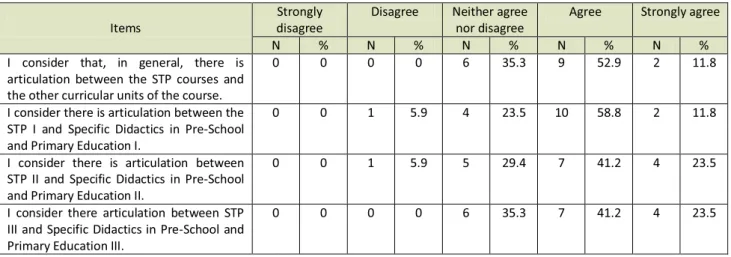
The vast majority of students agrees (52.9%) or strongly agrees (11.8%), that, in general, there is articulation between the STP courses and the other curricular units in their study plan. It is also worth highlighting the clear articulation between STP I and Specific Didactics I, with which the majority of respondents agrees (58.8%) or strongly agrees (11.8%) (Table 2).
Table 2: Students perception about the articulation between Supervision Teacher Practice and other curricular units in the course Items
Strongly disagree
Disagree Neither agree nor disagree
Agree Strongly agree
N % N % N % N % N %
I consider that, in general, there is articulation between the STP courses and the other curricular units of the course.
0 0 0 0 6 35.3 9 52.9 2 11.8
I consider there is articulation between the STP I and Specific Didactics in Pre-School and Primary Education I.
0 0 1 5.9 4 23.5 10 58.8 2 11.8
I consider there is articulation between STP II and Specific Didactics in Pre-School and Primary Education II.
0 0 1 5.9 5 29.4 7 41.2 4 23.5
I consider there articulation between STP III and Specific Didactics in Pre-School and Primary Education III.
0 0 0 0 6 35.3 7 41.2 4 23.5
4.2 Functioning of Supervised Teaching Practice
The vast majority of students said they strongly agree (82.4%) that STP proceed from the 1st semester and last throughout the entire course. A large part agrees (52.9%) or totally agrees (11.8%), that there is articulation between the work performed in the three curricular units.
Nevertheless, they show less agreement about the existence of articulation between the internship in primary school and the pre-school internship. They appear to be divided in response to this item: while some (47.1%) neither agreed, nor disagreed, the others agreed (29.4%) or strongly agreed (11.8%), that there is such an articulation (Table 3).
Table 3: Students perception on the functioning of Supervised Teaching Practice Items Strongly disagree Disagree Neither agree nor disagree Agree Strongly agree N % N % N % N % N %
I consider it is fundamental that the STP proceed from the 1st semester and last throughout the entire course.
0 0 0 0 1 5.9 2 11.8 14 82.4
I consider there is articulation in the work carried out in the three STP courses.
0 0 0 0 6 35.3 9 52.9 2 11.8
I consider there is articulation between the primary school and pre-school internship.
0 0 2 11.8 8 47.1 5 29.4 2 11.8
4.3 Research in Supervised Teaching Practice
The students agree (52.9%) or strongly agree (17.6%), that conducting research work is important within the STP. However, they show less agreement as to the connection between this work and the internship carried out at the cooperating institutions. Although the majority has a favourable opinion - 35.3% agree and 17.6% strongly agree with this link - some are undecided (41.2%) (Table 4).
Table 4: Students perception about research work within the Supervised Teaching Practice Items
Strongly disagree
Disagree Neither agree nor disagree
Agree Strongly agree
N % N % N % N % N %
I consider that conducting a research project is important within the context of the STP.
0 0 0 0 5 29.4 9 52.9 3 17.6
I consider there is a connection between research project and the internship carried out at the cooperating institutions.
4.4 Supervision of Supervised Teaching Practice
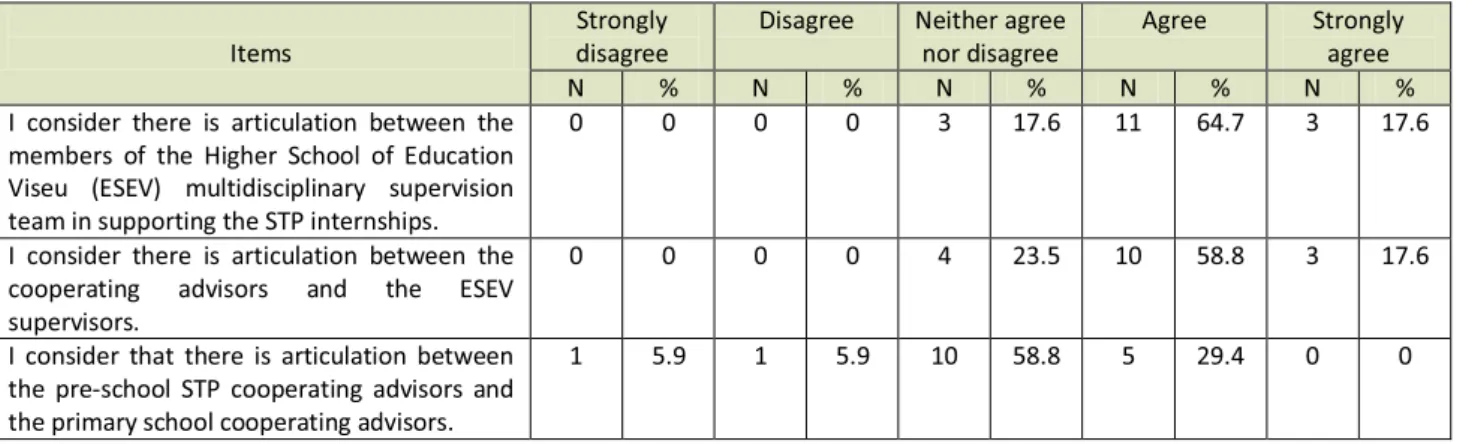
Supervision of the STP in supporting the internships is highly appreciated by students. The vast majority agrees (64.7%) or strongly agrees (17.6%) that there is articulation between the members of the multidisciplinary supervisory team from ESEV in supporting the internships. They also agree (58.8%) or strongly agree (17.6%) that there is articulation between the cooperating advisors and the ESEV supervisors. Nevertheless, the majority of respondents (58.8%) were undecided about the existence of articulation between the cooperating advisors in the pre-school and primary school (Table 5).
Table 5: Students perception regarding Supervised Teaching Practice supervision Items
Strongly disagree
Disagree Neither agree nor disagree
Agree Strongly agree
N % N % N % N % N %
I consider there is articulation between the members of the Higher School of Education Viseu (ESEV) multidisciplinary supervision team in supporting the STP internships.
0 0 0 0 3 17.6 11 64.7 3 17.6
I consider there is articulation between the cooperating advisors and the ESEV supervisors.
0 0 0 0 4 23.5 10 58.8 3 17.6
I consider that there is articulation between the pre-school STP cooperating advisors and the primary school cooperating advisors.
1 5.9 1 5.9 10 58.8 5 29.4 0 0
4.5 Strengths and weaknesses of Supervised Teaching Practice
Content analysis of the responses of the students showed a remarkable difference between the number of positive and negative aspects indicated in the proportion of two-thirds to one-third, respectively. Many students did not !"#$%&#'#"()$%*"')+,"-$+')#.'&$/"0+'"*"#'+1(("+$".'-&00"-$%#('$/"'$"0!'2#"()$%*"3'4%$/'25"++',&+%$%*"36
The most highly valued positive aspects were as follows in decreasing order: availability and support of supervisors and cooperating advisors, knowledge acquired, duration of the internship (three days) and professional experience. The negative aspects mentioned most often were the difficulty in reconciling work in the Supervised Teaching Practice and other curricular units, the lack of articulation between some curricular units and the STP and reduced number of contact hours in STP I.
5 Conclusion
This study seeks to reflect on the organization model and functioning of the STP that is being implemented at ESEV from the perceptions of graduating masters students. The data show that the trainees have a very positive perspective of this component of training, highlighting the fact that it goes on throughout the course.
A large majority of students recognizes that there is articulation between the three STP curricular units and between these and the other curricular units of the course. However, they admit that this articulation could be improved with regards to some of the curricular units as well as between internship conducted at the primary school and pre-school levels.
The trainees recognize the importance of conducting a research project within their STP, as pointed out by Zeichner (1993), Ponte (2000) and Estrela (2002). Nevertheless, they do emphasize the need for greater connection between this work and the internship.
The supervision of professional practice is assessed very positively by the students, who recognize the articulation 7"$4""#' $/"'898:' +1,"0*%+&0+' )#.' $/"' -&&,"0)$%#(' ).*%+&0+;' "!,/)+%<%#(' $/"%0' 4%55%#(#"++' $&' +1,,&0$' $/"' $0)%#""+ ' work. However, the articulation between the primary school and pre-school cooperating advisors is considered less favourably by most students.
!"#"$ %"#&'(#$ )%"$ *+$ '*+"$ ,*(!$ (!"$ -*+.*+/#$ 0-$ (!"$ 12("%+)'$ 13)'&)(*0+$ 4055*((""6#$ 7%"'*5*+)%8$ %"70%(9$ 7&:'*#!".$ *+$ ;":%&)%8$ (!*#$ 8")%9$ ,!*<!$ 70*+($ (0,)%.#$ )#7"<(#$ (!)($ ."#"%3"$ %"3*",$ )+.$ *57%03"5"+(=$ >(!"$ #(%0+/"#( and most articulated investment in research projects focused on problems of the course, stronger interdisciplinary articulation around supervised professional practice which occupies or should occupy the central place in the course 0-$#(&.8?@ Therefore, it should keep what was shown to be more positive and seek to improve the functioning of the STP, strengthening the articulation between this component and the curricular units of the course, promoting a more obvious connection between research projects and practice and improving articulation between the primary and pre-school internships. Thus, the practice can become a place for the confluence of the genesis of the future teacher's professional knowledge (Schön, 1987; Roldão, 2000; Alarcão, 2005).
It is also worth continuing the collaborative work between the ESEV supervision team and between them and the advisors of the cooperating institutions, creating spaces for dialogue between primary and pre-school cooperating advisors as a way to establish better co55&+*<)(*0+$:"(,""+$(!"#"$(,0$'"3"'#$0-$".&<)(*0+$-0%$,!*<!$(!*#$5)#("%6#$ degree qualifies.
References
Alarcão, I. (2005). Professores reflexivos em uma escola reflexiva. São Paulo: Cortez. Bardin, L. (1979). Análise de conteúdo. Lisboa: Edições 70.
Estrela, M. T. (2002). Modelos de formação de professores e seus pressupostos conceptuais. Revista de Educação, 11 (1), 17-28.
Fortin, M. F. (2003). O processo de investigação: Da concepção à realização. Loures: Lusociência. Ghiglione, R., & Matalon, B. (2001). O inquérito: Teoria e prática. Oeiras: Celta Editora.
Ponte, J. P. (2002). Investigar a nossa própria prática. In GTI (Eds.), Reflectir e investigar sobre a própria prática profissional (pp. 5-28). Lisboa: APM.
Roldão, M. (2000). Formar Professores. Os desafios da profissionalidade e o currículo. Universidade de Aveiro: CIFOP. Schön, D. (1983). The Reflective Practitioner: How Professionals Think in Action. Nova Iorque: Basic Books.
Schön, D. (1987). Educating the reflective practitioner. Nova Iorque: Jossey Bass.
Shulman, L. (1986). Those who Understand: Knowledge Growth in Teaching. Educational Researcher, 15(2), 4-14. Zeichner, K. (1993). A formação reflexiva de professores: Ideias e práticas. Lisboa: Educa.
Acknowledgments:
To the Portuguese Foundation for Science and Technology (FCT) through the project PEst-OE/CED/UI4016/2011, and the Centre for Studies in Education, Technologies and Health (CI&DETS).