A Computational Framework for Sound Segregation in
Music Signals
FACULDADE DE ENGENHARIA DA UNIVERSIDADE DO PORTO Departamento de Engenharia Electrot´ecnica e de Computadores
A Computational Framework for Sound Segregation in
Music Signals
Lu´ıs Gustavo Pereira Marques Martins
Disserta¸c˜ao submetida para satisfa¸c˜ao parcial dos requisitos do grau de doutor
em
Engenharia Electrot´ecnica e de Computadores
Disserta¸c˜ao realizada sob a orienta¸c˜ao do Professor Doutor An´ıbal Jo˜ao de Sousa Ferreira,
do Departamento de Engenharia Electrot´ecnica e de Computadores da Faculdade de Engenharia da Universidade do Porto
This thesis was partially supported by the Portuguese Science and Technology
Foundation (FCT), INESC Porto, the Calouste Gulbenkian Foundation, the European Commission under the IST research network of excellence VISNET and VISNET II of the 6th Framework Programme and the COST IC0601 Action on Sonic Interaction Design (SID).
Copyright c! 2008 by Lu´ıs Gustavo P. M. Martins
All rights reserved. No part of the material protected by this copyright notice may be reproduced or utilized in any form or by any means, electronic or mechanical, including photocopying, recording or by any information storage and retrieval system, without the prior permission of the author.
Typeset by the author with the LATEX Documentation System. Author email: [email protected]
DOCTORAL DISSERTATION COMMITTEE
Prof. Gaël Richard
Full Professor in Audio Signal Processing Head of the Audio, Acoustics and Waves Research Group TELECOM Paris Tech
Prof. Isabel Maria Martins Trancoso
Full Professor at Instituto Superior Técnico da Universidade Técnica de Lisboa
Prof. Artur Pimenta Alves
Full Professor at Faculdade de Engenharia da Universidade do Porto
Prof. Diamantino Rui da Silva Freitas
Associate Professor at Faculdade de Engenharia da Universidade do Porto
Prof. Aníbal João de Sousa Ferreira
To my grandparents Il´ıdio and Lucinda (“requiescat in pace”) and Antonio and Ermelinda, whose lives will always be an inspiration for me. To my beloved parents Artur e Concei¸c˜ao and my dear brother Edu for all their unconditional support and love.
Abstract
Music is built from sound, ultimately resulting from an elaborate interaction between the sound-generating properties of physical objects (i.e. music instruments) and the sound perception abilities of the human auditory system.
Humans, even without any kind of formal music training, are typically able to ex-tract, almost unconsciously, a great amount of relevant information from a musical signal. Features such as the beat of a musical piece, the main melody of a complex musical ar-rangement, the sound sources and events occurring in a complex musical mixture, the song structure (e.g. verse, chorus, bridge) and the musical genre of a piece, are just some examples of the level of knowledge that a naive listener is commonly able to extract just from listening to a musical piece. In order to do so, the human auditory system uses a variety of cues for perceptual grouping such as similarity, proximity, harmonicity, common fate, among others.
This dissertation proposes a flexible and extensible Computational Auditory Scene Analysis framework for modeling perceptual grouping in music listening. The goal of the proposed framework is to partition a monaural acoustical mixture into a perceptually motivated topological description of the sound scene (similar to the way a naive listener would perceive it) instead of attempting to accurately separate the mixture into its original and physical sources. The presented framework takes the view that perception primarily depends on the use of low-level sensory information, and therefore requires no training or prior knowledge about the audio signals under analysis. It is however designed to be efficient and flexible enough to allow the use of prior knowledge and high-level information in the segregation procedure.
The proposed system is based on a sinusoidal modeling analysis front-end, from which spectral components are segregated into sound events using perceptually inspired grouping cues. A novel similarity cue based on harmonicity (termed “Harmonically-Wrapped Peak Similarity”) is also introduced. The segregation process is based on spectral clustering methods, a technique originally proposed to model perceptual grouping tasks in the com-puter vision field. One of the main advantages of this approach is the ability to incorporate various perceptually-inspired grouping criteria into a single framework without requiring multiple processing stages.
Experimental validation of the perceptual grouping cues show that the novel harmonicity-based similarity cue presented in this dissertation compares favourably to other state-of-the-art harmonicity cues, and that its combination with other grouping
cues, such as frequency and amplitude similarity, improves the overall separation perfor-mance. In addition, experimental results for several Music Information Retrieval tasks, including predominant melodic source segregation, main melody pitch estimation, voicing detection and timbre identification in polyphonic music signals, are presented. The use of segregated signals in these tasks allows to achieve final results that compare or outperform typical and state-of-the-art audio content analysis systems, which traditionally represent statistically the entire polyphonic sound mixture. Although a specific implementation of the proposed framework is presented in this dissertation and made available as open source software, the proposed approach is flexible enough to be able to utilize different analysis front-ends and grouping criteria in a straightforward and efficient manner.
Keywords: Sound, Computational Auditory Scene Analysis, Audio Source Separation, Music Information Retrieval, Sinusoidal Modeling, Spectral Clustering, Normalized Cut, Predominant Melodic Source Separation, Main Melody Pitch Estimation, Timbre Recognition.
Resumo
A m´usica ´e composta por som, e em ´ultima instˆancia resulta de uma interac¸c˜ao com-plexa entre as propriedades sonoras de objectos f´ısicos (i.e. instrumentos musicais) e as capacidades de percep¸c˜ao sonora do sistema auditivo humano.
Os seres humanos, mesmo indiv´ıduos sem qualquer tipo de forma¸c˜ao musical, tipica-mente demonstram uma capacidade de extrair, de forma quase inconsciente, uma relevante quantidade de informa¸c˜ao sobre um sinal sonoro musical. A percep¸c˜ao do ritmo de uma pe¸ca musical, a melodia principal de um arranjo musical complexo, as fontes e eventos sonoros que tˆem lugar numa mistura musical complexa, a estrutura de uma m´usica (e.g. introdu¸c˜ao, refr˜ao) ou o seu g´enero (e.g. rock, jazz, cl´assica) s˜ao apenas alguns exemplos do n´ıvel de conhecimento que um ouvinte, mesmo que sem forma¸c˜ao musical, ´e normal-mente capaz de inferir ao simplesnormal-mente escutar um excerto musical. Para este efeito, o sistema auditivo humano faz uso de uma variedade de pistas de natureza perceptiva que conduzem ao agrupamento perceptual dos est´ımulos ac´usticos em eventos ou enti-dades sonoras coerentes. Este agrupamento ´e em grande parte baseado em crit´erios de similaridade, proximidade harm´onica e espacial, entre outras.
Esta disserta¸c˜ao prop˜oe uma plataforma computacional flex´ıvel e extens´ıvel para a an´alise de sinais e cenas sonoras complexas, permitindo uma modeliza¸c˜ao de alguns dos processos de agrupamento perceptual do sistema auditivo humano envolvidos na percep¸c˜ao de sinais musicais. O objectivo desta plataforma ´e permitir representar uma mistura sonora monaural atrav´es de uma descri¸c˜ao perceptualmente relevante da cena sonora (ou seja, semelhante `a forma como um ouvinte sem treino musical a percepcionaria), ao inv´es de tentar obter uma separa¸c˜ao exacta das v´arias fontes sonoras que a constituem. Esta abordagem assume que a percep¸c˜ao se baseia principalmente no uso de informa¸c˜ao sen-sorial de baixo n´ıvel, n˜ao carecendo por isso de treino ou conhecimento pr´evio acerca dos sinais sonoros em an´alise. N˜ao obstante, a plataforma proposta ´e suficientemente flex´ıvel e eficiente, permitindo o uso de conhecimento pr´evio e de informa¸c˜ao de alto n´ıvel no processo de segrega¸c˜ao.
O sistema proposto baseia-se num modelo de an´alise sinusoidal, a partir do qual as componentes espectrais s˜ao segregadas em eventos sonoros atrav´es do uso de m´etricas baseadas em pistas de natureza perceptiva, entre as quais uma nova m´etrica de similari-dade harm´onica (chamada de “Harmonically-Wrapped Peaks Similarity”). O processo de segrega¸c˜ao ´e baseado em m´etodos de agrupamento espectral (“spectral clustering”), uma
t´ecnica originalmente proposta para modelar as tarefas de agrupamento na ´area da vis˜ao por computador. Uma das principais vantagens desta abordagem ´e a possibilidade de in-corporar e combinar v´arios crit´erios de agrupamento inspirados em princ´ıpios perceptuais numa ´unica plataforma, sem a necessidade de m´ultiplas fases de processamento.
A valida¸c˜ao experimental destes crit´erios de agrupamento com relevˆancia perceptual demonstram que a nova m´etrica de similaridade harm´onica proposta neste trabalho se compara favoravelmente a outras t´ecnicas estado da arte, e que a sua combina¸c˜ao com outros crit´erios de similaridade, tais como proximidade em frequˆencia e amplitude, per-mite melhorar de forma global os resultados de segrega¸c˜ao de misturas sonoras musi-cais. Adicionalmente, resultados experimentais obtidos para v´arias aplica¸c˜oes na ´area da Recupera¸c˜ao de Informa¸c˜ao Musical (“Music Information Retrieval”) – e.g. segrega¸c˜ao da linha mel´odica predominante, estima¸c˜ao da melodia principal, detec¸c˜ao de segmentos vozeados e identifica¸c˜ao e reconhecimento de instrumentos musicais em misturas musicais polif´onicas – demonstram que o uso de sinais segregados nestas tarefas permitem obter resultados finais compar´aveis ou melhores que os obtidos por outras abordagens estado da arte para a an´alise de conte´udos ´audio onde os sinais polif´onicos s˜ao tradicionalmente representados no seu todo de forma estat´ıstica. Apesar de esta disserta¸c˜ao apresentar uma implementa¸c˜ao em software que ´e disponibilizada como software open source, a abor-dagem proposta ´e suficientemente flex´ıvel, permitindo incorporar de forma simples e efi-ciente diferentes metodologias de an´alise, novas m´etricas bem como outras t´ecnicas de segrega¸c˜ao de sinais sonoros complexos.
Palavras-chave: Som, M´usica, An´alise Computacional de Cenas Auditivas, Separa¸c˜ao de Fontes Sonoras, Recupera¸c˜ao de Informa¸c˜ao Musical, Modelos Sinusoidais, Agrupamento Espectral, Cortes Normalizados, Separa¸c˜ao da Linha Mel´odica Predominante, Estima¸c˜ao da Melodia Principal, Reconhecimento de Timbre.
R´esum´e
La musique est faite de sons et r´esulte d’une interaction complexe entre les propri´et´es sonores d’objets physiques (i.e. instruments musicaux) et les capacit´es perceptives du syst`eme auditif humain.
Les ˆetres humains, avec ou sans formation musicale, sont capables d’extraire, de mani`ere presque inconsciente, une ´enorme quantit´e d’information pertinente `a partir d’un signal sonore. Des caract´eristiques comme le rythme d’une pi`ece de musique, la m´elodie principale d’un arrangement musical complexe, la structure d’une chanson (e.g. cou-plet, refrain, etc.) ainsi que le genre musical sont juste quelques exemples du niveau d’information qu’un auditeur, mˆeme sans formation musicale, est normalement capable d’extraire en ´ecoutant simplement une pi`ece de musique. A cette fin, le syst`eme auditif humain utilise une vari´et´e d’indices de regroupement perceptuel tels que, entre autres, des crit`eres de similarit´e et de proximit´e harmonique et spatiale.
Cette dissertation propose une plate-forme de programmation informatique adaptative et extensible pour l’analyse computationnelle de signaux sonores complexes (“Computa-tional Auditory Scene Analysis”), permettant une mod´elisation de processus de groupe-ment perceptuels impliqu´es dans l’´ecoute musicale. Le but de cette plate-forme est de repr´esenter un m´elange sonore d’un unique canal sous la forme d’une description topologique de grande pertinence perceptive (c’est-`a-dire similaire `a celle d’un auditeur sans formation musicale), ceci sans essayer d’obtenir une s´eparation des signaux des sources physiques constituant ce m´elange sonore. L’impl´ementation de cette plate-forme fait l’hypoth`ese que la perception d´epend en premi`ere instance d’informations sensorielles de bas niveau, et ne requi`ere donc aucune formation ni connaissance a priori des signaux musicaux ´ecout´es. Cependant, cette plate-forme est adaptative et permet, si besoin est, l’inclusion de connaissance a priori et d’information de haut niveau.
Le syst`eme propos´e se base sur un mod`ele d’analyse sinuso¨ıdal, `a partir duquel les composantes spectrales sont attribu´ees `a divers ´ev´enements sonores `a partir d’indices de groupements perceptifs. Un nouvel indice de similarit´e harmonique est par ailleurs pr´esent´e (appel´e “Harmonically-Wrapped Peak Similarity”). Ce processus d’attribution se base sur des m´ethodes de groupement spectral (“spectral clustering”) dont l’origine se trouve dans la mod´elisation des tˆaches de groupement perceptif utilis´ee dans la recherche en vision artificielle. Un des avantages principaux de cette approche est la possibilit´e
d’inclure divers crit`eres de groupements d’inspiration perceptuelle dans une mˆeme plate-forme, sans requ´erir une multiplication de phases de calcul successives.
La validation exp´erimentale des crit`eres de groupement perceptif montre que le nouvel indice de similarit´e harmonique propos´e dans cette dissertation est meilleur que les crit`eres utilis´es dans l’´etat de l’art actuel, et que sa combinaison avec d’autres indices, tels que la similarit´e fr´equentielle et d’amplitude, am´eliore les r´esultats globaux du processus de repr´esentation. De plus, les r´esultats exp´erimentaux pour diverses tˆaches de r´ecup´eration d’information musicale (“Music Information Retrieval”), telles que la s´eparation de source m´elodique principale, l’estimation de fr´equence fondamentale de la m´elodie principale, la d´etection de parties vois´ees et l’identification de timbres dans les signaux polyphoniques, sont pr´esent´es. Ces r´esultats sont comparables, voire meilleurs que ceux des syst`emes d’analyses du contenu audio de l’´etat de l’art qui, eux, n’utilisent traditionnellement pas de repr´esentation en ´ev´enements sonores s´epar´es. Cette dissertation pr´esente une impl´ementation “software” de cette plate-forme qui est disponible sous une licence libre. L’approche suivie est adaptative, l’incorporation d’autres modules de software d’analyse est ainsi facilit´ee.
Mots-cl´es: Son, Analyse computationnelle des sc`enes auditives, S´eparation de sources acoustiques, R´ecup´eration d’information musicale, Mod´elisation sinusoidale, Groupement spectral, Coupe normalis´ee, S´eparation de source m´elodique principale, Estimation de m´elodie principale, Reconaissance de timbres.
Acknowledgments
“The secret to creativity is knowing how to hide your sources.”
Albert Einstein
The work reported in this document is not the work of a single person. It is in fact a collaborative effort and, at the risk of unfair omission, I would like to express my gratitude to those who somehow, directly or indirectly, contributed to it.
First I would like to gratefully acknowledge all the encouragement, support and wise supervision of Prof. An´ıbal Ferreira. He has been one of the key persons in my research career, being the one who first introduced me to the joys and challenges of audio and signal processing, back in 1997, when I was still finishing my undergrad studies. I am deeply thankful for his encouragement, inspiration and research opportunities during all these years, and for allowing me to share his passion for sound processing, which ultimately lead to this work. I must also thank him for his thorough proof-reading and revision of this dissertation, as well as for all his valuable comments and suggestions.
I am also deeply thankful to INESC Porto, where I have been extremely lucky to re-side for the past ten years and interact with such brilliant and insightful researchers. In particular, I would like to express my deepest gratitude and admiration for Prof. Pimenta Alves, Prof. Pedro Guedes de Oliveira and Prof. Ruela. Together with Prof. An´ıbal Fer-reira, they invited me to join INESC Porto and the Telecommunications and Multimedia Unit (UTM), where I had the opportunity to develop and make public my research work and to participate in so many compelling research projects. I must thank them for their never ending encouragement and support since day one.
ACKNOWLEDGMENTS
I truly enjoyed working with many people at INESC Porto and I would like to thank them here for all the interesting discussions we had about so many different topics and in particular about the work in this dissertation: S´ılvio Macedo, Teresa Andrade, Rui Cam-pos, Gustavo Carneiro, Jaime Dias, Ricardo Morla, Lu´ıs Teixeira, Filipe Sousa, Tˆania Cal¸cada, Paula Viana, V´ıtor Soares, Andr´e Rocha, Miguel Falc˜ao, Gabriel Falc˜ao, Prof. Corte Real and Prof. Manuel Ricardo. Thanks also to Renata Rodrigues for her avail-ability and help on all those administrative tasks.
A special mention goes to Lu´ıs Filipe Teixeira, Pedro Carvalho, Jaime Cardoso and Fabien Gouyon my fellow office mates at UTM. Thanks to Pedro Carvalho, who together with S´ılvio Macedo, started the initiative to promote the UTM’s LabMeetings, where so many times I had the opportunity to present my work and get valuable feedback from the INESC Porto research community, as well as to attend so many interesting talks from colleagues and invited researchers. I must also thank him for his willingness to share his quiet and private office when presented with the proposal to create a new small group at INESC Porto focused in multimedia analysis and processing.
Jaime Cardoso was (and still is!) my ultimate and reliable resource for those tricky mathematical questions, always willing to spend a couple of hours to help me understand how such mathematical problems end up having elegant solutions after all. His work and his forward thinking will always be an inspiration to me.
Fabien Gouyon, who I had the luck to meet several times at the MTG and who later made me so honoured by joining INESC Porto (bringing his huge knowledge and experience to the group) spent a substantial part of his time proof-reading this document. I am deeply thankful to him for his incisive comments and points of view and for making me think out of the box. I must also thank him for his efforts into making my internship at McGill a reality as well as for his big help with the translation of parts of this dissertation to French. Merci beaucoup Fabien!
Luis Teixeira, my “Portuguese Invasion” buddy in the Marsyas project during our first internship in beautiful Victoria, made those long and well spent hours in the lab refactoring Marsyas from the inside out a pleasure (although we were always asking ourselves if we would ever be able to make it work again!). I will always remember those discussions during dinner about what has turned out to become MarsyasX (and yes, I still have that napkin!). Since the very first time I met Lu´ıs (several years ago, when we managed to implement some sort of a CORBA service for audio classification in the ORBIT Project) I have always been learning something new and more advanced with him. I must thank him for all I have learned with him and hope the future will allow us to keep collaborating
ACKNOWLEDGMENTS
(if nothing else, in the scope of MarsyasX ).
More recently, it has been a pleasure to have Carlos Guedes as a colleague at INESC Porto. His strong music background combined with his technical abilities are really unique and his works are always an inspiration. I must thank him for pointing me such valuable bibliographic references on music perception and cognition and for those discussions about such interesting topics of research.
I must also not forget all the people from the former MOG team at INESC Porto, where I had the opportunity to learn so much from such a motivated and knowledgeable team working in so many important projects. Many thanks to Pedro Cardoso for inviting me to make part of his team and for the confidence he always has put in my abilities. Thanks to Pedro Ferreira, Vitor Teixeira and Ernesto Santos, and all the MOG team for welcoming me to their group and for sharing their knowledge with me.
I would also like to express my gratitude to the School of Arts of Universidade Cat´olica Portuguesa (UCP) for inviting me as a teacher during the past few years. This has been a truly fulfilling opportunity to meet and learn from so many brilliant people and to make part of such a great school. In particular I would like to express my greatest gratitude to
´
Alvaro Barbosa, coordinator of the School of Arts, for his accessibility and support since the day he invited me to join the UCP. Many thanks for his support when confronted with my intentions to pursue some academic internships abroad in the scope of my research activities, and for his availability to deal with the many troubles that resulted from those decisions of mine. Thanks to Lu´ıs Teixeira for his valuable support, discussions and motivation. Thanks to all my colleagues and personnel at UCP and to all my students during the past years for keeping me so motivated with everything related to sound.
During the scope of this work I have been extremely lucky to do some research intern-ships in some of the top research groups in my field of research.
Many thanks to Prof. Xavier Serra and to the MTG people (Fabien Gouyon, Pedro Cano, Emilia Gom´ez, ´Oscar Celma, Jordi Bonada, Xavier Amatriain, Pau Arumi, just to name a few) for making me feel so welcome during my several visits to Barcelona and for all our discussions about my work.
Many thanks to Prof. Thomas Sikora for welcoming me to his group at the Technical University of Berlin (TUB) where I had the chance to work in close collaboration with Juan Jos´e Burred (as well as Gunnar Eisenberg, in the scope of the VISNET project). I am particularly honoured to be a co-author with Juan Jos´e Burred and grateful for all his availability to collaborate with me and for sharing his knowledge and skills, even at a time when he was working hard finishing his PhD thesis. I really hope we will be able to
ACKNOWLEDGMENTS
keep up our collaboration in the future.
Many thanks to Prof. Stephen McAdams and Prof. Philippe Depalle for welcoming me at the CIRMMT, McGill University, where I had the chance to work once again with Mathieu Lagrange and to present most of the work proposed in this dissertation to the CIRMMT team members. I was truly honoured by their comments and suggestions and I would like to thank the CIRMMT people for their support and discussions during my stay.
I would also like to thank Prof. Mark Sandler for all his availability to receive me at his group at the Queen Mary University at the beginning of my PhD activities (although sadly it ended up not being feasible to join such an excellent research group).
A very special reference should go to my three internships at the University of Victoria (UVic), where I was invited to work under the wise supervision of Prof. George Tzanetakis. I owe him my deepest gratitude for his never ending availability and support since we first exchanged our first emails in the scope of the Marsyas software framework, years before I even decided to enroll into a PhD program. In fact, his invitation to become involved on the development of Marsyas was a key aspect in my research career, having a direct impact on the work presented in this thesis.
While at UVic, I was also extremely fortunate to meet and to closely collaborate with Mathieu Lagrange, a post-doc researcher at Prof. Tzanetakis’ lab at the time. In fact, a great deal of the work in this dissertation is the result of this close collaboration with Mathieu Lagrange and Prof. George Tzanetakis, as evident from several scientific publications where I have the honour to be their co-author. I will be forever grateful to Mathieu Lagrange’s “best ideas ever”, and for the enlightening discussions with him and Prof. Tzanetakis (even when collaborating thousands of miles apart!). I will always be grateful for the amount of time they both spent proof-reading this dissertation and for all the valuable comments and suggestions.
I would also thank to all the UVic people for their warm welcome during my three visits to Victoria, namely Graham Perceival, Jennifer Murdoch, Ajay Kapur, Adam Tindale, Manj Benning, Steven Ness, Prof. Andrew Schloss, Kirk McNally, and Isabel.
Thanks also to the Marsyas developers and users communities who helped improve the framework and keep my motivation towards contributing to it always high, with a positive impact on the work presented in this thesis.
Finally, I would like to thank Anssi Klapuri for kindly providing the multi pitch es-timator code for some of the evaluations presented in this dissertation (as well as in one
ACKNOWLEDGMENTS
of the published articles) and thank all the anonymous reviewers for their thorough com-ments and suggestions for improvement on all the papers submitted in the scope of this work.
On a more personal note, I would like to leave a warm word of thanks to my family and friends. To my parents and grand parents, for all their love and immense support. Thank you for transmitting to me the love of learning. To my brother Edu, for all his love, admiration and support, and for being my much loved best friend.
For being true friends, with whom I share so many happy memories, and for making Porto a place so great to live, a word of gratitude goes to Pedro, Johny, Meiras, Banderas, Vitor, Pedro Yoga, Lu, Elsa, Duarte and Susaninha. A very special word goes to Cris and Haneleh, for always being there for me, and for their children, my beloved goddaughter Kaki and her brother Smiguel, the most incredible kids in the world!
Du, you deserve a very special loving word, for being such an incredible and kind human being, who stood by my side and coped with my moody behavior in the last months of writing my thesis and suffered with those long absences during my stays abroad. This journey would have been much harder without you in my life.
To all my childhood friends back in Sever do Vouga (my beautiful hometown), thank you for still remembering and supporting me even after being away for so long during this endeavour. Bastos, Lala, Sara (“requiescat in pace”), Bamb, Ariana, Beckas, Sandrita, Joca, Dudu, Silvana, Fibras, S´onia, Ki´o, Lu´ıs dos Seguros, Bino, Lalo, Carc, Nelinho, Larachas, Guidinha, Sotto and JP, you are always in my heart. To my cousin Jorge, a special thanks for his friendship and for being my host during many of my stays in Barcelona.
Porto, Lu´ıs Gustavo Martins September 2008
ACKNOWLEDGMENTS
Reader Notes
This document is composed of six chapters. All chapters begin with a small introduction to its contents. In the end, bibliographic references are listed. These references are identified in the text using the authors names and year of publication within square brackets.
Not surprisingly, many acronyms are used throughout the text. To avoid cluttering the text with definitions, a list of acronyms at the beginning of the document is provided, allowing easy referencing.
A final note regarding the fonts used to typeset this document. The font used in body text is Computer Modern Roman and the blocks containing program code and class or module names use the Adobe Courier font. Chapter and section titles are in various sizes ofAdobe Helvetica-Narrow Bold.
Table of Contents
Abstract i Resumo iii R´esum´e v Acknowledgments ix Table of Contents xv List of Figures xxList of Tables xxviii
Acronyms xxxi
1 Introduction 1
1.1 Context and Motivation . . . 1 1.2 Thesis Statement . . . 2 1.2.1 Current State . . . 3 1.2.2 The Main Challenges . . . 3 1.3 Related Research Areas . . . 4 1.4 Applications . . . 6 1.5 Main Contributions . . . 8 1.6 Outline of the Dissertation . . . 9
TABLE OF CONTENTS
2 Music Listening 11
2.1 Introduction . . . 11 2.2 The Human Auditory System . . . 12 2.3 Scene Analysis in Audition . . . 14 2.3.1 Perceptual Organization of Sound . . . 17 2.3.2 The Specific Case of Music Perception . . . 22 2.4 Computational Auditory Scene Analysis (CASA) . . . 26 2.4.1 Computational Models for Music Scene Analysis . . . 28 2.4.2 Base Architecture of CASA Systems . . . 29 2.4.3 Mid-level Representations for Music Signals . . . 30 2.4.4 Computational Approaches to Scene Organization . . . 35 2.4.5 CASA Evaluation Approaches . . . 38 2.4.6 Previous Work on CASA . . . 41 2.5 Summary . . . 49
3 A Framework for Sound Segregation in Music Signals 51
3.1 Introduction . . . 51 3.2 System Overview . . . 52 3.3 Concepts and Terminology . . . 55 3.4 Sinusoidal Modeling of Music Signals . . . 56 3.4.1 Short-Term Sinusoidal Analysis . . . 58 3.4.2 Peak Parameters Estimation . . . 58 3.5 Time Segmentation of Music Signals . . . 60 3.5.1 Fixed Length Texture Windows . . . 60 3.5.2 Dynamic Length Texture Windows . . . 61 3.5.3 Onset Detection Algorithm . . . 62 3.6 Grouping Sound Events . . . 65 3.6.1 Spectral Clustering . . . 65 3.6.2 Constructing the Similarity Graph . . . 68 3.6.3 The Normalized Cut Criterion . . . 74 3.6.4 Partitioning Approaches . . . 77 3.6.5 The Grouping Algorithm . . . 81 3.7 Perceptual Cues as Grouping Criteria . . . 81 3.7.1 Amplitude and Frequency Similarity . . . 82 3.7.2 Harmonically Wrapped Peak Similarity (HWPS) . . . 91
TABLE OF CONTENTS
3.7.3 Combining Similarity Functions . . . 108 3.8 Sound Event Resynthesis . . . 110 3.8.1 Cluster Selection . . . 111 3.8.2 Additive Synthesis . . . 112 3.9 Summary . . . 113
4 Experimental Validation and Applications 115
4.1 Introduction . . . 115 4.2 Preliminary Evaluation of Perceptual Grouping Cues . . . 117 4.2.1 Evaluation of the HWPS Cue . . . 117 4.2.2 Combined Use of Grouping Cues . . . 119 4.3 Predominant Melodic Source Segregation . . . 120 4.3.1 Corpus Description and Experimental Setup . . . 121 4.3.2 Experimental Results . . . 122 4.3.3 On the Use of Dynamic Texture Windows . . . 123 4.4 Main Melody Pitch Estimation . . . 125 4.4.1 Corpus Description and Experimental Setup . . . 125 4.4.2 Experimental Results . . . 127 4.5 Voicing Detection in Polyphonic Music Signals . . . 129 4.5.1 Corpus Description and Experimental Setup . . . 130 4.5.2 Experimental Results . . . 131 4.6 Timbre Identification in Polyphonic Music Signals . . . 132 4.6.1 System Overview . . . 132 4.6.2 Timbre Models and Instrument Recognition . . . 134 4.6.3 Corpus Description and Experimental Setup . . . 137 4.6.4 Experimental Results . . . 138 4.7 Summary . . . 141 5 Software Implementation 143 5.1 Introduction . . . 143 5.2 Design Requirements . . . 143 5.3 Implementation Strategies . . . 145 5.4 Developing with MARSYAS . . . 147 5.4.1 Contributions to the MARSYAS Framework . . . 148 5.5 Implementing the Sound Segregation Framework in MARSYAS . . . 150 5.5.1 Implementing Texture Windows . . . 150
TABLE OF CONTENTS
5.5.2 Implementing Spatial Cues from Stereo Audio Signals . . . 153 5.5.3 Implementing Sinusoidal Modeling . . . 154 5.5.4 Implementing Similarity Cues . . . 155 5.5.5 Implementing the Grouping Algorithm . . . 161 5.5.6 Implementing the Sound Event Resynthesis . . . 161 5.5.7 The peakClustering Tool . . . 162 5.6 Summary . . . 163
6 Conclusions 165
6.1 Results and Contributions . . . 165 6.2 Future Work . . . 166
Appendix A Graph Laplacians for Spectral Clustering 171
A.1 The Unnormalized Graph Laplacian . . . 173 A.2 The Normalized Graph Laplacian . . . 175
Appendix B Evaluation Metrics 177
B.1 Signal-to-Distortion Ratio (SDR) . . . 177 B.2 Signal-to-Distortion Ratio with Optimized Gain Factor (SDRogf) . . . 177
B.3 Segmental Signal-to-Distortion Ratio (SSDR) . . . 178
Appendix C MARSYAS: An Open Source Audio Processing Framework 179 C.1 Framework Architecture . . . 180 C.1.1 Dataflow Programming . . . 180 C.1.2 Implicit Patching and Composition . . . 181 C.1.3 Basic Processing Units and Networks . . . 181 C.1.4 Dynamic Access to Modules and Controls . . . 183 C.1.5 Dynamic Linking of Controls . . . 184 C.2 Interoperability . . . 185 C.2.1 MATLAB . . . 185 C.2.2 Trolltech Qt4 . . . 186 C.2.3 Open Sound Control . . . 188 C.2.4 Marsyas runtime as a Max/MSP external . . . 189 C.2.5 SWIG Bindings . . . 189 C.3 MARSYAS Source Code . . . 191
TABLE OF CONTENTS
Appendix D Using HWPS for Efficient Dominant Harmonic Source
Segre-gation 193
D.1 Proposed Algorithm . . . 194 D.2 Corpus Description and Experimental Setup . . . 195 D.3 Experimental Results . . . 195 D.4 Discussion . . . 196
List of Figures
1 A sketch of the peripheral region of the human auditory system (adapted from [Beranek, 1990]). . . 13 2 The main types of auditory processing and their interactions (adapted
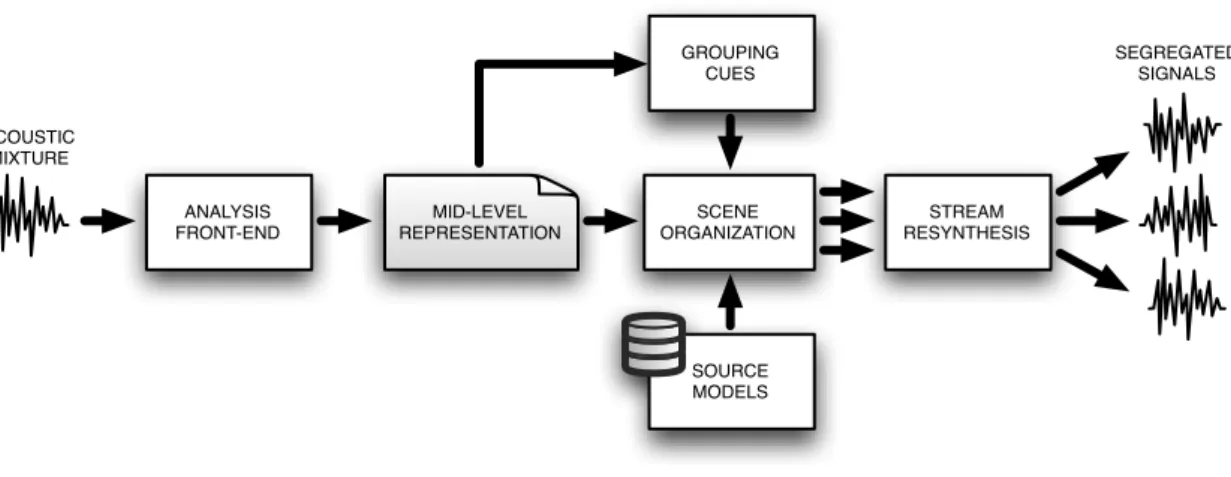
from [McAdams and Bigand, 1993]). . . 16 3 System Architecture of a typical CASA system. . . 30 4 Representations of an acoustic signal of a piano tone (C3) followed by an
overlapping clarinet tone (G3). The upper panel (a) shows the time domain representation of the signal, followed in panel (b) by its spectrogram repre-sentation. Panel (c) shows a sparser spectrogram where only spectral peaks are considered and panel (d) shows the corresponding peak trajectories after tracking spectral peaks over time. . . 31 5 Tree representation of a simple music scene (i.e. a C major chord whose
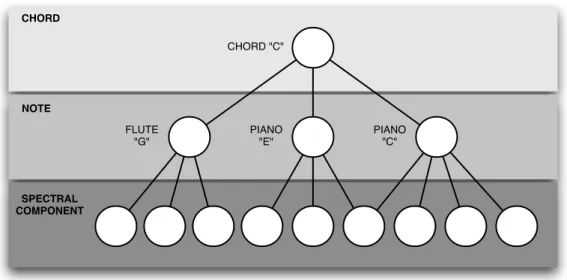
notes are played by two different instruments – a flute and a piano). At each level of the tree a different perception of the same acoustic mixture is represented (the white circles depict the “perceptual” sound elements). Listeners usually start by hearing the sound as a whole chord and, de-pending on prior knowledge, attention and listening context, may be able to also perceive the individual notes or even the frequency components in the chord. For the sake of simplicity, the time structure of the spectral components is omitted. Figure adapted from [Kashino, 2006]. . . 37 6 Block-diagram of the proposed sound segregation framework. . . 53
LIST OF FIGURES
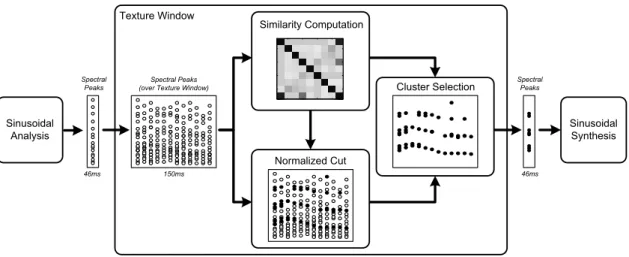
7 Similarity cues currently implemented in the proposed sound segregation framework (black boxes). The system is flexible enough to accommodate new similarity cues (gray blocks) allowing to model an increasing number of perceptual mechanisms involved in human hearing. The individual similar-ity matrices from each grouping cue are combined into an overall similarsimilar-ity matrix that can be subsequently used by the clustering algorithm for sound event segregation (i.e. Normalized Cut). . . 54 8 Dynamic adjustment of the length of the texture windows based on the
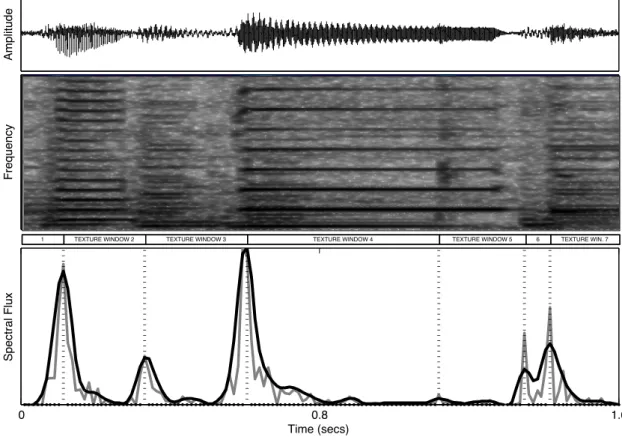
detection of onsets in the audio signal. The top panel depicts the time domain representation of a fragment of a polyphonic jazz recording, below which is displayed its corresponding spectrogram. The bottom panel plots both the onset detection function SF (n) (gray line – see Equation 6), as well as its filtered version (black line – see Equation 7). The automatically identified onsets (see Section 3.5.3) are represented as vertical dotted lines. 62 9 An example dataset containing non-convex and non-Gaussian shaped
dis-tributions (a) and the resultant grouping of the data points after applying spectral clustering (b). Such a clustering result would be hard to attain if using techniques such as k-means or EM, which assume convex shaped or Gaussian distributed data sets. . . 66 10 Example of an undirected similarity graph (where the nodes of the graph
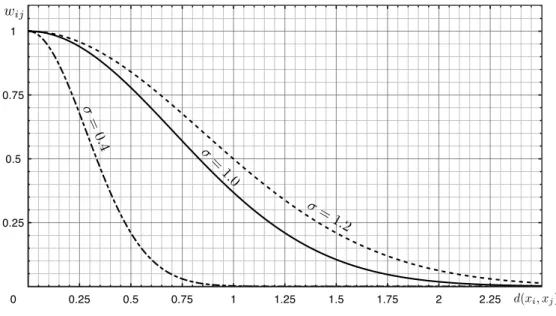
can be the peaks of the magnitude spectrum of a sound signal), and an undirected edge is formed between each pair of nodes. The edge weight is a function of the similarity between nodes (which can be defined by means of various grouping cues, such as frequency, amplitude and harmonicity proximity, among others – see Section 3.7). . . 68 11 Gaussian similarity function as defined in Equation 8 for three values of σ. . 70 12 Two sets A and B of harmonically related peaks, following the values
spec-ified in Table 1. . . 72 13 Graphic representation of the similarity matrix W for two harmonic
se-ries, as defined in Table 1 and depicted in Figure 12, using some “ideal” harmonicity distance. High similarity values are mapped to black and low similarity values to white. . . 73
LIST OF FIGURES
14 Example of an undirected similarity graph, where the result of the mincut criterion defined in Equation 14 is depicted in opposition to a better and more balanced cut where the similarity between points in the same cluster and the dissimilarity between points in different clusters are maximized. . . 75
15 Histograms for the amplitude, frequency (in Hz and Bark) and HWPS distance distributions in four different audio signals (organized in columns). See text for details. . . 83
16 Histograms of the normalized distance histograms (left column) and the corresponding histograms for the Gaussian similarity function Wa, Wf and
Wh(right column) for the audio signal “Tones A+B”. The gray dashed lines
in the left plots represent scaled segments of the Gaussian function defined in Equation 8 using the specified σ values for each similarity cue (see text for details). Panel (g) shows the histogram of the combined Gaussian similarity function Waf h (defined and discussed in Section 3.7.3). . . 86
17 Histograms of the normalized distance histograms (left column) and the corresponding histograms for the Gaussian similarity function Wa, Wf and
Wh (right column) for the audio signal “Jazz1”. The gray dashed lines in
the left plots represent scaled segments of the Gaussian function defined in Equation 8 using the specified σ values for each similarity cue (see text for details). Panel (g) shows the histogram of the combined Gaussian similarity function Waf h (defined and discussed in Section 3.7.3). . . 87
18 Bipartite segregation results of the signal “Tones A+B” (see Table 1 and Figure 12) using different similarity cues. Panel (a) shows the time-frequency plot of the sinusoidal representation of the mixed signal, where darker shades of gray represent higher amplitude peak values. The first three rows in the figure (plots (b) to (g)) represent the pairwise clusters obtained by using in each case a single similarity cue, while the last row (plots (h), (i)) show the clusters obtained by combining all the previous similarity cues (as discussed in Section 3.7.3). . . 89
LIST OF FIGURES
19 Bipartite segregation results of the signal “Jazz1” using different similarity cues. Panel (a) shows the time-frequency plot of the sinusoidal represen-tation of the mixed signal, where darker shades of gray represent higher amplitude peak values. The first three rows in the figure (plots (b) to (g)) represent the pairwise clusters obtained by using in each case a single sim-ilarity cue, while the last row (plots (h), (i)) show the clusters obtained by combining all the previous similarity cues (as discussed in Section 3.7.3). . 90
20 HWPS calculation for peaks A0 ♦ and A1 ∗, from Figure 12. From top to bottom: Shifted Spectral Pattern, Harmonically-Wrapped Frequency and Histogram of Harmonically-Wrapped Frequency. Notice the high correla-tion between the two histograms at the bottom of the Figure. . . 95
21 HWPS calculation for peaks A1 ♦ and B1 ∗, from Figure 12. From top to bottom: Shifted Spectral Pattern, Harmonically-Wrapped Frequency and Histogram of Harmonically-Wrapped Frequency. Notice the lack of corre-lation between the two histograms at the bottom of the Figure. . . 96
22 Example of the HWPS computation for two harmonically related peaks, A1 and A0, from a same frame k, and assuming an ideal wrapping function h. The top panel shows the illustrative spectrum representation used in this example and the helixes represent the shifting and wrapping steps performed by the HWPS algorithm for each peak (see text for details). The bottom panel shows the resulting combined histograms, where the white bars refer to the histogram ˆFAk1 and the black bars refer to ˆFAk0. Given the similarity between the two histograms, the HWPS value will result high, as expected for two harmonically related peaks. . . 100
23 Example of the HWPS computation for two non-harmonically related peaks, A1 and B0, from a same frame k, and assuming an ideal wrapping function h. The top panel shows the illustrative spectrum representation used in this example and the helixes represent the shifting and wrapping steps performed by the HWPS algorithm for each peak (see text for de-tails). The bottom panel shows the resulting combined histograms, where the white bars refer to the histogram ˆFk
A1 and the black bars refer to ˆF k
B0.
Given the difference between the two histograms, the HWPS value will result low, as expected for two non-harmonically related peaks. . . 102
LIST OF FIGURES
24 Example of the HWPS computation for two harmonically related peaks, Ak
1 and Ak+n0 , from two different frames k and k + n, and assuming an ideal wrapping function h. The top panel shows the illustrative spectrum representations for each frame as used in this example. The helixes rep-resent the shifting and wrapping steps performed by the HWPS algorithm for each peak (see text for details). The bottom panel shows the resulting combined histograms, where the white bars refer to the histogram ˆFk
A1 and
the black bars refer to ˆFAk+n0 . The similarity between the two histograms is basically given by the high and similar values in bin 0, which correspond to the aligned peaks from the harmonic series A. Given the low values of the remaining bins, their impact into the HWPS result will be negligible. As a result, the HWPS will still result high valued, although smaller than the value obtained for similar peaks when in the same frame (see Figure 22). . . 105
25 Harmonically-Wrapped Peak Similarity (HWPS) matrix for two harmonic sources using the correct f0 estimates (left), and using the conservative estimate of wrapping frequency (likely a harmonic of the “true” f0) (right). High similarity values are mapped to black and low similarity values to white. . . 106
26 Fisher (a) and Density (b) criteria versus the f0of the second source for the Srinivasan cue (dotted line), the Virtanen cue (dashed line) and the HPWS cue (solid line). The f0 of the first source is set to 440 Hz. . . 119
27 Distribution of errors as percentages of total pitch estimates across cor-pus. The top plot presents a segment of the normalized error distribution, N E (no significant error values exist outside the plotted ranges), while the bottom plot depicts the corresponding octave wrapped error distribution, N Echr. The pitch errors from using Praat on the separated voice signals
are represented in black colour, while its use on mixed signals is represented by the slashed line and white bars. The multiple pitch approach of Klapuri is represented in gray. . . 128
LIST OF FIGURES
28 Distribution of errors over the MIREX audio melody extraction dataset. The top plot presents a segment of the normalized error distribution, NE (no significant error values exist outside the plotted range), while the bottom plot depicts the corresponding octave wrapped error distribution, N Echr. The pitch errors from using Praat on the separated voice signals
are represented in black colour, while its use on mixed signals is represented by the slashed line and white bars. The multiple pitch approach of Klapuri is represented in gray. . . 130 29 Block diagram of the timbre recognition system. . . 133 30 Resulting sound source formation clusters for two notes played by a piano
and an oboe (E4 and B4, respectively). . . 134 31 Examples of prototype envelopes for a range of one octave. . . 135 32 Weak matching of an alto sax cluster and a portion of the piano prototype
envelope. . . 136 33 Overview of the MARSYAS network used for the sound segregation
frame-work proposed in this thesis. Detailed views of the blocks signaled with numbered dark circles and the data structures signaled with letters inside gray squares are presented in Figures 33, 35, 36, 37 and 38. . . 151 34 Graphic representation of the data structures used at different points of the
data flow of the MARSYAS networks depicted in Figures 33, 35, 36, 37 and 38. . . 152 35 Detailed view of the MARSYAS network used for the computation of the
texture windows and the corresponding spectral representations used as the base for the sinusoidal modeling of the audio signals. A detailed view of the optional MARSYAS network which implements the onset detector used for the dynamic adjustment of the texture windows is depicted at the bottom of the figure. . . 156 36 Detailed view of the MARSYAS network used for the computation of the
different similarity cues and the subsequent grouping process. This com-posite and hierarchical architecture is flexible enough to support the future inclusion of new similarity cues and the expression of more complex com-bination schemes of similarity cues (as exemplified in Figure 37). . . 157
LIST OF FIGURES
37 The hierarchical composition and Implicit Patching architecture of MARSYAS allows to efficiently express complex combination schemes of similarity cues by using different instances of FanOutIn composite MarSystem’s. The figure shows an illustrative composition expressing Waf h = max[(Wf.∗ Wa), Wh]. ∗ Ws (where the .∗ operator represents the
element-by-element matrix multiplication). . . 160 38 Sound event resynthesis MARSYAS network, based on an additive
synthe-sis approach and implemented as a bank of sinusoidal oscillators using an overlap-add scheme. . . 162 39 Building blocks in MARSYAS 0.2. . . 183 40 Processing slices of data in MARSYAS 0.2. . . 184 41 Common and specialized GUIs for Marsyas modules. . . 187
List of Tables
1 Frequencies and amplitudes of the peaks from two harmonic series A and B, as depicted in Figure 12. . . 72 2 Results for the separation of two harmonics sets of peaks. Mean and
stan-dard deviation values of the Fisher and Density criteria are computed for the Srinivasan (Ws), Virtanen (Wv), HWPS (Wh), and HWPS with prior
knowledge of the two f0’s (Wh(f0)). . . 118 3 SDR values (in dB) for experiments using different “old+new” mixtures.
The following conventions are used : X is saxophone, N is noise, V is violin, S is harmonic sweep, and C is voice. A, F, H correspond to using amplitude, frequency and HWPS similarities, respectively. . . 120 4 SDR values (in dB) using “texture windows” for experiments with
differ-ent “old+new” mixtures. The same experimdiffer-ental setup and convdiffer-entions described in Table 3 are used. . . 120 5 SDR measurements (in dB) of predominant sound source separation in
polyphonic music using different similarity measures. The first column (AF) shows the results of using only the amplitude and frequency simi-larity cues, while the remaining ones present the performance of adding the use of the harmonicity cues proposed by Srinivasan (HS), Virtanen (HV) and the rough (rHWPS) and precise (HWPS) frequency estimation HWPS cues, respectively. . . 123 6 SDRogf measurements (in dB) of predominant melodic source segregation
from monaural polyphonic audio recordings using fixed and dynamic ad-justment of the length of texture windows. . . 124
LIST OF TABLES
7 Normalized Pitch Errors (NE and NEchr) and Gross Errors (GE and GE−
8ve) across corpus, for different evaluation scenarios. . . 127
8 Normalized Pitch Errors (NE and NEchr) and Gross Errors (GE and GE−
8ve) for MIREX Dataset, using different evaluation scenarios. . . 129
9 Voicing Detection Percentage Accuracy using different classifiers and eval-uation scenarios, where NB refers to a Naive Bayes classifier, SVM to a support vector machine and ZeroR is the “random” baseline classifier. . . . 131 10 Confusion matrix for single–note instrument identification. Six different
instruments from the RWC database were considered: piano (p), oboe (o), clarinet (c), trumpet (t), violin (v), alto sax (s). . . 138 11 Recall and precision values for instrument presence detection in
multiple-note mixtures. . . 139 12 Instrument classification performance for 2-, 3- and 4-note mixtures. . . 141 13 Instrument classification confusion matrix for 2-, 3- and 4-note mixtures . . 141 14 Performance comparison between the Ncut and HESR approaches.
Compu-tational cost is expressed in terms of real-time and separation performance in terms of SSDR (in dB). . . 195
Acronyms
AM Amplitude Modulation
API Application Programming Interface ASA Auditory Scene Analysis
ASR Automatic Speech Recognition
CASA Computational Auditory Scene Analysis CMSA Computational Music Scene Analysis CPR Cluster Peak Ratio
DFT Discrete Fourier Transform DWT Discrete Wavelet Transform EM Expectation-Maximization F0 Fundamental Frequency FM Frequency Modulation FFT Fast Fourier Transform
FOSS Free and Open Source Software FP False Positive
GMM Gaussian Mixture Models GNU “GNU is Not Unix”
ACRONYMS
GPL GNU Public License GUI Graphical User Interface HCI Human Computer Interaction
HESR Harmonically Enhanced Spectral Representation HWPS Harmonically Wrapped Peak Similarity
ICA Independent Component Analysis JND Just Noticeable Difference
KNN K-Nearest Neighbor
MARSYAS Music Analysis, Retrieval and SYnthesis for Audio Signals MCA Music Content Analysis
MFCC Mel-Frequency Cepstral Coefficients MIDI Musical Instrument Digital Interface MIR Music Information Retrieval
MIREX Music Information Retrieval Evaluation eXchange Ncut Normalized cut
NMF Non-Negative Matrix Factorization PCA Principal Component Analysis PRC Precision
RBF Radial Basis Functions RCL Recall
SDR Signal-to-Distortion Ratio
SDRogf Signal-to-Distortion Ratio with optimized gain factor
SMC Sound and Music Computing SMO Sequential Minimal Optimization
ACRONYMS
SMS Spectral Modeling Synthesis SNR Signal-to-Noise Ratio
SSDR Segmental Signal-to-Distortion Ratio STFT Short-Time Fourier Transform STS Short-Term Sinusoidal
SVD Singular Value Decomposition SVM Support Vector Machine TP True Positive
Chapter
1
Introduction
“The beautiful thing about learning is that no one can take it away from you.”
B.B. King
1.1 Context and Motivation
This dissertation is framed in the general field of Sound and Music Computing (SMC), which focuses the analysis and understanding of sound and music, synthesis and processing of sound, music generation modeling, music interfaces, performance modeling and control, and sound interaction design [Serra et al., 2007].
Sound is the effect of the resonance of objects and materials in a medium (e.g. the air) while music can be coarsely defined as an intended organisation of sounds for par-ticular uses in social and cultural contexts. Indeed, music is an important aspect of all human cultures, being the language of human emotions, of social bonding, of personal development and intellectual enrichment.
Sound and music are therefore intrinsically connected by a communication chain cover-ing all aspects of the relationship between sonic energy and meancover-ingful information, both from sound to sense (as in musical content extraction or perception), and from sense to sound (as in music composition or sound synthesis).
Finding its roots in the biology of humans and being intimately attached to their own daily existence, music took a central position in the current technological society. Over the past 50 years, music and technology have established such a strong connection that all stages of the economic chain, from production to distribution and consumption, are
INTRODUCTION
now digital. As a result, music is quickly starting to become a commodity as ubiquitous as water or electricity, at least in all first world societies [Serra et al., 2007].
However, the real sound and sense for music is still identified with the extremes of this chain, where musicians play and where listeners search for and enjoy music as active consumers. All the rest is virtual, digitally encoded and difficult to access. It is therefore necessary to somehow bridge this semantic gap (i.e. the separation that currently exists between sound and sense), stimulating a constructive interaction between culture, science and industry.
Indeed, and accordingly to a recent roadmap proposed for the field of SMC [Serra et al., 2007], the next revolution is about the connection between sound and sense, that is, the connection between physical energy encoded in technology and the hu-man subjective experience. Hence, new technology is required to close this gap and change the way people normally interact with music at the different levels of the digital chain. From early research in audio processing and synthesis during the second half of the past century, the challenge is now in moving to a position where areas such as Music Infor-mation Retrieval (MIR) [Downie, 2003], Interactive Multimedia Systems and sound- and music-aware environments are more relevant than ever. Innovative products are starting to foster social interaction among people and new opportunities will be further developed by offering new tools for expression and communication. This revolution will be leveraged by the dynamic forces that drive music itself, which in turn will lead to the creation of new cultural and business opportunities, from industrial to creative industries, from developers to artists, from creators to consumers.
1.2 Thesis Statement
The main problem this work tries to address is the identification and segregation of sound events in monaural (i.e. single-channel) “real-world” polyphonic music signals1. The approach presented has been inspired by the current knowledge of how listeners perceive sound events in music signals, be it music notes, chords, harmonic textures, melodic contours, instruments (i.e. sound sources) or any other type of event.
Indeed, when taking at hands the challenge of constructing a machine listening system, approaching the problem through engineering alone may not be the most suitable strategy. The perception of music is by nature intrinsically related to the perception of sound and
1In this text, the term polyphonic music, sound or mixture refers to sounds or musical pieces where
THESIS STATEMENT
therefore the principles upon which the human auditory system are based should first be understood [Scheirer, 2000, pp.14].
However, the objective is not, at least at this stage, to provide a complete music-listening framework that models the high level processes involved on how music expert listeners turn musical data into models of musical structure, or how cognitive music struc-tures give rise to affective response or even how musicians turn intentions into music. Such problems mainly fall into the realm of Music Psychology [McAdams and Bigand, 1993, Deutsch, 1999], and are out of the scope of this work.
Instead, the work presented and discussed in this dissertation attempts to propose a sound segregation framework and some of the building blocks involved in sound and music perception, while already paving the way for the future inclusion of higher level processes involved in the cognition of acoustic and musical events in audio signals.
1.2.1 Current State
Typical sound analysis and MIR systems represent statistically the entire polyphonic or complex sound mixture (e.g. [Pachet and Cazaly, 2000, Tzanetakis and Cook, 2002]), without any attempt to first identify the different sound entities or events that may coexist in the signal. There is however some evidence that this approach has reached a “glass ceiling” [Aucouturier and Pachet, 2004] in terms of analysis and retrieval performance.
One obvious direction for further progress is to attempt to individually characterize the different sound events comprising the polyphonic mixture, and use this structured rep-resentation to improve the extraction of perceptually relevant information from complex audio and musical mixtures.
However, such sound segregation systems (including the one proposed in this thesis) face some demanding challenges, making their performance still quite limited compared to the human auditory system. Nevertheless, some of the current results already provide alternative and improved approaches to common sound analysis and MIR applications.
1.2.2 The Main Challenges
Human listeners are able to perceive individual sound events in complex mixtures, even if listening to a monaural music recording, which may even include unknown timbres or musical instruments.
Some techniques for sound separation are based on recordings done with multi-ple microphones, enabling the use of the spatial location of the source in the separa-tion [Torkkola, 2000], often making the separasepara-tion task easier. However, often only a
INTRODUCTION
single-channel recording is available, and even the common stereo (i.e. two-channel) for-mat usually used for music distribution may not be sufficient for spatial location based separation (except in some trivial cases).
The use of prior information about the sources or musical instruments in a recording can also help to optimize the segregation algorithm by using training signals where each instrument is present in isolation (e.g. [Burred and Sikora, 2007]). However, such systems may lack the ability to analyse generic sound signals, where the assumptions about the pre-trained sound sources do not hold.
As a result, this work takes the challenge to attempt sound event segregation in monau-ral “real-world” music signals (although stereo information can be easily incorporated and made useful to the segregation task), using an approach that is not necessarily based on the use of source-specific prior knowledge (i.e. it is not trained for a specific sound source or music instrument). Instead, the general properties of the sound and music sig-nals, together with some of the known principles of human auditory system, are explored, requiring a multidisciplinary approach to the problem.
1.3 Related Research Areas
Being an intrinsically multidisciplinary field, Sound and Music Computing (SMC) is a con-temporary designation encompassing disciplines historically known as Audio Processing, Music Technology, Computer Music, Computer Audition, among others, all committed to developing new and more advanced musical tools. The SMC field is generally considered to include all types of sounds and human communication processes except speech. Speech research has its own aims and methodologies (although most of them are of valuable importance for sound processing in general [Rabiner and Juang, 1993]) and is therefore outside the scope of the SMC field [Serra et al., 2007].
Specifically, the work presented in this thesis falls under the very active field of research known as Computational Auditory Scene Analysis (CASA) [Wang and Brown, 2006], which is in turn part of the Sound and Music Description and Understanding SMC sub-topics [Serra et al., 2007, Ch.4]. CASA focuses on the development of computational approaches for the segregation of different sound producing objects in an acoustical scene, based on the principles underlying the human perception of complex acoustic mixtures, a discipline known as Auditory Scene Analysis (ASA) [Bregman, 1990].
Several areas of study relate to CASA. Audio and especially music signals are complex data-intensive, time-varying signals with unique characteristics that elicit new challenges
RELATED RESEARCH AREAS
to these relevant research areas. Therefore, research in CASA provides a good way to test, evaluate and create new algorithms and tools in all those research areas. The following paragraphs provide short descriptions of these research areas and their connection to CASA.
Digital Signal Processing [Oppenheim and Schafer, 1975] is related to the computer manipulation of analog signals (commonly sounds or images) which have been converted to digital form (i.e. sampled). The various techniques of Time-Frequency analysis developed for processing audio signals in many cases originally developed for Speech Processing and Recognition [Rabiner and Juang, 1993], are of special importance for this work.
Machine Learning is a broad subfield of artificial intelligence and is focused on the de-sign and development of algorithms and techniques that allow computers to improve their performance in inferring relevant information from data, based on previous results and training by humans [Duda et al., 2000, Witten and Frank, 2005]. In the particular case of the work presented in this thesis, machine learning techniques are used to implement a computer system which is able to identify sound “objects” in a complex acoustic mix-ture, taking into consideration grouping cues inspired in Auditory Scene Analysis (ASA) principles [Bregman, 1990] (e.g. the Spectral Clustering technique, as will be described in Chapter 3).
Computer Vision [Marr, 1982] is a term used to describe any algorithm and system that extracts information from visual signals such as image and video. The visual and acoustical perception in humans, although based on different mechanisms, often follow similar principles, hence some of the techniques and ideas developed in the realm of one discipline may prove useful and successful at the other (e.g. the Normalized Cut criterion, proposed for the segmentation of images [Shi and Malik, 2000], and proposed in this work for sound segregation – see Chapter 3).
Information Retrieval [van Rijsbergen, 1979] refers to techniques for searching and re-trieving text documents based on user queries (e.g. web searches provided by Google2). More recently, techniques for multimedia information retrieval such as content-based re-trieval systems for sound and music [Gouyon et al., 2008] have started appearing and a related field of research of specific interest to this thesis is Music Information Retrieval (MIR) [Downie, 2003, Orio, 2006]. MIR has been rapidly evolving over the past few years and it encompasses a wide variety of ideas, algorithms, tools, and systems that have been proposed to handle the increasingly large and varied amounts of musical data available digitally.
INTRODUCTION
Finally, Perception research. The human perceptual system has unique character-istics and abilities that should be taken into account to develop more effective com-puter systems for analysing and processing sensory data. The work on Psychoacous-tics [Stevens, 1957, Moore, 1989, Zwicker and Fastl, 1990] and Auditory Scene Analysis (ASA) [Bregman, 1990, McAdams and Bigand, 1993] describe the relationship between acoustic sound signals, the physiology of the human ear and the cognitive processes in-volved in the perception of sound and music.
1.4 Applications
Sound mixtures present challenging problems for most audio applications where the anal-ysis or the application of some processing only to a certain source within the mixture is virtually impossible. This presents an opportunity for the development of sound source separation solutions which first separate the mixture into its constituent sources, subse-quently allowing their individual analysis and processing.
Additionally to the scientific challenge of creating a listening machine, where a model of the auditory apparatus could be experimentally tested and evaluated, there are several other fields of application for a CASA system. Some examples are enumerated in the following list.
• Sound and music description. The analysis of sound mixtures is difficult and one approach towards simplifying the problem is to use source separation as a pre-processing step. For instance, estimating the fundamental frequencies of concurrent sounds in a polyphonic mixture may be easier to tackle if us-ing the separated monophonic signals comus-ing from each instrument playus-ing (e.g. [Lagrange et al., 2008a, Klapuri, 2008]).
• Sound manipulation. Separation enables the efficient manipulation of mixed sound signals. The removal or volume adjustment of the playing sources, the changing of the source location in the stereo field or the upmixing of audio recordings (e.g. [Lagrange et al., 2007b]) are just some examples.
• Robust automatic speech and speaker recognition. Although much progress has been made in automatic speech and speaker recognition in recent years, the performance of these systems still degrades quickly when in the presence of acoustic interference or concurrent signals, the normal situation in real-world scenarios. CASA presents some new approaches to this problem, in which
APPLICATIONS
speech is regarded as just one of the many sources in a complex sound mixture. After segregation from interfering components, the separated speech signal can then be further processed in an attempt to improved speech and speaker recog-nition in environmental mixtures.
• Object-based audio coding. The current and more common audio coding meth-ods encode a polyphonic signal as a single stream (e.g. MPEG1–Layer 3, a.k.a. MP3). However, higher coding flexibility and efficiency could be achieved if each separated element or sound “object” in the mixture could be independently encoded with specific source codecs (e.g. [Tolonen, 2000, Ferreira and Sinha, 2005, Vincent and Plumbley, 2005]. The MPEG-4 stan-dard [Pereira and Ebrahimi, 2002] implements this approach as the “Structured Audio” component [Scheirer, 1998], and the standard includes a format for cod-ing object-based audio scenes.
• Automatic music transcription. Automatic music transcription attempts to derive a musical score from an acoustical recording of a music piece (e.g. [Klapuri, 2006, Bello, 2003, Martins and Ferreira, 2002, Marolt, 2004, Klapuri and Davy, 2006, Paiva et al., 2006]). Given the specific challenges elicited by polyphonic music signals (as discussed in section 2.3.2), CASA can contribute with new and robust approaches to this problem by firstly segregat-ing the playsegregat-ing instruments in a mixture before proceedsegregat-ing with their individual transcriptions.
• Audio and music information retrieval. One of the current key research chal-lenges in the SMC field is the efficient automatic annotation and subsequent search of audio recording archives (private or on the Internet). Given the huge amounts of audio content on those archives, and the fact that most recordings contain mixtures of sound sources, the separation of the such mixtures is a prerequisite for automatic content based analysis.
• Auditory scene reconstruction. Audio restoration is another field of application for CASA, where unwanted sources in a sound mixture can be separated and subsequently removed or enhanced (e.g. [Esquef et al., 2002]). This area has recently started finding application in the cell-phone industry, where CASA principles are being used to enhance speech intelligibility in noisy environments.
INTRODUCTION
on understanding speech in noisy environments since they equally amplify both signals. CASA could provide a solution to speech segregation from noisy signals, improving speech intelligibility.
1.5 Main Contributions
The main contributions of this thesis towards a sound segregation approach for music signals are summarized below.
1. Proposal and experimental validation of a flexible and efficient framework for sound segregation of “real-world” polyphonic music, inspired by ideas from Computational Auditory Scene Analysis (CASA).
2. Definition of a novel harmonicity cue, termed Harmonically Wrapped Peak Similarity (HWPS), experimentally shown as a good grouping criteria for sound segregation in polyphonic music signals.
3. Development of the proposed sound segregation approach as open source software, based on the MARSYAS framework3.
Publications Related to the Thesis
The research work presented in this thesis has resulted in the collaborative publications listed below (sorted by relevance). The articles are available in PDF format at http: //www.fe.up.pt/˜lgustavo.
1. Lagrange, M., Martins, L. G., Murdoch, J., and Tzanetakis, G. (2008). Normalized cuts for predominant melodic source separation. IEEE Transac-tions on Audio, Speech, and Language Processing, 16(2). Special Issue on MIR. [Lagrange et al., 2008a]
2. Martins, L. G., Burred, J. J., Tzanetakis, G., and Lagrange, M. (2007). Polyphonic instrument recognition using spectral clustering. In Proc. International Conference on Music Information Retrieval (ISMIR), Vienna, Austria. [Martins et al., 2007] 3. Lagrange, M., Martins, L. G., and Tzanetakis, G. (2008). A computationally efficient
scheme for dominant harmonic source separation. In Proc. IEEE International Con-ference on Acoustics, Speech, and Signal Processing (ICASSP), Las Vegas, Nevada, USA. [Lagrange et al., 2008b]
![Figure 1: A sketch of the peripheral region of the human auditory system (adapted from [Beranek, 1990]).](https://thumb-eu.123doks.com/thumbv2/123dok_br/15238255.1022815/55.892.217.730.159.503/figure-sketch-peripheral-region-human-auditory-adapted-beranek.webp)
![Figure 2: The main types of auditory processing and their interactions (adapted from [McAdams and Bigand, 1993]).](https://thumb-eu.123doks.com/thumbv2/123dok_br/15238255.1022815/58.892.217.667.201.539/figure-types-auditory-processing-interactions-adapted-mcadams-bigand.webp)