4th International Conference
on Live Interfaces
ICLI 2018
4th International Conference
on Live Interfaces
Inspiration, Performance, Emancipation
Dates
14-16 June 2018
Location
Casa da Música & Passos Manuel, Porto, Portugal
Website
www.liveinterfaces.org
Edited by
José Alberto Gomes Miguel Carvalhais Rui Penha Design Michelle Martins ISBN 978-989-746-170-5 Published by Universidade do Porto Praça Gomes Teixeira 4099-002 Porto Portugal
Contents
Foreword Keynotes Rajele JainFrom the Natyashastra Andrew McPherson Comparative Musical Instrument Design
Papers
Vincent Goudard
Gestural Ergonomics of Visual Interfaces: The MP.TUI Library for Max
Raul Masu, Nuno N. Correia Penguin: Design of a Screen Score Interactive System Raffaella Folgieri, Maria Elide Vanutelli, Paola Maria Sala, Ludovico Dei Cas, Dario Dei Cas, Claudio Lucchiari The Creative Mind: DRACLE Further Development
Henrique Portovedo, Paulo Ferreira-Lopes, Ricardo Mendes HASGS: The Repertoire
as an Approach to Prototype Augmentation
Tiago Ângelo, Rui Penha, José Alberto Gomes, Pedro Rebelo Actuated Musical Instruments: a State of the Art
11 14 16 19 27 34 45 52
Koichi Samuels, Hadi Bastani Digital Media, Live Interfaces and Inclusion: ethnographic perspectives
Jung In Jung
Bridging Abstract Sound and Dance Ideas with Technology: Interactive Dance Composition as Practice-Based Research
Renick Bell, Joana Chicau A Trans-Disciplinary Tool for Collaborative, Choreographed, and Embodied Audio-Visual Live Coding
Joanne Armitage, Shelly Knotts Vibez: A Small Sense of Presence at a Distance
Performances
Joana Chicau, Renick Bell Círculo e Meio
Ryan Kirkbride, Lucy Cheesman, Laurie Johnson Fingerprints Masato Kakinoki Act: Study Subject: History Topic: _
Filipe Lopes, Gilberto Bernardes, Clara Cardoso
Variações sobre Espaço #6 Marcin Pietruszewski
formulae si:v
Alice Eldridge, Chris Kiefer, Thor Magnusson, Thanos Polymeneas Liontiris Brain Dead Ensemble: An Acoustically Networked Feedback Quartet
Visda Goudarzi, Enrique Tomás, Artemi-Maria Gioti Collaborative Design Methods towards Evaluation of
a Tangible Interface
Alex McLean, Dave Griffiths, Ellen Harlizius-Klück
Digital Art: A Long History Thor Magnusson
Ergomimesis: Towards a Language Describing Instrumental Transductions Marije Baalman, Simon
Emmerson, Øyvind Brandtsegg Instrumentality, Perception and Listening in Crossadaptive Performance
Michael Rottmann
Before Ink Starts to Blink: Scripts and Diagrams on Paper as Interfaces for Machines and Humans (in Creative Processes Ricardo Melo, Miguel Carvalhais The Interactor Cedes Control: An Heuristic for Planned
Serendipity in Interactive Systems Thanos Polymeneas Liontiris, Thor Magnusson, Chris Kiefer, Alice Eldridge
The Ensemble as Expanded
Interface: Sympoetic Performance in the Brain Dead Ensemble
Cécile Chevalier, Chris Kiefer Listening Mirrors: Prototyping for a Hybrid Audio Augmented Reality Installation
Paul Granjon, Patrick Hénaff, Alain Dutech
Guido and Am I Robot? Case Study of Two Robotic Artworks Operating in Public Spaces 62 71 78 86 96 110 117 126 133 151 160 173 181 191 196 197 198 199 200
Henrique Portovedo Music for HASGS Joe Watson
The Thing Breathed
Amy Alexander, Curt Miller A performance of PIGS:
Percussive Image Gestural System Lee Westwood, Danny Bright Noise Peddler: A live exploration of the pedalboard as performance interface
Alexandra Tibbitts, John Sullivan, Ólafur Bogason, Brice Gatinet A Method for Gestural Control of Augmented Harp Performance Adriana Sá, John Klima
CityStrings
Joanne Armitage and Shelly Knotts Vibez Alex McLean Yaxu: Feedforward
Doctoral Symposium
Luís AlyPerformative Sound Design: A Bio-signal Control Metaphor for Performative Sound Design Jack Armitage
Supporting Live Craft Process in Digital Musical Instrument Design Raul Masu
DMIs Design: Fostering Authorship of Composers and Creativity of Performers
Terhi Marttila
Playful Readings and Deeper Meanings
Francisca Gonçalves
Acoustic Ecology as Tool for Environmental Awareness: The Ocean Soundscape 202 204 209 213 216 219 220 221 224 228 231 234 237
liveinterfaces.org
ICLI
POR
TO
2018
HASGS
The Repertoire
as an Approach
to Prototype
Augmentation
Henrique Portovedo
1 [email protected]Paulo Ferreira Lopes
1 [email protected]Ricardo Mendes
2 [email protected]1 CITAR, Portuguese Catholic University,
Oporto, Portugal
2 Information Systems and Processing,
University of Aveiro, Aveiro, Portugal
Abstract
This paper discusses the development
of HASGS regarding augmentation
procedures applied to an acoustic
instrument. This development has been
driven by the compositional aspects of
the original music created in specific for
this instrumental electronic augmented
system. Instruments are characterized
not only by their sound and acoustical
properties but also by their
performa-tive interface and repertoire. This last
aspect has the potential to establish a
practice among performers at the same
time as creating the ideal of community
contributing to the past, present and
future of that instrument. Augmenting
an acoustic instrument places some
limitations on the designer ́s palette of
feasible gestures because of those
intrinsic performance gestures, and the
existing mechanical interface, which
have been developed over years,
some-times, centuries of acoustic practice.
We conclude that acoustic instruments
and digital technology, are able to
influ-ence and interact mutually creating
Augmented Performance environments
based on the aesthetics and intentions
of repertoire being developed.
Keywords
Saxophone
Augmented Instruments
Gestural Interaction
Live electronics
Open-access article distributed under the Creative Commons Attribution 3.0 Unported License, which permits unrestricted use, distribution, and reproduction in any medium, provided the original author and source are credited.
ICLI
PORTO
2018
46 Introduction
Augmenting an acoustic instrument places some limitations on the designer ́s palette of feasible gestures because of those intrinsic per-formance gestures, and the existing mechani-cal interface, which have been developed over years, sometimes, centuries of acoustic practice (Thibodeau and Wanderley 2013). A fundamen-tal question when augmenting an instrument is whether it should be playable in the existing way: to what degree, if any, will augmentation modify traditional techniques? The goal here, according to our definition of “augmented”, is to expand the gestural palette, at the same time as providing the performer with extra control of electronic parameters. From previous studies conducted by this research team we can say that the use of nonstandard performance gestures can also be exploited for augmentation and is, thus, a form of technique overloading.
It seems straightforward to define musical ges-ture as an action pattern that produces music, is encoded in music, or is made in response to music. The notion of gesture goes beyond this purely physical aspect in that it involves an action as a movement unit, or a chunk, which may be planned, goal directed, and perceived as a holistic entity (Buxton and Meyers 1986). Movements used to control sound in many multimedia settings differ from those used for acoustic instruments. For digital electron-ic instruments the link between gesture and sound is defined by the electronic design and the programming. This opens up many possible choices for the relationship between gesture and sound, usually referred to as mapping. The mapping from gesture to sound can be fairly straightforward so that, for example, a fast movement has a direct correspondence in the attack time or loudness of the sound. However, with electronically generated sounds it is also possible to make incongruent, “unrealistic” links between gesture and sound. The gestural control of electronic instruments encompasses a wide range of approaches and types of works, e.g. modifying acoustic instruments for mixed acoustic/electronics music, public interactive installations, and performances where a dancer
interacts with a sound environment. For these types of performances and interactions, the boundaries between, for instance, control and communicative gestures tend to get blurred. In the case of digital interactive performanc-es, such as when a dancer is controlling the sound produced, there is very little distinction between sound-producing gestures, gestures made, or accompanying movements. To give enough freedom to the performers, the design of the interaction between sound and gesture is generally not as deterministic as in perfor-mances of acoustic music.
In our perspective, augmented instruments and systems should preserve, as much as possi-ble, the technique that experienced musicians gain along several years of studying the acous-tic instrument. The problem with augmented instruments is that they require, most of times, a new learning process of playing the instru-ment, some of them with a complex learning curve. Our system is prototyped in a perspec-tive of retaining the quality of the performance practice gained over years of studying and practicing the acoustic instrument. Considering the electric guitar one of the most successful examples of instruments augmentations and, at the same time, one of the first instruments to be augmented, we consider that the preser-vation of the playing interface was a key factor of success, allied to the necessity of exploring new sonic possibilities for new genres of music aesthetics. The same principles are applied to the Buchla’s Keyboard from the 70’s, that stills influence new instruments, both physi-cal instruments and digital applications. With HASGS is our intention to integrate the control of electronic parameters organically providing a degree of augmented playability within the acoustic instrument (Portovedo, Ferreira Lopes and Mendes 2017).
Recent Work
HASGS was initially developed within a DiY approach, justifiable by the repertoire that motivated the project. It is the repertoire that has been influencing the way this system has been developing. We consider the concept of Reduced Augmentation because, from the idea of having all the features of an EWI (Electronic
ICLI
PORTO
2018
47
Wind Instrument) on an acoustic instrument, this could lead to performance technique over-load, as well as making the acoustic instrument to much personal in terms of new hardware displacement. The proliferation regarding to the creation of augmented instruments in the NIME context is very big, but just a little number of them acquire recognition from the music mar-ket and players. As any musical instrument is a product of a technology of its time, augmented instruments are lacking the validation from composers and performers apart from their inventors. Due mostly to the novelty of the tech-nology, few experimental hyper-instruments are built by artists. These artists mostly use the in-struments themselves. There is no standardized hyperinstrument yet for which a composer could write. It is difficult to draw the line between the composer and the performer while using such systems. The majority of performers using such instruments are concerned with improvisation, as a way of making musical expression as free as possible (Palacio Quintin 2008).
In the first prototype of HASGS, we were using, attached to the saxophone one Arduino Nano board, processing and mapping the informa-tion from one ribbon sensor, one keypad, one trigger button and two pressure sensors. One of the pressure sensors was located on the sax-ophone mouthpiece, in order to sense the teeth pressure when blowing. Most of the sensors (ribbon, trigger, pressure) were distributed between the two thumb fingers. This proved to be very efficient once that the saxophonist doesn’t use very much of these fingers in order to play the acoustic saxophone. This allowed, as well, very precise control of the parameters assigned to the sensors. The communication between the Arduino and the computer was programmed through Serial Port using USB protocol. This communication sent all the MIDI commands. The computer was running a Node. js program that simulated a MIDI port and every time it received data from the USB port, it sent that data to the virtual MIDI port.
A second prototype of HASGS was experienced having the features of the first prototype but adding a second device for augmentation. The MYO armband was consider an optional, or second layer, to the augmentation process.
The communication between the device and the computer was done using the bluetooth protocol. In this case, the mappings were based on Myo object for Max/MSP written by Jules Françoise. The creation of mappings using an application sold by Thalmic Labs were also possible, more precisely if using a DAW like Ableton Live. The MYO armband was used to collect data from its Accelerometer, Gyro-scope, orientation of Quaternions and from eight Electromyograms. The analysis of MYO’s behavior according to the normal position of different saxophones performance was possi-ble to collect very different values. This showed to be an enormous potential to characterize in-voluntary gestures, as well as imprinting char-acteristics of bio feedback data to the pieces.
Present State
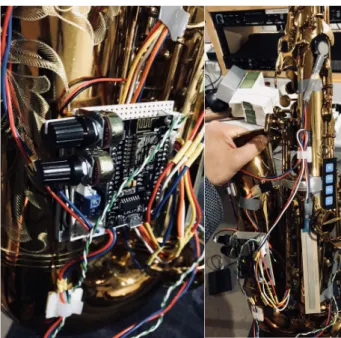
Taking in consideration that this system is still not a finalized interface, but an evolucionary prototype, our third version, presented here, started with the substitution of the Arduino Nano by an ESP8266 board. The communica-tion between the sensors and the data received into the computer became wireless due to this fact. Both the computer and HASGS connect now to a Personal Hotspot created by a mobile phone API. This specification will allow much performance freedom to the performer, allow-ing now space for the integration of an accel-erometer/gyroscope. To the previous sensors in the system were added two knobs allowing independent volume control for two parame-ters (Image 1). Regarding the use of the option-al MYO Armband we started to use MYO Map-per developed by Balandino di Donato which proved to be more flexible, not only with Max/ MSP but as well with other software.
ICLI
PORTO
2018
48
In the process of developing the repertoire, a new table of instructions regarding commu-nication between the sensors and the com-puter was sent to composers. We asked for a normalization on the software used, giving preference to Max/MSP. In that way, the table mentioned before showed the objects and at-tributes regarding the mapping of each sensor. An Max/MSP abstraction was produced for that purpose (Figure 2).
Figure 2. Max/MSP Abstraction for income data from HASGS sensors
Repertoire
While new repertoire is being created, nota-tional development is very much dependent on the composer’s preferences and how they decide to use devices and sensors. The new pieces being written show us that expressive notation will be represented with symbols and graphics, very much like the pieces composed for acoustic instruments these days. Expressive notation is nor dependent of technology nor of the device’s control associated with new instru-ments for the producing of electronic music. Notation in music has been constantly evolve over time, according to the desire of producing new sounds or new sonic textures. This evo-lution has contributed largely for the develop-ment of extended techniques and instrudevelop-mental virtuosity. Yet when acoustic instruments are played or combined in unconventional ways, the result can sometimes sound like electronic music (Roads 2015). One of the things to be considered, regarding to the new repertoire for augmented instruments, and more precisely, to this augmented saxophone system, is the presence of multiple layers of information, something that still not common when writing for a monophonic instrument (Figure 3).
Figure 3. Example of Notation for HASGS
ICLI
PORTO
2018
49
In the following examples of some pieces be-ing written for HASGS, we describe the com-poser’s approach as well as describing their musical intentionality allowed by the systems itself or its possible evolution. This is part of the corpus of study that is motivating the evolution of HASGS to acquire more or less sensors, more or less features.
Cicadas Memories
Composed by Nicolas Canot, Cicadas Memo-ries is much more an improvisational process than a piece of written music. It was commis-sioned to be performed as a part of the HASGS (Hybrid Augmented Saxophone of Gestural Symbiosis) project. It explores a method that eventually introduces a non-standard musical way of thinking: the present of the live per-formed music is (at last partially) controlled, altered by the actualization of the past. In the case of CICADAS Memories, this means that the actual gesture of the player will alter (one minute later) the electronic sound-field used as the sonic background for the saxophone’s rhythmic patterns (also created by the key-pad’s « 4 bits » layers of memory). Therefore, the performer has to develop two simultaneous ways of thinking (and acting) while performing: a part of his mind for the present (the patterns imposed by the software but created by the player’s past action on the keypads), another one for the future (its gestural connection to the sensors). He has to deal with two temporal-ities usually separated in the act of live music performance: he writes the future score and improvises on his past gestures, in the present time. CICADAS MEMORIES could be defined as a multi-temporal sensitive feedback loop. Regarding the sonic / musical context, this explores the thinking of the piece as a process (maybe under the influence of Agostino di Scip-io’s thinking) rather than «written music».
Senza Perderla
Composed in collaboration between the programmer Balandino di Donato and the composer Giuseppe Silvi, Senza Perderla it’s
a “Duo” for acoustic saxophonist and Virtual Saxophone in Physical Modeling Synthesis controlled by HASGS including MYO. The Syn-thesized Sax will be reproduced by S.T.ONE Loudspeaker so both physical (internal) than acoustical (perceived) characteristics of saxo-phone are reproduced. Using not only HASGS technology, the piece is structured with: a wire-piezo transducer fixed between ligature and embouchure; a disc-piezo transducer at the bell; an omnidirectional microphone inside the tube, under F plate; the two piezo are used to track pitch and amplitude of saxophone; the omnidirectional microphone is used to create controllable feedback between tube and loud-speaker, being used alone, with air, with tone. The notation system is organized with the fol-lowing criteria: the first sinusoidal description of tones represents pitch expansion during the duration of the work; diamonds are soprano sax, normal heads are for esax; the ideograms above the system describe sound places, the toponomics of that sounds; the ideograms at the bottom of the system describe sound processing (Figure 3).
Verisimilitude
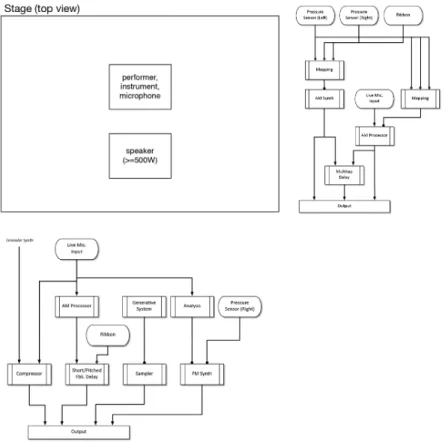
Composed by Tiago Ângelo, the setup for this piece, written for tenor saxophone and the HASGS system, uses a single speaker placed on front of the performer at the same height as the saxophone’s bell. A play of acoustic sound source and electronic (processed and gener-ated) sound using computer music techniques is driven in three sections - A, B and C (Figure 4) - each with its own specific processors and gen-erators, implementing different mappings and control levels not only from the HASGS control-ler but also from real-time sound analysis.
ICLI PORTO 2018 50 Comprovisador
Comprovisador is a system designed by Pedro Louzeiro to enable mediated soloist-ensemble interaction using machine listening, algorithmic compositional procedures and dynamic nota-tion, in a networked environment. In real-time, as a soloist improvises, Comprovisador’s algorithms produce a score that is immediately sight-read by an ensemble of musicians, cre-ating a coordinated response to the improvisa-tion. Interaction is mediated by a performance director through parameter manipulation. Im-plementation of this system requires a network of computers in order to display notation (sep-arate parts) to each of the musicians playing in the ensemble. More so, wireless connectivity enables computers – and therefore musicians – to be far apart from each other, enabling space as a compositional element. Compro-visador consists of two applications – host and client. The adaptation for HASGS has been
done mapping its keypad to preset’s selection, ribbon for phrase amplitude and instrumental density, as well as other sensors to control spa-cialization and instrumentation.
Conclusions and Future Work
Starting as an artistic exploratory project, the conception and development of the HASGS (Hybrid Augmented Saxophone of Gestural Symbiosis) became, as well, a research proj-ect including a group of composers and en-gineers. The project has been developed at Portuguese Catholic University, University of California Santa Barbara, ZKM Karlsruhe and McGill University Montreal. The idea to benefit of this augmentation system was to recover and recast pieces written for other systems using electronics that are already outdated. The system intended as well to retain the focus on the performance keeping gestures central-ized into the habitual practice of the acoustic instrument, reducing the potential use of
ICLI
PORTO
2018
51
ternal devices as foot pedals, faders or knobs. Taking a reduced approach, the technology chosen to prototype HASGS was developed in order to serve the aesthetic intention of some of the pieces being written for it, avoiding the overload of solutions that could bring artefacts and superficial use of the augmentation pro-cesses which sometimes occur on augmented instruments prototyped for improvisational intentionality. Traditional music instruments and digital technology, including new interfac-es for music exprinterfac-ession, are able to influence and interact mutually creating Augmented Performance environments. The new repertoire written by erudite composers and sound artists is contributing then for a system intended to survive in the proliferation of so much new instruments and interfaces for musical expres-sion. The outcomes of the experience suggest as well that certain forms of continuous multi parametric mappings are beneficial to create new pieces of music, sound materials and per-formative environments.
Future work will include a profound reflection on the performative aspects of each piece, evaluating the mapping strategies of each new piece that is being written for HASGS. The notational aspect of the pieces being created will be, as well, a key aspect of this research, and how it could contribute to new interpreta-tive paradigms. In the scope of this paper we decide to focus on the aesthetic of each piece and how HASGS could serve as the interface of their musical intention, how to influence them and how the prototype can evolve.
Acknowledgments
This research is supported by National Funds through FCT - Foundation for Science and Technology under the project SFRH/ BD/99388/2013. Fulbright has been associ-ated with this project supporting the research residency at University of California Santa Bar-bara. We acknowledge as well as the compos-ers with pieces mentioned here, Nicolas Canot, Balandino di Donato and Giuseppe Silvi, Tiago Ângelo and Pedro Louzeiro.
Buxton, W., and B. Meyers. “A Study in Two-Handed
Input “ In Human Factors in Computing Systems, 1986.
Palacio-Quintin, Cléo. “Eight Years of Practice
on the Hyper-Flute: Tecnhnology and Musical Perspectives “ In New Interfaces for Musica Expression Genova, Italy 2008.
Portovedo, H., Ferreira Lopes, P. and Mendes R. “Saxophone Augmentation: An hybrid augmented
system of gestual symbiosis”. ARTECH 2017: Proceedings of the 8th International Conference on Digital Arts, ACM, 2017
Thibodeau J., and M. M. Wanderley “Trumpet
Augmentation and Technological Symbiosis.” Computer Music Journal 37:3, no. Fall 2013 (2013): 12-25.
Roads, Curtis. Composing Electronic Music: A New