DEPARTAMENTO DE QUÍMICA E BIOQUÍMICA
Synthesis of new antibiotic glycosides and computational
studies on their interaction with model lipid bilayers
Mestrado em Química Especialização em Química
Rafael de Santana Nunes
Dissertação orientada por:
Professora Doutora Amélia Pilar Rauter Doutor Miguel Machuqueiro
The search for new antibiotics with innovative mechanisms of action represents a foremost chal-lenge to the scientific community owing to the increasing spread of bacterial resistance to the available therapeutics. In this context, our research group is particularly interested in exploiting the potential usefulness of sugar-based surfactants as antibacterial agents. These molecules are known for their biocompatibility properties and feature low ecotoxicity, making them suitable for several industrial and medicinal applications. In previous work, we reported a series of alkyl 2-deoxy-/2,6-dideoxy-arabino-hexopyranosides [1–3], some of which exhibited potent and selec-tive antibacterial activities against Bacillus cereus, Bacillus subtilis and, particularly, Bacillus
anthracis, which is considered a bioterrorism agent. However, the most potent compound,
do-decyl 2,6-dideoxy-α-l-arabino-hexopyranoside, was also shown to induce acute toxicity towards human lymphocytes. Hence, we were motivated to further optimize this structure with the intent to achieve a potentially non-toxic drug candidate, and to better understand the struc-tural determinants governing bioactive profile. The available data on the surface activity of these compounds and preliminary biological studies suggest a mechanism of action involving aggregation of glycosides into micelles and their interaction with bacterial cell membranes in a detergent-like manner. However, the molecular interactions driving this phenomena are yet to be unraveled. In this research work, we present an interdisciplinary approach to this ongoing investigation, based on (i) the design, synthesis and antibacterial evaluation of deoxy glyco-side analogues, and (ii) a computational study focused on their interactions with a model lipid bilayer.
The rationale for design of new dodedyl deoxy glycosides related to the lead compound was conceived aiming at exploring the biological impact of specific structural modifications, namely the replacement of one hydrogen atom at 2-position of the sugar moiety by a hydroxy group (i.e. 6-deoxy glycoside) or by a fluorine atom (i.e. 2,6-dideoxy-2-fluoro glycoside) and, alternatively, the replacement of the methyl group at 6-position by a hydrogen atom (i.e. 2-deoxy pen-topyranoside). Accordingly, their preparation was accomplished following distinct approaches. The synthesis of dodecyl α-l-rhamnopyranoside (dodecyl 6-deoxy-α-l-mannopyranoside) suc-ceeded through stereoselective glycosylation of the peracetylated trichloroacetimidate
sor (prepared from l-rhamnose in three steps) catalyzed by trimethylsilyl triflate, followed by deacetylation (85% yield over two steps). Target compounds deoxygenated and/or fluorinated at 2-position of the sugar, in turn, were prepared using glycals as starting materials. New dodecyl 2-deoxy-α- and β-l-threo-pentopyranosides were synthesized by reaction of peracetylated l-xylal (obtained from l-xylose in three steps) with dodecanol catalyzed by triphenylphosphane hydro-bromide and subsequent deprotection. The glycosylation reaction gave the α- and β-anomers in 23% and 10% isolated yields, respectively, and considerable amounts of 2,3-unsaturated glyco-sides, arising from acid-catalyzed allylic rearrangement, were also isolated (27% yield). Interest-ingly, an unusual, solvent-dependent conformational behaviour was found to be assumed by the
β-glycoside, as rationalized by combined NMR analysis and DFT calculations. Finally, dodecyl
2,6-dideoxy-2-fluoro glycosides were accessed by one-pot electrophilic fluorination/nucleophilic addition of dodecanol to protected 6-deoxy-l-glucal derivatives mediated by selectfluor, followed by deprotection. Reaction with the readily available acetylated glycal gave the α-l-gluco- and
α-l-manno-glycosides in 37% yield (inseparable mixture), and the β-l-gluco-glycoside in 5%
yield. When the silylated glycal (prepared from the corresponding acetylated glycal by one-pot deacetylation and silylation) was employed, improved gluco-stereoselectivity was achieved, affording the α-l-gluco- and β-l-gluco-glycosides in 27% yield (inseparable mixture), and the
α-l-manno-glycoside in 7% yield. With regard to the antibacterial activity using the broth
dilution method, the 6-deoxy glycoside and 2-deoxy pentopyranosides were moderately active towards B. cereus (MIC = 32 µg mL-1). The 2,6-dideoxy-2-fluoro-α-l-glycosides were the most active compounds, presenting antibacterial activity competitive with that of the lead compound (MIC = 16 µg mL-1), whereas the β-gluco-stereoisomer was not active in the range of concen-trations tested. The non-fluorinated compounds were further tested against B. anthracis, using the agar dilution method, and have been proven to be potent inhibitors of this pathogen (MIC = 8-16 µg mL-1), highlighting their potential in the context of biosecurity as well.
Molecular dynamics (MD) simulations have been widely employed to explore the structural and dynamic properties of a variety of amphiphilic systems, including surfactant micelles and lipid bilayers, as well as to probe relevant intermolecular phenomena such as drug-membrane inter-actions. Hence, we performed a MD study for this family of alkyl deoxy glycosides, including some of the newly synthesized compounds, looking for insights into their mechanism of action. Our results confirm that these glycosides form stable micelles in solution, in agreement with experimental data on their surface activity. The micelles were shown to interact strongly with a membrane model, and several partition and/or fusion events were observed, indicating a clear preference for the lipidic phase. The direct concentration-dependent effect of these glycosides in the lipid bilayer was also studied, which revealed an increase in the phospholipid hydro-carbon chain ordering, as well as in the membrane thickness. These biophysical alterations, corresponding to a possible decrease in membrane fluidity, may have a significant impact on the structural integrity of a biological membrane. This is particularly relevant since our preliminary results suggest that membrane pore formation/stabilization is not likely to be involved in the mechanism of action for these sugar-based surfactants.
In summary, this work shows that this family of deoxy glycosides comprises very potent membrane-active antibacterial compounds which do not seem to exert their action through commonly known mechanisms. Instead, we suggest a mechanism relying on membrane ordering and stiff-ening, upon partitioning of these compounds.
A descoberta de novos antibióticos que apresentem mecanismos de ação inovadores representa um dos principais desafios que a comunidade científica enfrenta, sobretudo devido à disseminação crescente de estirpes bacterianas resistentes às terapêuticas disponíveis. Neste contexto, o nosso grupo de investigação está particularmente interessado em explorar a potencial utilidade ter-apêutica de surfactantes derivados de açúcares enquanto agentes antibacterianos. Estas molécu-las são conhecidas pela sua biocompatibilidade e por apresentarem baixa toxicidade ecológica, pelo que se consideram apropriadas para aplicações em medicina e na indústria. Em trabalhos anteriores, descrevemos uma série de 2-desoxi-/2,6-didesoxi-arabino-hexopiranósidos de alquilo [1–3], alguns dos quais exibiram actividades antibacterianas potentes e seletivas quando tes-tadas em estirpes de Bacillus, nomeadamente B. cereus, B. subtilis e, em particular, B.
an-thracis, sendo o último considerado um agente de bioterrorismo. No entanto, o composto mais
potente, 2,6-didesoxy-arabino-hexopiranósido de dodecilo, revelou também induzir toxicidade aguda em linfócitos humanos. Assim, considerámos relevante proceder com a otimização desta estrutura, perspectivando, por um lado, vir a alcançar um candidato a fármaco potencialmente não tóxico e, por outro, aprofundar o nosso conhecimento no que diz respeito às características estruturais que determinam a sua bioactividade. Os dados por nós obtidos sobre a actividade superficial destes compostos, bem como estudos biológicos preliminares que realizámos, sugerem um mecanismo de ação que deverá envolver a associação de glicósidos em agregados micelares em solução e a interação destas estruturas com as membranas celulares bacterianas, de forma semelhante à acção de detergentes. No entanto, as interações moleculares que conduzem a estes fenómenos ainda não foram elucidadas. Neste trabalho, procurámos contribuir para esta in-vestigação em curso por via de uma abordagem interdisciplinar, nomeadamente através do (i)
design, síntese e subsequente avaliação da actividade antibacteriana de desoxiglicósidos
análo-gos ao composto líder, e de um (ii) estudo computacional centrado na interação dos mesmos compostos com um modelo de bicamada lipídica.
O racional para a síntese de novos desoxiglicósidos de dodecilo relationados com o composto líder foi concebido com o intuito de explorar o eventual impacto biológico de modificações estruturais específicas, nomeadamente a substituição de um átomo de hidrogénio na posição 2 do açúcar
por um grupo hidroxilo (para a formação de um 6-desoxiglicósido) ou por um átomo de flúor (para a formação de 2,6-didesoxi-2-fluoroglicósidos) e, em alternativa, a substituição de grupo metilo na posição 6 por um átomo de hidrogénio (para a formação de 2-desoxipentopiranósidos). Por conseguinte, a sua preparação envolveu necessariamente estratégias distintas. A síntese de
α-l-rhamnopiranósido de dodecilo (6-desoxi-α-l-mannopiranósido de dodecilo) foi conseguida
através da glicosilação estereoseletiva do precursor tricloroacetimidato peracetilado (que foi obtido de forma simples e eficiente a partir da l-rhamnose, em três passos) catalizada pelo triflato de trimetilsililo, seguida de uma reação de desacetilação (rendimento de 85% para os dois passos). Os compostos-alvo desoxigenados e/ou fluorados na posição 2 do açúcar, por sua vez, foram preparados utilizando glicais como materiais de partida. Assim, novos 2-desoxi-α- e
β-l-threo-pentopiranósidos de dodecilo foram também sintetizados, desta vez por via da reação
do l-xilal peracetilado (obtido a partir da l-xilose em três passos por via de metodologias con-vencionais) com dodecanol catalisada por hidrobrometo de trifenilfosfónio e subsequente reação de desproteção. A reação de glicosilação originou os correspondentes anómeros α e β com rendi-mentos de 23% e 10%, respectivamente, e foram ainda isoladas quantidades consideráveis de glicósidos 2,3-insaturados (rendimento total de 27%), que se formam por rearranjo alílico e con-comitante eliminação de ácido acético em meio ácido. Esta metodologia merece pois otimização futura com vista a promover a conversão selectiva dos intermediários saturados, por exemplo através da utilização de éteres benzílicos como grupos protetores uma vez que estes são em geral mais estáveis em meio ácido. Curiosamente, verificou-se que o anómero β assume um comportamento conformacional atípico, dependendo do solvente, que foi possível racionalizar combinando análise por NMR e cálculos quânticos (DFT). Finalmente, preparámos vários 2,6-didesoxi-2-fluoroglicósidos de dodecilo através da fluoração eletrófila e simultânea adição nu-cleófila de dodecanol a derivados protegidos do 6-desoxi-l-glucal, que ocorrem na presença de selectfluor, e subsequente reação de desproteção. Quando a reação foi conduzida usando o gli-cal peracetilado, disponível comercialmente, obtiveram-se os glicósidos exibindo configuração
α-l-gluco e α-l-manno com um rendimento de 37% (sob a forma de uma mistura inseparável
de epímeros), e o glicósido exibindo configuração β-l-gluco com um rendimento de 5%. Por sua vez, a reação a partir do glical sililado (que foi previamente sintetizado partindo do glical acetilado correspondente por desacetilação e subsequente sililação, num único passo) promoveu a formação preferencial dos estereoisómeros exibindo configuração gluco, tendo sido isolados os
α-l-gluco- e β-l-gluco-glicósidos com um rendimento de 27% (desta vez sob a forma de uma
mistura inseparável de anómeros), e o α-l-manno-glicósido com um rendimento de 7%. No que diz respeito à actividade antibacteriana destes compostos, quando determinada pelo método de diluição em meio líquido, verificou-se que o 6-desoxiglicósido e os 2-desoxipentopiranósidos apresentam actividades moderadas quando testados contra B. cereus (CMI = 32 µg mL-1).
Por outro lado, os 2,6-didesoxi-2-fluoro-α-l-glicósidos revelaram ser os compostos mais activos, apresentando uma actividade antibacteriana competitiva com a exibida pelo composto líder (CMI = 16 µg mL-1), enquanto que o estereoisómero β-gluco não foi de todo activo na gama de concentrações testada. Alguns dos compostos sintetizados, nomeadamente aqueles que não apresentam um átomo de flúor na sua estrutura, foram ainda testados no que se refere à
in-ibição de B. anthracis, neste caso utilizando o método de diluição em meio sólido. Verificou-se que todos estes compostos são inibidores potentes deste agente patogénico e, por consequên-cia, consideramos particularmente relevante a sua potencial aplicação também no contexto da segurança biológica.
As simulações de dinâmica molecular têm sido bastante utilizadas enquanto método para explo-rar as propriedades estruturais e dinâmicas de uma variedade de sistemas amfifílicos, incluindo micelas de surfactantes e bicamadas lipídicas, assim como para investigar fenómenos intermolec-ulares importantes, tais como interações fármaco-membrana. Neste contexto, realizámos um estudo de dinâmica molecular com o objectivo de estudar esta família de desoxiglicósidos de alquilo, incluindo alguns dos sintetizados no âmbito desta dissertação, na perspectiva contribuir para a elucidação do seu mecanismo de ação. Os nossos resultados confirmam que estes glicósi-dos formam micelas estáveis em solução aquosa, em concordância com os daglicósi-dos experimentais que se conhecem relativamente à sua actividade superficial. Verificou-se ainda que essas micelas interagem fortemente com um modelo de membrana na sua vizinhança, tendo sido observados vários eventos de partição e/ou fusão micela-membrana, indicando uma preferência clara para a fase lipídica. Também foi estudado o efeito destas moléculas sobre uma bicamada lipídica, em função da sua concentração. Este estudo demonstrou que tanto a ordem das cadeias hidrocar-bonadas dos fosfolípidos como a espessura da bicamada aumentam quando a concentração de glicósido é aumentada. Estas alterações biofísicas, que correspondem a uma eventual diminuição da fluidez membranar, poderão ter um impacto significativo na integridade estrutural de uma membrana biológica. Consideramos portanto este resultado particularmente importante, uma vez que estudos preliminares por nós realizados sugerem que o mecanismo de ação destes glicósi-dos surfactantes não deverá envolver a formação/estabilização de poros membranares.
Em suma, o trabalho realizado demonstra que esta família de desoxiglicósidos inclui vários compostos que apresentam actividades antibacterianas muito potentes e cujo mecanismo de ação deverá ser diferente daqueles que se conhecem para outras classes de antibióticos. Sugerimos pois um mecanismo baseado na ordenação dos fosfolípidos de membrana como consequência da partição de glicósidos.
Palavras-chave: antibióticos, glicósidos surfactantes, glicosilação, dinâmica molecular, bica-madas lipídicas.
I would like to start by expressing my gratitude to my supervisors. I am sincerely grateful to Prof. Amélia Pilar Rauter, for all her enthusiasm and sympathy, for encouraging me to explore my ideas, as well as for having provided me with so many opportunities. I am specially thankful to Dr. Miguel Machuqueiro for his guidance and scientific input, but also for all his friendship, patience and encouragement.
I sincerely acknowledge Prof. Maria José Calhorda for welcoming me in her group and for many fruitful discussions throghout the last years.
I wish to thank Diogo Vila-Viçosa ("Mini-Chefe") for his crucial role in this work and for sharing with me his enthusiasm for indoor climbing. I thank Paulo Costa, Vítor Teixeira and Bruno Calçada and Pedro Reis from the modelling group for all their help and companionship. I am also very thankful to all my colleagues and friends from the Carbohydrate Chemistry Group, most specially Dr. Alice Martins, Dr. Nuno Xavier, Ana Marta Matos and Catarina Dias for the nice moments we spent togeter. In particular, I thank João Pedro Pais, not only for his contribution to this work with antimicrobial activity evaluation, but also for the several brainstorming sessions. I also thank Tiago Silva for the many late hours working together on our endless theses.
I should acknowledge all the professors and/or researches that have contributed to this work, namely Prof. Maria José Brito for her valuable help with NMR experiments, Dr. Carlos Cordeiro and Dr. Ana Patrícia Marques for the HRMS spectra, Prof. Carlos Borges for the ESI-MS spectra and for his support along the course, Prof. Christopher Maycock and Dr. Rita Ventura for several NMR experiments carried out at ITQB and for having introduced me to the organic chemistry laboratory a few years ago. My thanks are further extended to Prof. M. Soledade Santos e Prof. Filomena Martins, Prof. Cristina Moiteiro and Prof. Helena Gaspar for helpful discussions, and also to Dr. Ana Pelerito from Instituto Nacional de Saúde Ricardo Jorge for antimicrobial assays on B. anthracis.
Above all, I am deeply grateful to my family and friends for their unconditional love and support, regardless of the circumstances.
List of Figures xv
List of Schemes xix
List of Tables xxi
List of Abbreviations xxiii
1 Introduction 1
1.1 Bacterial infections and therapeutics . . . 1
1.2 Carbohydrate-based structures as antibacterial agents . . . 2
1.3 Scope of this work . . . 4
I - Synthesis of new deoxy glycosides with potential antibacterial activity 7
2 Brief introduction 9
2.1 Carbohydrates . . . 9
2.2 Chemical glycosylation . . . 13
2.3 Target compounds and synthetic routes . . . 17
3 Results and discussion 21
3.1 Synthesis . . . 21
3.1.1 Synthesis of dodecyl α-l-rhamnopyranoside . . . 22
3.1.2 Synthesis and in silico conformational study of dodecyl
2-deoxy-l-threo-pentopyra-nosides . . . 26
3.1.3 Synthesis of dodecyl 2,6-dideoxy-2-fluoroglycosides . . . 40
3.2 Antibacterial activity . . . 53
4 Conclusion 57 5 Experimental section 61 5.1 General methods and materials . . . 61
5.2 Compound index . . . 63
5.3 Synthesis . . . 68
5.4 Antibacterial activity . . . 85
5.5 Computational details . . . 86
II - Modelling the interaction of antibiotic glycosides with lipid bilayers 87 6 Molecular modeling 89 6.1 Molecular mechanics/molecular dynamics (MM/MD) . . . 89
6.2 Objectives . . . 94
7 Computational methods 97 7.1 Simulations details . . . 97
7.1.1 MM/MD settings . . . 97
7.1.2 Initial configurations . . . 99
7.1.3 Minimization and initialization procedures . . . 103
7.2 Analyses details . . . 105
7.2.1 Radius of gyration . . . 105
7.2.2 Solvent accessible surface area . . . 106
7.2.3 Principal moments of inertia . . . 106
7.2.4 Area per lipid . . . 108
7.2.5 Order parameter . . . 108
7.2.7 Lateral diffusion . . . 109
8 Results and discussion 111 8.1 Micellization of glycosides in aqueous media . . . 111
8.1.1 Micelle formation/equilibration . . . 112
8.1.2 Structural analysis . . . 113
8.2 Interaction of glycoside micelles with a model membrane . . . 117
8.3 Glycoside/phospholipid binary mixtures . . . 121
8.3.1 Equilibration . . . 122
8.3.2 Structural analysis . . . 124
8.4 Membrane pore stability . . . 131
9 Conclusion 135
10 Final remarks 137
A NMR spectra 139
B Auxiliary figures and tables 151
1.1 Structures of the alkyl deoxyglycosides synthesized by Rauter and co-workers. . . 3
2.1 Representative structures of monosaccharides (d-glucose), oligosaccharides (sucrose) and polysaccharides (cellulose). . . 10 2.2 Electrostatic (a) and stereoelectronic (b) interpretations of the anomeric effect. . . . 13 2.3 Examples of common (a) 1,2-cis, (b) 1,2-trans and (c) neither 1,2-cis nor 1,2-trans glycosidic
linkages . . . 15 2.4 Structures of the lead compound 1 and target glycosides 2-5. . . . 17
3.1 Proposed chair conformation for dodecyl 2-deoxy-β-l-threo-pentopyranoside 18 based on NMR data obtained in chloroform-d. . . . 33 3.2 Structure of the 4C1 conformer of dodecyl 2-deoxy-β-l-threo-pentopyranoside 18 obtained
from DFT calculations in chloroform. . . 39
6.1 Representation of a system of particles with periodic boundary conditions in two dimensions. 93
7.1 Structures of the glycolipids studied in this work. . . 98 7.2 Representation of different ellipsoidal geometric shapes. . . 107
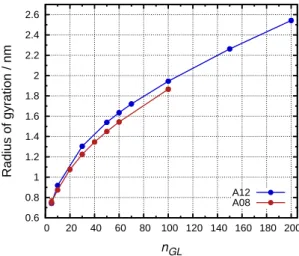
8.1 Representative snapshots for the self-assembly of 60 glycolipids (GL = A12) in aqueous media.113 8.2 Radius of gyration as a function of the aggregation number averaged from the simulations of
glycolipid micelles. . . 114 8.3 Solvent accessible surface area (SASA) analysis for the simulated glycolipid micelles at
dif-ferent aggregation numbers. . . 115 8.4 Principal moments of inertia (MOI) analysis for the simulated glycolipid micelles at different
aggregation numbers. . . 116 8.5 Representative snapshots for the full insertion of 30 glycolipids (GL = A12) into a
phospho-lipid bilayer consisting of 256 DMPC molecules . . . 120 8.6 Lateral view of an equilibrated binary mixture consisting of glycolipid (GL = A12) and
phospholipid (DMPC) molecules (GL/PC = 23.4%) obtained from our simulations. . . 123 8.7 Total area of the bilayer as a function of the glycolipid molar fraction averaged from the
binary mixture simulations. . . 125 8.8 Deuterium order parameters averaged over the sn-1 and sn-2 phospholipid hydrocarbon
chains for the simulated binary mixtures at different glycolipid molar fractions. . . 126
8.9 Deuterium order parameter of the phospholipid hydrocarbon chains as a function of the glycolipid molar fraction averaged from the binary mixture simulations. . . 127 8.10 Lipid bilayer thickness distribution histograms for the simulated binary mixtures at different
glycolipid molar fractions . . . 129 8.11 Membrane thickness as a function of the glycolipid molar fraction averaged from the binary
mixture simulations . . . 130 8.12 Lateral diffusion coefficient as a function of the glycolipid molar fraction averaged from the
binary mixture simulations. . . 130 8.13 Volume of water molecules inside the glycoside (GL = A12)/phospholipid bilayer as a function
of time computed from the membrane pore simulations. . . 131 8.14 Representative snapshots from a membrane pore simulation consisting of 52 glycolipid (GL
= A12) and 196 phospholipid (DMPC) molecules . . . 133
A.1 1H NMR (400 MHz, CDCl3) spectrum of dodecyl α-l-rhamnopyranoside (2). . . 141
A.2 13C NMR (100 MHz, CDCl
3) spectrum of dodecyl α-l-rhamnopyranoside (2). . . 141
A.3 1H NMR (400 MHz, CDCl
3) spectrum of dodecyl 2-deoxy-α-l-threo-pentopyranoside (3). . . 142
A.4 13C NMR (100 MHz, CDCl3) spectrum of dodecyl 2-deoxy-α-l-threo-pentopyranoside (3). . 142
A.5 1H NMR (400 MHz, MeOD) spectrum of dodecyl 2-deoxy-α-l-threo-pentopyranoside (3). . . 143 A.6 13C NMR (100 MHz, MeOD) spectrum of dodecyl 2-deoxy-α-l-threo-pentopyranoside (3). . 143
A.7 1H NMR (400 MHz, CDCl
3) spectrum of dodecyl 2-deoxy-β-l-threo-pentopyranoside (18). . 144
A.8 13C NMR (100 MHz, CDCl3) spectrum of dodecyl 2-deoxy-β-l-threo-pentopyranoside (18). . 144
A.9 1H NMR (400 MHz, MeOD) spectrum of dodecyl 2-deoxy-β-l-threo-pentopyranoside (18). . 145 A.10 13C NMR (100 MHz, MeOD) spectrum of dodecyl 2-deoxy-β-l-threo-pentopyranoside (18). . 145
A.11 1H NMR (400 MHz, CDCl
3) spectrum of dodecyl 2,6-dideoxy-2-fluoro-α-l-glucopyranoside
(4) and dodecyl 2,6-dideoxy-2-fluoro-α-l-mannopyranoside (5). . . 146 A.12 13C NMR (100 MHz, CDCl3) spectrum of dodecyl 2,6-dideoxy-2-fluoro-α-l-glucopyranoside
(4) and dodecyl 2,6-dideoxy-2-fluoro-α-l-mannopyranoside (5). . . 146 A.13 19F NMR (376 MHz, CDCl
3) spectrum of dodecyl 2,6-dideoxy-2-fluoro-α-l-glucopyranoside
(4) and dodecyl 2,6-dideoxy-2-fluoro-α-l-mannopyranoside (5). . . 147 A.14 1H NMR (400 MHz, CDCl3) spectrum of dodecyl 2,6-dideoxy-2-fluoro-α-l-glucopyranoside
(4). . . 147 A.15 13C NMR (100 MHz, CDCl
3) spectrum of dodecyl 2,6-dideoxy-2-fluoro-α-l-glucopyranoside
(4). . . 148 A.16 19F NMR (376 MHz, CDCl3) spectrum of dodecyl 2,6-dideoxy-2-fluoro-α-l-glucopyranoside
(4). . . 148 A.17 1H NMR (400 MHz, CDCl
3) spectrum of dodecyl 2,6-dideoxy-2-fluoro-β-l-glucopyranoside
(31). . . 149 A.18 13C NMR (100 MHz, CDCl3) spectrum of dodecyl 2,6-dideoxy-2-fluoro-β-l-glucopyranoside
(4). . . 149 A.19 19F NMR (376 MHz, CDCl
3) spectrum of dodecyl 2,6-dideoxy-2-fluoro-β-l-glucopyranoside
(31). . . 150 B.1 Radius of gyration as a function of time computed from the simulations of glycolipid (GL =
A12) micelles at different aggregation numbers. . . 153 B.2 Radius of gyration as a function of time computed from the simulations of glycolipid (GL =
B.3 Radius of gyration as a function of time computed from the simulations of glycolipid (GL = A08) micelles at different aggregation numbers. . . 155 B.4 Radius of gyration as a function of time computed from the simulations of glycolipid (GL =
A08) micelles at different aggregation numbers. . . 156 B.5 Total area of the lipid bilayer as a function of time computed from the simulated binary
mixtures at different glycolipid (GL = A12) molar fractions. . . 157 B.6 Total area of the lipid bilayer as a function of time computed from the simulated binary
mixtures at different glycolipid (GL = A08) molar fractions. . . 158 B.7 Total area of the lipid bilayer as a function of time computed from the simulated binary
mixtures at different glycolipid (GL = R12) molar fractions. . . 159 B.8 Total area of the lipid bilayer as a function of time computed from the simulated binary
mixtures at different glycolipid (GL = T12) molar fractions. . . 160 B.9 Total area of the lipid bilayer as a function of time computed from the simulated binary
mixtures at different glycolipid (GL = G12) molar fractions. . . 161 B.10 Total area of the lipid bilayer as a function of time computed from the simulated binary
mixtures at different glycolipid (GL = G08) molar fractions. . . 162 B.11 Mean square displacement (MSD) as a function of time for the phospholipid phosphorus
2.1 Representation of the equilibrium between the detectable isomers of d-glucose in aqueous
solution . . . 11
2.2 Representation of a generic glycosylation reaction. . . 14
2.3 Mechanisms for glycosylation reactions involving glycosyl donors bearing (a) a non-participating group and (b) a participating group . . . . 16
2.4 Synthetic strategies towards (a) dodecyl α-l-rhamnopyranoside 2, (b) dodecyl 2-deoxy-α-l-threo-pentopyranoside 3 and (c) dodecyl 2,6-dideoxy-2-fluoro-α-l-gluco/l-mannopyranosides 4/5. . . . 19
3.1 Synthesis of dodecyl α-l-rhamnopyranoside 2. . . 22
3.2 Mechanism for the TMSOTf-catalysed activation of trichloroacetimidate 6 . . . 25
3.3 Synthesis of 3,4-di-O-acetyl-l-xylal 7. . . 26
3.4 General mechanisms for the acid-catalyzed convertion of glycals into 2-deoxyglycosides and 2,3-unsaturated glycosides. . . 29
3.5 Synthesis of dodecyl 2-deoxy-l-threo-pentopyranosides 3 and 18. . . 30
3.6 Representation of the chair conformations observed by NMR in chloroform-d and methanol-d4 for (a) dodecyl 2-deoxy-α-l-threo-pentopyranoside 3 and (b) dodecyl 2-deoxy-β-l-threo-pentopyranoside 18. . . . 37
3.7 Mechanism for the selectfluor triflate-promoted electrophilic fluorination-nucleophilic addi-tion reacaddi-tion of 3,4-di-O-acetyl-l-fucal 19 with benzyl alcohol . . . 41
3.8 Generic representation of the four possible stereoisomers arising from reaction of a protected l-glucal derivative with an alcohol in the presence of selectfluor. . . 42
3.9 Synthesis of dodecyl 2,6-dideoxy-2-fluoroglycosides 4 and 5. . . . 43
3.10 Conversion of acetylated glycal 8 into silylated glical 27. . . . 49
3.11 Synthesis of dodecyl 2,6-dideoxy-2-fluoro-l-glucopyranosides 4 and 31. . . 50
3.1 1H NMR data for dodecyl 2-deoxy-α-l-threo-pentopyranoside (3). . . 34 3.2 1H NMR data for dodecyl 2-deoxy-β-l-threo-pentopyranoside (18). . . 35 3.3 13C NMR data for dodecyl 2-deoxy-α-l-threo-pentopyranoside (3). . . 36
3.4 13C NMR data for dodecyl 2-deoxy-β-l-threo-pentopyranoside (18). . . 36
3.5 DFT-calculated free energy differences between the chair conformations of dodecyl 2-deoxy-α-l-threo-pentopyranoside (3) and dodecyl 2-deoxy-β-l-threo-pentopyranoside (18) using an implicit solvent model. . . 38 3.6 Selected 1H and 19F NMR data for acetylated 2,6-dideoxy-2-fluoroglycosides 24-26 . . . . . 44
3.7 Selected 13C NMR data for acetylated 2,6-dideoxy-2-fluoroglycosides 24-26 . . . . 45 3.8 Selected 1H and 19F NMR data for silylated 2,6-dideoxy-2-fluoroglycosides 28-30 . . . 51 3.9 Selected 13C NMR data for silylated 2,6-dideoxy-2-fluoroglycosides 28-30 . . . . 52
3.10 Antibacterial activities expressed as MIC and MBC against B. cereus determined by the broth microdilution method . . . 55 3.11 Antibacterial activities expressed as MIC against three strains of B. anthracis determined by
the agar dilution method . . . 56
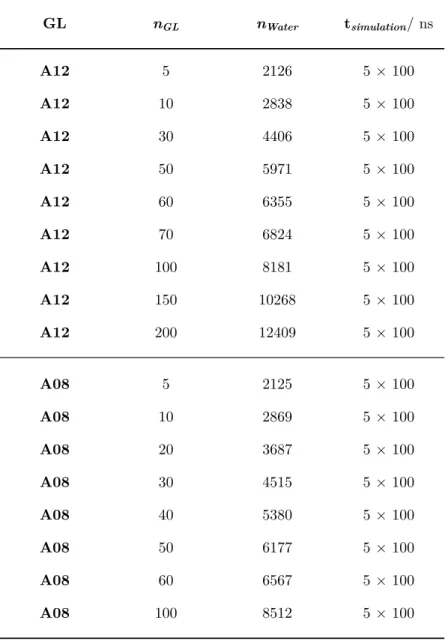
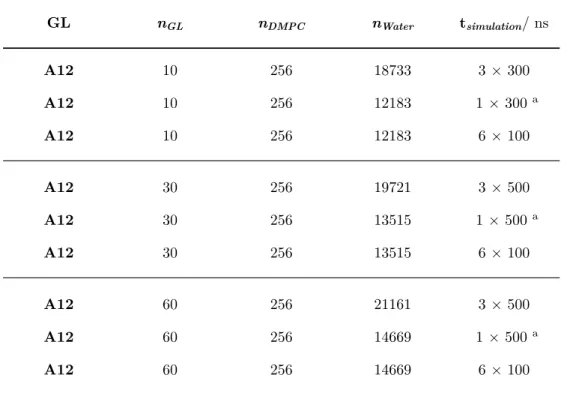
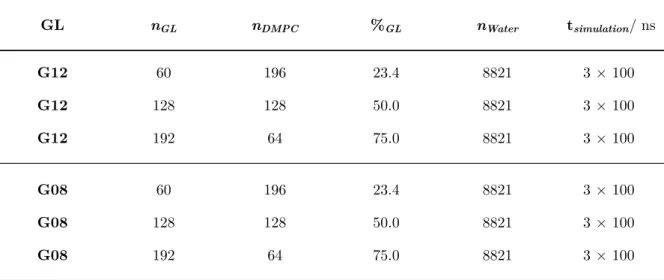
7.1 Simulations details of the glycoside micellization systems. . . 100 7.2 Simulations details of the glycoside micelle/phospholipid bilayer systems. . . 101 7.3 Simulations details of the glycoside/phospholipid binary mixtures. . . 102 7.4 Simulations details of the membrane pore stability systems. . . 104
8.1 Summary of the results obtained for the glycoside micelle/phospholipid bilayer interaction studies . . . 119
B.1 Lateral diffusion coefficients determined for the glycoside/phospholipid binary mixtures . . . 163
A08 2,6-Dideoxy-α-l-arabino-hexopyranoside A12 2,6-Dideoxy-α-l-arabino-hexopyranoside
Ac Acetyl
Ac2O Acetic anhydride
AcOH Acetic acid
app apparent aq. aqueous br broad Bu Butyl c concentration in g/mL calcd. calculated
CIM Concentração Mínima Inibitória COSY Correlation Spectroscopy
Cquat. quaternary carbon
D Lateral self-diffusion coefficient
d doublet
DBU 1,8-Diazabicyclo[5.4.0]undec-7-ene dd doublet of doublets
ddd doublet of doublets of doublets DFT Density Functional Theory DMAP 4-(Dimethylamino)pyridine DMF N,N -Dimethylformamide DMPC 1,2-Dimyristoyl-sn-glycero-3-phosphocholine DMSO Dimethylsulfoxide DPPC 1,2-Dipalmitoyl-sn-glycero-3-phosphocholine dq doublet of quartets dt doublet of triplets Et Ethyl
EtOAc Ethyl acetate
ESI Electrospray Ionization
g gram
G08 Octyl β-d-glucopyranoside G12 Dodecyl β-d-glucopyranoside
GL Glycolipid
h hour(s)
HMBC Heteronuclear Multiple Bond Correlation HMQC Heteronuclear Multiple Quantum Correlation
HRMS High Resolution Mass Spectrometry HSQC Heteronuclear Single Quantum Correlation
Hz Hertz J Coupling constant kcal kilocalory m multiplet MD Molecular Dynamics Me Methyl MeNO2 Nitromethane MeOH Methanol
MBC Mininum Bactericidal Concentration MIC Mininum Inhibitory Concentration
min. minute(s)
MM Molecular Mechanics
mmol milimole
MOI Moments Of Inertia m.p. melting point
MS Molecular sieves or Mass Spectrometry MSD Mean Square Displacement
m/z mass-to-charge ratio NaOMe Sodium methoxide
nm nanometer
NMR Nuclear Magnetic Resonance
NOESY Nuclear Overhauser Effect Spectroscopy PBC Periodic Boundary Conditions
PC Phosphatidylcholine ppm parts-per-million q quartet QM Quantum Mechanics quint quintet R12 Dodecyl α-l-rhamnopyranoside satd. saturated s singlet
SASA Solvent Accessible Surface Area
Selectfluor 1-chloromethyl-4-fluorodiazoniabicyclo[2.2.2]-octane bis(tetrafluoroborate) |SCD| Deuterium order parameter
Rf Retention factor r.t. room temperature
t triplet
T12 Dodecyl 2-deoxy-α-l-threo-pentopyranoside TBAF Tetra-n-butylammonium fluoride
TBDMSCl tert-Butyldimethylsilyl chloride THF Tetrahydrofuran
TLC Thin-Layer Chromatigraphy TMS Tetramethylsilane
TMSOTf Trimethylsilyl trifluoromethanesulfonate TPHB Triphenylphosphane hydrobromide
Å Angstrom
[α]20
D specific optical rotation δ chemical shift
Introduction
1.1
Bacterial infections and therapeutics
Modern medicine has been dependent on chemotherapeutic agents such as antibiotics 1 for the prevention and/or treatment of infectious diseases since quite a long time. In the nineteenth century, pneumonia, diarrhea and other infections were the main causes of human death. There-fore, the introduction of antibiotics was of of great importance to society in light of its impact on the prevention and/or treatment of these previously life-threatening diseases [4, 5]. The most important discovery in the modern era of antimicrobial agents was penincillin, in 1929 [6]. Since then, other more effective antibiotics have been discovered and developed, mainly through the elucidation of drug-target interactions and lead optimization approaches [7], and also by means of high-throughput screening campaigns exploiting genomics [8].
Nowadays, bacterial infections still represent a major public health concern owing to the in-creasing prevalence of multiple antibiotic-resistant bacterial strains. It has been estimated that at least 25 000 patients die every year in Europe because of bacterial infections that cannot be treated with the available antibiotics [4, 9]. Hence, the development of new antimicrobial agents with novel mechanisms of action has emerged as one of the greatest challenges facing modern society and merits innovative strategies from the viewpoint of the scientific community [10]. The emergence of antibiotic resistance has also motivated great efforts to unravel the complex mechanims by which the currently available antibiotics mediate bacterial cell death, which have been proven to involve many genetic and biochemical pathways as well as alterations at the ultrastructural level [7]. Furthermore, the molecular mechanisms underlying drug-resistance phenomena have been thoroughly investigated likewise. New mechanism are constantly being described, including the prevention of access to drug targets, changes in antibiotic targets by mutation, and direct modification/inactivation of antibiotics [11, 12].
1
The term "antibiotics" earlier referred to compounds produced by microorganisms that are effective against other microorganisms. Nowadays, the definition also includes other antimicrobial compounds of synthetic or semisynthetic origin [4].
Antibiotics can be classified based on their respective cellular targets, in addition to being distinguished between bacteriostatic (i.e. those that merely inhibit bacterial cell growth) and bactericidal (i.e. those that induce bacterial cell death) antibiotics. Most bactericidal antibi-otics are inhibitors of the synthesis of nucleic acids, cell wall or proteins [4, 7]. However, many are known to target bacterial cell membranes. Interestingly, bacterial membrane lipid composition has been shown to play an important role in determining the potency of certain antimicrobial agents, namely antimicrobial peptides [13–15] and other polycationic compounds [16, 17], some of which are thought to induce the formation of lipid domains/lipid phase sep-aration by clustering negatively charged lipids. Moreover, regulatory processes of membrane lipid homeostasis (i.e. the ability to adjust membrane lipid composition, usually in response to physical/environmental changes) are known to be further involved in antibiotic resistance mechanisms [18].
1.2
Carbohydrate-based structures as antibacterial agents
The fact that carbohydrates represent the most abundant, multifunctional and stereochemically rich class of natural products makes them particularly interesting scaffolds for drug discovery. Indeed, not only carbohydrates can be regarded as renewable/environmentally friendly raw materials, but also the increasing knowledge of the many biological processes involving carbo-hydrates, in particular carbohydrate-protein interactions, provides a unique opportunity for the development of drug candidates that should mimic their function in biological systems, known as glycomimetics, which are a relatively untapped source of therapeutic agents [19, 20]. Most carbohydrate-based antibiotics are compounds of natural or semisynthetic origin. They encompass several major classes of compounds that feature distinct mechanisms of action. For instance, aminoglycoside antibiotics (i.e kanamycins, gentamycins, neomycins and apramycins) and macrolide antibiotics (i.e. erythromycin, clarithromycin and azithromycin) act by inhibit-ing protein synthesis, whereas glycopeptide antibiotics (i.e. vancomycin and teicoplanin) and nucleoside antibiotics (i.e. tunicamycins, mureidomycins and liposidomycins) exert their an-tibacterial activity through the interruption of bacterial cell wall assembly [21].
The design and synthesis of new antibiotic compounds emboding a sugar moitey in their struc-ture has also occupied a prominent place in drug discovery. Inhibition of the biosynthetic pathway of key carbohydrates that are present in bacterial cell walls (i.e. peptidoglycan and lipopolysaccharides) is an attractive approach that has been extensively explored [21]. An-other important class of synthetic antibiotic compounds includes carbohydrate-based surfac-tants, which are known for their potential to interact with phospholipid bilayers, eventually leading to the disruption of bacterial cell membranes, as a result of their amphiphilic prop-erties. The synthesis and biological activity of such type of compounds has been reviewed elsewhere [21]. Therefore, we will now highlight only the work developed by our research group in the context of this subject.
Amongst several antimicrobial sugar-based surfactants, featuring a long hydrocarbon chain, that have been synthesized in our group, we emphasize a series of (N -alkylcarbamoyl)methyl enulosides, and their related pyranoid-conjugated diene esters. Those carrying a dodecyl chain displayed significantly potent antibacterial and/or antifungal activities, namely against the clin-ically relevant Bacillus cereus, Bacillus subtilis and Enterococcus faecalis bacterial strains, as well as toward the fungal pathogen Penicillium aurantiogriseum [22].
The synthesis of a new family of alkyl deoxyglycosides has also been undertaken by our group [1–3]. These are octyl/dodecyl 2-deoxy or 2,6-dideoxy-arabino-hexopyranosides (Figure 1.1), easily accessed by reaction of fatty alcohols with readily available glycals in the presence of triph-enylphosphane hydrobromide, a simple procedure that favors the formation of the α-anomers in high yields, followed by deprotection [23]. Their antimicrobial activities were preliminarily evaluated against various pathogens using the paper disk diffusion method, and minimal in-hibitory concentrations (MIC) were determined for those that showed relevant activity, in this case using the dilution method.
HO O HO OH OR HO O HO OR OH (a) OR HO HO O OR HO HO O (b) HO O HO OR HO O HO OR (c)
Figure 1.1: Structures of the alkyl deoxyglycosides synthesized by Rauter and co-workers. (a) 2-Deoxy-d-arabino-hexopyranosides [2], (b) 2,6-dideoxy-l-arabino-hexopyranosides [1] and (c) 2,6-dideoxy-d-arabino-hexopyranosides [3]. R = C8H17 or C12H25.
Regarding the alkyl 2-deoxy-d-arabino-hexopyranosides (Figure 1.1a), the most active com-pounds were the octyl and dodecyl β-glycosides, which exhibited moderate activity against
E. faecalis (MIC = 31.3 µg mL-1) [2]. In the case of the alkyl
2,6-dideoxy-α-l-arabino-hexopyranosides (Figure 1.1b), the dodecyl α-glycoside proved to be the most active com-pound, exhibiting very potent activities, particularly against B. subtillis and B. cereus (MIC = 7.8 µg mL-1 in both cases), within the same order of magnitude of those presented by the
con-trol chloramphenicol (MIC = 3.1 µg mL-1 and 6.3 µg mL-1, against B. subtillis and B. cereus, respectively). This compound was also effective against E. faecalis (MIC = 15.6 µg mL-1) and
Listeria monocytogenes (MIC = 31.3 µg mL-1) [2]. Despite these promising results regarding
bioactivity, this compound was shown to induce acute toxicity toward human lymphocytes at a concentration of 10 µg mL-1 [2]. Hence, in our ongoing research we have been developing a library of analogues of this compound, in the attempt to achieve a simultaneously bioac-tive and non-toxic, potential drug candidate. More recently, we synthesized the corresponding alkyl 2,6-dideoxy-d-arabino-hexopyranoside stereoisomers (Figure 1.1c), using the methodol-ogy described above to obtain the intermediate 2-deoxy-d-glycosides followed by regioselective tosylation at 6-position of the sugar and subsequent reductive deoxygenation [3]. Furthermore, the results concerning the antibacterial activity of this family of compounds against three strains of Bacillus anthracis was also reported therein for the first time. This pathogen is responsible for lethal anthrax infections in humans and livestock, and is a well-known bioterrorism agent [24]. Therefore, many efforts have been dedicated to the search for effective inhibitors of this life-threatening pathogen [25–29]. The most active compound was again dodecyl
2,6-dideoxy-α-l-arabino-hexopyranoside (MIC = 50 µM). Interestingly, the corresponding
2,6-dideoxy-d-glycoside exhibited a lower antibacterial activity (MIC = 25 µM), indicating that configuration of the sugar moiety is able to tune the antibacterial potency displayed by enantiomers for these amphiphilic molecular entities.
1.3
Scope of this work
Following the promising results obtained so far with alkyl deoxyglycosides as antibacterial agents (see Section 1.2), our group is now interested in the development of novel sugar-based sur-factants that should display improved properties for future application in therapeutics and biosecurity fields (i.e. potent bactericidal activity and low toxicity against human linfocite cells). To achieve such purpose, it is paramount that the structural determinants required for the antibacterial activity of this family of compounds targetting Bacillus spp. are deeply stud-ied and their mechanism of action clarifstud-ied. The herein presented research work combines two distinct contributions to this investigation, relying on a multidisciplinary approach.
In Part I (Chapters 2-5) of this manuscript, we present the synthesis of a series of new dodecyl deoxyglycosides, starting from commercially available sugars or appropriate glycosyl donors, and the preliminary evalutaion of their antiantibacterial activity, using B. cereus as a model microbe due to its genotypic similarity with B. anthracis [30–34]. Some of the newly synthesized compounds were further tested for their antibacterial activity towards B. anthracis. In Part II (Chapters 6-9), molecular dynamics (MD) simulations were performed aiming (i) to provide an atomistic description of the aggregates formed by these molecules in aqueous media, (ii) to study their adsorption properties at a model lipid bilayer interface and (iii) to investigate the eventual structural destabilization of model membranes by this family of
surfactant glycosides.
Having introduced the scientific problem in the precedent sections, theoretical and methodolo-gycal aspects relevant to both the experimental and computational studies carried out will also be briefly described further ahead in this manuscript.
GLYCOSIDES WITH POTENTIAL
ANTIBACTERIAL ACTIVITY
Brief introduction
2.1
Carbohydrates
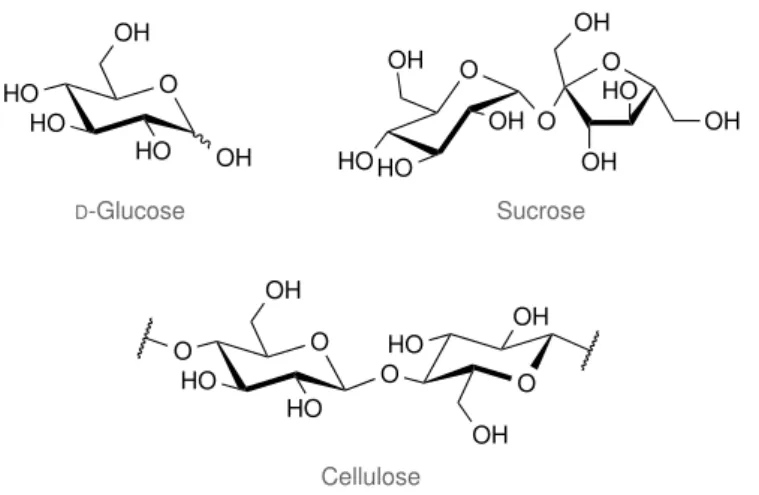
Carbohydrates 1 have long been recognized as the most abundant biomolecules in the living world. They occur either as single units (known as monosaccharides, i.e. d-glucose, which is by far the most plentiful of carbohydrates, Figure 2.1) or as compounds that consist of multiple sugar residues joined to each other by glycosidic linkages (oligosaccharides and polysaccharides, i.e. sucrose and cellulose, respectively, Figure 2.1). Carbohydrates are also structural compo-nents of nucleic acids (i.e. deoxyribonucleic acid (DNA), which contains repeated monomeric units of 2-deoxy-d-ribose) and can be found associated with other biomolecules in complex gly-coconjugates (i.e. glycolipids, glycopeptides and glycoproteins) that participate in a wide range of biochemical processes. In fact, the primary significance of carbohydrates lies on their major importance in biology [36].
Until the end of the twentieth century, however, they were thought to act exclusively as sources of energy storage (i.e. glycogen, the main reservoir of d-glucose in animals) and structural building blocks (i.e. cellulose, cell wall component in plants) [37]. Eventually, the great information-carrying potential of carbohydrates came to be recognized, along with the discovery that glycans2 play key functional roles in triggering biological regulation and recognition events [38, 39]. These include intracellular trafficking, cell adhesion, cell growth, disease development, host–pathogen interaction during infection and immune response [40, 41]. A multitude of other physiological functions and their implications in human disease continue to be unveiled by the expanding fields of glycobiology and glycomics [42–44].
1
The term “carbohydrate” was originally derived in the nineteenth century from the French hydrate de carbone and referred only to monosaccharides because their empirical composition could be expressed as Cn(H2O)n.
However, it has been extended to include monosaccharide derivatives (i.e. alditols, deoxysugars and aminosugars, amongst others), their oligomers and polymers [35].
2 “Glycan” generally refers to both polysaccharides and the glycosidic moiety of glycoconjugates [35]. 9
OH HO O HO OH OH HO D-Glucose O O HO OH HO Cellulose OH OH HO O O O HO OH O OH OH HO O HO OH Sucrose
Figure 2.1: Representative structures of monosaccharides (d-glucose), oligosaccharides (su-crose) and polysaccharides (cellulose).
The versatility of carbohydrates in biological systems is undoubtedly a result of the their struc-tural diversity and complexity. Indeed, carbohydrates are highly functionalized and hence stere-ochemically rich molecules which have been explored by great sugar chemists for over a hundred years. The most remarkable contribution to the field is that of Emil Fischer (1852-1919), who elegantly elucidated the structure of d-(+)-glucose and assigned the relative configurations of the parent monosaccharides in 1891, despite the very limited resources available by the time [38, 45].
Sugars are aliphatic polyhydroxylated aldehydes (generically referred to as aldoses, i.e. d-glucose) or ketones (ketoses, i.e. d-fructose), the later being less common in Nature. The presence of multiple stereogenic centers gives rise to many stereoisomers, and as a consequence several conventions had to be adopted in order to properly name and represent them. The sim-plest of aldoses is glyceraldehyde, a triose containing only one asymmetric center and therefore occurring as two enantiomeric entities, d- and l-glyceraldehyde. By convention, monosaccha-rides containing more than three carbon atoms (the commonest being hexoses, i.e. d-mannose and pentoses, i.e. d-xylose) are hence assigned to the d- or l- series according to the absolute configuration (R or S, respectively, as it is for d- and l-glyceraldehyde) of their configurational atom 3. The trivial name of the monosaccharide (i.e. “glucose”) defines the stereochemistry of the remaining stereocenters relatively to that of the configurational atom [38].
Most monosaccharides exist nearly exclusively as cyclic hemiacetals/hemiketals (generically named lactols), which are formed by means of an intramolecular cyclization reaction involving both hydroxy and carbonyl functionalities. Participation of distinct hydroxy groups leads to rings of different size, the most common being either six- or five-membered (named pyranoses and furanoses, respectively). From this process also arises a new center of chirality (known as anomeric center) and hence two diastereomers, which are designated either α- or β-anomer
3
depending on the relative configurations of the anomeric center and the configurational atom4. In solution, reducing sugars5 can be found as equilibrium anomeric mixtures of the aforemen-tioned cyclic forms, which interconvert via the acyclic polyhydroxyaldehyde/ketone with a con-comitant change in optical rotation over time. This process, called mutarotation, is illustrated in Scheme 2.1 for d-glucose in aqueous solution. Equilibration between α-d-glucopyranose and β-d-glucopyranose may occur by hemiacetal hydrolysis in either of the diastereomers, fol-lowed by ring-closure of the open-chain form (via intramolecular nucleophilic displacement of the aldehyde by the 5-hydroxy group). The same pathway holds for the α-d-glucofuranose/β-d-glucofuranose equilibrium (though involving the 4-hydroxy group instead). It is worth to mention that hydration - intermolecular addition of water to form a gem-diol - is a competing process in aqueous solution, though vestigial for most common hexoses and pentoses [46].
O O HO OH HO OH O HO OH HO OH OH OH OH O OH OH OH 6 6 55 4 4 3 3 2 2 OH OH OH OH HO α−D-Glucopyranose (38%) D-Glucose (0%) β−D-Glucopyranose (62%) α−D-Glucofuranose (<1%) β−D-Glucofuranose (<1%) 1 1 O HO HO OH HO OH HO
Scheme 2.1: Representation of the equilibrium between the detectable isomers of d-glucose in aqueous solution [38].
Equilibrium compositions of carbohydrate solutions are governed by the relative thermody-namic stability of each isomer and their kinetics of formation which depend, in turn, on several effects. For most sugars the 6-membered pyranose structures are strongly stabilized over their
4
In the current strict definition, the α-anomer is the diasteromer in which the newly formed hydroxy group is cis relatively to the oxygen attached to the configurational atom, whereas in the β-anomer they are formally
trans, in the Fischer projection [35]. For most cases, however, the following general rule can be applied: for
sugars belonging to the d-series, the anomeric substituent is projected down in α-anomers and up in β-anomers. The opposite applies to the l-series.
5
The term “reducing” refers to the presence of a free hemiacetal, in opposition to glycosides which present an acetal linkage at the anomeric carbon (see Section 2.2).
5-membered furanose counterparts and a chair conformation is usually preferred. Thus, aqueous solutions of d-glucose are composed almost exclusively by pyranose forms in4C1 conformations 6 as depicted in Scheme 2.1. More considerable amounts of furanose forms are observed for
other sugars, mostly as a result of the destabilization of the corresponding pyranoses by steric effects [46]. The anomeric composition arises, in turn, from a compromise between steric and electronic effects at the anomeric center. In fact, although β-d-glucopyranose is the most pop-ulated isomer (c.a. 62%) in equilibrated aqueous solutions of d-glucose, considerable amounts of its corresponding α-anomer are still observed (c.a. 38%), even though it should be energet-ically destabilized due to steric and solvation considerations. Moreover, the isomer featuring an axial substituent at this position is favored in the case of other monosaccharides (i.e. d-mannose). This result is rationalized in terms of a phenomenon by which the axial orientation of the anomeric substituent in pyranoses and their derivatives is stabilized over its equatorial positioning, named anomeric effect 7 by Lemieux [49]. The magnitude of this stabilization
in-creases with the electronegativity of the substituent and is usually attenuated with the increased polarity of the solvent [47, 49, 50]. However, in the case of positively charged substituents an inversion of this tendency is observed as their equatorial positioning is preferred, owing to the so-called reverse anomeric effect.
Though the origins of the anomeric effect(s) are still controversial [47–53], it has been explained essentially by means of two models. The first is an electrostatic interpretation, based on the interaction of the dipoles formed by (i) the lone-paired electrons of the endocyclic oxygen and (ii) the polarized bond between the anomeric carbon and the exocyclic heteroatom, which is unfavorable in the case of an equatorial substituent (Figure 2.2a). In agreement with this interpretation is the aforementioned reverse anomeric effect, since it features a reversed dipole in the bond between the anomeric carbon and the exocyclic substituent. According to the other model, which highlights a stereoelectronic component for the anomeric effect, an axial substituent may be stabilized via hyperconjugation, as a result of the syn-periplanar arrange-ment of one of the ring oxygen non-bonding orbitals (n) containing a lone pair of electrons, and the anti-bonding orbital (σ*) of the anomeric carbon (Figure 2.2b). This eventual n → σ* interaction is greatly supported by observed variations in bond lengths and angles around the anomeric center.
The anomeric effect is ubiquitous in carbohydrates and has been further recognized in other molecules containing two heteroatoms in a tetrahedral center. It is known for its important implications on conformational preferences and, particularly, in chemical reactivity, as will be highlighted in the next section.
6
Typically,4C1is the most populated chair conformation for d-sugars, whereas their enantiomers commonly
assume a 1C
4 conformation. For further detail about conformational preferences of carbohydrates, see i.e. ref.
[46], chapter 2.
7
The term “endo-anomeric” effect is also frequently found in the literature, in order to distinguish the aforementioned effect from the so-called “exo-anomeric effect”, which is similar in nature but deals with the relative orientation of the sugar ring and the exocyclic substituent. For more insight into the subject see refs.
HO O X HO O X (a) HO O X HO O X (b)
Figure 2.2: Electrostatic (a) and stereoelectronic (b) interpretations of the anomeric effect. X = generic electronegative substituent.
2.2
Chemical glycosylation
As mentioned earlier in this chapter, most carbohydrates appear in Nature mainly as polysac-charides or associated with other biological macromolecules (i.e. lipids and proteins) in a variety of glycoconjugates. In either case, monosaccharides are linked via glycosidic bonds, which are formed in the following of a glycosylation reaction [54]. Living systems feature complex enzy-matic machinery and regulatory mechanisms to ensure selectivity and efficiency in this process. In contrast, glycosidic bond formation still poses remarkable challenges to the synthetic chemist, mainly due the unparalleled structural heterogeneity of carbohydrates and glycostructures that may be conceived [42, 55]. Since the present work addresses the preparation of glycosides8, the reader will be provided at this stage with a brief overview of general considerations on chemical glycosylation9.
Generally, a glycosylation reaction involves the nucleophilic displacement of a leaving group at the anomeric position of a sugar (glycosyl donor) by the hydroxy group (or other nucleophile, by extension8) of a second molecule (glycosyl acceptor) usually in the presence of an activator (promoter/catalyst). This process is illustrated in Scheme 2.2 for the formation of a generic disaccharide. Although conceptually quite simple, glycosylation reactions are actually hampered by a set of specific difficulties that must be taken into account.
The first is the need to temporarily mask the functional groups not intended to participate in the reaction, in order to avoid the formation of complex regioisomeric mixtures. This problem (regioselectivity) has been successfully tackled by efficient protection/deprotection strategies and is particularly relevant when the glycosyl acceptor is a sugar, due to the presence of multiple hydroxy groups [60].
8
According to the IUPAC/IUBMB-JCBN recommendations, “glycosides are mixed acetals formally arising
by elimination of water between the hemiacetal or hemiketal hydroxy group of a sugar and a hydroxy group of a second compound”. Yet this definiton has been extended to include compounds in which the anomeric hydroxy
group is replaced by other groups, such as -SR, -NR1R2 or CR1R2R3[35].
(PO)n O + HO O activator glycosyl donor glycosyl acceptor 1,2-cis- and/or 1,2-trans-linked glycoside (PO)n O ∗ 1 ∗ 1 2 2 O O LG PO PO
Scheme 2.2: Representation of a generic glycosylation reaction. P = generic protecting group, LG = leaving group.
Another issue deals with the control of reactivity, which depends on the nucleophilicity of the glycosyl acceptor and both the leaving-group ability of the glycosyl donor and its stability. In fact, glycosylations with secondary sugar hydroxy groups - which are not particularly good nu-cleophiles - can often be sluggish and hence low-yielding, as were the first reactions performed at the turn of the twentieth century when only few glycosyl donors (anomeric chlorides/bromides, hemiacetals and, later, acetates) and synthetic methods were available. An important overturn in this area was witnessed during the mid-70’s with the development of new anomeric leaving groups, namely glycosyl trichloroacetimidates, thioglycosides and glycosyl fluorides, all of which are broadly used nowadays. Enormous progress has also been made in the last decades, in par-ticular with the introduction of more sophisticated donors such as glycosyl iodides and glycals, amongst many others, and a wave of methodological improvements [54].
However, the most important aspect in glycosylation is arguably stereoselectivity, once the formation of a glycosidic bond gives rise to a new asymmetric center (Scheme 2.2). Con-trol of the stereochemical outcome in these reactions was early noticed to be a considerable challenge, depending on the target glycosidic linkages. These can be usefully distinguished be-tween either 1,2-cis linkages, which include those found in α-d-galactosides, α-l-fucosides, β-d-mannosides and α-d-glucosides (Figure 2.3a), or 1,2-trans linkages such as those presented by
β-d-glucosides, β-d-xylosides and α-d-arabinosides (Figure 2.3b). The two above-mentioned
types of glycosyl residues can be found in a wide variety of natural compounds, along with several deoxygenated derivatives such as 2-deoxyglucosides and sialosides, which can be de-fined as neither 1,2-cis- nor 1,2-trans-linked glycosides (Figure 2.3c). This distinction is made because while 1,2-trans glycosidic linkages are notably easier to prepare by taking advantage of the known effect of neighboring group participation (that is, through the use of acyl pro-tecting groups at 2-position), the stereoselective synthesis of 1,2-cis-linked glycosides is not as straightforward, requiring the use of non-participating protecting groups (i.e. benzyl ethers) at 2-position and usually leading to mixtures of anomeric diastereomers [54].
Glycosylation is a complex process and several of its mechanistic aspects are still subject to intense debate, namely with respect to the nature of the active intermediates that are involved and the relative contribution of their reactivity to the stereochemical outcome [42, 61, 62]. Nevertheless, the commonly accepted rationalization [56–59] invokes that it often follows uni-molecular nucleophilic substitution (SN1) pathways, as depicted in Scheme 2.3.
OH O HO O OH HO α−D -Galacto-pyranoside O OHOH O α−L -Fuco-pyranoside OH HO O HO OH OH β−D -Manno-pyranoside O OH O OH OH OH α−D -Gluco-furanoside O (a) HO O HO OH HO β−D -Gluco-pyranoside O HO O HO OH AcHN 2-Acetamido-2-deoxy-β−D-glucopyranoside O HO O HO HO β−D -Xylo-pyranoside O O HO O OH OH α−D -Arabino-furanoside (b) HO O HO OH 2-Deoxy-β−D -glucopyranoside O HO O HO OH 2-Deoxy-α−D -glucopyranoside O COOH AcHN OH O α-Sialoside O HO OH HO (c)
Figure 2.3: Examples of common (a) 1,2-cis, (b) 1,2-trans and (c) neither 1,2-cis nor 1,2-trans glycosidic linkages (adapted from ref. [54]).
The first step is the departure of the anomeric leaving group, generally mediated by an activa-tor, leading to the formation of a glycosyl cation which is stabilized by resonance to form an oxycarbenium ion. In the case of a glycosyl donor bearing a non-participating group (Scheme 2.3a), the nucleophile (glycosyl acceptor) may attack either face of this reactive intermediate and thus both 1,2-trans (route a) and 1,2-cis (route b) glycosides are possibly formed. Although the 1,2-cis-linked thermodynamic product is typically prevalent due to the anomeric effect (i.e.
α-glucosides), other factors may significantly influence the stereochemical outcome of a
glycosy-lation reaction (i.e. steric factors, conformation, temperature and solvent, among others). For this reason the stereoselective synthesis of several 1,2-cis glycosidic linkages (i.e. β-mannosides) is known to be particularly challenging.
When the glycosyl donor features an acyl-type participating group at 2-position (Scheme 2.3b), the glycosyl cation may be intramolecularly stabilized through the participation of the neighboring carbonyl oxygen to form a bicyclic acyloxonium ion. As the nucleophilic attack
on this major intermediate proceeds with inversion of configuration (route c), the 1,2-trans glycoside is generally formed with high stereoselectivity, although small amounts of the 1,2-cis-linked product may be formed via displacement of the oxycarbenium ion in equilibrium. Although most glycosylation reactions follow the general mechanisms herein discussed, each type of glycosyl donor has particular features regarding reactivity. Glycals (cyclic enol ether derivatives of pyranoses/furanoses) are worth-mentioning because they are suitable precursors for the preparation of important bioactive 2-deoxyglycosides. They can be either converted into other glycosyl donors or directly employed in glycosylation reactions, which usually proceed via polar addition to the double bond. The regio- and stereochemical outcome of these reactions is mainly governed by the intermediacy of an oxycarbenium ion as well [54, 63].
(PO)n O activator glycosyl donor LG RO glycosyl cation (PO)n O oxycarbenium ion OR1 H a b RO 1,2-trans glycoside (PO)n O RO OR1 1,2-cis glycoside (major product) (PO)n O RO OR1 a b glycosyl acceptor (PO)n O activator glycosyl donor LG R2OCO glycosyl cation (PO)n O oxycarbenium ion OR1 H a b R2OCO 1,2-trans glycoside (major product) (PO)n O R2OCO OR1 1,2-cis glycoside (PO)n O R2OCO OR1 a, c b glycosyl acceptor (PO)n O acyloxonium ion (major intermediate) O O R2 c (a) (b) (PO)n O RO (PO)n O O O R2
Scheme 2.3: Mechanisms for glycosylation reactions involving glycosyl donors bearing (a) a non-participating group and (b) a participating group (adapted from ref. [54]). LG = leaving group, P = generic protecting group, R = non-participating group, R1 = generic aglycone residue, COR2 = participating group.
2.3
Target compounds and synthetic routes
After having introduced relevant aspects of carbohydrate structure and reactivity, we will now present the target compounds and discuss the synthetic strategies envisaged to access them. The main goal in this part of the work is the preparation of novel surfactant glycosides with potential antibacterial activity. As described previously (see Section 1.2), an original fam-ily of alkyl deoxyglycosides displaying antimicrobial activity has been reported by our group [1–3]. Though the mechanism of action of these compounds is yet to be unraveled, several structure-bioactivity relationships could already be established from the studies carried out so far, namely: (i) the amphiphilic nature of these molecules and their high surface activity is a pre-requisite for antimicrobial activity; (ii) bioactivity is tuned by the deoxygenation pattern of the glycosidic moiety, since 2,6-dideoxyglycosides were active towards Bacillus spp., E. faecalis and
L. monocytogenes but none of the related 2-deoxyglycosides displayed significant activity; (iii)
sugar stereochemistry, in particular anomeric configuration, seems to modulate their antibiotic properties, the most effective compounds being α-anomers and belonging to the l-series; (iv) the nature of the aglycone10 revealed also to be determinant, as dodecyl glycosides presented higher activity than other glycosylated fatty alcohols ([1–3] and unpublished results).
Aiming to better understand the importance of key structural features for bioactivity and, ultimately, to achieve a non-toxic potential drug candidate, we disclose now the synthesis (Section 3.1) and preliminary antimicrobial activity assessment (Section 3.2) of a series of compounds structurally related to dodecyl 2,6-dideoxy-α-l-arabino-hexopyranoside 1 , the most potent antibacterial of this family of compounds against Bacillus spp. [1–3]: dodecyl α-l-rhamnopyranoside 2, dodecyl 2-deoxy-α-l-threo-pentopyranoside 3 and dodecyl 2,6-dideoxy-2-fluoro-α-l-gluco/l-mannopyranosides 4/5 (Figure 2.4). O HO HO O 11 4 R1 = F, R2 = H 5 R1 = H, R2 = F R2 O HO HO O 11 3 O HO HO O 11 2 OH O HO HO O 11 1 R1
Figure 2.4: Structures of the lead compound 1 and target glycosides 2-5.
10

![Table 3.10: Antibacterial activities expressed as MIC and MBC against B. cereus de- de-termined by the broth microdilution method a [92, 93].](https://thumb-eu.123doks.com/thumbv2/123dok_br/15580083.1049106/83.892.128.748.185.1121/table-antibacterial-activities-expressed-cereus-termined-microdilution-method.webp)