Lisboa 2007
Ideas, Images,
Symbols
Coordenação
J. Carlos Viana Ferreira Teresa de Ataíde Malafaia
Coordenação
J. Carlos Viana Ferreira Teresa de Ataíde Malafaia
Revisão de texto
Andreia Maratá Mário Semião
Design, paginação e arte final
Inês Mateus
Edição
Centro de Estudos Anglísticos da Universidade de Lisboa
Impressão e acabamento
COLIBRI - Artes Gráficas
Tiragem 500 exemplares
ISBN 978-972-8886-09-7
Depósito Legal 263 609 / 07
2007
PUBLICAÇÃO APOIADA PELA
The Tenses of the Imagination. The Imitation of Life in Literary and Cultural Studies
Luísa Leal de Faria . . . 9 The Rechabite Emblem, Rituals and Ceremonies
Joanne Paisana . . . 19 A Touch of Disenchantment. An Approach to Isaiah Berlin’s The Decline
of Utopian Ideas in the West
Adelaide Meira Serras . . . 33 The ‘Jersey Lily’: A Tangled Web of Victorian Celebrities
Iolanda Freitas Ramos . . . 43 The Empire on Film: Recasting India from the Raj revival to Lagaan
Ana Cristina Mendes . . . 63 When photography became art. Julia Margaret Cameron and the Woman’s
Mission
Maria Teresa de Ataíde Malafaia . . . 81 Progress as a problem for historians of ideas
David Wootton . . . 93 Prospero’s ‘magic garment’: The place of science and magic in The Tempest
Fátima Vieira . . . 103 Living the British dream? Immigration, identity and the idea of citizenship
in 21stcentury Britain
Elisabete Silva . . . 123 Hydrography and the Anxiety of the Sea. The Nautical Chart as
a Cultural Model
Isabel Capeloa Gil . . . 133 Landscapes of the being — autobiographies and images of the self
Ana Clara Birrento . . . 149 But… you want me to think?
Anna Alba C. Caruso . . . 163 America vs anti-America: a short history of an idea
Valdemar de Azevedo Ferreira . . . 169 ‘Chagall is for shopgirls’: art and memory in Alice Munro’s Short Story ‘Soon’
A Tangled Web • CEAUL / ULICES 2007
The Imitation of Life in Literary
and Cultural Studies
Luísa Leal de Faria
The Imitation of Life in Literary and Cultural Studies
I must begin by confessing that my title, “The Tenses of Imagination,” is not original: I borrowed it from the last chapter of the book Writing in Society by Raymond Williams. His statement, right at the start, that “imagination has a history,” and that “there are changing and conflicting interpretations of what it is and of its value” (Williams 259), seemed to summarize something I have been thinking about on the subject of “representation.” In the tradition already set by Williams in Culture and Society, and later in Keywords, where he included the study of the senses and the uses of words in English as fundamental tools for the understanding of “culture,” it seemed always clear that the semantics of the word “imagination” were connected to the Latin root: to imagine is to make an image, which linguistically relates to “to imitate.” The contemporary study of “representation,” on the other hand, emphasising the significance of collective symbolic representations, seemed to obliterate other possibilities of interpretation of the uses of repre sen -tation, namely the importance of the concept of imi-tation, or mimesis, and the mimetic approach as a theory of representation.
The concept of imitation, or mimesis, has, indeed, suffered a dramatic shift in recent literary and cultural history. In the last couple of decades the word has almost vanished from critical texts and was replaced by another word and another concept: representation. This change means a shift in emphasis which reveals new trends in literary and cultural analysis. What I want to discuss, briefly, is the significance of this change; or, in other words, why it is important to recognize that the vanishing of a word and its substitution with another carries such deep meanings and far reaching consequences for those who work in literary and cultural studies.
“Imitation” refers, as we all know, to a body of theory that Stuart Hall called the “reflective or mimetic approach” to explaining how representation
of meaning through language works (Hall 24). And, in a very good and useful chapter of the book Representation: Cultural Representations and Signifying Practices, “The Work of Representation,” it becomes quite clear that we are faced with two totally different methods which call for, of course, the use of different words. If it was accepted, along the centuries, that art imitated life, or even, more recently, that life imitated art, we come now to the conclusion that there are severe limitations to the concept of mimesis and that we must replace it with a different concept, that translates the symbolic and the collective in the process of communication. This is what Hall calls the “constructionist approach,” which recognizes the “public, social character of language,” and emphasises the construction of meaning through the use of representational systems – concepts and signs” (Hall 25).
But, when we try to follow the genealogy of the use of the words and their meaning in time, imitation and representation come to stress two different aspects of what is, if I may call it so, the creative process. In a very general, and perhaps provocative way, I would say that mimesis or imitation theorizes the aesthetic views on literature and the arts, and representation theorizes the political implications of literature and the arts. Imagination, then, a word usually associated with the creative process, suffers accordingly. In a discussion of “imitation,” “representation” and finally “imagination,” it is perhaps useful to start with Plato and Aristotle, and remember how differently they appreciated the concept of imitation. For both, poetry imitated life. But whereas for Aristotle poetry represented the highest truth about men, for Plato poetry played a devastating influence in the balance of the city. Aristotle was concerned with definitions of the ways in which tragedy imitated life, with the means through which feelings could be aroused in the spectator. Poetics, for him, were concerned with words, sounds, gestures; tragedy imitated the lives of superior men, comedy the lives of lower men. One uplifted the feelings of the public, the other provoked laughter. For Aristotle in the Poetics poetry and drama are just there, as part of a culture in which they represent the infinite possibilities of human endeavour. For him, poetry has a higher status than history, exactly because it imitates life, whereas history just describes facts. In imitation, Aristotle founds the representation of what is possible, verisimilar and necessary. The difference between the historian and the poet does not lie in
the fact that one writes in prose and the other in verse, but rather in the fact that one says “the things that happened” and the other “the things that might happen” (Aristotle). Therefore, poetry is more philosophical and higher than history, because it is concerned with the universal, whereas history is concerned with the particular. And the “possible” is, according to Aristotle, something we believe in.1 Poetry comes close to truth, but truth
of a higher nature: not just what was later called realism, the imitation of real situations, but the rising of the particular to universal status.
For Plato, the arts suffer a severe indictment; they are third degree imitations, that is, they are three times removed from the reality of forms. In the dialogue between Socrates and Glaucus, in Book X of the Republic, Plato denounces the falsity of art, and claims the superiority of the carpenter above the painter or the poet, stresses the uselessness of Homer and the need to banish poetry and the poets from the city. If Voluptas, the voluptuous Muse, was allowed in, then “pleasure and pain would be kings of the city, replacing law and reason” (Plato 372),2 and the structure would collapse:
people would follow the feelings excited in them by the examples of tragedy or comedy, they would take imitation for reality, they would corrupt the harmony of a city that should be ruled, not by imagination, but by reason. Poetry could only be allowed in the city under very strict controlling conditions. “If imitative poetry can prove, with good reason, that it may
1“É pois a tragédia imitação de acções de carácter elevado, completa em si mesma, de
certa extensão, em linguagem ornamentada e com as várias espécies de ornamentos distribuídas pelas diversas partes do drama, imitação que se efectua, não por narrativa, mas mediante actores, e que, suscitando o terror e a piedade, tem por efeito a purifica ção (catarse) desses sentimentos” (Aristóteles 110). “…[A] tragédia não é imitação de homens, mas de acções e de vida, de felicidade ou de infelicidade” (Aristóteles 111). “Não é ofício do poeta narrar o que realmente acontece; é, sim, o de representar o que poderia acontecer, quer dizer: o que é possível, verosímil e necessariamente”…. “Por isso, a poesia é mais filosófica e elevada do que a história, pois refere aquela principalmente o universal, e esta o particular” (Aristóteles 117).
2“Si, au contraire, tu admets la Muse voluptueuse, le plaisir et la douleur seront rois de
ta cité, à la place de la loi et de ce principe que, d’un commun accord, on a toujours regardé comme le meilleur, la raison.” (Plato 372)
have a place in a well policed city, then we will gladly receive it, because we are aware of the fascination it has upon us – but it would be impious to betray what we take to be the truth,”3claims Socrates (Plato). In other words,
Plato denies to poetry the status of truth, and restricts it to philosophy. But when he recognizes that poetry exerts a deep fascination upon people, Plato recognizes that poetry possesses a fantastic subversive power which should be banished for the sake of harmony and reason; if allowed to remain the city, then poetry should be under the control of the state.
Aristotle and Plato started two different ways of looking at literature. Their views of the power of imagination and its capacity to imitate life took opposite directions: Aristotle stressed the aesthetic implications, Plato the political ones. But in a way, they must be taken together in the complex question of canon formation, a central issue when we want to discuss imitation, representation and imagination. The aesthetic implications related to the choice of canonical works has always mingled with their representative capacity. And representation here acquires a double sense: canonical works represent “the best that has been thought and written in the world,” as Matthew Arnold might say, and so they stand for other works; together, these works represent a way in which a society, or a group, wishes to represent itself. In this sense, the choice of books, as a result either of the workings of the selective tradition, as Raymond Williams put it, or as a result of more intentional policies of national culture formation, is cultural and political. Along the centuries, the subversive power of literature triggered, more than once, repressive measures of book banishment. The political implications of selection and exclusion suggest a Platonic control over the imagination, which came to the fore when the politics of canon formation began to be discussed a few decades ago. My point is that we cannot dissociate the question of the aesthetic value of a literary work from its representative value in the question of the canon. But it is also that the
3“Déclarons néanmoins que si la poésie imitative peut nous prouver par de bonnes
raisons qu’elle a sa place dans une cité bien policée, nous l’y recevrons avec joie, car nous avons conscience du charme qu’elle exerce sur nous – mais il serait impie de trahir ce qu’on regarde comme la vérité.” (Plato 372)
stress put nowadays on the political implications of the choice of literary syllabi often obscures the interpretation of literature as literature.
For centuries, the concept of mimesis seemed a very satisfactory way in which to discuss literature. In this context, the comprehensive work Mimesis: Representation of Reality in Western Literature, by Erich Auerbach remains, in my view, an inescapable reference, not only because of its breadth and insight, but also because of some of the problems it also raises. With Auerbach, we follow a fascinating process of canon formation in Western literature, from the ur-texts The Odyssey and the Bible to contemporary literature. We follow a discourse on literature that proceeds within the codes of the reflective or mimetic approach, but in a highly sophisticated way. Auerbach never stresses a possible relationship between the works of literature and the social or political contexts in which they were produced and consumed. He probably expects the reader to know, but that relationship is certainly of little importance. What is important is the relationship between literature and literature, a kind of anxiety of influence, and the stylistic constraints within which the works were produced. Auerbach examines the way through which the realism of the Odyssey and the figurative meanings of the Bible mingle and separate in centuries of European literature conditioned by the theory of the styles. His thesis, if it can be put in a couple of words, is that “modern realism in the form it reached in France in the early nineteenth century is, as an aesthetic phenomenon, characterized by complete emancipation from [the doctrine of styles]” (Auerbach 554). And he goes on to say that this emancipation is more complete, and more significant for later literary forms of the imitation of life than any previous attempt, and that Stendhal and Balzac opened the way to modern realism, “which has ever since developed in increasingly rich forms, in keeping with the constantly changing and expanding reality of modern life” (Auerbach 554). Still, for Auerbach there were previous revolutions against the doctrine of the styles, namely during the Middle-Ages and throughout the Renaissance, when a “serious realism” had existed. It was the artificial return to classicism towards the end of the sixteenth century that had interrupted a tradition in realism which took shape, in the Middle-Ages, around the story of Christ “with its ruthless mixture of everyday reality and the highest and most sublime tragedy”(Auerbach 555).
Auerbach and Mimesis seemed relevant to me, in the context of this discussion, for two connected reasons: on the one hand, Mimesis discusses at length the “representation of reality in Western Literature”; on the other, the architecture of the whole work points to one argument put forward by Harold Bloom in The Western Canon: “The Western Canon does not exist in order to augment preexisting social elites. It is there to be read by you and by strangers, so that you and those you will never meet can encounter authentic aesthetic power and the authority of what Baudelaire (and Erich Auerbach after him) called ‘aesthetic dignity’ (Bloom 36). But, as John Guillory reminds us, the question of aesthetic judgement is perhaps the wrong question to ask in the context of canon formation. The appeal to a transcendent court of judgement that decides value or the kind of pleasure works of art may give, made by the conservative defenders of the canon, or, on the other hand, the argument that judgement is always interested or prejudiced, put forward by the liberal critics, who therefore appeal to the standards of representative democracy, are wrong ways to look into this matter. In other words, we must dismiss the “scene of conspiracy” or the “scene of representation” (Guillory 235) where the debate took place in recent years, and look at the institutional context where the reproduction of the works is insured, that is, where their continual reintroduction to generations of readers is performed (Guillory 237). And that is, in large measure, the “school”.
For Guillory, the right way to look at canon formation would be to understand the historical circumstances that determined its shapes, and see its history as the history of both the production and reception of texts (Guillory 238), under the understanding that writing and reading are social practices, subjected to institutional forms of organization, of which the most important is the school. “The canon,” he states, “is itself a historical event; it belongs to the history of the school” (244). The school should, now, resist homoge niz ing canonical works in any way, and alternatively, begin to historicize them. By doing this, Guillory stresses that it may be “possible to acquire not only the knowledge the school offers but a knowledge of this knowledge, a knowledge of how the practice of reading is regulated or constrained by the institution and its social formation” (248).
When quoting these words I am inevitably reminded of Plato: of litera -ture as third degree imitation, and of the need to tame imagination to fit
the needs of the city, just as Guillory’s approach suggests a removal from the text into the contexts, a removal from the enjoyment of the text to the study of its function as a social tool. The historical context of canon formation and the view that reading and writing are social practices are two very important questions that should be included in literary and cultural studies. But beyond these issues, that we can research and describe using the tools of the historian and of the sociologist, is it still possible to rescue for the study of literature the aesthetic dimension that a reading of Aristotle suggests?
As an example of a possible way in which to study canonicity, John Guillory reproduces Done’s poem “The Canonization”, and declares: “I shall not attempt here an interpretation of the poem, but only a kind of historical contextualization, a reflection of its canonicity, which is offered as a preface to interpretation” (Guillory 245). This is a long way from the first reference to canonicity applied to secular literature that I have found in the English language. I am referring to an essay by Carlyle, written in 1840. It is called “The Hero as Poet”, and deals on Dante and Shakespeare. In the age of “Sceptical Dilettantism” and “Triviality,” when men worship the shows of things, says Carlyle, “have we not two mere Poets, if not deified, yet we may say beatified? Shakespeare and Dante are Saints of Poetry; really, if we will think of it, canonised, so that it is impiety to meddle with them. … They are canonised, though no Pope or Cardinals took hand in doing it. Such, in spite of every perverting influence, in the most unheroic times, is still our indestructible reverence for heroism” (Carlyle 85).
When the study of literature stressed its relation to mimesis, or the imitation of life, the power of “creative imagination” exerted its fascination upon the readers, as it did upon Carlyle. The ambiguity contained in the word – imagination as “one of the highest prerogatives of Man. By this faculty he unites, independently of the will, former images and ideas, and thus creates brilliant and novel results,” as Darwin said in 1871, or imagination as the “fabrication of images without any foundation in reality,” as Kames wrote in 1762 (quoted in Williams 260) – was unimportant. But when the reader turned into the critic, when the profession of Literature required that tools for interpretation and transmition be developed in the school, the transforming power of imagination upon fact had to be anatomised, leading, sometimes, to the autopsy of the literary text, in what Antony Easthope called
“the modernist reading.” And when the “cultural turn” in literary studies began to take place, when the concept of “signifying practices” began to replace “rhetoric” and “genre,” then imagination turned into representation. From Plato and Aristotle to contemporary times, the paradigms of literary and of cultural studies make, indeed, a “tangled web.”
References
Aristóteles. Poética. Tradução directa do grego, introdução e notas Eurodo de Sousa. Lisboa: Guimarães Editora, 1964.
Auerbach, Erich. Mimesis: The Representation of Reality in Western Literature. Princeton N. J.: Princeton University Press, 1974.
Bloom, Harold. The Western Canon: The Books and School of the Ages. New York: Harcourt Brace & Company, 1994.
Carlyle, Thomas. “Hero as a Poet.” On Heroes, Hero-Worship and the Heroic in History. New York: AMS Press, 1840, 1974.
Easthope, Anthony. Literary into Cultural Studies. London and New York: Routledge, 2003.
Guillory, John. “Canon.” Critical Terms for Literary Study. Ed. Frank Lentricchia and Thomas McLaughlin. Second Edition. Chigaco and London: The University of Chigaco Press, 1995.
Hall, Stuart, ed. Representations: Cultural Representations and Signifying Practices. London: Sage Publications, 2001.
Platon. La République. Intr., trad., notes Robert Baccou. Paris: Garnier-Flamarion, 1966.
A Tangled Web • CEAUL / ULICES 2007
and Ceremonies
Joanne Paisana
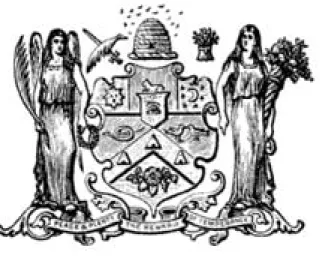
Fig. 1 The Rechabite Emblem
And I set before the sons of the house of the Rechabites pots full of wine, and cups, and I said unto them, Drink ye wine. But they said, We will drink no wine: for Jonadab the son of Rechab our father commanded us saying. Ye shall drink no wine, neither ye, nor your sons for ever.
The campaign advertisements of companies like Nike are able to reach a global market, thus enabling people of vastly different local cultures to simultaneously feel part of Western culture. The masterful simplicity of a quasi-universally recognisable symbol for correctness and positiveness was surely a stroke of marketing genius on Carolyn Davidson’s part. The slogan “Just Do It” commands us, simply, to act, (using the right Nike product for the job, of course).1The Nike swoosh is illustrative of a certain
kind of symbol, the kind that, after profound implantation in a culture, is subliminally, and cynically used for commercial profit.
However, symbols do not have to be so simplistic in order to be effective – in order for the intended ideas to be successfully associated with them. The Founding Fathers of America put their heads together in 1776 and, after trial and error, in 1782 decided on the unique combination of symbols and mottoes for both sides of the Great Seal which conveyed their vision of America.
The ideas the creators wanted to convey about their new nation included a preference for peace (the American bald eagle, the noblest of birds, which rises above everything, looks to the left, to the olive branch and not to the right, the thirteen arrows symbolising warfare). The majestic Ideas, images and symbols intertwine in any society we care to examine. Nowadays, they have free passage on the world’s cultural and commercial highways. Globalization has ensured that certain symbols and imagery in the late twentieth century are recognised worldwide. Whoever is unable to associate a brand name and slogan with the symbol shown below, for example, does not share the contemporary Western culture.
1Graphic art student Ms Davidson introduced the ‘swoosh’ to Nike’s founders in 1971,
17 years before the slogan ‘Just Do It’ was adopted. The Nike brand name is derived from the name of the Greek god of victory.
eagle and the stars and stripes have come to represent America today, and are universally recognised. In the eighteenth century, the complex symbolism incorporated in the Great Seal portrayed ideas which would have been easily recognisable to a contemporary populace. However, I doubt whether many of today’s citizens of Uncle Sam, (another powerful symbol in itself), could so readily decipher the ideas underpinning the different symbols. Symbolism is culture- and time-bound.
Gusfield notes that: “It is in symbols, rituals and ceremonies that societies reflexively perceive themselves” (Gusfield 39). I would add: societies or sections of them. For example, the extremist ideas of a particular teetotal friendly society called the Independent Order of Rechabites (IOR) are reinforced by the society’s symbolic emblem, rituals and ceremonies. The members of this total abstinence society were united by well-defined concepts and ideas which were easily identifiable in the emblem of the Order,2created in 1835, the elements of which will be briefly described.
2At the Second Movable Conference, Liverpool, 1837, the Committee’s Report stated
“That lectures on the various symbols in the arms and upon the object of Rechabitism be delivered in our Tents” (Campbell 69).
The Emblem
3I wish to thank William Turnbull of the Rechabite Society (now Healthy Investment),
and Rex Madin PHCR, for their help with the interpretation of the symbols of the Rechabite emblem.
PEACE AND PLENTY THE REWARDS OF TEMPERANCE
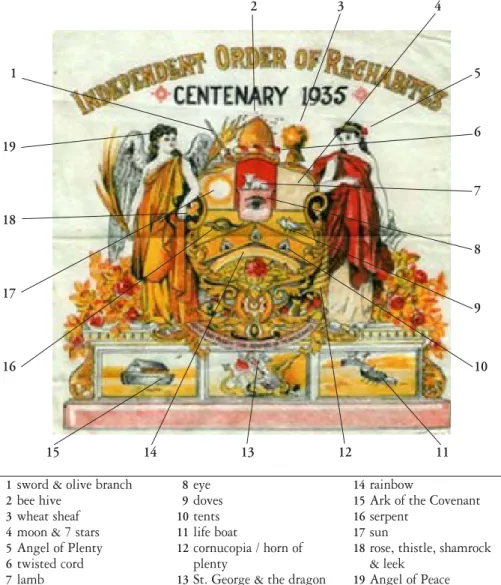
Fig. 3 The Rechabite Emblem3
1sword & olive branch
2bee hive
3wheat sheaf
4moon & 7 stars
5Angel of Plenty 6twisted cord 7lamb 8eye 9doves 10tents 11life boat 12cornucopia / horn of plenty
13St. George & the dragon
14rainbow
15Ark of the Covenant
16serpent
17sun
18rose, thistle, shamrock & leek 19Angel of Peace 2 12 13 14 3 4 11 15 16 17 18 19 1 5 10 9 8 7 6
1. Bee hive: bees represent hard work. In heraldry, bees usually appear in groups and symbolise a sense of order as well as diligence.
2. Wheat sheaf: the wheat sheaf represents goodness and plenty, the reward of honest work. It is the basic food stuff which cannot be anything but the gift of the gods.
3. Moon & 7 stars: they indicate that we must be the reflectors of the light of temperance truth. The seven stars remind us of the seven churches mentioned in the book of Revelation and may signify that Rechabitism is for all churches and is not confined to a particular section of religious people. Seven is the perfect number and suggests that we must aim at perfection even though we may not attain it.
4. Angel of Plenty: she is next to a horn of plenty, full of fruits and flowers, signifying that Temperance will bring good things.
5. Twisted cord: this represents strength and unity. We must be united if we are to defeat this great enemy strong drink.
6. Lamb: the lamb represents sacrifice, in particular, self-sacrifice. To get the most out of life we must be willing to both deny ourselves and to do good to others. 7. (All-seeing) eye: we must be watchful and sober. God is watching.
8. Doves: they have symbolised gentleness, peace and love since ancient times. 9. Tents: Rechabite branches are called tents. The Biblical passage from Jeremiah
35: 5-6, quoted at the beginning of this paper, suggested the name ‘Rechabite’ for the teetotal society, and as the Sons of Rechab dwelt in tents, the choice of the ‘tent’ as the basic unit of each society was an obvious one.
10. Life boat: this connotes rescue – the Rechabites will rescue drinkers from their peril.
11. Cornucopia/horn of plenty: this is the reward of temperance.
12. St George & the dragon: the patron saint of England represents the fight against evil.
13. Rainbow: the symbol of the covenant. God made a covenant with the ancient Rechabites. The covenant is the promise given by one person to one or more people, i.e. the promise not to drink alcohol.
14. Ark of the Covenant: this represents security.
15. Serpent: the serpent reminds us of the biblical words of Solomon concerning wine. It “bites like a serpent and stings like an adder.” The serpent is also a symbol of wisdom – it would be wise to avoid strong drink.
16. Sun: this represents God. The light and heat, of which the sun is the source, symbolises Truth and Love. For the Rechabites, the truth about strong drink
must be made known.
17. Rose, thistle, shamrock & leek: these are the four floral emblems representing the countries of the United Kingdom.
18. Angel of Peace: she holds an olive branch, the universal symbol of peace. 19. Sword & olive branch: the olive branch is the emblem of peace, while the
sword stands for justice. For the Rechabites, their cause is a just one. They are not going to put the sword down until they have driven the robber strong drink from the land.
The main idea behind the Rechabite emblem is reflected in the motto: “Peace and Plenty the Rewards of Temperance.” The idea that spiritual and material gain is a natural product of temperance underpins the whole Rechabite ethos. The individual symbols, juxtaposed on a heraldic shield, transmit a positive message of success through individual effort, supported by God. There are Christian references (the eye and Ark of the Covenant), and also patriotic national symbols (St George, the rose, thistle, shamrock and leek). The former is not surprising, for the creator of both the emblem and the ritual, Rev. Joseph Thompson, was a church minister, albeit of a relatively obscure sect called the Cowherdites.4There are some similarities
with Masonic symbols (especially the all-seeing eye, which appears in a triangle in many lodges, over the Master’s chair). Some members would undoubtedly have been members of both societies. Indeed, the symbolic eye was present in ALL friendly society logos. This demonstrates the tangled web of ideas, symbols and imagery that intertwined, and intertwines, in different organisations of a voluntary self help or philanthropic nature.
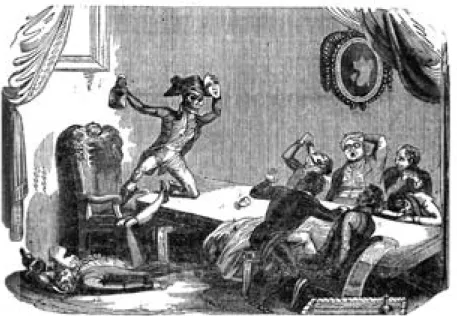
Through identification with the symbolic emblem of their organisation, Rechabites received support and encouragement. However, they stressed a negative image of drink itself. In this respect they were no different from the other thousands of teetotallers active in the nineteenth century. The effect of an exaggerated emphasis on the dangers of taking “the first sip,” for example, and the demonization of strong drink in any form or taken for any reason whatsoever, were powerful reinforcers, ensuring a certain code of
conduct among members of the society. (It is not clear how successful this ploy was in actually converting people to teetotalism). The picture below, taken from a nineteenth-century temperance journal, is illustrative of this point. The title is self-explanatory. “Death Unmasked” shows a bottle of liquor in its “true” colours – death. On revelation the imbibers are shocked, but will they heed the message?
Fig. 4 “Death Unmasked”
Supplement to The Preston Temperance Advocate, July 1836, front page.
Ritual and Ceremonies
Rituals and ceremonies were an important part of the Rechabite experience, although they were certainly not unique to this friendly society. Initiation was particularly important, and every new member had to participate. It had two aims; to bond the newcomer to his tent through a shared experience, and to reinforce the serious intention behind the society – mutual benefit. There are strong parallels with freemasonry, and indeed the Rechabite ceremonies may have arisen by imitation, when freemason members brought their practices with them into friendly societies.
An extract from the First Rechabite “Making” Book is shown below. MAKING PART FOR THE C.R. [Chief Ruler]
(…) (The C.R. taking a Brother by the hand, shall say):
This union of our hands is a type of that union of the heart which ought to subsist between us and every brother belonging to this honourable Order, for, when mankind are only externally united together, we often find that “trifles light as air” frequently separate man from man and cause them to become the direct enemies of each other; but when mankind are united in heart and in life, nothing on earth can separate them – nothing but death; nay, not even that can dissolve the friendship that is cemented between them. (…)
I shall now acquaint you with a few signs and tokens peculiar to our Order. We have some others which will be made known to you after you have been initiated the proper time.
PASSWORD,
ENTER, SIGN, – RAPS AT THE DOOR. SIGNIFICATION.
PASSWORD, COUNTERSIGN, SIGNIFICATION
(Worthy Levite, introduce our Brother to our most worthy Past Chief Ruler) (Campbell 15)
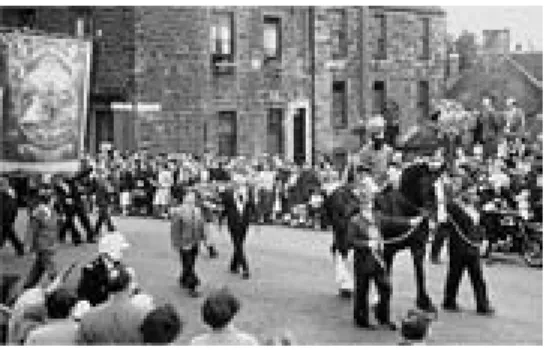
Rituals and ceremonies also had a public face. The procession (see fig. 5 below) served to both reinforce the fraternal, common bonds of members and also to show the community their pride and strength. Before feasts, meetings, funerals and more joyful celebrations, members of a tent would march through the streets. As well as regalia, a giant marching banner was a common feature. To celebrate Queen Victoria’s accession to the throne, Rechabites marched in Castletown, Isle of Man:
At 11 o’clock, the members of the Independent Order of Rechabites (who celebrated their anniversary on this occasion), with the children of the various Sunday-schools of the town and neighbourhood to the number of about 1,000, assembled at the green, and walked in procession, accompanied by the Rechabite Band, to St. Mary’s Church. The Rechabites, two and two, with their band of music, and two splendid banners: one bearing a representation
of the prophet Jeremiah and the sons of Rechab, reverse, the Arms of the Order, supported by Peace and Plenty. The other bore the Temperance Arms; reverse, John the Baptist preaching in the wilderness, supported by Temperance and Justice. The flags were painted by Messrs Smith, of Castletown, and by our own countryman Mr C. Hudson, of this town [Douglas]. They were very much admired, and reflected credit upon the artists.
The Rechabites retired to the Tent, at the Schoolhouse [probably the Primitive Methodist], where a plentiful supply of tea, buns, and beef, was provided; after partaking of it, the band and a few of the members again walked through some of the streets. A public temperance meeting was held in the market-place, where great attention was given to the addresses delivered.
“Mona’s Herald,” 1838 <www.isle-of-man.com/manxnotebook/history/socs/ rech_his.htm>).
Not everyone thought public processions a good idea, however. The following Isle of Man newspaper extract of 1837, although sympathetic to the Rechabite cause, is particularly critical of the “revolting spectacle” of parading women.
“All the world’s a stage.
And all the men and women merely players.”
The truth of the above lines of our immortal Bard, are every day more and more confirmed, for scarcely has one silly pageant passed from our view, but another, if possible still sillier, is ready to supply its place, and the rival candidates for absurd distinction, jostle each other on the stage for precedence. We were led into this train of thinking by the motley exhibition of Tuesday last. With the nature of tee-totalism no one can find fault, we feel favourably disposed towards it, from the great and obvious benefit it has conferred on society, being mainly instrumental in removing from it many vile and revolting scenes of self-debasement and self-sacrifice; – good indeed must be that institution or society, let it be Rechabite Tee-total, Temperance, or what it may, which has the power to arrest the steps of man on the downward path to perdition, and that too at a time when all other stay has lost its power and efficacy.
This could all be accomplished, and men, however vile; could return to that line of duty they had so recklessly left, without all this parade of flags, stars,
gilt sparrows, inverted wine glasses, scarfs, medals, rosettes and such masonic or odd fellow-looking trumpery, without having recourse to
“The thundering drum,
Or the vile squeaking of the wry-neck’d fife,”
and filling our peaceable old town with all the tumult and noise of a general election; but even admitting the utility of the procession, as regards the males, we know not a more ridiculous, nay, revolting spectacle than that of the rosy checked daughters of our Isle — against whom it would be foul and wrong even to breathe a suspicion injurious to their virtues — to see them parading our streets and forming a conspicuous part in the procession, and courting observation, — the retiring from which is women’s greatest charm, and allowing the world to judge that their practices must have been the most abandoned, to justify each a humiliation, in which
“They roughen to the sense,
And all the winning softness of the sex is lost.”
(Manx Liberal, 29 July 1837)
Fig. 5 A Friendly Society Procession
An important part of ritual and ceremony was the Rechabite regalia. Richardson Campbell wrote of the Rechabite sash:
White is an emblem of purity for the Rechabites. The white sash, therefore, is to teach you that your life must be pure and free from immoral blemishes, and I trust that while you wear the robe of purity you will keep yourself unspotted from the world. (Campbell 15).
Each official of the Rechabites had a ritualistic and a practical function. Some of the evocative names for officials of the IOR, with modern equiva -lents, are shown below. Their functions are self-evident.
HCR High Chief Ruler (President) HDR High Deputy Ruler (Vice President) CR Chief Ruler (Branch Chairman) PCR Past Chief Ruler (Past Branch Chairman) DCR Deputy Chief Ruler (Branch Vice Chairman) CS Corresponding Secretary (Clerk)
SS Sick Steward (Sick Visitor) TS Tent Steward (Assistant at Meetings) IG Inside Guardian (Inside Doorkeeper) OG Outside Guardian (Outside Doorkeeper)
Regalia served to distinguish members from one another, each official had his/her own distinctive marker, and also to show a common bond. It was a source of pride for members.
Fig. 6 Rechabite Sash Rechabite Sash – Honorary Member
Rechabite nomenclature and rituals, as seen in the use of official titles, passwords, and initiation ceremonies, were important because they provided the membership of each Tent with a distinctive means of identity that differentiated them both from other friendly/teetotal society members and from ordinary citizens; by holding to the teetotal pledge, keeping to the ceremonies, and with the mutual support of the other members, they strove to improve their life and that of others.
We are surrounded by a tangled web of ideas, images and symbols. The Independent Order of Rechabites is just one example of how individuals, through combination, can use these elements to their own and to society’s advantage.
Bibliography
Campbell, R. Rechabite History. Manchester: Board of Directors, 1911.
Gusfield, J. R., ed. Kenneth Burke. On Symbols and Society. Chicago: The University of Chicago Press, 1989.
<www.historyshelf.org/shelf/friend/13.php> (accessed 1.11.05)
A Tangled Web • CEAUL / ULICES 2007
An Approach to Isaiah Berlin’s
“The Decline of Utopian Ideas in the West”
Adelaide Meira Serras
An Approach to Isaiah Berlin’s
“The Decline of Utopian Ideas in the West”
“Life can be seen through many windows, none of them necessarily clear or opaque, less or more distorting than any of the others.”
This encapsulation engraved on the glass-fronted rooms of Wolfson College, founded by Isaiah Berlin (1966), bespeaks of his openness and democratic view of the world at large. However, the optimistic tone which we can feel, I would say almost touch, in these words seems, on occasion, to be clouded by doubts. That is precisely the case with his essay “The Decline of Utopian Ideas in the West” (1978).
As part and parcel of a volume edited by Henry Hardy (1990), entitled Isaiah Berlin. The Crooked Timber of Humanity, this essay does a thorough analysis of the essential options and expectations of humanity throughout the ages.
Focusing on the notion of utopian discourse, Isaiah Berlin, questions the possibilities of prevalence of such a trend of thought whose outstanding trait is the strong belief in man’s ability to achieve, or at least to conceive perfection. As he states, “the idea of a perfect society is a very old dream, whether because of the ills of the present, which lead men to conceive of what their world would be like without them – or because these Utopias are fictions deliberately constructed as satires, intended to criticise the actual world and to shame those who control existing regimes, or those who suffer them too tamely;” (Berlin “Decline Utopian Ideas” 20). This old dream, as Berlin tells us, dates back to Antiquity, with works from Plato or Aristotle onwards, as well as from the Biblical narrative.
For Berlin, these utopian works may rise from an idyllic past, looking back on a lost golden age, or a paradise later made inaccessible for mankind. In both cases, man becomes an outcast owing to his own error, either the
hubristic error of the hero, who, defying the gods, after a turn of the wheel of fortune meets his tragic fate, or the sin of disobedience which in the Christian narrative triggers off the expulsion of the primeval couple.
In spite of the relevance of these visions in the history of western ideas, the most influential are, in my opinion, those which project their dream in a more or less remote future. In so doing they are nurturing ideologies, that is, in the words of Raymond Williams, “a system of beliefs characteristic of a particular group or class,” or even “a system of illusory beliefs – false ideas or false consciousness – which can be contrasted with true or scientific knowledge” (175); so, utopian writing is a way of deploying a fair amount of sensible reasoning in order to convince the reader that he is being introduced to the paragon of a happy society or living system. Whether it resolves itself into an illusion or not, does not alter the fact that a systematic representation of a possible reality is on offer. More’s Utopia is the first of many other utopian fictions mainly of the Renaissance and Enlightenment periods displaying this kind of perfect alternative to their own contempora -neous real society.
However, in his approach both of retrospective or prospective works, Berlin highlights the need for a universal idea of perfection, stemming from timeless, universal values, conveyed by utopian discourse. Usually these values are identified in total unison as truth, virtue and happiness. Truth and virtue would concur to ensure humankind a happy life, bearing in mind, of course, that the notion of what a happy life consists of will have a unique answer. So the author considers a universalistic Weltanschauung opening the way for the flourishing of Utopia a quite unavoidable premise. If one is tempted by a sceptical or relativistic view of society or of the world, the utopian dream will stop making sense; it will just fall apart.
Thus, Berlin confronts the Enlightenment and the Romantic periods as the two poles of a universalistic and a pluralistic conception of life. The former corresponds to the richest production of utopian works, whereas the latter presents its decline.
Actually, Berlin’s evaluation of the Enlightenment seems rather complex, or as Raymond Tallis puts it in a subtitle to his work, Enemies of Hope, his attitude is one of “Yes-But to the Enlightenment” (1). On the one hand, Enlightenment means the apology of absolute reason as the key to the
understanding of the Universe. René Descartes stands as its main voice, especially through his essay “Discourse on Method” (1637), the masterpiece which would teach man to hold the key of the mysteries of the universe. There were, however, voices against the rationalist stream, namely from the empiricist model based on the experimental approach defended by Francis Bacon as far back as the early years of the seventeenth-century, and by Newton’s scientific triumphs in the field of physics, and later theorised by John Locke’s Essay Concerning Human Understanding (1690). This trend of thought, despite the methodological divergence from the rationalist point of view, also agreed with the idea of a pattern of universal laws which would uncover Nature to the human mind. Rationalists and empiricists alike trusted the extraordinary qualities of humankind to improve their lot in a variety of ways. This widespread self-assurance was very suitably expressed in Pope’s epic poem, Essay on Man (1744).
The emphasis on knowledge, present in Pope’s poem – “know then thyself, presume not God to man,/The proper study of mankind is man” (Pope 14) – refers to Berlin’s conception of knowledge in western culture, with its origins in the classical and Judaic-Christian matrix, not just as descriptive knowledge of the universe, but simultaneously as ethical and political knowledge transferable into action. “To know what is good is to yield a good way of living” (Berlin: Crooked Timber 28-29).
All these meant there was a strong hope that the conditions for a better standard of living were developing, that is, a strong belief in progress was growing. Utopian discourse opened the way to inform and convince an even wider intellectual circle of the benevolent bias of the profound changes to be expected. The idea of bienfaisance, defended by philosophers such as Leibniz, Spinoza or Shaftesbury, to name but a few among the optimistic European thinkers, went in tandem with the dream of a healthy, peaceful society where nobody had to perform unpleasant tasks, suffer injustice or any kind of threat, all of them common facets of Utopia.
The epic, intervenient capacity of Enlightenment utopias apparently impressed Isaiah Berlin: the route of progress towards perfection is the kind of ideal that helps to strengthen Berlin through his haphazard life. Having to move from one country to another since his childhood and later having to face two World Wars and keeping “a prodigiously energetic capacity
for enjoyment of life, of people in all their variety, of their ideas and idiosyncrasies, of literature, of music, of art,” as Henry Hardy says (1), is no small feat.
On the other hand, as Peter Gay points out, a programme of progress is not a theory of progress (100). Christian tradition hindered many enlightened thinkers (with some exceptions like Turgot or, on occasion, Voltaire) from an enthusiastic support of a progress-based theory of life in general. Some of them would defend, instead, a cyclical theory. David Hume, for instance, observes that tendency in the course of civilization:
“When the arts and sciences come to perfection in any state, from that moment they naturally, or rather necessarily decline, and seldom or never revive in that nation, where they formerly flourished” (135).
Also the uniform and controlled environment recurrent in utopian literature and, above all, its static nature strike a note precisely against that notion of enlightened progress. Once perfection is reached, there is no room for perfecting either man or society. The superlative quality of a utopian world becomes claustrophobic as far as individual needs are concerned. At this point the Romantic reaction opposing the excessive rationalistic collective order with emotion and a spiritual vision of relationships – between man and Nature, man and other men, and man and God (or transcendence) – seemed rather more gratifying than the former projects.
Instead of a perfect, tightly ruled society, ensuring human well-being, the Romantic reader discovers in the former utopias a nightmarish oppressive world where there is no place for hope. The danger of levelling as a synonym of lowering the moral, political, aesthetic or even emotional standards of living, thus reducing man to a mere vegetative being satiated with the basic animal needs, causes man’s rejection of the utopian solution. Jeremy Bentham’s Panopticon (1791) is an illustrative example of this kind of reaction. Its efficacious architectural project of a prison composed of indi vidual cells, ranged round a central post enables a twenty-four hour inexpen sive surveillance. This ensures a harmonious self-contained community where violence is suppressed, profit guaranteed, and individual will eradicated. What constituted a highly intelligent achievement for the men of the Enlightenment period became a classic example of Romantic rejection.
explores the very same idea highlighting the importance of psycho logical domination by a hypothetically constant observation as a means of potential exercise of power. The lack of privacy and especially of an individual identity within a human hive is presented as the negative face of utopian writing, i.e., dystopia.
The rise of dystopian writing implies, in Berlin’s perspective, the decline of utopian ideas in western thought precisely from the Romantic period onwards. In so doing he is devaluing other reactions which had previously emerged, even during the Enlightenment. Although he mentions Montaigne and Montesquieu, he fails to consider the pluralistic approach of L’Esprit des Lois, or of Lettres Persanes as something more significant than apparent, superficial variables, incapable of jeopardizing what he considers the central human goals: the need of food and drink and of security, the urge to procreate, to live in society with justice and a certain degree of liberty… (Crooked Timber 31). However, I think Berlin is here deliberately confounding basic needs man shares with any other living creature, and two essential values which have been the object of multiple diverging inter -pretation, as Berlin himself brilliantly exposed in his essay “Two Concepts of Liberty.”
Doubts about the utopian universalistic dream of a unique perfect society which man was to gain through knowledge began almost as soon as this very ideal took form. As early as 1726, Jonathan Swift’s Gulliver’s Travels satirised Francis Bacon’s vision of an institution of knowledge and technology capable of improving human society; in 1755 the Lisbon earthquake also reminded men they did not dominate Nature, as Voltaire pointed out in his letter Sur le Désastre de Lisbonne. Again, however, Berlin asserts that even the most pessimistic thinkers of the Enlightenment agreed on the notion of progress and so encouraged humanity’s pursuit of the light of truth, lumen naturale always present and always the same in spite of man’s inability to live under its brilliance due to either wickedness or stupidity (Crooked Timber 52).
The twentieth-century witnessed a considerable increase in dystopian literature and film production, perhaps as a consequence of that recurrent wickedness or stupidity Berlin mentioned. Instead of a narrative of achieve -ments and improvement towards that harmonious static paradise, it
displayed the dispirited bend humankind was suffering from. The fear of a totalitarian regime, as a distorted caricature of Marxist egalitarian dream ideology, or as the aftermath of Hitler’s expansionist attempt, together with human insecurity in relation to the mechanised, technologically dominated environment led to the production of works such as Orwell’s Nineteen Eighty-four, or Huxley’s Brave New World.
Berlin associates this chilling image of utopia with the individualistic theoretical approach, resulting in pluralistic or relativist solutions for men trying to envisage the best society to live in. That is what he calls “the disturbing heritage of the romantic movement” (Crooked Timber 44).
He seems unable to recognise the possibility, or the significance of the simultaneous coexistence of different utopias, according to the different space-located, historical cultures they are related with. He envisages them as the only meagre solution left to men, a negotiation for “some kind of equilibrium, necessarily unstable, between the different aspirations of differing groups of human beings” (Crooked Timber 47).
Industrialisation, bureaucracy, massive urbanism and now globalisation with the consequent framing of civic and political rules and laws, with impersonal timetables and a standard way of living may be contributing factors towards the negative reception of well-regulated, secure and monoto nously uniform utopian societies of former times. Moreover, the need to assert individual rights, to defend what Isaiah Berlin defined as passive freedom, makes dissatisfaction grow along with material consumerism.
The western world is now engaged in constructing a fundamentally secular and deconsecrated industrial society. This is a society in which – if it is achieved – all men will live in comfort. Perhaps there will also be a large measure of formal freedom and religious and philosophical toleration. But it is a society that threatens to deprive human life of all spiritual content, a society in which the growth of freedom is likely to be accompanied by the growth of numbers of those whose inner emptiness robs them of the desire to use it, a society in which religious and philosophical toleration will be made all the easier to achieve as spiritual impoverishment makes religious and philosophical commitment constantly more rare.
Lucien Goldman’s words draw our attention to another aspect implicit in Berlin’s notion of decadence of utopia, namely, the emptiness, the spiritual desert he may have felt especially in the second half of the twentieth-century western cultures. Escapism would alternate with gloomy visions of a future social framework, thus avoiding a serious answer to the essential issues central to Berlin’s reflection, namely the pursuit of happiness based on justice and freedom. These goals pervade Berlin’s urge for universalism, for timeless values or cardinal ideas through which, in a biographical perspective, he could make sense out of his life scattered over different European countries.
Notwithstanding the patent fragmentary quality of the present day world, it does not necessarily mean the end of a dream; perhaps it induces the end of the dream, but gains a kaleidoscopic power which Berlin himself practiced through his immense intellectual curiosity. Moreover, utopian discourse will benefit from the multiplicity of authorial individualism insofar as it can enrich that otherwise impoverished spiritual heritage.
He asserted that “out of the crooked timber of humanity no straight thing was ever made. And for that reason no perfect solution is, not merely in practice, but in principle, possible in human affairs, and any determined attempt to produce it is likely to lead to suffering, disillusionment and failure” (Crooked Timber 48).
Nowadays, as in Berlin’s lifetime, western culture faces difficult chal -lenges. Terrorism may be paralleled with the horror of Hitler’s genocide. Humanism seems to loose ground confronted with the predatory and destructive wave we are witnessing. However, there is always the other side of this reality. He missed man’s ability to straighten things up, to twist some wrongly directed branches, or, in other words the path to small scattered islands of less imperfect worlds as a guarantee of a perfect teleological vision in progress. Such disbelief could allude to the slight ironic touch of disenchantment which haunts his essay as a legacy marked by a bitter taste of disillusion.
Or perhaps he did glimpse a harmonious world created out of the perfect balance of such opposite ideals when looking through some other of those many windows at Wolfson College, because none of them is “necessarily clear or opaque, less or more distorting than any of the others.”
References
Bentham, Jeremy. “Panopticon; or the Inspection-House: containing the Idea of a New Principle of Construction Appicable to Any Sort of Establishment, in Which Persons of any Description Are to be Kept Under Inspection; and in Particular to Penitentiary-Houses, Prisons, Houses of Industry, Work-Houses, Poor-Work-Houses, Lazarettos, Manufactories, Hospitals, Mad-Work-Houses, and Schools: with a Plan of Management Adapted to the Principle: in a Series of Letters, Written in the Year 1787, from Crecheff in White Russia, to a Friend in England.” The Panopticon Writings. Ed. Miran Bozovic. London: Verso, 1995: 29-95.
Berlin, Isaiah. “Two Concepts of Liberty.” The Proper Study of Mankind. An
Anthology of Essays. Ed. Henry Hardy and Roger Hausheer. Foreword and
introduction Noel Annan. Introduction Roger Hausheer. London: Pimlico, 1998: 191-243.
—-. “The Decline of Utopian Ideas in the West.” The Crooked Timber of Humanity.
Chapters in the History of Ideas. Ed. Henry Hardy. Princeton, New Jersey:
Princeton University Press, 1990: 20-48.
Foucault, Michel. Discipline and Punishment: The Birth of Prison. Trans. Alan Sheridan. New York: Pantheon, 1977.
Gay, Peter. The Enlightenment: An Interpretation. The Science of Freedom. New York & London: W – W – Norton & Company, 1996.
Goldmann, Lucian. The Philosophy of the Enlightenment. Trans. Henry Maas. London: Methuen, 1973.
Hardy, Henry. Isaiah Berlin: A Personal Impression. Retrieved November, 8, 2005. <http://berlin.wolf.ox.ac.uk/writings_on_ib/hhonib/obituary1.html> Hume, David. “Of the Rise and Progress of the Arts and Sciences.” Essays Moral,
Political and Literary. Ed. Eugene F. Miller. Indianapolis: Liberty Fund, 1985:
111-137.
Pope, Alexander. Essay on Man. Epistles I-IV. Introduction and notes E. E. Morris. London: Macmillan&Co Ltd, 1960.
Tallis, Raymond. Enemies of Hope. A Critique of Contemporary Pessimism. London: Macmillan Press Ltd, 1999.
Williams, Raymond. “Ideology.” Ideology. Ed. Terry Eagleton. New York: Longman Group Uk Limited, 1994: 175-189.
Sir Isaiah Berlin, OM, CBE, MA, FBA. Retrieved November, 9, 2005
A Tangled Web • CEAUL / ULICES 2007
A Tangled Web of Victorian Celebrities
Iolanda Freitas Ramos
A Tangled Web of Victorian Celebrities
This paper is based on Lillie Langtry’s autobiography and it will focus on her rise from a tomboy to a provincial housewife and finally a sophisti -cated PB – i.e., a Professional Beauty. It intends to show how a beautiful woman was able to become a celebrity by taking advantage of a tangled web of ideas, images, and symbols within the Victorian frame of mind.
The remarkable life of the “Jersey Lily” is a good example of a different kind of self-made woman who used her looks and wit in order to gain fame and fortune. Accordingly, she was able to achieve a certain amount of social power and financial independence, both abiding by the rules of society and also breaking them during her lifetime.
Lillie Langtry, née Emilie Charlotte Le Breton, was born in Jersey in the Channel Islands in 1853, and died in 1929 in Monte Carlo, Monaco. One of the last photographs of her, which can be seen at the National Portrait Gallery in London (Beatty viii), depicts her with lilies in her hand. Her Christian names were, in her own words, “dreadful to my way of thinking – but, happily, perhaps on account of my skin being unusually white, I was nicknamed ‘Lillie’ very early in life and that sobriquet has clung to me ever since” (Langtry Days I Knew: Autobiography 13).
Four years prior to her death, she published The Days I Knew,1a vivid
account of the late-Victorian and Edwardian golden circles. Here and there, she mocks “those prudish Victorian days” (Days I Knew: Autobiography 34), saying that “what was considered risqué and compromising then would pass unnoticed in the present day” (185), and even mentions the occasion when
1The work was published both in London (Langtry 1925a) and New York (Langtry
Queen Victoria made her famous statement “We are not amused” (46-47). The book almost seems a Who’s Who of the period, allowing the reader to get in touch with 19th century public figures such as William Gladstone,
Benjamin Disraeli, Sir Randolph Churchill, the Baron de Rothschild, the arctic explorer Sir Allen Young, Oscar Wilde, and John Everett Millais, among many others.
As a matter of fact, she was proud to be in the company of “celebrated makers of History” (88). She met some of the most distin guished person -alities of her time, including those who belonged to the diplomatic world. For instance, she mentions in her book that she did not understand the Portuguese language when she recalls the occasion when she was introduced to the First Attaché in the Portuguese Legation in London, the Marquis de Soveral, described as a “handsome foreigner” (Days I Knew: Autobiography 137). Once, in Paris, he took her to see a bullfight conducted as “the royal Portuguese corridas” (138), an event she enjoyed and described in detail. She also wrote about her exciting experience of racing down the hills inside a toboggan in the island of Madeira, when she stopped there on her way to Cape Town in 1905 (151-152).
Although this volume was published in 1925, it recalled events reaching back to the 1850s, including Queen Victoria’s State funeral procession (139). “Certainly the world and Society have changed a great deal since my early years” (Days I Knew: Autobiography 185), she asserts, but her memoirs followed the tradition of Victorian autobiographies,2 which
were written by people of “lofty reputation” or by people who had something of “historical importance” to say (Marcus 31-32). Most of all, a strong quest for respectability is implicit in the text, as well as an explicit need to recount that the society in which she had grown up had disappeared, at least enough for her to have to describe it to the reader:
In my day London society was very different to what it is now. (…) Rank was more highly considered and the line more finely drawn between the social grades, the inner circle consequently being comparatively small which suggests
that in the vastly enlarged society of today the excitement of my advent could not be repeated. (Langtry Days I Knew: Autobiography 32-33)
Like all autobiographies, The Days I Knew provides a landscape for a critical comment on theories of representation,3 both of the self and the
others, and on the division between fact and fiction. According to Laura Beatty in Lillie Langtry: Manners, Masks and Morals, “by the time she came to compose her memoirs she had learnt that everything could be rewritten. Whatever had been sad, unworthy or unscrupulous was transformed at the touch of a pen” (6).
Consequently, there is not a single allusion to her well-known liaison with the Prince of Wales, or to her daughter Jeanne-Marie, born in 1881 of her affair with Prince Louis of Battenberg. Neither is there a word about her being harassed by King Leopold of the Belgians (Langtry Days I Knew: Autobiography 89), nor the torrid revelation of any closely-guarded secret. The only thing she cares to deny is that she once, at a supper party, dropped a piece of ice down the Prince of Wales’s back (35). It seems she never forgot Gladstone’s wise words, when he once told her: “In your professional career, you will receive attacks, personal and critical, just and unjust. Bear them, never reply, and, above all, never rush into print to explain or defend yourself” (103). A modern reader can go further, and recall Roland Barthes’s statement: “It is my political right to be a subject which I must protect” (15, apud Anderson 1).
The concept of intention has been a recent topic for a discussion of auto biography (see Marcus 3), and as Linda Anderson points out, “‘intentionality’ signals the belief that the author is behind the text, controlling its meaning” (2). On the one hand, and at first sight, it seems that Lillie Langtry’s only purpose is to entertain the reader with an enjoyable narration of her eventful life, and “to bring again the wonder and the joy and the delight” revealed by “the days I knew”, as she says at the end
3Current studies on culture discuss representation as the production of meaning
through language, discourse and image. The intentional approach is only one of the three theories of representation (see Hall 24-26).
of the book (Days I Knew: Autobiography 185). On the other hand, to those who could criticize her futile way of living, there seems to be an emphasis on her pursuit of a serious career on stage, and therefore an intention to set an example for independent women to follow their personal ambitions.
Lillie Langtry was the only daughter of the Dean of Jersey, and grew up with six brothers that made sure she did not become too spoiled. It is reasonable to infer from her own words that the strong character she showed all her life was developed in childhood:
My brothers lost no opportunity during my earliest youth of impressing on me what a miserable handicap it was to be a girl, a silly creature, given to weeping on the slightest provocation, easily scared and full of qualms. So I was quick to perceive that (…) I must steady my nerves, control my tears and look at things from a boy’s point of view. (Days I Knew: Autobiography 20-21)
Pleading weakness was never an option, and this attitude would of course be crucial to her success and distinctiveness, making her more than just a beautiful woman. Her strong will was connected with a physical vitality, and not only did she ride, but also swim and row. In fact, according to Victorian patterns, she had an absolutely feminine beauty and the strong character of a man. Perhaps the more vulnerable side of her personality came to the surface many years later, when the manipulative femme fatale, that had led Edward Langtry, her first husband, to drown his sorrows in alcohol and to die in an asylum, became herself a victim of emotional and physical abuse by George Alexander Baird, one of her lovers.
The idyllic scenario of the island as a cherished playground for adventure and freedom during her childhood had been gradually replaced during her adolescence by a feeling of claustrophobia. The magic was gone, and the island had become too small for 20-year-old Lillie. Moreover, it was like a prison from which she had to escape. When she met the then wealthy Mr Langtry, she fell in love with his luxurious yacht, and married the owner. In fact, she married in her travelling gown, on 9 March 1874, because the couple sailed away the same day to Southampton.
As is known, marriage was both the traditional getaway solution and the “conventional starting point for families” (Thompson 90). The new couple even posed for a photograph “looking distinctly Hogarthian,” as Laura Beatty puts it (vii). But for Lillie, as for so many Victorian women,
marriage turned out to be a disappointment. After a severe attack of typhoid fever, her physician ordered a change of air, and in January 1876 the Langtrys moved to London. This was where the real adventure began.
At first, Lillie spent her time reading books and magazines, walking in Hyde Park watching for famous people to pass, and going to museums and picture galleries in order to become aware of all the interesting things that were new to her. The Langtrys knew only a few English families who some -times wintered in Jersey, like Lord and Lady Suffield, and Lord Ranelagh, whose afternoon parties were very popular. Through him they received their first invitation in London, from Lady Olivia Sebright, an amateur actress and a hostess who gathered at Sunday evening receptions men and women fond of literature and art.
Being in mourning for her younger brother, Lillie wore a simple black gown designed by her Jersey dressmaker, with no jewels – she had none, anyway – and with her hair twisted carelessly at the nape of her neck, in a knot which later became known as “The Langtry” (Langtry Days I Knew: Autobiography 27). She became the centre of attraction in spite of, or probably due to, her modest appearance. In fact, at the dawn of her dis cov -ery, she looked like a milliner’s assistant (cf. Beatty vii). That 25-year-old woman had all the qualities of the classic Victorian heroine – she was young, beautiful, unknown, poor, and acceptable.
She was also lucky to be claimed by Sir John Everett Millais as his countrywoman, and he asked her to sit for him so that he could reproduce on canvas her classic features. The “manly” Millais (Langtry Days I Knew: Autobiography 28) had married Effie Gray after the annullment of her white wedding to John Ruskin, and he played the role of Lillie’s father figure by helping her to establish her fame in London.
Among other people whom she met on that first night in London society, early in 1877, and who remained her long-lasting friends, were James McNeill Whistler and Frank Miles (see Beatty vii). The latter, a young artist, made two sketches of her with a lily in her hair on the spot.4
4See “Lillie Langtry,” <http://www.hurstmereclose.freeserve.co.uk/html/lillie_langtry.
One he gave to her, the other he sold the next day to a printer. In no time it was outselling all other prints of PBs, making her face famous. The portraits and pencil drawings of her by Frank Miles, in particular the “Triptych”, show the sensual gaze of her big blue-violet-greyish eyes.5 On
19 May 1877 Vanity Fair recorded Lillie’s arrival in Society:
All male London is going wild about the Beautiful Lady who has come to us from the Channel Islands. She is certainly the most splendid creature that has ever risen upon London from an unknown horizon, (…) it is as though some newer and more perfect creature had risen, like Aphrodite, from the sea. She has a husband to make her happy, but still awaits a poet to make her known. (Beatty 81)
Her portraits were in every shop window and made the public so familiar with her features that wherever she went, she was immediately recognized. Mrs Langtry was nevertheless able to make fun of the notion of celebrity. For instance, in her autobiography, she recalls an episode when a shopkeeper took her for Sarah Bernhardt. Her coment was: “One celebrity was as another to him” (Langtry Days I Knew: Autobiography vi). Her mixed feelings of not only being amused and flattered by all this excitement but also of being afraid for her physical integrity are described in her autobiography (31-32). She had passed in a few weeks from being an anonymous person to a celebrity, and she realized there were both benefits and negative consequences of this over whelming public attention from all social classes in London.
Generally speaking, people knew the ladies of society, not because they actually met them, but because there were photographs and prints everywhere, especially in magazines and the popular press. Lillie Langtry lived in the age that invented the camera, and photography was emerging as a new art in spite of the fact that it was criticized by painters.6On the one
hand, they despised it by saying that a photograph was simply an illustration. Consequently, acccording to them, it was unable to convey inner reality and pure beauty, which could only be depicted on canvas. On the other hand,
5See “Pictures of Lillie,” <http://www.lillielangtry.com>.
6For an outline of the nineteenth-century division between “art as expressive creativity