Carvalho, Freire, Conboy, Baptista, Freire, Azevedo & Oliveira / TUSED / 8(1) 2011 29
Student Perceptions of Secondary Science Teachers’ Practices
Following Curricular Change
Carolina CARVALHO1,Sofia FREIRE2 , Joseph CONBOY2, Mónica BAPTISTA1, Ana FREIRE3, Mário AZEVEDO3
, Teresa OLIVEIRA3 1
Prof. Dr., University of Lisbon, Institute of Education, Lisbon-Portugal 2
Researcher, University of Lisbon, Institute of Education, Lisbon-Portugal 3
Retired Lecturer, University of Lisbon, Institute of Education, Lisbon-Portugal
Received: 15.10.2009 Revised: 21.12.2010 Accepted: 02.01.2011
The original language of the article is English (v.8, n.1, March 2011, pp.29-41)
ABSTRACT
Inquiry-based teaching has emerged as a highly valued strategy in science education. In Portugal, the science curriculum has been redesigned in order to promote such teaching. This implies substantial change in teacher practice. It is therefore important to understand students’ perceptions of teacher practice. In this study, we describe student perception of teacher practices and look for associations between the perceptions and student motivation. Three low-achieving, secondary-level science classes were studied. Motivation was measured by two scales (Intrinsic and Extrinsic); Perceptions were measured in four dimensions. Significant associations (p < .05) were observed between intrinsic motivation and (a) Perception of the use of Laboratory Work; (b) Perception of Science-Technology-Society and (c) Perceived Student Autonomy. No association was noted between intrinsic motivation and the Perception of Teacher as Facilitator. Results are generally consistent with previous literature. Teacher professional development lags behind curricular change. Teachers require new conceptions of assessment.
Key Words: Student Perceptions; Motivation; Investigation Activities; Curricular Change.
INTRODUCTION
One goal of science education is the development of scientific literacy, so that students can participate, actively and responsibly, in a society increasingly dominated by science and technology (Osborne & Dillon, 2008). Knowledge of isolated, disembodied scientific facts is not sufficient. Beyond the products of science, students need to understand its processes, potentialities and limits. They need to know how to evaluate scientific claims (Driver, Asoko, Leach, Mortimer & Scott, 1994; Driver, Newton & Osborne, 2000; Galvão & Freire, 2004; Lederman, 2006; Simon, Erduran & Osborne, 2006). When students acquire scientific
Correspondence Author email: [email protected] © ISSN:1304-6020
TÜRK FEN EĞİTİMİ DERGİSİ Yıl 8, Sayı 1, Mart 2011
Journal of
TURKISH SCIENCE EDUCATION Volume 8, Issue 1, March 2011
Carvalho, Freire, Conboy, Baptista, Freire, Azevedo & Oliveira / TUSED / 8(1) 2011 30
information in the absence of knowledge about the methods by which it was constructed, they develop a superficial understanding of science (Duschl, 2000).
In Portugal the development of scientific literacy is a goal assumed by recent governments. These have implemented legislative efforts to improve educational success (Law n. 6/2001, Law n. 453/2004) and have registered some improvements in educational indicators. Even so, rates of school failure and abandonment are still high (Ministry of Education, 2006). Science performance of 15-year-olds has been consistently below the European average (OECD, 2006).
Following recent international discussions about science education goals, new curriculum guidelines for teaching science in basic and secondary education in Portugal have emerged (Ministry of Education, 2001, 2003). The overall goal of the new curriculum is to increase scientific literacy in order to empower future citizens with the requisite knowledge for dealing with science and technology issues. In accordance with these general guidelines, several educational strategies have been proposed. These are often student-centred, constructivist approaches that include analysis and discussion of social, technological, and environmental issues
However, some Portuguese studies suggest that, although teachers have developed a discourse that corresponds to the new orientations, they have not changed essential dimensions of their own practices (Abelha, Martins, Costa & Roldão, 2007; Correia & Freire, 2009; Preto, 2008; Raposo & Freire, 2008; Seixas, 2007; Viana & Freire, 2006). In addition, other studies have identified barriers to curricular innovation, including (a) teachers’ difficulties with understanding new concepts and curricular documents, (b) resistance to changing a traditional vision of science education and (c) resistance to adopting new practices in line with a constructivist approach (Galvão et al., 2004; Galvão, Reis, Freire & Oliveira, 2007).
Keeping these issues in mind, it is essential to understand the real impact of curricular reform on teachers’ practices. Considering the scientific literature that suggests that students’ perceptions about teachers’ practices are more reliable than teachers’ self-reports of their own practices (Lawrenz, Huffman & Robey, 2003), we measured student perceptions about innovative practices supposedly implemented by three teachers. In addition, considering studies that highlight the importance of investigation activities in stimulating student involvement in science classes (Novak & Krajick, 2006; NRC, 1996), we aimed at understanding how student perception of teacher use of investigation activities is associated with motivation to learn school science. In this way, the present study emerges from the confluence of three types of studies: (a) studies centered on the potentialities of using investigation activities in science classes, (b) studies of the challenges that curricular innovation poses to the teacher, and (c) studies that use student perceptions as a means to collect data about teacher practice. Each of these issues will now be developed.
Investigation activities
The creation of inquiry-based learning environments and the development of authentic investigation activities have emerged as a promising approach to science education. Indeed, the literature indicates that good investigation activities promote complex reasoning as well as the development of exploration processes (Ask & Klein, 2000). Many authors support the use of this approach in the classroom as a way to improve students’ engagement with their own learning and to create successful learning situations (Novak & Krajick, 2006; NRC, 1996).
Investigation activities involve observing, questioning, searching for information, planning research, reviewing previous knowledge, interpreting and analyzing data, discussing
Carvalho, Freire, Conboy, Baptista, Freire, Azevedo & Oliveira / TUSED / 8(1) 2011 31
and communicating results, explaining and arguing (Ash & Klein, 2000; NRC, 1996). While the approach is similar in some ways to ―discovery learning‖, it is unfettered by a limited view that treats science as a set of unquestioned empirical truths that are achieved by following a universal method (Driver et al., 2000). On the contrary, the investigation activity approach (IA) admits a socially constructed dimension to science. As a result, activities such as (a) questioning; (b) decision making about appropriate methods for data collection; (c) analysis, interpretation and explanation of data; (d) argumentation in support of theoretical claims; and (d) communication of results; all constitute important dimensions of the construction of scientific knowledge. In addition, the IA approach acknowledges the roles of creativity, innovation and imagination (Driver et al., 2000; Lederman, 2006; Simon et al., 2006).
As a consequence, some principal techniques in the IA approach are to require students (a) to be aware of the relationship between methods of collecting evidence and ultimate conclusions; (b) to explain results and develop arguments that support their explanations; and (c) to present and discuss results with the class (Bybee, 2006; Hofstein & Lunetta, 2003). As Flick and Lederman (2006) state, ―it is this alternation of doing and reflecting that provides students with opportunities to develop their inquiry skills as well as understanding about what they have done‖ (p. xi, italics in the original).
IA may also offer the kind of activities that students seek and enjoy. Student-centred studies reveal that students seek personalisation of their learning environments. They enjoy more active involvement with their learning and more opportunities to make decisions about their own learning. They desire personal relevance in what they learn (Baram-Tsabari & Yaber, 2005; Osborne & Collins, 2001; Swarat, 2008). So IA, by providing authentic, meaningful and challenging learning experiences, based on choice and agency, may be a good approach to the attainment of such student expectations and may help shape students’ motivation for learning science.
Challenges for teachers
In order to reach the goals of science literacy, teachers must employ contextualized learning experiences that take into account students’ experience and every-day concerns. The best learning activities will naturally encompass the interdisciplinary dimension of science (Galvão & Freire, 2004). Such learning experiences emerge from a constructivist and inquiry perspective and usually emphasize practical work, such as field work, laboratory activities, simulation, debates, and the presentation of results (Galvão & Freire, 2004).
In this way, the new curriculum poses fresh challenges to teachers, who are faced with new conceptions regarding the goals of science education. They may feel conflicted as to the teaching-learning process they were taught about as teachers-in-training. The basic roles of teachers and students may require reinterpretation. And teachers’ interpretations of investigation activities (based on their own conceptions of science and of the construction of scientific knowledge) will affect how they use IA in the classroom (Hofstein & Lunneta, 2003; Pekemez, Johnson & Gott, 2005). Overcoming these challenges will be difficult and some teachers will resist change.
In addition, studies show that many teachers lack a deep understanding of the nature of scientific knowledge and about the scientific enterprise, and so it will be quite difficult for these teachers to establish a connection between products and processes of science (Abell & McDonald, 2006; Pekmez et al., 2005). This difficulty may give rise to greater resistance.
Besides resistance to innovation, the literature also points to teachers’ lack of knowledge and competencies for adopting new practices, the inexistence of adequate material to support the new practices and external pressures from the overall system (Fullan, 2001). In Portugal, evidence indicates that changes, consistent with the goal of science education, have
Carvalho, Freire, Conboy, Baptista, Freire, Azevedo & Oliveira / TUSED / 8(1) 2011 32
not occurred. Activities still tend to be teacher centred; the focus is still on knowledge of disembodied facts. The creation of inquiry learning environments through investigation activities and a focus on understanding remains a distant goal (Galvão & Abrantes, 2005).
A few national studies have investigated change implemented in secondary science curriculum. The results are consistent with the international literature at both the basic and secondary levels: In short, there is a gap between how teachers represent their classroom activity and what teachers actually do. Although teachers acknowledge the new curriculum guidelines are important, they do not put into practice this belief. Confronted with the discrepancy, teachers point to the lack of material resources, time constraints, and student resistance to new practices. They also blame pressure from national exams which, according to them, are still centred on a knowledge of disembodied facts (Preto, 2008; Seixas, 2007).
Data from these studies usually derive from teacher interviews and classroom observation. Such studies are useful in describing teachers’ perspectives and interpretations of the new science curriculum, as well as their intentions regarding change. Recently a number of studies have also emphasized student perceptions of teacher practices and change (Lawrenz et al., 2003; McIntyre, Pedder & Rudduck, 2005).
The role of student perception
Indeed, recent literature about the impact of curricular change acknowledges the usefulness of including students as sources of data (Hofstein, Levy & Shore, 2001; Lawrenz et al., 2003; McIntyre et al., 2005; Osborne, Simon & Collins, 2003). By questioning students we may better understand how they perceive teacher practices, as well as their conceptions about learning science education goals. An especially useful technique might employ the confrontation of student perceptions with teacher perceptions (Kinchin, 2004; Tsai, 2003).
We also recognize that the teacher/classroom/student dynamic occurs in a social milieu that can also shape responses to innovation. Social forces such as individualism and competition can affect students’ conceptions and perceptions about the school’s role, teachers’ roles, learning, and teaching quality (Dochy, Segers, Bossche & Struyven, 2005). These conceptions and perceptions will impact students’ reactions to changes in teaching strategies. Resistance to innovation may result if the strategies are incongruent with student beliefs about how things in school ought to be (Dochy et al, 2005; Kinchin, 2004; Tsai, 2000).
In spite of the many factors that can lead to resistance, teachers do introduce changes in their own practice in an attempt to improve student performance. Even when this is accomplished, there are still two hurdles to jump: (a) the change must be perceived by students as change for the better; and (b) the results, in terms of student motivation and achievement, should be in line with the teacher’ expectations. It may be, however, that innovation is often not perceived as such (Fraser, 2007; Hofstein & Lunetta, 2003) and, as a result, changes might not have the expected results (Baptista & Freire, 2006).
Studies focusing on students’ perceptions about teachers' practices indicate that the perceptions of students and teachers differ: While teachers may believe they are developing constructivist teaching practices, students may disagree (Kinchin, 2004; Tsai 2003). Thus, efforts to change may fall short of the expected impact because students perceive practices differently from the teacher (Lawrenz et al., 2003; Tsai, 2003). According to Kingchin (2004), these situations can affect the quality of student learning. As such, changes should be made in dialogue with students. Dialogue in pursuit of student perceptions will give rise to u seful reflection on the teacher’s part (Fraser, 2007; Hofstein & Lunetta, 2003; McIntyre et al., 2005).
Carvalho, Freire, Conboy, Baptista, Freire, Azevedo & Oliveira / TUSED / 8(1) 2011 33
In summary, teaching strategies that emphasize student investigation activities have been proposed as one way to develop scientific literacy. As a response, new curriculum guidelines in Portugal have been developed that follow this generally constructivist line. Teachers, even though they may express agreement with the curricular changes, face many obstacles to the effective implementation of such innovation. Among these obstacles is resistance that may arise from student social perception, or alternatively, a lack of student perception that change has occurred. As such, it is important to understand how students perceive teachers’ practices.
In this study we analyse some student perceptions of teacher use of investigation activities in high school science classes in Portugal. At a descriptive level, our goal is to analyse and comprehend the perceptions that students report about practices of teachers who are attempting to emphasise investigation activities in their classrooms. We then seek to establish an association between student perceptions and student motivation for learning science.
METHODOLOGY
a) Context of the study
The study was not planned in a conventional sense. Rather it emerged from a series of serendipitous circumstances. Three secondary-level science teachers who had recently completed master degrees with our institution had assumed, as personal goals, the implementation of inquiry-based, investigation activity-centred practice in their classrooms. The students’ lack of motivation was a major factor in the teachers’ decision to consciously change their practice. The graduate degree programmes they had completed did not, per se, prepare them for the practical implementation of the inquiry/IA approach. They were, however, sufficiently impressed by the theory, and by the evidence, to endeavour to change their own teaching practice.
Having learned through informal contacts about the teachers’ ongoing work, we concluded that we had ready access to a small group of teachers who (a) showed no sign of resistance to the new curriculum guidelines; (b) were highly motivated to improve their practice and; (c) with master degrees completed, had a good understanding of the nature of scientific knowledge and the scientific enterprise.
The study design is decidedly pre-experimental. There is no intention in the study of comparing student perceptions before the teachers started to change their practice with perceptions after the fact. Nor is it intended to study student performance as a function of curriculum change. Instead it is our modest intention to describe student perceptions about teacher practice and estimate the nature of its association with student motivation. Evaluations of the new curriculum and the impact of curricular innovation must take into account not only performance results, but also students’ reactions to the changes. A better understanding of their perceptions, and how these are intertwined with motivation, will eventually be useful in focussing attention on the nature and variety of changes needed to improve science performance. Such improvements are greatly needed in Portugal in light of the consistently poor performance in science registered by large-scale assessments such as PISA.
Carvalho, Freire, Conboy, Baptista, Freire, Azevedo & Oliveira / TUSED / 8(1) 2011 34
b) Participants
We gathered data on the perceptions of 59 students from three secondary education class groups assigned to the three teachers. The two schools involved are located in the urban area of greater Lisbon, Portugal. All three classes pursue the same Physics-Chemistry curriculum. Two were 12th grade classes (n1= 19; n2=11) and one an 11th grade class (n3=29). The three class groups were composed of students who are considered academically and motivationally weak. In order to overcome achievement and motivation problems, the three teachers were attempting to change their practice towards an inquiry teaching approach as advocated by the new curriculum.
c) Data Collection Instruments
Two questionnaires were applied in order to measure (a) student perceptions of teachers’ practices and (b) student motivation for studying sciences.
The questionnaire Teacher Practices as Perceived by Students (TPPS) includes 57 items, responded on a 5-point Likert-type scale anchored at Disagree and Agree. The questionnaire is designed to map student perceptions concerning (a) how investigation activities are implemented; (b) the teacher’s assessment system; (c) the social environment and student interactions; (d) issues related to science, technology, and society.
Following factor analysis and reliability assessment, 33 items were removed from the TPPS. The remaining 24 items yield four theoretically and factor-analytically derived summative scales: (a) Perception of the use of Laboratory Work (How students perceive the frequency of laboratory work in classes; 5 items, = .78; theoretical maximum = 25); (b) Perception of Teacher as Facilitator (Students perceive themselves as playing a central role, assisted by their teacher; 6 items, = .76; theoretical maximum = 30); (c) Perception of Science-Technology-Society (Students learn about and discuss issues related to the history of science, as well as contemporary topics related to their lives; 7 items, = .79; theoretical maximum = 35); and (d) Perceived Student Autonomy (Students feel a sense of agency and control over their learning; 6 items; = .71; theoretical maximum = 30). To facilitate interpretations of the raw scores, each dimension was also reported as a PO MP score (percent of maximum possible; Cohen & Cohen, 1999).
The Student Motivation for Studying Science (SMSS) questionnaire measures both intrinsic and extrinsic motivation for studying Physics-Chemistry. The SMSS consists of 39 items (responded on a 5-point Likert-type scale anchored at Disagree and Agree) and includes two sub-scales: (a) Intrinsic motivation (24 items; = .94) and (b) Extrinsic motivation (15 items; = .78). High scores on Intrinsic motivation indicate that students are engaged with learning science in order to understand its concepts and procedures. High scores on Extrinsic Motivation indicate that students may strive for the sake of pleasing others or for external rewards, such as having good grades.
While academic achievement was not a principal variable in the study, it was included as a means of analysing students in broad performance categories. Achievement was operationalised as the mean of self-reported, previous-year final grades in three subject areas Physics-Chemistry, Mathematics and Portuguese.
d) Procedures
Both questionnaires were applied at the end of the school year, during Physics-Chemistry classes. No names were required on the forms. Teachers distributed the forms in each of their classes indicating that the forms were to be completed anonymously.
Analyses were conducted with SPSS (version 16). Descriptive statistics were used to portray reported student motivation and perceptions. In the preparation of the instruments we
Carvalho, Freire, Conboy, Baptista, Freire, Azevedo & Oliveira / TUSED / 8(1) 2011 35
carried out principal components factor analysis. The intraclass correlation was calculated in order to determine proportion of variance explained by differences between groups. To ascertain if student perceptions are associated with their motivation, we performed correlation analyses using Pearson’s r.
RESULTS
a) Participant description
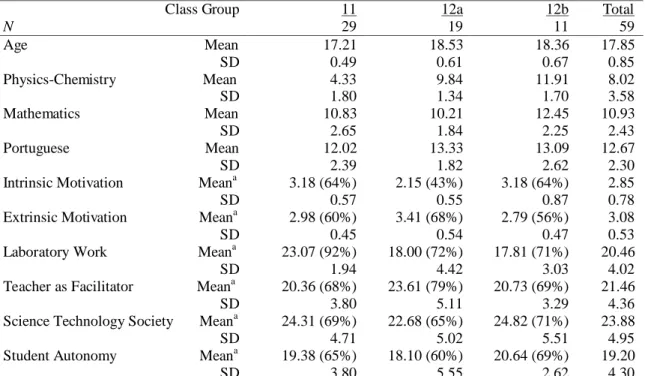
Table 1 shows total descriptive statistics as well as those for the three class groups (indicated as 11, 12a and 12b). Included in Table 1 are the principal variables of student motivation and perceptions of teacher practice, as well as the secondary variables of achievement and age.
Age. The order of mean ages of the students is as we would expect: the year 11 students average about one year younger than the year 12 students. However, keeping in mind that the values reported are of age at last birthday, the observed mean ages are somewhat higher than we might expect in secondary education and are consistent with the elevated rate of grade retention in Portugal. The oldest student in year 12 was 20; in year 11, 19 years.
Achievement. In year 11, all of the students report preceding-year final grades of less than 10 in Physics-Chemistry (a mark of 10 is considered passing). The maximum reported score was 9; the minimum 3. In group 12a, the evaluations vary between 8 and 13. Finally in group 12b, all the students are passing Physics-Chemistry (low score 10; high score 15). The mean evaluation scores observed in the discipline Portuguese (on the order of 12 and 13) are closer to what would be considered average in the national context.
Reading Table 1 by rows of disciplines, rather than by the three class groups, it is clear that Physics-Chemistry is the discipline that causes the greatest academic achievement challenge for these students. All three groups report lowest scores in Physics-Chemistry.
Table 1. Descriptive Statistics in the Three Class Groups: Age, Achievement, Motivation and
Perceptions
Class Group 11 12a 12b Total
N 29 19 11 59 Age Mean 17.21 18.53 18.36 17.85 SD 0.49 0.61 0.67 0.85 Physics-Chemistry Mean 4.33 9.84 11.91 8.02 SD 1.80 1.34 1.70 3.58 Mathematics Mean 10.83 10.21 12.45 10.93 SD 2.65 1.84 2.25 2.43 Portuguese Mean 12.02 13.33 13.09 12.67 SD 2.39 1.82 2.62 2.30
Intrinsic Motivation Meana 3.18 (64%) 2.15 (43%) 3.18 (64%) 2.85
SD 0.57 0.55 0.87 0.78
Extrinsic Motivation Meana 2.98 (60%) 3.41 (68%) 2.79 (56%) 3.08
SD 0.45 0.54 0.47 0.53
Laboratory Work Meana 23.07 (92%) 18.00 (72%) 17.81 (71%) 20.46
SD 1.94 4.42 3.03 4.02
Teacher as Facilitator Meana 20.36 (68%) 23.61 (79%) 20.73 (69%) 21.46
SD 3.80 5.11 3.29 4.36
Science Technology Society Meana 24.31 (69%) 22.68 (65%) 24.82 (71%) 23.88
SD 4.71 5.02 5.51 4.95
Student Autonomy Meana 19.38 (65%) 18.10 (60%) 20.64 (69%) 19.20
SD 3.80 5.55 2.62 4.30
Note. Secondary schools in Portugal use an evaluation scale that varies between 0 (low) and 20 (high). A score of 10 is considered passing.
a
Carvalho, Freire, Conboy, Baptista, Freire, Azevedo & Oliveira / TUSED / 8(1) 2011 36
Motivation. Table 1 also provides the mean, POMP score and standard deviation of the two dimensions of motivation: intrinsic and extrinsic. Group 12a exhibits the lowest intrinsic motivation of the three class groups as well as the highest level of extrinsic motivation. While in the other two groups the score of intrinsic motivation is greater than extrinsic motivation, in group 12a extrinsic exceeds the intrinsic. The intra-class correlation calculated across the three groups indicates that about 38% of the observed variance in Intrinsic Motivation can be attributed to differences between the groups.
Student perceptions of teacher practices. The final block of Table 1 presents descriptives of the four dimensions of student perception (a) Laboratory Work; (b) Teacher as Facilitator; (c) Science-Technology-Society (STS); and (d) Student Autonomy. Greatest perception of the use of laboratory work resides in group 11. Group 12a displays the highest perception of the Teacher as Facilitator but the lowest perception both of Autonomy and the use of the Science-Technology-Society approach. The intra-class correlation calculated across the three groups indicates that about 41% of the observed variance in the perception of Laboratory Work can be attributed to differences between the groups. Group differences explain comparatively less variance in the other dimensions (Teacher as Facilitator, 11.6%; Science-Technology-Society, 2.9%; Student Autonomy, 4.3%).
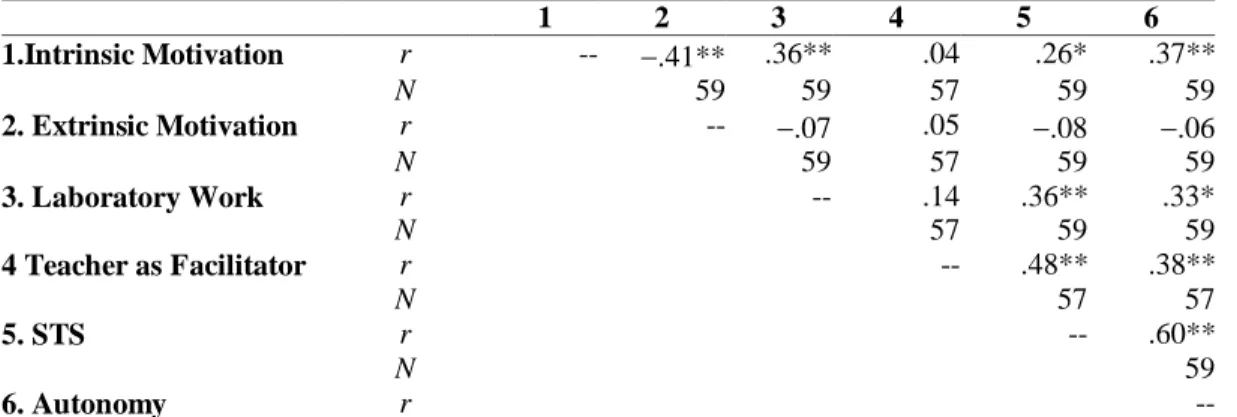
Student perceptions of teacher practices and motivation. Table 2 presents the observed associations between the four dimensions of student perceptions and students’ motivation for learning Physics-Chemistry. We note positive associations between intrinsic motivation and (a) student perception of autonomy (r= .37, p = .004); (b) student perception of laboratory work (r= .36, p = .005) and; (c) students’ perception of STS (r=.26, p = .046). Only the dimension Teacher as Facilitator failed to demonstrate an association with intrinsic motivation. Extrinsic motivation was uncorrelated with the student perceptions, and negatively related to intrinsic motivation (r= .41, p< .001).
With one exception, all of the associations between the dimensions of student perception were positive and significant. The correlation between the perception of Laboratory Work and the perception of Teacher as Facilitator is positive but statistically equivalent to zero (r=.14, p = .29). The greatest association was observed between the dimensions of Autonomy and perceptions of the use of the Science-Technology-Society approach (r=.60, p< .0001).
Table 2. Correlations (Pearson r) among Dimensions of Motivation and Perception
1 2 3 4 5 6 1.Intrinsic Motivation r -- .41** .36** .04 .26* .37** N 59 59 57 59 59 2. Extrinsic Motivation r -- .07 .05 .08 .06 N 59 57 59 59 3. Laboratory Work r -- .14 .36** .33* N 57 59 59 4 Teacher as Facilitator r -- .48** .38** N 57 57 5. STS r -- .60** N 59 6. Autonomy r --
Note. N = number of cases in each analysis. * p < .05. ** p < .01 (two-tail).
Carvalho, Freire, Conboy, Baptista, Freire, Azevedo & Oliveira / TUSED / 8(1) 2011 37
DISCUSSION and CONCLUSIONS
The new Portuguese science curriculum was intended to improve Portuguese students´ scientific literacy and engagement, by encouraging teachers to organize their teaching in new ways. The association between teacher practice and learning strategies has been suggested by some authors as an important factor in understanding student success in science (Rennie, Goodrum & Hackling, 2001). However, other researchers have not encountered such an association (Secker & Lissitz, 1999; Shymansky, Yore & Anderson, 2004). These contradictory results might be explained by the methodological difficulty in separating and isolating which factors are at the core of student academic success; factors that go well beyond teacher practice to include family values, school organization, and both individual and group SES, among others (Secker & Lissitz, 1999). Even so, the literature reveals that student perception about teacher practice plays an important role in the individual student’s personal involvement with learning (Struyven, Docky, Janssen & Gielen, 2008). Furthermore, it can be a potential tool for promoting teachers’ reflection. This is particularly important, since teachers do not simply transpose innovation into their practices. They actively interpret innovations, according to their own beliefs and conceptions, as well as according to their perceptions of the educational context. So the implemented curriculum might be quite different from the intended curriculum. Student perceptions about how teachers implement the curriculum can function as a starting point for promoting teachers’ reflection and, as such, to revise and to develop new conceptions and beliefs in accordance with curricular goals.
What do student perceptions about teachers’ practices in this study tells us about how the teachers implemented the curricular innovations?
Generally speaking, students perceived an STS dimension in their teachers’ practices. This is an important dimension within the new science curriculum and it is frequently associated with improved efforts to learn science (Aikenhead, 2005). In order to achieve this, the new curriculum also emphasizes both a new role for the teacher—that of facilitator— and the importance of developing laboratory work. What can students’ perceptions tell us about those issues?
In this study we observed that students with the lowest grades in Physics/Chemistry (the 11th grade group) displayed the higher intrinsic motivation for learning science (compared with the 12a group which also presented an average failing grade in Physics/Chemistry). These 11th graders were the students who noted more the use of laboratory work in their classes. To a lesser extent they also observed the teacher’s incorporation of a science-technology-society approach in their classes. So, these results are in accordance with other studies illuminating the association between an STS dimension (Aikenhead, 2005) and laboratory work (Hofstein & Lunetta, 2003) with greater levels of motivation for learning science.
Regarding the overall sample, intrinsic motivation was associated with the perception of (a) the use of laboratory work; (b) the inclusion of an STS dimension; and (c) student autonomy. This was an expected result. The literature indicates that teachers’ efforts to link science to society improves motivation to learn science. The link is best established by means of student-centred practical activities that demand from the students agency and autonomy as well as the mobilization of complex competencies, (Novak & Krajick, 2006; Osborne & Collins, 2001). However, unexpectedly, motivation was unassociated with the perception of the teacher role as a facilitator.
The role of facilitator is an important dimension of the new curriculum that emphasizes a constructivist approach to learning. In this approach, interactional and discursive processes play important roles in initiating students into scientific ways of knowing. This is true not
Carvalho, Freire, Conboy, Baptista, Freire, Azevedo & Oliveira / TUSED / 8(1) 2011 38
only concerning the substantive dimension of science knowledge but also for its procedural and epistemological dimensions (Driver et al., 1994;Flick & Lederman, 2006; Simon et al., 2006). Furthermore, a teacher’s facilitating role is significant for the quality of students’ learning experiences, particularly in inquiry environments. As pointed by Palmer (2009), although intrinsic motivation is associated with greater effort to learn science, it does not guarantee that the students develop profound knowledge of the sciences. The teacher must still use appropriate teaching strategies, such as orientating and scaffolding the learning process.
Considering the weak performance of these students in science, mathematics and Portuguese, we can speculate that they, as a group, are characterized by (a) weak cognitive resources for independent learning; and (b) faulty metacognitive and self-regulatory processes. These characteristics seem opposite to the implied competencies fundamental to the efficacy of the IA approach, in which the student must have an active role that includes questioning, planning, interpretation, argumentation, and explanation (Ash & Klein, 2000; NRC, 1996). And they call our attention for the importance of the teacher assuming a non-traditional role in the inquiry environment: the role of facilitator and mentor who spends pedagogical time and resources in social constructivist activities such as scaffolding (Palmer, 2009).
But in this study it is interesting to note that the students’ intrinsic motivation was linked to perceived autonomy while unrelated to the teacher’s perceived role as facilitator. What do these results can tell us about the teachers’ pedagogical practices? How exactly did the teachers interpret the curriculum and implement guidelines considering laboratory work? How did they explore the STS dimension?
The students’ perception that they are developing laboratory work might be associated with an experience of engagement and agency, as laboratory work generally centers on the students’ active participation. This experience might have been more enhanced by their feeling that they were exploring useful science themes that have a connection to their lives (STS dimension). However, it seems that teachers may have developed a guided inquiry. According to this approach, teaching centers on students’ activities, but guides their questioning, responses and tasks development. It seems as though teachers interpreted the new curriculum guidelines for creating IA more as a ―cookbook‖ approach, requiring that the student only follow predefined steps. Our lack of knowledge about these details limits the possibilities of generalization of the results of the study. However, this leads us to the conclusion that teacher professional development is lagging behind curricular changes.
Teachers need to develop professionally. They may not only need to develop didactic knowledge for implementing new practices but also epistemological knowledge about the nature of science and how scientific knowledge is built in order to develop authentic inquiry environments. By working together with science educators, teachers can be more aware of, and reflect on, their own practices. Teacher knowledge of student perceptions of what is happening in the classroom can be a powerful means for teachers to confront their own practices, strategies and the changes they themselves have introduced. Such knowledge may originate greater teacher reflection and, thus, promote professional development.
Carvalho, Freire, Conboy, Baptista, Freire, Azevedo & Oliveira / TUSED / 8(1) 2011 39
REFERENCES
Abell, S., & McDonald, J.T. (2006). Envisioning a curriculum of inquiry in the elementary school. In L.B. Flick & N.G. Lederman (Eds.), Scientific inquiry and nature of science (pp. 249-262). Dordrecht: Springer.
Abelha, M., Martins, I., Costa, N., & Roldão, M.C. (2007). Impacte da reorganização curricular das ciências físicas e naturais nas dinâmicas de trabalho docente. Revista de Educação, 15(2), 79-96.
Aikenhead, G.S. (2005). Research into STS science education. Educación Química, 16, 384-398.
Ash, D., & Klein, C. (2000). Inquiry in the informal learning environment. In J. Minstrell, & E. van Zee (Eds.), Inquiry into inquiry learning and teaching in science (pp. 216-240). Washington, CA: Corwin Press.
Baptista, M., & Freire, A. (2006). Investigações em aulas de ciências Físico-Químicas. Mudança nas percepções de alunos do 8º ano relativamente ao Ensino e Avaliação. Investigação em Educação, 5, 237-257.
Baram-Tsabari, A., & Yaber, A. (2005). Characterizing children's spontaneous interests in science and technology. International Journal of Science Education, 27(7), 803- 826. Bybee, R.W. (2006). Scientific inquiry and science teaching. In L.B. Flick & N.G. Lederman
(Eds.), Scientific inquiry and nature of science (pp. 1-14). Dordrecht: Springer.
Cohen, P., & Cohen, J. (1999). The problem of units and the circumstance of POMP. Multivariate Behavioral Research, 34(3), 315-346.
Correia, M., & Freire, A. (2009). Trabalho laboratorial e práticas de avaliação de professores de ciências físico-químicas do ensino básico. Ensaio Pesquisa em Educação em Ciências, 9(1), 128-151.
Dochy, F., Segers, M., Bossche, V. P., & Struyven, K. (2005). Students’ perceptions of a problem-based environment. Learning Environment Research, 8, 41-66.
Driver, R., Asoko, H., Leach, J., Mortimer, E., & Scott, P. (1994). Constructing scientific knowledge in the classroom. Educational Researcher, 23(7), 5-12.
Driver, R., Newton, P., & Osborne, J. (2000). Establishing the norms of scientific argumentation in classrooms. Science Education, 84(3), 224-238.
Duschl, R. (2000). Making the nature of science explicit. In R. Millar, J. Leach & J. Osborne (eds.), Improving science education (pp. 187-206). Buckingham: Open University Press. Flick, L.B., & Lederman, N. G. (2006). Introduction. In L.B. Flick & N.G. Lederman (Eds.),
Scientific inquiry and nature of science (pp. ix-xviii). Dordrecht: Springer.
Fraser, B.J. (2007). Classrooms learning environments. In S.K. Abell & N.G. Lederman (Eds.), Handbook of research on science education (pp. 103-124). Hillsdale, NJ: Lawrence Erlbaum Associates Publishers.
Fullan, M. (2001). The new meaning of educational change (3rd edition). London: Routdlege Falmer.
Galvão, C., & Abrantes, P. (2005). Physical and natural sciences - a new curriculum in Portugal. In P. Nentwig & D. Waddington (Eds.), Making it relevant: Context-based learning of science (pp. 175-194). Munster: Waxman.
Galvão, C., & Freire, A. (2004). A perspective CTS no currículo das ciências físicas e naturais em Portugal. In I. Martins, F. Paixão, & R. Vieira (Eds.), Perspectivas Ciência-Tecnologia-Sociedade na inovação da educação em ciência. Actas III Seminário Ibérico CTS no Ensino das Ciências. Aveiro: Universidade de Aveiro.
Galvão, C., Freire, A., Lopes, A.M., Neves, A., Oliveira, T., & Santos, M.C. (2004). Innovation in Portuguese science curriculum: Some evaluation issues. In Ministry of
Carvalho, Freire, Conboy, Baptista, Freire, Azevedo & Oliveira / TUSED / 8(1) 2011 40
Education (Ed.), Flexibility in curriculum: Citizenship and communication (pp. 49-66). Lisboa: ME.
Galvão, C., Reis, P., Freire, A., & Oliveira, T. (2007). Science curriculum in Portugal: From the development to the evaluation of students’ competences. In D. Waddington, P. Nentwig & S. Schanze (Eds.), Making it comparable: Standards in science education (pp. 237-253). Münster: Waxmann.
Hofstein, A., & Lunetta, V.N. (2003). The laboratory in science education: Foundations for the twenty-first century. Science Education, 88(1), 28-54.
Hofstein, A., Levy, T., & Shore, R. (2001). Assessment of the learning environment of inquiry-type laboratories in high school chemistry. Learning Environments Research, 4, 193-207.
Kinchin, I. (2004). Investigating students’ believes about their preferred role as learners. Educational Research, 46(3), 301-312.
Law n. 6/2001, 18 January. Law n. 453/2004, 27July.
Lawrenz, F., Huffman, D., & Robey, J. (2003). Relationships between students, teacher and observer perceptions of science classrooms and students’ achievement. International Journal of Science Education, 25(3), 409-420.
Lederman, N.G. (2006). Syntax of nature of science within inquiry and science instruction. In L.B. Flick & N.G. Lederman (Eds.), Scientific inquiry and nature of science (pp. 301-318). Dordrecht: Springer.
McIntyre, D., Pedder, D., & Rudduck, J. (2005). Pupil voice: comfortable and uncomfortable learnings for teachers. Research Papers in Education, 20 (2), 149-168.
Ministry of Education (2001). Currículo nacional do ensino básico. Competências Essenciais. Lisboa: Ministério da Educação.
Ministry of Education. (2003). Reforma do ensino secundário. Documento orientador da revisão curricular ensino secundário. Lisboa: Ministry of Education.
Ministry of Education (2006). Séries cronológicas: 30 anos de estatísticas de educação – Alunos 1977 a 2006 (Vol. 2). Lisboa: GIASE.
NRC (National Research Council). (1996). National science education standards. Washington, National Academy Press.
Novak, A., & Krajcik, J.(2006). Using technology to support inquiry in middle school science. In L. B. Flick, & N. G. Lederman (Eds.), Scientific inquiry and nature of science. Netherlands: Springer.
OECD (2006). Assessment of scientific literacy in OECD/PISA project. Available: http://www.pisa.oecd.org/ 8th February 2008.
Osborne, J., & Collins, S. (2001). Pupils' views of the role and value of the science curriculum: a focus-group study. International Journal of Science Education, 23(5), 441-467.
Osborne, J., & Dillon, J. (2008). Science education in Europe: Critical reflections. King’s College London: The Nuffield Foundation.
Osborne, J., Simon, S., & Collins, S. (2003). Attitudes towards science: A review of the literature and its implications. International Journal of Science Education, 25(9), 1049– 79.
Palmer, D.H. (2009). Student interest generated during an inquiry skills lesson. Journal of Research in Science Teaching, 46(2), 147-165.
Pekmez, E.S., Johnson, P., & Gott, R. (2005). Teachers’ understanding of the nature and purpose of practical work. Research in Science and Technological Education, 23(1), 3-23.
Carvalho, Freire, Conboy, Baptista, Freire, Azevedo & Oliveira / TUSED / 8(1) 2011 41
Preto, A. (2008). Ensino da biologia e geologia no ensino secundário, exames e trabalho experimental. Tese de mestrado em Educação apresentada à Universidade de Lisboa através da Faculdade de Ciências.
Raposo, P., & Freire, A. (2008). Avaliação das aprendizagens: perspectivas de professores de Física e Química. Revista de Educação, 16(1), 97-127.
Rennie, L., Goodrum, D., & Hackling, M. (2001). Science teaching and learning in Australian schools: Results of a national study. Research in Science Education, 31, 455-498.
Secker, C., & Lissitz, R. (1999). Estimating the impact of instructional practices on students achievement in science. Journal of Research in Science Teaching, 36(10), 1110-1126. Seixas, P. (2007). Relação teoria-prática nas aulas de biologia e geologia do 10º ano de
escolaridade: Um estudo no contexto da actual reforma curricular. Tese de mestrado em Educação, apresentada à Universidade de Lisboa através da Faculdade de Ciências. Shymansky, J., Yore, L., & Anderson, J. (2004). Impact of a school district’s science reform
effort on the achievement and attitudes of third and fourth grade students. Journal of Research in Science Teaching, 41(8), 771-790.
Simon, S., Erduran, S., & Osborne, J. (2006). Learning to teach argumentation: Research and development in the science classroom. International Journal of Science Education, 28(2-3), 235-260.
Struyven, K., Dochy, F., Janssens, S., & Gielen, S. (2008). Students’ experiences with contrasting learning environments: The added value of students’ perceptions. Learning Environments Research, 11, 83-109.
Swarat, S. (2008). What Makes a Topic Interesting? A conceptual and methodological exploration of the underlying dimensions of topic interest. Electronic Journal of Science Education, 12(2), 1-26.
Tsai, C. (2000). Relationship between students epistemological believes and perceptions of constructive learning environments. Educational Research, 42(2), 193-205.
Tsai, C. (2003). Taiwanese science students’ and teachers’ perceptions of the laboratory learning environments: exploring epistemological gaps. International Journal of Science Education, 25(7), 847-860.
Viana, P., & Freire, A. (2006). Perspectivas de professores de Física e Química sobre as orientações curriculares. Revista de Educação, 16(2), 55-74.